DEFORMATION OF SINGLE CRYSTALS
AND POLY-CRYSTALLINE MATERIALS
BATCH 7
DEFORMATION OF SINGLE CRYSTALS
• When a single crystal is deformed under a tensile
stress, it is observed that plastic deformation occurs
by slip on well‐defined parallel crystal planes.
• Slip always occurs on a particular set of
crystallographic planes, known as slip planes.
• Slip always takes place along a consistent set of
directions within these planes. These are called slip
directions.
• Slip occurs most readily on the plane of greatest
atomic density.
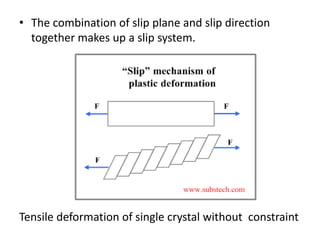
• The combination of slip plane and slip direction
together makes up a slip system.
Tensile deformation of single crystal without constraint
SCHMID’S LAW
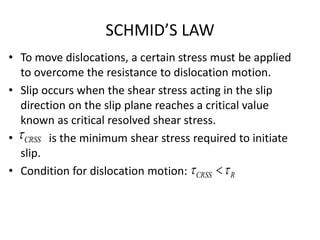
• To move dislocations, a certain stress must be applied
to overcome the resistance to dislocation motion.
• Slip occurs when the shear stress acting in the slip
direction on the slip plane reaches a critical value
known as critical resolved shear stress.
• is the minimum shear stress required to initiate
slip.
• Condition for dislocation motion:
CRSS
RCRSS  



 coscoscoscos
cos/
cos

A
P
A
P
R
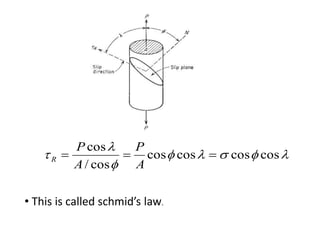
• This is called schmid’s law.
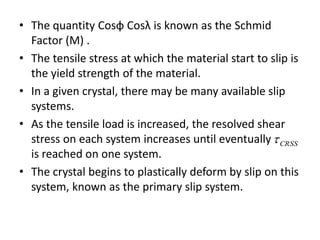
• The quantity Cosφ Cosλ is known as the Schmid
Factor (M) .
• The tensile stress at which the material start to slip is
the yield strength of the material.
• In a given crystal, there may be many available slip
systems.
• As the tensile load is increased, the resolved shear
stress on each system increases until eventually
is reached on one system.
• The crystal begins to plastically deform by slip on this
system, known as the primary slip system.
CRSS
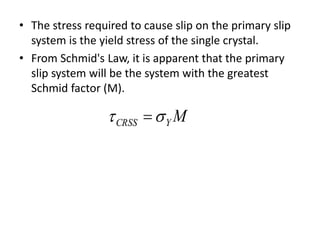
• The stress required to cause slip on the primary slip
system is the yield stress of the single crystal.
• From Schmid's Law, it is apparent that the primary
slip system will be the system with the greatest
Schmid factor (M).
MYCRSS  
Plastic Deformation of polycrystalline
materials
• Deformation and slip is more complex in
polycrystalline materials .
• Due to the random crystallographic orientations of
the numerous grains and the effect of neighbouring
atoms, the direction of slip varies from one grain to
another.
• These materials are made up of a number of small
crystals or grains.
• For each crystal, slip occurs along the slip system
that has the most favourable orientation.
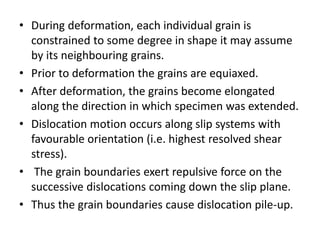
• During deformation, each individual grain is
constrained to some degree in shape it may assume
by its neighbouring grains.
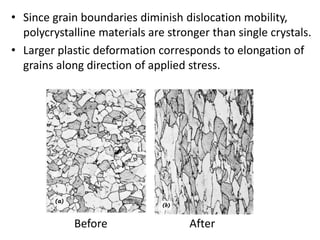
• Prior to deformation the grains are equiaxed.
• After deformation, the grains become elongated
along the direction in which specimen was extended.
• Dislocation motion occurs along slip systems with
favourable orientation (i.e. highest resolved shear
stress).
• The grain boundaries exert repulsive force on the
successive dislocations coming down the slip plane.
• Thus the grain boundaries cause dislocation pile-up.
• Since grain boundaries diminish dislocation mobility,
polycrystalline materials are stronger than single crystals.
• Larger plastic deformation corresponds to elongation of
grains along direction of applied stress.
Before After
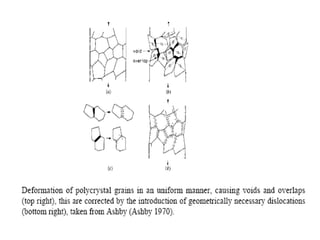
• When a crystal is surrounded by other crystals of
different crystallographic orientation, deformation of
the crystal cannot start at the primary system as the
strain taking place need to be compatible with the
strain at the boundary in the other crystals.
• Because strains along grain boundaries must be the
same for each grain, the grains will deform in a
cooperative manner.
• Since plastic deformation of a single grain is
restrained by its neighboring grain, a polycrystalline
material will have an intrinsically greater resistance
to plastic flow than would a single crystal.
REFERENCES
1. George E Dieter, “Mechanical metallurgy”,
Mc Graw Hill, Singapore, 1995.
2. M.N. Shetty, “Dislocations and Mechanical
Behaviour of Materials”, PHI Learning Private
Ltd,2013.
THANK YOU....

Deformation of single and polycrystals

  • 1.
    DEFORMATION OF SINGLECRYSTALS AND POLY-CRYSTALLINE MATERIALS BATCH 7
  • 2.
    DEFORMATION OF SINGLECRYSTALS • When a single crystal is deformed under a tensile stress, it is observed that plastic deformation occurs by slip on well‐defined parallel crystal planes. • Slip always occurs on a particular set of crystallographic planes, known as slip planes. • Slip always takes place along a consistent set of directions within these planes. These are called slip directions. • Slip occurs most readily on the plane of greatest atomic density.
  • 3.
    • The combinationof slip plane and slip direction together makes up a slip system. Tensile deformation of single crystal without constraint
  • 4.
    SCHMID’S LAW • Tomove dislocations, a certain stress must be applied to overcome the resistance to dislocation motion. • Slip occurs when the shear stress acting in the slip direction on the slip plane reaches a critical value known as critical resolved shear stress. • is the minimum shear stress required to initiate slip. • Condition for dislocation motion: CRSS RCRSS  
  • 5.
  • 6.
    • The quantityCosφ Cosλ is known as the Schmid Factor (M) . • The tensile stress at which the material start to slip is the yield strength of the material. • In a given crystal, there may be many available slip systems. • As the tensile load is increased, the resolved shear stress on each system increases until eventually is reached on one system. • The crystal begins to plastically deform by slip on this system, known as the primary slip system. CRSS
  • 7.
    • The stressrequired to cause slip on the primary slip system is the yield stress of the single crystal. • From Schmid's Law, it is apparent that the primary slip system will be the system with the greatest Schmid factor (M). MYCRSS  
  • 8.
    Plastic Deformation ofpolycrystalline materials • Deformation and slip is more complex in polycrystalline materials . • Due to the random crystallographic orientations of the numerous grains and the effect of neighbouring atoms, the direction of slip varies from one grain to another. • These materials are made up of a number of small crystals or grains. • For each crystal, slip occurs along the slip system that has the most favourable orientation.
  • 9.
    • During deformation,each individual grain is constrained to some degree in shape it may assume by its neighbouring grains. • Prior to deformation the grains are equiaxed. • After deformation, the grains become elongated along the direction in which specimen was extended. • Dislocation motion occurs along slip systems with favourable orientation (i.e. highest resolved shear stress). • The grain boundaries exert repulsive force on the successive dislocations coming down the slip plane. • Thus the grain boundaries cause dislocation pile-up.
  • 10.
    • Since grainboundaries diminish dislocation mobility, polycrystalline materials are stronger than single crystals. • Larger plastic deformation corresponds to elongation of grains along direction of applied stress. Before After
  • 12.
    • When acrystal is surrounded by other crystals of different crystallographic orientation, deformation of the crystal cannot start at the primary system as the strain taking place need to be compatible with the strain at the boundary in the other crystals. • Because strains along grain boundaries must be the same for each grain, the grains will deform in a cooperative manner. • Since plastic deformation of a single grain is restrained by its neighboring grain, a polycrystalline material will have an intrinsically greater resistance to plastic flow than would a single crystal.
  • 13.
    REFERENCES 1. George EDieter, “Mechanical metallurgy”, Mc Graw Hill, Singapore, 1995. 2. M.N. Shetty, “Dislocations and Mechanical Behaviour of Materials”, PHI Learning Private Ltd,2013.
  • 14.