Knowledge Engineering
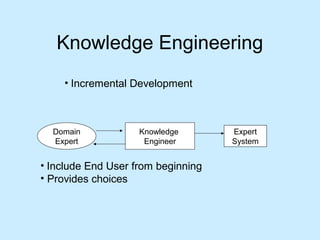
Domain
Expert
Knowledge
Engineer
Expert
System
• Include End User from beginning
• Provides choices
• Incremental Development
Requirements of Expert Systems
• Functional Requirements
• Structural Requirements
Functional Requirements of ES
• Problem Area
– “…solve problems efficiently and effectively in a
narrow problem area.” (Waterman, 1986, p.xvii)
– “…typical, pertains to problems that can be
symbolically represented.” (Liebowitz, 1988, p.3)
• Not number crunching problems
• Can be qualitative or quantitative variables
Functional Requirements of ES
• Problem Difficulty
– “…apply expert knowledge to difficult real world
problems.” (Waterman, 1986, p.18)
– “…solve problems that are difficult enough to
require significant human expertise for their
solution.” (Edward Feigenbaum in Harmon & King,
1985, p.5)
Functional Requirements of ES
• Performance Requirement
– “the ability to perform at the level of an expert…”
(Liebowitz, 1988, p.3)
– “…matches a competent level of human expertise
in a particular field.” (Bishop, 1986, p.38)
Functional Requirements of ES
• Explain Reasoning
– “incorporation of explanation processes…”
(Liebowitz, 1988, p.3)
– The ability to explain how the system arrived at a
solution
• From Decision Support
– People more confident w/conclusion because understand
how system arrived to a conclusion
– Also understand how people reason
– Rarely used in Medicine: liability falls upon the System
Developer
Structural Requirements of ES
• Have to have a Knowledge Base
• Knowledge Component
– Encapsulation of human expertise
– “A computer based system in which
representations of expertise are stored…”
(Edwards and Connell, 1989, p.3)
– “The knowledge of an expert system consists of
facts and heuristics. The ‘facts’ constitute a body
of information that is widely shared, publicly
available, and generally agreed upon by experts in
the field.” (Edward Feigenbaum in Harmon & King,
1985, p.5)
Structural Requirements of ES
• Separate knowledge and control
– “…make domain knowledge explicit and separate
from the rest of the system.” (Waterman, 1986,
p.18)
– Knowledge (need a knowledge base) and Meta-
knowledge (how to use the knowledge)
• Knowledge and Meta-knowledge are two different things
Structural Requirements of ES
• Use inference procedures - heuristics (rule of
thumb) - uncertainty
– “…an intelligent computer program that uses
knowledge and inference procedures.” (Edward
Feigenbaum in Harmon & King, 1985, p.5)
– “Exhibit intelligent behavior by skillful application of
heuristics.” (Waterman, 1986, p.18)
Components of ES/KBS
• Knowledge Base
• Inference Engine
• Working Memory
• Explanation Facility
• User Interface
– Front End: the part the end user uses to retrieve information
– Different from system to system
– Usually “yes/no” questions
Knowledge Base
• Collection of domain knowledge, heuristics or
rules of thumb
– Put domain knowledge is a knowledge base
• Representation Methods (may be 1000’s of rules)
– Rules: if-then-else
• Each rule has a condition part and an action part
• Example
– IF customer’s billing category is not set
» AND customer has good payment history
– THEN
» Set the customer’s billing category to priority
– Frames
– Semantic Net
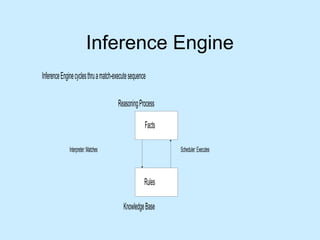
Inference Engine
• An executor of knowledge to solve a problem
• Reasoning process (the inference process)
• Two Parts
– Interpreter
• Decides how to apply the rules to infer new knowledge
• Then passes to the scheduler
– Scheduler
• Decides the order in which the rules should be applied
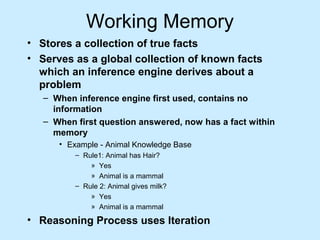
Working Memory
• Stores a collection of true facts
• Serves as a global collection of known facts
which an inference engine derives about a
problem
– When inference engine first used, contains no
information
– When first question answered, now has a fact within
memory
• Example - Animal Knowledge Base
– Rule1: Animal has Hair?
» Yes
» Animal is a mammal
– Rule 2: Animal gives milk?
» Yes
» Animal is a mammal
• Reasoning Process uses Iteration
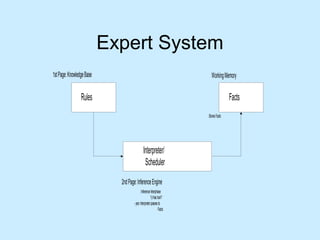
Expert System
Rules Facts
Interpreter/
Scheduler
1stPage:KnowledgeBase WorkingMemory
2ndPage:InferenceEngine
StoresFacts
InferenceInterphase
1)Hashair?
-yes:Interpreterpassesto
Facts
Inference Engine
InferenceEnginecyclesthruamatch-executesequence
ReasoningProcess
Facts
Rules
Interpreter:Matches Scheduler:Executes
KnowledgeBase
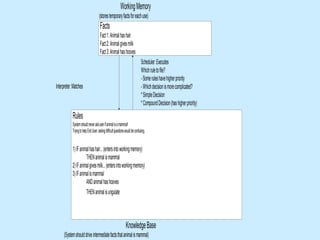
WorkingMemory
(storestemporaryfactsforeachuse)
Facts
Fact1:Animalhashair
Fact2:Animalgivesmilk
Fact3:Animalhashooves
Rules
Systemshouldneveraskuserifanimalisamammal!
TryingtohelpEndUser:askingdifficultquestionswouldbeconfusing.
1)IFanimalhashair...(entersintoworkingmemory)
THENanimalismammal
2)IFanimalgivesmilk...(entersintoworkingmemory)
3)IFanimalismammal
ANDanimalhashooves
THENanimalisungulate
Interpreter:Matches
Scheduler:Executes
Whichruletofile?
-Someruleshavehigherpriority
-Whichdecisionismorecomplicated?
*SimpleDecision
*CompoundDecision(hashigherpriority)
KnowledgeBase
(Systemshoulddriveintermediatefactsthatanimalismammal)
Explanation Facility
• The component of an ES that explains how
solutions were reached and justifies the steps
used to reach them
• Three Types
– How
• It explains how the system reached a particular state
(backtrack)
– What If
• It explains what would have happened if a particular fact or
rule had been different (“Does not give milk…” Sensitivity
Analysis/Forecasting)
– Why Not
• It explains why an expected conclusion were not reached
(Must have MORE knowledge)
User Interface
• User friendly interface to the system
– Example: Does animal have hair? Does
animal chew meat?
• A user answers and/or asks questions
Will ES work for My Problem?
• When is ES development possible?
– Task does not require common sense
• Impossible to code everything into system
– Task requires only cognitive skills
• Motor Skills will not work
– Skills of Quarterback
» Motor Skills
» Cognitive Skills
– Experts can articulate their methods
• Knowing this, this, & this… I arrive at this.
• Many years of experience
– Genuine experts exist (task)
– Experts agree on solutions (multiple domain experts must agree)
– Task is not too difficult (task clearly understood)
– Task is not poorly understood
– Robotics & Systems not in this field
Will ES work for My Problem?
• Need to know your End Users in order to sell
– Chief Information Officer (CIO) is interested in a business
solution, not a technical solution
• Technical solution is for Computer Science
• When is ES development appropriate?
– Task requires symbol manipulation (not a number crunching
problem)
– Task required heuristic solutions (rule of thumb decision)
– Task is not too easy (don’t try Tick-Tack-Toe)
– Task has practical value
– Task is of manageable size
Will ES work for My Problem?
• Resistance from Management or Experts
– People Resistant to change
– Must champion your cause (persuasion)
– Expert System brings change
• Can change corporate culture
• Resistance from End Users
– Threat of losing job & usefulness
Will ES work for MY Problem?
• Still trying to
determine what
Intelligent Technology
can do for NASA
– Saving money
– So what?
• Have to put into
User’s View
– Selling the product
• NASA
– Cheaper
– Faster
– More reliable
– Smaller
• Then will be willing to
listen to you about
your Intelligent
System
References
• Bishop, Peter. Fifth Generation Computers Concepts,
Implementations & Uses, 1986, Chichester, England: Ellis
Horwood Ltd.
• Edwards, Alex and Connel, N.A.D. Expert Systems in
Accounting, 1989, Herfordshire, UK: Prentice Hall International
(UK) Ltd.
• Harmon, Paul and King, David. Expert Systems: Artificial
Intelligence in Business. 1985, New York: Wiley.
• Liebowitz, Jay, Introduction to Expert Systems, 1988, Santa
Cruz, CA: Mitchell Publishing, Inc.
• Waterman, Donald A. A Guide to Expert Systems, 1986,
reading, MA: Addison-Wesley.

Artificial Intelligence: Knowledge Engineering

  • 1.
    Knowledge Engineering Domain Expert Knowledge Engineer Expert System • IncludeEnd User from beginning • Provides choices • Incremental Development
  • 2.
    Requirements of ExpertSystems • Functional Requirements • Structural Requirements
  • 3.
    Functional Requirements ofES • Problem Area – “…solve problems efficiently and effectively in a narrow problem area.” (Waterman, 1986, p.xvii) – “…typical, pertains to problems that can be symbolically represented.” (Liebowitz, 1988, p.3) • Not number crunching problems • Can be qualitative or quantitative variables
  • 4.
    Functional Requirements ofES • Problem Difficulty – “…apply expert knowledge to difficult real world problems.” (Waterman, 1986, p.18) – “…solve problems that are difficult enough to require significant human expertise for their solution.” (Edward Feigenbaum in Harmon & King, 1985, p.5)
  • 5.
    Functional Requirements ofES • Performance Requirement – “the ability to perform at the level of an expert…” (Liebowitz, 1988, p.3) – “…matches a competent level of human expertise in a particular field.” (Bishop, 1986, p.38)
  • 6.
    Functional Requirements ofES • Explain Reasoning – “incorporation of explanation processes…” (Liebowitz, 1988, p.3) – The ability to explain how the system arrived at a solution • From Decision Support – People more confident w/conclusion because understand how system arrived to a conclusion – Also understand how people reason – Rarely used in Medicine: liability falls upon the System Developer
  • 7.
    Structural Requirements ofES • Have to have a Knowledge Base • Knowledge Component – Encapsulation of human expertise – “A computer based system in which representations of expertise are stored…” (Edwards and Connell, 1989, p.3) – “The knowledge of an expert system consists of facts and heuristics. The ‘facts’ constitute a body of information that is widely shared, publicly available, and generally agreed upon by experts in the field.” (Edward Feigenbaum in Harmon & King, 1985, p.5)
  • 8.
    Structural Requirements ofES • Separate knowledge and control – “…make domain knowledge explicit and separate from the rest of the system.” (Waterman, 1986, p.18) – Knowledge (need a knowledge base) and Meta- knowledge (how to use the knowledge) • Knowledge and Meta-knowledge are two different things
  • 9.
    Structural Requirements ofES • Use inference procedures - heuristics (rule of thumb) - uncertainty – “…an intelligent computer program that uses knowledge and inference procedures.” (Edward Feigenbaum in Harmon & King, 1985, p.5) – “Exhibit intelligent behavior by skillful application of heuristics.” (Waterman, 1986, p.18)
  • 10.
    Components of ES/KBS •Knowledge Base • Inference Engine • Working Memory • Explanation Facility • User Interface – Front End: the part the end user uses to retrieve information – Different from system to system – Usually “yes/no” questions
  • 11.
    Knowledge Base • Collectionof domain knowledge, heuristics or rules of thumb – Put domain knowledge is a knowledge base • Representation Methods (may be 1000’s of rules) – Rules: if-then-else • Each rule has a condition part and an action part • Example – IF customer’s billing category is not set » AND customer has good payment history – THEN » Set the customer’s billing category to priority – Frames – Semantic Net
  • 12.
    Inference Engine • Anexecutor of knowledge to solve a problem • Reasoning process (the inference process) • Two Parts – Interpreter • Decides how to apply the rules to infer new knowledge • Then passes to the scheduler – Scheduler • Decides the order in which the rules should be applied
  • 13.
    Working Memory • Storesa collection of true facts • Serves as a global collection of known facts which an inference engine derives about a problem – When inference engine first used, contains no information – When first question answered, now has a fact within memory • Example - Animal Knowledge Base – Rule1: Animal has Hair? » Yes » Animal is a mammal – Rule 2: Animal gives milk? » Yes » Animal is a mammal • Reasoning Process uses Iteration
  • 14.
    Expert System Rules Facts Interpreter/ Scheduler 1stPage:KnowledgeBaseWorkingMemory 2ndPage:InferenceEngine StoresFacts InferenceInterphase 1)Hashair? -yes:Interpreterpassesto Facts
  • 15.
  • 16.
  • 17.
    Explanation Facility • Thecomponent of an ES that explains how solutions were reached and justifies the steps used to reach them • Three Types – How • It explains how the system reached a particular state (backtrack) – What If • It explains what would have happened if a particular fact or rule had been different (“Does not give milk…” Sensitivity Analysis/Forecasting) – Why Not • It explains why an expected conclusion were not reached (Must have MORE knowledge)
  • 18.
    User Interface • Userfriendly interface to the system – Example: Does animal have hair? Does animal chew meat? • A user answers and/or asks questions
  • 19.
    Will ES workfor My Problem? • When is ES development possible? – Task does not require common sense • Impossible to code everything into system – Task requires only cognitive skills • Motor Skills will not work – Skills of Quarterback » Motor Skills » Cognitive Skills – Experts can articulate their methods • Knowing this, this, & this… I arrive at this. • Many years of experience – Genuine experts exist (task) – Experts agree on solutions (multiple domain experts must agree) – Task is not too difficult (task clearly understood) – Task is not poorly understood – Robotics & Systems not in this field
  • 20.
    Will ES workfor My Problem? • Need to know your End Users in order to sell – Chief Information Officer (CIO) is interested in a business solution, not a technical solution • Technical solution is for Computer Science • When is ES development appropriate? – Task requires symbol manipulation (not a number crunching problem) – Task required heuristic solutions (rule of thumb decision) – Task is not too easy (don’t try Tick-Tack-Toe) – Task has practical value – Task is of manageable size
  • 21.
    Will ES workfor My Problem? • Resistance from Management or Experts – People Resistant to change – Must champion your cause (persuasion) – Expert System brings change • Can change corporate culture • Resistance from End Users – Threat of losing job & usefulness
  • 22.
    Will ES workfor MY Problem? • Still trying to determine what Intelligent Technology can do for NASA – Saving money – So what? • Have to put into User’s View – Selling the product • NASA – Cheaper – Faster – More reliable – Smaller • Then will be willing to listen to you about your Intelligent System
  • 23.
    References • Bishop, Peter.Fifth Generation Computers Concepts, Implementations & Uses, 1986, Chichester, England: Ellis Horwood Ltd. • Edwards, Alex and Connel, N.A.D. Expert Systems in Accounting, 1989, Herfordshire, UK: Prentice Hall International (UK) Ltd. • Harmon, Paul and King, David. Expert Systems: Artificial Intelligence in Business. 1985, New York: Wiley. • Liebowitz, Jay, Introduction to Expert Systems, 1988, Santa Cruz, CA: Mitchell Publishing, Inc. • Waterman, Donald A. A Guide to Expert Systems, 1986, reading, MA: Addison-Wesley.