JF302 – Material Technology 1 1.0 MATERIAL STRUCTURE AND BINARY ALLOY SYSTEM
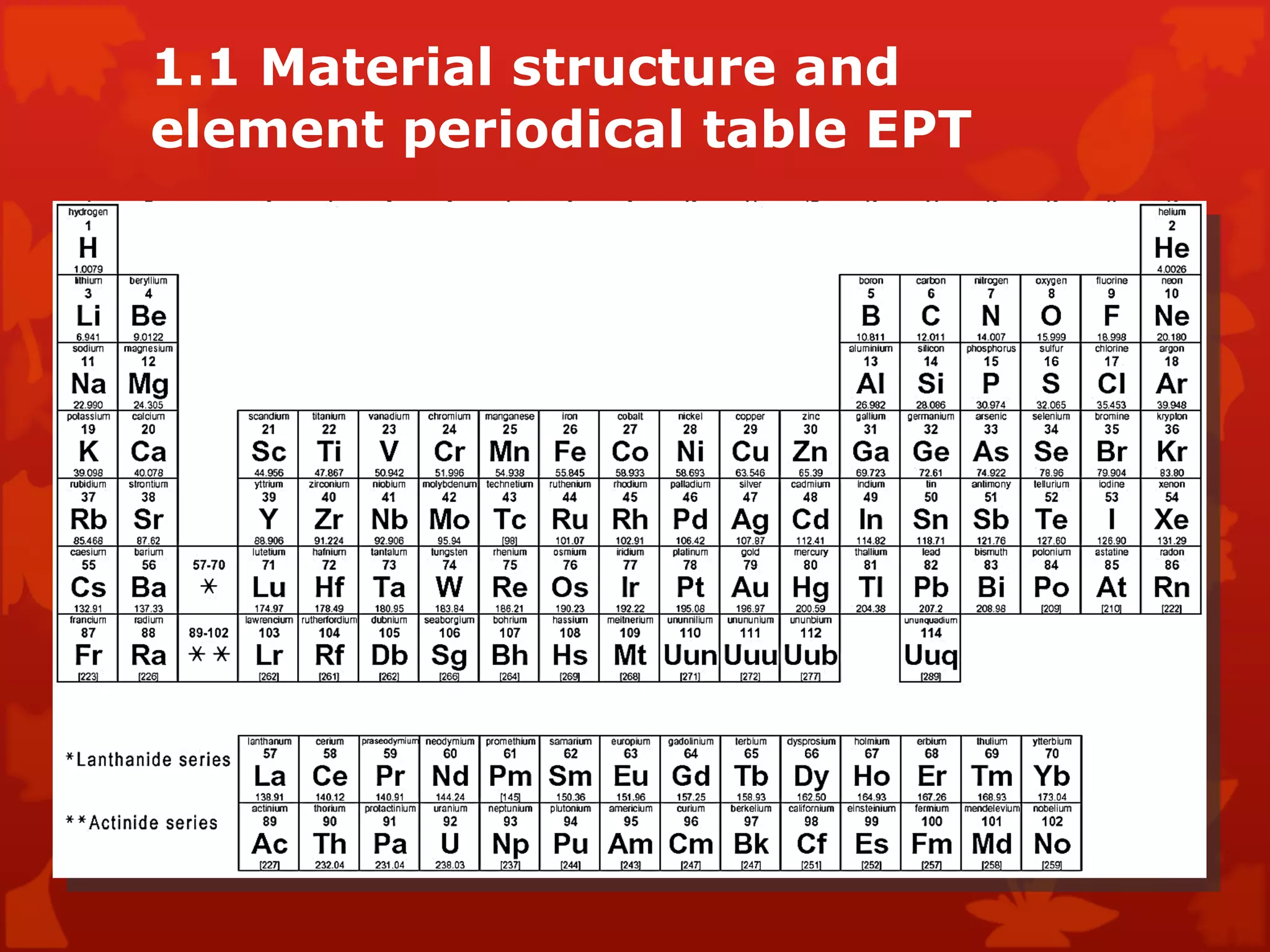
1.1 Material structure and element periodical table EPT
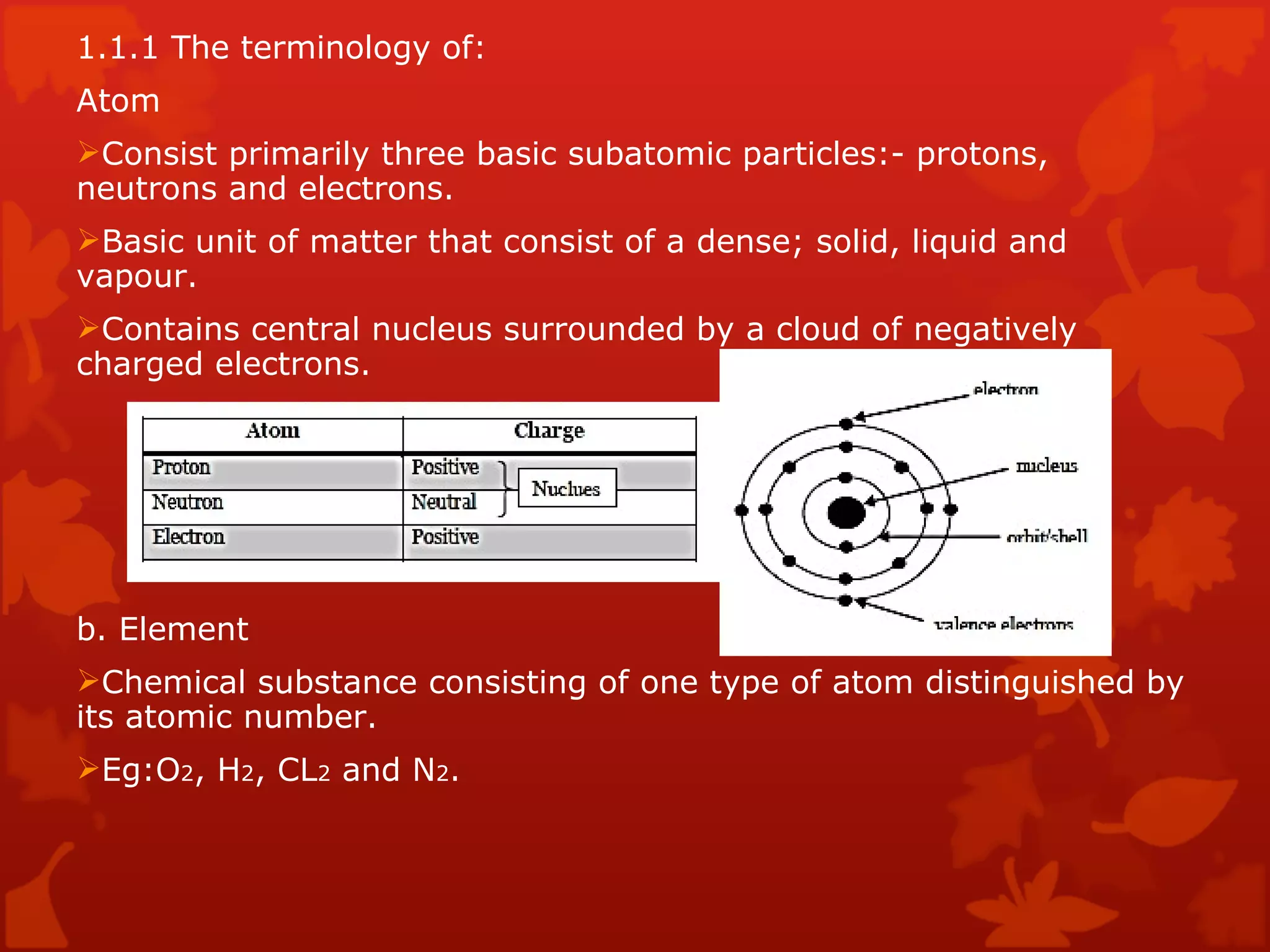
1.1.1 The terminology of: Atom Consist primarily three basic subatomic particles:- protons, neutrons and electrons. Basic unit of matter that consist of a dense; solid, liquid and vapour. Contains central nucleus surrounded by a cloud of negatively charged electrons. b. Element Chemical substance consisting of one type of atom distinguished by its atomic number. Eg:O 2 , H 2 , CL 2  and N 2 .
1.1.1 The terminology of: c. Mixture The molecules of two or more different substances are mixed in the form of alloys, solutions, suspension and colloids. A material system made up by two or more different substance which are mixed together but are not combined chemically. d. Compound Chemical substance consisting of two or more different chemical elements that can be separated into simpler substance by chemical reaction. Eg; H 2 O and HCl
1.1.2 Atomic numbers and atomic mass of EPT. Atomic numbers The number of proton (positively charged particles) that arc in its nucleus. In a neutral atom the atomic number = to the number of electrons in its charge cloud. b. Atomic masses Relative atomic mass of an alement in the mass in grams of 6.023x10 23  atoms (Avogadro’s number,N A  ) of the element.
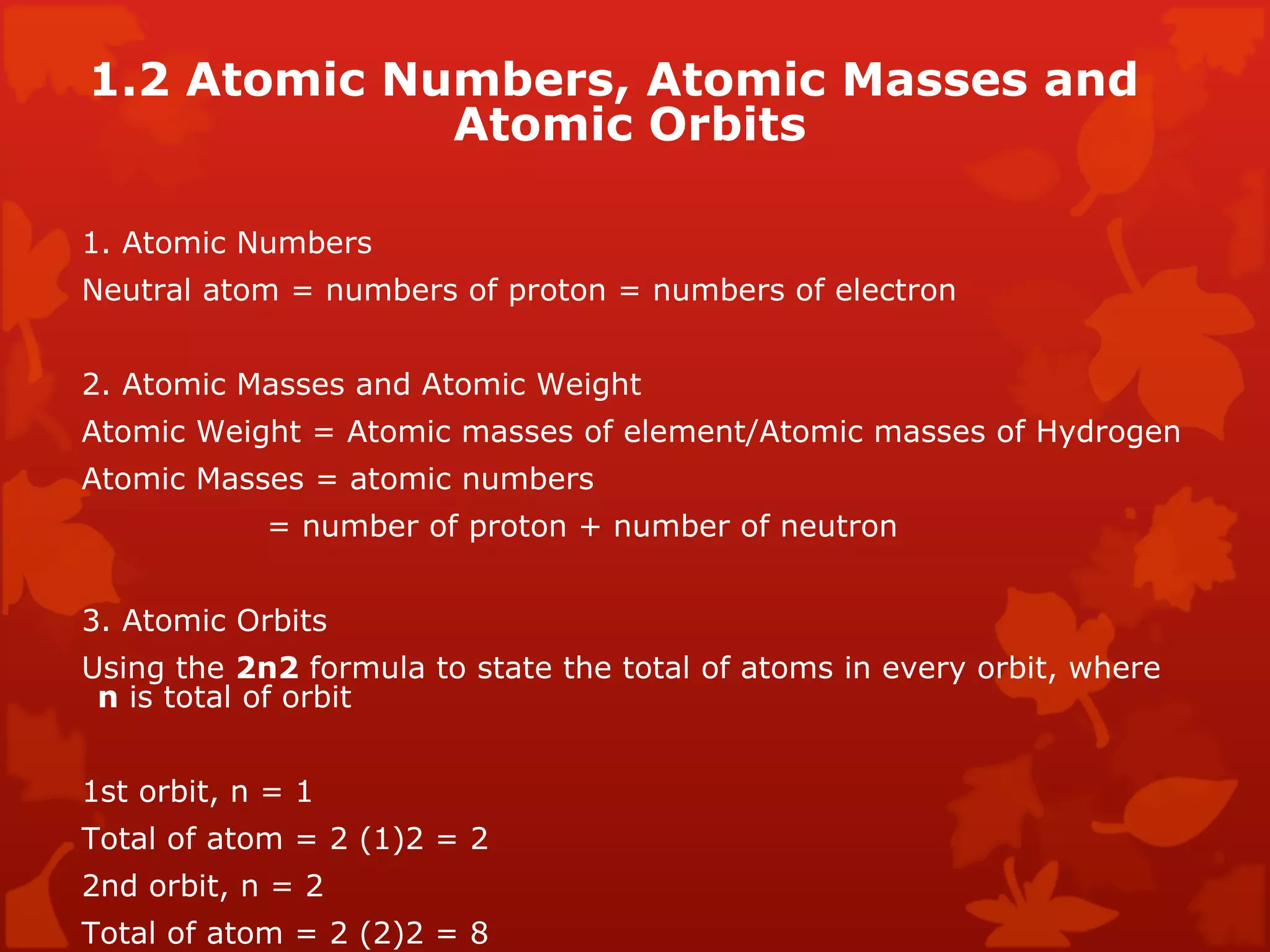
1.2 Atomic Numbers, Atomic Masses and Atomic Orbits  1. Atomic Numbers  Neutral atom = numbers of proton = numbers of electron  2. Atomic Masses and Atomic Weight  Atomic Weight = Atomic masses of element/Atomic masses of Hydrogen  Atomic Masses = atomic numbers    = number of proton + number of neutron  3. Atomic Orbits  Using the  2n2  formula to state the total of atoms in every orbit, where  n  is total of orbit  1st orbit, n = 1  Total of atom = 2 (1)2 = 2  2nd orbit, n = 2  Total of atom = 2 (2)2 = 8
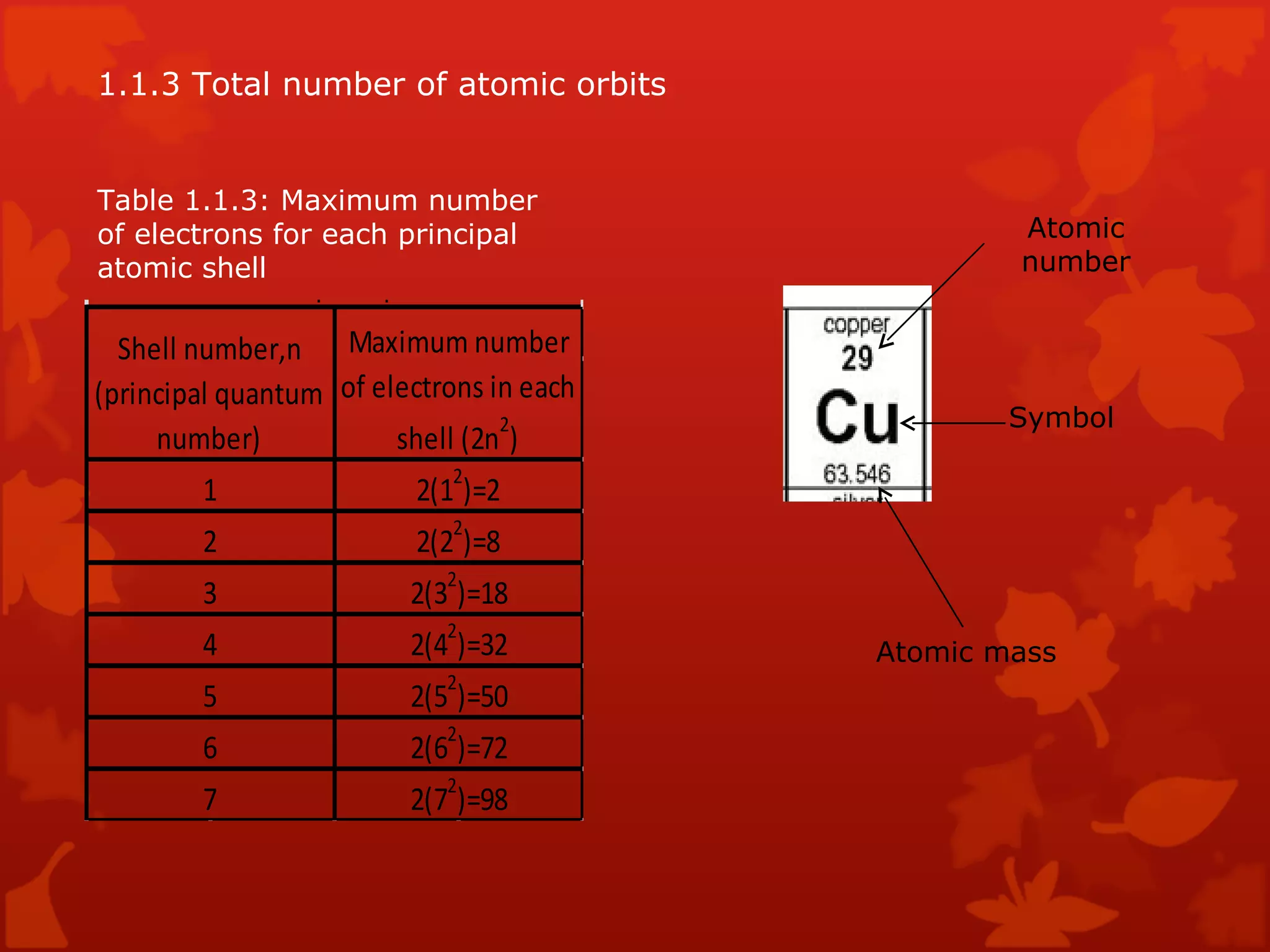
1.1.3 Total number of atomic orbits Symbol Atomic number Atomic mass Table 1.1.3: Maximum number of electrons for each principal atomic shell
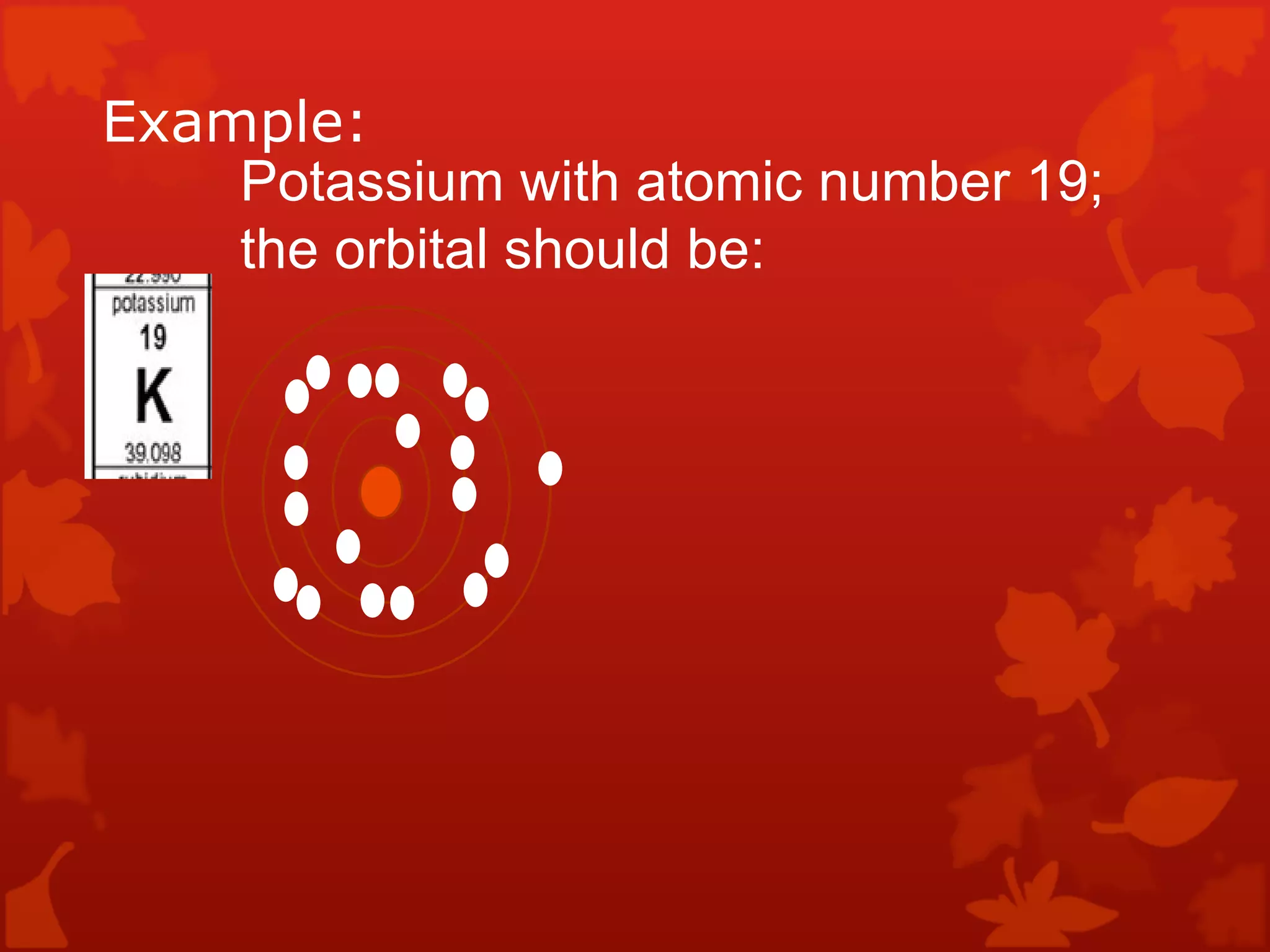
Example:  Potassium with atomic number 19; the orbital should be:
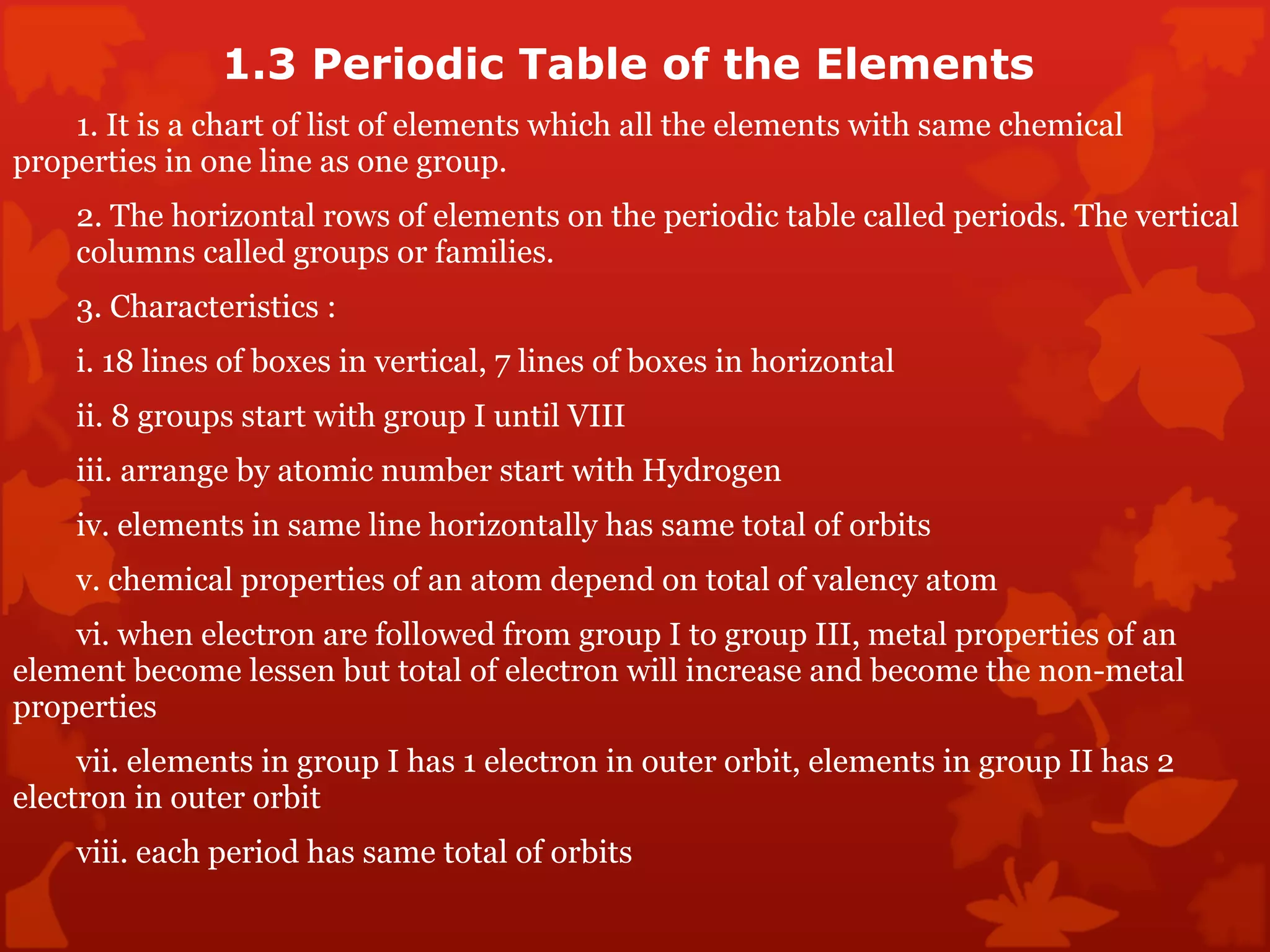
1.3 Periodic Table of the Elements  1. It is a chart of list of elements which all the elements with same chemical  properties in one line as one group.  2. The horizontal rows of elements on the periodic table called periods. The vertical  columns called groups or families .  3. Characteristics :  i. 18 lines of boxes in vertical, 7 lines of boxes in horizontal  ii. 8 groups start with group I until VIII  iii. arrange by atomic number start with Hydrogen  iv. elements in same line horizontally has same total of orbits  v. chemical properties of an atom depend on total of valency atom vi. when electron are followed from group I to group III, metal properties of an  element become lessen but total of electron will increase and become the non-metal  properties  vii. elements in group I has 1 electron in outer orbit, elements in group II has 2  electron in outer orbit  viii. each period has same total of orbits
4. Usages :  i. to classified certain elements easier  ii. as a revision where elements reactive properties can be known  (way to the right, the reactive properties are lessen)  iii. elements in first group has same chemical properties  iv. easier to acknowledge certain unknown element and also its  properties and the usage  v. easier to analyze and understand every reaction between the  elements
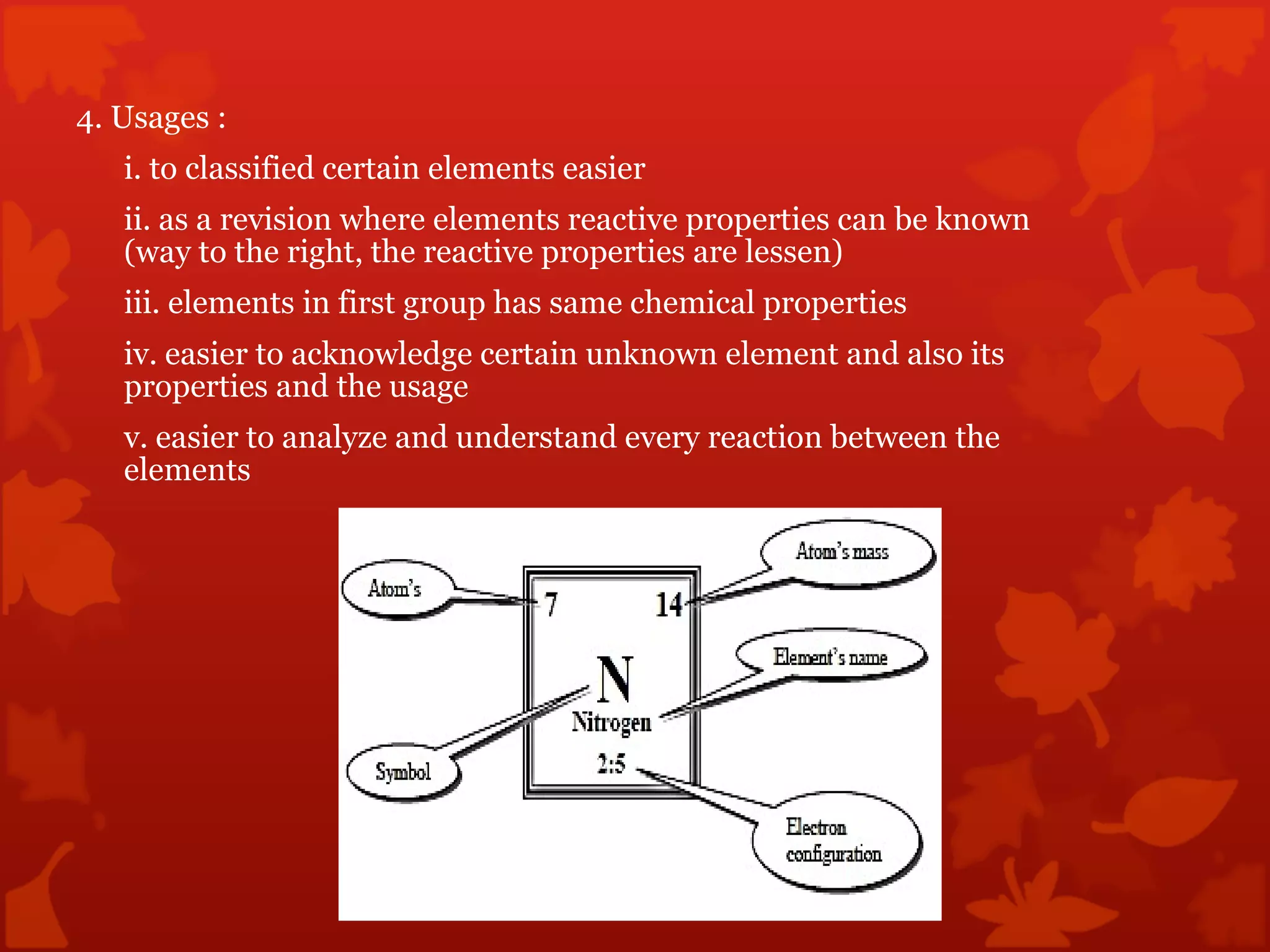
1.4 Crystal Structures  It is atomic arrangements which have a repetitive pattern in all the three dimensions of space are called crystal structures or crystals.  Fig 1 : Structure and grain boundaries
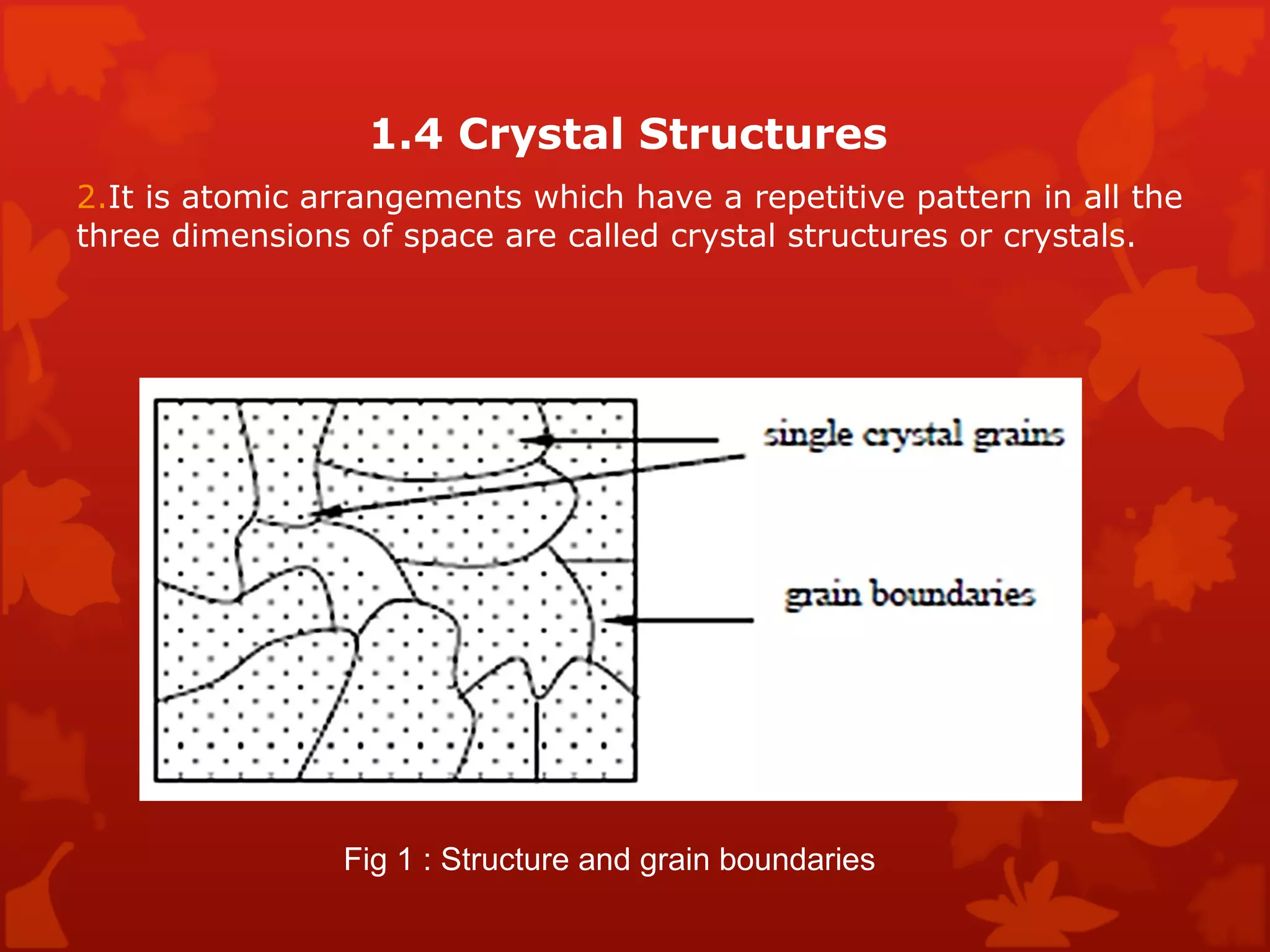
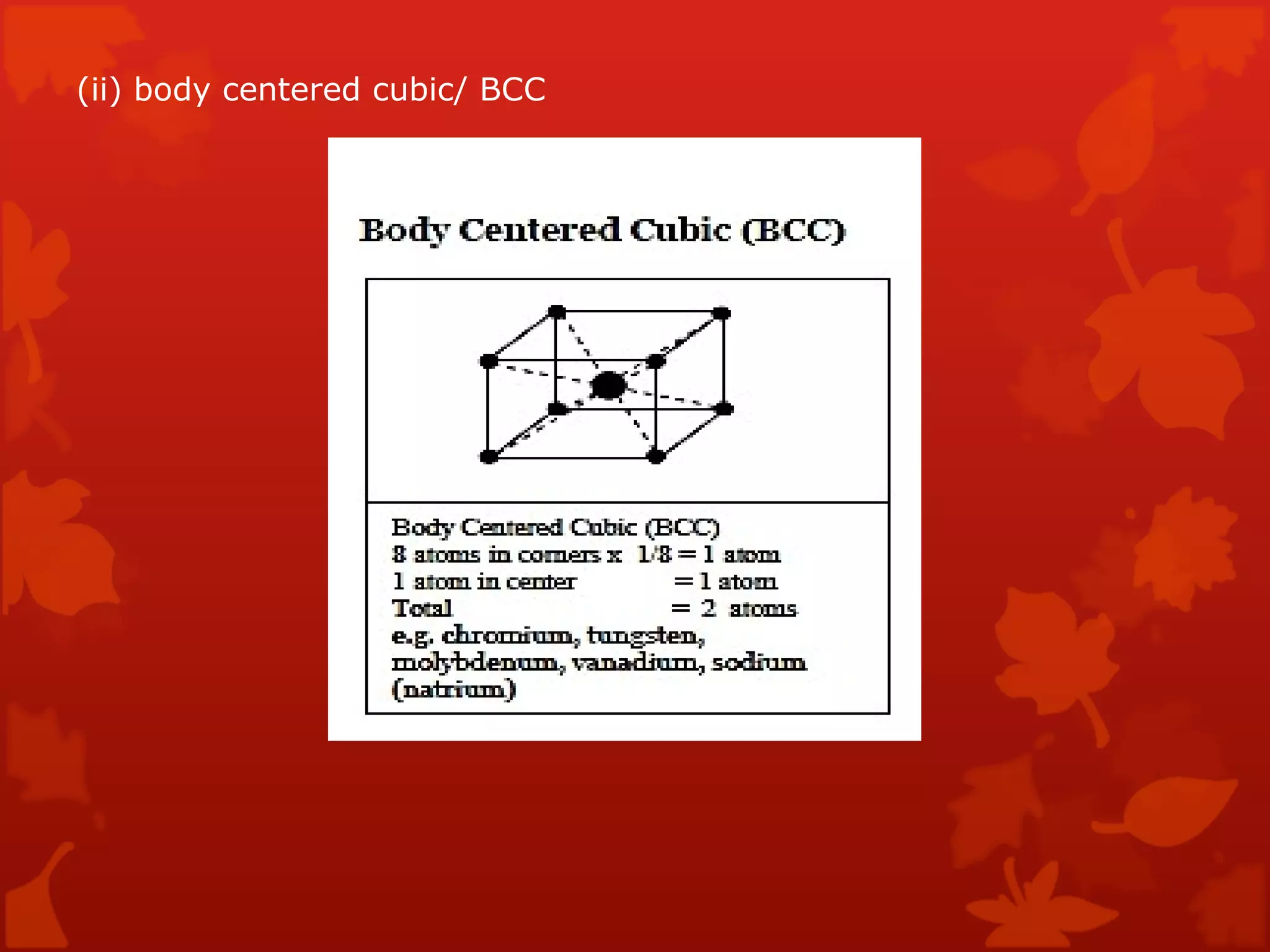
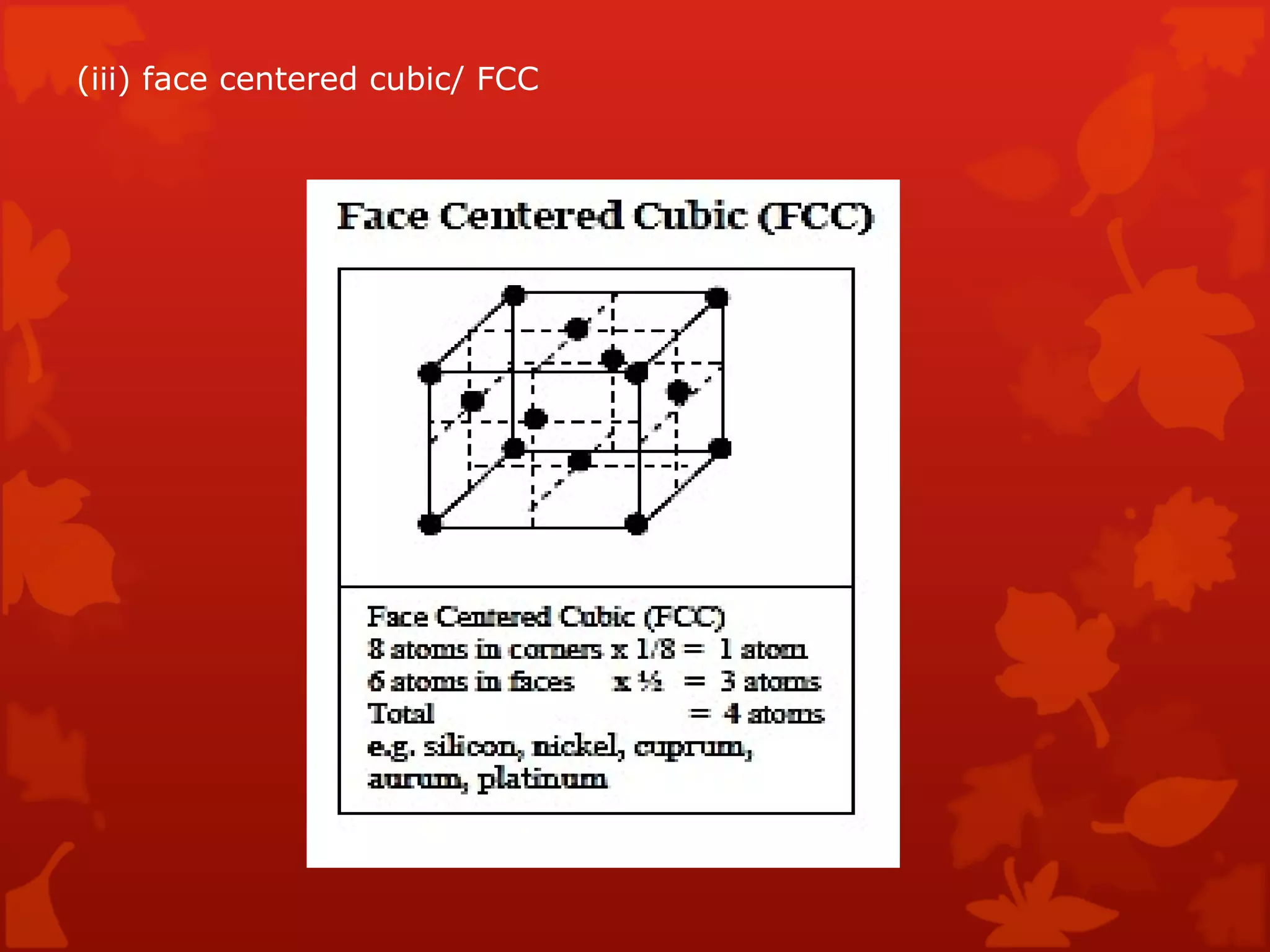
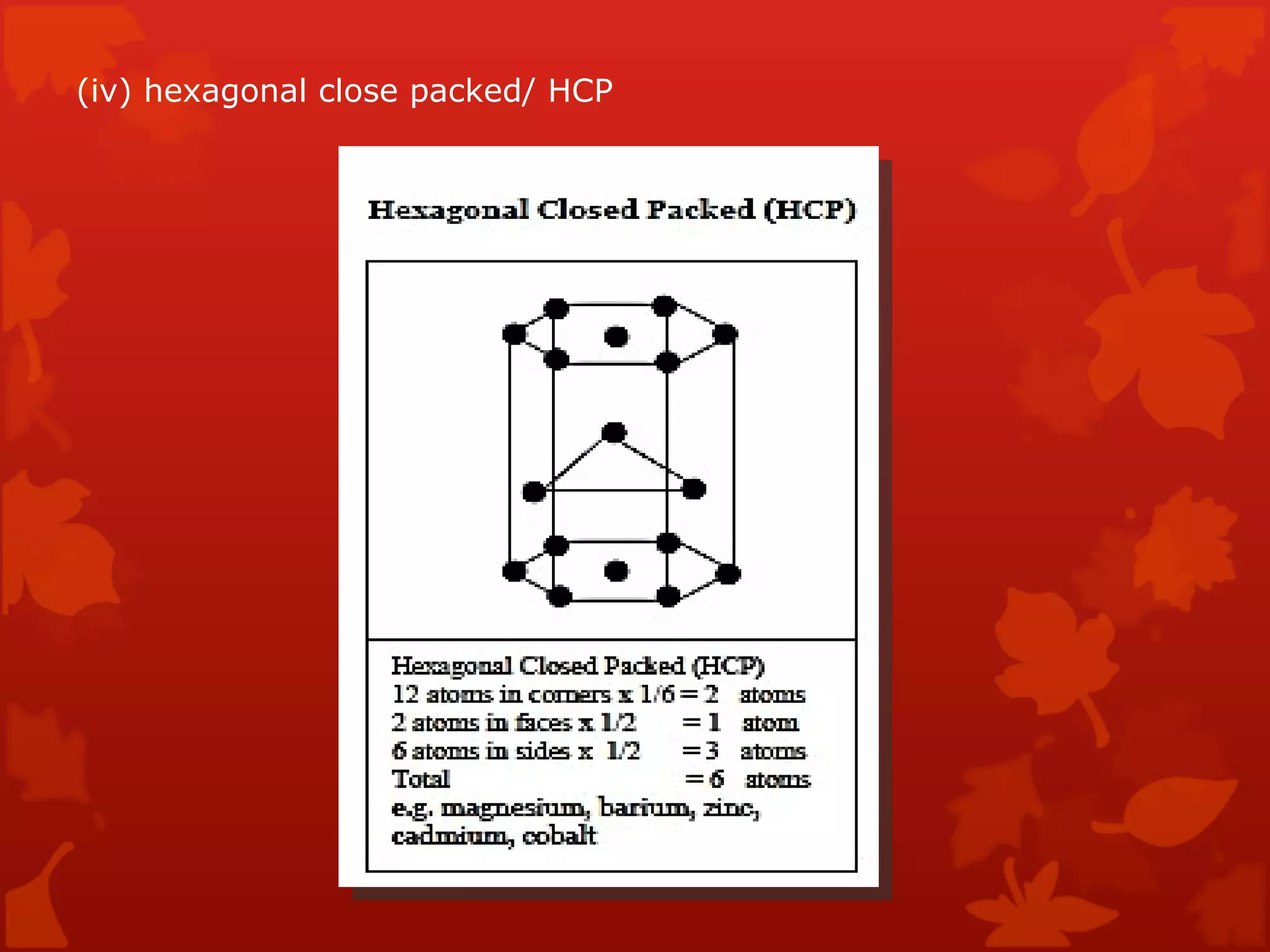
2. There are 4 types well-known crystal structures and it was :  (i) simple cube
(ii) body centered cubic/ BCC
(iii) face centered cubic/ FCC
(iv) hexagonal close packed/ HCP
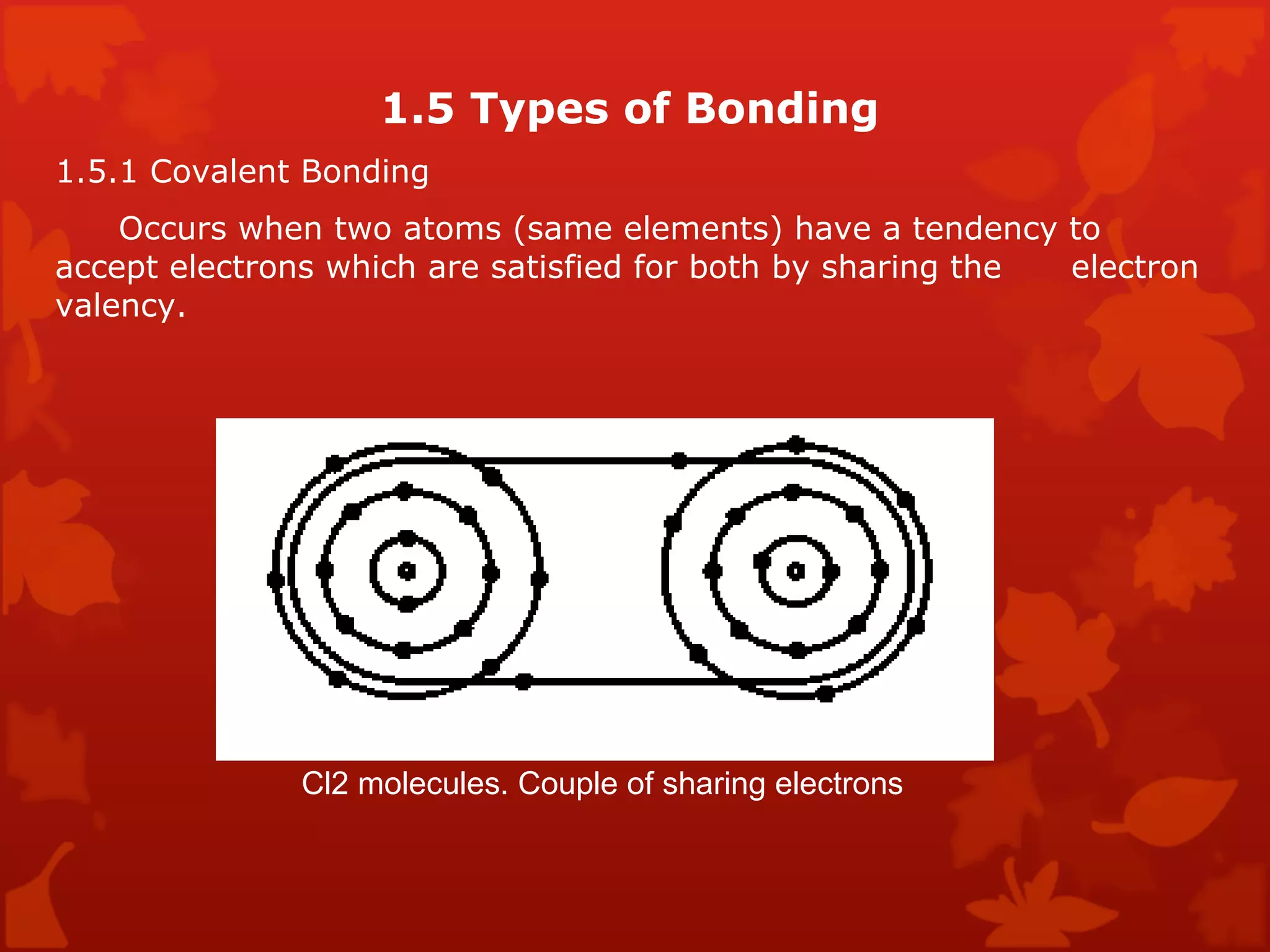
1.5 Types of Bonding 1.5.1 Covalent Bonding Occurs when two atoms (same elements) have a tendency to  accept electrons which are satisfied for both by sharing the  electron valency. Cl2 molecules. Couple of sharing electrons
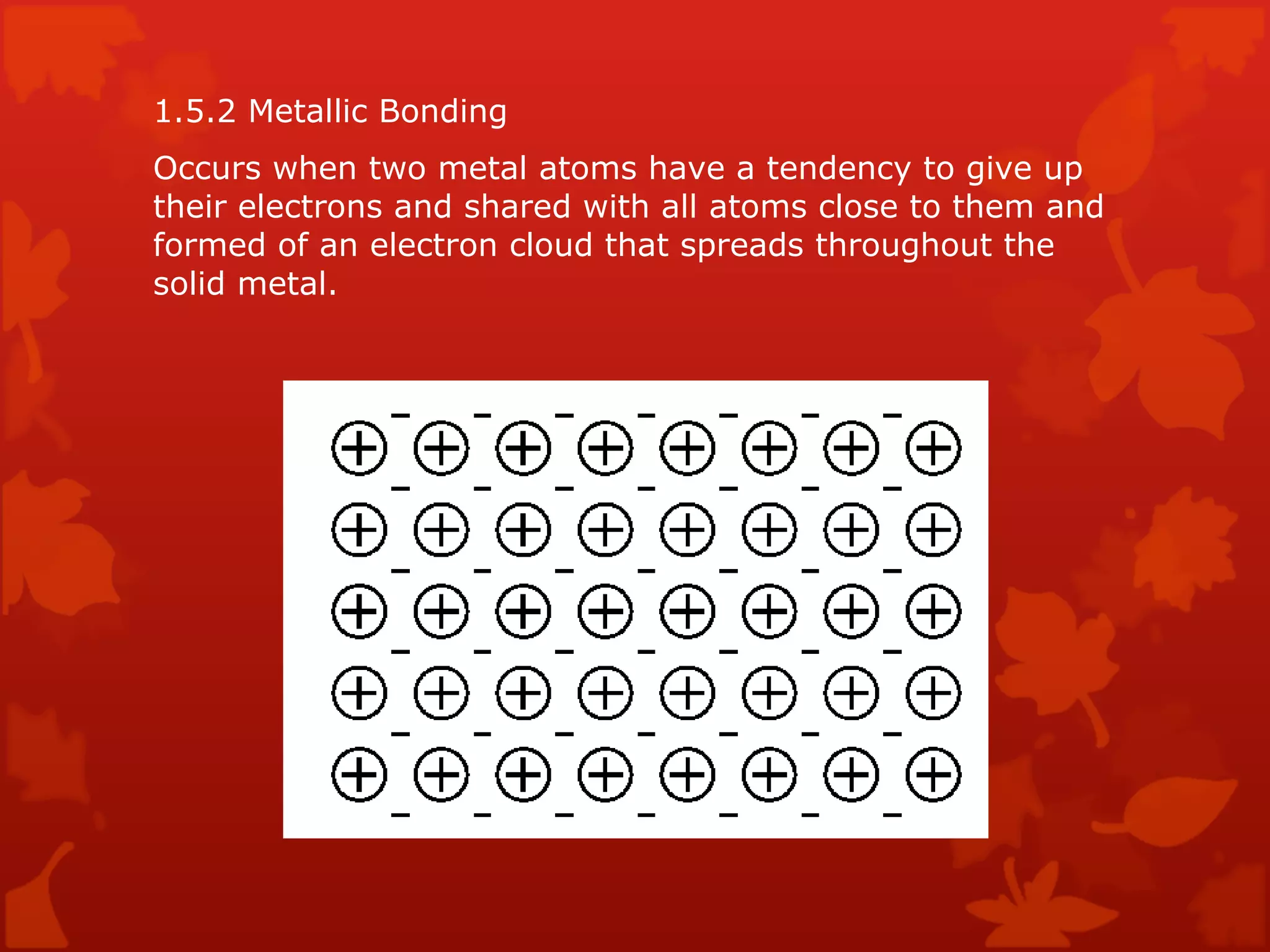
1.5.2 Metallic Bonding Occurs when two metal atoms have a tendency to give up their electrons and shared with all atoms close to them and formed of an electron cloud that spreads throughout the solid metal.
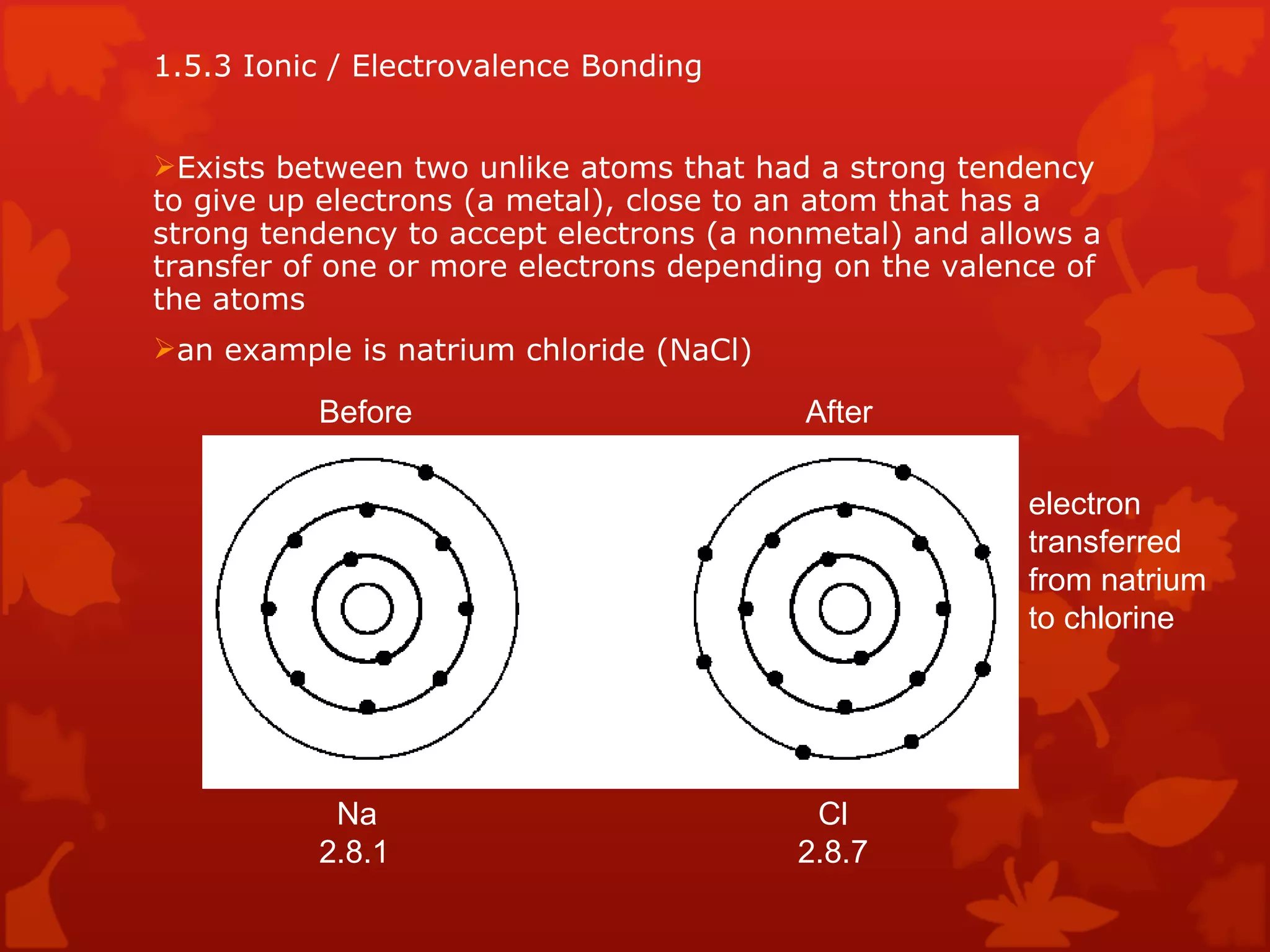
1.5.3 Ionic / Electrovalence Bonding Exists between two unlike atoms that had a strong tendency to give up electrons (a metal), close to an atom that has a strong tendency to accept electrons (a nonmetal) and allows a transfer of one or more electrons depending on the valence of the atoms an example is natrium chloride (NaCl) Before After electron transferred from natrium to chlorine Na  Cl 2.8.1    2.8.7
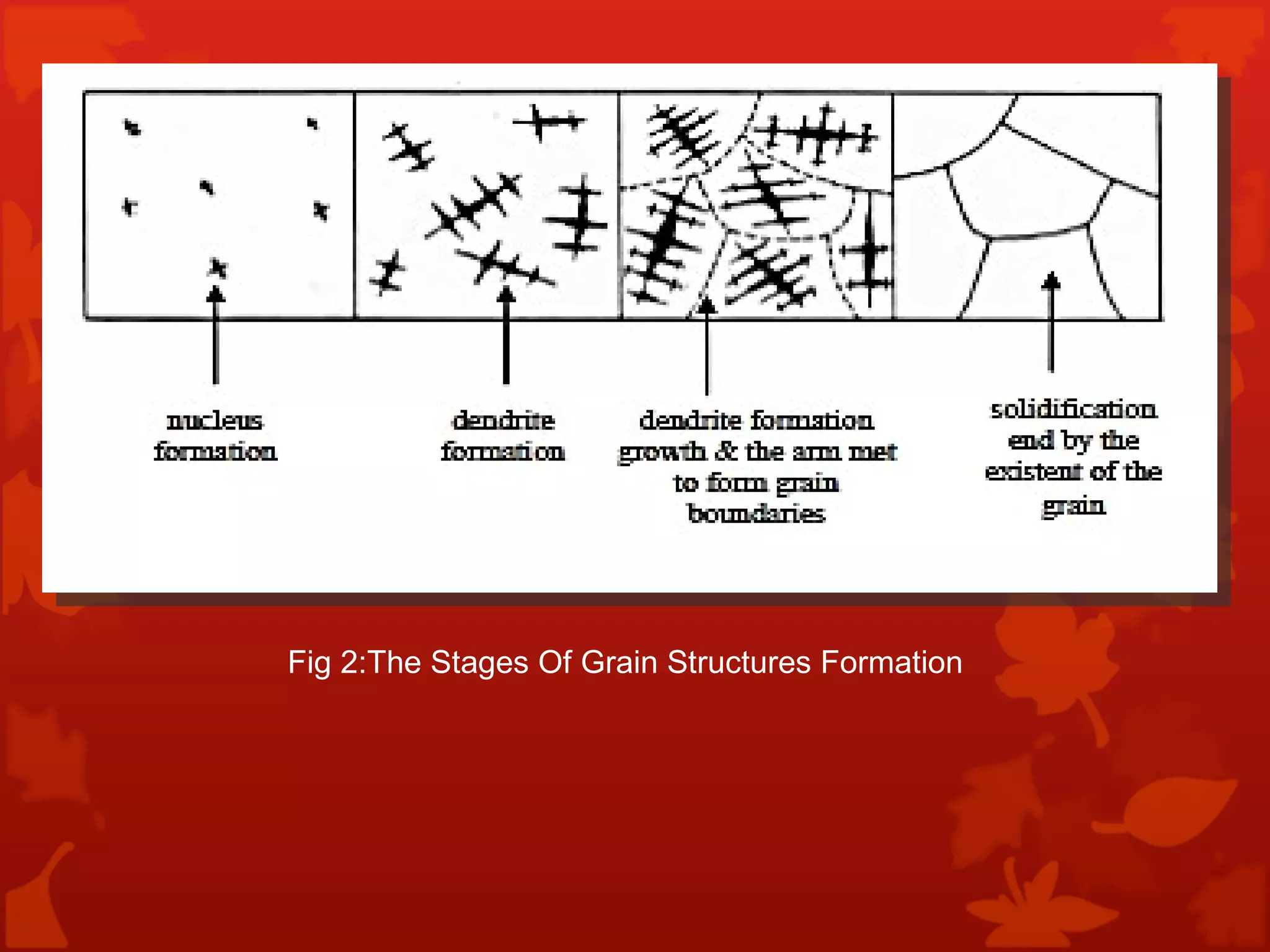
1.6 The Stages Of Grain Structures Formation  1. Solidification process occurs along with the grain formation.  2. Nucleus tips freely find their own way to much colder place.  3. Causing the nucleus to grow and expanding.  4. The expand will form the secondary dendrite arm with 90 degree to each other.  5. This will continue until a structure called dendrite structure existed.
Fig 2:The Stages Of Grain Structures Formation
1.7 The Differences Between Base Metal and Alloy  1. Base metal  metal has same elements, extreme  properties and cannot fulfill the need for  engineering work.  its characteristics :  (i) malleable – can be shape to many form  (ii) ductile – can be form to fine wire  2. Alloy  a metal alloy is a combination of two or more metals or a metal and a non-metals.
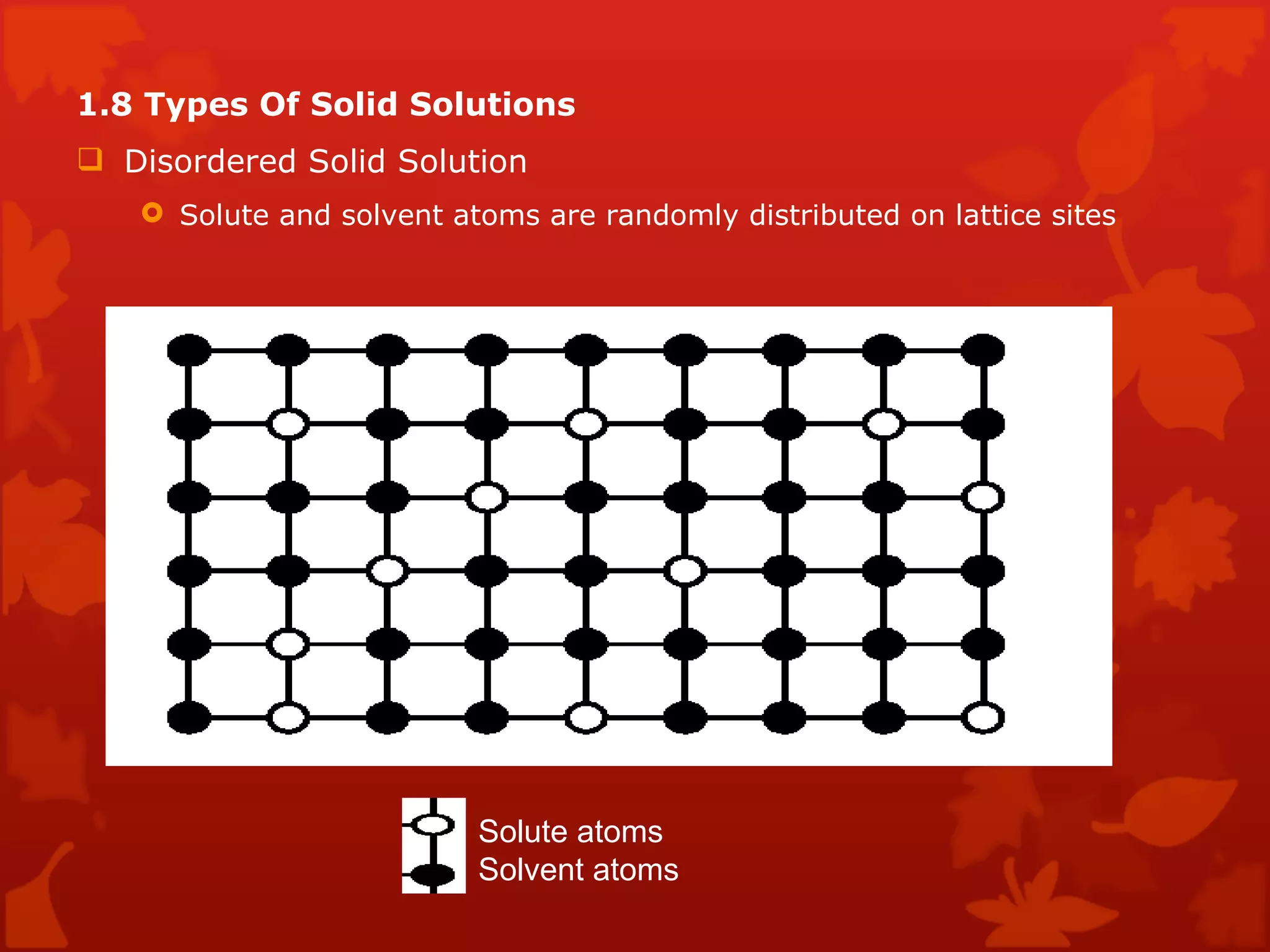
1.8 Types Of Solid Solutions  Disordered Solid Solution  Solute and solvent atoms are randomly distributed on lattice sites  Solute atoms  Solvent atoms
Ordered Solid Solution  The atoms (solute and solvent) take up preferred positions and the solution becomes ordered  Solute atoms  Solvent atoms
Interstitial Solid Solution  Atoms of small atomic radius fit into the empty spaces or interstices of the lattice structure of the solvent atoms  Solute atoms  Solvent atoms
Intermetallic Compounds  made up of 2 or more elements producing a new phase with its own composition, crystal structure and properties  Intermetallic compound (valence compound) is a phase, having chemical composition equal to a fixed simple ratio, like CuZn,Cu 3 Sn, Mg 2 Pb, etc. Sometimes intermetallic compounds exist over a range of composition, differing from the valence law. Intermetallic compounds of this sort are called  electron compounds or intermediate solutions . An example of a phase diagram with intermetallic compound  AB 2  is shown in the figure below.
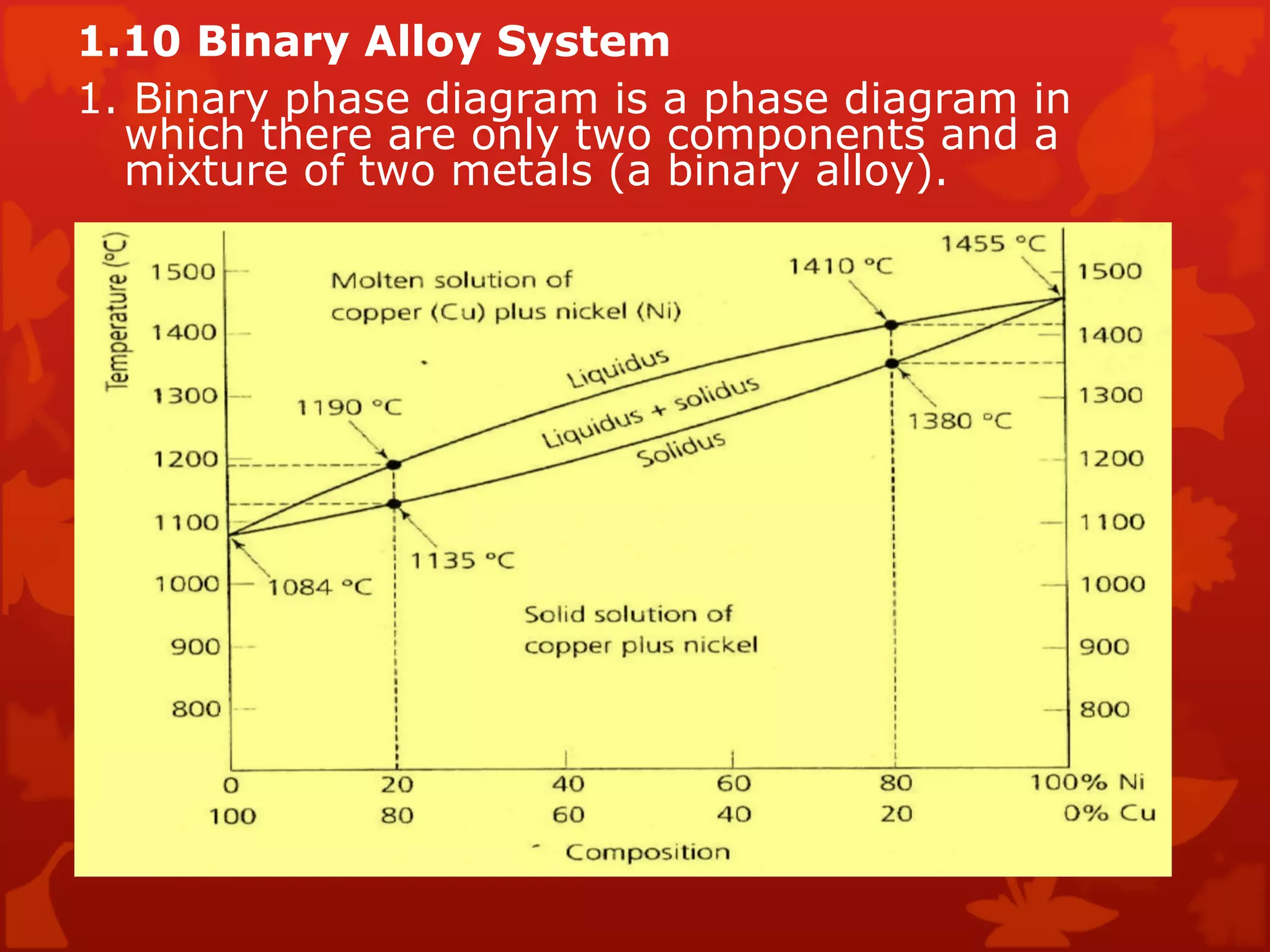
1.9 Terminologies In Phase Diagram  1. Phase  Is a region that differs in structure or composition from another region  2. Equilibrium Phase Diagram  Are graphical representations of what phases are present in a materials system at various temperatures, pressures and compositions  3. Composition  Are percentage of certain materials contains purposely or not added to another material. With this it can cause changes in phases, the properties and the shape of the microstructures.  4. Liquidus  The temperature at which liquid starts to solidify under equilibrium conditions.  5. Solidus  The temperature which all liquid has completely solidified.
1.10 Binary Alloy System  1. Binary phase diagram is a phase diagram in which there are only two components and a mixture of two metals (a binary alloy).

Chapter 1 (JF302)

  • 1.
    JF302 – MaterialTechnology 1 1.0 MATERIAL STRUCTURE AND BINARY ALLOY SYSTEM
  • 2.
    1.1 Material structureand element periodical table EPT
  • 3.
    1.1.1 The terminologyof: Atom Consist primarily three basic subatomic particles:- protons, neutrons and electrons. Basic unit of matter that consist of a dense; solid, liquid and vapour. Contains central nucleus surrounded by a cloud of negatively charged electrons. b. Element Chemical substance consisting of one type of atom distinguished by its atomic number. Eg:O 2 , H 2 , CL 2 and N 2 .
  • 4.
    1.1.1 The terminologyof: c. Mixture The molecules of two or more different substances are mixed in the form of alloys, solutions, suspension and colloids. A material system made up by two or more different substance which are mixed together but are not combined chemically. d. Compound Chemical substance consisting of two or more different chemical elements that can be separated into simpler substance by chemical reaction. Eg; H 2 O and HCl
  • 5.
    1.1.2 Atomic numbersand atomic mass of EPT. Atomic numbers The number of proton (positively charged particles) that arc in its nucleus. In a neutral atom the atomic number = to the number of electrons in its charge cloud. b. Atomic masses Relative atomic mass of an alement in the mass in grams of 6.023x10 23 atoms (Avogadro’s number,N A ) of the element.
  • 6.
    1.2 Atomic Numbers,Atomic Masses and Atomic Orbits 1. Atomic Numbers Neutral atom = numbers of proton = numbers of electron 2. Atomic Masses and Atomic Weight Atomic Weight = Atomic masses of element/Atomic masses of Hydrogen Atomic Masses = atomic numbers = number of proton + number of neutron 3. Atomic Orbits Using the 2n2 formula to state the total of atoms in every orbit, where n is total of orbit 1st orbit, n = 1 Total of atom = 2 (1)2 = 2 2nd orbit, n = 2 Total of atom = 2 (2)2 = 8
  • 7.
    1.1.3 Total numberof atomic orbits Symbol Atomic number Atomic mass Table 1.1.3: Maximum number of electrons for each principal atomic shell
  • 8.
    Example: Potassiumwith atomic number 19; the orbital should be:
  • 9.
    1.3 Periodic Tableof the Elements 1. It is a chart of list of elements which all the elements with same chemical properties in one line as one group. 2. The horizontal rows of elements on the periodic table called periods. The vertical columns called groups or families . 3. Characteristics : i. 18 lines of boxes in vertical, 7 lines of boxes in horizontal ii. 8 groups start with group I until VIII iii. arrange by atomic number start with Hydrogen iv. elements in same line horizontally has same total of orbits v. chemical properties of an atom depend on total of valency atom vi. when electron are followed from group I to group III, metal properties of an element become lessen but total of electron will increase and become the non-metal properties vii. elements in group I has 1 electron in outer orbit, elements in group II has 2 electron in outer orbit viii. each period has same total of orbits
  • 10.
    4. Usages : i. to classified certain elements easier ii. as a revision where elements reactive properties can be known (way to the right, the reactive properties are lessen) iii. elements in first group has same chemical properties iv. easier to acknowledge certain unknown element and also its properties and the usage v. easier to analyze and understand every reaction between the elements
  • 11.
    1.4 Crystal Structures It is atomic arrangements which have a repetitive pattern in all the three dimensions of space are called crystal structures or crystals. Fig 1 : Structure and grain boundaries
  • 12.
    2. There are4 types well-known crystal structures and it was : (i) simple cube
  • 13.
  • 14.
  • 15.
  • 16.
    1.5 Types ofBonding 1.5.1 Covalent Bonding Occurs when two atoms (same elements) have a tendency to accept electrons which are satisfied for both by sharing the electron valency. Cl2 molecules. Couple of sharing electrons
  • 17.
    1.5.2 Metallic BondingOccurs when two metal atoms have a tendency to give up their electrons and shared with all atoms close to them and formed of an electron cloud that spreads throughout the solid metal.
  • 18.
    1.5.3 Ionic /Electrovalence Bonding Exists between two unlike atoms that had a strong tendency to give up electrons (a metal), close to an atom that has a strong tendency to accept electrons (a nonmetal) and allows a transfer of one or more electrons depending on the valence of the atoms an example is natrium chloride (NaCl) Before After electron transferred from natrium to chlorine Na Cl 2.8.1 2.8.7
  • 19.
    1.6 The StagesOf Grain Structures Formation 1. Solidification process occurs along with the grain formation. 2. Nucleus tips freely find their own way to much colder place. 3. Causing the nucleus to grow and expanding. 4. The expand will form the secondary dendrite arm with 90 degree to each other. 5. This will continue until a structure called dendrite structure existed.
  • 20.
    Fig 2:The StagesOf Grain Structures Formation
  • 21.
    1.7 The DifferencesBetween Base Metal and Alloy 1. Base metal metal has same elements, extreme properties and cannot fulfill the need for engineering work. its characteristics : (i) malleable – can be shape to many form (ii) ductile – can be form to fine wire 2. Alloy a metal alloy is a combination of two or more metals or a metal and a non-metals.
  • 22.
    1.8 Types OfSolid Solutions Disordered Solid Solution Solute and solvent atoms are randomly distributed on lattice sites Solute atoms Solvent atoms
  • 23.
    Ordered Solid Solution The atoms (solute and solvent) take up preferred positions and the solution becomes ordered Solute atoms Solvent atoms
  • 24.
    Interstitial Solid Solution Atoms of small atomic radius fit into the empty spaces or interstices of the lattice structure of the solvent atoms Solute atoms Solvent atoms
  • 25.
    Intermetallic Compounds made up of 2 or more elements producing a new phase with its own composition, crystal structure and properties Intermetallic compound (valence compound) is a phase, having chemical composition equal to a fixed simple ratio, like CuZn,Cu 3 Sn, Mg 2 Pb, etc. Sometimes intermetallic compounds exist over a range of composition, differing from the valence law. Intermetallic compounds of this sort are called  electron compounds or intermediate solutions . An example of a phase diagram with intermetallic compound  AB 2  is shown in the figure below.
  • 26.
    1.9 Terminologies InPhase Diagram 1. Phase Is a region that differs in structure or composition from another region 2. Equilibrium Phase Diagram Are graphical representations of what phases are present in a materials system at various temperatures, pressures and compositions 3. Composition Are percentage of certain materials contains purposely or not added to another material. With this it can cause changes in phases, the properties and the shape of the microstructures. 4. Liquidus The temperature at which liquid starts to solidify under equilibrium conditions. 5. Solidus The temperature which all liquid has completely solidified.
  • 27.
    1.10 Binary AlloySystem 1. Binary phase diagram is a phase diagram in which there are only two components and a mixture of two metals (a binary alloy).