DR SANKALP MOHAN 
SENIOR RESIDENT 
DEPARTMENT OF NEUROLOGY 
MBS HOSPITAL,KOTA
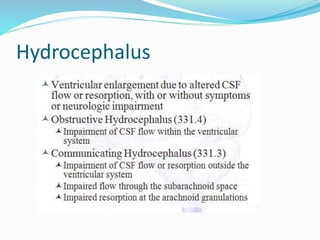
Hydrocephalus
COMMUNICATING 
HYDROCEPHALUS
NORMAL PRESSURE 
HYDROCEPHALUS 
 First described by Hakim in 1964 
 Normal pressure hydrocephalus (NPH) is a clinical 
symptom complex characterized by abnormal gait, 
urinary incontinence, and dementia.
EPIDEMIOLOGY 
 elderly individuals (age >65 y) the prevalence of NPH 
was 1.4% 
 Incidence -1.4 per 1,00,000 
 No race or gender prediliction 
 more than 60% of patients with iNPH had 
cerebrovascular disease. 
 In another similar study, more than 75% had 
Alzheimer disease pathology at the time of shunt 
surgery.
ETIOLOGY 
 IDIOPATHIC – 50 % 
 SECONDARY CAUSES 
 subarachnoid hemorrhage (23%), 
 meningitis (4.5%) 
 and traumatic brain injury (12.5%)
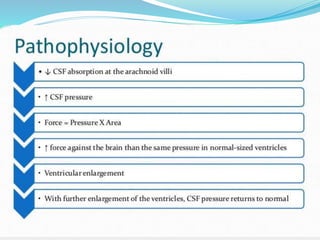
PATHOPHYSIOLOGY 
 Increased subarachnoid space volume does not 
accompany increased ventricular volume. 
 Symptoms result from distortion of the central portion 
of the corona radiata by the distended ventricles. 
Interstitial edema of the white matter 
 The periventricular white matter anatomically 
includes the sacral motor -abnormal gait and 
incontinence. 
 Dementia results from distortion of the 
periventricular limbic system.
CLINICAL FEATURES 
 CLASSIC TRIAD 
 GAIT DISTURBANCE -is typically the earliest feature 
noted and considered to be the most responsive to 
treatment 
 Apraxia of gait – no weakness or ataxia 
 bradykinetic, broad based, magnetic, and shuffling. 
 URINARY SYMPTOMS of NPH can present as 
urinary frequency, urgency, or frank incontinence.
 DEMENTIA 
 Usually mild 
 prominent memory loss and bradyphrenia. 
 Frontal and subcortical deficits 
 forgetfulness, decreased attention, 
 Aphasia /agnosia – alternate diagnosis -Alzheimer
Proposed diagnostic criteria 
Case of probable iNPH are 
 Older than 40 years of age 
 insidious (nonacute) progression of symptoms over a 
period of at least 3 months 
 CSF opening pressures between 70 and 245 mm H2O. 
 MRI or CT must show an Evan’s index of at least 0.3 
 as well as temporal horn enlargement 
 , periventricular signal changes, periventricular 
edema, or an aqueductal/fourth ventricular flow void
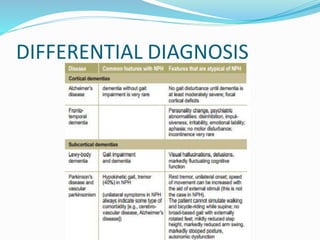
DIFFERENTIAL DIAGNOSIS
 Diagnosis of NPH less likely IF- 
 ● Intracranial pressure above 25 cm H2O (this rules 
 out iNPH, by definition) 
 ● Age under 40 (iNPH unlikely) 
 ● Asymmetrical or transient symptoms 
 ● Cortical deficits, e.g., aphasia, apraxia, or paresis 
 ● Progressive dementia without gait disturbance 
 (even if the ventricles are enlarged) 
 ● Lack of progression of symptoms
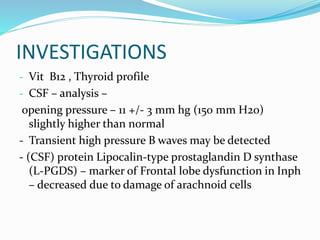
INVESTIGATIONS 
- Vit B12 , Thyroid profile 
- CSF – analysis – 
opening pressure – 11 +/- 3 mm hg (150 mm H2o) 
slightly higher than normal 
- Transient high pressure B waves may be detected 
- (CSF) protein Lipocalin-type prostaglandin D synthase 
(L-PGDS) – marker of Frontal lobe dysfunction in Inph 
– decreased due to damage of arachnoid cells
CT SCAN 
disproportionately enlarged temporal horns 
of the lateral ventricles compared with the 
relatively normal sulcal size.
CT SCAN 
 Ventriculomegaly that is out of proportion to sulcal 
atrophy. 
 differentiates NPH from ex vacuo ventriculomegaly, 
 Frontal and occipital periventricular hypoattenuating 
areas, represent transependymal CSF flow - 
infrequent and often may represent periventricular 
leukoencephalopathy 
 corpus callosal thinning, -nonspecific
 Rounding of frontal horns 
 clinical picture and 
ventriculosulcal disproportion on 
either CT or MRI scans, 50-70% of 
patients are likely to respond to a 
CSF-shunting procedure.
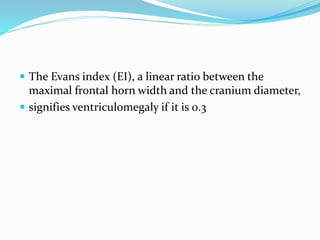
 The Evans index (EI), a linear ratio between the 
maximal frontal horn width and the cranium diameter, 
 signifies ventriculomegaly if it is 0.3
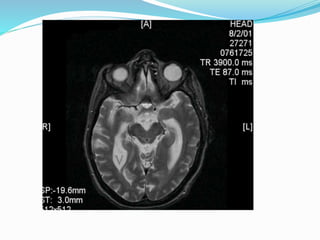
Magnetic Resonance Imaging 
 Temporal horns out of proportion to hippocampal atrophy 
 MRI provides additional physiologic information on NPH 
 T2-weighted images, regions of moving CSF demonstrate 
no signal, instead of the increased signal observed in slow-moving 
CSF, 
 CSF flow studies- jet of turbulent CSF flow may be 
observed distal to the aqueduct 
 Cine phase-contrast MRI quantifies CSF flow in terms of 
stroke volume 
 - significant corelation to shunt responsiveness
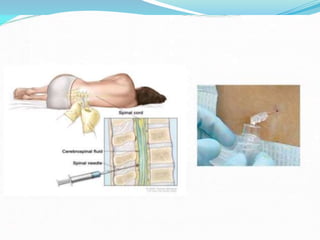
CSF TAP TEST 
 Most prefer 45 -50 ml removal 
 Csf pressures may be transiently elevated 
 Improvement may be delayed and appear 1-2 days after 
 Sensitivity of test – 62 % and 33 % specificity 
 However it has been listed in guidelines of prognostic 
evaluation of NPH
EXTERNAL LUMBAR DRAINAGE 
 greater impact on brain volume expansion 
 300 ml drained for 5 days 
 Complications -including headache, radiculopathy, 
and bacterial meningitis 
 More sensitive than csf tap test 
 sensitivity, specificity, and negative predictive value 
were 95%, 64%, and 78%, respectively. 
 PPV 80 -100 % 
 Requires hospitalisation specialised care
OTHER TESTS 
 CSF infusion testing.- One drain is used for 
continuous pressure monitoring while the other drain 
is used to continuously infuse solution into the CSF 
space. 
 Ro – impedance of flow offered by csf absorption 
 Isotopic cisternography is no longer in frequent use 
 Acqueductal CSF flow – not of much diagnostic use
PRESURGICAL EVALUATION 
 Neuropsychological evaluation (eg, Folstein test or 
formal neuropsychological evaluation)- not validated 
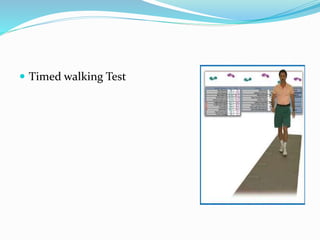
 Timed walking test. 
 Videotaping the gait evaluation before and after the 
large volume lumbar puncture.- IS PREFERABLE 
 Reduction in bladder hyperactivity also may be a sign 
of good outcome from shunting.
 Timed walking Test
MANAGEMENT 
 No prospective, double blind, randomized, controlled 
clinical triaL 
 Medical management – levodopa trial to rule out idiopthic 
parkinson disease 
 No drug is known to work in NPH 
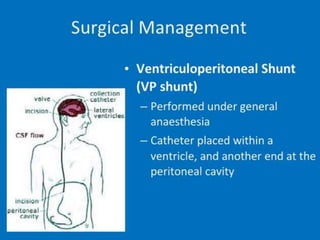
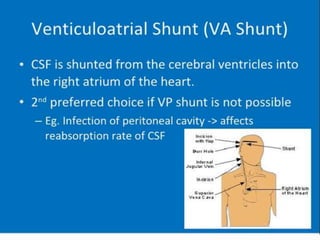
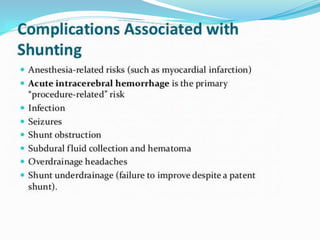
 Surgical Management – mainstay 
 Benefit expected from shunt surgery in probable case of 
NPH 50 %- 61 %
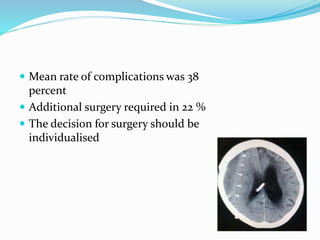
 Mean rate of complications was 38 
percent 
 Additional surgery required in 22 % 
 The decision for surgery should be 
individualised
Newer advances 
 adjustable shunt valves – adjusts the opening pressure 
 the introduction of gravity-controlled valves - low 
valve opening pressure when the patient is lying down. 
 G valves lower the risk of overdrainage by 90%
 Endoscopic third ventriculostomy (ETV). 
 Alternative to shunt placement for treatment 
of hydrocephalus. 
 Effective in obstructive hydrocephalus. Efficacy in 
NPH not known
FOLLOW UP 
 Routine follow up 2 to 3 times per year 
 Earlier if shunt inection/failure 
 Bedside clinical examination follow up CTScan within 
few weeks 
 D Dimer ,CRP in case of ventriculoatrial shunts for 
subclinical septicemia and thromboembolism
Whether to shunt or Not? 
 High CSF pressure should prompt investigation for a 
secondary cause of NPH 
 Response to a 40-mL to 50-mL (high-volume) lumbar 
tap suggests a potential benefit to shunting 
 An ELD may be used to evaluate those who do not 
respond to a high-volume tap 
 There is no substantial predictive value to MRI CSF 
flow studies 
 IF multi-infarct or Alzheimer’s disease dementia ??
THANK YOU
REFERNCES 
 Curr Neurol Neurosci Rep. Sep 2008; 8(5): 371–376 
 MDS 17th International Congress of Parkinson's 
Disease and Movement Disorders, Volume 28, 
June 2013 Abstract Supplement 
 Congress of neurological surgeons INPH guidelines – 
volume 57 ,number 3 2005 
 Bradley s Neurology in Clinical practice

Normal pressure hydrocephalus

  • 1.
    DR SANKALP MOHAN SENIOR RESIDENT DEPARTMENT OF NEUROLOGY MBS HOSPITAL,KOTA
  • 2.
  • 3.
  • 4.
    NORMAL PRESSURE HYDROCEPHALUS  First described by Hakim in 1964  Normal pressure hydrocephalus (NPH) is a clinical symptom complex characterized by abnormal gait, urinary incontinence, and dementia.
  • 5.
    EPIDEMIOLOGY  elderlyindividuals (age >65 y) the prevalence of NPH was 1.4%  Incidence -1.4 per 1,00,000  No race or gender prediliction  more than 60% of patients with iNPH had cerebrovascular disease.  In another similar study, more than 75% had Alzheimer disease pathology at the time of shunt surgery.
  • 6.
    ETIOLOGY  IDIOPATHIC– 50 %  SECONDARY CAUSES  subarachnoid hemorrhage (23%),  meningitis (4.5%)  and traumatic brain injury (12.5%)
  • 7.
    PATHOPHYSIOLOGY  Increasedsubarachnoid space volume does not accompany increased ventricular volume.  Symptoms result from distortion of the central portion of the corona radiata by the distended ventricles. Interstitial edema of the white matter  The periventricular white matter anatomically includes the sacral motor -abnormal gait and incontinence.  Dementia results from distortion of the periventricular limbic system.
  • 9.
    CLINICAL FEATURES CLASSIC TRIAD  GAIT DISTURBANCE -is typically the earliest feature noted and considered to be the most responsive to treatment  Apraxia of gait – no weakness or ataxia  bradykinetic, broad based, magnetic, and shuffling.  URINARY SYMPTOMS of NPH can present as urinary frequency, urgency, or frank incontinence.
  • 10.
     DEMENTIA Usually mild  prominent memory loss and bradyphrenia.  Frontal and subcortical deficits  forgetfulness, decreased attention,  Aphasia /agnosia – alternate diagnosis -Alzheimer
  • 11.
    Proposed diagnostic criteria Case of probable iNPH are  Older than 40 years of age  insidious (nonacute) progression of symptoms over a period of at least 3 months  CSF opening pressures between 70 and 245 mm H2O.  MRI or CT must show an Evan’s index of at least 0.3  as well as temporal horn enlargement  , periventricular signal changes, periventricular edema, or an aqueductal/fourth ventricular flow void
  • 12.
  • 14.
     Diagnosis ofNPH less likely IF-  ● Intracranial pressure above 25 cm H2O (this rules  out iNPH, by definition)  ● Age under 40 (iNPH unlikely)  ● Asymmetrical or transient symptoms  ● Cortical deficits, e.g., aphasia, apraxia, or paresis  ● Progressive dementia without gait disturbance  (even if the ventricles are enlarged)  ● Lack of progression of symptoms
  • 15.
    INVESTIGATIONS - VitB12 , Thyroid profile - CSF – analysis – opening pressure – 11 +/- 3 mm hg (150 mm H2o) slightly higher than normal - Transient high pressure B waves may be detected - (CSF) protein Lipocalin-type prostaglandin D synthase (L-PGDS) – marker of Frontal lobe dysfunction in Inph – decreased due to damage of arachnoid cells
  • 16.
    CT SCAN disproportionatelyenlarged temporal horns of the lateral ventricles compared with the relatively normal sulcal size.
  • 18.
    CT SCAN Ventriculomegaly that is out of proportion to sulcal atrophy.  differentiates NPH from ex vacuo ventriculomegaly,  Frontal and occipital periventricular hypoattenuating areas, represent transependymal CSF flow - infrequent and often may represent periventricular leukoencephalopathy  corpus callosal thinning, -nonspecific
  • 19.
     Rounding offrontal horns  clinical picture and ventriculosulcal disproportion on either CT or MRI scans, 50-70% of patients are likely to respond to a CSF-shunting procedure.
  • 20.
     The Evansindex (EI), a linear ratio between the maximal frontal horn width and the cranium diameter,  signifies ventriculomegaly if it is 0.3
  • 21.
    Magnetic Resonance Imaging  Temporal horns out of proportion to hippocampal atrophy  MRI provides additional physiologic information on NPH  T2-weighted images, regions of moving CSF demonstrate no signal, instead of the increased signal observed in slow-moving CSF,  CSF flow studies- jet of turbulent CSF flow may be observed distal to the aqueduct  Cine phase-contrast MRI quantifies CSF flow in terms of stroke volume  - significant corelation to shunt responsiveness
  • 23.
    CSF TAP TEST  Most prefer 45 -50 ml removal  Csf pressures may be transiently elevated  Improvement may be delayed and appear 1-2 days after  Sensitivity of test – 62 % and 33 % specificity  However it has been listed in guidelines of prognostic evaluation of NPH
  • 24.
    EXTERNAL LUMBAR DRAINAGE  greater impact on brain volume expansion  300 ml drained for 5 days  Complications -including headache, radiculopathy, and bacterial meningitis  More sensitive than csf tap test  sensitivity, specificity, and negative predictive value were 95%, 64%, and 78%, respectively.  PPV 80 -100 %  Requires hospitalisation specialised care
  • 27.
    OTHER TESTS CSF infusion testing.- One drain is used for continuous pressure monitoring while the other drain is used to continuously infuse solution into the CSF space.  Ro – impedance of flow offered by csf absorption  Isotopic cisternography is no longer in frequent use  Acqueductal CSF flow – not of much diagnostic use
  • 29.
    PRESURGICAL EVALUATION Neuropsychological evaluation (eg, Folstein test or formal neuropsychological evaluation)- not validated  Timed walking test.  Videotaping the gait evaluation before and after the large volume lumbar puncture.- IS PREFERABLE  Reduction in bladder hyperactivity also may be a sign of good outcome from shunting.
  • 30.
  • 31.
    MANAGEMENT  Noprospective, double blind, randomized, controlled clinical triaL  Medical management – levodopa trial to rule out idiopthic parkinson disease  No drug is known to work in NPH  Surgical Management – mainstay  Benefit expected from shunt surgery in probable case of NPH 50 %- 61 %
  • 35.
     Mean rateof complications was 38 percent  Additional surgery required in 22 %  The decision for surgery should be individualised
  • 37.
    Newer advances adjustable shunt valves – adjusts the opening pressure  the introduction of gravity-controlled valves - low valve opening pressure when the patient is lying down.  G valves lower the risk of overdrainage by 90%
  • 39.
     Endoscopic thirdventriculostomy (ETV).  Alternative to shunt placement for treatment of hydrocephalus.  Effective in obstructive hydrocephalus. Efficacy in NPH not known
  • 40.
    FOLLOW UP Routine follow up 2 to 3 times per year  Earlier if shunt inection/failure  Bedside clinical examination follow up CTScan within few weeks  D Dimer ,CRP in case of ventriculoatrial shunts for subclinical septicemia and thromboembolism
  • 41.
    Whether to shuntor Not?  High CSF pressure should prompt investigation for a secondary cause of NPH  Response to a 40-mL to 50-mL (high-volume) lumbar tap suggests a potential benefit to shunting  An ELD may be used to evaluate those who do not respond to a high-volume tap  There is no substantial predictive value to MRI CSF flow studies  IF multi-infarct or Alzheimer’s disease dementia ??
  • 42.
  • 43.
    REFERNCES  CurrNeurol Neurosci Rep. Sep 2008; 8(5): 371–376  MDS 17th International Congress of Parkinson's Disease and Movement Disorders, Volume 28, June 2013 Abstract Supplement  Congress of neurological surgeons INPH guidelines – volume 57 ,number 3 2005  Bradley s Neurology in Clinical practice