Brain Herniation
Dr SANJOG CHANDANA
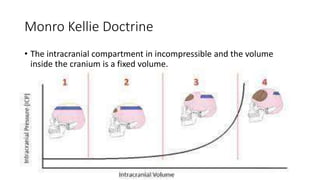
Monro Kellie Doctrine
• The intracranial compartment in incompressible and the volume
inside the cranium is a fixed volume.
Cerebral Herniation
• Occurs when brain tissue, blood and CSF shifts from their normal
position inside the skull
• Is a medical emergency and requires immediate medical attention
Cerebral herniation
• Cerebral herniation is caused by number of factors that cause mass
effect within the skull and increase the intracranial pressure
• Includes
• Cerebral edema
• Hematoma
• Stroke
• Tumor
• Infections
Intracranial Hypertension
• Defined as sustained elevation of ICP above 20 mm hg for > 5 mins.
• The mass effect of a hematoma causes decrease in the volume of CSF
and venous blood within the brain to maintain Normal ICP.
• Degrees
• Mild : 20-29 mmhg
• Moderate : 30-40 mmhg
• Severe : >40 mmhg.
Pressure regulation
• CPP = MAP – ICP.
• CBF remains constant with variations in the MAP ( 50-150 mmhg)
• Beyond this limits or with acute brain insult this autoregulation is
disturbed.
Metabolic Regulation
• Cerebral blood flow is sensitive to changes in PaCO2 and PaO2
• Hypoventilation  increase PaCO2  increase CBF  Increase ICP
• Hyperventialtion  Decrasede PaCO2  Decrease CBF  Decrease
ICP.
• Arterial hypoxemia  Increase CBF and ICP
• Increase in PaCO2  Cerebral vasoconstriction
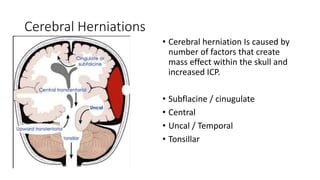
Cerebral Herniations
• Cerebral herniation Is caused by
number of factors that create
mass effect within the skull and
increased ICP.
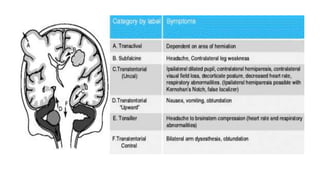
• Subflacine / cinugulate
• Central
• Uncal / Temporal
• Tonsillar
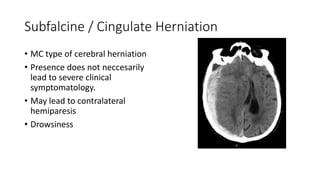
Subfalcine / Cingulate Herniation
• MC type of cerebral herniation
• Presence does not neccesarily
lead to severe clinical
symptomatology.
• May lead to contralateral
hemiparesis
• Drowsiness
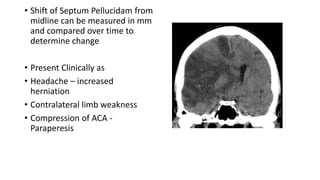
• Shift of Septum Pellucidam from
midline can be measured in mm
and compared over time to
determine change
• Present Clinically as
• Headache – increased
herniation
• Contralateral limb weakness
• Compression of ACA -
Paraperesis
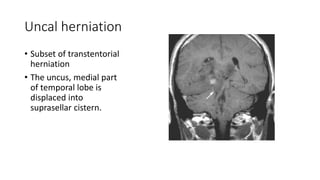
Uncal herniation
• Subset of transtentorial
herniation
• The uncus, medial part
of temporal lobe is
displaced into
suprasellar cistern.
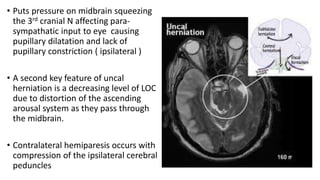
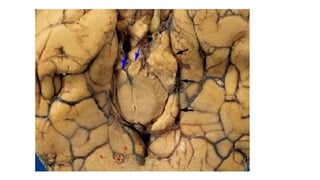
• Puts pressure on midbrain squeezing
the 3rd cranial N affecting para-
sympathatic input to eye causing
pupillary dilatation and lack of
pupillary constriction ( ipsilateral )
• A second key feature of uncal
herniation is a decreasing level of LOC
due to distortion of the ascending
arousal system as they pass through
the midbrain.
• Contralateral hemiparesis occurs with
compression of the ipsilateral cerebral
peduncles
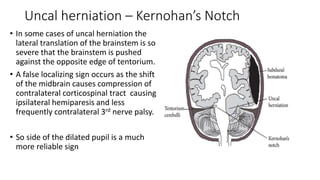
Uncal herniation – Kernohan’s Notch
• In some cases of uncal herniation the
lateral translation of the brainstem is so
severe that the brainstem is pushed
against the opposite edge of tentorium.
• A false localizing sign occurs as the shift
of the midbrain causes compression of
contralateral corticospinal tract causing
ipsilateral hemiparesis and less
frequently contralateral 3rd nerve palsy.
• So side of the dilated pupil is a much
more reliable sign
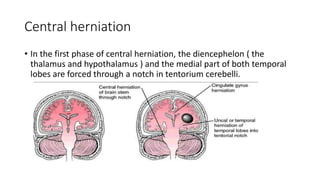
Central herniation
• In the first phase of central herniation, the diencephelon ( the
thalamus and hypothalamus ) and the medial part of both temporal
lobes are forced through a notch in tentorium cerebelli.
Central herniation
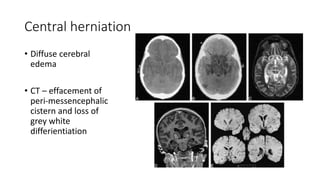
• Diffuse cerebral
edema
• CT – effacement of
peri-messencephalic
cistern and loss of
grey white
differientiation
Central Herniation - Stages
1. Early diencephalic stage
2. Late diencephalic stage
3. Midbrain – upper pons stage
4. Lower pons – Medullary stage
5. Medullary stage.
Early diencephalic stage ( reversible)
• Decreasing level of consciousness with difficulty in concentrating,
agitation and drowsiness
• Pupils are small but reactive
• Pupils may dilate briskly in response to a pinch if the skin on the neck
( ciliospinal reflex)
• Oculocephalic and oculovertebral reflexes are intact.
• Planters are flexors
• Respiration contains deep sighs, yawns and occasional pauses 
progress to Cheyne- Stokes
Late Diencephalic
• Patient becomes more difficult to arouse
• Localizing motor response to pain disappears
• Decorticate posturing
• Sighing and yawning
• Progressive diencephalic impairment is thought to be the result of
stretching of the small penetrating vessels of the posterior cerebral
and communicating arteries which supply the hypothalamus and
thalamus.
Midbrain – upper pons stage
• Motor tone is increased
• Decrebrate posturing
• Signs of oculomotor failure appear
• The pupils are irregular and fixed at mid position
• Occulo-cephalic movements are difficult to elicit
• Platers – extensor
• Hyperventilation
Lower pons – Medullary stage
• No spontaneous motor activity
• Lower extremities – may withdraw to planter stimulation
• Mid position – fixed pupils
• Absent oculocephalic and oculovestibular reflexes
• Ataxic respirations
Medullary stage
• Generalized Flaccidity
• Absent pupillary reflexes and ocular movements
• Slow irregular respirations
• Death.
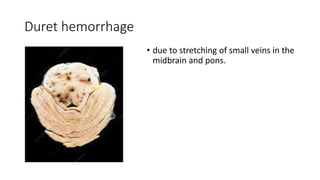
Duret hemorrhage
• due to stretching of small veins in the
midbrain and pons.
Tonsillar herniation
• The cerebral tonsils move downward thorough the
foramen magnum causing compression of the
medulla oblongata and upper cervical spinal cord
• Increased pressure in posterior fossa
• May cause cardiac and respiratory dysfunction
• Loss of Consciousness( RAS)
• Focal lower cranial N dysfunction
• Relative preservation of Upper brain stem function –
Such as pupillary light reflexes and verticle eye
movements
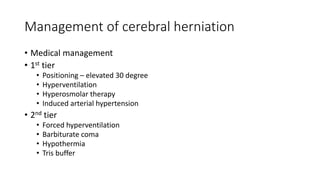
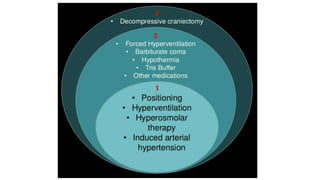
Management of cerebral herniation
• Medical management
• 1st tier
• Positioning – elevated 30 degree
• Hyperventilation
• Hyperosmolar therapy
• Induced arterial hypertension
• 2nd tier
• Forced hyperventilation
• Barbiturate coma
• Hypothermia
• Tris buffer
• Surgical : Decompressive craniectomy
Brain herniation
Brain herniation

Brain herniation

  • 1.
  • 2.
    Monro Kellie Doctrine •The intracranial compartment in incompressible and the volume inside the cranium is a fixed volume.
  • 4.
    Cerebral Herniation • Occurswhen brain tissue, blood and CSF shifts from their normal position inside the skull • Is a medical emergency and requires immediate medical attention
  • 5.
    Cerebral herniation • Cerebralherniation is caused by number of factors that cause mass effect within the skull and increase the intracranial pressure • Includes • Cerebral edema • Hematoma • Stroke • Tumor • Infections
  • 6.
    Intracranial Hypertension • Definedas sustained elevation of ICP above 20 mm hg for > 5 mins. • The mass effect of a hematoma causes decrease in the volume of CSF and venous blood within the brain to maintain Normal ICP. • Degrees • Mild : 20-29 mmhg • Moderate : 30-40 mmhg • Severe : >40 mmhg.
  • 8.
    Pressure regulation • CPP= MAP – ICP. • CBF remains constant with variations in the MAP ( 50-150 mmhg) • Beyond this limits or with acute brain insult this autoregulation is disturbed.
  • 9.
    Metabolic Regulation • Cerebralblood flow is sensitive to changes in PaCO2 and PaO2 • Hypoventilation  increase PaCO2  increase CBF  Increase ICP • Hyperventialtion  Decrasede PaCO2  Decrease CBF  Decrease ICP. • Arterial hypoxemia  Increase CBF and ICP • Increase in PaCO2  Cerebral vasoconstriction
  • 10.
    Cerebral Herniations • Cerebralherniation Is caused by number of factors that create mass effect within the skull and increased ICP. • Subflacine / cinugulate • Central • Uncal / Temporal • Tonsillar
  • 11.
    Subfalcine / CingulateHerniation • MC type of cerebral herniation • Presence does not neccesarily lead to severe clinical symptomatology. • May lead to contralateral hemiparesis • Drowsiness
  • 12.
    • Shift ofSeptum Pellucidam from midline can be measured in mm and compared over time to determine change • Present Clinically as • Headache – increased herniation • Contralateral limb weakness • Compression of ACA - Paraperesis
  • 14.
    Uncal herniation • Subsetof transtentorial herniation • The uncus, medial part of temporal lobe is displaced into suprasellar cistern.
  • 15.
    • Puts pressureon midbrain squeezing the 3rd cranial N affecting para- sympathatic input to eye causing pupillary dilatation and lack of pupillary constriction ( ipsilateral ) • A second key feature of uncal herniation is a decreasing level of LOC due to distortion of the ascending arousal system as they pass through the midbrain. • Contralateral hemiparesis occurs with compression of the ipsilateral cerebral peduncles
  • 17.
    Uncal herniation –Kernohan’s Notch • In some cases of uncal herniation the lateral translation of the brainstem is so severe that the brainstem is pushed against the opposite edge of tentorium. • A false localizing sign occurs as the shift of the midbrain causes compression of contralateral corticospinal tract causing ipsilateral hemiparesis and less frequently contralateral 3rd nerve palsy. • So side of the dilated pupil is a much more reliable sign
  • 18.
    Central herniation • Inthe first phase of central herniation, the diencephelon ( the thalamus and hypothalamus ) and the medial part of both temporal lobes are forced through a notch in tentorium cerebelli.
  • 19.
    Central herniation • Diffusecerebral edema • CT – effacement of peri-messencephalic cistern and loss of grey white differientiation
  • 20.
    Central Herniation -Stages 1. Early diencephalic stage 2. Late diencephalic stage 3. Midbrain – upper pons stage 4. Lower pons – Medullary stage 5. Medullary stage.
  • 21.
    Early diencephalic stage( reversible) • Decreasing level of consciousness with difficulty in concentrating, agitation and drowsiness • Pupils are small but reactive • Pupils may dilate briskly in response to a pinch if the skin on the neck ( ciliospinal reflex) • Oculocephalic and oculovertebral reflexes are intact. • Planters are flexors • Respiration contains deep sighs, yawns and occasional pauses  progress to Cheyne- Stokes
  • 22.
    Late Diencephalic • Patientbecomes more difficult to arouse • Localizing motor response to pain disappears • Decorticate posturing • Sighing and yawning • Progressive diencephalic impairment is thought to be the result of stretching of the small penetrating vessels of the posterior cerebral and communicating arteries which supply the hypothalamus and thalamus.
  • 23.
    Midbrain – upperpons stage • Motor tone is increased • Decrebrate posturing • Signs of oculomotor failure appear • The pupils are irregular and fixed at mid position • Occulo-cephalic movements are difficult to elicit • Platers – extensor • Hyperventilation
  • 24.
    Lower pons –Medullary stage • No spontaneous motor activity • Lower extremities – may withdraw to planter stimulation • Mid position – fixed pupils • Absent oculocephalic and oculovestibular reflexes • Ataxic respirations
  • 25.
    Medullary stage • GeneralizedFlaccidity • Absent pupillary reflexes and ocular movements • Slow irregular respirations • Death.
  • 26.
    Duret hemorrhage • dueto stretching of small veins in the midbrain and pons.
  • 27.
    Tonsillar herniation • Thecerebral tonsils move downward thorough the foramen magnum causing compression of the medulla oblongata and upper cervical spinal cord • Increased pressure in posterior fossa • May cause cardiac and respiratory dysfunction • Loss of Consciousness( RAS) • Focal lower cranial N dysfunction • Relative preservation of Upper brain stem function – Such as pupillary light reflexes and verticle eye movements
  • 29.
    Management of cerebralherniation • Medical management • 1st tier • Positioning – elevated 30 degree • Hyperventilation • Hyperosmolar therapy • Induced arterial hypertension • 2nd tier • Forced hyperventilation • Barbiturate coma • Hypothermia • Tris buffer
  • 30.
    • Surgical :Decompressive craniectomy