Top 5 Symptoms and causes of
hydrocephalus
Learn more about Spina Bifida
and Hydrocephalus at
http://www.spinabifida.net
Definition
 Hydrocephalus means abnormal or
excessive accumulation of CSF in
the intracranial cavity.
 To understand Hydrocephalus , we
have to take an idea about the
cerebrospinal fluid (CSF) circulation.
CSF Circulation
 CSF is a dynamic fluid, its main function
is to keep the internal environment of
Central Nervous System (C.N.S)
constant. It also play a role in mechanical
protection of the brain and spinal cord.
 Because CSF is dynamic fluid it is
secreted and reabsorbed continuously.
CSF is secreted by choroid plexus, the
main bulk of choroid plexus is present in
the Lateral Ventricles, but there is
choroid plexus also in the Third Ventricle
and Fourth Ventricle.
CSF Circulation (Cont.)
 The rate of formation of CSF is about 0.3-
0.35 ml/min i.e. it is about 500 cc/day
although the constant amount of CSF
present in the ventricles and subarachnoid
space is about 150 cc. This means that
most of the amount secreted is reabsorbed
again.
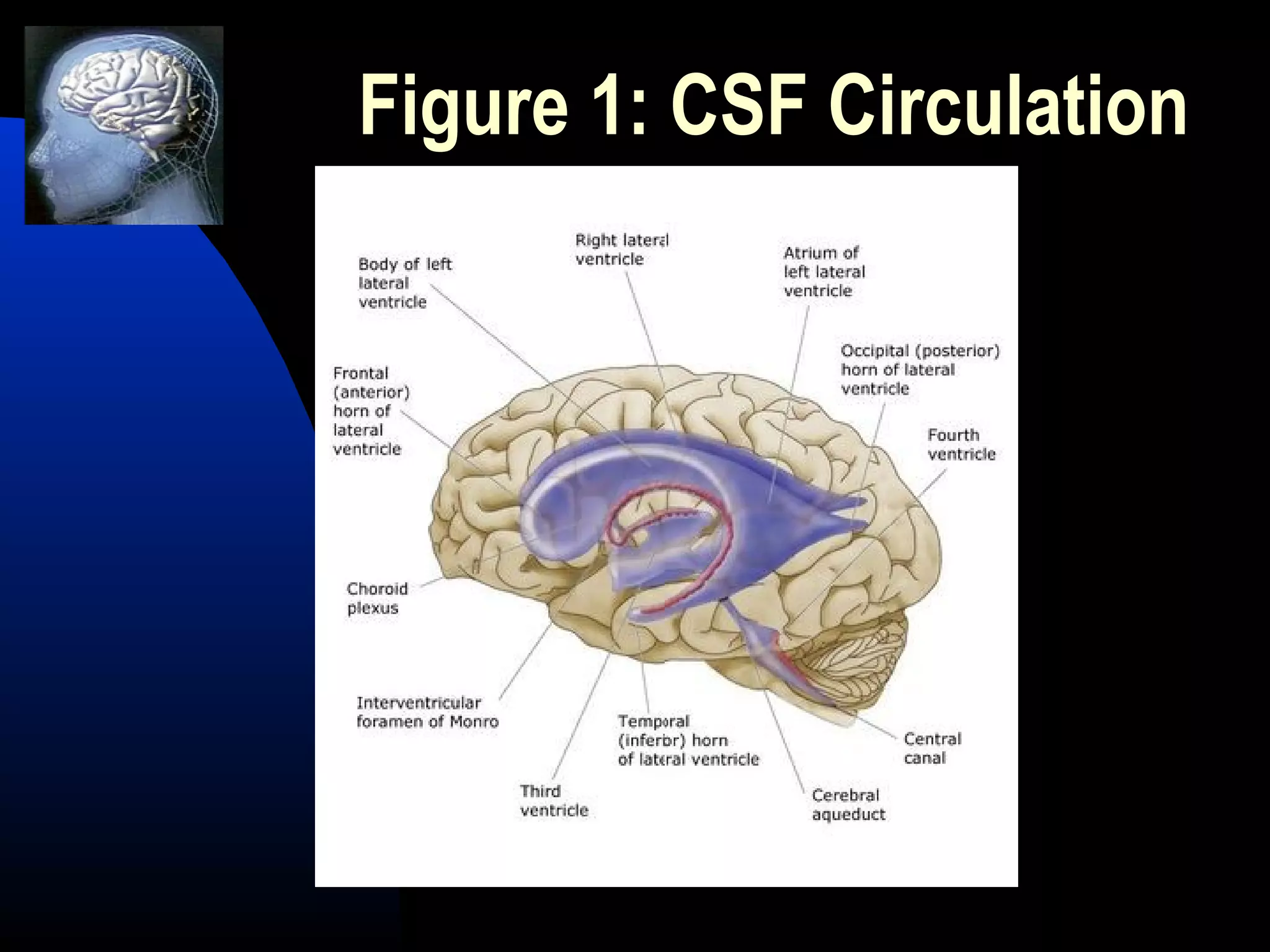
 CSF pass from lateral ventricles through
Foramina of Monro to the third ventricle,
then through Aqueduct of Sylvius to the
fourth ventricle ( Fig. 1).
Figure 1: CSF Circulation
CSF Circulation (Cont.)
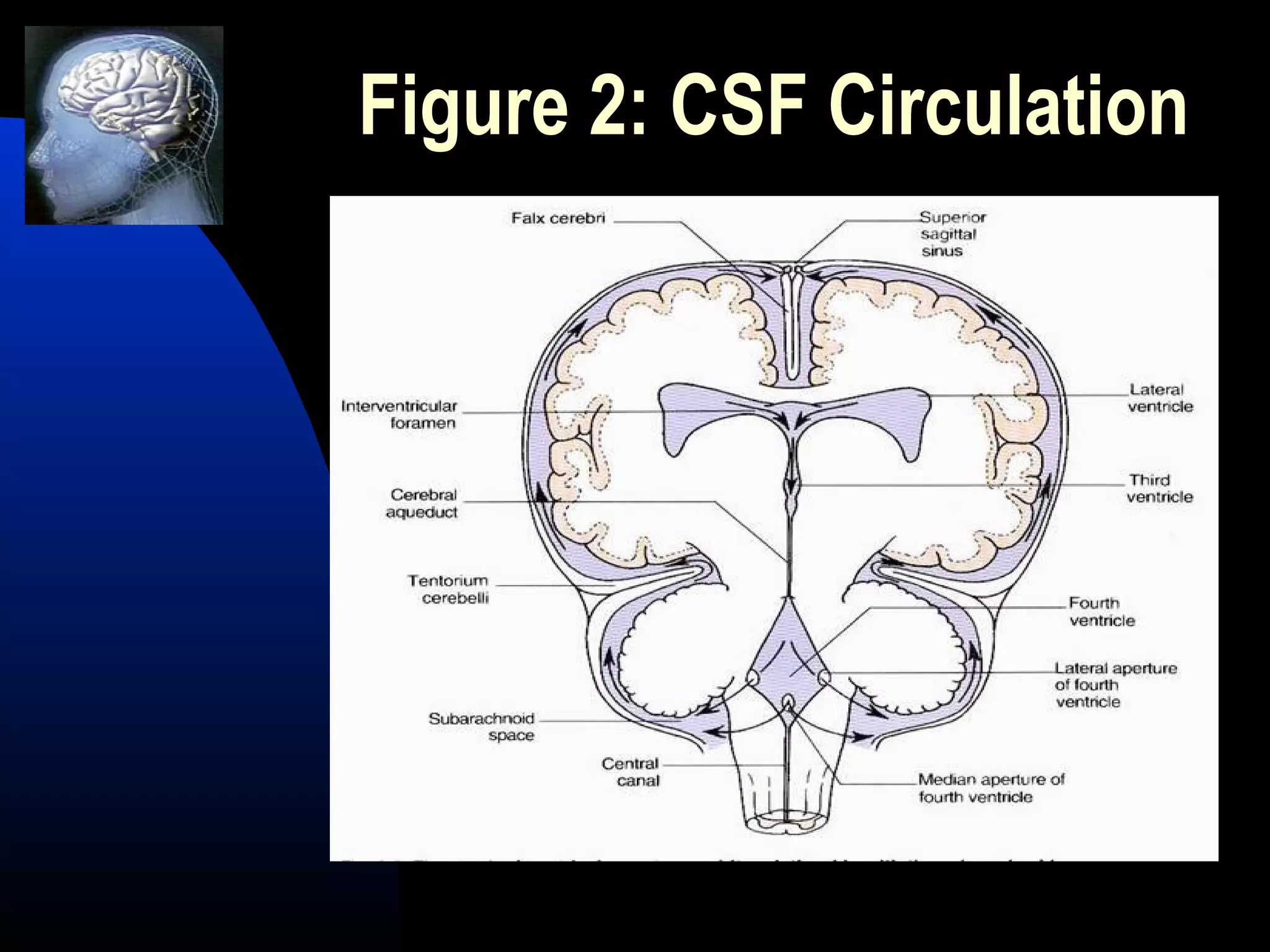
 The fourth ventricle have three apertures
or foramina, One mid-line (Foramen of
Magendi) and two lateral foramina
(Foramena of Luschka) (Fig. 2). Through
these Foramina CSF passes from the
ventricular system to the subarachnoid
space .
 It accumulate first in Cisterna Magna, part
of CSF descends downwards around the
spinal cord, but the majority passes
upwards through the Tentorial Hiatus over
the surface of both cerebral hemispheres
to be absorbed by the Arachnoid villi in the
Superior sagittal sinus (SSS).
Figure 2: CSF Circulation
CSF Circulation (Cont.)
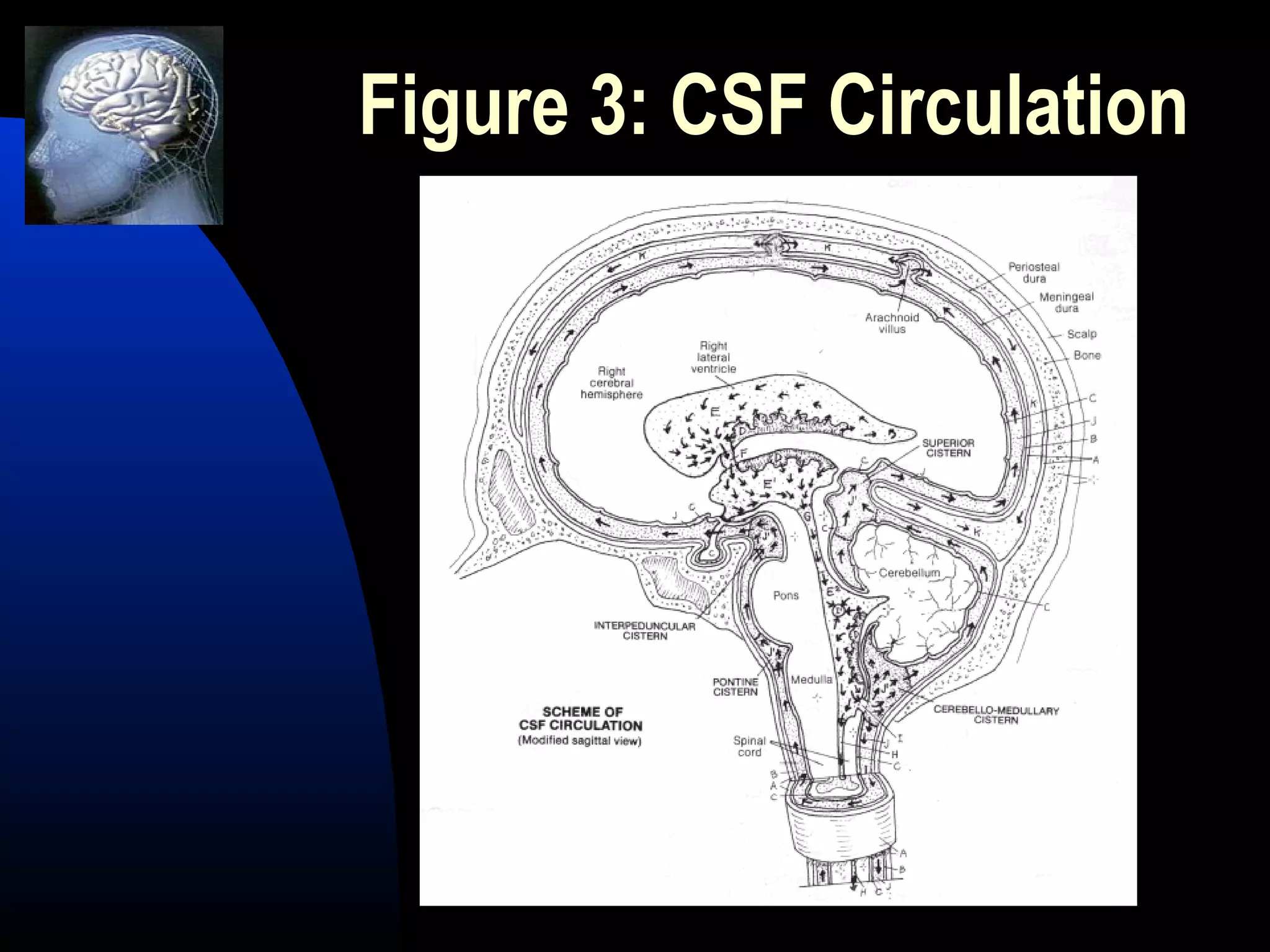
 So, CSF is secreted from the blood
by choroid plexus and reabsorbed in
the blood by Arachnoid villi, this
explains the physiological dynamic
function of CSF that keeps the
internal environment of CNS
constant. ( Fig. 3).
Figure 3: CSF Circulation
Pathogenesis of
Hydrocephalus
 Any disturbance in CSF secretion,
circulation and absorption will results in
abnormal accumulation, so the
pathogenesis may be :
 Obstruction of CSF pathway (main
factor).
 Excessive formation of CSF as in case of
choroid plexus papilloma ( rare ).
 Decreased absorption as in SSS
thrombosis around arachnoid villi.
Etiology of CSF pathway
Obstruction
 Congenital anomalies: this is Commonly
seen in the area of Aqueduct, such as
forking of Aqueduct, gliosis or obstruction.
N.B. CNS is the commonest system in the
body liable to congenital anomalies.
 Post–traumatic or Post–Hemorrhagic:
Subarachnoid hemorrhage, whether
spontaneously (as in Ruptured Intracranial
aneurysm or AVM) or after head trauma
may result in inflammatory reactions,
adhesions, and obstruction of
subarachnoid space and so Hydrocephalus
Etiology of CSF pathway
Obstruction (Cont.)
 Post–Inflammatory or Post-meningitic:
Inflammation of Meninges usually heals by
Fibrosis and adhesions within the
subarachnoid Spaces, so obstruction of
CSF pathway.
 Neoplasm: Any abnormal mass such as
tumor or abscess along the pathway of
CSF may result in obstruction.
N.B: In some cases of Hydrocephalus, we
can not diagnose the underlying etiological
cause, this is what is called Hydrocephalus
of undetected cause. These cases are
mostly due to mild unnoticed Head trauma
or sub clinical Meningitis.
Questions?
Learn more about Spina Bifida
and Hydrocephalus at
http://www.spinabifida.net

Top 5 symptoms and causes of hydrocephalus

  • 1.
    Top 5 Symptomsand causes of hydrocephalus Learn more about Spina Bifida and Hydrocephalus at http://www.spinabifida.net
  • 2.
    Definition  Hydrocephalus meansabnormal or excessive accumulation of CSF in the intracranial cavity.  To understand Hydrocephalus , we have to take an idea about the cerebrospinal fluid (CSF) circulation.
  • 3.
    CSF Circulation  CSFis a dynamic fluid, its main function is to keep the internal environment of Central Nervous System (C.N.S) constant. It also play a role in mechanical protection of the brain and spinal cord.  Because CSF is dynamic fluid it is secreted and reabsorbed continuously. CSF is secreted by choroid plexus, the main bulk of choroid plexus is present in the Lateral Ventricles, but there is choroid plexus also in the Third Ventricle and Fourth Ventricle.
  • 4.
    CSF Circulation (Cont.) The rate of formation of CSF is about 0.3- 0.35 ml/min i.e. it is about 500 cc/day although the constant amount of CSF present in the ventricles and subarachnoid space is about 150 cc. This means that most of the amount secreted is reabsorbed again.  CSF pass from lateral ventricles through Foramina of Monro to the third ventricle, then through Aqueduct of Sylvius to the fourth ventricle ( Fig. 1).
  • 5.
    Figure 1: CSFCirculation
  • 6.
    CSF Circulation (Cont.) The fourth ventricle have three apertures or foramina, One mid-line (Foramen of Magendi) and two lateral foramina (Foramena of Luschka) (Fig. 2). Through these Foramina CSF passes from the ventricular system to the subarachnoid space .  It accumulate first in Cisterna Magna, part of CSF descends downwards around the spinal cord, but the majority passes upwards through the Tentorial Hiatus over the surface of both cerebral hemispheres to be absorbed by the Arachnoid villi in the Superior sagittal sinus (SSS).
  • 7.
    Figure 2: CSFCirculation
  • 8.
    CSF Circulation (Cont.) So, CSF is secreted from the blood by choroid plexus and reabsorbed in the blood by Arachnoid villi, this explains the physiological dynamic function of CSF that keeps the internal environment of CNS constant. ( Fig. 3).
  • 9.
    Figure 3: CSFCirculation
  • 10.
    Pathogenesis of Hydrocephalus  Anydisturbance in CSF secretion, circulation and absorption will results in abnormal accumulation, so the pathogenesis may be :  Obstruction of CSF pathway (main factor).  Excessive formation of CSF as in case of choroid plexus papilloma ( rare ).  Decreased absorption as in SSS thrombosis around arachnoid villi.
  • 11.
    Etiology of CSFpathway Obstruction  Congenital anomalies: this is Commonly seen in the area of Aqueduct, such as forking of Aqueduct, gliosis or obstruction. N.B. CNS is the commonest system in the body liable to congenital anomalies.  Post–traumatic or Post–Hemorrhagic: Subarachnoid hemorrhage, whether spontaneously (as in Ruptured Intracranial aneurysm or AVM) or after head trauma may result in inflammatory reactions, adhesions, and obstruction of subarachnoid space and so Hydrocephalus
  • 12.
    Etiology of CSFpathway Obstruction (Cont.)  Post–Inflammatory or Post-meningitic: Inflammation of Meninges usually heals by Fibrosis and adhesions within the subarachnoid Spaces, so obstruction of CSF pathway.  Neoplasm: Any abnormal mass such as tumor or abscess along the pathway of CSF may result in obstruction. N.B: In some cases of Hydrocephalus, we can not diagnose the underlying etiological cause, this is what is called Hydrocephalus of undetected cause. These cases are mostly due to mild unnoticed Head trauma or sub clinical Meningitis.
  • 13.
    Questions? Learn more aboutSpina Bifida and Hydrocephalus at http://www.spinabifida.net