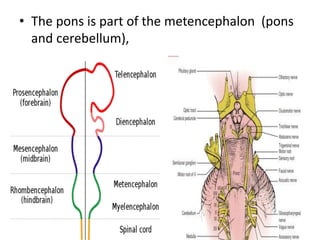
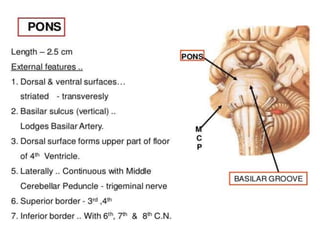
• The pons is part of the metencephalon (pons
and cerebellum),
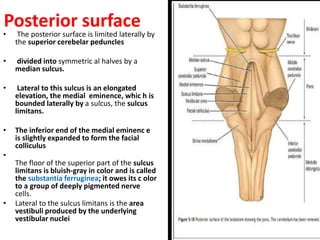
Posterior surface
• The posterior surface is limited laterally by
the superior cerebelar peduncles
• divided into symmetric al halves by a
median sulcus.
• Lateral to this sulcus is an elongated
elevation, the medial eminence, whic h is
bounded laterally by a sulcus, the sulcus
limitans.
• The inferior end of the medial eminenc e
is slightly expanded to form the facial
colliculus
•
The floor of the superior part of the sulcus
limitans is bluish-gray in color and is called
the substantia ferruginea; it owes its c olor
to a group of deeply pigmented nerve
cells.
• Lateral to the sulcus limitans is the area
vestibuli produced by the underlying
vestibular nuclei
INTERNAL STRUCTURE
TEGMENTUM
BASAL REGION
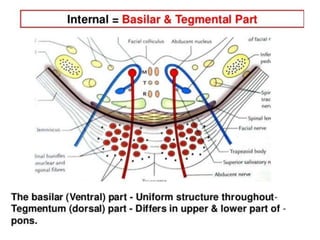
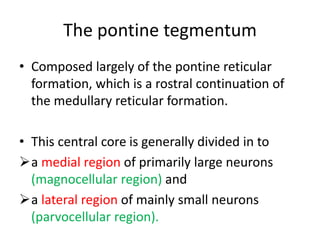
The pontine tegmentum
• Composed largely of the pontine reticular
formation, which is a rostral continuation of
the medullary reticular formation.
• This central core is generally divided in to
a medial region of primarily large neurons
(magnocellular region) and
a lateral region of mainly small neurons
(parvocellular region).
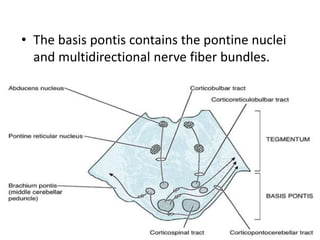
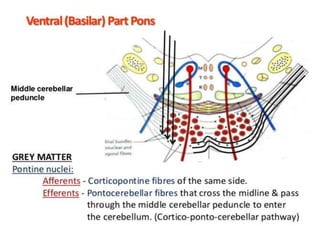
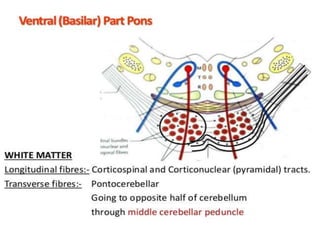
• The basis pontis contains the pontine nuclei
and multidirectional nerve fiber bundles.
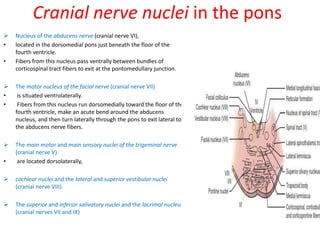
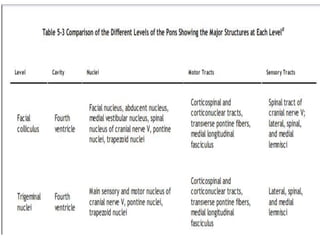
Cranial nerve nuclei in the pons
 Nucleus of the abducens nerve (cranial nerve VI),
• located in the dorsomedial pons just beneath the floor of the
fourth ventricle.
• Fibers from this nucleus pass ventrally between bundles of
corticospinal tract fibers to exit at the pontomedullary junction.
 The motor nucleus of the facial nerve (cranial nerve VII)
• is situated ventrolaterally.
• Fibers from this nucleus run dorsomedially toward the floor of the
fourth ventricle, make an acute bend around the abducens
nucleus, and then turn laterally through the pons to exit lateral to
the abducens nerve fibers.
 The main motor and main sensory nuclei of the trigeminal nerve
(cranial nerve V)
• are located dorsolaterally,
 cochlear nuclei and the lateral and superior vestibular nuclei
(cranial nerve VIII).
 The superior and inferior salivatory nuclei and the lacrimal nucleus
(cranial nerves VII and IX)
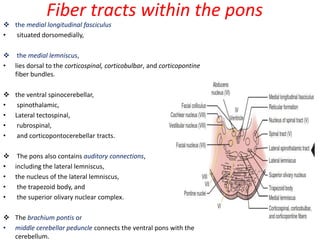
Fiber tracts within the pons
 the medial longitudinal fasciculus
• situated dorsomedially,
 the medial lemniscus,
• lies dorsal to the corticospinal, corticobulbar, and corticopontine
fiber bundles.
 the ventral spinocerebellar,
• spinothalamic,
• Lateral tectospinal,
• rubrospinal,
• and corticopontocerebellar tracts.
 The pons also contains auditory connections,
• including the lateral lemniscus,
• the nucleus of the lateral lemniscus,
• the trapezoid body, and
• the superior olivary nuclear complex.
 The brachium pontis or
• middle cerebellar peduncle connects the ventral pons with the
cerebellum.
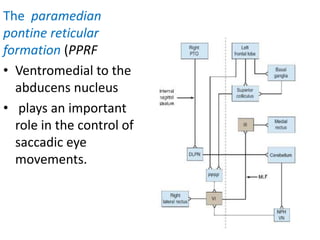
The paramedian
pontine reticular
formation (PPRF
• Ventromedial to the
abducens nucleus
• plays an important
role in the control of
saccadic eye
movements.
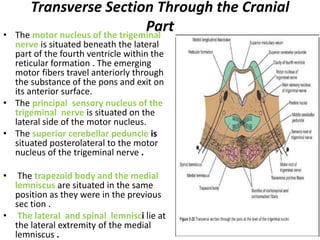
Transverse Section Through the Cranial
Part• The motor nucleus of the trigeminal
nerve is situated beneath the lateral
part of the fourth ventricle within the
reticular formation . The emerging
motor fibers travel anteriorly through
the substance of the pons and exit on
its anterior surface.
• The principal sensory nucleus of the
trigeminal nerve is situated on the
lateral side of the motor nucleus.
• The superior cerebellar peduncle is
situated posterolateral to the motor
nucleus of the trigeminal nerve .
• The trapezoid body and the medial
lemniscus are situated in the same
position as they were in the previous
sec tion .
• The lateral and spinal lemnisci lie at
the lateral extremity of the medial
lemniscus .
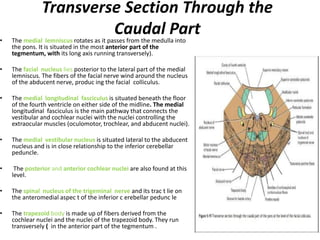
Transverse Section Through the
Caudal Part• The medial lemniscus rotates as it passes from the medulla into
the pons. It is situated in the most anterior part of the
tegmentum, with its long axis running transversely).
• The facial nucleus lies posterior to the lateral part of the medial
lemniscus. The fibers of the facial nerve wind around the nucleus
of the abducent nerve, produc ing the facial colliculus.
• The medial longitudinal fasciculus is situated beneath the floor
of the fourth ventricle on either side of the midline. The medial
longitudinal fasciculus is the main pathway that connects the
vestibular and cochlear nuclei with the nuclei controlling the
extraocular muscles (oculomotor, trochlear, and abducent nuclei).
• The medial vestibular nucleus is situated lateral to the abducent
nucleus and is in close relationship to the inferior cerebellar
peduncle.
• The posterior and anterior cochlear nuclei are also found at this
level.
• The spinal nucleus of the trigeminal nerve and its trac t lie on
the anteromedial aspec t of the inferior c erebellar pedunc le
• The trapezoid body is made up of fibers derived from the
cochlear nuclei and the nuclei of the trapezoid body. They run
transversely ( in the anterior part of the tegmentum .
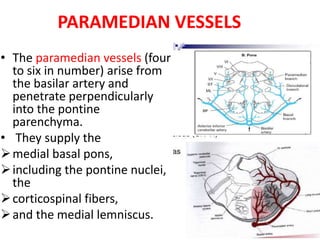
PARAMEDIAN VESSELS
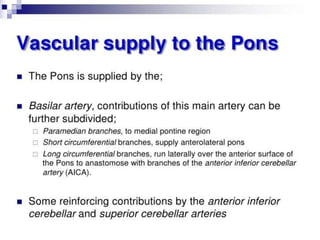
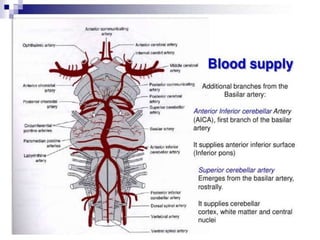
• The paramedian vessels (four
to six in number) arise from
the basilar artery and
penetrate perpendicularly
into the pontine
parenchyma.
• They supply the
medial basal pons,
including the pontine nuclei,
the
corticospinal fibers,
and the medial lemniscus.
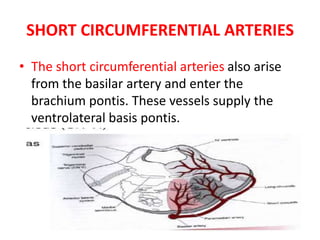
SHORT CIRCUMFERENTIAL ARTERIES
• The short circumferential arteries also arise
from the basilar artery and enter the
brachium pontis. These vessels supply the
ventrolateral basis pontis.
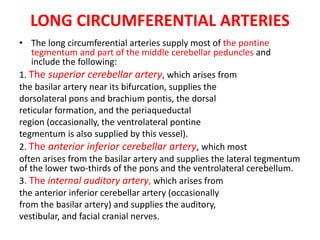
LONG CIRCUMFERENTIAL ARTERIES
• The long circumferential arteries supply most of the pontine
tegmentum and part of the middle cerebellar peduncles and
include the following:
1. The superior cerebellar artery, which arises from
the basilar artery near its bifurcation, supplies the
dorsolateral pons and brachium pontis, the dorsal
reticular formation, and the periaqueductal
region (occasionally, the ventrolateral pontine
tegmentum is also supplied by this vessel).
2. The anterior inferior cerebellar artery, which most
often arises from the basilar artery and supplies the lateral tegmentum
of the lower two-thirds of the pons and the ventrolateral cerebellum.
3. The internal auditory artery, which arises from
the anterior inferior cerebellar artery (occasionally
from the basilar artery) and supplies the auditory,
vestibular, and facial cranial nerves.
Superior pontine syndrome
Middle pontine syndromes
Inferior pontine syndromes
Ventral pontine syndromes
Dorsal pontine syndromes
Paramedian pontine syndromes
Lateral pontine syndromes
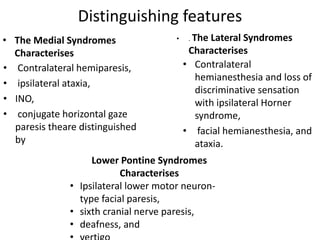
Distinguishing features
• Contralateral hemiparesis,
• ipsilateral ataxia,
• INO,
• conjugate horizontal gaze
paresis theare distinguished
by
• The Medial Syndromes
Characterises
• . The Lateral Syndromes
Characterises
• Contralateral
hemianesthesia and loss of
discriminative sensation
with ipsilateral Horner
syndrome,
• facial hemianesthesia, and
ataxia.
Lower Pontine Syndromes
Characterises
• Ipsilateral lower motor neuron-
type facial paresis,
• sixth cranial nerve paresis,
• deafness, and
Superior pontine syndromes
• Medial superior pontine syndrome
• Lateral superior pontine syndrome
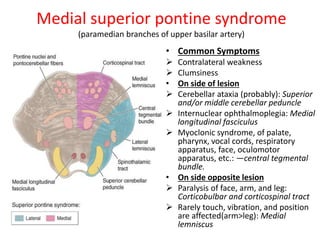
Medial superior pontine syndrome
(paramedian branches of upper basilar artery)
• Common Symptoms
 Contralateral weakness
 Clumsiness
• On side of lesion
 Cerebellar ataxia (probably): Superior
and/or middle cerebellar peduncle
 Internuclear ophthalmoplegia: Medial
longitudinal fasciculus
 Myoclonic syndrome, of palate,
pharynx, vocal cords, respiratory
apparatus, face, oculomotor
apparatus, etc.: —central tegmental
bundle.
• On side opposite lesion
 Paralysis of face, arm, and leg:
Corticobulbar and corticospinal tract
 Rarely touch, vibration, and position
are affected(arm>leg): Medial
lemniscus
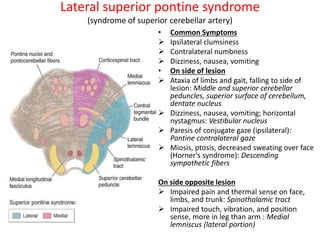
Lateral superior pontine syndrome
(syndrome of superior cerebellar artery)
• Common Symptoms
 Ipsilateral clumsiness
 Contralateral numbness
 Dizziness, nausea, vomiting
• On side of lesion
 Ataxia of limbs and gait, falling to side of
lesion: Middle and superior cerebellar
peduncles, superior surface of cerebellum,
dentate nucleus
 Dizziness, nausea, vomiting; horizontal
nystagmus: Vestibular nucleus
 Paresis of conjugate gaze (ipsilateral):
Pontine contralateral gaze
 Miosis, ptosis, decreased sweating over face
(Horner's syndrome): Descending
sympathetic fibers
On side opposite lesion
 Impaired pain and thermal sense on face,
limbs, and trunk: Spinothalamic tract
 Impaired touch, vibration, and position
sense, more in leg than arm : Medial
lemniscus (lateral portion)
Middle Pontine Syndromes
• Medial midpontine syndrome
• Lateral midpontine syndrome
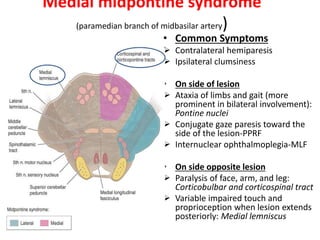
Medial midpontine syndrome
(paramedian branch of midbasilar artery)
• Common Symptoms
 Contralateral hemiparesis
 Ipsilateral clumsiness
• On side of lesion
 Ataxia of limbs and gait (more
prominent in bilateral involvement):
Pontine nuclei
 Conjugate gaze paresis toward the
side of the lesion-PPRF
 Internuclear ophthalmoplegia-MLF
• On side opposite lesion
 Paralysis of face, arm, and leg:
Corticobulbar and corticospinal tract
 Variable impaired touch and
proprioception when lesion extends
posteriorly: Medial lemniscus
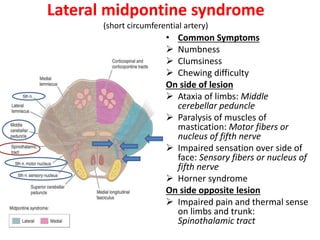
Lateral midpontine syndrome
(short circumferential artery)
• Common Symptoms
 Numbness
 Clumsiness
 Chewing difficulty
On side of lesion
 Ataxia of limbs: Middle
cerebellar peduncle
 Paralysis of muscles of
mastication: Motor fibers or
nucleus of fifth nerve
 Impaired sensation over side of
face: Sensory fibers or nucleus of
fifth nerve
 Horner syndrome
On side opposite lesion
 Impaired pain and thermal sense
on limbs and trunk:
Spinothalamic tract
Inferior Pontine Syndromes
• Medial inferior pontine syndrome
• Lateral inferior pontine syndrome
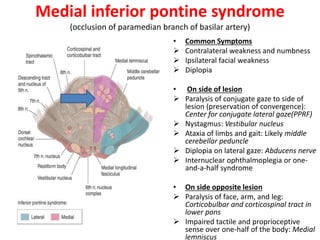
Medial inferior pontine syndrome
(occlusion of paramedian branch of basilar artery)
• Common Symptoms
 Contralateral weakness and numbness
 Ipsilateral facial weakness
 Diplopia
• On side of lesion
 Paralysis of conjugate gaze to side of
lesion (preservation of convergence):
Center for conjugate lateral gaze(PPRF)
 Nystagmus: Vestibular nucleus
 Ataxia of limbs and gait: Likely middle
cerebellar peduncle
 Diplopia on lateral gaze: Abducens nerve
 Internuclear ophthalmoplegia or one-
and-a-half syndrome
• On side opposite lesion
 Paralysis of face, arm, and leg:
Corticobulbar and corticospinal tract in
lower pons
 Impaired tactile and proprioceptive
sense over one-half of the body: Medial
lemniscus
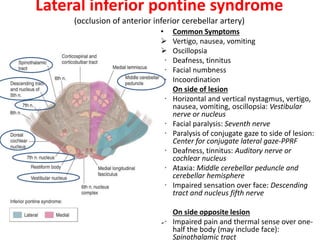
Lateral inferior pontine syndrome
(occlusion of anterior inferior cerebellar artery)
• Common Symptoms
 Vertigo, nausea, vomiting
 Oscillopsia
 Deafness, tinnitus
 Facial numbness
 Incoordination
• On side of lesion
 Horizontal and vertical nystagmus, vertigo,
nausea, vomiting, oscillopsia: Vestibular
nerve or nucleus
 Facial paralysis: Seventh nerve
 Paralysis of conjugate gaze to side of lesion:
Center for conjugate lateral gaze-PPRF
 Deafness, tinnitus: Auditory nerve or
cochlear nucleus
 Ataxia: Middle cerebellar peduncle and
cerebellar hemisphere
 Impaired sensation over face: Descending
tract and nucleus fifth nerve
• On side opposite lesion
 Impaired pain and thermal sense over one-
half the body (may include face):
Spinothalamic tract
VENTRAL PONTINE SYNDROMES
a. Millard-Gubler Syndrome
b. Raymond Syndrome
c. Pure Motor Hemiparesis
d. Dysarthria—Clumsy Hand Syndrome
e. Ataxic Hemiparesis
f. Locked-in Syndrome.
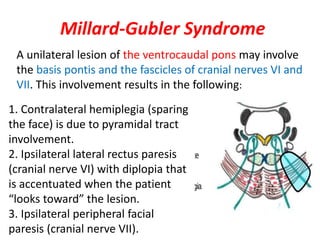
Millard-Gubler Syndrome
A unilateral lesion of the ventrocaudal pons may involve
the basis pontis and the fascicles of cranial nerves VI and
VII. This involvement results in the following:
1. Contralateral hemiplegia (sparing
the face) is due to pyramidal tract
involvement.
2. Ipsilateral lateral rectus paresis
(cranial nerve VI) with diplopia that
is accentuated when the patient
“looks toward” the lesion.
3. Ipsilateral peripheral facial
paresis (cranial nerve VII).
Raymond Syndrome-Alternating
Abducent Hemiplegia
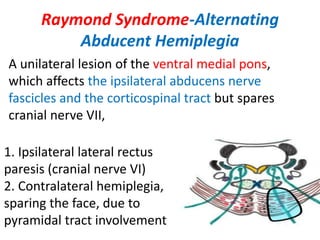
A unilateral lesion of the ventral medial pons,
which affects the ipsilateral abducens nerve
fascicles and the corticospinal tract but spares
cranial nerve VII,
1. Ipsilateral lateral rectus
paresis (cranial nerve VI)
2. Contralateral hemiplegia,
sparing the face, due to
pyramidal tract involvement
Pure Motor Hemiparesis
• Lesions (especially lacunar infarction) involving the
corticospinal tracts in the basis pontis may produce a pure
motor hemiplegia with or without facial involvement
• Features include:-
a. severe dysarthria and dysphagia
b. Bouts of uncontrollable laughter (fou rire prodromique)
• Other locations of lesions causing pure motor hemiplegia
include
 the posterior limb of the internal capsule,
 the cerebral peduncle,
 The medullary pyramid
Dysarthria—Clumsy Hand Syndrome
• Vascular lesions in the basis pontis (especially
lacunar infarction) at the junction of the upper
one-third and lower two-thirds of the pons
• Features :-
facial weakness and severe dysarthria and
dysphagia
clumsiness, impaired finger dexterity, and paresis
of the hand
Hyperreflexia and a Babinski’s sign may occur on
the same side as the arm paresis, but sensation is
spared
Ataxic Hemiparesis
• A lesion (usually a lacunar infarction) in the basis pontis at the
junction of the upper one-third and the lower two-thirds of
the pons
• Features :-
 hemiparesis that is more severe in the lower extremity, is
associated with ipsilateral hemiataxia and
 occasionally dysarthria, nystagmus,
 and paresthesias.
The lesion is located in the contralateral pons.
• The ataxia is unilateral, probably because transverse fibers
originating from the contralateral pontine nuclei (and
projecting to the contralateral cerebellum) are spared
Locked-in Syndrome(de-efferented state)
• Bilateral ventral pontine lesions
(infarction, tumor, hemorrhage, trauma, cervical manipulation, tumor, pontine
abscess, encephalitis, arteritis, neuro-Behcet’s, multiple sclerosis, air
embolism, heroin abuse, diazepam toxicity, or central pontine myelinolysis)
Features:-
1. Quadriplegia due to bilateral corticospinal tract
involvement in the basis pontis
2. Aphonia due to involvement of the corticobulbar
fibers innervating the lower cranial nerve nuclei
3. Occasional impairment of horizontal eye movements
due to bilateral involvement of the fascicles
of cranial nerve VI
 Because the reticular formation is not injured, the patient is fully awake.
 The supranuclear ocular motor pathways lie dorsally and are therefore
spared; therefore, vertical eye movements and blinking are intact (the
patient may actually convey his wishes in Morse code)
DORSAL PONTINE SYNDROMES
a. Foville Syndrome
b. Raymond-Cestan Syndrome
Foville Syndrome
• Lesions involving the dorsal pontine tegmentum in the caudal
third of the pons
• Features :-
1. Contralateral hemiplegia (with facial sparing) which is due to
interruption of the corticospinal tract.
2. Ipsilateral peripheral-type facial palsy which is due to
involvement of the nucleus and fascicle (or both) of cranial
nerve VII.
3. Inability to move the eyes conjugately to the ipsilateral side
(gaze is “away from” the lesion) due to involvement of the PPRF
or abducens nucleus, or both.
Raymond-Cestan Syndrome
• Is seen with rostral lesions of the dorsal pons.
• Features:-
1. Cerebellar signs (ataxia) with a coarse “rubral” tremor which is
due to the involvement of the cerebellum.
2. Contralateral hypesthesia with reduction of all sensory
modalities (face and extremities) which is due to the involvement
of the medial lemniscus and the spinothalamic tract.
3. With ventral extension, there may be contralateral hemiparesis
(due to corticospinal tract involvement) or paralysis of conjugate
gaze toward the side of the lesion (due to involvement of the
PPRF).
PARAMEDIAN PONTINE SYNDROMES
• The most common etiology is small vessel disease;
• vertebrobasilar large vessel disease and cardiac embolism are less common
causes
• Unilateral mediobasal infarcts: severe facio-brachio-crural
hemiparesis,dysarthria, and homolateral or bilateral ataxia.
• Unilateral mediolateral basal infarcts: slight hemiparesis with ataxia and
dysarthria, ataxic hemiparesis, or dysarthria— clumsy hand syndrome
• Unilateral mediocentral or mediotegmental infarcts: Presentations
include dysarthria—clumsy hand syndrome, ataxic hemiparesis with
prominent sensory or eye movement disorders, and hemiparesis with
contralateral facial or abducens palsy.
• Bilateral centrobasal infarcts:pseudobulbar palsy and bilateral
sensorimotor disturbance
As a rare occurrence, pontine lesions have been
associated with
• anosognosia for the hemiplegia ,
• blepharospasm ,
• brief clonic jerking and other convulsive-like
movements ,
• jaw-opening dystonia, hemidystonia ,
• a focally enhanced startled response symptomatic
orthostatic tremor ,
• dysarthria-dysmetria or dysarthria-facial paresis,
• body lateropulsion from paramedian tegmental
involvement ventral to the fourth ventricle,
• truncal ataxia without limb ataxia ,
LATERAL PONTINE SYNDROMES
• Marie-Foix Syndrome
• It consists of the following:
1. Ipsilateral cerebellar ataxia due to involvement of
cerebellar connections
2. Contralateral hemiparesis due to involvement of the
corticospinal tract
3. Variable contralateral hemihypesthesia for pain and
temperature due to involvement of the spinothalamic tract
• Isolated bilateral ataxia due to selective involvement of part of the
decussation of the superior cerebellar peduncle
• bilateral deafness
• cheiro-pedal syndrome with numbness of hand and foot associated
with hypesthesia and hypalgesia ,
• painful Horner syndrome
• contralateral hemihyperhidrosis ,
• intraoral sensory loss ,
• trigeminal neuralgia ,
• ipsilateral transient eye and nose pain ,
• Isolated cranial nerve palsies ,
• transient hemiageusia
• , disturbances of cognition and affect,
• pathologic crying,
• prodrome of inappropriate or pathological laughter (fou rire
prodromique) resulting from rostral and medial pontine involvement
• , rapid eye movement sleep behavior disorder occurring either in
isolation or in association with narcolepsy
Pontine Haemorrhage
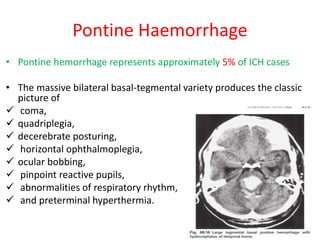
• Pontine hemorrhage represents approximately 5% of ICH cases
• The massive bilateral basal-tegmental variety produces the classic
picture of
 coma,
 quadriplegia,
 decerebrate posturing,
 horizontal ophthalmoplegia,
 ocular bobbing,
 pinpoint reactive pupils,
 abnormalities of respiratory rhythm,
 and preterminal hyperthermia.
Pontine Haemorrhage
• These hemorrhages are frequently located in the
tegmentum, lateral to the midline,
• and thus produce syndromes of predominantly
unilateral dorsal pontine involvement
• (“one-and-a-half” syndrome ,
• Internuclear ophthalmoplegia,
• fifth and seventh nerve palsies), with
• variable degrees of long-tract interruption.
• These hematomas result from rupture of distal
tegmental branches of a long circumferential artery
originating from the basilar trunk.
Pons anatomy and syndromes

Pons anatomy and syndromes

  • 2.
    • The ponsis part of the metencephalon (pons and cerebellum),
  • 5.
    Posterior surface • Theposterior surface is limited laterally by the superior cerebelar peduncles • divided into symmetric al halves by a median sulcus. • Lateral to this sulcus is an elongated elevation, the medial eminence, whic h is bounded laterally by a sulcus, the sulcus limitans. • The inferior end of the medial eminenc e is slightly expanded to form the facial colliculus • The floor of the superior part of the sulcus limitans is bluish-gray in color and is called the substantia ferruginea; it owes its c olor to a group of deeply pigmented nerve cells. • Lateral to the sulcus limitans is the area vestibuli produced by the underlying vestibular nuclei
  • 6.
  • 8.
    The pontine tegmentum •Composed largely of the pontine reticular formation, which is a rostral continuation of the medullary reticular formation. • This central core is generally divided in to a medial region of primarily large neurons (magnocellular region) and a lateral region of mainly small neurons (parvocellular region).
  • 9.
    • The basispontis contains the pontine nuclei and multidirectional nerve fiber bundles.
  • 10.
    Cranial nerve nucleiin the pons  Nucleus of the abducens nerve (cranial nerve VI), • located in the dorsomedial pons just beneath the floor of the fourth ventricle. • Fibers from this nucleus pass ventrally between bundles of corticospinal tract fibers to exit at the pontomedullary junction.  The motor nucleus of the facial nerve (cranial nerve VII) • is situated ventrolaterally. • Fibers from this nucleus run dorsomedially toward the floor of the fourth ventricle, make an acute bend around the abducens nucleus, and then turn laterally through the pons to exit lateral to the abducens nerve fibers.  The main motor and main sensory nuclei of the trigeminal nerve (cranial nerve V) • are located dorsolaterally,  cochlear nuclei and the lateral and superior vestibular nuclei (cranial nerve VIII).  The superior and inferior salivatory nuclei and the lacrimal nucleus (cranial nerves VII and IX)
  • 11.
    Fiber tracts withinthe pons  the medial longitudinal fasciculus • situated dorsomedially,  the medial lemniscus, • lies dorsal to the corticospinal, corticobulbar, and corticopontine fiber bundles.  the ventral spinocerebellar, • spinothalamic, • Lateral tectospinal, • rubrospinal, • and corticopontocerebellar tracts.  The pons also contains auditory connections, • including the lateral lemniscus, • the nucleus of the lateral lemniscus, • the trapezoid body, and • the superior olivary nuclear complex.  The brachium pontis or • middle cerebellar peduncle connects the ventral pons with the cerebellum.
  • 12.
    The paramedian pontine reticular formation(PPRF • Ventromedial to the abducens nucleus • plays an important role in the control of saccadic eye movements.
  • 14.
    Transverse Section Throughthe Cranial Part• The motor nucleus of the trigeminal nerve is situated beneath the lateral part of the fourth ventricle within the reticular formation . The emerging motor fibers travel anteriorly through the substance of the pons and exit on its anterior surface. • The principal sensory nucleus of the trigeminal nerve is situated on the lateral side of the motor nucleus. • The superior cerebellar peduncle is situated posterolateral to the motor nucleus of the trigeminal nerve . • The trapezoid body and the medial lemniscus are situated in the same position as they were in the previous sec tion . • The lateral and spinal lemnisci lie at the lateral extremity of the medial lemniscus .
  • 15.
    Transverse Section Throughthe Caudal Part• The medial lemniscus rotates as it passes from the medulla into the pons. It is situated in the most anterior part of the tegmentum, with its long axis running transversely). • The facial nucleus lies posterior to the lateral part of the medial lemniscus. The fibers of the facial nerve wind around the nucleus of the abducent nerve, produc ing the facial colliculus. • The medial longitudinal fasciculus is situated beneath the floor of the fourth ventricle on either side of the midline. The medial longitudinal fasciculus is the main pathway that connects the vestibular and cochlear nuclei with the nuclei controlling the extraocular muscles (oculomotor, trochlear, and abducent nuclei). • The medial vestibular nucleus is situated lateral to the abducent nucleus and is in close relationship to the inferior cerebellar peduncle. • The posterior and anterior cochlear nuclei are also found at this level. • The spinal nucleus of the trigeminal nerve and its trac t lie on the anteromedial aspec t of the inferior c erebellar pedunc le • The trapezoid body is made up of fibers derived from the cochlear nuclei and the nuclei of the trapezoid body. They run transversely ( in the anterior part of the tegmentum .
  • 20.
    PARAMEDIAN VESSELS • Theparamedian vessels (four to six in number) arise from the basilar artery and penetrate perpendicularly into the pontine parenchyma. • They supply the medial basal pons, including the pontine nuclei, the corticospinal fibers, and the medial lemniscus.
  • 21.
    SHORT CIRCUMFERENTIAL ARTERIES •The short circumferential arteries also arise from the basilar artery and enter the brachium pontis. These vessels supply the ventrolateral basis pontis.
  • 22.
    LONG CIRCUMFERENTIAL ARTERIES •The long circumferential arteries supply most of the pontine tegmentum and part of the middle cerebellar peduncles and include the following: 1. The superior cerebellar artery, which arises from the basilar artery near its bifurcation, supplies the dorsolateral pons and brachium pontis, the dorsal reticular formation, and the periaqueductal region (occasionally, the ventrolateral pontine tegmentum is also supplied by this vessel). 2. The anterior inferior cerebellar artery, which most often arises from the basilar artery and supplies the lateral tegmentum of the lower two-thirds of the pons and the ventrolateral cerebellum. 3. The internal auditory artery, which arises from the anterior inferior cerebellar artery (occasionally from the basilar artery) and supplies the auditory, vestibular, and facial cranial nerves.
  • 23.
    Superior pontine syndrome Middlepontine syndromes Inferior pontine syndromes Ventral pontine syndromes Dorsal pontine syndromes Paramedian pontine syndromes Lateral pontine syndromes
  • 24.
    Distinguishing features • Contralateralhemiparesis, • ipsilateral ataxia, • INO, • conjugate horizontal gaze paresis theare distinguished by • The Medial Syndromes Characterises • . The Lateral Syndromes Characterises • Contralateral hemianesthesia and loss of discriminative sensation with ipsilateral Horner syndrome, • facial hemianesthesia, and ataxia. Lower Pontine Syndromes Characterises • Ipsilateral lower motor neuron- type facial paresis, • sixth cranial nerve paresis, • deafness, and
  • 25.
    Superior pontine syndromes •Medial superior pontine syndrome • Lateral superior pontine syndrome
  • 26.
    Medial superior pontinesyndrome (paramedian branches of upper basilar artery) • Common Symptoms  Contralateral weakness  Clumsiness • On side of lesion  Cerebellar ataxia (probably): Superior and/or middle cerebellar peduncle  Internuclear ophthalmoplegia: Medial longitudinal fasciculus  Myoclonic syndrome, of palate, pharynx, vocal cords, respiratory apparatus, face, oculomotor apparatus, etc.: —central tegmental bundle. • On side opposite lesion  Paralysis of face, arm, and leg: Corticobulbar and corticospinal tract  Rarely touch, vibration, and position are affected(arm>leg): Medial lemniscus
  • 27.
    Lateral superior pontinesyndrome (syndrome of superior cerebellar artery) • Common Symptoms  Ipsilateral clumsiness  Contralateral numbness  Dizziness, nausea, vomiting • On side of lesion  Ataxia of limbs and gait, falling to side of lesion: Middle and superior cerebellar peduncles, superior surface of cerebellum, dentate nucleus  Dizziness, nausea, vomiting; horizontal nystagmus: Vestibular nucleus  Paresis of conjugate gaze (ipsilateral): Pontine contralateral gaze  Miosis, ptosis, decreased sweating over face (Horner's syndrome): Descending sympathetic fibers On side opposite lesion  Impaired pain and thermal sense on face, limbs, and trunk: Spinothalamic tract  Impaired touch, vibration, and position sense, more in leg than arm : Medial lemniscus (lateral portion)
  • 28.
    Middle Pontine Syndromes •Medial midpontine syndrome • Lateral midpontine syndrome
  • 29.
    Medial midpontine syndrome (paramedianbranch of midbasilar artery) • Common Symptoms  Contralateral hemiparesis  Ipsilateral clumsiness • On side of lesion  Ataxia of limbs and gait (more prominent in bilateral involvement): Pontine nuclei  Conjugate gaze paresis toward the side of the lesion-PPRF  Internuclear ophthalmoplegia-MLF • On side opposite lesion  Paralysis of face, arm, and leg: Corticobulbar and corticospinal tract  Variable impaired touch and proprioception when lesion extends posteriorly: Medial lemniscus
  • 30.
    Lateral midpontine syndrome (shortcircumferential artery) • Common Symptoms  Numbness  Clumsiness  Chewing difficulty On side of lesion  Ataxia of limbs: Middle cerebellar peduncle  Paralysis of muscles of mastication: Motor fibers or nucleus of fifth nerve  Impaired sensation over side of face: Sensory fibers or nucleus of fifth nerve  Horner syndrome On side opposite lesion  Impaired pain and thermal sense on limbs and trunk: Spinothalamic tract
  • 31.
    Inferior Pontine Syndromes •Medial inferior pontine syndrome • Lateral inferior pontine syndrome
  • 32.
    Medial inferior pontinesyndrome (occlusion of paramedian branch of basilar artery) • Common Symptoms  Contralateral weakness and numbness  Ipsilateral facial weakness  Diplopia • On side of lesion  Paralysis of conjugate gaze to side of lesion (preservation of convergence): Center for conjugate lateral gaze(PPRF)  Nystagmus: Vestibular nucleus  Ataxia of limbs and gait: Likely middle cerebellar peduncle  Diplopia on lateral gaze: Abducens nerve  Internuclear ophthalmoplegia or one- and-a-half syndrome • On side opposite lesion  Paralysis of face, arm, and leg: Corticobulbar and corticospinal tract in lower pons  Impaired tactile and proprioceptive sense over one-half of the body: Medial lemniscus
  • 33.
    Lateral inferior pontinesyndrome (occlusion of anterior inferior cerebellar artery) • Common Symptoms  Vertigo, nausea, vomiting  Oscillopsia  Deafness, tinnitus  Facial numbness  Incoordination • On side of lesion  Horizontal and vertical nystagmus, vertigo, nausea, vomiting, oscillopsia: Vestibular nerve or nucleus  Facial paralysis: Seventh nerve  Paralysis of conjugate gaze to side of lesion: Center for conjugate lateral gaze-PPRF  Deafness, tinnitus: Auditory nerve or cochlear nucleus  Ataxia: Middle cerebellar peduncle and cerebellar hemisphere  Impaired sensation over face: Descending tract and nucleus fifth nerve • On side opposite lesion  Impaired pain and thermal sense over one- half the body (may include face): Spinothalamic tract
  • 34.
    VENTRAL PONTINE SYNDROMES a.Millard-Gubler Syndrome b. Raymond Syndrome c. Pure Motor Hemiparesis d. Dysarthria—Clumsy Hand Syndrome e. Ataxic Hemiparesis f. Locked-in Syndrome.
  • 35.
    Millard-Gubler Syndrome A unilaterallesion of the ventrocaudal pons may involve the basis pontis and the fascicles of cranial nerves VI and VII. This involvement results in the following: 1. Contralateral hemiplegia (sparing the face) is due to pyramidal tract involvement. 2. Ipsilateral lateral rectus paresis (cranial nerve VI) with diplopia that is accentuated when the patient “looks toward” the lesion. 3. Ipsilateral peripheral facial paresis (cranial nerve VII).
  • 36.
    Raymond Syndrome-Alternating Abducent Hemiplegia Aunilateral lesion of the ventral medial pons, which affects the ipsilateral abducens nerve fascicles and the corticospinal tract but spares cranial nerve VII, 1. Ipsilateral lateral rectus paresis (cranial nerve VI) 2. Contralateral hemiplegia, sparing the face, due to pyramidal tract involvement
  • 37.
    Pure Motor Hemiparesis •Lesions (especially lacunar infarction) involving the corticospinal tracts in the basis pontis may produce a pure motor hemiplegia with or without facial involvement • Features include:- a. severe dysarthria and dysphagia b. Bouts of uncontrollable laughter (fou rire prodromique) • Other locations of lesions causing pure motor hemiplegia include  the posterior limb of the internal capsule,  the cerebral peduncle,  The medullary pyramid
  • 38.
    Dysarthria—Clumsy Hand Syndrome •Vascular lesions in the basis pontis (especially lacunar infarction) at the junction of the upper one-third and lower two-thirds of the pons • Features :- facial weakness and severe dysarthria and dysphagia clumsiness, impaired finger dexterity, and paresis of the hand Hyperreflexia and a Babinski’s sign may occur on the same side as the arm paresis, but sensation is spared
  • 39.
    Ataxic Hemiparesis • Alesion (usually a lacunar infarction) in the basis pontis at the junction of the upper one-third and the lower two-thirds of the pons • Features :-  hemiparesis that is more severe in the lower extremity, is associated with ipsilateral hemiataxia and  occasionally dysarthria, nystagmus,  and paresthesias. The lesion is located in the contralateral pons. • The ataxia is unilateral, probably because transverse fibers originating from the contralateral pontine nuclei (and projecting to the contralateral cerebellum) are spared
  • 40.
    Locked-in Syndrome(de-efferented state) •Bilateral ventral pontine lesions (infarction, tumor, hemorrhage, trauma, cervical manipulation, tumor, pontine abscess, encephalitis, arteritis, neuro-Behcet’s, multiple sclerosis, air embolism, heroin abuse, diazepam toxicity, or central pontine myelinolysis) Features:- 1. Quadriplegia due to bilateral corticospinal tract involvement in the basis pontis 2. Aphonia due to involvement of the corticobulbar fibers innervating the lower cranial nerve nuclei 3. Occasional impairment of horizontal eye movements due to bilateral involvement of the fascicles of cranial nerve VI  Because the reticular formation is not injured, the patient is fully awake.  The supranuclear ocular motor pathways lie dorsally and are therefore spared; therefore, vertical eye movements and blinking are intact (the patient may actually convey his wishes in Morse code)
  • 41.
    DORSAL PONTINE SYNDROMES a.Foville Syndrome b. Raymond-Cestan Syndrome
  • 42.
    Foville Syndrome • Lesionsinvolving the dorsal pontine tegmentum in the caudal third of the pons • Features :- 1. Contralateral hemiplegia (with facial sparing) which is due to interruption of the corticospinal tract. 2. Ipsilateral peripheral-type facial palsy which is due to involvement of the nucleus and fascicle (or both) of cranial nerve VII. 3. Inability to move the eyes conjugately to the ipsilateral side (gaze is “away from” the lesion) due to involvement of the PPRF or abducens nucleus, or both.
  • 43.
    Raymond-Cestan Syndrome • Isseen with rostral lesions of the dorsal pons. • Features:- 1. Cerebellar signs (ataxia) with a coarse “rubral” tremor which is due to the involvement of the cerebellum. 2. Contralateral hypesthesia with reduction of all sensory modalities (face and extremities) which is due to the involvement of the medial lemniscus and the spinothalamic tract. 3. With ventral extension, there may be contralateral hemiparesis (due to corticospinal tract involvement) or paralysis of conjugate gaze toward the side of the lesion (due to involvement of the PPRF).
  • 44.
    PARAMEDIAN PONTINE SYNDROMES •The most common etiology is small vessel disease; • vertebrobasilar large vessel disease and cardiac embolism are less common causes • Unilateral mediobasal infarcts: severe facio-brachio-crural hemiparesis,dysarthria, and homolateral or bilateral ataxia. • Unilateral mediolateral basal infarcts: slight hemiparesis with ataxia and dysarthria, ataxic hemiparesis, or dysarthria— clumsy hand syndrome • Unilateral mediocentral or mediotegmental infarcts: Presentations include dysarthria—clumsy hand syndrome, ataxic hemiparesis with prominent sensory or eye movement disorders, and hemiparesis with contralateral facial or abducens palsy. • Bilateral centrobasal infarcts:pseudobulbar palsy and bilateral sensorimotor disturbance
  • 45.
    As a rareoccurrence, pontine lesions have been associated with • anosognosia for the hemiplegia , • blepharospasm , • brief clonic jerking and other convulsive-like movements , • jaw-opening dystonia, hemidystonia , • a focally enhanced startled response symptomatic orthostatic tremor , • dysarthria-dysmetria or dysarthria-facial paresis, • body lateropulsion from paramedian tegmental involvement ventral to the fourth ventricle, • truncal ataxia without limb ataxia ,
  • 46.
    LATERAL PONTINE SYNDROMES •Marie-Foix Syndrome • It consists of the following: 1. Ipsilateral cerebellar ataxia due to involvement of cerebellar connections 2. Contralateral hemiparesis due to involvement of the corticospinal tract 3. Variable contralateral hemihypesthesia for pain and temperature due to involvement of the spinothalamic tract
  • 47.
    • Isolated bilateralataxia due to selective involvement of part of the decussation of the superior cerebellar peduncle • bilateral deafness • cheiro-pedal syndrome with numbness of hand and foot associated with hypesthesia and hypalgesia , • painful Horner syndrome • contralateral hemihyperhidrosis , • intraoral sensory loss , • trigeminal neuralgia , • ipsilateral transient eye and nose pain , • Isolated cranial nerve palsies , • transient hemiageusia • , disturbances of cognition and affect, • pathologic crying, • prodrome of inappropriate or pathological laughter (fou rire prodromique) resulting from rostral and medial pontine involvement • , rapid eye movement sleep behavior disorder occurring either in isolation or in association with narcolepsy
  • 48.
    Pontine Haemorrhage • Pontinehemorrhage represents approximately 5% of ICH cases • The massive bilateral basal-tegmental variety produces the classic picture of  coma,  quadriplegia,  decerebrate posturing,  horizontal ophthalmoplegia,  ocular bobbing,  pinpoint reactive pupils,  abnormalities of respiratory rhythm,  and preterminal hyperthermia.
  • 49.
    Pontine Haemorrhage • Thesehemorrhages are frequently located in the tegmentum, lateral to the midline, • and thus produce syndromes of predominantly unilateral dorsal pontine involvement • (“one-and-a-half” syndrome , • Internuclear ophthalmoplegia, • fifth and seventh nerve palsies), with • variable degrees of long-tract interruption. • These hematomas result from rupture of distal tegmental branches of a long circumferential artery originating from the basilar trunk.