Page  Company Presentation CSF Dynamics
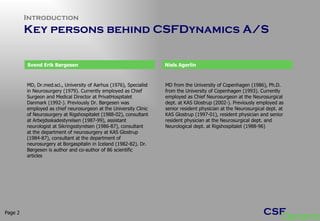
Introduction Key persons behind CSFDynamics A/S Page  MD, Dr.med.sci., University of Aarhus (1976), Specialist in Neurosurgery (1979). Currently employed as Chief Surgeon and Medical Director at PrivatHospitalet Danmark (1992-). Previously Dr. Børgesen was  employed as chief neurosurgeon at the University Clinic of Neurosurgery at Rigshospitalet (1988-02), consultant at Arbejdsskadestyrelsen (1987-99), assistant neurologist at Sikringsstyrelsen (1986-87), consultant at the department of neurosurgery at KAS Glostrup (1984-87), consultant at the department of neurosurgery at Borgaspitalin in Iceland (1982-82). Dr. Børgesen is author and co-author of 86 scientific articles Svend Erik Børgesen Niels Agerlin MD from the University of Copenhagen (1986), Ph.D. from the University of Copenhagen (1993). Currently employed as Chief Neurosurgeon at the Neurosurgical dept. at KAS Glostrup (2002-). Previously employed as senior resident physician at the Neurosurgical dept. at KAS Glostrup (1997-01), resident physician and senior resident physician at the Neurosurgical dept. and Neurological dept. at Rigshospitalet (1988-96)
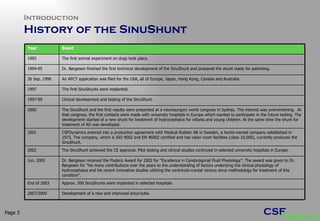
Introduction History of the SinuShunt Page  Year Event 1993 The first animal experiment on dogs took place. 1994-95  Dr. Børgesen finished the first technical development of the SinuShunt and prepared the shunt ready for patenting. 26 Sep. 1996  An APCT application was filed for the USA, all of Europe, Japan, Hong Kong, Canada and Australia. 1997 The first SinuShunts were implanted. 1997-99  Clinical development and testing of the SinuShunt. 2000 The SinuShunt and the first results were presented at a neurosurgery world congress in Sydney. The interest was overwhelming.  At that congress, the first contacts were made with university hospitals in Europe which wanted to participate in the future testing. The development started of a new shunt for treatment of hydrocephalus for infants and young children. At the same time the shunt for treatment of AD was developed.  2001 CSFDynamics entered into a production agreement with Medical Rubber AB in Sweden, a family-owned company established in 1973. The company, which is ISO 9002 and EN 46002 certified and has clean room facilities (class 10,000), currently produces the SinuShunt.  2002 The SinuShunt achieved the CE approval. Pilot testing and clinical studies continued in selected university hospitals in Europe. Jun. 2003 Dr. Børgesen received the Pudenz Award for 2002 for “Excellence in Cerebrospinal Fluid Physiology”. The award was given to Dr. Børgesen for “his many contributions over the years to the understanding of factors underlying the clinical physiology of hydrocephalus and his recent innovative studies utilizing the ventriculo-cranial venous sinus methodology for treatment of this condition”.  End of 2003  Approx. 200 SinuShunts were implanted in selected hospitals 2007/2009 Development of a new and improved sinus-tube.
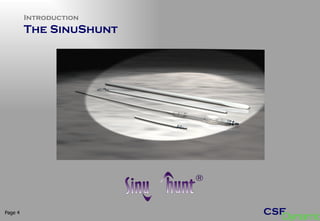
Introduction The SinuShunt  Page
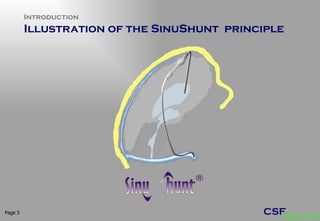
Introduction Illustration of the SinuShunt  principle  Page
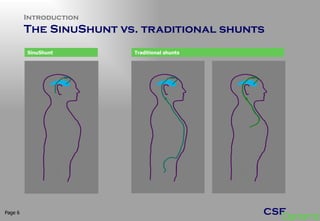
Introduction The SinuShunt vs. traditional shunts Page  SinuShunt Traditional shunts
Hydrocephalus Page
Page  Hydrocephalus occurs when there is an imbalance between the CSF produced and the rate at which it is drained Hydrocephalus that is present at birth is thought to be caused by a complex interaction of various factors and perhaps generic factors Acquired hydrocephalus may result from intraventricular hemorrhage, meningitis, head trauma, tumours and cysts The common clinical presentation in a child is increasing head size, irritability, failure to feed and vomiting Motor and general developmental delay, failure to make appropriate visual and social contact are among the most common problems found in children with hydrocephalus In about 40% of the cases there is excessive head growth. The same percentage applies to fullness of anterior fontanelle. Splayed sutures in 20% and scalp vein dilatation in 15% In adults symptoms are gate disturbances and dementia Over the past 25 years the mortality of Hydrocephalus has decreased from 54% to 5%. Intellectual disability has decreased from 62% to 30% Hydrocephalus Causes and symptoms of Hydrocephalus  Causes Symptoms
Hydrocephalus Diagnosis and treatment of Hydrocephalus  Page  It is very important that Hydrocephalus is diagnosed early to minimise morbidity and mortality In babies and infants it is sufficient to visualise the intracranial structures and ventricles In older children a CT scan or MRI could be performed. This would further assist in visualising underlying causes if there are any Conventional ventriculoperitoneal (VP) shunts are designed for treatment of normal or high pressure Hydrocephalus. They aim at shunting CSF past the partially or fully obstructed outflow pathways CFS is intended to be drained until a certain, predefined intracranial pressure level is reached 75% of Hydrocephalus patients are treated by shunting 3. ventriculostomy is another way of treating Hydrocephalus patients  As the surgical procedure is more complicated than implanting shunts only 25% of patients are treated by 3rd ventriculostomy  Diagnosis Treatment
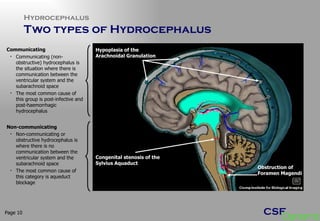
Hydrocephalus Two types of Hydrocephalus  Page  Communicating Communicating (non-obstructive) hydrocephalus is the situation where there is communication between the ventricular system and the subarachnoid space The most common cause of this group is post-infective and post-haemorrhagic hydrocephalus Non-communicating Non-communicating or obstructive hydrocephalus is where there is no communication between the ventricular system and the subarachnoid space The most common cause of this category is aqueduct blockage Congenital stenosis of the Sylvius Aquaduct Obstruction of Foramen Magendi Hypoplasia of the Arachnoidal Granulation
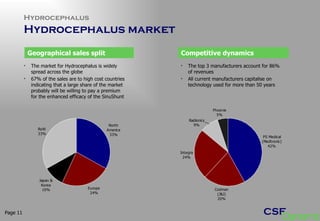
Hydrocephalus Hydrocephalus market  Page  The market for Hydrocephalus is widely spread across the globe 67% of the sales are to high cost countries indicating that a large share of the market probably will be willing to pay a premium for the enhanced efficacy of the SinuShunt The top 3 manufacturers account for 86% of revenues All current manufacturers capitalise on technology used for more than 50 years Competitive dynamics Geographical sales split Geographical sales split
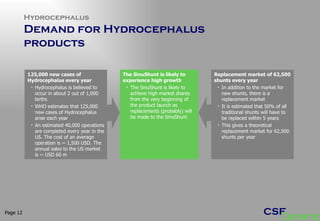
Hydrocephalus Demand for Hydrocephalus  products  Page  The SinuShunt is likely to experience high growth  The SinuShunt is likely to achieve high market shares from the very beginning of the product launch as replacements (probably) will be made to the SinuShunt 125,000 new cases of Hydrocephalus every year Hydrocephalus is believed to occur in about 2 out of 1,000 births WHO estimates that 125,000 new cases of Hydrocephalus arise each year An estimated 40,000 operations are completed every year in the US. The cost of an average operation is ~ 1,500 USD. The annual sales to the US market is ~ USD 60 m Replacement market of 62,500 shunts every year In addition to the market for new shunts, there is a replacement market It is estimated that 50% of all traditional shunts will have to be replaced within 5 years This gives a theoretical replacement market for 62,500 shunts per year
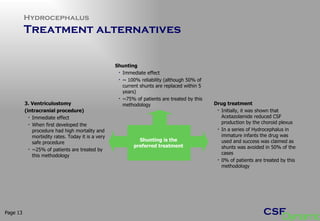
Hydrocephalus Treatment alternatives  Page  Shunting Immediate effect  ~ 100% reliability (although 50% of current shunts are replaced within 5 years) ~75% of patients are treated by this methodology 3. Ventriculostomy  (intracranial procedure) Immediate effect  When first developed the procedure had high mortality and morbidity rates. Today it is a very safe procedure ~25% of patients are treated by this methodology Drug treatment Initially, it was shown that Acetazolamide reduced CSF production by the choroid plexus In a series of Hydrocephalus in immature infants the drug was used and success was claimed as shunts was avoided in 50% of the cases 0% of patients are treated by this methodology Shunting is the preferred treatment
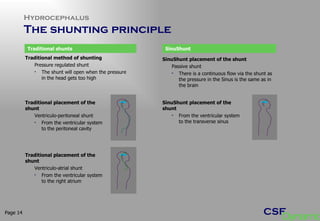
Hydrocephalus The shunting principle Page  Traditional method of shunting Pressure regulated shunt The shunt will open when the pressure in the head gets too high Traditional placement of the shunt Ventriculo-peritoneal shunt From the ventricular system to the peritoneal cavity SinuShunt placement of the shunt Passive shunt There is a continuous flow via the shunt as the pressure in the Sinus is the same as in the brain  Traditional placement of the shunt Ventriculo-atrial shunt From the ventricular system to the right atrium SinuShunt Traditional shunts SinuShunt placement of the shunt From the ventricular system to the transverse sinus
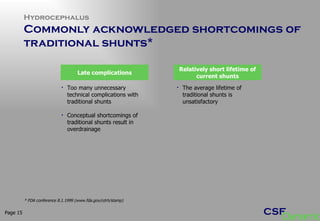
Hydrocephalus Commonly acknowledged shortcomings of traditional shunts*  Page  Late complications Too many unnecessary technical complications with traditional shunts Conceptual shortcomings of traditional shunts result in overdrainage Relatively short lifetime of current shunts The average lifetime of traditional shunts is unsatisfactory * FDA conference 8.1.1999 (www.fda.gov/cdrh/stamp)
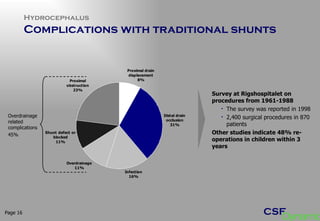
Hydrocephalus Complications with traditional shunts Page  Survey at Rigshospitalet on procedures from 1961-1988  The survey was reported in 1998 2,400 surgical procedures in 870 patients Other studies indicate 48% re-operations in children within 3 years Overdrainage related complications 45%
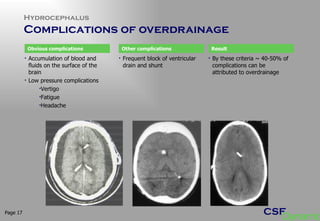
Hydrocephalus Complications of overdrainage  Page  Accumulation of blood and fluids on the surface of the brain Low pressure complications Vertigo Fatigue Headache Obvious complications Frequent block of ventricular drain and shunt Other complications By these criteria ~ 40-50% of complications can be attributed to overdrainage Result
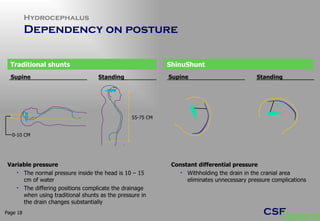
Hydrocephalus Dependency on posture Page  Variable pressure The normal pressure inside the head is 10 – 15 cm of water The differing positions complicate the drainage when using traditional shunts as the pressure in the drain changes substantially Traditional shunts ShinuShunt 55-75 CM Supine Standing Supine Standing Constant differential pressure Withholding the drain in the cranial area eliminates unnecessary pressure complications  0-10 CM
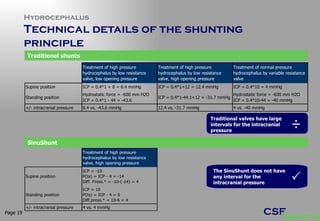
Hydrocephalus Technical details of the shunting  principle Page  Traditional shunts SinuShunt Traditional valves have large intervals for the intracranial pressure The SinuShunt does not have any interval for the intracranial pressure  ÷
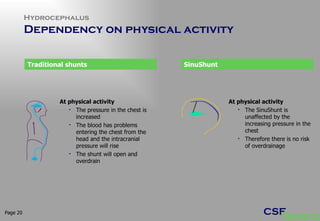
Hydrocephalus Dependency on physical activity  Page  At physical activity The pressure in the chest is increased  The blood has problems entering the chest from the head and the intracranial pressure will rise  The shunt will open and overdrain Traditional shunts SinuShunt At physical activity The SinuShunt is unaffected by the increasing pressure in the chest Therefore there is no risk of overdrainage
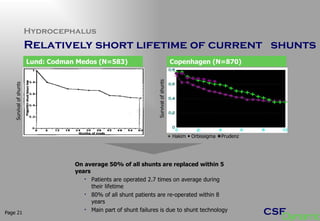
Hydrocephalus Relatively short lifetime of current  shunts   Page  On average 50% of all shunts are replaced within 5 years Patients are operated 2.7 times on average during their lifetime  80% of all shunt patients are re-operated within 8 years Main part of shunt failures is due to shunt technology Copenhagen (N=870) +  Hakim     Orbissigma   Prudenz Survival of shunts Lund: Codman Medos (N=583) Survival of shunts
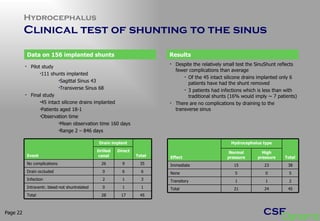
Hydrocephalus Clinical test of shunting to the sinus Page  Data on 156 implanted shunts Results Pilot study 111 shunts implanted  Sagittal Sinus 43 Transverse Sinus 68 Final study 45 intact silicone drains implanted Patients aged 18-1 Observation time Mean observation time 160 days Range 2 – 846 days Despite the relatively small test the SinuShunt reflects fewer complications than average Of the 45 intact silicone drains implanted only 6 patients have had the shunt removed 3 patients had infections which is less than with traditional shunts (16% would imply ~ 7 patients)  There are no complications by draining to the transverse sinus Event Drain implant Total Drilled canal Direct No complications 26 9 35 Drain occluded 0 6 6 Infection 2 1 3 Intraventr. bleed-not shuntrelated 0 1 1 Total 28 17 45 Effect Hydrocephalus type Total Normal pressure High pressure Immediate 15 23 38 None 5 0 5 Transitory 1 1 2 Total 21 24 45
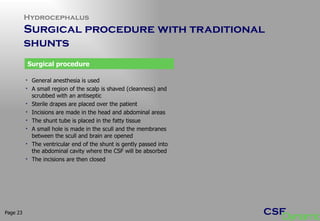
Hydrocephalus Surgical procedure with traditional  shunts  Page  General anesthesia is used A small region of the scalp is shaved (cleanness) and scrubbed with an antiseptic Sterile drapes are placed over the patient Incisions are made in the head and abdominal areas The shunt tube is placed in the fatty tissue A small hole is made in the scull and the membranes between the scull and brain are opened The ventricular end of the shunt is gently passed into the abdominal cavity where the CSF will be absorbed The incisions are then closed Surgical procedure
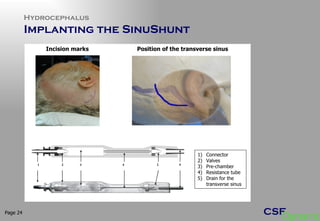
Hydrocephalus Implanting the SinuShunt Page  1) Connector 2) Valves 3) Pre-chamber 4) Resistance tube 5) Drain for the transverse sinus  Incision marks Position of the transverse sinus
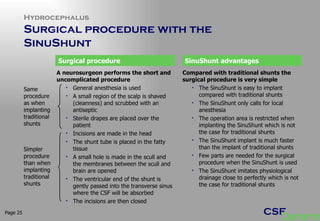
Hydrocephalus Surgical procedure with the  SinuShunt  Page  A neurosurgeon performs the short and uncomplicated procedure General anesthesia is used A small region of the scalp is shaved (cleanness) and scrubbed with an antiseptic Sterile drapes are placed over the patient Incisions are made in the head  The shunt tube is placed in the fatty tissue A small hole is made in the scull and the membranes between the scull and brain are opened The ventricular end of the shunt is gently passed into the transverse sinus where the CSF will be absorbed The incisions are then closed Surgical procedure SinuShunt advantages Compared with traditional shunts the surgical procedure is very simple The SinuShunt is easy to implant compared with traditional shunts  The SinuShunt only calls for local anesthesia The operation area is restricted when implanting the SinuShunt which is not the case for traditional shunts The SinuShunt implant is much faster than the implant of traditional shunts  Few parts are needed for the surgical procedure when the SinuShunt is used The SinuShunt imitates physiological drainage close to perfectly which is not the case for traditional shunts Same procedure as when implanting traditional shunts Simpler procedure than when implanting traditional shunts
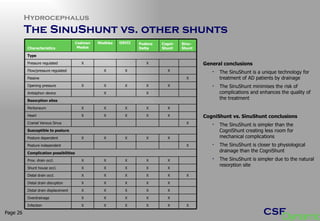
Hydrocephalus The SinuShunt vs. other shunts  Page  General conclusions The SinuShunt is a unique technology for treatment of AD patients by drainage The SinuShunt minimises the risk of complications and enhances the quality of the treatment  CogniShunt vs. SinuShunt conclusions The SinuShunt is simpler than the CogniShunt creating less room for mechanical complications  The SinuShunt is closer to physiological drainage than the CogniShunt The SinuShunt is simpler due to the natural resorption site Characteristics Codman Medos Miethke OSVII Pudenz Delta Cogni-Shunt Sinu-Shunt Type Pressure regulated X X Flow/pressure regulated X X X Passive X Opening pressure X X X X X Antisiphon device X X Resorption sites Peritoneum X X X X X Heart X X X X X Cranial Venous Sinus X Susceptible to posture Posture dependent X X X X X Posture independent X Complication possibilities Prox. drain occl. X X X X X Shunt house occl. X X X X X Distal drain occl. X X X X X X Distal drain disruption X X X X X Distal drain displacement X X X X X Overdrainage X X X X X Infection X X X X X X
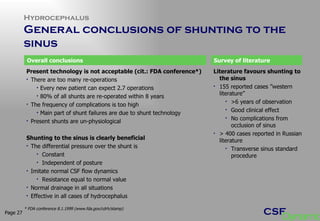
Hydrocephalus General conclusions of shunting to the sinus  Page  Present technology is not acceptable (cit.: FDA conference*) There are too many re-operations Every new patient can expect 2.7 operations 80% of all shunts are re-operated within 8 years The frequency of complications is too high  Main part of shunt failures are due to shunt technology Present shunts are un-physiological  Shunting to the sinus is clearly beneficial The differential pressure over the shunt is  Constant Independent of posture Imitate normal CSF flow dynamics Resistance equal to normal value Normal drainage in all situations Effective in all cases of hydrocephalus Overall conclusions Survey of literature Literature favours shunting to the sinus  155 reported cases ”western literature” >6 years of observation Good clinical effect No complications from occlusion of sinus > 400 cases reported in Russian literature Transverse sinus standard procedure  * FDA conference 8.1.1999 (www.fda.gov/cdrh/stamp)
Alzheimer’s Disease Page
Alzheimer’s Disease  Causes and symptoms of AD  Page  The causes of AD are not fully understood by scientists One of the key findings is the negative impact of the aggregation of beta-amyloid and tau proteins  Slow onset. At first, the only symptom may be mild forgetfulness Patients typically start to forget simple everyday tasks  Later the patients loose their ability to speak and write and eventually they require total care Causes Symptoms
Alzheimer’s Disease  Diagnosis and treatment of AD  Page  Diagnosis is difficult Biopsy of cerebral tissue possible but risky Diagnosis is typically made too late as patients are not willing to face problem However, the future promises better diagnosis of AD (e.g. Neurosearch research) Some drugs are able to slow the onset of AD of up to 12 months  Revenues from current drugs on the market total USD2.1bn (2004e) A phase II study of the COGNIShunt has shown stabilising effects on patients with mild/moderate AD  Diagnosis Treatment
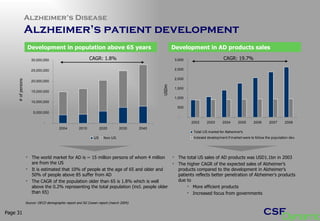
Alzheimer’s Disease  Alzheimer’s patient development Page  The world market for AD is ~ 15 million persons of whom 4 million are from the US It is estimated that 10% of people at the age of 65 and older and 50% of people above 85 suffer from AD The CAGR of the population older than 65 is 1.8% which is well above the 0.2% representing the total population (incl. people older than 65) CAGR: 1.8% Source: OECD demographic report and SG Cowen report (march 2004) CAGR: 19.7% The total US sales of AD products was USD1.1bn in 2003 The higher CAGR of the expected sales of Alzheimer’s products compared to the development in Alzheimer’s patients reflects better penetration of Alzheimer’s products due to  More efficient products Increased focus from governments # of persons USDm Development in population above 65 years Development in AD products sales
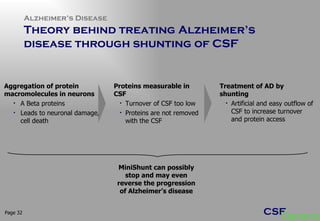
Alzheimer’s Disease  Theory behind treating Alzheimer’s disease through shunting of CSF  Page  Aggregation of protein macromolecules in neurons A Beta proteins Leads to neuronal damage/cell death Proteins measurable in CSF Turnover of CSF too low Proteins are not removed with the CSF Treatment of AD by shunting  Artificial and easy outflow of CSF to increase turnover and protein access  MiniShunt can possibly stop and may even reverse the progression of Alzheimer’s disease
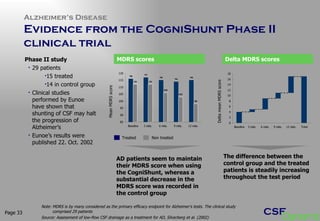
Alzheimer’s Disease  Evidence from the CogniShunt Phase II clinical trial Page  AD patients seem to maintain their MDRS score when using the CogniShunt, whereas a substantial decrease in the MDRS score was recorded in the control group Mean MDRS score Delta mean MDRS score Treated Non treated Note: MDRS is by many considered as the primary efficacy endpoint for Alzheimer’s tests. The clinical study comprised 29 patients  Source: Assessment of low-flow CSF drainage as a treatment for AD, Silverberg et al. (2002) The difference between the control group and the treated patients is steadily increasing throughout the test period Phase II study 29 patients 15 treated 14 in control group Clinical studies performed by Eunoe have shown that shunting of CSF may halt the progression of Alzheimer’s Eunoe’s results were published 22. Oct. 2002 MDRS scores Delta MDRS scores
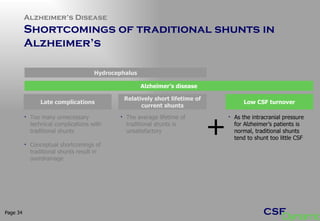
Alzheimer’s Disease  Shortcomings of traditional shunts in Alzheimer’s  Page  + As the intracranial pressure for Alzheimer’s patients is normal, traditional shunts tend to shunt too little CSF Late complications Too many unnecessary technical complications with traditional shunts Conceptual shortcomings of traditional shunts result in overdrainage Relatively short lifetime of current shunts The average lifetime of traditional shunts is unsatisfactory Low CSF turnover Alzheimer’s disease Hydrocephalus
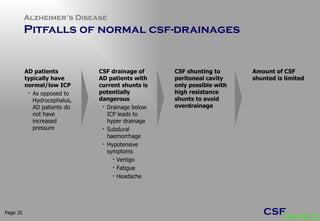
Alzheimer’s Disease  Pitfalls of normal csf-drainages  Page  CSF drainage of AD patients with current shunts is potentially dangerous Drainage below ICP leads to hyper drainage Subdural haemorrhage Hypotensive symptoms Vertigo Fatigue Headache AD patients typically have normal/low ICP As opposed to Hydrocephalus, AD patients do not have increased pressure CSF shunting to peritoneal cavity only possible with high resistance shunts to avoid overdrainage Amount of CSF shunted is limited
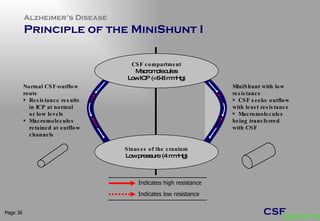
Alzheimer’s Disease  Principle of the MiniShunt I  Page  CSF compartment Macromolecules Low ICP (<6-8 mmHg) Sinuses of the cranium Low pressure (4 mmHg) Normal CSF-outflow route Resistance results  in ICP at normal  or low levels Macromolecules  retained at outflow  channels  MiniShunt with low resistance CSF seeks outflow  with least resistance Macromolecules  being transferred  with CSF Indicates high resistance Indicates low resistance
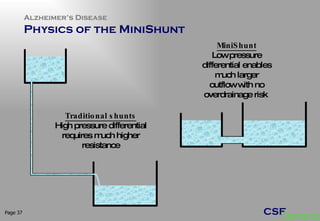
Alzheimer’s Disease  Physics of the MiniShunt Page  Traditional shunts High pressure differential requires much higher resistance MiniShunt Low pressure differential enables much larger outflow with no overdrainage risk
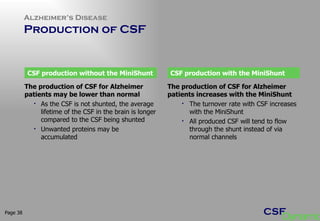
Alzheimer’s Disease  Production of CSF Page  The production of CSF for Alzheimer patients may be lower than normal As the CSF is not shunted, the average lifetime of the CSF in the brain is longer compared to the CSF being shunted Unwanted proteins may be accumulated  CSF production without the MiniShunt CSF production with the MiniShunt The production of CSF for Alzheimer patients increases with the MiniShunt The turnover rate with CSF increases with the MiniShunt All produced CSF will tend to flow through the shunt instead of via normal channels
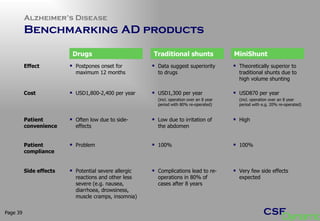
Alzheimer’s Disease  Benchmarking AD products  Page  Drugs Traditional shunts MiniShunt Effect Cost  Patient convenience Side effects Postpones onset for maximum 12 months USD1,800-2,400 per year Often low due to side-effects Potential severe allergic reactions and other less severe (e.g. nausea, diarrhoea, drowsiness, muscle cramps, insomnia) Data suggest superiority to drugs USD1,300 per year  (incl. operation over an 8 year period with 80% re-operated) Low due to irritation of the abdomen Complications lead to re-operations in 80% of cases after 8 years Theoretically superior to traditional shunts due to high volume shunting USD870 per year  (incl. operation over an 8 year period with e.g. 20% re-operated) High Very few side effects expected Patient compliance Problem 100% 100%
Alzheimer’s Disease  Conclusions regarding the  MiniShunt  Page  Treatment benefits It has immediate effect It is easy to implant It has no proven side effects It has much fewer complication possibilities which is especially important to AD patients due to the typical old age  Surgical benefits: The operation area is restricted The operation is fast Few parts are needed for the operation Clinical tested design of the MiniShunt Treatment downsides: None compared to the benchmark products Surgical downsides None compared to the benchmark products Benefits of the MiniShunt Drawbacks of the MiniShunt

Csf Presentation 2009

  • 1.
    Page CompanyPresentation CSF Dynamics
  • 2.
    Introduction Key personsbehind CSFDynamics A/S Page MD, Dr.med.sci., University of Aarhus (1976), Specialist in Neurosurgery (1979). Currently employed as Chief Surgeon and Medical Director at PrivatHospitalet Danmark (1992-). Previously Dr. Børgesen was employed as chief neurosurgeon at the University Clinic of Neurosurgery at Rigshospitalet (1988-02), consultant at Arbejdsskadestyrelsen (1987-99), assistant neurologist at Sikringsstyrelsen (1986-87), consultant at the department of neurosurgery at KAS Glostrup (1984-87), consultant at the department of neurosurgery at Borgaspitalin in Iceland (1982-82). Dr. Børgesen is author and co-author of 86 scientific articles Svend Erik Børgesen Niels Agerlin MD from the University of Copenhagen (1986), Ph.D. from the University of Copenhagen (1993). Currently employed as Chief Neurosurgeon at the Neurosurgical dept. at KAS Glostrup (2002-). Previously employed as senior resident physician at the Neurosurgical dept. at KAS Glostrup (1997-01), resident physician and senior resident physician at the Neurosurgical dept. and Neurological dept. at Rigshospitalet (1988-96)
  • 3.
    Introduction History ofthe SinuShunt Page Year Event 1993 The first animal experiment on dogs took place. 1994-95 Dr. Børgesen finished the first technical development of the SinuShunt and prepared the shunt ready for patenting. 26 Sep. 1996 An APCT application was filed for the USA, all of Europe, Japan, Hong Kong, Canada and Australia. 1997 The first SinuShunts were implanted. 1997-99 Clinical development and testing of the SinuShunt. 2000 The SinuShunt and the first results were presented at a neurosurgery world congress in Sydney. The interest was overwhelming. At that congress, the first contacts were made with university hospitals in Europe which wanted to participate in the future testing. The development started of a new shunt for treatment of hydrocephalus for infants and young children. At the same time the shunt for treatment of AD was developed. 2001 CSFDynamics entered into a production agreement with Medical Rubber AB in Sweden, a family-owned company established in 1973. The company, which is ISO 9002 and EN 46002 certified and has clean room facilities (class 10,000), currently produces the SinuShunt. 2002 The SinuShunt achieved the CE approval. Pilot testing and clinical studies continued in selected university hospitals in Europe. Jun. 2003 Dr. Børgesen received the Pudenz Award for 2002 for “Excellence in Cerebrospinal Fluid Physiology”. The award was given to Dr. Børgesen for “his many contributions over the years to the understanding of factors underlying the clinical physiology of hydrocephalus and his recent innovative studies utilizing the ventriculo-cranial venous sinus methodology for treatment of this condition”. End of 2003 Approx. 200 SinuShunts were implanted in selected hospitals 2007/2009 Development of a new and improved sinus-tube.
  • 4.
  • 5.
    Introduction Illustration ofthe SinuShunt principle Page
  • 6.
    Introduction The SinuShuntvs. traditional shunts Page SinuShunt Traditional shunts
  • 7.
  • 8.
    Page Hydrocephalusoccurs when there is an imbalance between the CSF produced and the rate at which it is drained Hydrocephalus that is present at birth is thought to be caused by a complex interaction of various factors and perhaps generic factors Acquired hydrocephalus may result from intraventricular hemorrhage, meningitis, head trauma, tumours and cysts The common clinical presentation in a child is increasing head size, irritability, failure to feed and vomiting Motor and general developmental delay, failure to make appropriate visual and social contact are among the most common problems found in children with hydrocephalus In about 40% of the cases there is excessive head growth. The same percentage applies to fullness of anterior fontanelle. Splayed sutures in 20% and scalp vein dilatation in 15% In adults symptoms are gate disturbances and dementia Over the past 25 years the mortality of Hydrocephalus has decreased from 54% to 5%. Intellectual disability has decreased from 62% to 30% Hydrocephalus Causes and symptoms of Hydrocephalus Causes Symptoms
  • 9.
    Hydrocephalus Diagnosis andtreatment of Hydrocephalus Page It is very important that Hydrocephalus is diagnosed early to minimise morbidity and mortality In babies and infants it is sufficient to visualise the intracranial structures and ventricles In older children a CT scan or MRI could be performed. This would further assist in visualising underlying causes if there are any Conventional ventriculoperitoneal (VP) shunts are designed for treatment of normal or high pressure Hydrocephalus. They aim at shunting CSF past the partially or fully obstructed outflow pathways CFS is intended to be drained until a certain, predefined intracranial pressure level is reached 75% of Hydrocephalus patients are treated by shunting 3. ventriculostomy is another way of treating Hydrocephalus patients As the surgical procedure is more complicated than implanting shunts only 25% of patients are treated by 3rd ventriculostomy Diagnosis Treatment
  • 10.
    Hydrocephalus Two typesof Hydrocephalus Page Communicating Communicating (non-obstructive) hydrocephalus is the situation where there is communication between the ventricular system and the subarachnoid space The most common cause of this group is post-infective and post-haemorrhagic hydrocephalus Non-communicating Non-communicating or obstructive hydrocephalus is where there is no communication between the ventricular system and the subarachnoid space The most common cause of this category is aqueduct blockage Congenital stenosis of the Sylvius Aquaduct Obstruction of Foramen Magendi Hypoplasia of the Arachnoidal Granulation
  • 11.
    Hydrocephalus Hydrocephalus market Page The market for Hydrocephalus is widely spread across the globe 67% of the sales are to high cost countries indicating that a large share of the market probably will be willing to pay a premium for the enhanced efficacy of the SinuShunt The top 3 manufacturers account for 86% of revenues All current manufacturers capitalise on technology used for more than 50 years Competitive dynamics Geographical sales split Geographical sales split
  • 12.
    Hydrocephalus Demand forHydrocephalus products Page The SinuShunt is likely to experience high growth The SinuShunt is likely to achieve high market shares from the very beginning of the product launch as replacements (probably) will be made to the SinuShunt 125,000 new cases of Hydrocephalus every year Hydrocephalus is believed to occur in about 2 out of 1,000 births WHO estimates that 125,000 new cases of Hydrocephalus arise each year An estimated 40,000 operations are completed every year in the US. The cost of an average operation is ~ 1,500 USD. The annual sales to the US market is ~ USD 60 m Replacement market of 62,500 shunts every year In addition to the market for new shunts, there is a replacement market It is estimated that 50% of all traditional shunts will have to be replaced within 5 years This gives a theoretical replacement market for 62,500 shunts per year
  • 13.
    Hydrocephalus Treatment alternatives Page Shunting Immediate effect ~ 100% reliability (although 50% of current shunts are replaced within 5 years) ~75% of patients are treated by this methodology 3. Ventriculostomy (intracranial procedure) Immediate effect When first developed the procedure had high mortality and morbidity rates. Today it is a very safe procedure ~25% of patients are treated by this methodology Drug treatment Initially, it was shown that Acetazolamide reduced CSF production by the choroid plexus In a series of Hydrocephalus in immature infants the drug was used and success was claimed as shunts was avoided in 50% of the cases 0% of patients are treated by this methodology Shunting is the preferred treatment
  • 14.
    Hydrocephalus The shuntingprinciple Page Traditional method of shunting Pressure regulated shunt The shunt will open when the pressure in the head gets too high Traditional placement of the shunt Ventriculo-peritoneal shunt From the ventricular system to the peritoneal cavity SinuShunt placement of the shunt Passive shunt There is a continuous flow via the shunt as the pressure in the Sinus is the same as in the brain Traditional placement of the shunt Ventriculo-atrial shunt From the ventricular system to the right atrium SinuShunt Traditional shunts SinuShunt placement of the shunt From the ventricular system to the transverse sinus
  • 15.
    Hydrocephalus Commonly acknowledgedshortcomings of traditional shunts* Page Late complications Too many unnecessary technical complications with traditional shunts Conceptual shortcomings of traditional shunts result in overdrainage Relatively short lifetime of current shunts The average lifetime of traditional shunts is unsatisfactory * FDA conference 8.1.1999 (www.fda.gov/cdrh/stamp)
  • 16.
    Hydrocephalus Complications withtraditional shunts Page Survey at Rigshospitalet on procedures from 1961-1988 The survey was reported in 1998 2,400 surgical procedures in 870 patients Other studies indicate 48% re-operations in children within 3 years Overdrainage related complications 45%
  • 17.
    Hydrocephalus Complications ofoverdrainage Page Accumulation of blood and fluids on the surface of the brain Low pressure complications Vertigo Fatigue Headache Obvious complications Frequent block of ventricular drain and shunt Other complications By these criteria ~ 40-50% of complications can be attributed to overdrainage Result
  • 18.
    Hydrocephalus Dependency onposture Page Variable pressure The normal pressure inside the head is 10 – 15 cm of water The differing positions complicate the drainage when using traditional shunts as the pressure in the drain changes substantially Traditional shunts ShinuShunt 55-75 CM Supine Standing Supine Standing Constant differential pressure Withholding the drain in the cranial area eliminates unnecessary pressure complications 0-10 CM
  • 19.
    Hydrocephalus Technical detailsof the shunting principle Page Traditional shunts SinuShunt Traditional valves have large intervals for the intracranial pressure The SinuShunt does not have any interval for the intracranial pressure  ÷
  • 20.
    Hydrocephalus Dependency onphysical activity Page At physical activity The pressure in the chest is increased The blood has problems entering the chest from the head and the intracranial pressure will rise The shunt will open and overdrain Traditional shunts SinuShunt At physical activity The SinuShunt is unaffected by the increasing pressure in the chest Therefore there is no risk of overdrainage
  • 21.
    Hydrocephalus Relatively shortlifetime of current shunts Page On average 50% of all shunts are replaced within 5 years Patients are operated 2.7 times on average during their lifetime 80% of all shunt patients are re-operated within 8 years Main part of shunt failures is due to shunt technology Copenhagen (N=870) + Hakim  Orbissigma  Prudenz Survival of shunts Lund: Codman Medos (N=583) Survival of shunts
  • 22.
    Hydrocephalus Clinical testof shunting to the sinus Page Data on 156 implanted shunts Results Pilot study 111 shunts implanted Sagittal Sinus 43 Transverse Sinus 68 Final study 45 intact silicone drains implanted Patients aged 18-1 Observation time Mean observation time 160 days Range 2 – 846 days Despite the relatively small test the SinuShunt reflects fewer complications than average Of the 45 intact silicone drains implanted only 6 patients have had the shunt removed 3 patients had infections which is less than with traditional shunts (16% would imply ~ 7 patients) There are no complications by draining to the transverse sinus Event Drain implant Total Drilled canal Direct No complications 26 9 35 Drain occluded 0 6 6 Infection 2 1 3 Intraventr. bleed-not shuntrelated 0 1 1 Total 28 17 45 Effect Hydrocephalus type Total Normal pressure High pressure Immediate 15 23 38 None 5 0 5 Transitory 1 1 2 Total 21 24 45
  • 23.
    Hydrocephalus Surgical procedurewith traditional shunts Page General anesthesia is used A small region of the scalp is shaved (cleanness) and scrubbed with an antiseptic Sterile drapes are placed over the patient Incisions are made in the head and abdominal areas The shunt tube is placed in the fatty tissue A small hole is made in the scull and the membranes between the scull and brain are opened The ventricular end of the shunt is gently passed into the abdominal cavity where the CSF will be absorbed The incisions are then closed Surgical procedure
  • 24.
    Hydrocephalus Implanting theSinuShunt Page 1) Connector 2) Valves 3) Pre-chamber 4) Resistance tube 5) Drain for the transverse sinus Incision marks Position of the transverse sinus
  • 25.
    Hydrocephalus Surgical procedurewith the SinuShunt Page A neurosurgeon performs the short and uncomplicated procedure General anesthesia is used A small region of the scalp is shaved (cleanness) and scrubbed with an antiseptic Sterile drapes are placed over the patient Incisions are made in the head The shunt tube is placed in the fatty tissue A small hole is made in the scull and the membranes between the scull and brain are opened The ventricular end of the shunt is gently passed into the transverse sinus where the CSF will be absorbed The incisions are then closed Surgical procedure SinuShunt advantages Compared with traditional shunts the surgical procedure is very simple The SinuShunt is easy to implant compared with traditional shunts The SinuShunt only calls for local anesthesia The operation area is restricted when implanting the SinuShunt which is not the case for traditional shunts The SinuShunt implant is much faster than the implant of traditional shunts Few parts are needed for the surgical procedure when the SinuShunt is used The SinuShunt imitates physiological drainage close to perfectly which is not the case for traditional shunts Same procedure as when implanting traditional shunts Simpler procedure than when implanting traditional shunts
  • 26.
    Hydrocephalus The SinuShuntvs. other shunts Page General conclusions The SinuShunt is a unique technology for treatment of AD patients by drainage The SinuShunt minimises the risk of complications and enhances the quality of the treatment CogniShunt vs. SinuShunt conclusions The SinuShunt is simpler than the CogniShunt creating less room for mechanical complications The SinuShunt is closer to physiological drainage than the CogniShunt The SinuShunt is simpler due to the natural resorption site Characteristics Codman Medos Miethke OSVII Pudenz Delta Cogni-Shunt Sinu-Shunt Type Pressure regulated X X Flow/pressure regulated X X X Passive X Opening pressure X X X X X Antisiphon device X X Resorption sites Peritoneum X X X X X Heart X X X X X Cranial Venous Sinus X Susceptible to posture Posture dependent X X X X X Posture independent X Complication possibilities Prox. drain occl. X X X X X Shunt house occl. X X X X X Distal drain occl. X X X X X X Distal drain disruption X X X X X Distal drain displacement X X X X X Overdrainage X X X X X Infection X X X X X X
  • 27.
    Hydrocephalus General conclusionsof shunting to the sinus Page Present technology is not acceptable (cit.: FDA conference*) There are too many re-operations Every new patient can expect 2.7 operations 80% of all shunts are re-operated within 8 years The frequency of complications is too high Main part of shunt failures are due to shunt technology Present shunts are un-physiological Shunting to the sinus is clearly beneficial The differential pressure over the shunt is Constant Independent of posture Imitate normal CSF flow dynamics Resistance equal to normal value Normal drainage in all situations Effective in all cases of hydrocephalus Overall conclusions Survey of literature Literature favours shunting to the sinus 155 reported cases ”western literature” >6 years of observation Good clinical effect No complications from occlusion of sinus > 400 cases reported in Russian literature Transverse sinus standard procedure * FDA conference 8.1.1999 (www.fda.gov/cdrh/stamp)
  • 28.
  • 29.
    Alzheimer’s Disease Causes and symptoms of AD Page The causes of AD are not fully understood by scientists One of the key findings is the negative impact of the aggregation of beta-amyloid and tau proteins Slow onset. At first, the only symptom may be mild forgetfulness Patients typically start to forget simple everyday tasks Later the patients loose their ability to speak and write and eventually they require total care Causes Symptoms
  • 30.
    Alzheimer’s Disease Diagnosis and treatment of AD Page Diagnosis is difficult Biopsy of cerebral tissue possible but risky Diagnosis is typically made too late as patients are not willing to face problem However, the future promises better diagnosis of AD (e.g. Neurosearch research) Some drugs are able to slow the onset of AD of up to 12 months Revenues from current drugs on the market total USD2.1bn (2004e) A phase II study of the COGNIShunt has shown stabilising effects on patients with mild/moderate AD Diagnosis Treatment
  • 31.
    Alzheimer’s Disease Alzheimer’s patient development Page The world market for AD is ~ 15 million persons of whom 4 million are from the US It is estimated that 10% of people at the age of 65 and older and 50% of people above 85 suffer from AD The CAGR of the population older than 65 is 1.8% which is well above the 0.2% representing the total population (incl. people older than 65) CAGR: 1.8% Source: OECD demographic report and SG Cowen report (march 2004) CAGR: 19.7% The total US sales of AD products was USD1.1bn in 2003 The higher CAGR of the expected sales of Alzheimer’s products compared to the development in Alzheimer’s patients reflects better penetration of Alzheimer’s products due to More efficient products Increased focus from governments # of persons USDm Development in population above 65 years Development in AD products sales
  • 32.
    Alzheimer’s Disease Theory behind treating Alzheimer’s disease through shunting of CSF Page Aggregation of protein macromolecules in neurons A Beta proteins Leads to neuronal damage/cell death Proteins measurable in CSF Turnover of CSF too low Proteins are not removed with the CSF Treatment of AD by shunting Artificial and easy outflow of CSF to increase turnover and protein access MiniShunt can possibly stop and may even reverse the progression of Alzheimer’s disease
  • 33.
    Alzheimer’s Disease Evidence from the CogniShunt Phase II clinical trial Page AD patients seem to maintain their MDRS score when using the CogniShunt, whereas a substantial decrease in the MDRS score was recorded in the control group Mean MDRS score Delta mean MDRS score Treated Non treated Note: MDRS is by many considered as the primary efficacy endpoint for Alzheimer’s tests. The clinical study comprised 29 patients Source: Assessment of low-flow CSF drainage as a treatment for AD, Silverberg et al. (2002) The difference between the control group and the treated patients is steadily increasing throughout the test period Phase II study 29 patients 15 treated 14 in control group Clinical studies performed by Eunoe have shown that shunting of CSF may halt the progression of Alzheimer’s Eunoe’s results were published 22. Oct. 2002 MDRS scores Delta MDRS scores
  • 34.
    Alzheimer’s Disease Shortcomings of traditional shunts in Alzheimer’s Page + As the intracranial pressure for Alzheimer’s patients is normal, traditional shunts tend to shunt too little CSF Late complications Too many unnecessary technical complications with traditional shunts Conceptual shortcomings of traditional shunts result in overdrainage Relatively short lifetime of current shunts The average lifetime of traditional shunts is unsatisfactory Low CSF turnover Alzheimer’s disease Hydrocephalus
  • 35.
    Alzheimer’s Disease Pitfalls of normal csf-drainages Page CSF drainage of AD patients with current shunts is potentially dangerous Drainage below ICP leads to hyper drainage Subdural haemorrhage Hypotensive symptoms Vertigo Fatigue Headache AD patients typically have normal/low ICP As opposed to Hydrocephalus, AD patients do not have increased pressure CSF shunting to peritoneal cavity only possible with high resistance shunts to avoid overdrainage Amount of CSF shunted is limited
  • 36.
    Alzheimer’s Disease Principle of the MiniShunt I Page CSF compartment Macromolecules Low ICP (<6-8 mmHg) Sinuses of the cranium Low pressure (4 mmHg) Normal CSF-outflow route Resistance results in ICP at normal or low levels Macromolecules retained at outflow channels MiniShunt with low resistance CSF seeks outflow with least resistance Macromolecules being transferred with CSF Indicates high resistance Indicates low resistance
  • 37.
    Alzheimer’s Disease Physics of the MiniShunt Page Traditional shunts High pressure differential requires much higher resistance MiniShunt Low pressure differential enables much larger outflow with no overdrainage risk
  • 38.
    Alzheimer’s Disease Production of CSF Page The production of CSF for Alzheimer patients may be lower than normal As the CSF is not shunted, the average lifetime of the CSF in the brain is longer compared to the CSF being shunted Unwanted proteins may be accumulated CSF production without the MiniShunt CSF production with the MiniShunt The production of CSF for Alzheimer patients increases with the MiniShunt The turnover rate with CSF increases with the MiniShunt All produced CSF will tend to flow through the shunt instead of via normal channels
  • 39.
    Alzheimer’s Disease Benchmarking AD products Page Drugs Traditional shunts MiniShunt Effect Cost Patient convenience Side effects Postpones onset for maximum 12 months USD1,800-2,400 per year Often low due to side-effects Potential severe allergic reactions and other less severe (e.g. nausea, diarrhoea, drowsiness, muscle cramps, insomnia) Data suggest superiority to drugs USD1,300 per year (incl. operation over an 8 year period with 80% re-operated) Low due to irritation of the abdomen Complications lead to re-operations in 80% of cases after 8 years Theoretically superior to traditional shunts due to high volume shunting USD870 per year (incl. operation over an 8 year period with e.g. 20% re-operated) High Very few side effects expected Patient compliance Problem 100% 100%
  • 40.
    Alzheimer’s Disease Conclusions regarding the MiniShunt Page Treatment benefits It has immediate effect It is easy to implant It has no proven side effects It has much fewer complication possibilities which is especially important to AD patients due to the typical old age Surgical benefits: The operation area is restricted The operation is fast Few parts are needed for the operation Clinical tested design of the MiniShunt Treatment downsides: None compared to the benchmark products Surgical downsides None compared to the benchmark products Benefits of the MiniShunt Drawbacks of the MiniShunt

Editor's Notes