Normal Pressure Hydrocephalus Jerry Ryan MD University of Wisconsin - Madison
Objectives 1. Evaluate patients suspected of having NPH and distinguish NPH from other causes of gait disturbance, incontinence and dementia 2. Identify patients who need referral for consideration of treatment of NPH. 3. Understand treatment of NPH and follow patients who have received neurosurgical interventions for NPH in the office. 4. Educate patients with NPH and their families about the disorder.
How big is the problem? Prevalence Normal Pressure Hydrocephalus (NPH) Estimates vary from 0- 5% as a cause for dementia Some of variation due to inconsistent definition of NPH Study of 166 patients shunted for presumed NPH calculated incidence of shunt responsive NPH to be one patient per 2.2 million persons per year J Vanneste, P Augustijn, C Dirven, WF Tan and ZD Goedhart Neurology 1992;42:54–9
So why do I need to know about NPH? Potentially reversible cause of significant morbidity Recent direct to consumer advertising
What should Family Physicians know about NPH? Diagnostic features Diagnostic studies Limitations of prognostic studies Patients likely to benefit from treatment Complications of treatment Patient follow up
Etiology 50% cases idiopathic Leading theory is impairment of CSF outflow Intraventricular pressure studies reveal waves of increased pressure- B-waves Adult hydrocephalus syndrome Adult symptomatic hydrocephalus
Etiology 50% cases NPH secondary to other illnesses Subarachnoid hemorrhage Meningitis Cranial trauma Secondary NPH has higher response rate to shunting than idiopathic NPH
Pathophysiology Ventricle enlargement leads to periventricular ischemia regardless of etiology Compression and stretching of arterioles and venules Arterial hypertension and cerebral arteriosclerosis increased in NPH
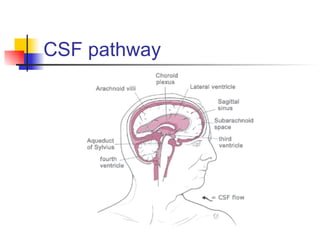
CSF pathway CSF produced by choroid plexus at rate approximately 20 ml/hr Flows from lateral ventricles through foramina of Monro into third ventricle Enters fourth ventricle through aqueduct of Sylvius Enters subarachnoid space Resorbed by arachnoid villi at top of brain
CSF pathway
Diagnostic Triad Gait Disturbance Urinary Incontinence Dementia
Diagnostic Triad Gait disturbance No classic gait disturbance Gait  may be  wide based, shuffling More severely affected patients have “magnetic gait”- feet stuck to ground and difficult to initiate walking Difficulties with walking motions resolve with minimal support of patient or lying patient down May resemble Parkinson’s gait Not associated with limb weakness Hyperreflexia
Diagnostic Triad Urinary Incontinence True incontinence found only in severely affected patients Urinary urgency in most patients with NPH Due to stretching of periventricular nerve fibers and loss of detrusor inhibition Bladder sphincter muscle unaffected
Diagnostic Triad Dementia Presence of dementia in NPH extremely variable Some shunt responsive patients have little or no dementia Dementia usually least responsive of symptoms to intervention Mental status changes may resemble depression
Differential Diagnoses- Alzheimer’s (AD) Both AD and NPH cause memory impairment AD- “cortical” abnormalities Aphasia, Apraxia, Agnosia Impaired recognition and encoding deficits NPH- “subcortical” abnormalities Memory impairment but intact recognition Slow information processing Difficulty with complex tasks
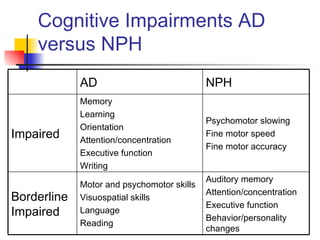
Cognitive Impairments AD versus NPH Auditory memory Attention/concentration Executive function Behavior/personality changes Motor and psychomotor skills Visuospatial skills Language Reading Borderline Impaired Psychomotor slowing Fine motor speed Fine motor accuracy Memory Learning Orientation Attention/concentration Executive function Writing Impaired NPH AD
Differential Diagnoses- Alzheimer’s (AD) AD and NPH can usually be distinguished with formal neuropsychological testing Primary care office testing may not be adequate to distinguish Mental impairment early in course of AD but usually late in course of NPH and often minimal impairment AD often associated with hippocampal atrophy on imaging studies
Differential Diagnoses- Parkinson’s Disease Both NPH and Parkinson’s Disease (PD) can have similar gait disturbances Hypokinesia Freezing Imbalance Extrapyramidal symptoms Trial of levadopa can help distinguish between PD and NPH
Differential Diagnoses- Other Depression Subcortical arteriosclerotic encephalopathy Multi-infarct encephalopathy Chronic alcoholism B 12 , Folate deficiency Electrolyte abnormalities Cervical or lumbar stenosis Peripheral neuropathy
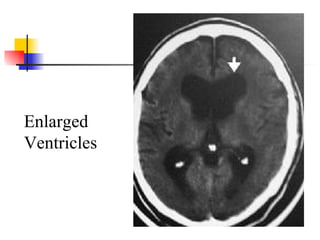
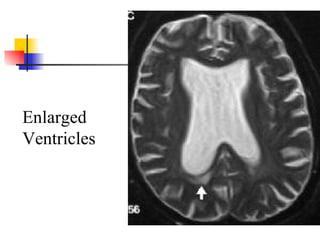
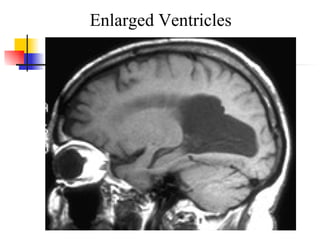
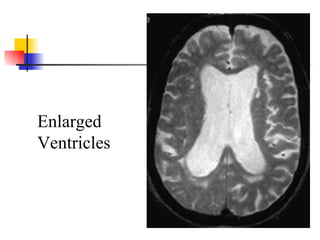
Diagnostic studies Ventricle enlargement on CT or MRI Severity graded by ratio of maximal frontal horn width divided by transverse inner diameter of skull 0.32 minimal for NPH but 0.40 more typical Lack of hippocampus or cortical atrophy Periventricular and cortical white matter lesions may be found in patients with NPH Large number white matter lesions may be marker for poor response to shunting
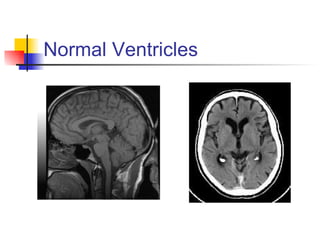
Normal Ventricles
Enlarged Ventricles
Enlarged Ventricles
Enlarged Ventricles
Enlarged Ventricles
So now that I know it’s NPH what next? Response to shunting varies significantly between patients Study 166 shunted NPH patients Overall response 36%, only 21% significant improvement Only 15% of patients with idiopathic NPH showed marked improvement J Vanneste, P Augustijn, C Dirven, WF Tan and ZD Goedhart Neurology 1992;42:54–9
Any Problems With Shunting? Complications of shunting Low immediate post-surgical risks Severe to moderate shunt related morbidity of 28% Infection Shunt malfunction Intracranial bleed Death or severe morbidity 7% J Vanneste, P Augustijn, C Dirven, WF Tan and ZD Goedhart Neurology 1992;42:54-9
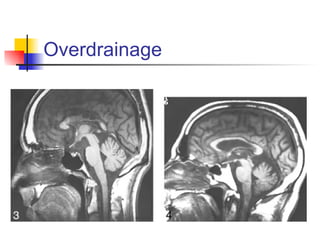
Overdrainage
Are Benefits of Shunting Long Lasting? Most studies show fairly significant decline in benefits over time Initial improvement 60-75% of patients Sustained improvement only 24-42% Results confounded due to high mortality from co-morbid conditions 57% patients dead within 5 years in study by Raftopoulos et.al.
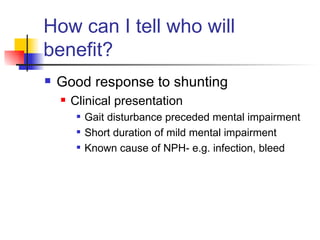
How can I tell who will benefit? Good response to shunting Clinical presentation Gait disturbance preceded mental impairment Short duration of mild mental impairment Known cause of NPH- e.g. infection, bleed
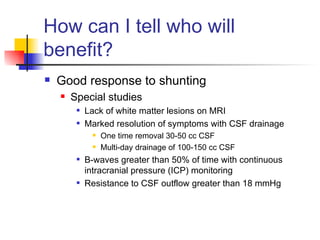
How can I tell who will benefit? Good response to shunting Special studies Lack of white matter lesions on MRI Marked resolution of symptoms with CSF drainage One time removal 30-50 cc CSF Multi-day drainage of 100-150 cc CSF B-waves greater than 50% of time with continuous intracranial pressure (ICP) monitoring Resistance to CSF outflow greater than 18 mmHg
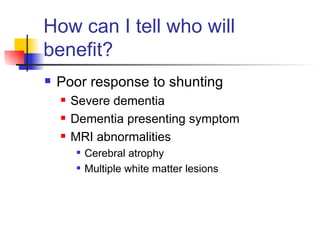
How can I tell who will benefit? Poor response to shunting Severe dementia Dementia presenting symptom MRI abnormalities Cerebral atrophy Multiple white matter lesions
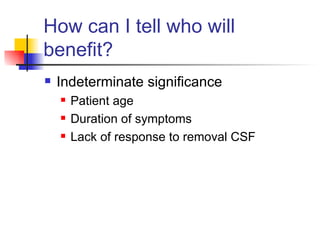
How can I tell who will benefit? Indeterminate significance Patient age Duration of symptoms Lack of response to removal CSF
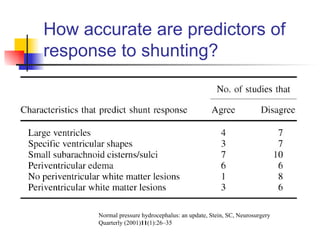
How accurate are predictors of response to shunting? Normal pressure hydrocephalus: an update, Stein, SC, Neurosurgery   Quarterly (2001) 11 (1):26–35
NPH Guidelines Worldwide group of experts assembled to develop guidelines for diagnosis and treatment of NPH Meetings supported by shunt manufacturer  Limited number of RCT’s noted by group Report published in Neurosurgery: Vol. 57 (3), Sept 2005 Supplement
Diagnosis- Probable Idiopathic NPH History Insidious onset Age over 40 Symptom duration 3-6 months No antecedent event known to cause secondary NPH Progressive over time No other medical, psychiatric or neurological condition that could cause symptoms
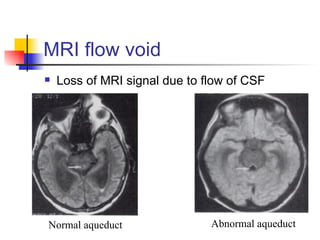
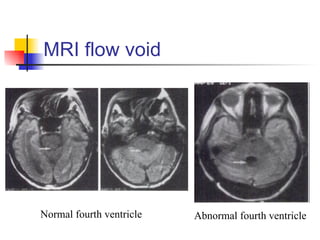
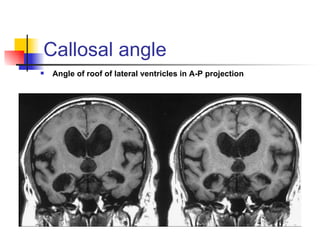
Diagnosis- Probable Idiopathic NPH Brain imaging Ventricular enlargement not attributable to cerebral atrophy or congenital disorder No macroscopic obstruction present At least one of the following Enlargement of lateral horns not attributable to hippocampus atrophy Callosal angle greater or equal to 40 degrees Evidence of altered brain water content on imaging not attributable ischemia or demylination An aqueductal or fourth ventricular flow void on MRI
Callosal angle Angle of roof of lateral ventricles in A-P projection
MRI flow void Loss of MRI signal due to flow of CSF Normal aqueduct Abnormal aqueduct
MRI flow void Normal fourth ventricle Abnormal fourth ventricle
Diagnosis- Probable Idiopathic NPH Clinical Gait/Balance- at least two of following present Decreased step height Decreased step length Decreased cadence/speed Decreased trunk sway Widened stance Toes turned outward while walking En bloc turning- turns take three or more steps Impaired balance- two or more corrective steps for eight steps on tandem gait testing
Diagnosis- Probable Idiopathic NPH Cognition- two of following present Psychomotor slowing Decreased fine motor speed Decreased fine motor accuracy Difficulty dividing or maintaining attention Impaired recall especially for recent events Impairment of executive functions- multi-step procedures, working memory, formulation of abstractions, insight Behavioral or personality changes
Diagnosis- Probable Idiopathic NPH Urinary Symptoms- one of following Episodic urinary incontinence not attributable to other causes Persistent urinary incontinence Fecal and urinary incontinence OR One of following Urinary urgency Urinary frequency- 6 or more voids in 12 hour period Nocturia- more than two voids in night
Diagnosis- Probable Idiopathic NPH Physiological Opening pressure 5-18 mmHg
Possible INPH History- Symptoms are Subacute or indeterminate onset Onset any time after childhood <3 months or indeterminate duration May follow trauma, hemorrhage or meningitis Symptoms not entirely explained by co-existing neurological conditions Non-progressive or not clearly progressive
Possible INPH Brain imaging- Ventricular enlargement associated with following Cerebral atrophy of sufficient severity to explain ventricular enlargement Structural lesion that may increase ventricular size
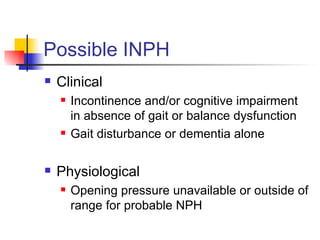
Possible INPH Clinical Incontinence and/or cognitive impairment in absence of gait or balance dysfunction Gait disturbance or dementia alone Physiological Opening pressure unavailable or outside of range for probable NPH
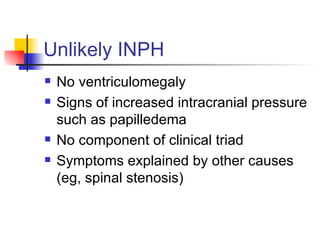
Unlikely INPH No ventriculomegaly Signs of increased intracranial pressure such as papilledema No component of clinical triad Symptoms explained by other causes (eg, spinal stenosis)
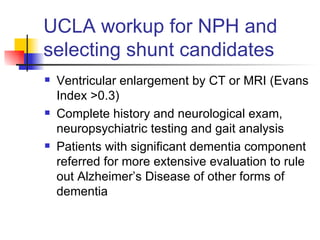
UCLA workup for NPH and selecting shunt candidates Ventricular enlargement by CT or MRI (Evans Index >0.3) Complete history and neurological exam, neuropsychiatric testing and gait analysis Patients with significant dementia component referred for more extensive evaluation to rule out Alzheimer’s Disease of other forms of dementia
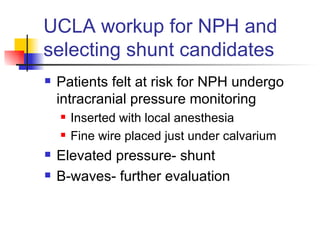
UCLA workup for NPH and selecting shunt candidates Patients felt at risk for NPH undergo  intracranial pressure monitoring Inserted with local anesthesia Fine wire placed just under calvarium Elevated pressure- shunt B-waves- further evaluation
UCLA workup for NPH and selecting shunt candidates Cerebrospinal Fluid Outflow Resistance Lumbar puncture performed Artificial spinal fluid infused Rise in ICP recorded by previously inserted ICP monitor Resistance to absorbtion of infused fluid calculated High resistance- shunt Normal resistance- further testing
UCLA workup for NPH and selecting shunt candidates Trial CSF drainage 3 day trial Small volumes removed- 30-50 cc Improved symptoms- shunt No improvement- no further studies, shunt no longer considered
UCLA workup for NPH and selecting shunt candidates Studies not performed Cisternogram High volume CSF drainage PET scan SPECT scan Tests felt not warranted due to expense or increased patient risk MRI flow void not routinely done as felt to be non-specific Further testing felt to add minimal additional prognostic information
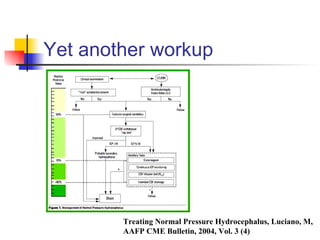
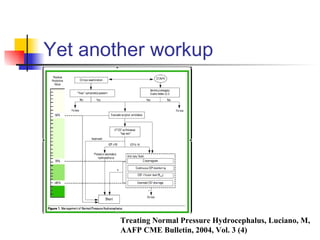
Yet another workup Treating Normal Pressure Hydrocephalus, Luciano, M, AAFP CME Bulletin, 2004, Vol. 3 (4)
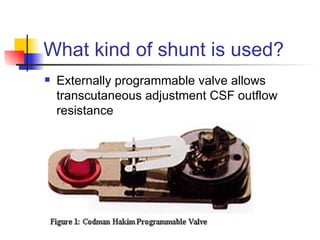
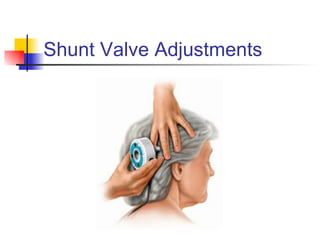
What kind of shunt is used? Externally programmable valve allows transcutaneous adjustment CSF outflow resistance
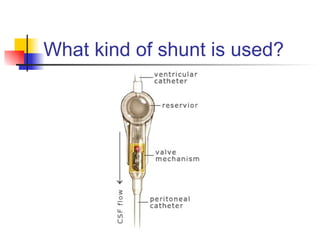
What kind of shunt is used?
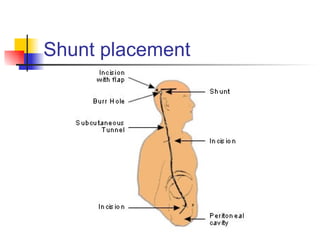
Shunt placement
Shunt Valve Adjustments
Now that my patient has had a shunt what happens next? Monitoring of mental function Patients should have neuropsychiatric testing prior to shunt Periodic testing post shunt to document improvement
Now that my patient has had a shunt what happens next? Monitor for complications of shunt Infection Shunt malfunction Excessive CSF drainage Subdural hematoma
Summary Best patients for shunt have gait disturbance with mild mental impairment Improvement with CSF drainage predict good response to shunt but lack of improvement of limited prognostic value Patients with significant dementia and limited gait disturbance unlikely to benefit from shunt.
Cochrane Database Conclusion: There is no evidence to indicate whether placement of a shunt is effective in the management of NPH. Conclusion based upon lack of randomized controlled trials
Suggested references Diagnosis and management of normal pressure hydrocephalus, Vanneste, JA, JNeurol (2000) 247:5–14 Neurosurgery: Vol. 57(3) Supplement, September 2005 Normal pressure hydrocephalus: an update, Stein, SC, Neurosurgery   Quarterly (2001) 11 (1):26–35 University of California- Los Angeles-  http://www.neurosurgery.ucla.edu/Diagnoses/Adult/AdultDis_1.html University of Virginia-  http://www.healthsystem.virginia.edu/internet/neurogram/neurogram3_3_nph.cfm
 

Normal Pressure Hydrocephalus

  • 1.
    Normal Pressure HydrocephalusJerry Ryan MD University of Wisconsin - Madison
  • 2.
    Objectives 1. Evaluatepatients suspected of having NPH and distinguish NPH from other causes of gait disturbance, incontinence and dementia 2. Identify patients who need referral for consideration of treatment of NPH. 3. Understand treatment of NPH and follow patients who have received neurosurgical interventions for NPH in the office. 4. Educate patients with NPH and their families about the disorder.
  • 3.
    How big isthe problem? Prevalence Normal Pressure Hydrocephalus (NPH) Estimates vary from 0- 5% as a cause for dementia Some of variation due to inconsistent definition of NPH Study of 166 patients shunted for presumed NPH calculated incidence of shunt responsive NPH to be one patient per 2.2 million persons per year J Vanneste, P Augustijn, C Dirven, WF Tan and ZD Goedhart Neurology 1992;42:54–9
  • 4.
    So why doI need to know about NPH? Potentially reversible cause of significant morbidity Recent direct to consumer advertising
  • 5.
    What should FamilyPhysicians know about NPH? Diagnostic features Diagnostic studies Limitations of prognostic studies Patients likely to benefit from treatment Complications of treatment Patient follow up
  • 6.
    Etiology 50% casesidiopathic Leading theory is impairment of CSF outflow Intraventricular pressure studies reveal waves of increased pressure- B-waves Adult hydrocephalus syndrome Adult symptomatic hydrocephalus
  • 7.
    Etiology 50% casesNPH secondary to other illnesses Subarachnoid hemorrhage Meningitis Cranial trauma Secondary NPH has higher response rate to shunting than idiopathic NPH
  • 8.
    Pathophysiology Ventricle enlargementleads to periventricular ischemia regardless of etiology Compression and stretching of arterioles and venules Arterial hypertension and cerebral arteriosclerosis increased in NPH
  • 9.
    CSF pathway CSFproduced by choroid plexus at rate approximately 20 ml/hr Flows from lateral ventricles through foramina of Monro into third ventricle Enters fourth ventricle through aqueduct of Sylvius Enters subarachnoid space Resorbed by arachnoid villi at top of brain
  • 10.
  • 11.
    Diagnostic Triad GaitDisturbance Urinary Incontinence Dementia
  • 12.
    Diagnostic Triad Gaitdisturbance No classic gait disturbance Gait may be wide based, shuffling More severely affected patients have “magnetic gait”- feet stuck to ground and difficult to initiate walking Difficulties with walking motions resolve with minimal support of patient or lying patient down May resemble Parkinson’s gait Not associated with limb weakness Hyperreflexia
  • 13.
    Diagnostic Triad UrinaryIncontinence True incontinence found only in severely affected patients Urinary urgency in most patients with NPH Due to stretching of periventricular nerve fibers and loss of detrusor inhibition Bladder sphincter muscle unaffected
  • 14.
    Diagnostic Triad DementiaPresence of dementia in NPH extremely variable Some shunt responsive patients have little or no dementia Dementia usually least responsive of symptoms to intervention Mental status changes may resemble depression
  • 15.
    Differential Diagnoses- Alzheimer’s(AD) Both AD and NPH cause memory impairment AD- “cortical” abnormalities Aphasia, Apraxia, Agnosia Impaired recognition and encoding deficits NPH- “subcortical” abnormalities Memory impairment but intact recognition Slow information processing Difficulty with complex tasks
  • 16.
    Cognitive Impairments ADversus NPH Auditory memory Attention/concentration Executive function Behavior/personality changes Motor and psychomotor skills Visuospatial skills Language Reading Borderline Impaired Psychomotor slowing Fine motor speed Fine motor accuracy Memory Learning Orientation Attention/concentration Executive function Writing Impaired NPH AD
  • 17.
    Differential Diagnoses- Alzheimer’s(AD) AD and NPH can usually be distinguished with formal neuropsychological testing Primary care office testing may not be adequate to distinguish Mental impairment early in course of AD but usually late in course of NPH and often minimal impairment AD often associated with hippocampal atrophy on imaging studies
  • 18.
    Differential Diagnoses- Parkinson’sDisease Both NPH and Parkinson’s Disease (PD) can have similar gait disturbances Hypokinesia Freezing Imbalance Extrapyramidal symptoms Trial of levadopa can help distinguish between PD and NPH
  • 19.
    Differential Diagnoses- OtherDepression Subcortical arteriosclerotic encephalopathy Multi-infarct encephalopathy Chronic alcoholism B 12 , Folate deficiency Electrolyte abnormalities Cervical or lumbar stenosis Peripheral neuropathy
  • 20.
    Diagnostic studies Ventricleenlargement on CT or MRI Severity graded by ratio of maximal frontal horn width divided by transverse inner diameter of skull 0.32 minimal for NPH but 0.40 more typical Lack of hippocampus or cortical atrophy Periventricular and cortical white matter lesions may be found in patients with NPH Large number white matter lesions may be marker for poor response to shunting
  • 21.
  • 22.
  • 23.
  • 24.
  • 25.
  • 26.
    So now thatI know it’s NPH what next? Response to shunting varies significantly between patients Study 166 shunted NPH patients Overall response 36%, only 21% significant improvement Only 15% of patients with idiopathic NPH showed marked improvement J Vanneste, P Augustijn, C Dirven, WF Tan and ZD Goedhart Neurology 1992;42:54–9
  • 27.
    Any Problems WithShunting? Complications of shunting Low immediate post-surgical risks Severe to moderate shunt related morbidity of 28% Infection Shunt malfunction Intracranial bleed Death or severe morbidity 7% J Vanneste, P Augustijn, C Dirven, WF Tan and ZD Goedhart Neurology 1992;42:54-9
  • 28.
  • 29.
    Are Benefits ofShunting Long Lasting? Most studies show fairly significant decline in benefits over time Initial improvement 60-75% of patients Sustained improvement only 24-42% Results confounded due to high mortality from co-morbid conditions 57% patients dead within 5 years in study by Raftopoulos et.al.
  • 30.
    How can Itell who will benefit? Good response to shunting Clinical presentation Gait disturbance preceded mental impairment Short duration of mild mental impairment Known cause of NPH- e.g. infection, bleed
  • 31.
    How can Itell who will benefit? Good response to shunting Special studies Lack of white matter lesions on MRI Marked resolution of symptoms with CSF drainage One time removal 30-50 cc CSF Multi-day drainage of 100-150 cc CSF B-waves greater than 50% of time with continuous intracranial pressure (ICP) monitoring Resistance to CSF outflow greater than 18 mmHg
  • 32.
    How can Itell who will benefit? Poor response to shunting Severe dementia Dementia presenting symptom MRI abnormalities Cerebral atrophy Multiple white matter lesions
  • 33.
    How can Itell who will benefit? Indeterminate significance Patient age Duration of symptoms Lack of response to removal CSF
  • 34.
    How accurate arepredictors of response to shunting? Normal pressure hydrocephalus: an update, Stein, SC, Neurosurgery Quarterly (2001) 11 (1):26–35
  • 35.
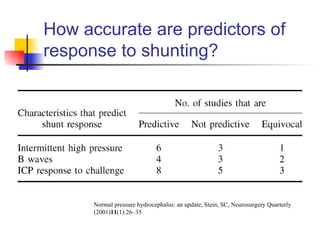
    How accurate arepredictors of response to shunting? Normal pressure hydrocephalus: an update, Stein, SC, Neurosurgery Quarterly (2001) 11 (1):26–35
  • 36.
    NPH Guidelines Worldwidegroup of experts assembled to develop guidelines for diagnosis and treatment of NPH Meetings supported by shunt manufacturer Limited number of RCT’s noted by group Report published in Neurosurgery: Vol. 57 (3), Sept 2005 Supplement
  • 37.
    Diagnosis- Probable IdiopathicNPH History Insidious onset Age over 40 Symptom duration 3-6 months No antecedent event known to cause secondary NPH Progressive over time No other medical, psychiatric or neurological condition that could cause symptoms
  • 38.
    Diagnosis- Probable IdiopathicNPH Brain imaging Ventricular enlargement not attributable to cerebral atrophy or congenital disorder No macroscopic obstruction present At least one of the following Enlargement of lateral horns not attributable to hippocampus atrophy Callosal angle greater or equal to 40 degrees Evidence of altered brain water content on imaging not attributable ischemia or demylination An aqueductal or fourth ventricular flow void on MRI
  • 39.
    Callosal angle Angleof roof of lateral ventricles in A-P projection
  • 40.
    MRI flow voidLoss of MRI signal due to flow of CSF Normal aqueduct Abnormal aqueduct
  • 41.
    MRI flow voidNormal fourth ventricle Abnormal fourth ventricle
  • 42.
    Diagnosis- Probable IdiopathicNPH Clinical Gait/Balance- at least two of following present Decreased step height Decreased step length Decreased cadence/speed Decreased trunk sway Widened stance Toes turned outward while walking En bloc turning- turns take three or more steps Impaired balance- two or more corrective steps for eight steps on tandem gait testing
  • 43.
    Diagnosis- Probable IdiopathicNPH Cognition- two of following present Psychomotor slowing Decreased fine motor speed Decreased fine motor accuracy Difficulty dividing or maintaining attention Impaired recall especially for recent events Impairment of executive functions- multi-step procedures, working memory, formulation of abstractions, insight Behavioral or personality changes
  • 44.
    Diagnosis- Probable IdiopathicNPH Urinary Symptoms- one of following Episodic urinary incontinence not attributable to other causes Persistent urinary incontinence Fecal and urinary incontinence OR One of following Urinary urgency Urinary frequency- 6 or more voids in 12 hour period Nocturia- more than two voids in night
  • 45.
    Diagnosis- Probable IdiopathicNPH Physiological Opening pressure 5-18 mmHg
  • 46.
    Possible INPH History-Symptoms are Subacute or indeterminate onset Onset any time after childhood <3 months or indeterminate duration May follow trauma, hemorrhage or meningitis Symptoms not entirely explained by co-existing neurological conditions Non-progressive or not clearly progressive
  • 47.
    Possible INPH Brainimaging- Ventricular enlargement associated with following Cerebral atrophy of sufficient severity to explain ventricular enlargement Structural lesion that may increase ventricular size
  • 48.
    Possible INPH ClinicalIncontinence and/or cognitive impairment in absence of gait or balance dysfunction Gait disturbance or dementia alone Physiological Opening pressure unavailable or outside of range for probable NPH
  • 49.
    Unlikely INPH Noventriculomegaly Signs of increased intracranial pressure such as papilledema No component of clinical triad Symptoms explained by other causes (eg, spinal stenosis)
  • 50.
    UCLA workup forNPH and selecting shunt candidates Ventricular enlargement by CT or MRI (Evans Index >0.3) Complete history and neurological exam, neuropsychiatric testing and gait analysis Patients with significant dementia component referred for more extensive evaluation to rule out Alzheimer’s Disease of other forms of dementia
  • 51.
    UCLA workup forNPH and selecting shunt candidates Patients felt at risk for NPH undergo intracranial pressure monitoring Inserted with local anesthesia Fine wire placed just under calvarium Elevated pressure- shunt B-waves- further evaluation
  • 52.
    UCLA workup forNPH and selecting shunt candidates Cerebrospinal Fluid Outflow Resistance Lumbar puncture performed Artificial spinal fluid infused Rise in ICP recorded by previously inserted ICP monitor Resistance to absorbtion of infused fluid calculated High resistance- shunt Normal resistance- further testing
  • 53.
    UCLA workup forNPH and selecting shunt candidates Trial CSF drainage 3 day trial Small volumes removed- 30-50 cc Improved symptoms- shunt No improvement- no further studies, shunt no longer considered
  • 54.
    UCLA workup forNPH and selecting shunt candidates Studies not performed Cisternogram High volume CSF drainage PET scan SPECT scan Tests felt not warranted due to expense or increased patient risk MRI flow void not routinely done as felt to be non-specific Further testing felt to add minimal additional prognostic information
  • 55.
    Yet another workupTreating Normal Pressure Hydrocephalus, Luciano, M, AAFP CME Bulletin, 2004, Vol. 3 (4)
  • 56.
    Yet another workupTreating Normal Pressure Hydrocephalus, Luciano, M, AAFP CME Bulletin, 2004, Vol. 3 (4)
  • 57.
    What kind ofshunt is used? Externally programmable valve allows transcutaneous adjustment CSF outflow resistance
  • 58.
    What kind ofshunt is used?
  • 59.
  • 60.
  • 61.
    Now that mypatient has had a shunt what happens next? Monitoring of mental function Patients should have neuropsychiatric testing prior to shunt Periodic testing post shunt to document improvement
  • 62.
    Now that mypatient has had a shunt what happens next? Monitor for complications of shunt Infection Shunt malfunction Excessive CSF drainage Subdural hematoma
  • 63.
    Summary Best patientsfor shunt have gait disturbance with mild mental impairment Improvement with CSF drainage predict good response to shunt but lack of improvement of limited prognostic value Patients with significant dementia and limited gait disturbance unlikely to benefit from shunt.
  • 64.
    Cochrane Database Conclusion:There is no evidence to indicate whether placement of a shunt is effective in the management of NPH. Conclusion based upon lack of randomized controlled trials
  • 65.
    Suggested references Diagnosisand management of normal pressure hydrocephalus, Vanneste, JA, JNeurol (2000) 247:5–14 Neurosurgery: Vol. 57(3) Supplement, September 2005 Normal pressure hydrocephalus: an update, Stein, SC, Neurosurgery Quarterly (2001) 11 (1):26–35 University of California- Los Angeles- http://www.neurosurgery.ucla.edu/Diagnoses/Adult/AdultDis_1.html University of Virginia- http://www.healthsystem.virginia.edu/internet/neurogram/neurogram3_3_nph.cfm
  • 66.