- S H U C H I J O S H I
CONUS MEDULLARIS
SYNDROME
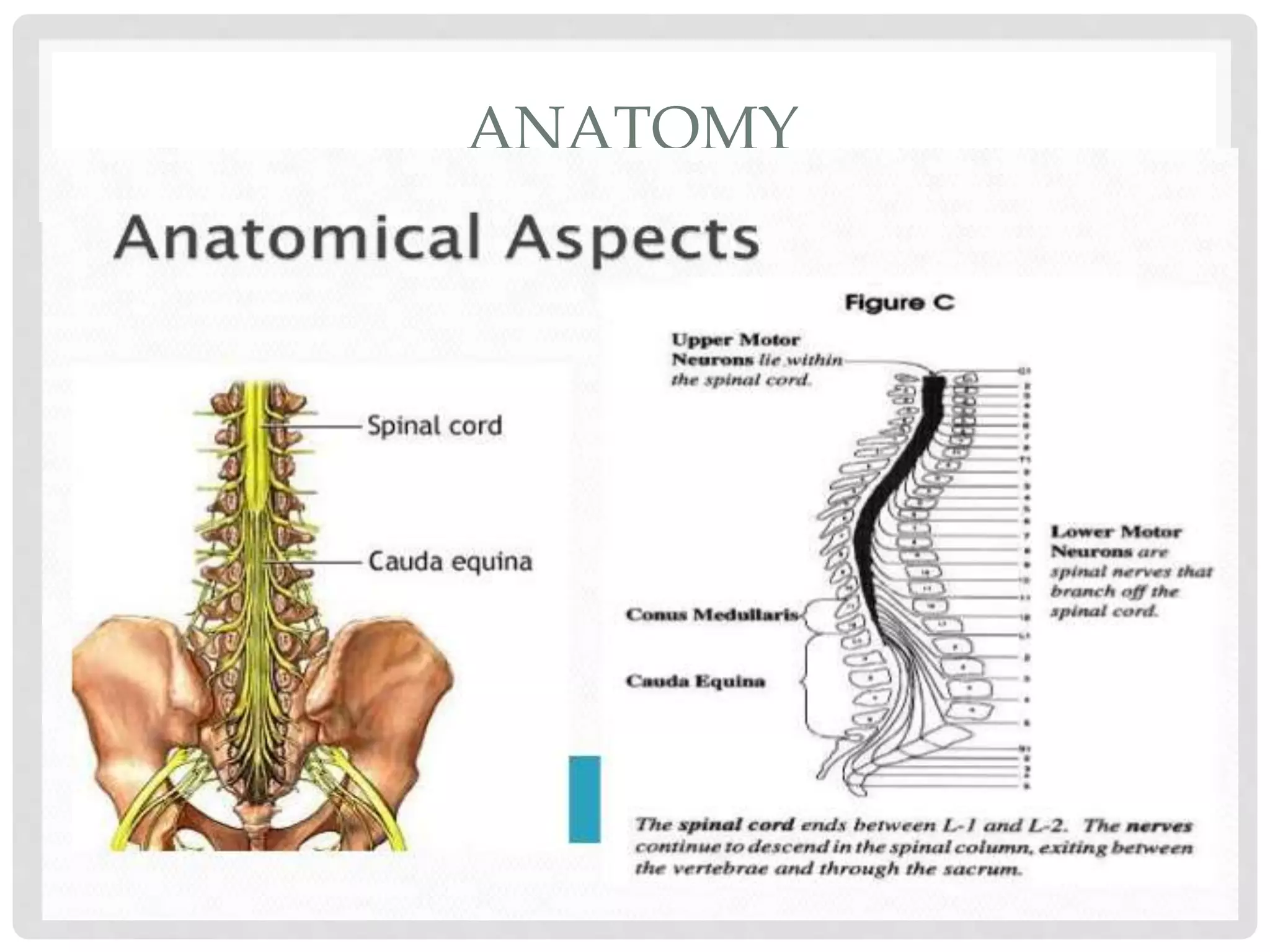
ANATOMY
24/11/2016 3
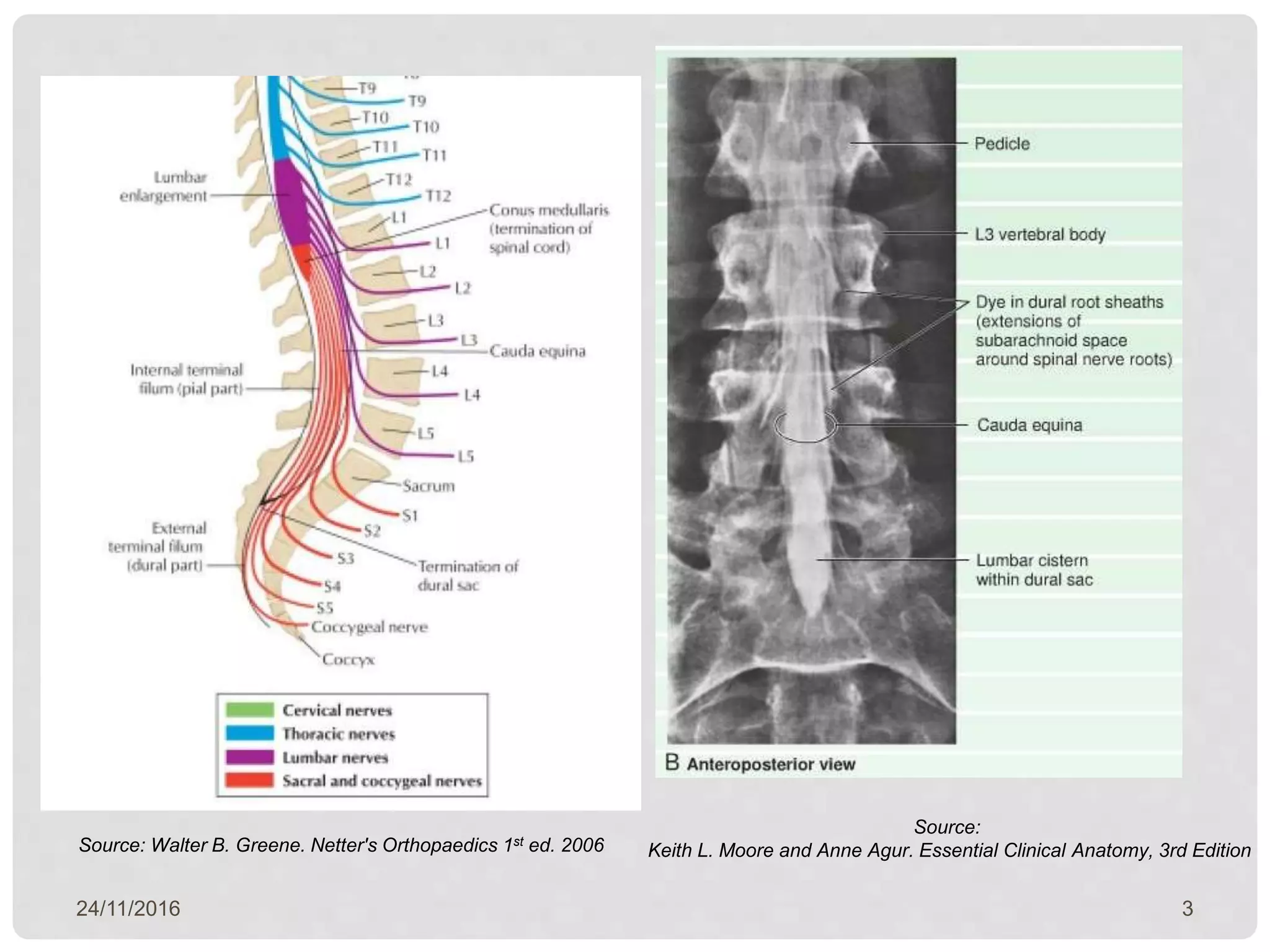
Source: Walter B. Greene. Netter's Orthopaedics 1st ed. 2006
Source:
Keith L. Moore and Anne Agur. Essential Clinical Anatomy, 3rd Edition
24/11/2016 4
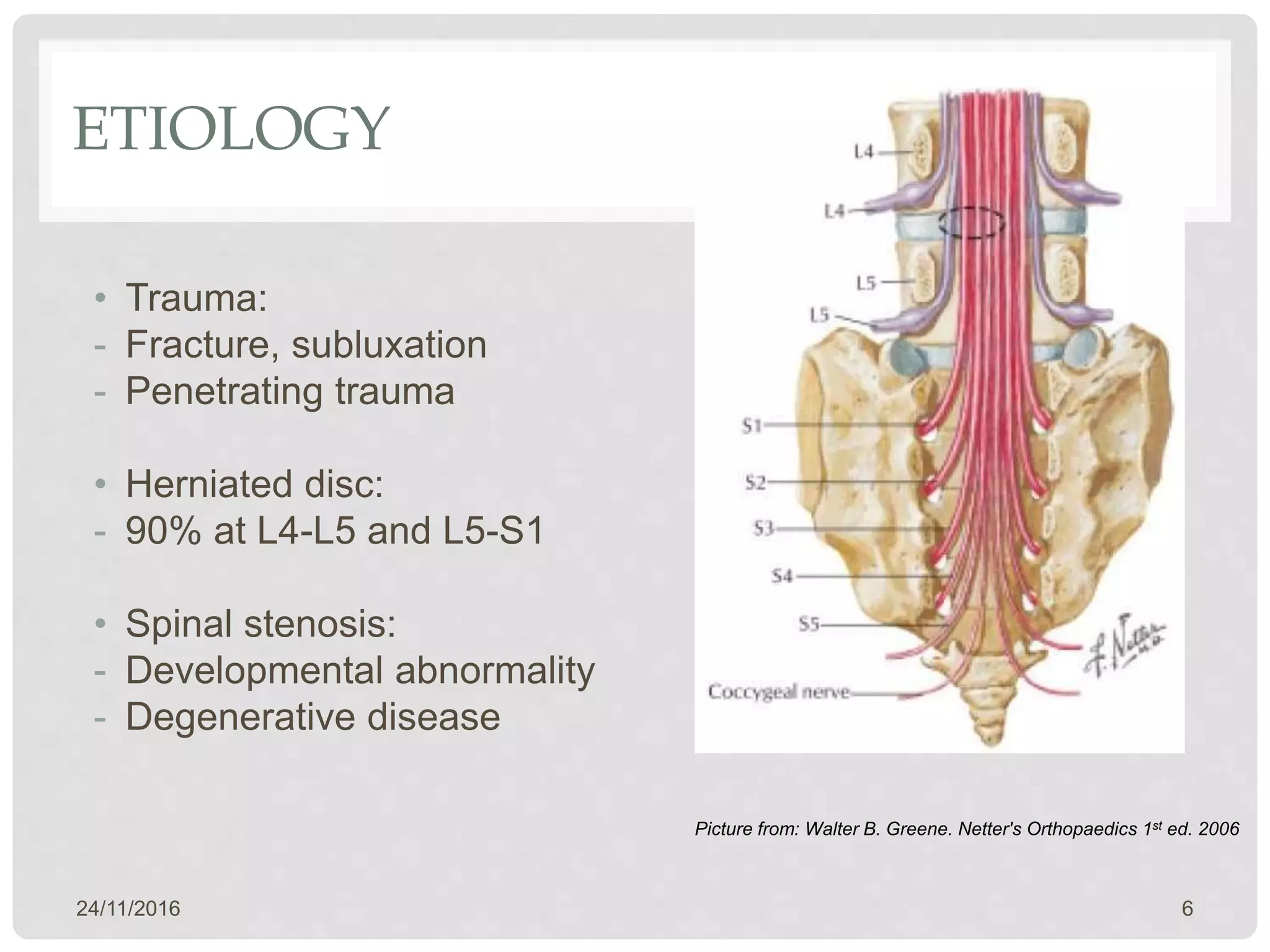
ETIOLOGY
• Trauma:
- Fracture, subluxation
- Penetrating trauma
• Herniated disc:
- 90% at L4-L5 and L5-S1
• Spinal stenosis:
- Developmental abnormality
- Degenerative disease
24/11/2016 6
Picture from: Walter B. Greene. Netter's Orthopaedics 1st ed. 2006
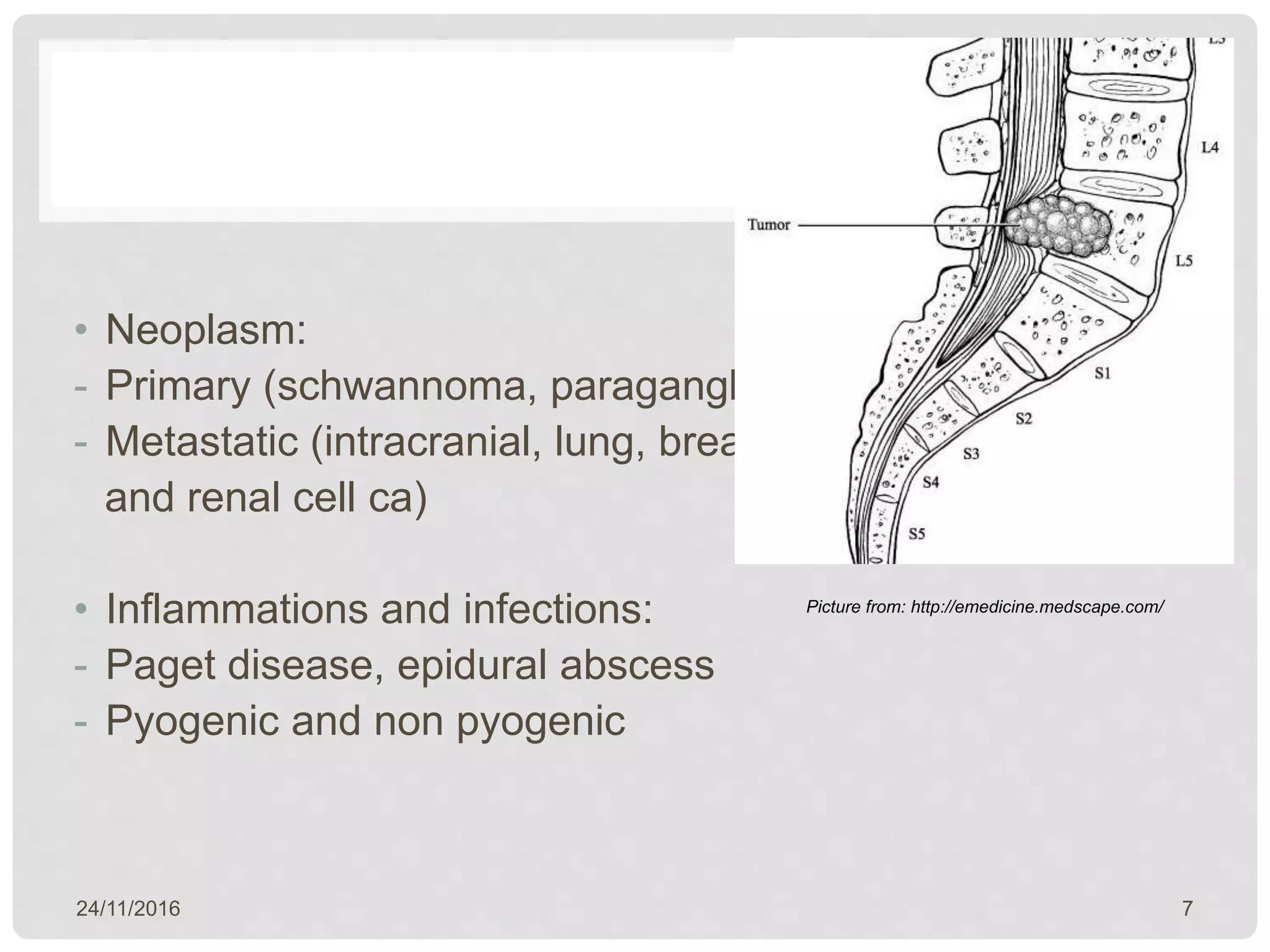
• Neoplasm:
- Primary (schwannoma, paraganglioma)
- Metastatic (intracranial, lung, breast
and renal cell ca)
• Inflammations and infections:
- Paget disease, epidural abscess
- Pyogenic and non pyogenic
24/11/2016 7
Picture from: http://emedicine.medscape.com/
• Iatrogenic:
- Misplaced pedicle screw, laminar hooks
- Continuous spinal anesthesia
24/11/2016 8
Picture from: http://www.science-art.com
CONUS MEDULLARIS SYNDROME
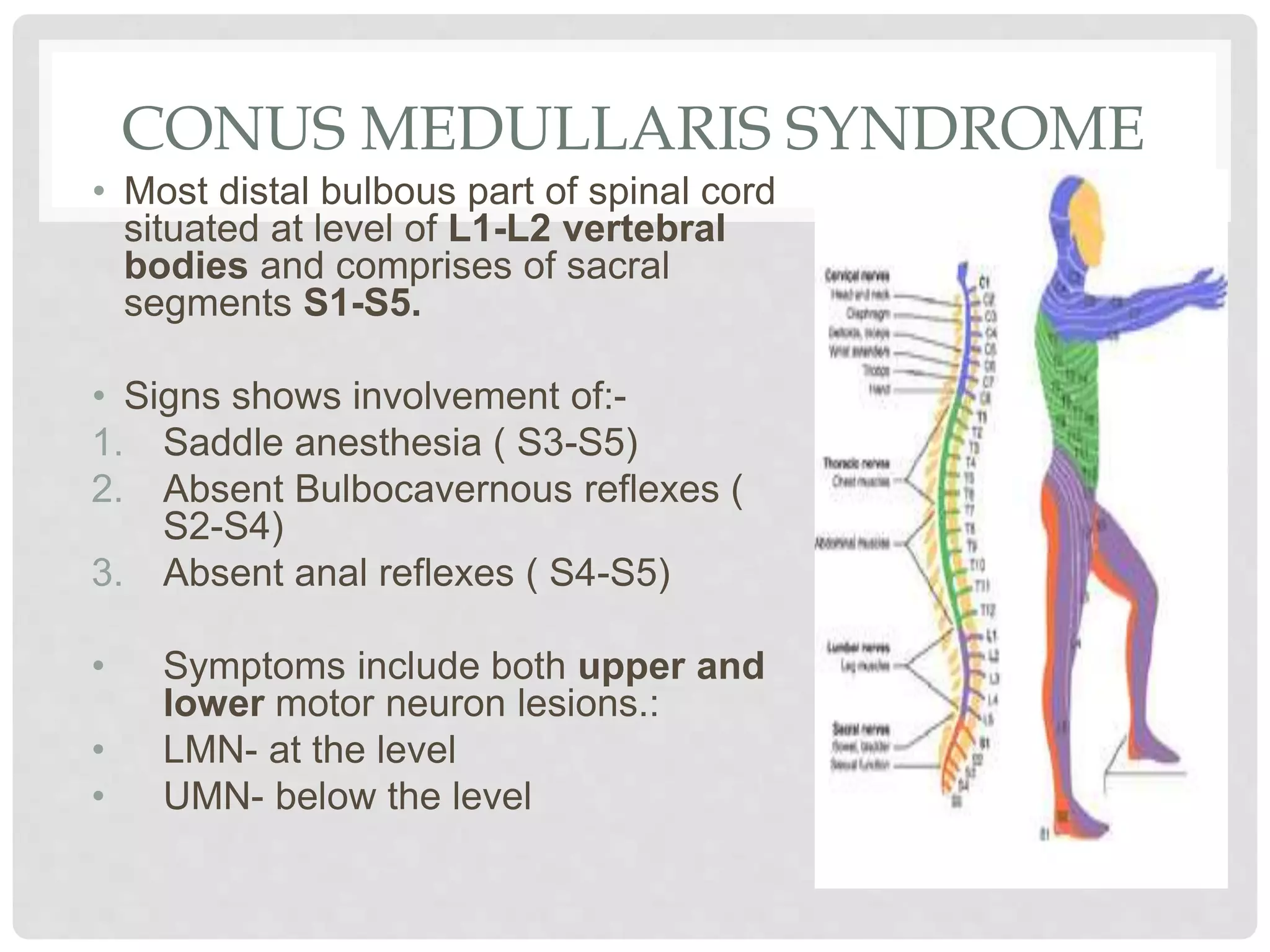
• Most distal bulbous part of spinal cord
situated at level of L1-L2 vertebral
bodies and comprises of sacral
segments S1-S5.
• Signs shows involvement of:-
1. Saddle anesthesia ( S3-S5)
2. Absent Bulbocavernous reflexes (
S2-S4)
3. Absent anal reflexes ( S4-S5)
• Symptoms include both upper and
lower motor neuron lesions.:
• LMN- at the level
• UMN- below the level
CONUS MEDULLARIS SYNDROME
• Symptoms
• Back pain
• Unilateral or bilateral leg pain
• Bladder dysfunction
• Bowel dysfunction
• Sexual dysfunction
• Diminished rectal tone
• Perianal sensory loss
• Lower extremity spasticity: specifically in muscles supplied by
myotomes S1-S5
CAUDA EQUINA SYNDROME
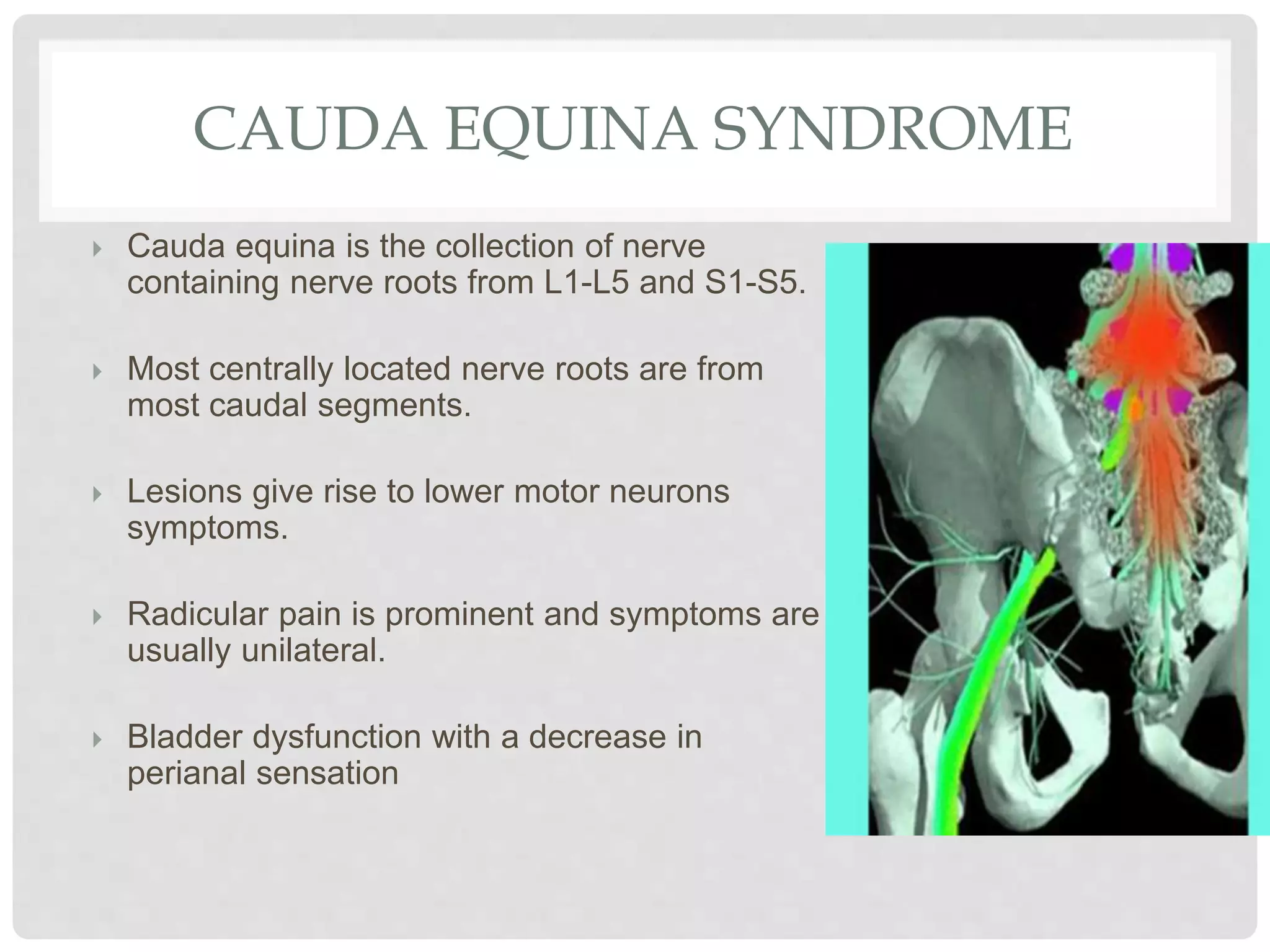
 Cauda equina is the collection of nerve
containing nerve roots from L1-L5 and S1-S5.
 Most centrally located nerve roots are from
most caudal segments.
 Lesions give rise to lower motor neurons
symptoms.
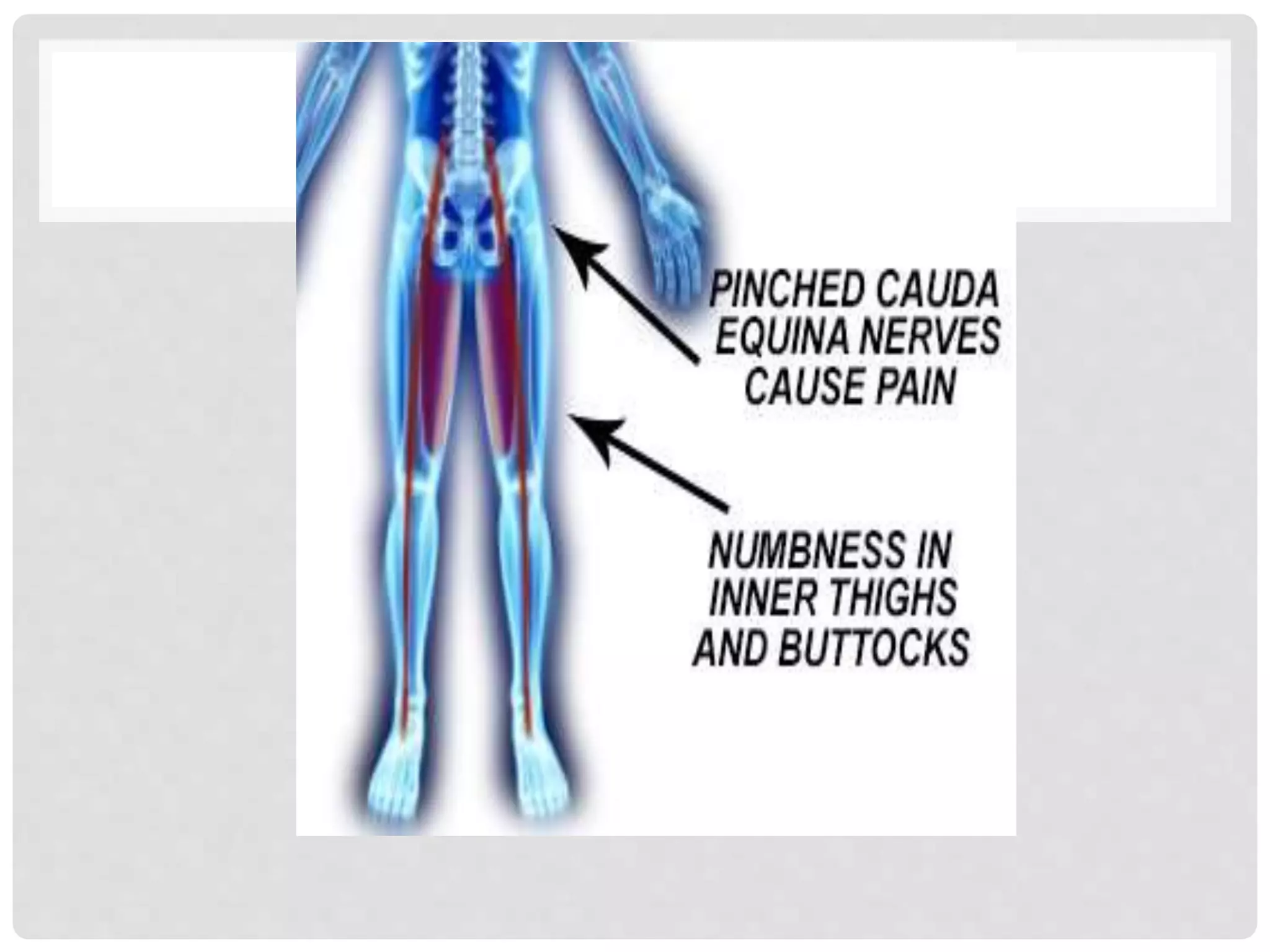
 Radicular pain is prominent and symptoms are
usually unilateral.
 Bladder dysfunction with a decrease in
perianal sensation
• Early radicular pain in the distribution of the lumbosacral roots due to the compression of the lumbar and sacral roots
below the L3 vertebral level.
• With extensive lesions, patients develop flaccid, hypotonic, areflexic paralysis that affects the glutei, posterior
thigh muscles, and anterolateral muscles of the leg and foot, resulting in a true peripheral type of paraplegia.
• Sensory testing usually reveals an asymmetric sensory loss in the saddle region, involving the anal, perineal, and
genital regions extending to the dorsal aspect of the thigh, the anterolateral aspect of the leg, and the outer aspect
of the foot.
CAUDA EQUINA SYNDROME
• Etiologies
• Disc herniation
• Disc fragment migration
• Iatrogenic epidural hematoma
• Post LP or spinal anesthesia
• Postoperatively
• Infection
• Tumor
• Trauma
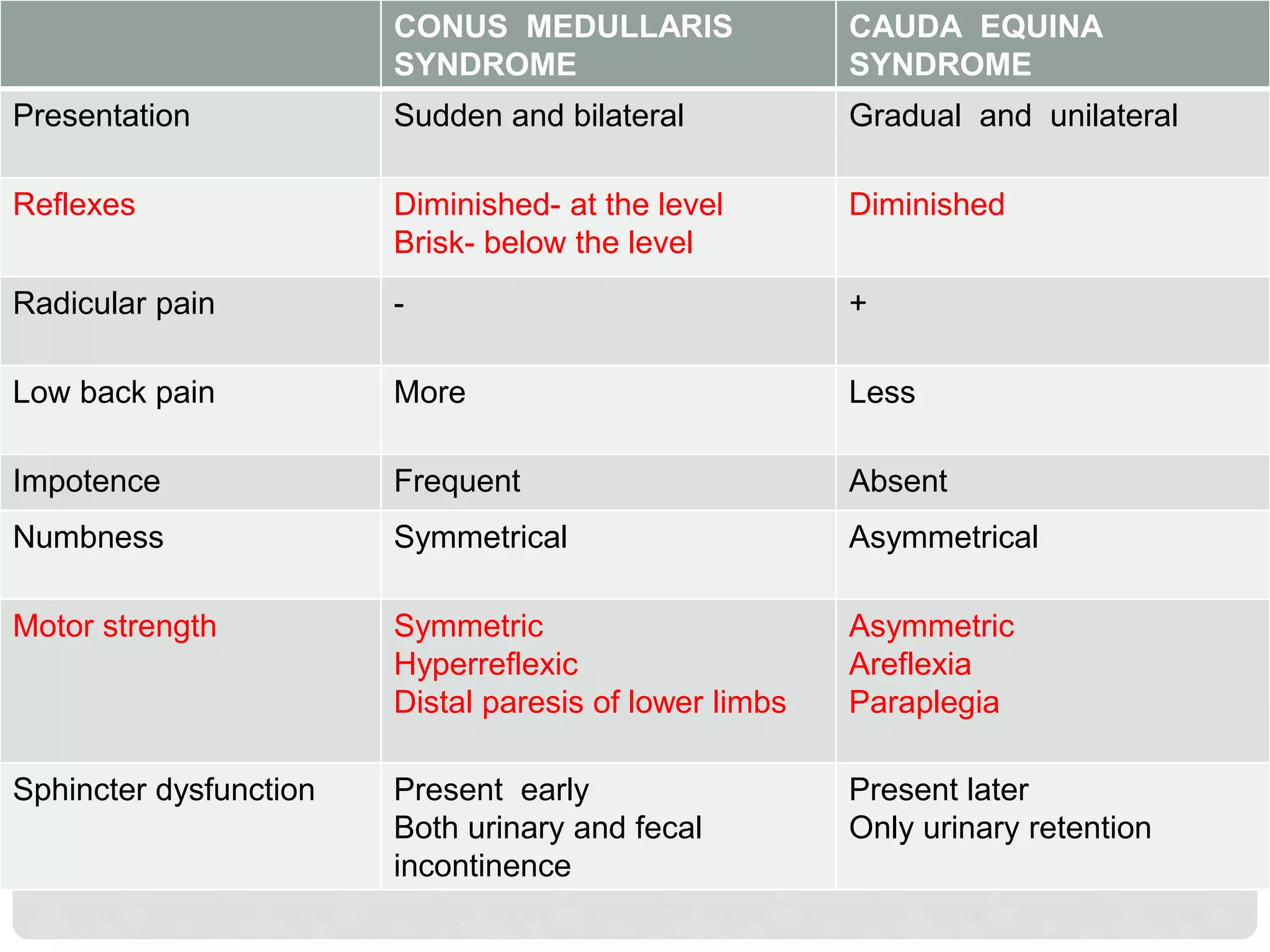
CONUS MEDULLARIS
SYNDROME
CAUDA EQUINA
SYNDROME
Presentation Sudden and bilateral Gradual and unilateral
Reflexes Diminished- at the level
Brisk- below the level
Diminished
Radicular pain - +
Low back pain More Less
Impotence Frequent Absent
Numbness Symmetrical Asymmetrical
Motor strength Symmetric
Hyperreflexic
Distal paresis of lower limbs
Asymmetric
Areflexia
Paraplegia
Sphincter dysfunction Present early
Both urinary and fecal
incontinence
Present later
Only urinary retention
INVESTIGATIONS
• Radiology – MRI
• Laboratory – FBC, ESR
• Needle electromyography of the bilateral external anal
sphincter muscles
• Lumbar puncture
24/11/2016 20
24/11/2016 21
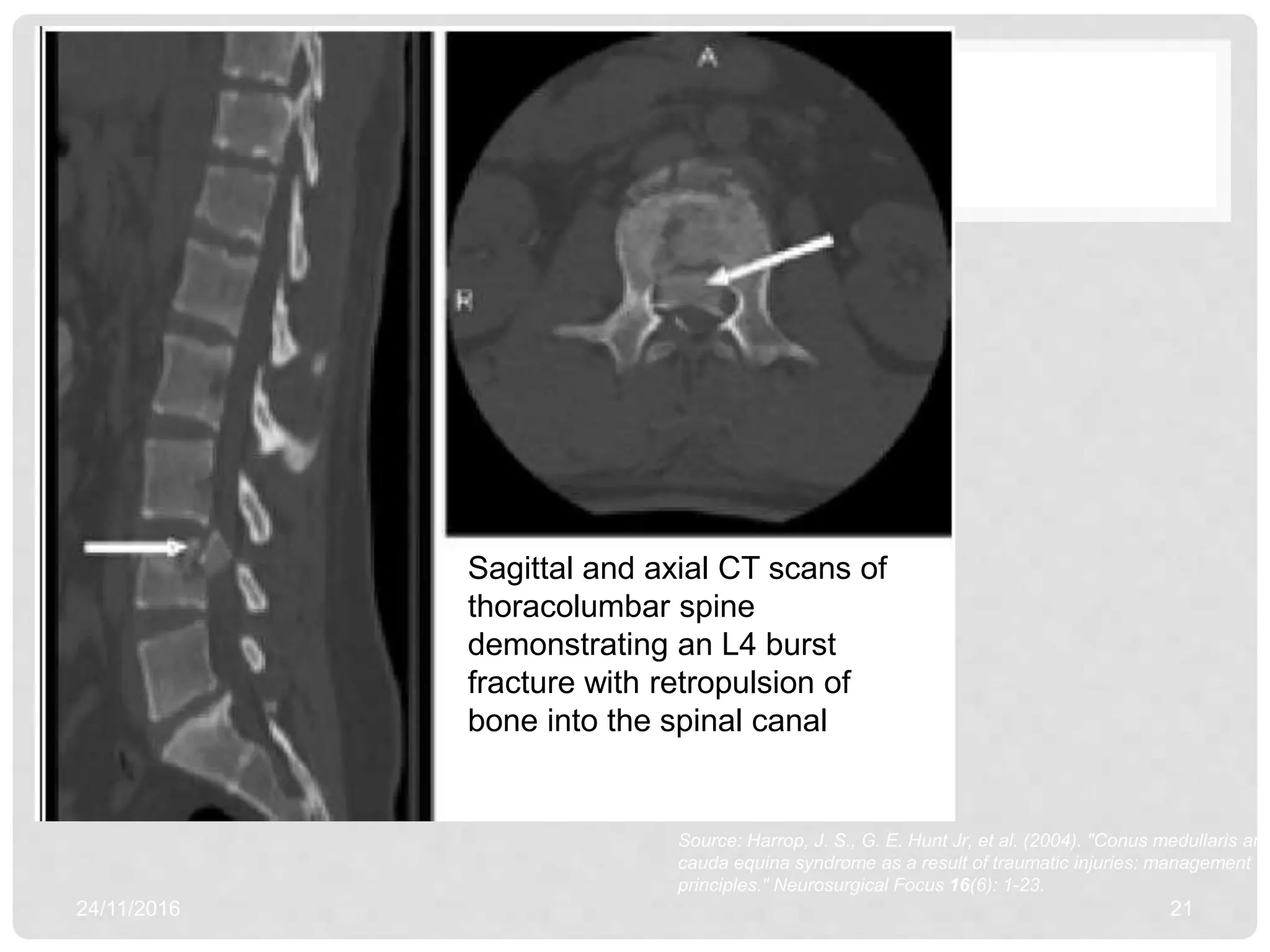
Sagittal and axial CT scans of
thoracolumbar spine
demonstrating an L4 burst
fracture with retropulsion of
bone into the spinal canal
Source: Harrop, J. S., G. E. Hunt Jr, et al. (2004). "Conus medullaris and
cauda equina syndrome as a result of traumatic injuries: management
principles." Neurosurgical Focus 16(6): 1-23.
24/11/2016 22
Sagittal MRI images
demonstrating large
central disc
extrusion at L5-S1
(arrows) with
compression on the
cauda equina.
Source: Levis, J. T. (2009). "Cauda
equina syndrome." Western
Journal of Emergency Medicine
10(1): 20.
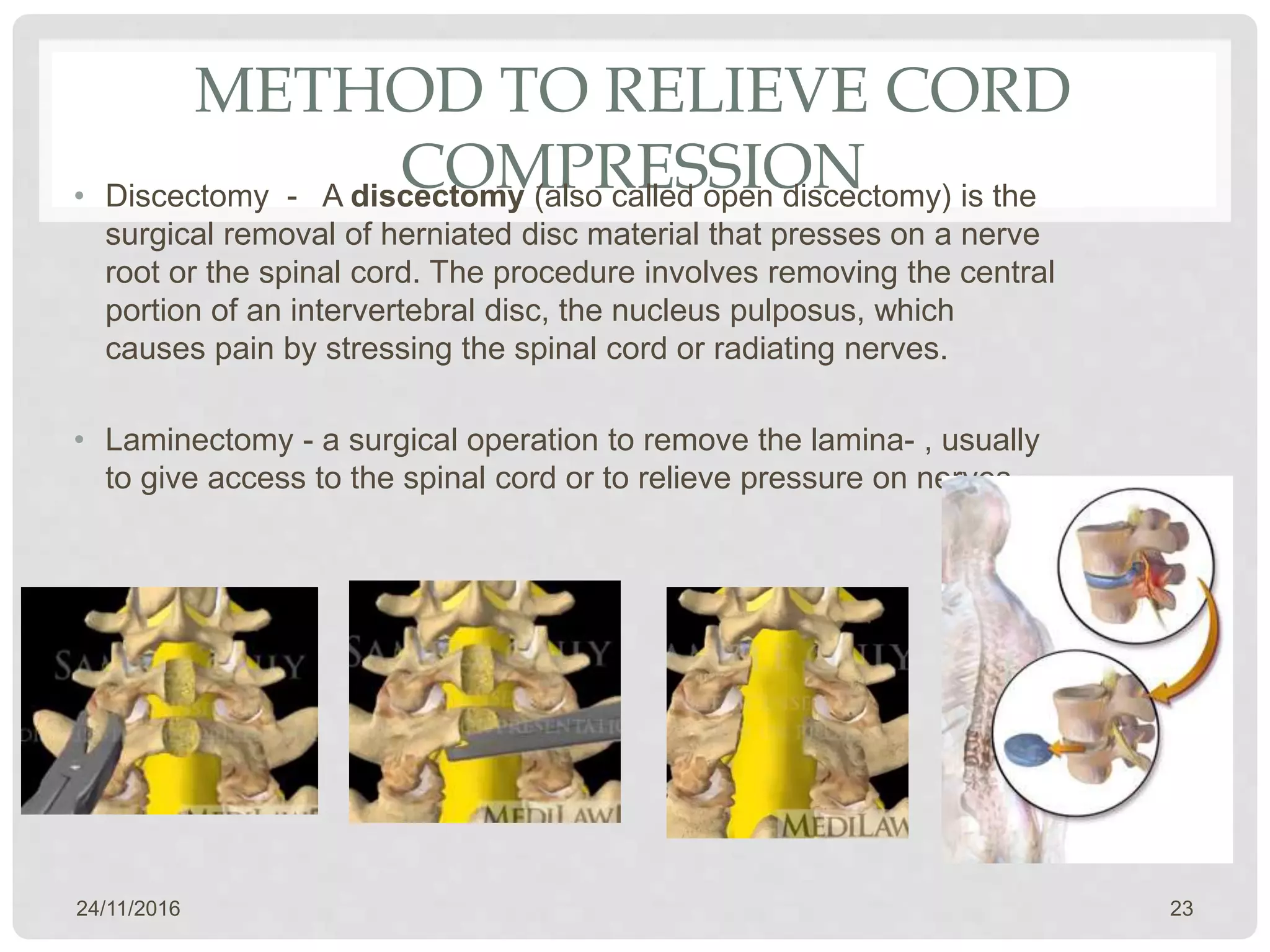
METHOD TO RELIEVE CORD
COMPRESSION• Discectomy - A discectomy (also called open discectomy) is the
surgical removal of herniated disc material that presses on a nerve
root or the spinal cord. The procedure involves removing the central
portion of an intervertebral disc, the nucleus pulposus, which
causes pain by stressing the spinal cord or radiating nerves.
• Laminectomy - a surgical operation to remove the lamina- , usually
to give access to the spinal cord or to relieve pressure on nerves.
24/11/2016 23
24/11/2016 24
Corpectomy

CAUDA EQUINA VS CONUS MEDULLARIS SYNDROME

  • 1.
    - S HU C H I J O S H I CONUS MEDULLARIS SYNDROME
  • 2.
  • 3.
    24/11/2016 3 Source: WalterB. Greene. Netter's Orthopaedics 1st ed. 2006 Source: Keith L. Moore and Anne Agur. Essential Clinical Anatomy, 3rd Edition
  • 4.
  • 6.
    ETIOLOGY • Trauma: - Fracture,subluxation - Penetrating trauma • Herniated disc: - 90% at L4-L5 and L5-S1 • Spinal stenosis: - Developmental abnormality - Degenerative disease 24/11/2016 6 Picture from: Walter B. Greene. Netter's Orthopaedics 1st ed. 2006
  • 7.
    • Neoplasm: - Primary(schwannoma, paraganglioma) - Metastatic (intracranial, lung, breast and renal cell ca) • Inflammations and infections: - Paget disease, epidural abscess - Pyogenic and non pyogenic 24/11/2016 7 Picture from: http://emedicine.medscape.com/
  • 8.
    • Iatrogenic: - Misplacedpedicle screw, laminar hooks - Continuous spinal anesthesia 24/11/2016 8 Picture from: http://www.science-art.com
  • 9.
    CONUS MEDULLARIS SYNDROME •Most distal bulbous part of spinal cord situated at level of L1-L2 vertebral bodies and comprises of sacral segments S1-S5. • Signs shows involvement of:- 1. Saddle anesthesia ( S3-S5) 2. Absent Bulbocavernous reflexes ( S2-S4) 3. Absent anal reflexes ( S4-S5) • Symptoms include both upper and lower motor neuron lesions.: • LMN- at the level • UMN- below the level
  • 10.
    CONUS MEDULLARIS SYNDROME •Symptoms • Back pain • Unilateral or bilateral leg pain • Bladder dysfunction • Bowel dysfunction • Sexual dysfunction • Diminished rectal tone • Perianal sensory loss • Lower extremity spasticity: specifically in muscles supplied by myotomes S1-S5
  • 12.
    CAUDA EQUINA SYNDROME Cauda equina is the collection of nerve containing nerve roots from L1-L5 and S1-S5.  Most centrally located nerve roots are from most caudal segments.  Lesions give rise to lower motor neurons symptoms.  Radicular pain is prominent and symptoms are usually unilateral.  Bladder dysfunction with a decrease in perianal sensation
  • 14.
    • Early radicularpain in the distribution of the lumbosacral roots due to the compression of the lumbar and sacral roots below the L3 vertebral level. • With extensive lesions, patients develop flaccid, hypotonic, areflexic paralysis that affects the glutei, posterior thigh muscles, and anterolateral muscles of the leg and foot, resulting in a true peripheral type of paraplegia. • Sensory testing usually reveals an asymmetric sensory loss in the saddle region, involving the anal, perineal, and genital regions extending to the dorsal aspect of the thigh, the anterolateral aspect of the leg, and the outer aspect of the foot.
  • 17.
    CAUDA EQUINA SYNDROME •Etiologies • Disc herniation • Disc fragment migration • Iatrogenic epidural hematoma • Post LP or spinal anesthesia • Postoperatively • Infection • Tumor • Trauma
  • 18.
    CONUS MEDULLARIS SYNDROME CAUDA EQUINA SYNDROME PresentationSudden and bilateral Gradual and unilateral Reflexes Diminished- at the level Brisk- below the level Diminished Radicular pain - + Low back pain More Less Impotence Frequent Absent Numbness Symmetrical Asymmetrical Motor strength Symmetric Hyperreflexic Distal paresis of lower limbs Asymmetric Areflexia Paraplegia Sphincter dysfunction Present early Both urinary and fecal incontinence Present later Only urinary retention
  • 20.
    INVESTIGATIONS • Radiology –MRI • Laboratory – FBC, ESR • Needle electromyography of the bilateral external anal sphincter muscles • Lumbar puncture 24/11/2016 20
  • 21.
    24/11/2016 21 Sagittal andaxial CT scans of thoracolumbar spine demonstrating an L4 burst fracture with retropulsion of bone into the spinal canal Source: Harrop, J. S., G. E. Hunt Jr, et al. (2004). "Conus medullaris and cauda equina syndrome as a result of traumatic injuries: management principles." Neurosurgical Focus 16(6): 1-23.
  • 22.
    24/11/2016 22 Sagittal MRIimages demonstrating large central disc extrusion at L5-S1 (arrows) with compression on the cauda equina. Source: Levis, J. T. (2009). "Cauda equina syndrome." Western Journal of Emergency Medicine 10(1): 20.
  • 23.
    METHOD TO RELIEVECORD COMPRESSION• Discectomy - A discectomy (also called open discectomy) is the surgical removal of herniated disc material that presses on a nerve root or the spinal cord. The procedure involves removing the central portion of an intervertebral disc, the nucleus pulposus, which causes pain by stressing the spinal cord or radiating nerves. • Laminectomy - a surgical operation to remove the lamina- , usually to give access to the spinal cord or to relieve pressure on nerves. 24/11/2016 23
  • 24.

Editor's Notes

  • #5 Dermatomes
  • #21 Diagnosis based on history & pe findings EMG-could help in predicting prognosis and monitoring recovery