Current Updates on Idiopathic Normal
Pressure Hydrocephalus
REVIEW ARTICLE
ASIAN JOURNAL OF NEUROSURGERY | VOLUME 14 | ISSUE 3 | JULY-SEPTEMBER 2019
 Idiopathic normal pressure hydrocephalus (iNPH) is one of the
neurodegenerative diseases which can be treated surgically with favorable
outcome.
 The gait disturbance, cognitive, and urinary symptoms are known as the
clinical triad of iNPH.
 This review, have addressed the comorbidities, differential diagnoses,
clinical presentations, and pathology of iNPH.
 Have also summarized the imaging studies and clinical procedures used
for the diagnosis of iNPH.
 The treatment modality, outcomes, and prognosis.
Idiopathic normal pressure
hydrocephalus (iNPH)
 commonly seen in the aging population.
 represents a rare cause of reversible neurological condition
 The gait disturbance, cognitive and urinary symptoms are known as the
clinical triad of iNPH.
 ventriculomegaly is one of the neuroradiological features
Co-Morbidities associated with iNPH
 Hypertension (40%–50%),
 diabetes mellitus (17%–23%),
 Alzheimer’s disease (AD) (14.8%),
 hyperlipidemia (13.5%)
 Others obesity, stroke and heart disease
Differential Diagnosis
 Parkinsonism represents 40% of iNPH mimics and 20% of possible or
probable iNPH
 Alzheimer’s disease – coexist with iNPH
 Other diseases may mimic iNPH – cerebrovascular diseases, vascular
dementia, other types of hydrocephalus – secondary hydrocephalus, UTI,
bladder and prostrate CA, BPH.
Clinical presentations
 About half of the iNPH patients presented with gait disturbance without
the other two symptoms i.e. cognitive, and urinary symptoms
 12%–60% of iNPH patients presented with all three symptoms
 Apathy represents the most common behavioural disturbance and
contributes to gait disorders in iNPH
 Other rare symptoms include oropharyngeal dysphagia, “falling spells” and
impulsive aggressive behaviour in both verbal and physical.
Clinical presentations of iNPH patients
Diagnostic Criteria
 Idiopathic NPH is classified as
 confirmed iNPH,
 possible iNPH,
 probable iNPH
 The concordance imaging findings of iNPH and clinical improvement
following clinical tests are important before a decision is made for CSF
diversion procedure
Neuro-imaging
for the
diagnosis of
iNPH
EVAN INDEX
The Silver Index
callosal angle
Magnetic resonance elastography
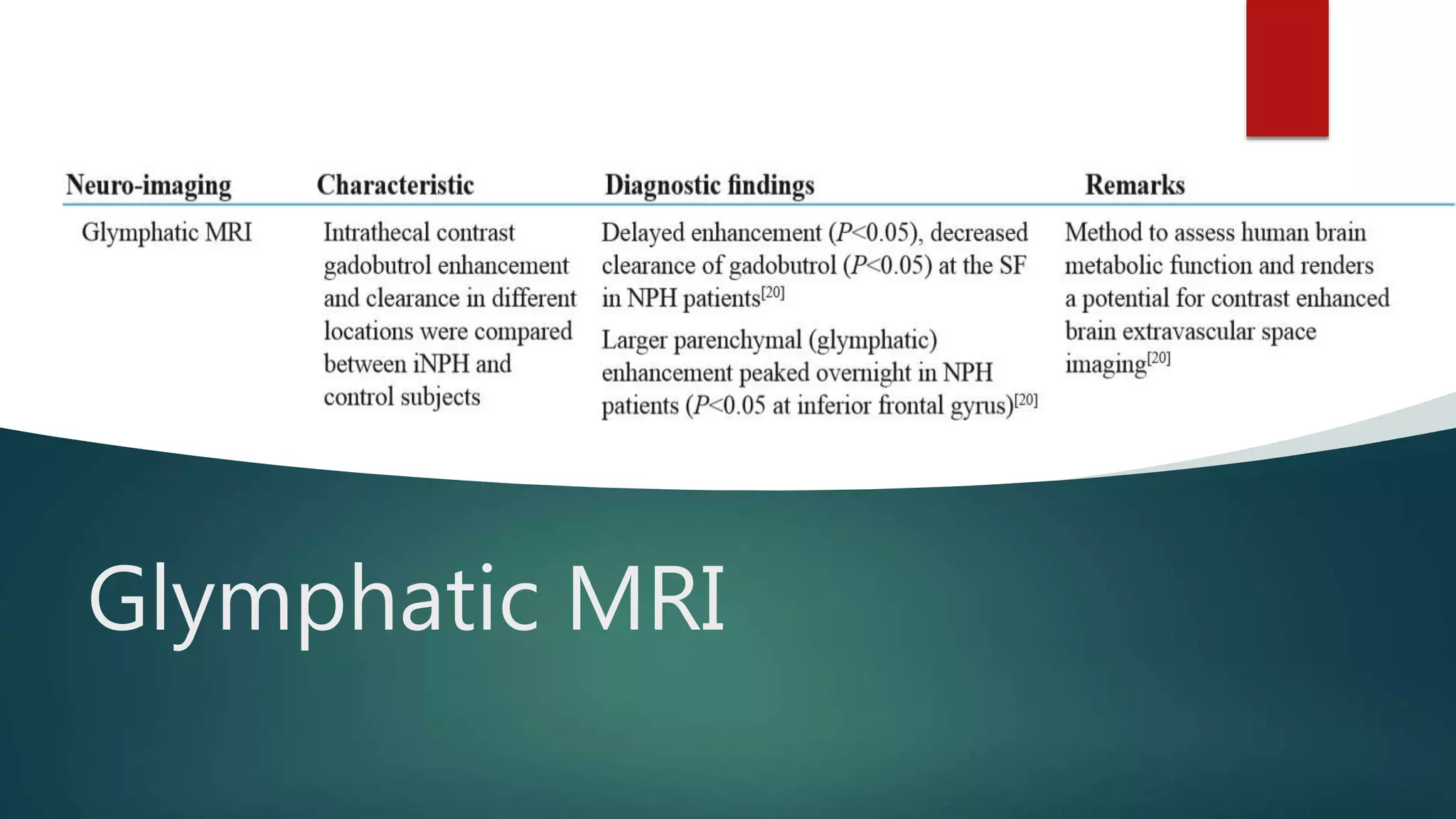
Glymphatic MRI
3D-PC MRI technique
MR phase-contrast-cine
Reversed aqueductal CSF net flow
MRI water Apparent diffusion
coefficient
FPV – Frontal periventricular; PDWM – Parietal deep white matter; LN – Lenticular nuclei;
sVD – Sub-cortical vascular dementia; ADC – Apparent diffusion coefficient; rCP – Regional cerebral perfusion; HC –
Healthy control;
Arterial spin labeling perfusion MRI
rCP – Regional cerebral perfusion
Computed tomography perfusion
GP – Global parenchyma
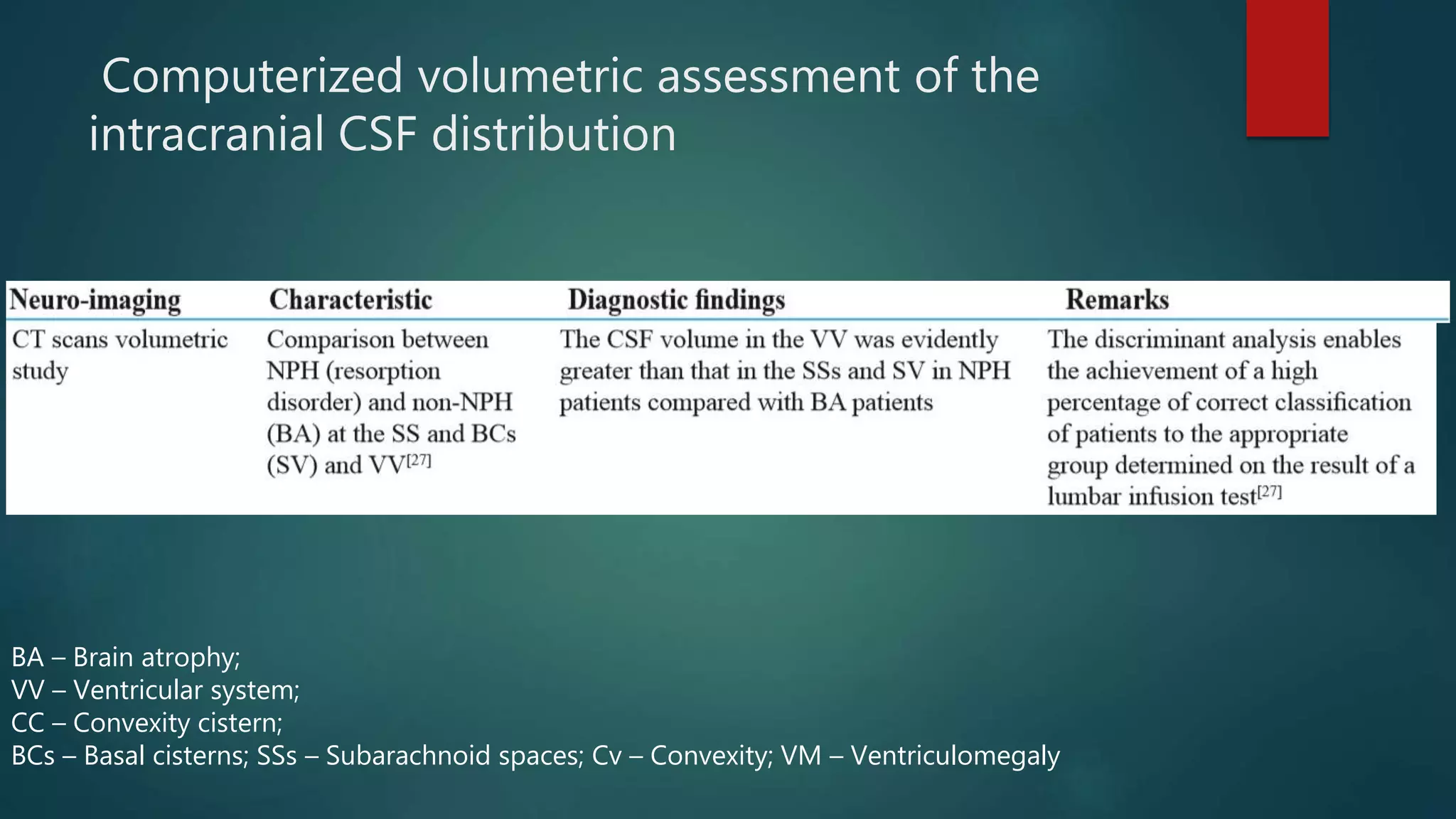
Computerized volumetric assessment of the
intracranial CSF distribution
BA – Brain atrophy;
VV – Ventricular system;
CC – Convexity cistern;
BCs – Basal cisterns; SSs – Subarachnoid spaces; Cv – Convexity; VM – Ventriculomegaly
Brain to ventricle ratios at the anterior and posterior
commissure levels and three-dimensional (3D) volumetric
convexity cistern to ventricle ratios
CC – Convexity cistern
BCs – Basal cisterns;
SF – Sylvian fissure
High-field 3D-MRI study of
subarachnoid space
VE – Ventricular enlargement; SSs – Subarachnoid spaces; Cv – Convexity; VM – Ventriculomegaly
clinical procedures for the diagnosis of
iNPH:
 CSF removal test/Tap test
 Improvement in the clinical symptoms
 Association of frontal assessment battery with the gait function
 Finger tapping and verbal fluency
 Simultaneous quantification of cognition and gait
 Gait parameters
 Timed Up and Go (TUG)
 Trunk sway
 Optic nerve sheath diameter
 2. CSF Markers
 Expression of hsa-miR-4274 – decrease in pt with Parkinson diseases compare to
iNPH
 Protein tyrosine phosphatase receptor type Q – increased in iNPH compare to
Alzheimer's diseases
 Glycan isoforms of transferrin (Tf)
 “brain-type” Tf with N acetylglucosaminylated glycans - decrease in iNPH compare to non
iNPH pt.
 Levels returns to normal level within 1-3 months after shunt surgery in iNPH
 “serum-type” Tf with α2,6-sialylated glycans.
 3. The computer-aided intrathecal infusion test
 The resistance to CSF outflow
 Resistance to CSF outflow correlated significantly with improvement after procedures
Treatment Modality of
Idiopathic Normal Pressure
Hydrocephalus
 Shunt surgery has been
established as the only durable
and effective treatment for
iNPH
 ventriculoperitoneal (VP) shunt
is the current standard
treatment.
 Tudor et al. found that there were no differences in the outcomes
(cognition, balance, function, gait, and mobility) between ETV and
standard practice (VP shunting using a nonprogrammable valve)
 Bayar et al. which found that headache was resolved in almost all patients
at the 3rd month, and gait disturbance, urinary incontinence, and cognitive
functions were improved by 86%, 72%, and 65% of the patients at the end
of the 1st year after LP shunt surgery.[50]
 authors have concluded that the efficacy and safety rates for LP Shunts
with programmable valves are comparable to those for VP shunts for the
treatment of patients with iNPH
 shunt revisions were more common in LP shunt-treated patients than in VP
shunt-treated patients.[45]
Outcomes and Prognosis
 Only about 40% of the iNPH patients improved after shunt surgery, and
around 60% reported their general health condition to be better than
preoperatively using self-assessed modified Rankin Scale (smRS) in a study
 Age and type 2 diabetes mellitus were two independent factors that
associated with increased risk of death among iNPH patients
 The surgical outcome deteriorates with durations after surgery. In a study,
82% demonstrated a successful response to surgery at their first
postoperative follow-up. However, this declined to 75% at 1 year and
62.5% patients at their last follow-up
Complications from Cerebrospinal Fluid Diversion
Procedure in Idiopathic Normal Pressure Hydrocephalus
Patients
 Complications from CSF diversion procedure can be categorized as
infection, shunt malfunction, subdural hygroma/hematoma, or any adverse
event attributed by a change in shunt setting or surgical procedure.
 re-surgery due to underdrainage, delayed subdural hematoma and
overdrainage
 VP shunt and ETV, Chan et al. found that ETV was associated with a
significantly higher mortality (3.2% vs. 0.5%)
Conclusion
 The diagnosis of iNPH should be considered when a patient presented
with relevant clinical signs and symptoms with concordance radiological
findings of iNPH.
 The CSF tap is performed as a diagnostic test with post-tapping evaluation
of clinical improvements.
 Patients who are diagnosed with iNPH may also suffer from other diseases
such as AD, parkinsonism, and other vascular and white matter diseases.
 The diagnostic criteria for iNPH should also include diagnostic tests to
exclude other concomitant diseases.
 The declination of number of responders during the follow-up may
suggest the possibility of other ongoing neurodegenerative changes which
could not be altered with CSF diversion procedure alone.
Thank you.

Idiopathic normal pressure hydrocephalus

  • 1.
    Current Updates onIdiopathic Normal Pressure Hydrocephalus REVIEW ARTICLE ASIAN JOURNAL OF NEUROSURGERY | VOLUME 14 | ISSUE 3 | JULY-SEPTEMBER 2019
  • 2.
     Idiopathic normalpressure hydrocephalus (iNPH) is one of the neurodegenerative diseases which can be treated surgically with favorable outcome.  The gait disturbance, cognitive, and urinary symptoms are known as the clinical triad of iNPH.  This review, have addressed the comorbidities, differential diagnoses, clinical presentations, and pathology of iNPH.  Have also summarized the imaging studies and clinical procedures used for the diagnosis of iNPH.  The treatment modality, outcomes, and prognosis.
  • 3.
    Idiopathic normal pressure hydrocephalus(iNPH)  commonly seen in the aging population.  represents a rare cause of reversible neurological condition  The gait disturbance, cognitive and urinary symptoms are known as the clinical triad of iNPH.  ventriculomegaly is one of the neuroradiological features
  • 4.
    Co-Morbidities associated withiNPH  Hypertension (40%–50%),  diabetes mellitus (17%–23%),  Alzheimer’s disease (AD) (14.8%),  hyperlipidemia (13.5%)  Others obesity, stroke and heart disease
  • 5.
    Differential Diagnosis  Parkinsonismrepresents 40% of iNPH mimics and 20% of possible or probable iNPH  Alzheimer’s disease – coexist with iNPH  Other diseases may mimic iNPH – cerebrovascular diseases, vascular dementia, other types of hydrocephalus – secondary hydrocephalus, UTI, bladder and prostrate CA, BPH.
  • 6.
    Clinical presentations  Abouthalf of the iNPH patients presented with gait disturbance without the other two symptoms i.e. cognitive, and urinary symptoms  12%–60% of iNPH patients presented with all three symptoms  Apathy represents the most common behavioural disturbance and contributes to gait disorders in iNPH  Other rare symptoms include oropharyngeal dysphagia, “falling spells” and impulsive aggressive behaviour in both verbal and physical.
  • 7.
  • 8.
    Diagnostic Criteria  IdiopathicNPH is classified as  confirmed iNPH,  possible iNPH,  probable iNPH  The concordance imaging findings of iNPH and clinical improvement following clinical tests are important before a decision is made for CSF diversion procedure
  • 9.
  • 10.
  • 11.
  • 12.
  • 13.
  • 14.
  • 15.
  • 16.
    MRI water Apparentdiffusion coefficient FPV – Frontal periventricular; PDWM – Parietal deep white matter; LN – Lenticular nuclei; sVD – Sub-cortical vascular dementia; ADC – Apparent diffusion coefficient; rCP – Regional cerebral perfusion; HC – Healthy control;
  • 17.
    Arterial spin labelingperfusion MRI rCP – Regional cerebral perfusion
  • 18.
    Computed tomography perfusion GP– Global parenchyma
  • 19.
    Computerized volumetric assessmentof the intracranial CSF distribution BA – Brain atrophy; VV – Ventricular system; CC – Convexity cistern; BCs – Basal cisterns; SSs – Subarachnoid spaces; Cv – Convexity; VM – Ventriculomegaly
  • 20.
    Brain to ventricleratios at the anterior and posterior commissure levels and three-dimensional (3D) volumetric convexity cistern to ventricle ratios CC – Convexity cistern BCs – Basal cisterns; SF – Sylvian fissure
  • 21.
    High-field 3D-MRI studyof subarachnoid space VE – Ventricular enlargement; SSs – Subarachnoid spaces; Cv – Convexity; VM – Ventriculomegaly
  • 22.
    clinical procedures forthe diagnosis of iNPH:  CSF removal test/Tap test  Improvement in the clinical symptoms  Association of frontal assessment battery with the gait function  Finger tapping and verbal fluency  Simultaneous quantification of cognition and gait  Gait parameters  Timed Up and Go (TUG)  Trunk sway  Optic nerve sheath diameter
  • 23.
     2. CSFMarkers  Expression of hsa-miR-4274 – decrease in pt with Parkinson diseases compare to iNPH  Protein tyrosine phosphatase receptor type Q – increased in iNPH compare to Alzheimer's diseases  Glycan isoforms of transferrin (Tf)  “brain-type” Tf with N acetylglucosaminylated glycans - decrease in iNPH compare to non iNPH pt.  Levels returns to normal level within 1-3 months after shunt surgery in iNPH  “serum-type” Tf with α2,6-sialylated glycans.  3. The computer-aided intrathecal infusion test  The resistance to CSF outflow  Resistance to CSF outflow correlated significantly with improvement after procedures
  • 24.
    Treatment Modality of IdiopathicNormal Pressure Hydrocephalus  Shunt surgery has been established as the only durable and effective treatment for iNPH  ventriculoperitoneal (VP) shunt is the current standard treatment.
  • 25.
     Tudor etal. found that there were no differences in the outcomes (cognition, balance, function, gait, and mobility) between ETV and standard practice (VP shunting using a nonprogrammable valve)  Bayar et al. which found that headache was resolved in almost all patients at the 3rd month, and gait disturbance, urinary incontinence, and cognitive functions were improved by 86%, 72%, and 65% of the patients at the end of the 1st year after LP shunt surgery.[50]  authors have concluded that the efficacy and safety rates for LP Shunts with programmable valves are comparable to those for VP shunts for the treatment of patients with iNPH  shunt revisions were more common in LP shunt-treated patients than in VP shunt-treated patients.[45]
  • 26.
    Outcomes and Prognosis Only about 40% of the iNPH patients improved after shunt surgery, and around 60% reported their general health condition to be better than preoperatively using self-assessed modified Rankin Scale (smRS) in a study  Age and type 2 diabetes mellitus were two independent factors that associated with increased risk of death among iNPH patients  The surgical outcome deteriorates with durations after surgery. In a study, 82% demonstrated a successful response to surgery at their first postoperative follow-up. However, this declined to 75% at 1 year and 62.5% patients at their last follow-up
  • 27.
    Complications from CerebrospinalFluid Diversion Procedure in Idiopathic Normal Pressure Hydrocephalus Patients  Complications from CSF diversion procedure can be categorized as infection, shunt malfunction, subdural hygroma/hematoma, or any adverse event attributed by a change in shunt setting or surgical procedure.  re-surgery due to underdrainage, delayed subdural hematoma and overdrainage  VP shunt and ETV, Chan et al. found that ETV was associated with a significantly higher mortality (3.2% vs. 0.5%)
  • 28.
    Conclusion  The diagnosisof iNPH should be considered when a patient presented with relevant clinical signs and symptoms with concordance radiological findings of iNPH.  The CSF tap is performed as a diagnostic test with post-tapping evaluation of clinical improvements.  Patients who are diagnosed with iNPH may also suffer from other diseases such as AD, parkinsonism, and other vascular and white matter diseases.  The diagnostic criteria for iNPH should also include diagnostic tests to exclude other concomitant diseases.  The declination of number of responders during the follow-up may suggest the possibility of other ongoing neurodegenerative changes which could not be altered with CSF diversion procedure alone.
  • 29.

Editor's Notes

  • #6 amyloid does not seem to play a pathogenetic role in the development of cognitive deficits in NPH.[8] The study had shown that β‑amyloid peptide (Aβ) 42 levels were significantly lower in NPH than in control patients, with no significant differences between AD and NPH.[8] On the contrary, t‑tau and p‑tau levels were significantly lower in NPH than in AD, with no differences between NPH and controls.[8] NPH patients with pathological Aβ 42 levels did not perform worse than NPH patients with normal Aβ 42 levels in any cognitive domains
  • #7 oropharyngeal dysphagia is due to corticobulbar tract compression by ventricular dilatation as shown in tractography analysis
  • #11 disproportionately enlarged subarachnoid space (DESH)  sylvian fissure SF and the subarachnoid space SS
  • #13 ROI region of intrest
  • #14 SF SILVIAN FISURE
  • #16  Vpeak – Peak velocity; SV – Stroke volume; MinV – Minute flow volume; FPV – Frontal periventricular; PDWM – Parietal deep white matter; LN – Lenticular nuclei; sVD – Sub‑cortical vascular dementia; ADC – Apparent diffusion coefficient; rCP – Regional cerebral perfusion; HC – Healthy control;