




CSF Dynamics
Basic items
Mohamed Elsayed Elsebaey
Neurosurgery Registrar
Egypt, Ismailia
Ministry of Health
Seba3y700025@gmail.com
Mohamed E Elsebaey
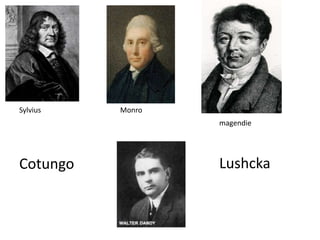
Sylvius Monro
magendie
Cotungo Lushcka
CSF
• Pathway
• Production & Rate
• Drainage
• Composition
• Pressure
• Volumes
• Blood supply
• Nerve supply
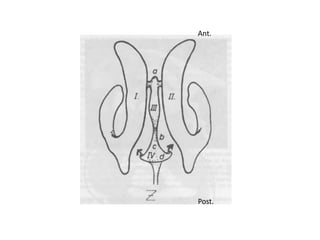
Ant.
Post.
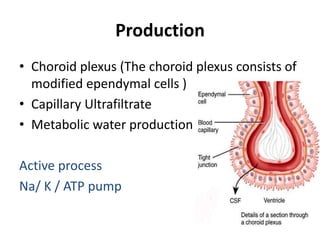
Production
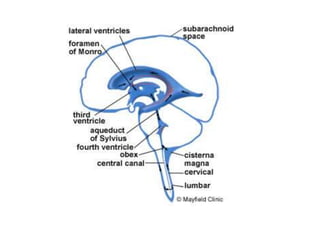
• Choroid plexus (The choroid plexus consists of
modified ependymal cells )
• Capillary Ultrafiltrate
• Metabolic water production
Active process
Na/ K / ATP pump
Choroid plexus are present in
• Lateral ventricle ( temp. horn )
• 3rd Ventricle
• 4th Ventricle ( post. Portion )
Rate
• Produced 0.3 – 0.4 ml per minute
• Total Volume is 150 ml
• Totally replaced about 3 times per day ( 450-600)
The ventricular system contains:
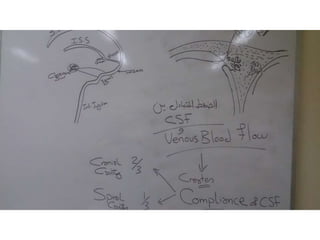
Only about 1/6 of the total volume ( 25 ml )
The remainder is present in spinal canal & S.A. spaces
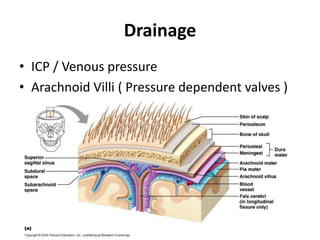
Drainage
• Cranial absorption:
85% - 90% through the SSS through the
Arachnoid villi
• Spinal absorption:
15% through the Dural sinusoids on the dorsal
nerve roots
Drainage
• ICP / Venous pressure
• Arachnoid Villi ( Pressure dependent valves )
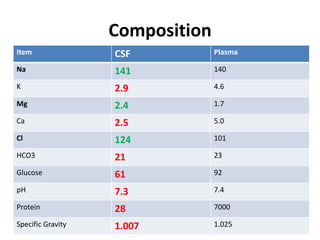
Composition
PlasmaCSFItem
140141Na
4.62.9K
1.72.4Mg
5.02.5Ca
101124Cl
2321HCO3
9261Glucose
7.47.3pH
700028Protein
1.0251.007Specific Gravity
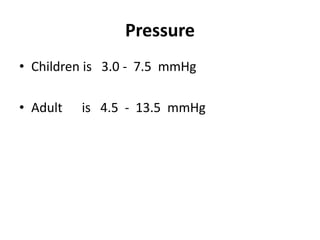
Pressure
• Children is 3.0 - 7.5 mmHg
• Adult is 4.5 - 13.5 mmHg
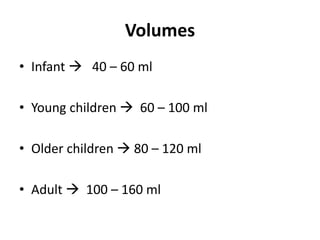
Volumes
• Infant  40 – 60 ml
• Young children  60 – 100 ml
• Older children  80 – 120 ml
• Adult  100 – 160 ml
Circulation
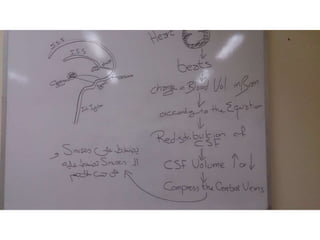
• CSF hydrostatic pressure
• Cilia of ependymal cells
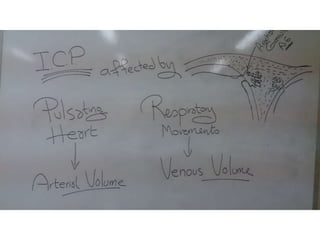
• Respiratory ventilation
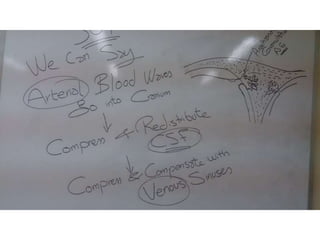
• Vascular pulsation of cerebral arteries
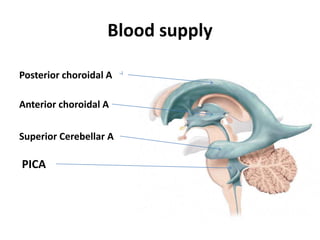
Blood supply
Posterior choroidal A
Anterior choroidal A
Superior Cerebellar A
PICA
CSF Dynamics
Dynamics CSF
It is not well understanding process up till
now although these researches and from this
point, the CSF dynamics research gain its
attractiveness
CSF
• French physiologist ( Magendie ) is who
gave the cerebrospinal fluid this name
• Clear colorless fluid
Function:
Reduces the effective weight of the brain
Protect the brain
Removes the metabolites
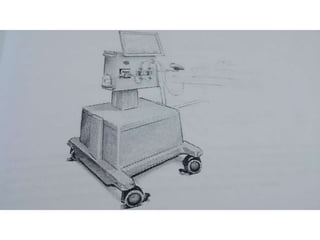
To assess CSF system dynamics
an infusion test can be performed
• This process of measuring is divided into 3
parts:
1. Mathematical model
2. Infusion protocol
3. Parameter estimation method
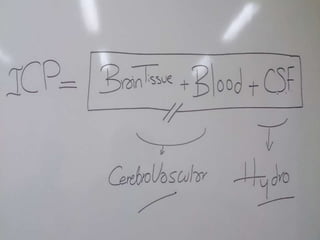
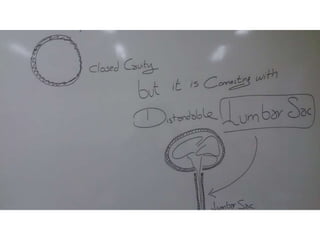
“Monroe” said
“ Cranium is rigid box
Filled with a nearly incompressible brain
Making the total cranial volume unchanged.”
CSF
• Choroidal plexus source
• Extrachoroidal source
• formation rate:
0.3 – 0.4 ml / minute
CSF Absorption
• Main absorption is through the
Arachnoid granulations and villi (unidirectional)
Other absorption sites:
1. Around Spinal nerve roots
2. Choroid plexus
3. Around cranial nerves
,
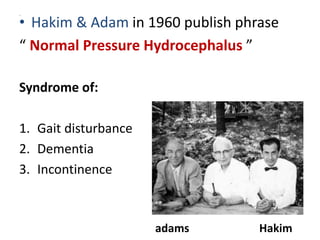
• Hakim & Adam in 1960 publish phrase
“ Normal Pressure Hydrocephalus ”
Syndrome of:
1. Gait disturbance
2. Dementia
3. Incontinence
adams Hakim
Normal Pressure HCP
• Idiopathic
No clear cause
• Secondary
For known cause like:
Traumatic brain injury
Subarachanoid Hge
Post meningitis
Post 4th vent. Tumour
surgery
Challenge here is to
• Diagnose the patient
• Predict patients who will gain benefit from
shunt surgery
Pathophysiology of INPH is still not
fully understood , so
Researches done for reaching the evidence
So
Importance of CSF hydrodynamics
INPH thoeries
• Effect of CerebroVascular disease
• Spinal aetilogy
• Non symptomatic HCP that become
symptomatic with increasing age
• Mechanical compression of the brain by
ventricles
• Increase intracranial arterial pulsations lead to
increase ICP lead to Periventricular damage
Diagnostic tests why ?
• Support diagnosis
• Decide if patient will gain benefit from
Treatment or not
Diagnostic tests
• CT brain
• MRI brain
• Neurophysiological studies
• NeuroPsychological studies
• Infusion test
• Tapping test
• Ext. lumbar drainage
used as simulating the effect of shunt by withdrawing
CSF then assess the clinical performance
Mathematical model
• Marmarou in 1973 put the basic model of CSF
system
Assumes
Total CSF formation rate + possible rate of
external infusion
equals
CSF absorption rate + rate of change of fluid stored
in the system
.
• Conductance outflow ( C out )
Physiological parameter of the filtration process
and describes the ease of flow across the CSF
outflow pathways while ( R out ) is the
resistance to flow
Conductance outflow is equal to
Outflow resistance
.
• Compliance:
Ratio of volume and pressure change, or
It is description of how the system is affected
by the change in volume or pressure
Infusion test
• Used to assess the Hydromechanic Properties
of CSF system
• Procedure:
2 needles inserted into the spinal canal at L3-
L4 interspace.
Sitting position
One needle used for infusion or withdrawal of
fluid ( Ringer )
Other Needle used for pressure measurement
It is so important to minimize CSF leakage
during puncture
Then supine position
The Zero pressure reference level is placed at
the Centre of the auditory meatus
Re-measuring done
Putting results into the equations then results
appeared
Infusion protocols
2 approaches:
 Constant infusion protocol
 Bolus infusion protocol
Parameter estimation methods
• Constant pressure infusion
• Constant infusion
• Bolus infusion
• Adaptive observer
• Prediction error
• Simulation error
• Real time estimation and investigation time
analysis
Complex
physical
mathematical
equations
Why we do this ?
Understanding them will increase basic
knowledge of the CSF system while these
variations have previously been suggested
as indicators for shunt surgery
So
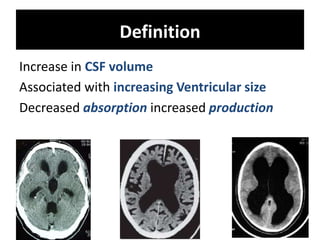
Definition
Increase in CSF volume
Associated with increasing Ventricular size
Decreased absorption increased production
4 research arms
1. Basic science … understanding diseases
on cellular level like edema, tumors
2. Computer based mathematical
modelling …… 
3. Animal studies
4. Clinical correlation 
Methods include
• CSF infusion study
• Overnight ICP monitoring
• Assessment of slow ICP waves
• Testing pressure reactivity
• Cerebral Auto regulation
• CO2 reactivity
• CBF studies combined with MRI co- registeration
Hydrocephalus
Obstructive
• Congenital
Aqueduct stenosis or forking
Dandy walker $
Arnold chiari malformation
Vein of Galen malformation
• Acquired
Aqueductal stenosis
Supratentorial masses : tentorial
herniation
Tumours: Ventricular, colliod cyst
– pineal region – post. Fossa
Abscesses / granuloma
Arachanoid cysts
• Communicating
Thickening of the meninges
Involvement of the arachnoid
granulations:
Infection
SAH : spontaneous, traumatic,
post op.
Meningitis
Increased CSF viscosity ,
high protein viscosity
Excessive CSF production,
choroid plexus papilloma
Pathological effects
CSF flow obstruction or impaired absorption 
Ventricular dilatation 
CSF permeates through the ependymal lining into
the periventricular white matter 
• Raised intracranial pressure
• White matter damage, If untreated  grey
matter damage
• Some CSF absorption occurs from periventricular
blood vessels
Clinical picture
Infants & young children Juvenile / adult
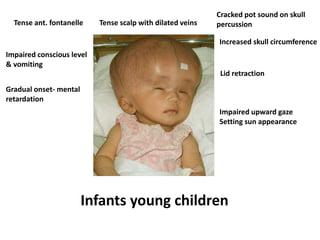
Tense ant. fontanelle
Impaired conscious level
& vomiting
Gradual onset- mental
retardation
Tense scalp with dilated veins
Cracked pot sound on skull
percussion
Increased skull circumference
Lid retraction
Impaired upward gaze
Setting sun appearance
Infants young children
Juvenile / Adult
Acute
Signs and symptoms of
increased ICP
Impaired upward gaze
Chronic
Dementia
Gait ataxia
Incontinence
Investigations
CT scan
• Pattern of ventricular enlargement help
determine the cause
Lateral + 3rd Vent. Dilatation
With normal 4th ventricle  aqueduct stenosis
With deviated or absent 4th ventricle 
posterior fossa mass
• Generalized dilatation  communicating HCP
• Isotope Cisternography / CSF infusion studies
/ ICP monitoring
In pts suspected normal pressure HCP
• Developmental assessment & psychomotor
analysis
To detect impaired cerebral function and
provide basal line for comparison
Management
• Acute deterioration
Ventricular drainage
VP or VA shunt
• Gradual deterioration
VP or VA shunt
Removal of a mass lesion if present
• Just observation, mostly in arrested HCP cases
Shunt complications
Any shunt
• Obstruction  proximal, Valve, distal
• Disconnection
• Infection
• Malposition
• Hardware erosion through skin
• Seizures
• Conduit for extraneural metastases of certain
tumors
• Silicone allergy
Shunt complications
VP Shunt
• Inguinal hernia
• Need to lengthen the catheter with growth
• Hydrocele
• CSF ascites
• Tip migration into viscus, anus
• Volvulus, intestinal obstruction
• Overshunting
Shunt complications
VA Shunt
• Repeated lengthing
• Infection, septicemia
• Retrograde blood flow into ventricles
• Shunt embolus
Shunt complications
LP shunt
• Lumbar nerve root irritation
• Arachnoiditis, adhesions
• Difficult access to proximal end if need
revision
Undershunting
Acute symptoms of increased ICP
Headache, nausea, vomiting , diplopia,
ataxia,seizures
Acute signs of increased ICP
Upward gaze palsy, abducent palsy, visual field
loss, papilledema
Swelling around shunt track
CSF Dynamics and CSF circulation

CSF Dynamics and CSF circulation

  • 1.
    CSF Dynamics Basic items MohamedElsayed Elsebaey Neurosurgery Registrar Egypt, Ismailia Ministry of Health Seba3y700025@gmail.com Mohamed E Elsebaey
  • 2.
  • 3.
    CSF • Pathway • Production& Rate • Drainage • Composition • Pressure • Volumes • Blood supply • Nerve supply
  • 5.
  • 6.
    Production • Choroid plexus(The choroid plexus consists of modified ependymal cells ) • Capillary Ultrafiltrate • Metabolic water production Active process Na/ K / ATP pump
  • 7.
    Choroid plexus arepresent in • Lateral ventricle ( temp. horn ) • 3rd Ventricle • 4th Ventricle ( post. Portion )
  • 8.
    Rate • Produced 0.3– 0.4 ml per minute • Total Volume is 150 ml • Totally replaced about 3 times per day ( 450-600) The ventricular system contains: Only about 1/6 of the total volume ( 25 ml ) The remainder is present in spinal canal & S.A. spaces
  • 9.
    Drainage • Cranial absorption: 85%- 90% through the SSS through the Arachnoid villi • Spinal absorption: 15% through the Dural sinusoids on the dorsal nerve roots
  • 10.
    Drainage • ICP /Venous pressure • Arachnoid Villi ( Pressure dependent valves )
  • 11.
  • 12.
    Pressure • Children is3.0 - 7.5 mmHg • Adult is 4.5 - 13.5 mmHg
  • 13.
    Volumes • Infant 40 – 60 ml • Young children  60 – 100 ml • Older children  80 – 120 ml • Adult  100 – 160 ml
  • 14.
    Circulation • CSF hydrostaticpressure • Cilia of ependymal cells • Respiratory ventilation • Vascular pulsation of cerebral arteries
  • 15.
    Blood supply Posterior choroidalA Anterior choroidal A Superior Cerebellar A PICA
  • 16.
  • 17.
    Dynamics CSF It isnot well understanding process up till now although these researches and from this point, the CSF dynamics research gain its attractiveness
  • 19.
    CSF • French physiologist( Magendie ) is who gave the cerebrospinal fluid this name • Clear colorless fluid Function: Reduces the effective weight of the brain Protect the brain Removes the metabolites
  • 20.
    To assess CSFsystem dynamics an infusion test can be performed • This process of measuring is divided into 3 parts: 1. Mathematical model 2. Infusion protocol 3. Parameter estimation method
  • 21.
    “Monroe” said “ Craniumis rigid box Filled with a nearly incompressible brain Making the total cranial volume unchanged.”
  • 29.
    CSF • Choroidal plexussource • Extrachoroidal source • formation rate: 0.3 – 0.4 ml / minute
  • 30.
    CSF Absorption • Mainabsorption is through the Arachnoid granulations and villi (unidirectional) Other absorption sites: 1. Around Spinal nerve roots 2. Choroid plexus 3. Around cranial nerves
  • 31.
    , • Hakim &Adam in 1960 publish phrase “ Normal Pressure Hydrocephalus ” Syndrome of: 1. Gait disturbance 2. Dementia 3. Incontinence adams Hakim
  • 32.
    Normal Pressure HCP •Idiopathic No clear cause • Secondary For known cause like: Traumatic brain injury Subarachanoid Hge Post meningitis Post 4th vent. Tumour surgery
  • 33.
    Challenge here isto • Diagnose the patient • Predict patients who will gain benefit from shunt surgery
  • 34.
    Pathophysiology of INPHis still not fully understood , so Researches done for reaching the evidence So Importance of CSF hydrodynamics
  • 35.
    INPH thoeries • Effectof CerebroVascular disease • Spinal aetilogy • Non symptomatic HCP that become symptomatic with increasing age • Mechanical compression of the brain by ventricles • Increase intracranial arterial pulsations lead to increase ICP lead to Periventricular damage
  • 36.
    Diagnostic tests why? • Support diagnosis • Decide if patient will gain benefit from Treatment or not
  • 37.
    Diagnostic tests • CTbrain • MRI brain • Neurophysiological studies • NeuroPsychological studies • Infusion test • Tapping test • Ext. lumbar drainage used as simulating the effect of shunt by withdrawing CSF then assess the clinical performance
  • 38.
    Mathematical model • Marmarouin 1973 put the basic model of CSF system Assumes Total CSF formation rate + possible rate of external infusion equals CSF absorption rate + rate of change of fluid stored in the system
  • 39.
    . • Conductance outflow( C out ) Physiological parameter of the filtration process and describes the ease of flow across the CSF outflow pathways while ( R out ) is the resistance to flow Conductance outflow is equal to Outflow resistance
  • 40.
    . • Compliance: Ratio ofvolume and pressure change, or It is description of how the system is affected by the change in volume or pressure
  • 41.
    Infusion test • Usedto assess the Hydromechanic Properties of CSF system • Procedure: 2 needles inserted into the spinal canal at L3- L4 interspace. Sitting position One needle used for infusion or withdrawal of fluid ( Ringer ) Other Needle used for pressure measurement
  • 42.
    It is soimportant to minimize CSF leakage during puncture Then supine position The Zero pressure reference level is placed at the Centre of the auditory meatus Re-measuring done Putting results into the equations then results appeared
  • 44.
    Infusion protocols 2 approaches: Constant infusion protocol  Bolus infusion protocol
  • 45.
    Parameter estimation methods •Constant pressure infusion • Constant infusion • Bolus infusion • Adaptive observer • Prediction error • Simulation error • Real time estimation and investigation time analysis Complex physical mathematical equations
  • 46.
    Why we dothis ? Understanding them will increase basic knowledge of the CSF system while these variations have previously been suggested as indicators for shunt surgery
  • 47.
  • 48.
    Definition Increase in CSFvolume Associated with increasing Ventricular size Decreased absorption increased production
  • 49.
    4 research arms 1.Basic science … understanding diseases on cellular level like edema, tumors 2. Computer based mathematical modelling ……  3. Animal studies 4. Clinical correlation 
  • 50.
    Methods include • CSFinfusion study • Overnight ICP monitoring • Assessment of slow ICP waves • Testing pressure reactivity • Cerebral Auto regulation • CO2 reactivity • CBF studies combined with MRI co- registeration
  • 51.
    Hydrocephalus Obstructive • Congenital Aqueduct stenosisor forking Dandy walker $ Arnold chiari malformation Vein of Galen malformation • Acquired Aqueductal stenosis Supratentorial masses : tentorial herniation Tumours: Ventricular, colliod cyst – pineal region – post. Fossa Abscesses / granuloma Arachanoid cysts • Communicating Thickening of the meninges Involvement of the arachnoid granulations: Infection SAH : spontaneous, traumatic, post op. Meningitis Increased CSF viscosity , high protein viscosity Excessive CSF production, choroid plexus papilloma
  • 52.
    Pathological effects CSF flowobstruction or impaired absorption  Ventricular dilatation  CSF permeates through the ependymal lining into the periventricular white matter  • Raised intracranial pressure • White matter damage, If untreated  grey matter damage • Some CSF absorption occurs from periventricular blood vessels
  • 53.
    Clinical picture Infants &young children Juvenile / adult
  • 54.
    Tense ant. fontanelle Impairedconscious level & vomiting Gradual onset- mental retardation Tense scalp with dilated veins Cracked pot sound on skull percussion Increased skull circumference Lid retraction Impaired upward gaze Setting sun appearance Infants young children
  • 55.
    Juvenile / Adult Acute Signsand symptoms of increased ICP Impaired upward gaze Chronic Dementia Gait ataxia Incontinence
  • 56.
    Investigations CT scan • Patternof ventricular enlargement help determine the cause Lateral + 3rd Vent. Dilatation With normal 4th ventricle  aqueduct stenosis With deviated or absent 4th ventricle  posterior fossa mass • Generalized dilatation  communicating HCP
  • 57.
    • Isotope Cisternography/ CSF infusion studies / ICP monitoring In pts suspected normal pressure HCP • Developmental assessment & psychomotor analysis To detect impaired cerebral function and provide basal line for comparison
  • 58.
    Management • Acute deterioration Ventriculardrainage VP or VA shunt • Gradual deterioration VP or VA shunt Removal of a mass lesion if present • Just observation, mostly in arrested HCP cases
  • 59.
    Shunt complications Any shunt •Obstruction  proximal, Valve, distal • Disconnection • Infection • Malposition • Hardware erosion through skin • Seizures • Conduit for extraneural metastases of certain tumors • Silicone allergy
  • 60.
    Shunt complications VP Shunt •Inguinal hernia • Need to lengthen the catheter with growth • Hydrocele • CSF ascites • Tip migration into viscus, anus • Volvulus, intestinal obstruction • Overshunting
  • 61.
    Shunt complications VA Shunt •Repeated lengthing • Infection, septicemia • Retrograde blood flow into ventricles • Shunt embolus
  • 62.
    Shunt complications LP shunt •Lumbar nerve root irritation • Arachnoiditis, adhesions • Difficult access to proximal end if need revision
  • 63.
    Undershunting Acute symptoms ofincreased ICP Headache, nausea, vomiting , diplopia, ataxia,seizures Acute signs of increased ICP Upward gaze palsy, abducent palsy, visual field loss, papilledema Swelling around shunt track