MUKINGE SCHOOL OF
NURSING
MICROBIOLOGY
HAANTOBOLO A.
BSC. BIOMED. MPH ( C)
MCB 018
NORMAL BODY FLORA
• Definition:
• Normal body flora are microorganisms which are
found in specific sites of the body
• Microorganisms that are well established on the
external and internal surfaces of the body
without causing disease
Normal flora’s Relationship to the Body
• The normal human body has a profuse normal flora.
• These relationships of micro-organism with the body
may be on the following basis:
• Symbiosis: micro-organisms live harmoniously with
the body (host) and with other micro-organisms.
• Both the body and microorganisms benefit.
• Eg the content of the alimentary canal nourish the
flora living there and in turn the flora synthesise
vitamin K which the body needs (for blood clotting)
but cannot provide for itself.
• Commensalism: this is the relation between two
different kinds of organisms when one receives
benefits from the other without damaging it
• Mutualism: The relation between two different
species of organisms that are interdependent;
each gains benefits from the activity of the
other
• Parasitism: The relation between two different
kinds of organisms in which one receives
benefits from the other by causing damage to it
(usually not fatal damage)
• Obligatory: this is where the microorganism is
completely dependent on the host
• Antibiosis: An association between organisms
that is harmful to one of them or between
organisms and a metabolic product of another.
• This has led to development of antibiotics.
• An antibiotic is a chemical agent which one
organism produces to inhibit or kill another.
TYPES OF NORMAL FLORA
• Resident flora; these are organisms constantly
found in a particulars site of the body e.g
staphylococus aureus which lives on the skin
without causing disease.
• Transient flora; this is non-pathogenic or
potentially pathogenic organism from the
environment.
• They stay on the site from seconds to weeks but
do not produce disease. Eg. Norovirus, which can
cause the stomach flu (viral gastroenteritis)
• Yeast candida
• The skin and mucous membrane always harbour
normal floras because they are in contact with
the environment.
• Some body parts have little or no normal flora:
These are:
• The lower respiratory tract. This is facilitated by
micro ciliary bodies that propel organisms to
external surface.
• The stomach due to the production of
hydrochloric acid
• The blood and internal organs-because of
leucocytes (phagocytic action) and physical
separation from external.
ELEMENTS THAT ALTER THE GROWTH OF
NORMAL FLORA
• Moisture: it encourages growth of micro-
organisms e.g axilla, between groins, breasts,
testicles, between toes.
• These areas must be kept dry to avoid over
growth of organisms
• Antibiotics; they may kill the normal flora e.g of
the intestine and encourage the growth of other
organisms.
• Antiseptic; regular use of antiseptics (soap)
reduces the bacteria population by more than
95% which can lead to death of normal flora
• POSITIVE EFFECTS OF NORMAL FLORA
• Prevent growth of pathogenic organism by means of
competition or antagonism reaction.
• Allows motivation of the immune response
• May induce low antibodies that may cross react with
pathogens.
• NEGATIVE EFFECTS OF NORMAL FLORA
• Normal flora may become opportunistic pathogen
• Some bowel flora acted upon by certain diets may
form carcinogens (cancer causing chemicals)
• Low grade toxaemia due to endotoxin of gastro
intestinal flora is possible
• It may synergise/promote growth of pathogens in
certain areas.
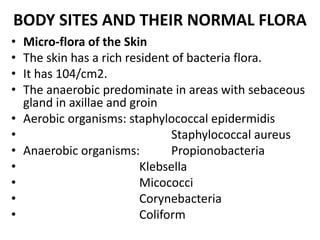
BODY SITES AND THEIR NORMAL FLORA
• Micro-flora of the Skin
• The skin has a rich resident of bacteria flora.
• It has 104/cm2.
• The anaerobic predominate in areas with sebaceous
gland in axillae and groin
• Aerobic organisms: staphylococcal epidermidis
• Staphylococcal aureus
• Anaerobic organisms: Propionobacteria
• Klebsella
• Micococci
• Corynebacteria
• Coliform
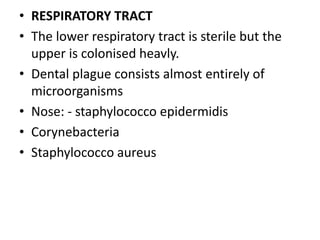
• RESPIRATORY TRACT
• The lower respiratory tract is sterile but the
upper is colonised heavly.
• Dental plague consists almost entirely of
microorganisms
• Nose: - staphylococco epidermidis
• Corynebacteria
• Staphylococco aureus
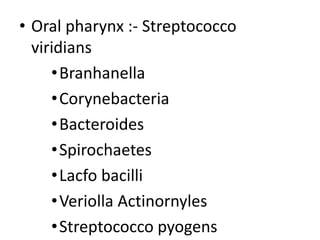
• Oral pharynx :- Streptococco
viridians
•Branhanella
•Corynebacteria
•Bacteroides
•Spirochaetes
•Lacfo bacilli
•Veriolla Actinornyles
•Streptococco pyogens
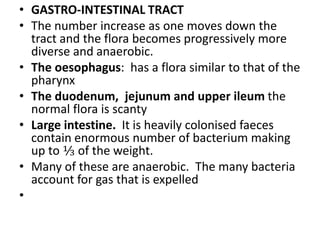
• GASTRO-INTESTINAL TRACT
• The number increase as one moves down the
tract and the flora becomes progressively more
diverse and anaerobic.
• The oesophagus: has a flora similar to that of the
pharynx
• The duodenum, jejunum and upper ileum the
normal flora is scanty
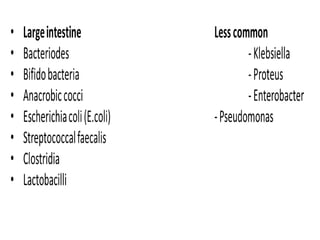
• Large intestine. It is heavily colonised faeces
contain enormous number of bacterium making
up to ⅓ of the weight.
• Many of these are anaerobic. The many bacteria
account for gas that is expelled
•
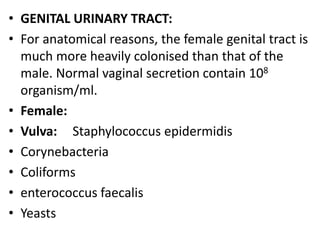
• GENITAL URINARY TRACT:
• For anatomical reasons, the female genital tract is
much more heavily colonised than that of the
male. Normal vaginal secretion contain 108
organism/ml.
• Female:
• Vulva: Staphylococcus epidermidis
• Corynebacteria
• Coliforms
• enterococcus faecalis
• Yeasts
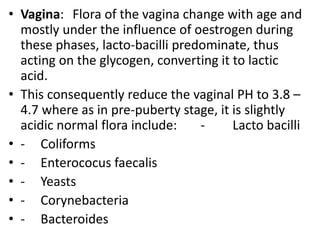
• Vagina: Flora of the vagina change with age and
mostly under the influence of oestrogen during
these phases, lacto-bacilli predominate, thus
acting on the glycogen, converting it to lactic
acid.
• This consequently reduce the vaginal PH to 3.8 –
4.7 where as in pre-puberty stage, it is slightly
acidic normal flora include: - Lacto bacilli
• - Coliforms
• - Enterococus faecalis
• - Yeasts
• - Corynebacteria
• - Bacteroides
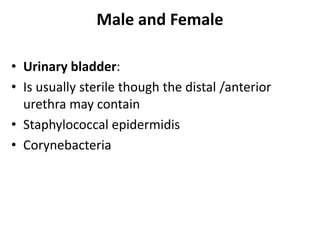
Male and Female
• Urinary bladder:
• Is usually sterile though the distal /anterior
urethra may contain
• Staphylococcal epidermidis
• Corynebacteria
• EXTERNAL AUDITORY MEATUS
• Staphylococcal epidermidis
• Corynebacteria
• Acid fast bacteria in the wax- occasionally
• CONJUNCTIVAL SAC
• Microbial population are minimised by the
mechanical flow of tears and presence of
lysozymes organisms include: -
corynebacteria
• -Staphylococcus species

NORMAL FLORA.pptx

  • 1.
    MUKINGE SCHOOL OF NURSING MICROBIOLOGY HAANTOBOLOA. BSC. BIOMED. MPH ( C) MCB 018
  • 2.
    NORMAL BODY FLORA •Definition: • Normal body flora are microorganisms which are found in specific sites of the body • Microorganisms that are well established on the external and internal surfaces of the body without causing disease
  • 3.
    Normal flora’s Relationshipto the Body • The normal human body has a profuse normal flora. • These relationships of micro-organism with the body may be on the following basis: • Symbiosis: micro-organisms live harmoniously with the body (host) and with other micro-organisms. • Both the body and microorganisms benefit. • Eg the content of the alimentary canal nourish the flora living there and in turn the flora synthesise vitamin K which the body needs (for blood clotting) but cannot provide for itself.
  • 4.
    • Commensalism: thisis the relation between two different kinds of organisms when one receives benefits from the other without damaging it • Mutualism: The relation between two different species of organisms that are interdependent; each gains benefits from the activity of the other • Parasitism: The relation between two different kinds of organisms in which one receives benefits from the other by causing damage to it (usually not fatal damage)
  • 5.
    • Obligatory: thisis where the microorganism is completely dependent on the host • Antibiosis: An association between organisms that is harmful to one of them or between organisms and a metabolic product of another. • This has led to development of antibiotics. • An antibiotic is a chemical agent which one organism produces to inhibit or kill another.
  • 6.
    TYPES OF NORMALFLORA • Resident flora; these are organisms constantly found in a particulars site of the body e.g staphylococus aureus which lives on the skin without causing disease. • Transient flora; this is non-pathogenic or potentially pathogenic organism from the environment. • They stay on the site from seconds to weeks but do not produce disease. Eg. Norovirus, which can cause the stomach flu (viral gastroenteritis) • Yeast candida
  • 7.
    • The skinand mucous membrane always harbour normal floras because they are in contact with the environment. • Some body parts have little or no normal flora: These are: • The lower respiratory tract. This is facilitated by micro ciliary bodies that propel organisms to external surface. • The stomach due to the production of hydrochloric acid • The blood and internal organs-because of leucocytes (phagocytic action) and physical separation from external.
  • 8.
    ELEMENTS THAT ALTERTHE GROWTH OF NORMAL FLORA • Moisture: it encourages growth of micro- organisms e.g axilla, between groins, breasts, testicles, between toes. • These areas must be kept dry to avoid over growth of organisms • Antibiotics; they may kill the normal flora e.g of the intestine and encourage the growth of other organisms. • Antiseptic; regular use of antiseptics (soap) reduces the bacteria population by more than 95% which can lead to death of normal flora
  • 9.
    • POSITIVE EFFECTSOF NORMAL FLORA • Prevent growth of pathogenic organism by means of competition or antagonism reaction. • Allows motivation of the immune response • May induce low antibodies that may cross react with pathogens. • NEGATIVE EFFECTS OF NORMAL FLORA • Normal flora may become opportunistic pathogen • Some bowel flora acted upon by certain diets may form carcinogens (cancer causing chemicals) • Low grade toxaemia due to endotoxin of gastro intestinal flora is possible • It may synergise/promote growth of pathogens in certain areas.
  • 10.
    BODY SITES ANDTHEIR NORMAL FLORA • Micro-flora of the Skin • The skin has a rich resident of bacteria flora. • It has 104/cm2. • The anaerobic predominate in areas with sebaceous gland in axillae and groin • Aerobic organisms: staphylococcal epidermidis • Staphylococcal aureus • Anaerobic organisms: Propionobacteria • Klebsella • Micococci • Corynebacteria • Coliform
  • 11.
    • RESPIRATORY TRACT •The lower respiratory tract is sterile but the upper is colonised heavly. • Dental plague consists almost entirely of microorganisms • Nose: - staphylococco epidermidis • Corynebacteria • Staphylococco aureus
  • 12.
    • Oral pharynx:- Streptococco viridians •Branhanella •Corynebacteria •Bacteroides •Spirochaetes •Lacfo bacilli •Veriolla Actinornyles •Streptococco pyogens
  • 13.
    • GASTRO-INTESTINAL TRACT •The number increase as one moves down the tract and the flora becomes progressively more diverse and anaerobic. • The oesophagus: has a flora similar to that of the pharynx • The duodenum, jejunum and upper ileum the normal flora is scanty • Large intestine. It is heavily colonised faeces contain enormous number of bacterium making up to ⅓ of the weight. • Many of these are anaerobic. The many bacteria account for gas that is expelled •
  • 15.
    • GENITAL URINARYTRACT: • For anatomical reasons, the female genital tract is much more heavily colonised than that of the male. Normal vaginal secretion contain 108 organism/ml. • Female: • Vulva: Staphylococcus epidermidis • Corynebacteria • Coliforms • enterococcus faecalis • Yeasts
  • 16.
    • Vagina: Floraof the vagina change with age and mostly under the influence of oestrogen during these phases, lacto-bacilli predominate, thus acting on the glycogen, converting it to lactic acid. • This consequently reduce the vaginal PH to 3.8 – 4.7 where as in pre-puberty stage, it is slightly acidic normal flora include: - Lacto bacilli • - Coliforms • - Enterococus faecalis • - Yeasts • - Corynebacteria • - Bacteroides
  • 17.
    Male and Female •Urinary bladder: • Is usually sterile though the distal /anterior urethra may contain • Staphylococcal epidermidis • Corynebacteria
  • 18.
    • EXTERNAL AUDITORYMEATUS • Staphylococcal epidermidis • Corynebacteria • Acid fast bacteria in the wax- occasionally • CONJUNCTIVAL SAC • Microbial population are minimised by the mechanical flow of tears and presence of lysozymes organisms include: - corynebacteria • -Staphylococcus species