Normal Flora
• Definition
• Normal flora, also
known as indigenous
microbiota, are the
beneficial
microorganisms that
reside on or within the
body of a healthy
organism. They play a
crucial role in
maintaining homeostasis
and protecting against
harmful
microorganisms.
Normal Flora
Distribution:
Normal flora can be found
on various body surfaces
and within different organs,
including:
* Skin
* Oral cavity
* Nasal cavity
* Respiratory tract
* Gastrointestinal tract
* Genitourinary tract
Normal Flora
Composition:
The composition of normal flora varies depending on the body
site. Common types of bacteria, fungi, and viruses found in
normal flora include:
**Skin:
* **Bacteria:** Staphylococcus epidermidis, Staphylococcus
aureus, Propionibacterium acnes
* **Fungi:** Malassezia species, Candida albicans
**Oral cavity:**
* **Bacteria:** Streptococcus mutans, Streptococcus sanguinis,
Lactobacillus species
* **Fungi:** Candida species
**Respiratory tract:**
* **Bacteria:** Haemophilus influenzae, Moraxella catarrhalis,
Streptococcus pneumoniae
**Gastrointestinal tract:**
* **Bacteria:** Bifidobacteria, Lactobacilli, Enterobacteriaceae,
Clostridia
* **Fungi:** Saccharomyces cerevisiae, Candida species
**Genitourinary tract:**
* **Bacteria:** Lactobacillus acidophilus, Escherichia coli,
Staphylococcus saprophyticus
* **Fungi:** Candida species
Normal Flora
• Resident flora
– Reflects age of
person
.
Normal Flora
Resident flora
Changes continuously
through out life
Normal Flora
• Resident flora
– Reflects nutrition
of person
Normal Flora
• Resident flora
– Reflects genetics
of person
Normal Flora
• Resident flora
– 90% is S.
epidermidis; S.
aureus, may be in
moist areas
Normal Flora
Resident flora
Reflects
environment of
person
• Resident flora
– Reflects sex of
person
Normal Flora
Sterile tissues
In a healthy human, the
internal tissues such
as:
• blood
• brain
• muscle
• cerebrospinal fluid
(CSF.)
are normally free of
microorganisms.
Normal Flora
1. They constitute a
protective host
defense
mechanism
by occupying
ecological niches.
Importance of The Normal Flora
(Advantages)
Importance of The Normal Flora
(Advantages)
2. They produce vitamin
B and vitamin K in
intestine.
Importance of The Normal Flora
(Advantages)
3.The oral flora
contribute to
immunity by
inducing low levels
of circulating and
secretary
antibodies that
may cross react
with pathogens.
Importance of The Normal Flora
(Advantages)
4. The oral bacteria
flora exert microbial
antagonism against
nonindigenous species
by production of
inhibitory fatty acids,
peroxides,
bacteriocins, etc.
Importance of The Normal Flora
(Advantages)
5. The normal flora may
antagonize other
bacteria through the
production of
substances which
inhibit or kill
nonindigenous species.
Importance of The Normal Flora
(Disadvantages)
1. They can cause
disease in the
following:
a) When individuals
become
immunocompromised
or debilitated.
b) When they change
their usual anatomic
location.
Importance of The Normal Flora
2. The oral flora of
humans may harm
their host since some
of these bacteria are
pathogens or
opportunistic
pathogens
Estimation of the Normal flora
It has been calculated
that the normal flora
human body about
1012 bacteria on the
skin, 1010 in the
mouth, and 1014 in the
gastrointestinal tract.
Normal Flora of the Skin
• The most
important sites
are:
1. Axilla
2.Groin
3.Areas between the
toes
Normal Flora of the Skin
• The majority of
skin
microorganisms are
found in the most
superficial layers
of the epidermis
and the upper
parts of the hair
follicles.
Normal Flora of the Skin
• Important bacteria:
1. Staphylococcus
epidermidis
2. Micrococcus sp.
3. Corynebacteria sp.
4. Mycobacterium
smegmatis
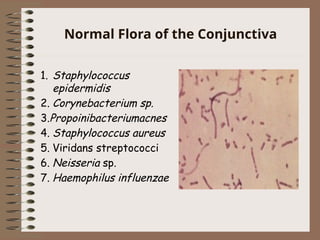
Normal Flora of the Conjunctiva
1. Staphylococcus
epidermidis
2. Corynebacterium sp.
3.Propoinibacteriumacnes
4. Staphylococcus aureus
5. Viridans streptococci
6. Neisseria sp.
7. Haemophilus influenzae
Pathogens which do infect the
conjunctiva
• Neisseria onorrhoeae
• Chlamydia
trachomatis
Normal Flora of the Respiratory Tract
A) The nares (nostrils)
1. Staphylococcus
epidermidis
2. Corynebacteria
3. Staphylococcus
aureus
4. Neisseria sp.
5. Haemophilus sp
6. Streptococcus
pneumoniae
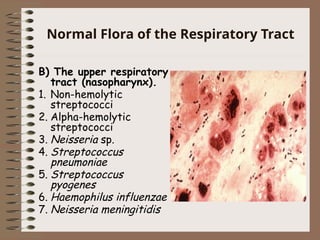
Normal Flora of the Respiratory Tract
B) The upper respiratory
tract (nasopharynx).
1. Non-hemolytic
streptococci
2. Alpha-hemolytic
streptococci
3. Neisseria sp.
4. Streptococcus
pneumoniae
5. Streptococcus
pyogenes
6. Haemophilus influenzae
7. Neisseria meningitidis
Normal Flora of the Respiratory Tract
• C) The lower respiratory
tract (trachea, bronchi,
and pulmonary tissues):
• Usually sterile.
• The individual may become
susceptible to infection by
pathogens descending from
the nasopharynx e.g.
• H. influenzae
• S. pneumoniae).
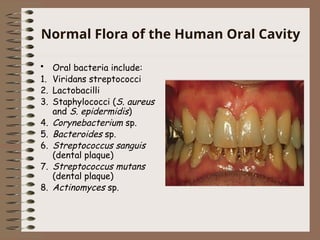
Normal Flora of the Human Oral Cavity
• Oral bacteria include:
1. Viridans streptococci
2. Lactobacilli
3. Staphylococci (S. aureus
and S. epidermidis)
4. Corynebacterium sp.
5. Bacteroides sp.
6. Streptococcus sanguis
(dental plaque)
7. Streptococcus mutans
(dental plaque)
8. Actinomyces sp.
The Normal Flora of The Ears
(i.e. external ear)
• The external ears
contains avariety of
microorganisms. These
include:
1. Staphylococcus
epidermidis
2. Staphylococcus aureus
3. Corynebacterium sp
Normal flora of the Urogenital Tract
a) The anterior urethra
1. Staphylococcus
epidermidis
2. Enterococcus faecalis
3. lpha-hemolytic
streptococci.
4. Some enteric bacteria
(e.g. E. coli, Proteus sp.)
5. Corynebacteria sp.
6. Acinetobacter sp.
7. Mycoplasma sp.
8. Candida sp.
9. Mycobacterium smegmatis
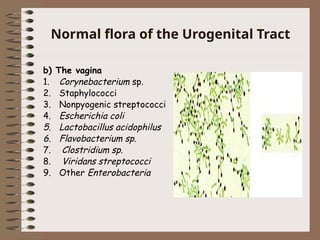
Normal flora of the Urogenital Tract
b) The vagina
1. Corynebacterium sp.
2. Staphylococci
3. Nonpyogenic streptococci
4. Escherichia coli
5. Lactobacillus acidophilus
6. Flavobacterium sp.
7. Clostridium sp.
8. Viridans streptococci
9. Other Enterobacteria
Normal Flora of the Gastrointestinal
Tract (GIT)
• In humans, the
GIT flora are
influenced by:
1. Age
2.Diet
3.Cultural conditions
4.The use of
antibiotics
Normal Flora of the Gastrointestinal
Tract (GIT)
• At birth
• The entire intestinal
tract is sterile, but
bacteria enter with
the first feed. The
initial colonizing
bacteria vary with
the food source of
the infant.
Normal Flora of the Gastrointestinal
Tract (GIT)
• In breast-fed
1. Bifidobacteria
account for more than
90% of the total
intestinal bacteria.
2. Enterobacteriaceae
3. Enterococci
4. Bacteroides
5. Staphylococci
6. Lactobacilli
7. Clostridia
Normal Flora of the Gastrointestinal
Tract (GIT)
• In bottle-fed infants
• Bifidobacteria are not
predominant. When
breast-fed infants are
switched to a diet of
cow's milk or solid food,
bifidobacteria are
progressively joined by:
1. Enterics
2. Bacteroides
3. Enterococci
4. Lactobacilli
5. Clostridia
Normal Flora of the Gastrointestinal
Tract (GIT)
In the upper GIT of
adult humans
• mainly acid-tolerant
lactobacilli
e.g. Helicobacter pylori
Normal Flora of the Gastrointestinal
Tract (GIT)
• The proximal small
intestine
1.Lactobacilli
2.Enterococcus faecalis
3.Coliforms
4.Bacteroides
The flora of the large intestine (colon)
1. Enterococci
2. Clostridia
3. lactobacilli
4. Bacteroides
5. Bifidobacterium
(Bifidobacterium bifidum)
6. Escherichia coli
7. Methanogenic bacteria
8. Viridans streptococci
9. Staphylococcus sp.
10. Proteus sp.
11. Candida albicans (Yeast)
12. Mycoplama sp.
THANK YOU
B

3_2017_10_1نوران تت

  • 2.
    Normal Flora • Definition •Normal flora, also known as indigenous microbiota, are the beneficial microorganisms that reside on or within the body of a healthy organism. They play a crucial role in maintaining homeostasis and protecting against harmful microorganisms.
  • 3.
    Normal Flora Distribution: Normal floracan be found on various body surfaces and within different organs, including: * Skin * Oral cavity * Nasal cavity * Respiratory tract * Gastrointestinal tract * Genitourinary tract
  • 4.
    Normal Flora Composition: The compositionof normal flora varies depending on the body site. Common types of bacteria, fungi, and viruses found in normal flora include: **Skin: * **Bacteria:** Staphylococcus epidermidis, Staphylococcus aureus, Propionibacterium acnes * **Fungi:** Malassezia species, Candida albicans **Oral cavity:** * **Bacteria:** Streptococcus mutans, Streptococcus sanguinis, Lactobacillus species * **Fungi:** Candida species **Respiratory tract:** * **Bacteria:** Haemophilus influenzae, Moraxella catarrhalis, Streptococcus pneumoniae **Gastrointestinal tract:** * **Bacteria:** Bifidobacteria, Lactobacilli, Enterobacteriaceae, Clostridia * **Fungi:** Saccharomyces cerevisiae, Candida species **Genitourinary tract:** * **Bacteria:** Lactobacillus acidophilus, Escherichia coli, Staphylococcus saprophyticus * **Fungi:** Candida species
  • 5.
    Normal Flora • Residentflora – Reflects age of person
  • 6.
    . Normal Flora Resident flora Changescontinuously through out life
  • 7.
    Normal Flora • Residentflora – Reflects nutrition of person
  • 8.
    Normal Flora • Residentflora – Reflects genetics of person
  • 9.
    Normal Flora • Residentflora – 90% is S. epidermidis; S. aureus, may be in moist areas
  • 10.
  • 11.
    • Resident flora –Reflects sex of person Normal Flora
  • 12.
    Sterile tissues In ahealthy human, the internal tissues such as: • blood • brain • muscle • cerebrospinal fluid (CSF.) are normally free of microorganisms. Normal Flora
  • 13.
    1. They constitutea protective host defense mechanism by occupying ecological niches. Importance of The Normal Flora (Advantages)
  • 14.
    Importance of TheNormal Flora (Advantages) 2. They produce vitamin B and vitamin K in intestine.
  • 15.
    Importance of TheNormal Flora (Advantages) 3.The oral flora contribute to immunity by inducing low levels of circulating and secretary antibodies that may cross react with pathogens.
  • 16.
    Importance of TheNormal Flora (Advantages) 4. The oral bacteria flora exert microbial antagonism against nonindigenous species by production of inhibitory fatty acids, peroxides, bacteriocins, etc.
  • 17.
    Importance of TheNormal Flora (Advantages) 5. The normal flora may antagonize other bacteria through the production of substances which inhibit or kill nonindigenous species.
  • 18.
    Importance of TheNormal Flora (Disadvantages) 1. They can cause disease in the following: a) When individuals become immunocompromised or debilitated. b) When they change their usual anatomic location.
  • 19.
    Importance of TheNormal Flora 2. The oral flora of humans may harm their host since some of these bacteria are pathogens or opportunistic pathogens
  • 20.
    Estimation of theNormal flora It has been calculated that the normal flora human body about 1012 bacteria on the skin, 1010 in the mouth, and 1014 in the gastrointestinal tract.
  • 21.
    Normal Flora ofthe Skin • The most important sites are: 1. Axilla 2.Groin 3.Areas between the toes
  • 22.
    Normal Flora ofthe Skin • The majority of skin microorganisms are found in the most superficial layers of the epidermis and the upper parts of the hair follicles.
  • 23.
    Normal Flora ofthe Skin • Important bacteria: 1. Staphylococcus epidermidis 2. Micrococcus sp. 3. Corynebacteria sp. 4. Mycobacterium smegmatis
  • 24.
    Normal Flora ofthe Conjunctiva 1. Staphylococcus epidermidis 2. Corynebacterium sp. 3.Propoinibacteriumacnes 4. Staphylococcus aureus 5. Viridans streptococci 6. Neisseria sp. 7. Haemophilus influenzae
  • 25.
    Pathogens which doinfect the conjunctiva • Neisseria onorrhoeae • Chlamydia trachomatis
  • 26.
    Normal Flora ofthe Respiratory Tract A) The nares (nostrils) 1. Staphylococcus epidermidis 2. Corynebacteria 3. Staphylococcus aureus 4. Neisseria sp. 5. Haemophilus sp 6. Streptococcus pneumoniae
  • 27.
    Normal Flora ofthe Respiratory Tract B) The upper respiratory tract (nasopharynx). 1. Non-hemolytic streptococci 2. Alpha-hemolytic streptococci 3. Neisseria sp. 4. Streptococcus pneumoniae 5. Streptococcus pyogenes 6. Haemophilus influenzae 7. Neisseria meningitidis
  • 28.
    Normal Flora ofthe Respiratory Tract • C) The lower respiratory tract (trachea, bronchi, and pulmonary tissues): • Usually sterile. • The individual may become susceptible to infection by pathogens descending from the nasopharynx e.g. • H. influenzae • S. pneumoniae).
  • 29.
    Normal Flora ofthe Human Oral Cavity • Oral bacteria include: 1. Viridans streptococci 2. Lactobacilli 3. Staphylococci (S. aureus and S. epidermidis) 4. Corynebacterium sp. 5. Bacteroides sp. 6. Streptococcus sanguis (dental plaque) 7. Streptococcus mutans (dental plaque) 8. Actinomyces sp.
  • 30.
    The Normal Floraof The Ears (i.e. external ear) • The external ears contains avariety of microorganisms. These include: 1. Staphylococcus epidermidis 2. Staphylococcus aureus 3. Corynebacterium sp
  • 31.
    Normal flora ofthe Urogenital Tract a) The anterior urethra 1. Staphylococcus epidermidis 2. Enterococcus faecalis 3. lpha-hemolytic streptococci. 4. Some enteric bacteria (e.g. E. coli, Proteus sp.) 5. Corynebacteria sp. 6. Acinetobacter sp. 7. Mycoplasma sp. 8. Candida sp. 9. Mycobacterium smegmatis
  • 32.
    Normal flora ofthe Urogenital Tract b) The vagina 1. Corynebacterium sp. 2. Staphylococci 3. Nonpyogenic streptococci 4. Escherichia coli 5. Lactobacillus acidophilus 6. Flavobacterium sp. 7. Clostridium sp. 8. Viridans streptococci 9. Other Enterobacteria
  • 33.
    Normal Flora ofthe Gastrointestinal Tract (GIT) • In humans, the GIT flora are influenced by: 1. Age 2.Diet 3.Cultural conditions 4.The use of antibiotics
  • 34.
    Normal Flora ofthe Gastrointestinal Tract (GIT) • At birth • The entire intestinal tract is sterile, but bacteria enter with the first feed. The initial colonizing bacteria vary with the food source of the infant.
  • 35.
    Normal Flora ofthe Gastrointestinal Tract (GIT) • In breast-fed 1. Bifidobacteria account for more than 90% of the total intestinal bacteria. 2. Enterobacteriaceae 3. Enterococci 4. Bacteroides 5. Staphylococci 6. Lactobacilli 7. Clostridia
  • 36.
    Normal Flora ofthe Gastrointestinal Tract (GIT) • In bottle-fed infants • Bifidobacteria are not predominant. When breast-fed infants are switched to a diet of cow's milk or solid food, bifidobacteria are progressively joined by: 1. Enterics 2. Bacteroides 3. Enterococci 4. Lactobacilli 5. Clostridia
  • 37.
    Normal Flora ofthe Gastrointestinal Tract (GIT) In the upper GIT of adult humans • mainly acid-tolerant lactobacilli e.g. Helicobacter pylori
  • 38.
    Normal Flora ofthe Gastrointestinal Tract (GIT) • The proximal small intestine 1.Lactobacilli 2.Enterococcus faecalis 3.Coliforms 4.Bacteroides
  • 39.
    The flora ofthe large intestine (colon) 1. Enterococci 2. Clostridia 3. lactobacilli 4. Bacteroides 5. Bifidobacterium (Bifidobacterium bifidum) 6. Escherichia coli 7. Methanogenic bacteria 8. Viridans streptococci 9. Staphylococcus sp. 10. Proteus sp. 11. Candida albicans (Yeast) 12. Mycoplama sp.
  • 40.
  • 41.