DEVELOPMENT OF THE TONGUE by: Dr. Carmina Romero Granado
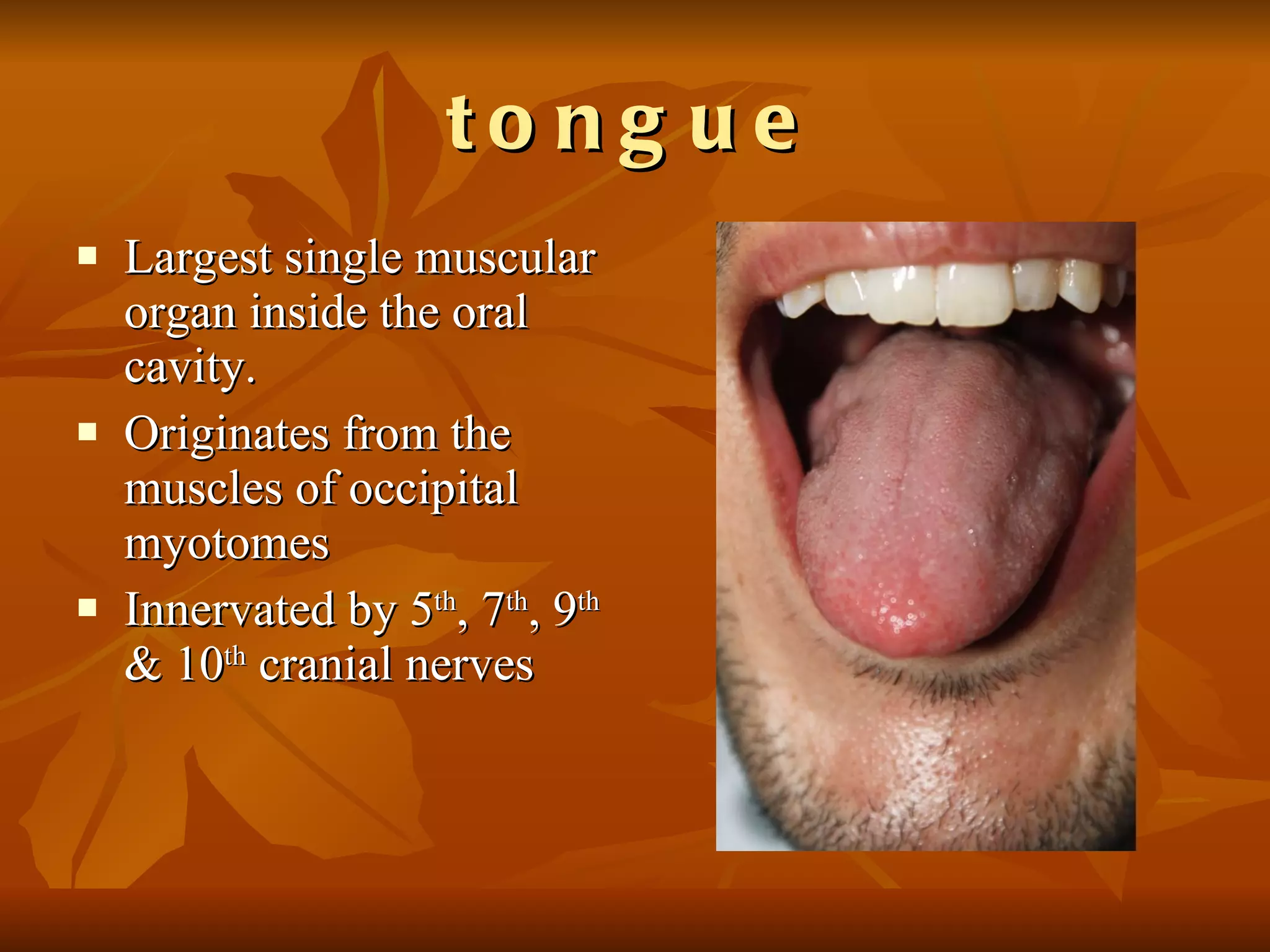
tongue Largest single muscular organ inside the oral cavity. Originates from the muscles of occipital myotomes Innervated by 5 th , 7 th , 9 th  & 10 th  cranial nerves
Extensive innervation is due to the long distance the muscle cells migrates to reach the tongue & varied functions  performed Muscles travel in the paths of these various nerves
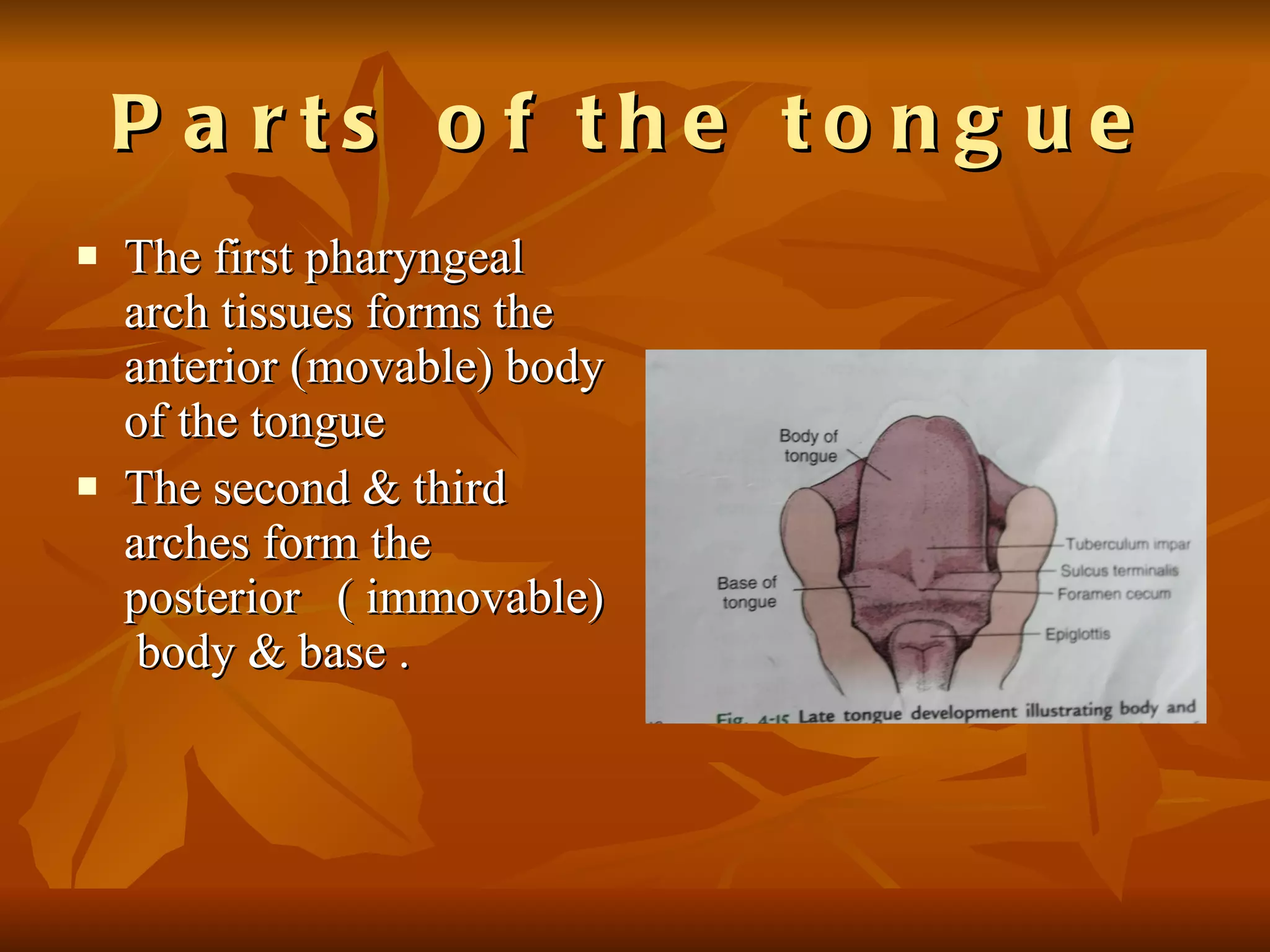
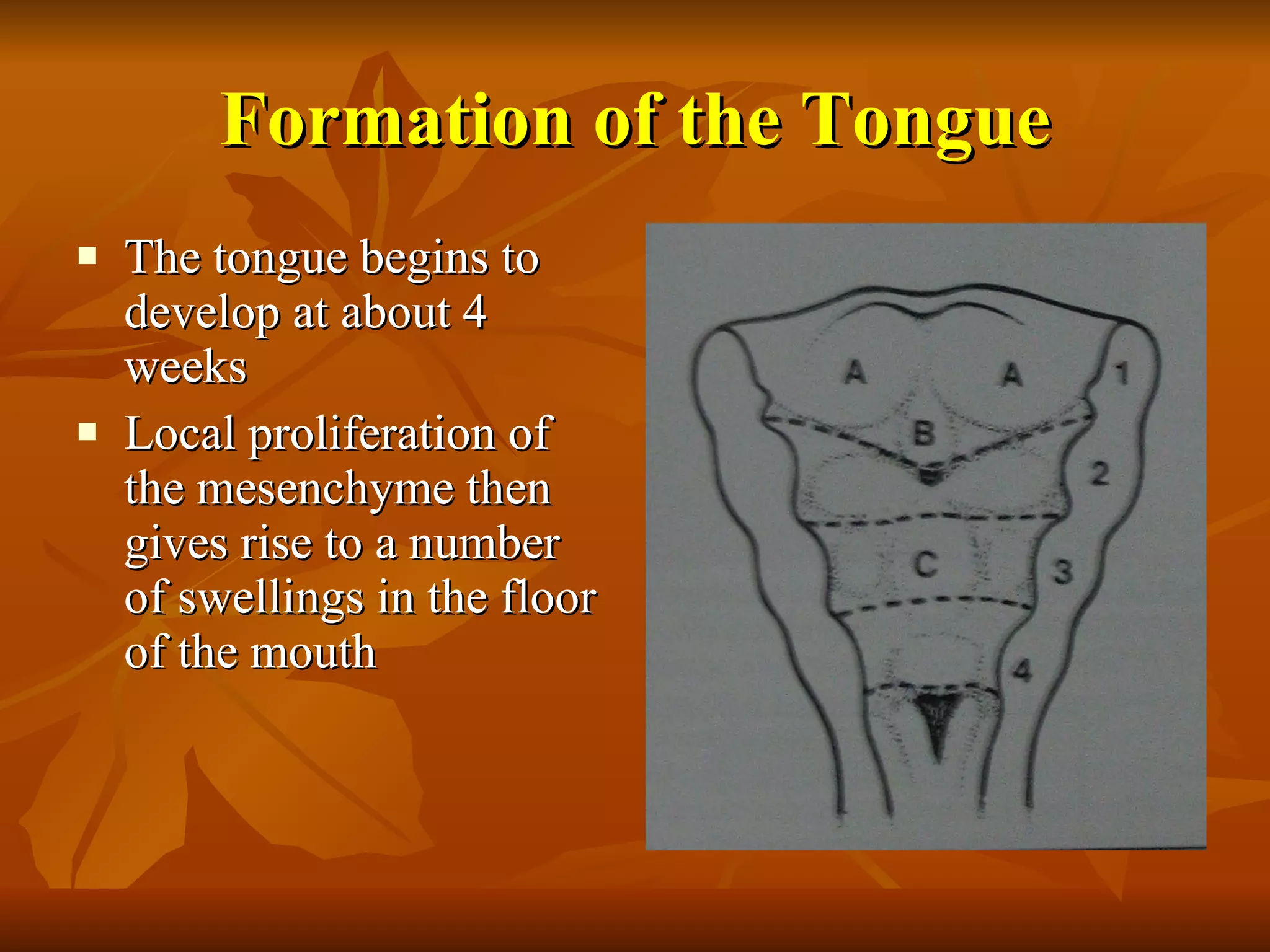
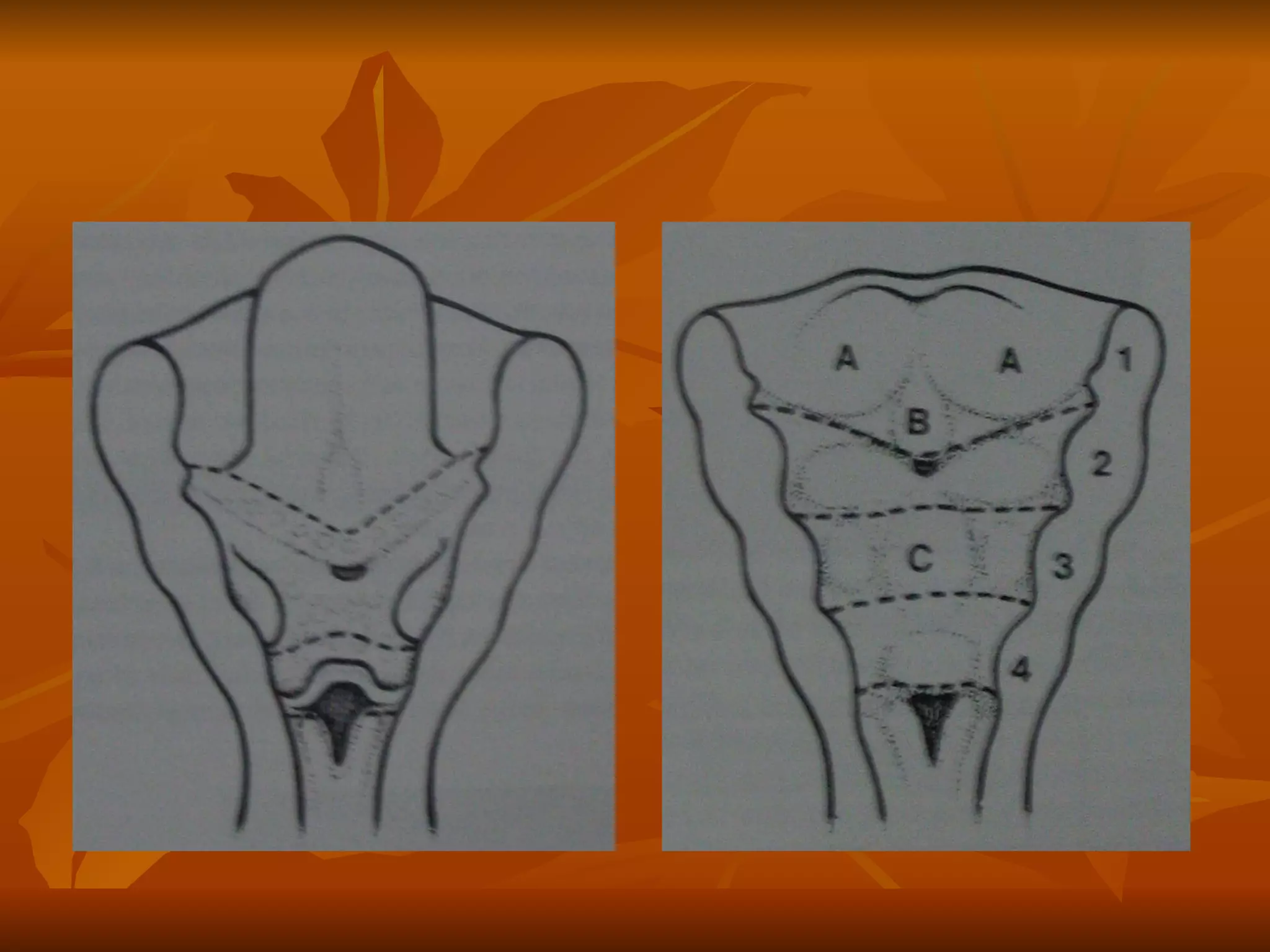
Parts of the tongue The first pharyngeal arch tissues forms the anterior (movable) body of the tongue The second & third arches form the posterior  ( immovable)  body & base .
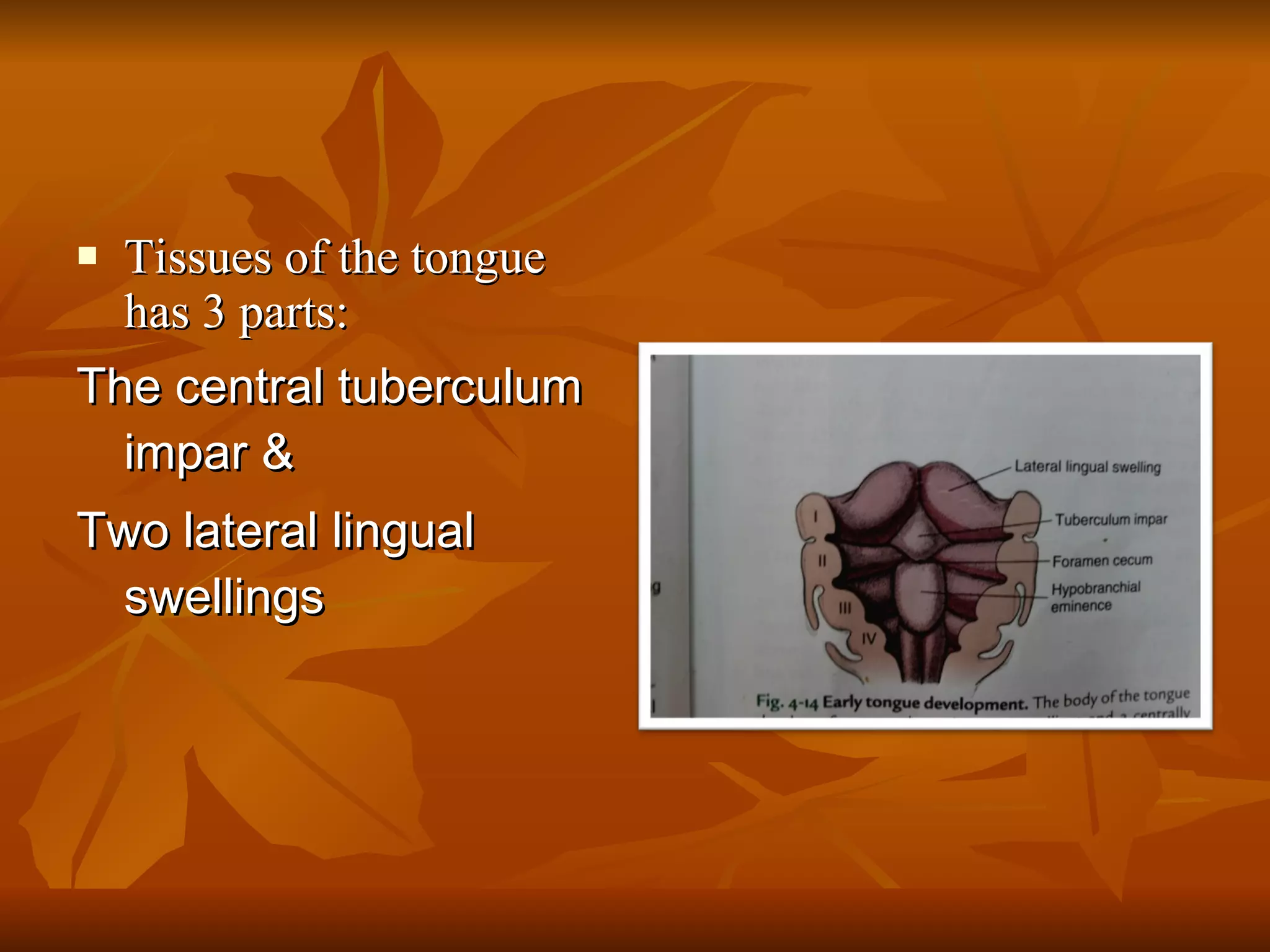
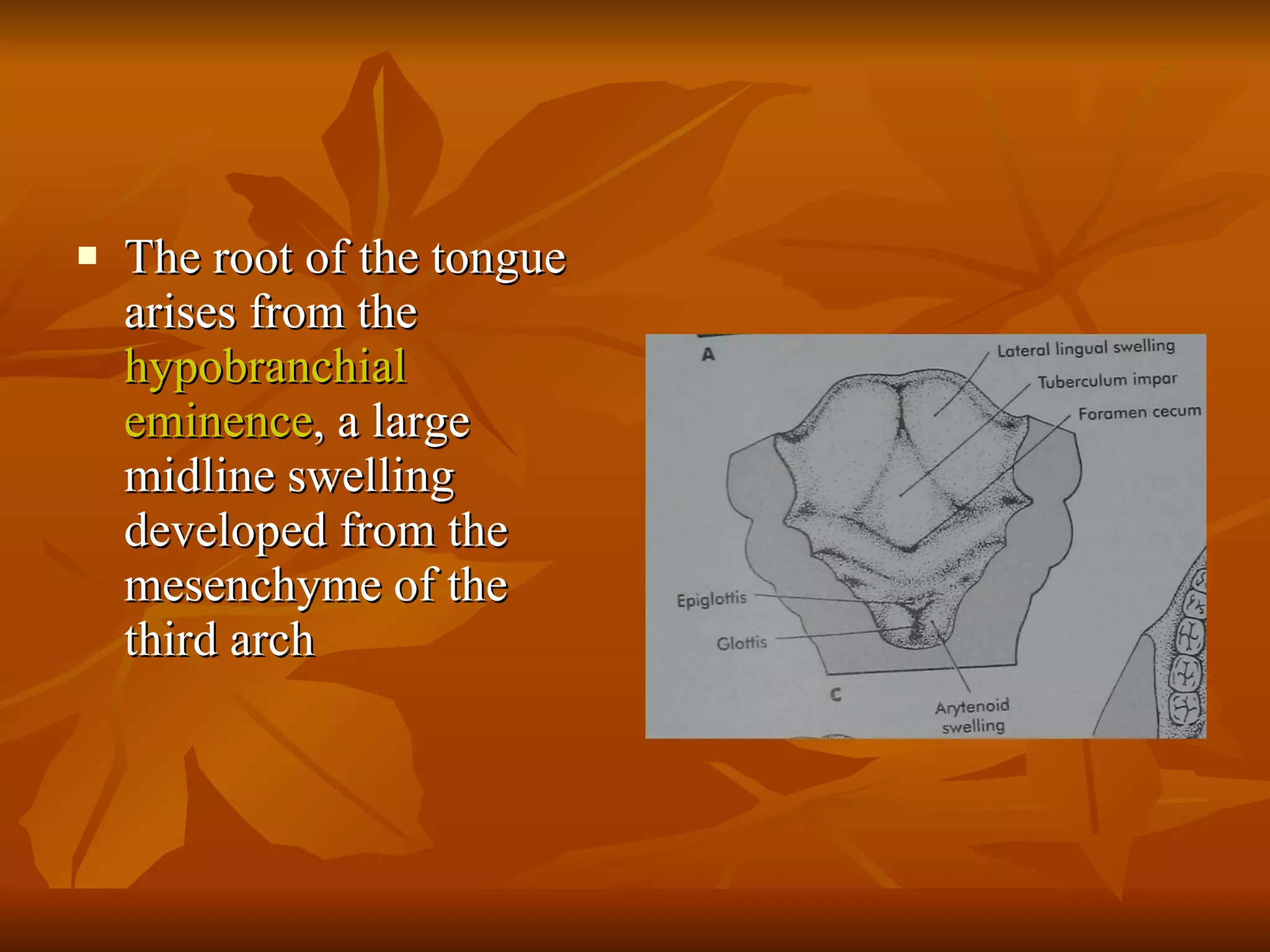
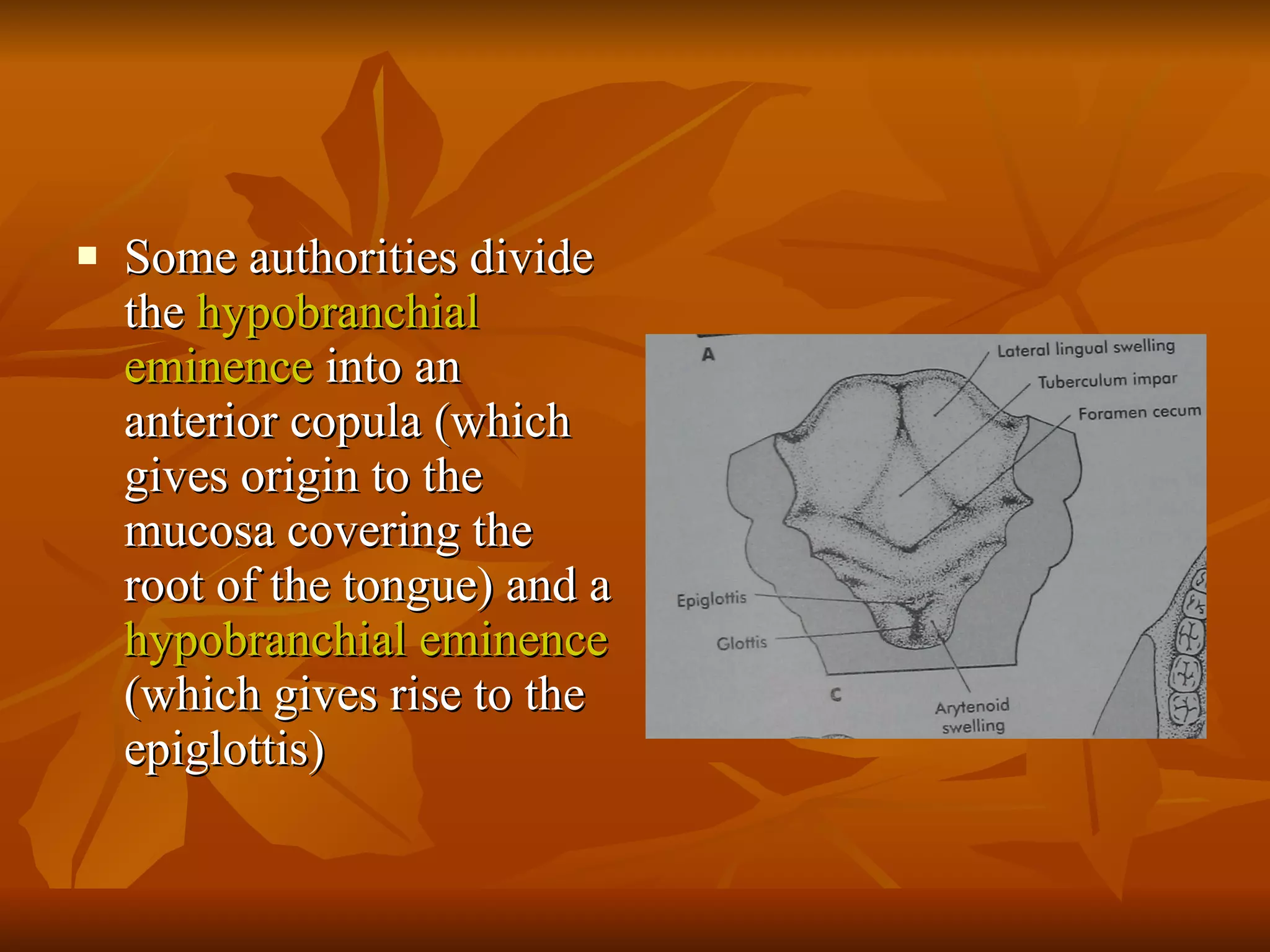
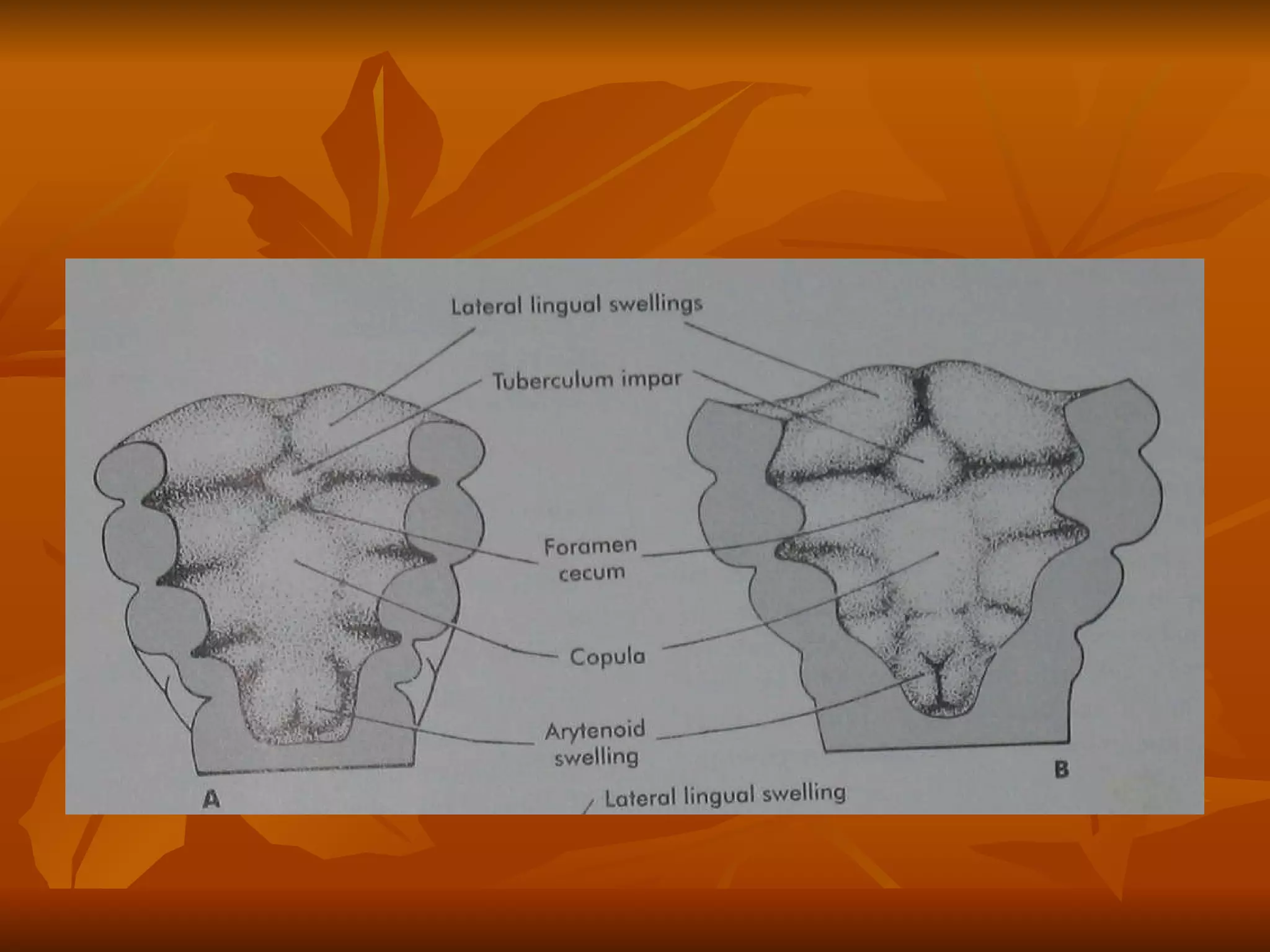
Tissues of the tongue has 3 parts: The central tuberculum impar &  Two lateral lingual swellings
Formation of the Tongue The tongue begins to develop at about 4 weeks Local proliferation of the mesenchyme then gives rise to a number of swellings in the floor of the mouth
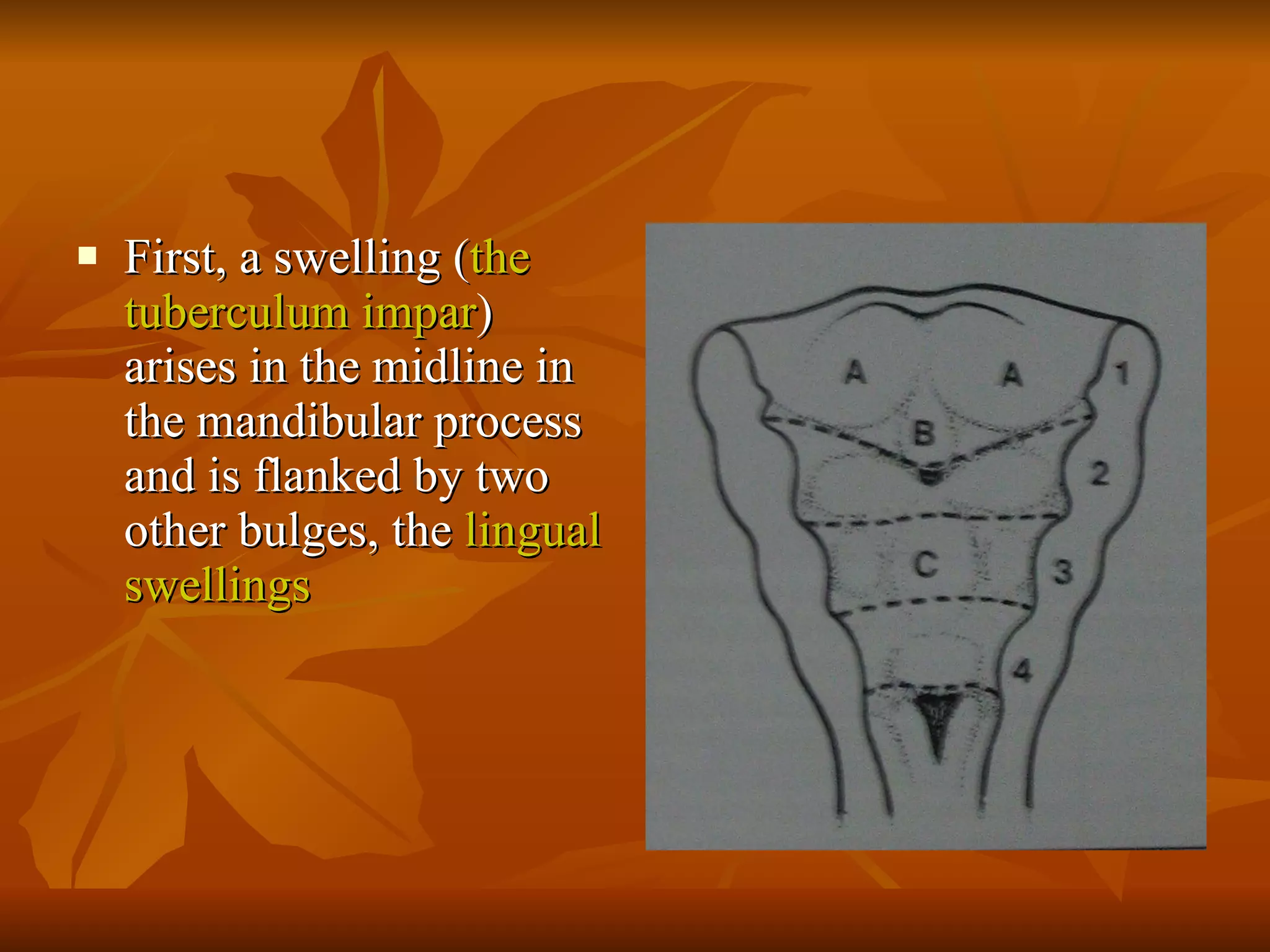
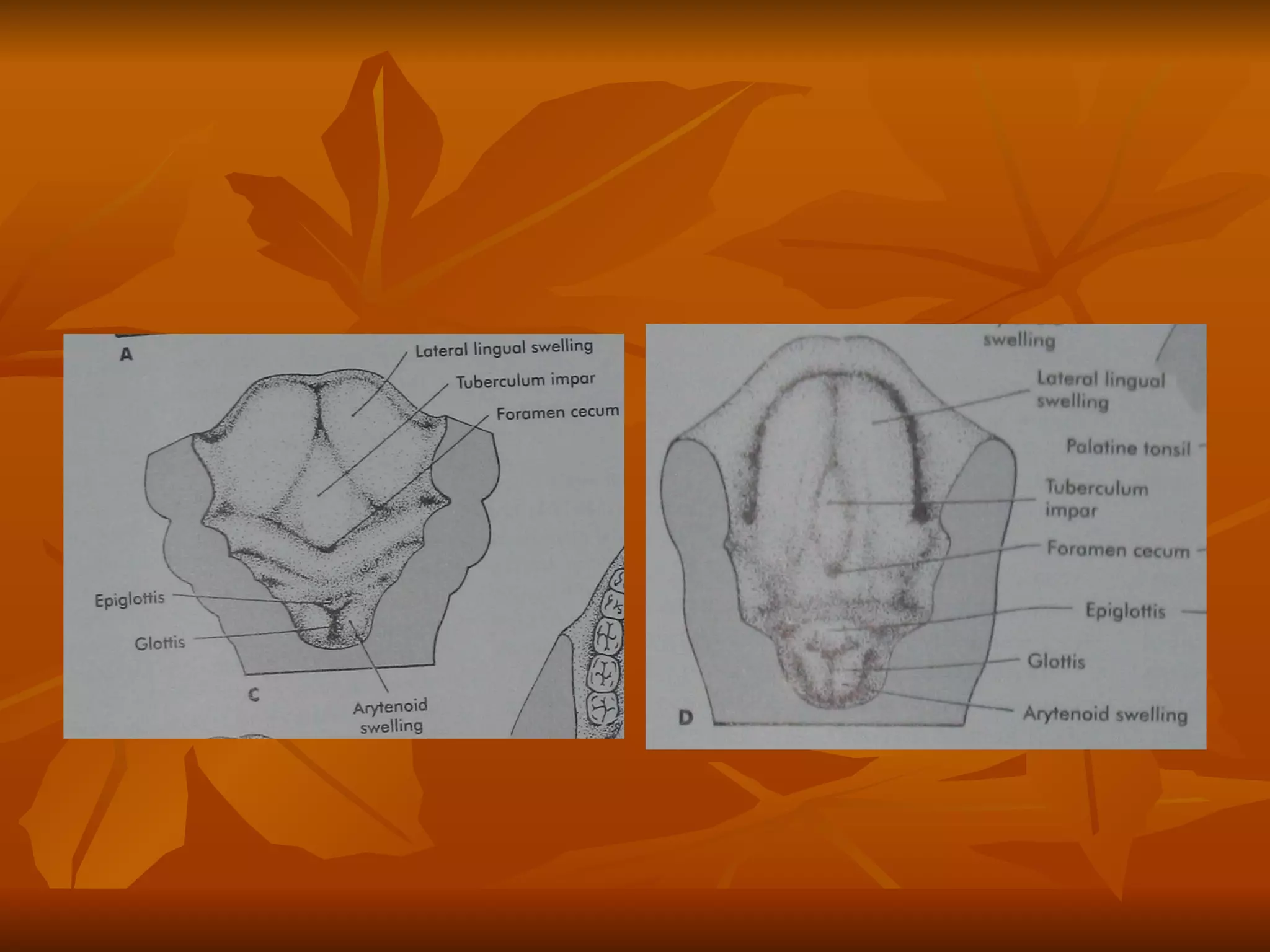
First, a swelling ( the tuberculum impar ) arises in the midline in the mandibular process and is flanked by two other bulges, the  lingual swellings
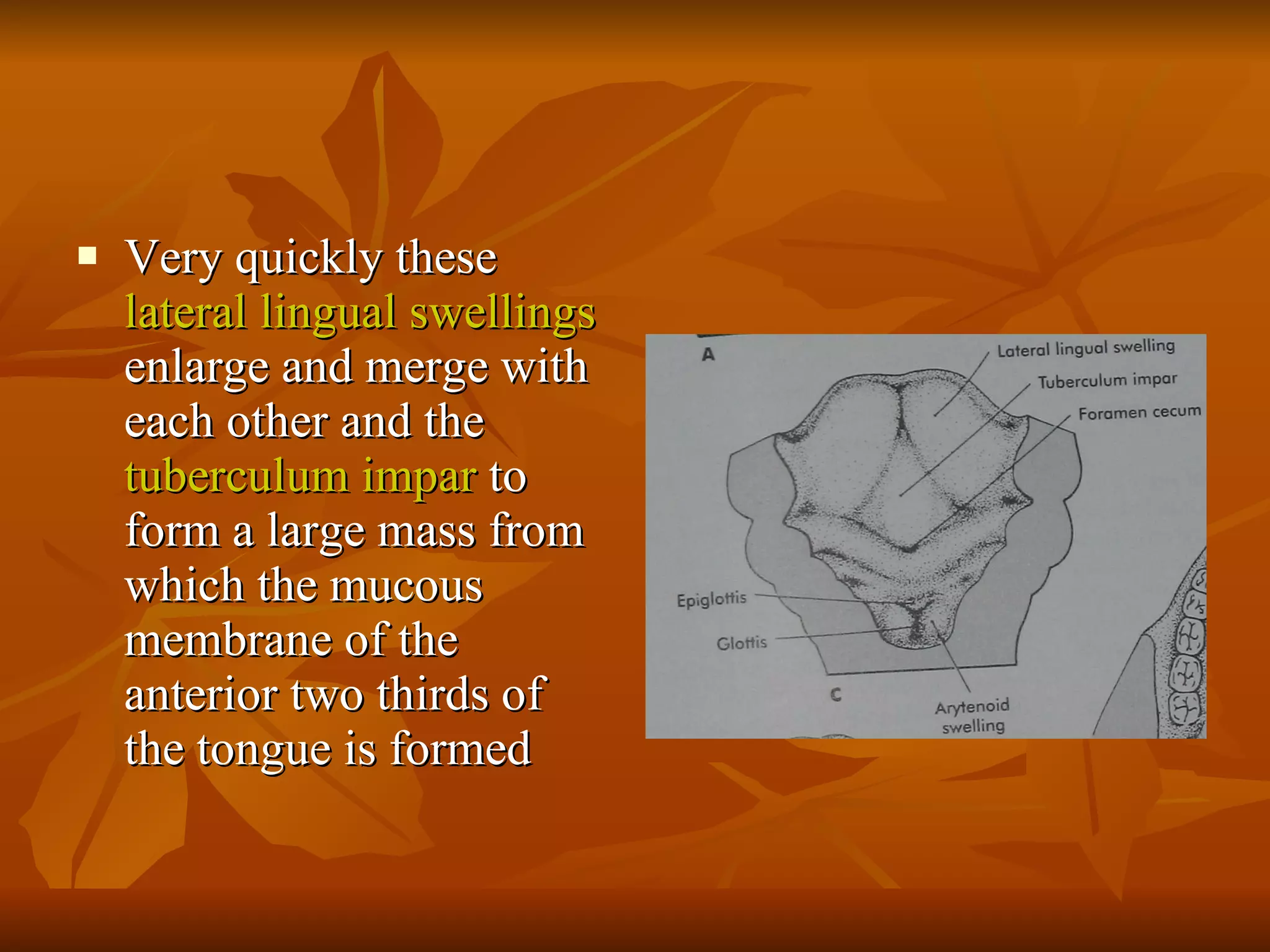
Very quickly these  lateral lingual swellings  enlarge and merge with each other and the  tuberculum impar  to form a large mass from which the mucous membrane of the anterior two thirds of the tongue is formed
The root of the tongue arises from the  hypobranchial eminence , a large midline swelling developed from the mesenchyme of the third arch
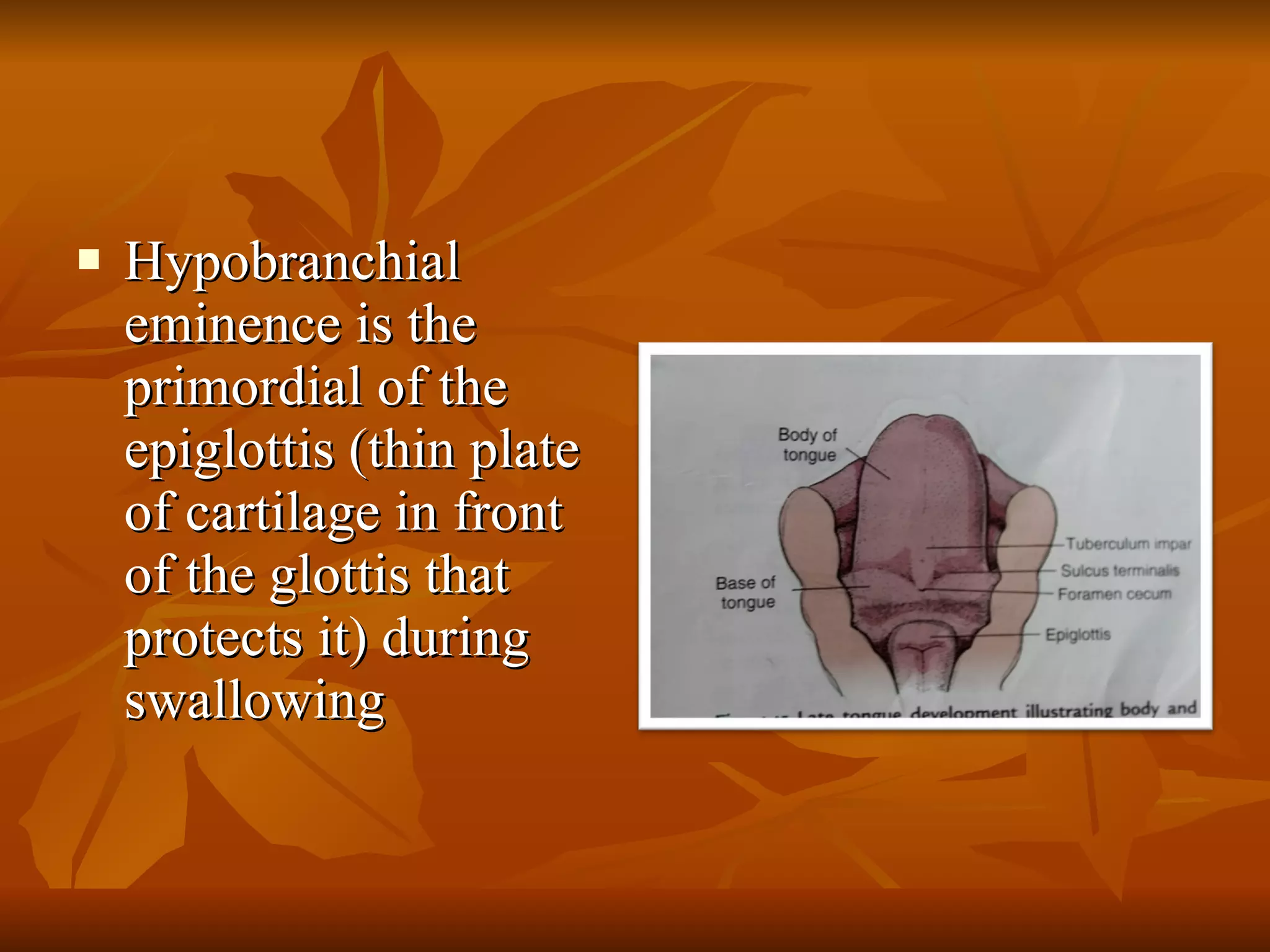
Hypobranchial eminence is the primordial of the epiglottis (thin plate of cartilage in front of the glottis that protects it) during swallowing
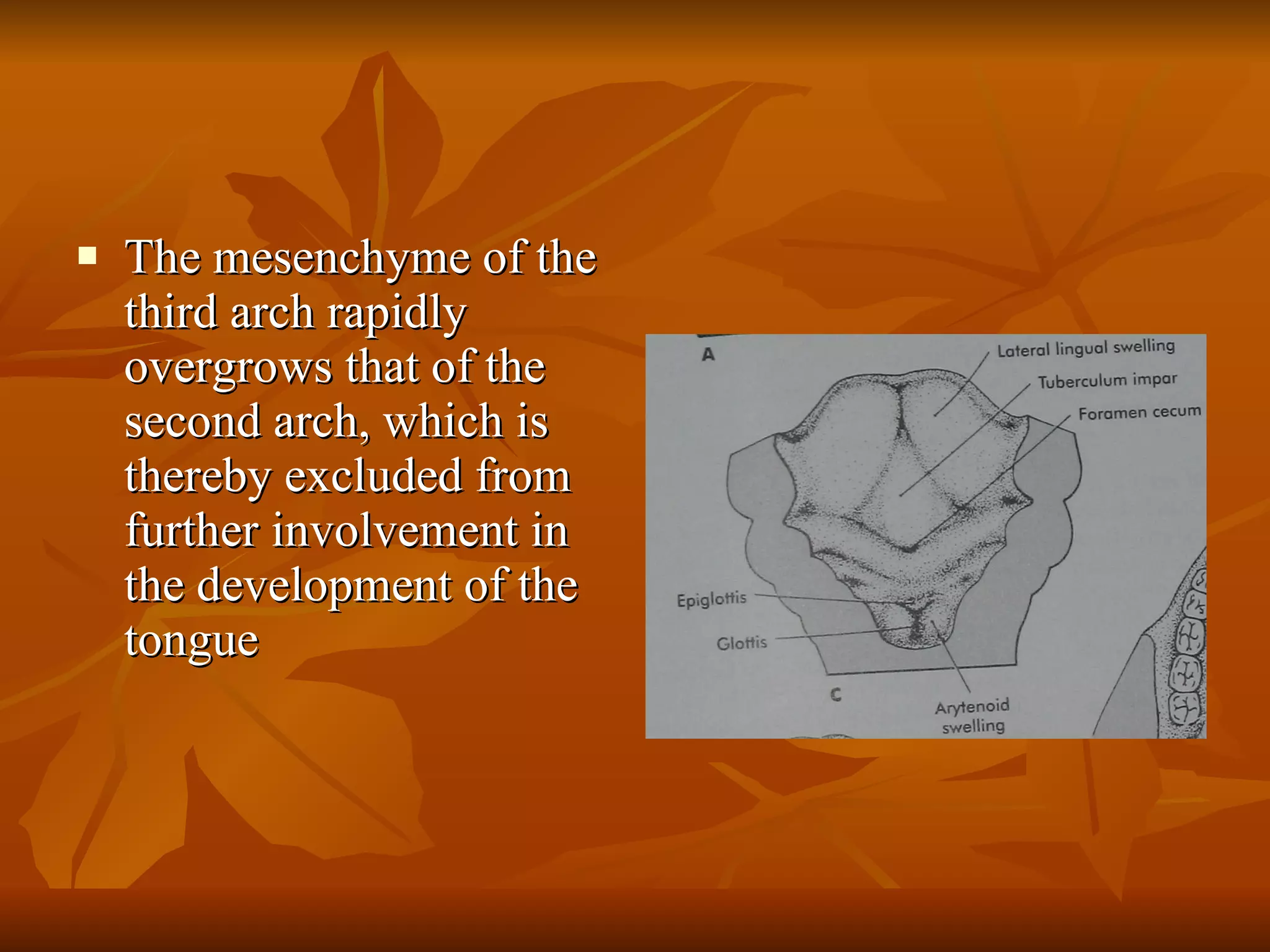
The mesenchyme of the third arch rapidly overgrows that of the second arch, which is thereby excluded from further involvement in the development of the tongue
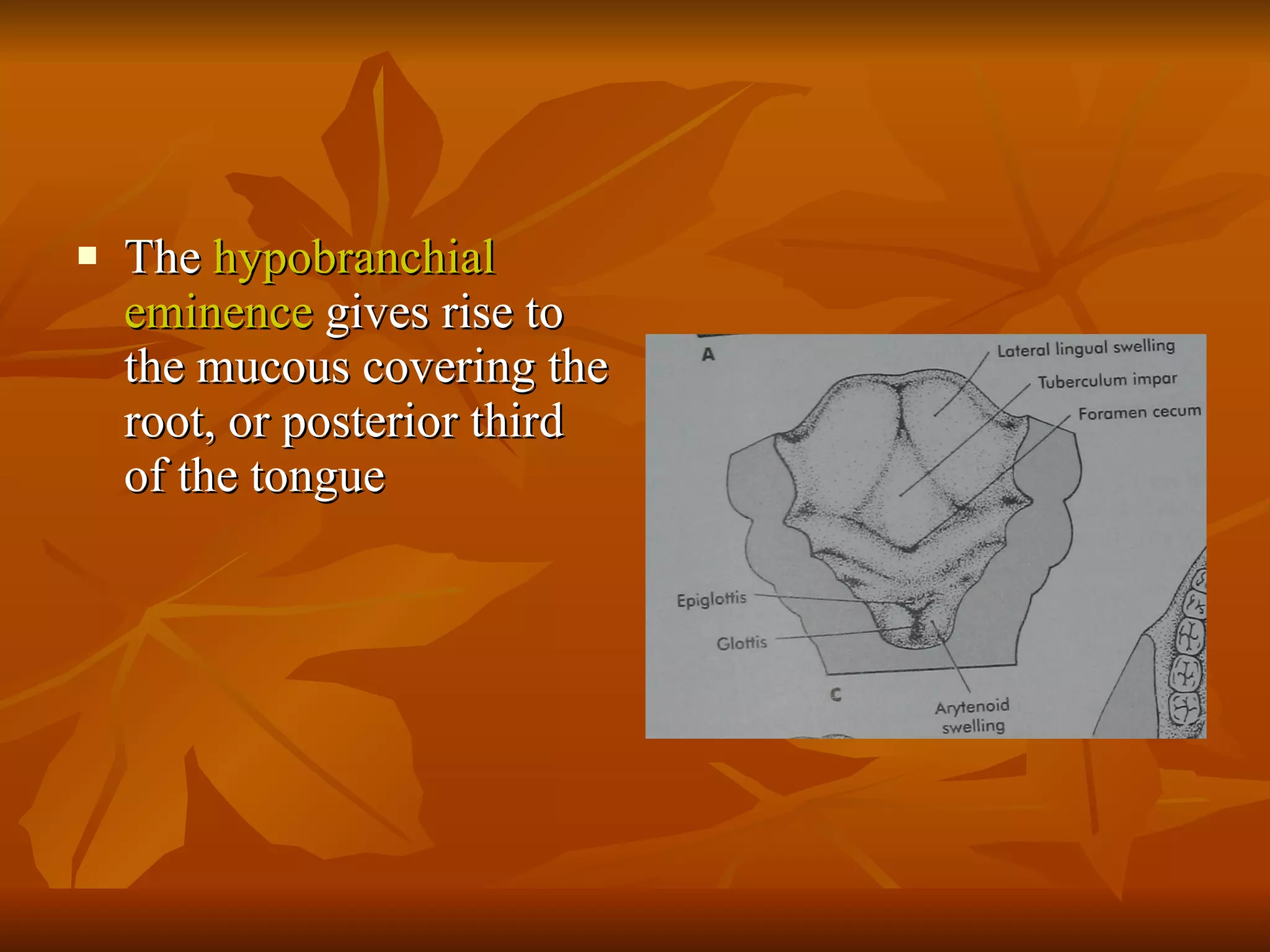
The  hypobranchial eminence  gives rise to the mucous covering the root, or posterior third of the tongue
Some authorities divide the  hypobranchial eminence  into an anterior copula (which gives origin to the mucosa covering the root of the tongue) and a  hypobranchial eminence  (which gives rise to the epiglottis)
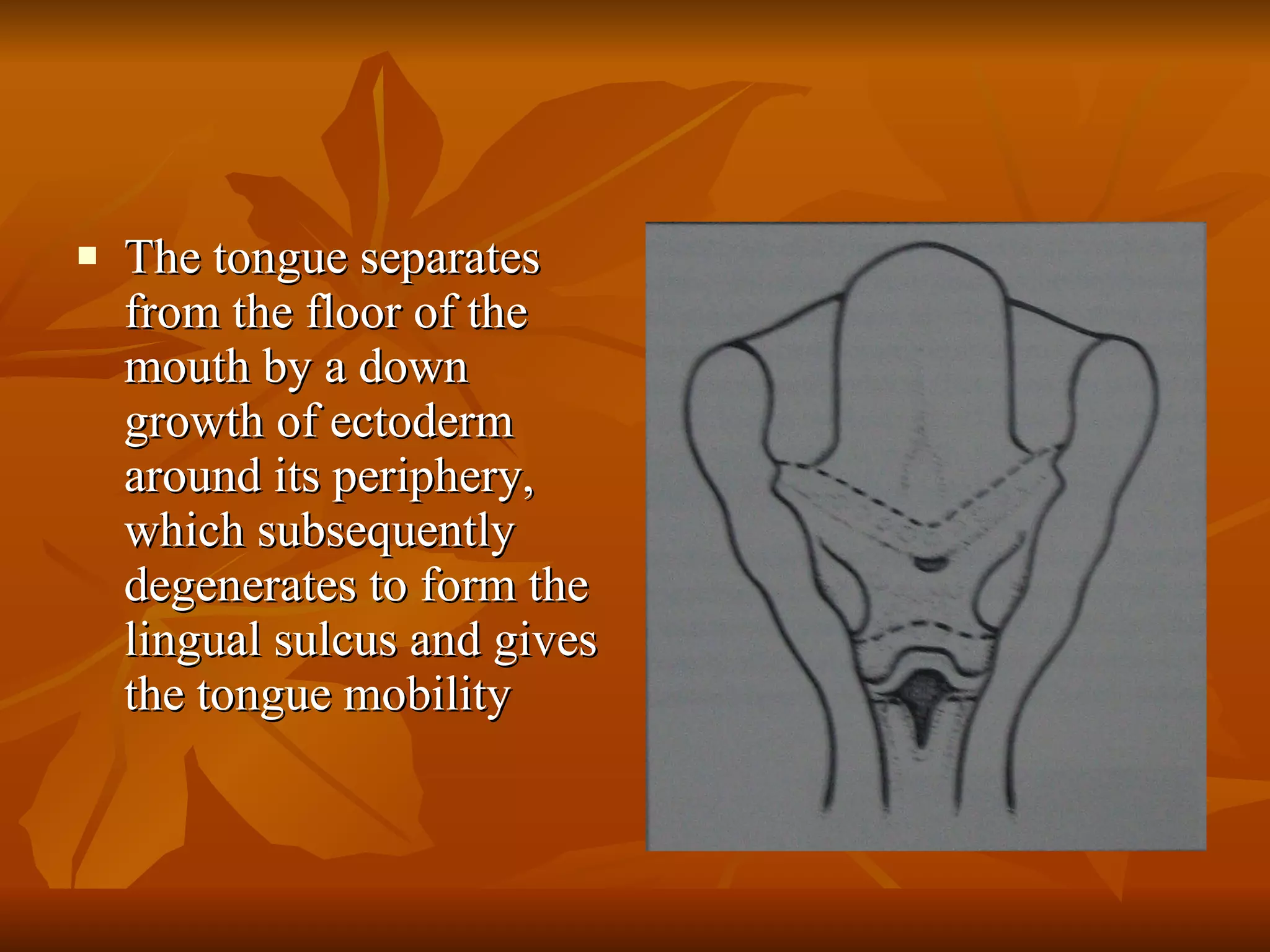
The tongue separates from the floor of the mouth by a down growth of ectoderm around its periphery, which subsequently degenerates to form the lingual sulcus and gives the tongue mobility
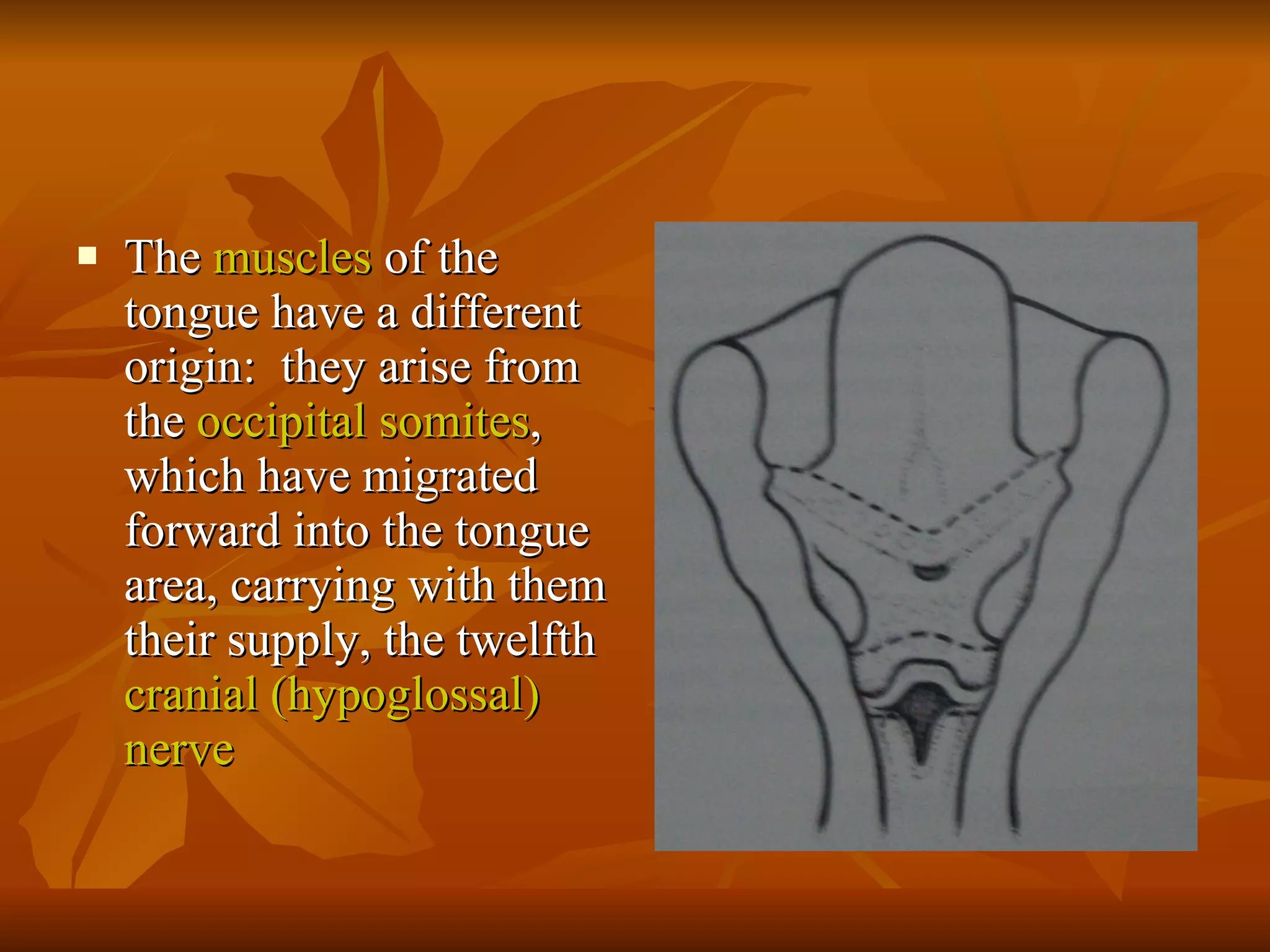
The  muscles  of the tongue have a different origin:  they arise from the  occipital somites , which have migrated forward into the tongue area, carrying with them their supply, the twelfth  cranial (hypoglossal) nerve
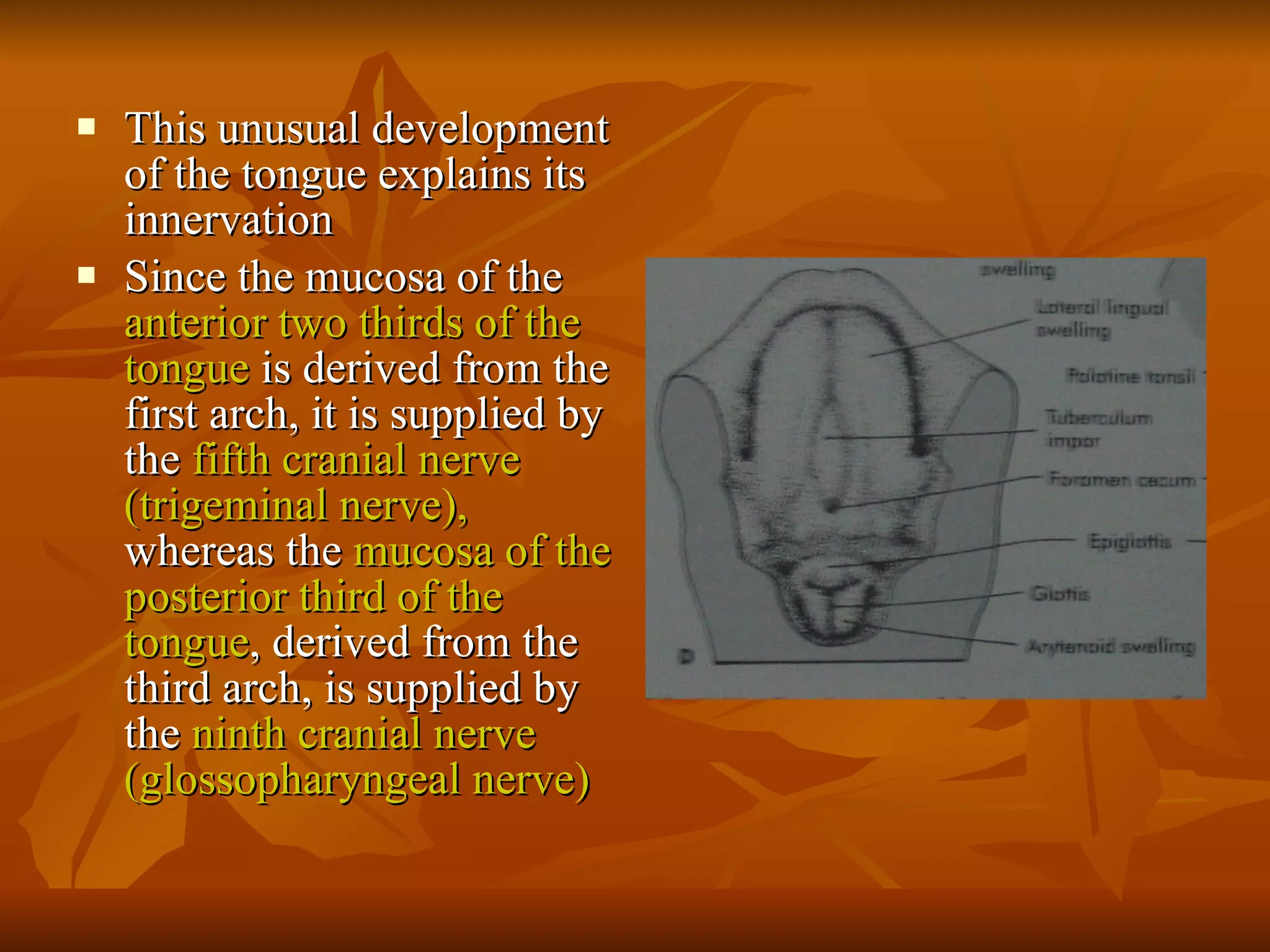
This unusual development of the tongue explains its innervation Since the mucosa of the  anterior two thirds of the tongue  is derived from the first arch, it is supplied by the  fifth cranial nerve (trigeminal nerve),  whereas the  mucosa of the posterior third of the tongue , derived from the third arch, is supplied by the  ninth cranial nerve (glossopharyngeal nerve)
The body & base of the tongue differ in structure of the mucous membrane: anterior (body)- papillary in nature Posterior (base)- lymphatic in nature this are separated by a V-shaped sulcus known as  sulcus terminalis
The anterior 2/3 is divide into two lateral halves by a  lingual septum  w/c is manifested externally as  median sulcus the dorsal mucosa covering the anterior part is velvet like in appearance because of the presence of invaginations & evaginations known as  lingual papilla
Types of lingual papilla: 4 types of lingual papilla: Filiform Fungiform Foliate circumvalate


Have a nice day Thank you for listening!!!

Development of the tongue

  • 1.
    DEVELOPMENT OF THETONGUE by: Dr. Carmina Romero Granado
  • 2.
    tongue Largest singlemuscular organ inside the oral cavity. Originates from the muscles of occipital myotomes Innervated by 5 th , 7 th , 9 th & 10 th cranial nerves
  • 3.
    Extensive innervation isdue to the long distance the muscle cells migrates to reach the tongue & varied functions performed Muscles travel in the paths of these various nerves
  • 4.
    Parts of thetongue The first pharyngeal arch tissues forms the anterior (movable) body of the tongue The second & third arches form the posterior ( immovable) body & base .
  • 5.
    Tissues of thetongue has 3 parts: The central tuberculum impar & Two lateral lingual swellings
  • 6.
    Formation of theTongue The tongue begins to develop at about 4 weeks Local proliferation of the mesenchyme then gives rise to a number of swellings in the floor of the mouth
  • 7.
    First, a swelling( the tuberculum impar ) arises in the midline in the mandibular process and is flanked by two other bulges, the lingual swellings
  • 8.
    Very quickly these lateral lingual swellings enlarge and merge with each other and the tuberculum impar to form a large mass from which the mucous membrane of the anterior two thirds of the tongue is formed
  • 9.
    The root ofthe tongue arises from the hypobranchial eminence , a large midline swelling developed from the mesenchyme of the third arch
  • 10.
    Hypobranchial eminence isthe primordial of the epiglottis (thin plate of cartilage in front of the glottis that protects it) during swallowing
  • 11.
    The mesenchyme ofthe third arch rapidly overgrows that of the second arch, which is thereby excluded from further involvement in the development of the tongue
  • 12.
    The hypobranchialeminence gives rise to the mucous covering the root, or posterior third of the tongue
  • 13.
    Some authorities dividethe hypobranchial eminence into an anterior copula (which gives origin to the mucosa covering the root of the tongue) and a hypobranchial eminence (which gives rise to the epiglottis)
  • 14.
    The tongue separatesfrom the floor of the mouth by a down growth of ectoderm around its periphery, which subsequently degenerates to form the lingual sulcus and gives the tongue mobility
  • 15.
    The muscles of the tongue have a different origin: they arise from the occipital somites , which have migrated forward into the tongue area, carrying with them their supply, the twelfth cranial (hypoglossal) nerve
  • 16.
    This unusual developmentof the tongue explains its innervation Since the mucosa of the anterior two thirds of the tongue is derived from the first arch, it is supplied by the fifth cranial nerve (trigeminal nerve), whereas the mucosa of the posterior third of the tongue , derived from the third arch, is supplied by the ninth cranial nerve (glossopharyngeal nerve)
  • 17.
    The body &base of the tongue differ in structure of the mucous membrane: anterior (body)- papillary in nature Posterior (base)- lymphatic in nature this are separated by a V-shaped sulcus known as sulcus terminalis
  • 18.
    The anterior 2/3is divide into two lateral halves by a lingual septum w/c is manifested externally as median sulcus the dorsal mucosa covering the anterior part is velvet like in appearance because of the presence of invaginations & evaginations known as lingual papilla
  • 19.
    Types of lingualpapilla: 4 types of lingual papilla: Filiform Fungiform Foliate circumvalate
  • 20.
  • 21.
  • 22.
  • 23.
  • 24.
  • 25.
    Have a niceday Thank you for listening!!!