DURAL FOLDS AND CAVERNOUS SINUS
 M.ARAVIND
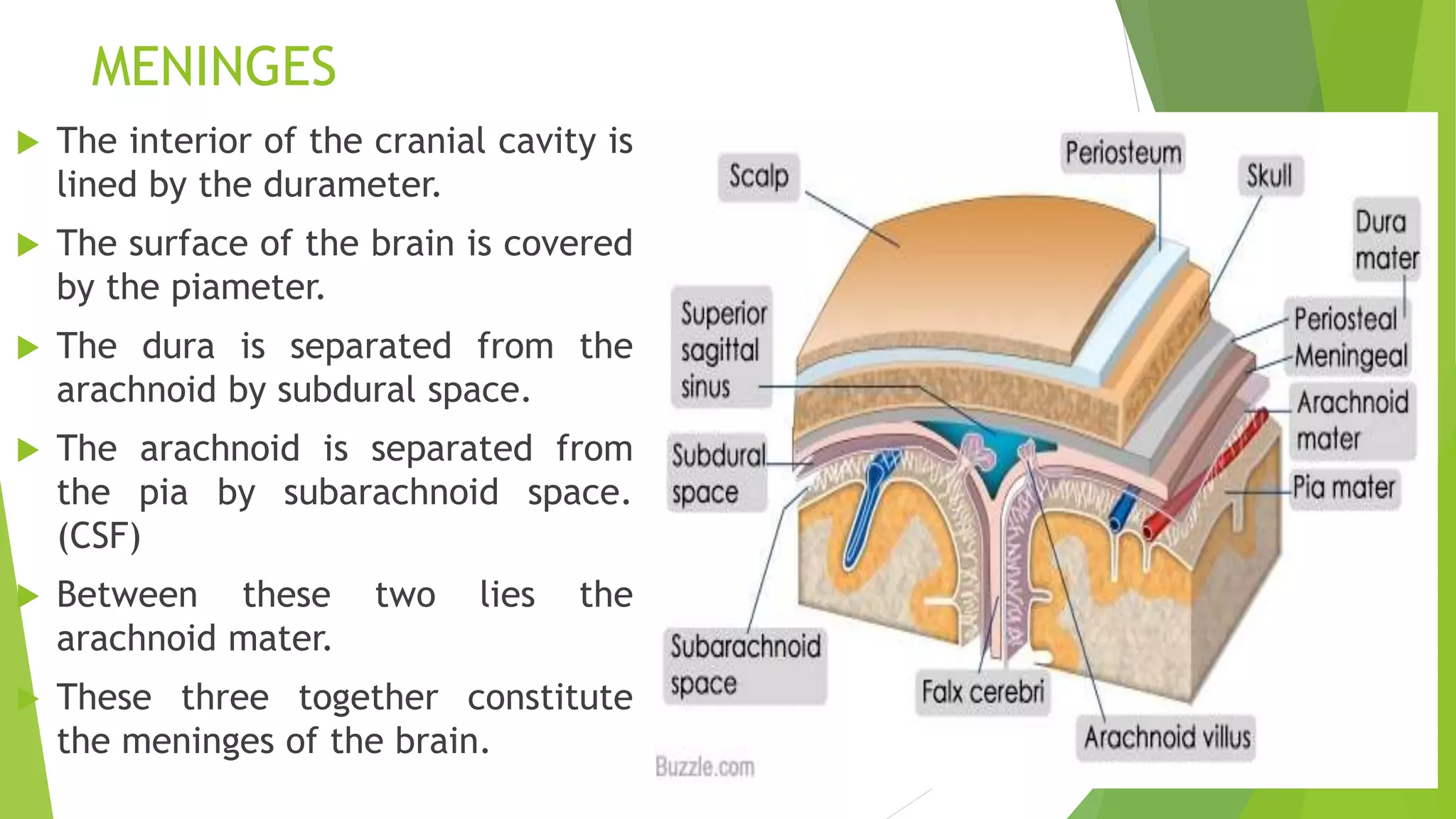
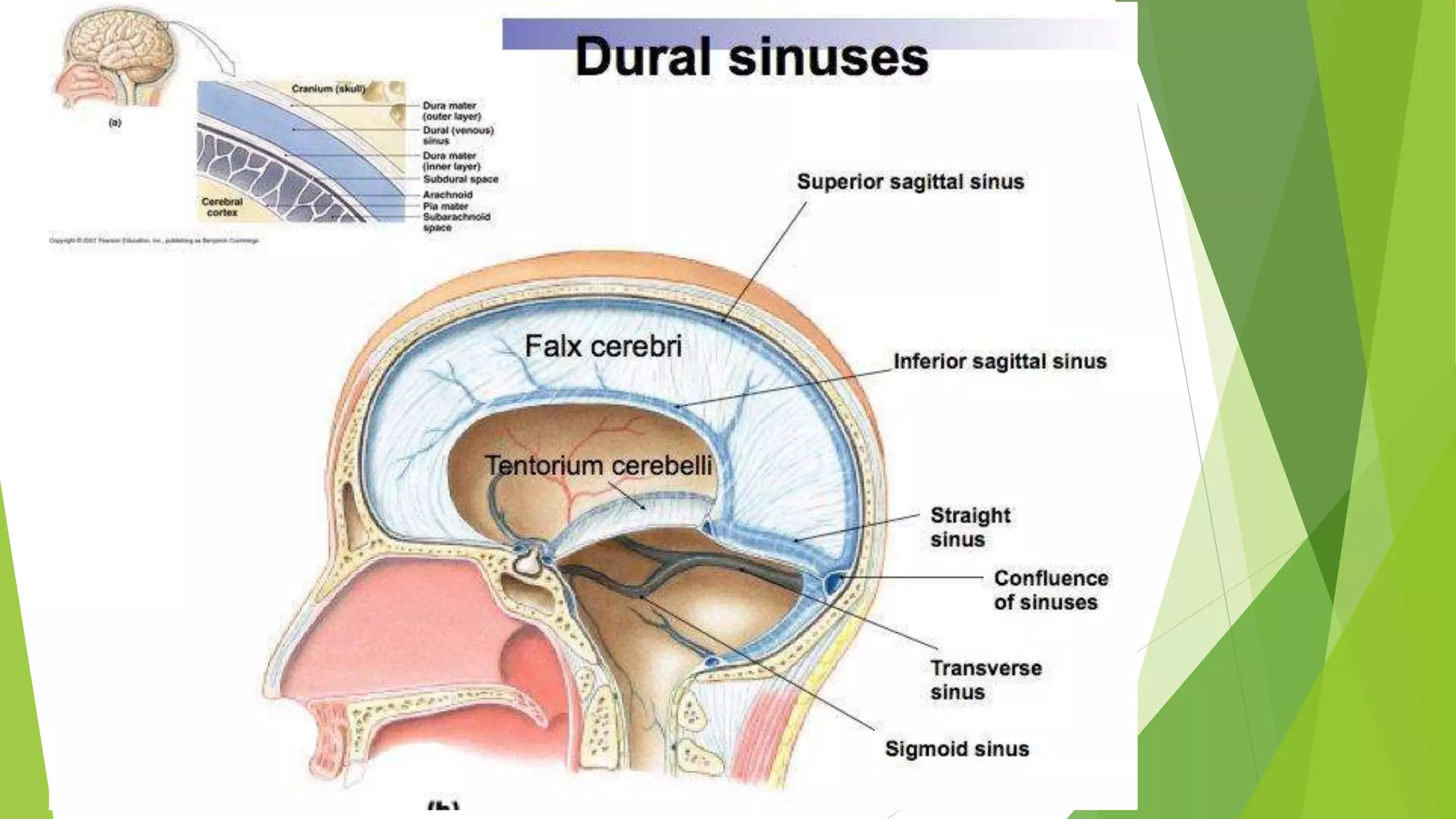
MENINGES
 The interior of the cranial cavity is
lined by the durameter.
 The surface of the brain is covered
by the piameter.
 The dura is separated from the
arachnoid by subdural space.
 The arachnoid is separated from
the pia by subarachnoid space.
(CSF)
 Between these two lies the
arachnoid mater.
 These three together constitute
the meninges of the brain.
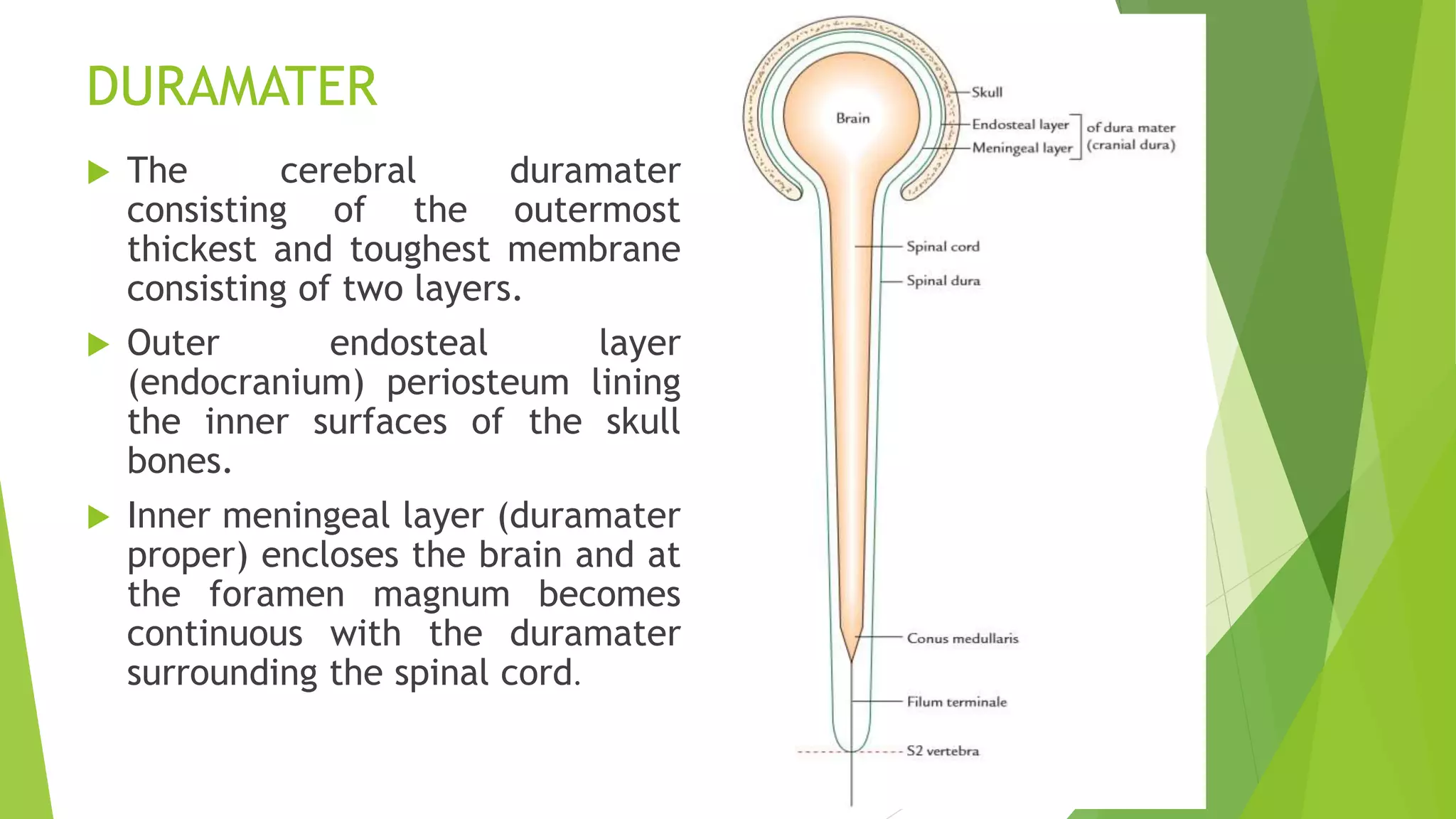
DURAMATER
 The cerebral duramater
consisting of the outermost
thickest and toughest membrane
consisting of two layers.
 Outer endosteal layer
(endocranium) periosteum lining
the inner surfaces of the skull
bones.
 Inner meningeal layer (duramater
proper) encloses the brain and at
the foramen magnum becomes
continuous with the duramater
surrounding the spinal cord.
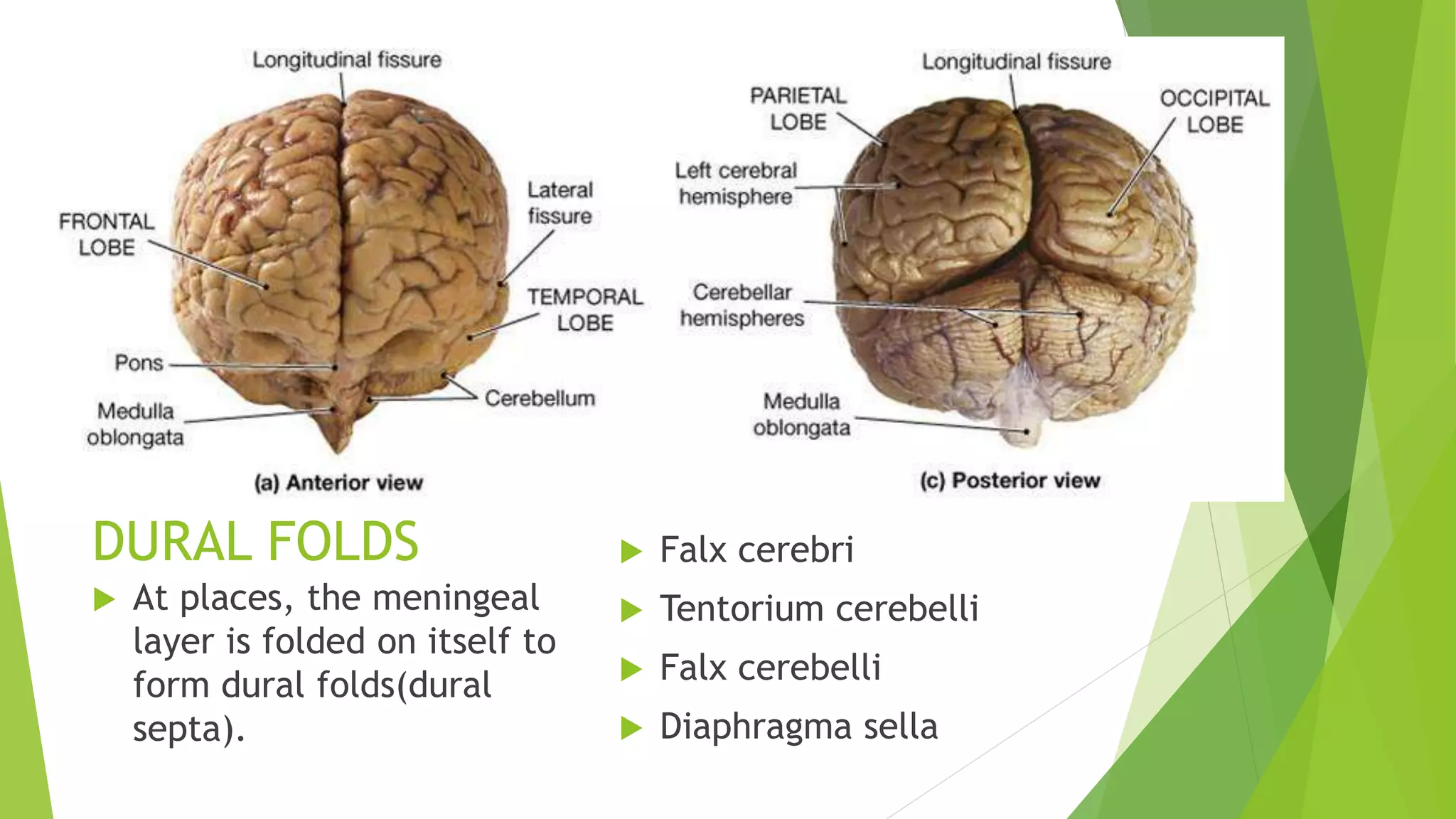
DURAL FOLDS
 At places, the meningeal
layer is folded on itself to
form dural folds(dural
septa).
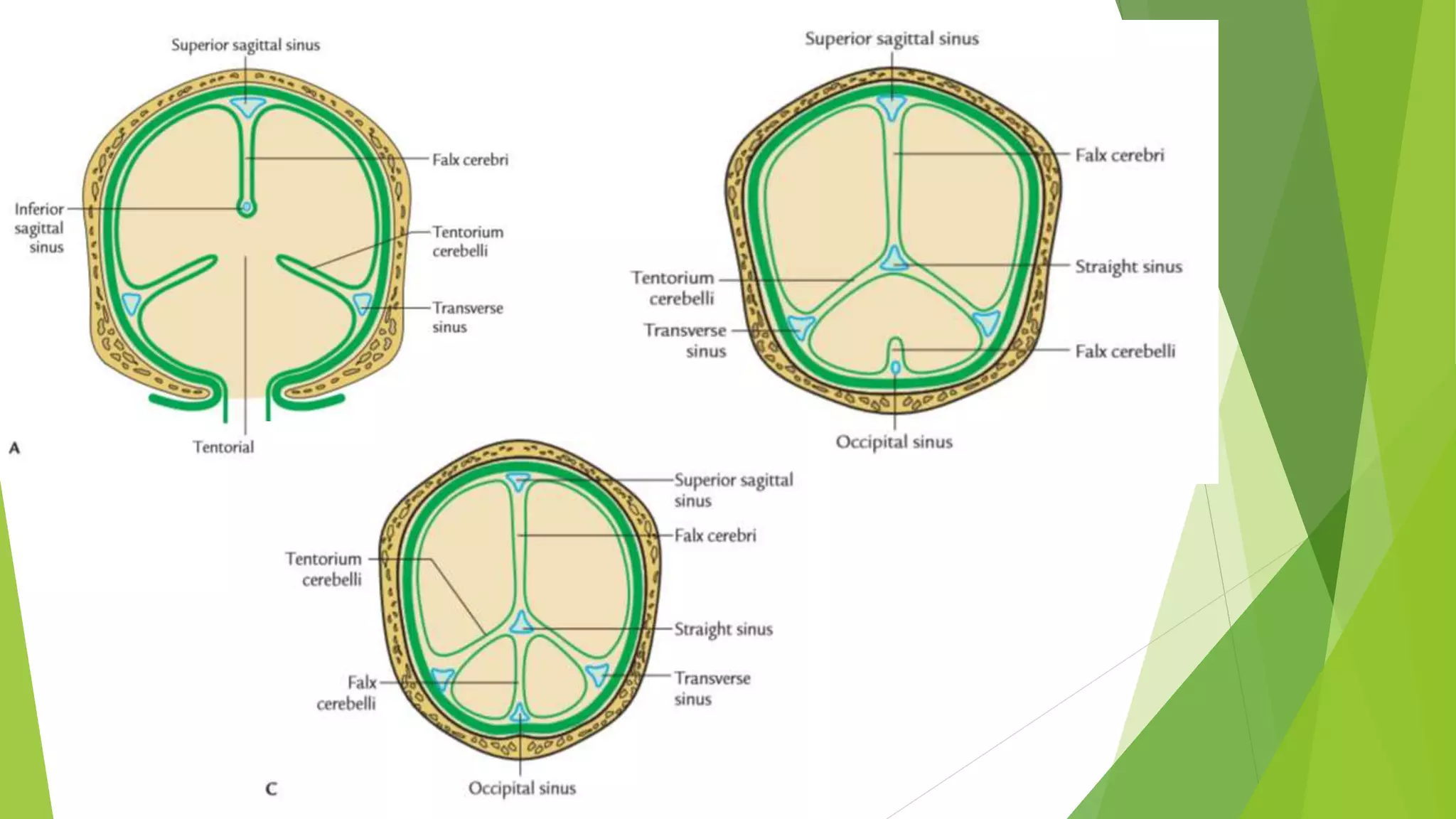
 Falx cerebri
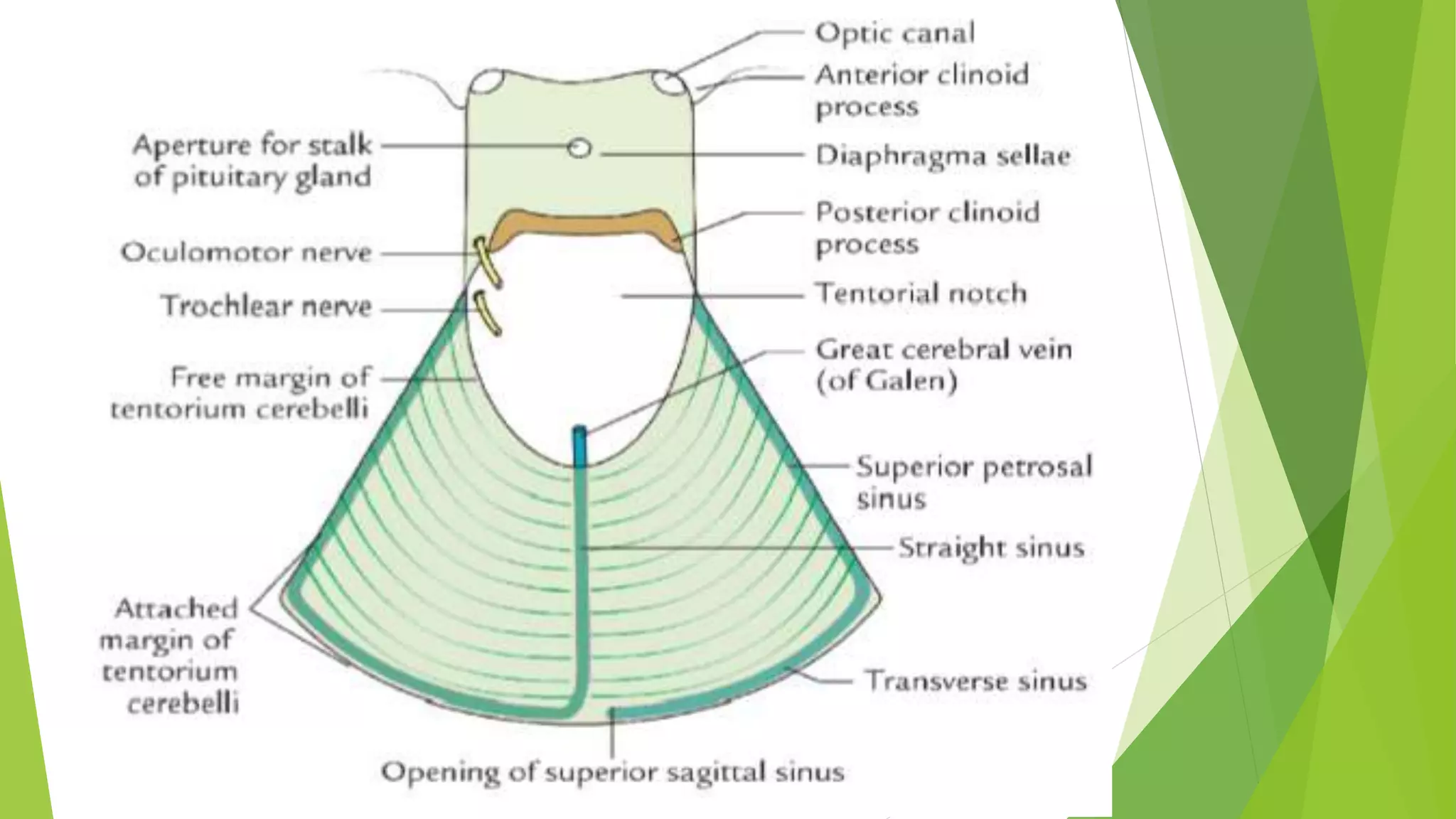
 Tentorium cerebelli
 Falx cerebelli
 Diaphragma sella
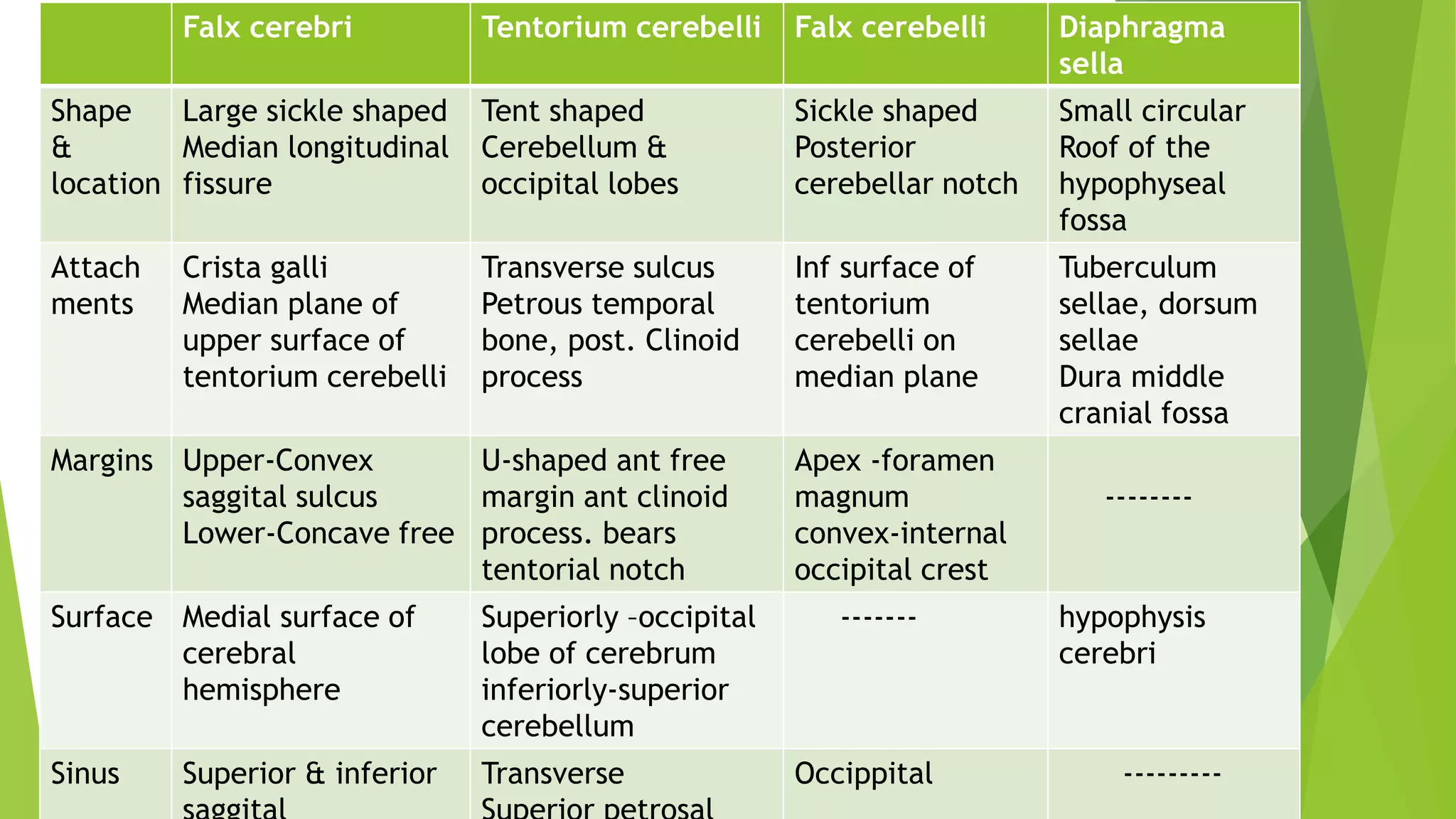
Falx cerebri Tentorium cerebelli Falx cerebelli Diaphragma
sella
Shape
&
location
Large sickle shaped
Median longitudinal
fissure
Tent shaped
Cerebellum &
occipital lobes
Sickle shaped
Posterior
cerebellar notch
Small circular
Roof of the
hypophyseal
fossa
Attach
ments
Crista galli
Median plane of
upper surface of
tentorium cerebelli
Transverse sulcus
Petrous temporal
bone, post. Clinoid
process
Inf surface of
tentorium
cerebelli on
median plane
Tuberculum
sellae, dorsum
sellae
Dura middle
cranial fossa
Margins Upper-Convex
saggital sulcus
Lower-Concave free
U-shaped ant free
margin ant clinoid
process. bears
tentorial notch
Apex -foramen
magnum
convex-internal
occipital crest
--------
Surface Medial surface of
cerebral
hemisphere
Superiorly –occipital
lobe of cerebrum
inferiorly-superior
cerebellum
------- hypophysis
cerebri
Sinus Superior & inferior Transverse Occippital ---------
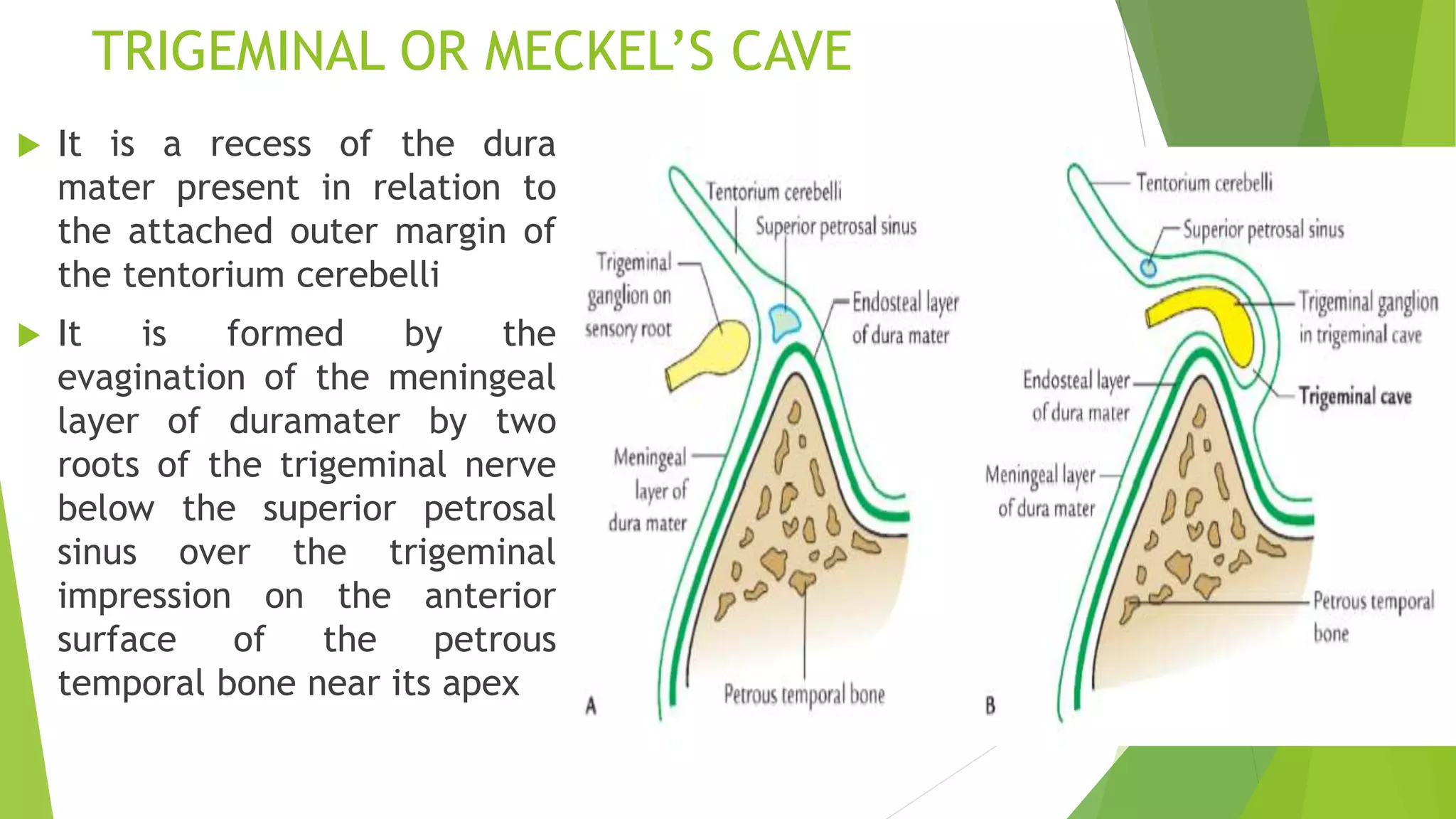
TRIGEMINAL OR MECKEL’S CAVE
 It is a recess of the dura
mater present in relation to
the attached outer margin of
the tentorium cerebelli
 It is formed by the
evagination of the meningeal
layer of duramater by two
roots of the trigeminal nerve
below the superior petrosal
sinus over the trigeminal
impression on the anterior
surface of the petrous
temporal bone near its apex
BLOOD SUPPLY OF DURA
 The vault- supplied by middle meningeal artery
 The anterior cranial fossa and the dural lining- supplied by anterior
ethmoidal, posterior ethmoidal and ophthalmic arteries
 The middle cranial fossa- supplied by middle meningeal arteries, accessory
meningeal and internal carotid arteries, and meningeal branches of ascending
pharyngeal artery.
 The posterior cranial fossa- supplied by meningeal branches of vertebral,
occipital and ascending pharyngeal arteries
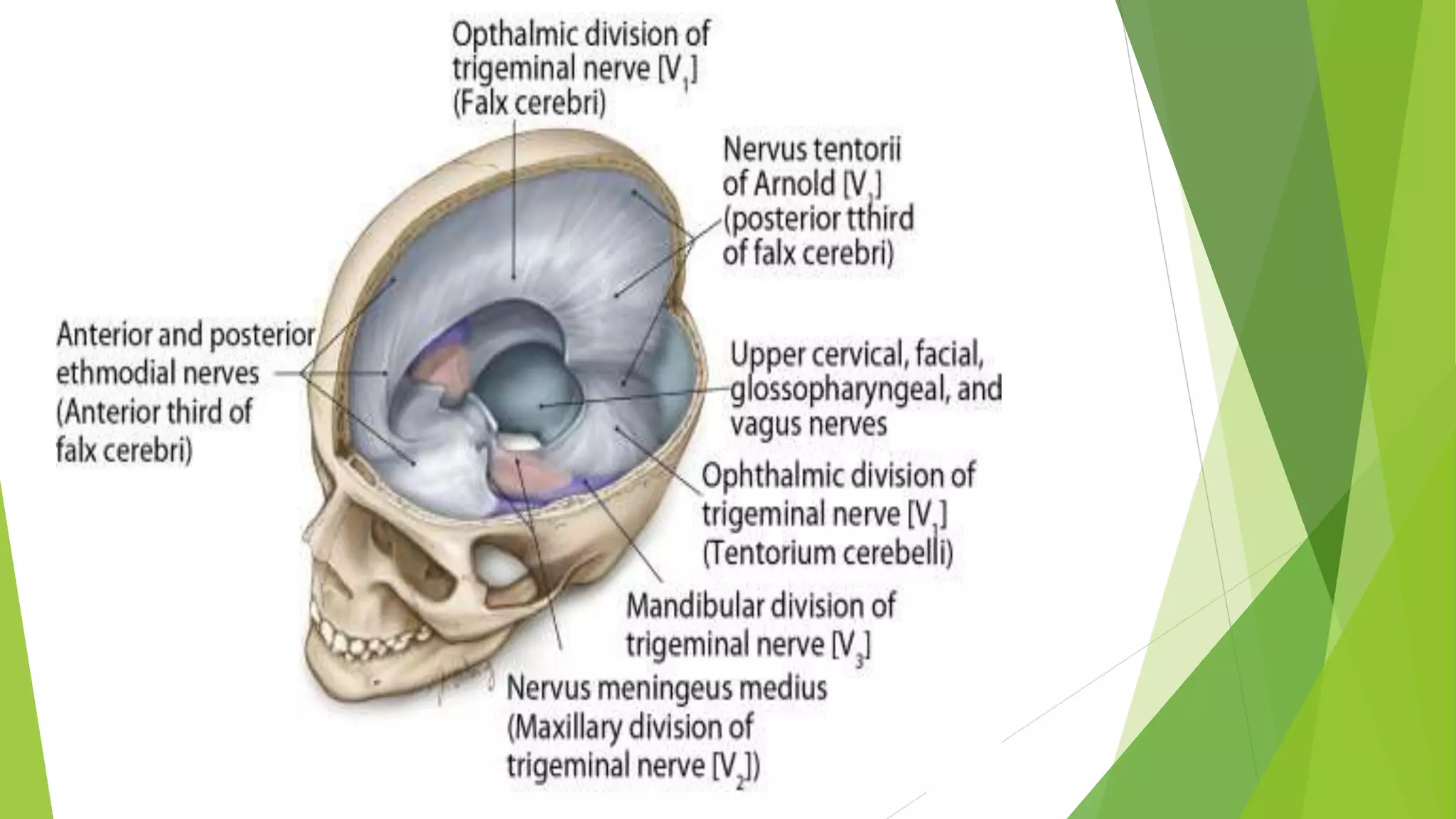
NERVE SUPPLY OF DURA
 The dura of the vault is supplied by sensory nerves derived
from ophthalmic division of trigeminal nerve
 The dura of the floor has rich nerve supply and is sensitive
to pain:
- anterior cranial fossa- supplied by anterior ethmoidal
nerve and partly by maxillary nerve
- middle cranial fossa- supplied by maxillary nerve in the
anterior part and by branches of mandibular nerve and from
the trigeminal ganglion in the posterior part
- posterior cranial fossa- supplied by recurrent branches of
1st, 2nd and 3rd cervical spinal nerves and by meningeal
branches of 9th and 10th cranial nerves
CLINICAL ANATOMY
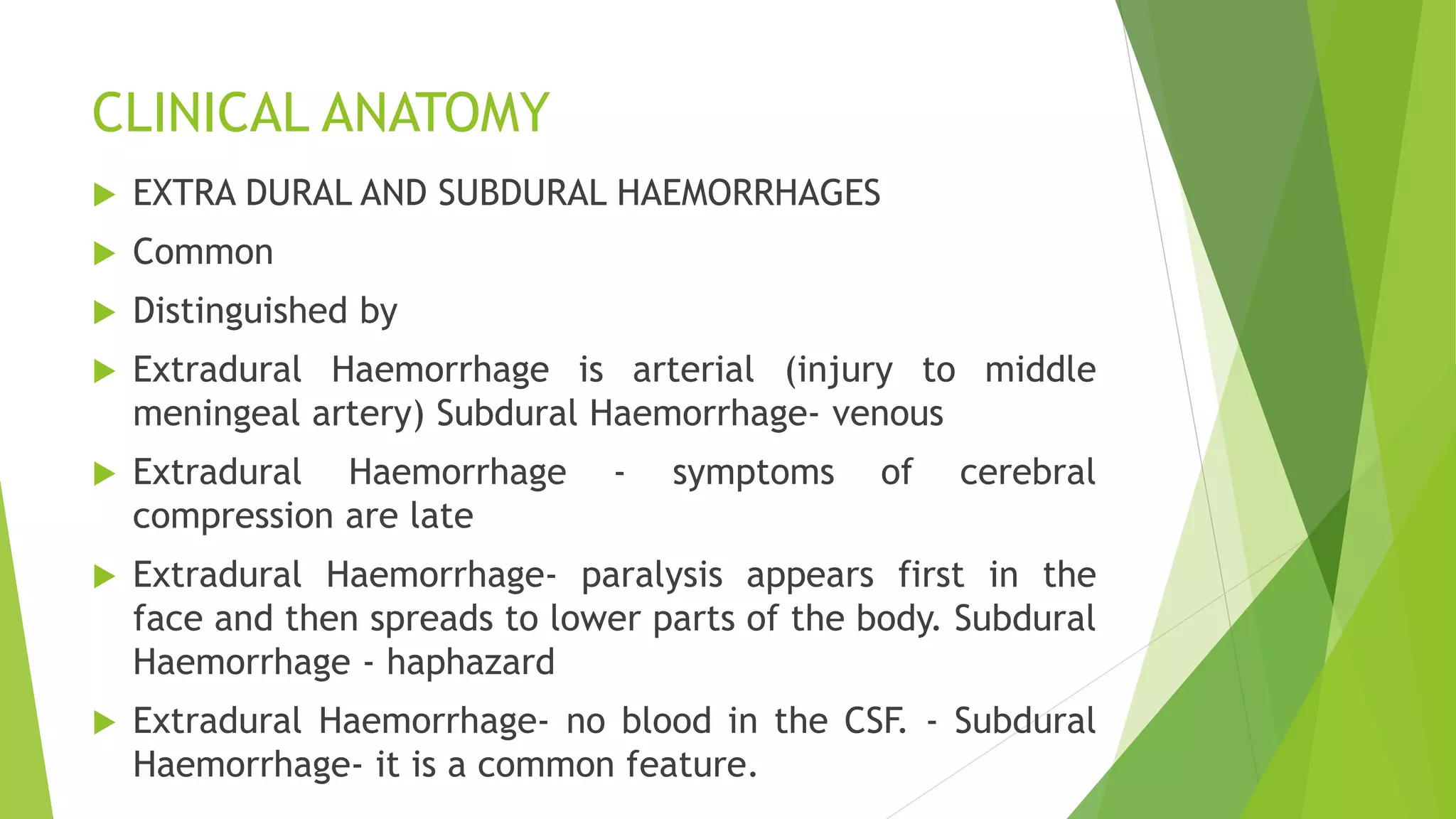
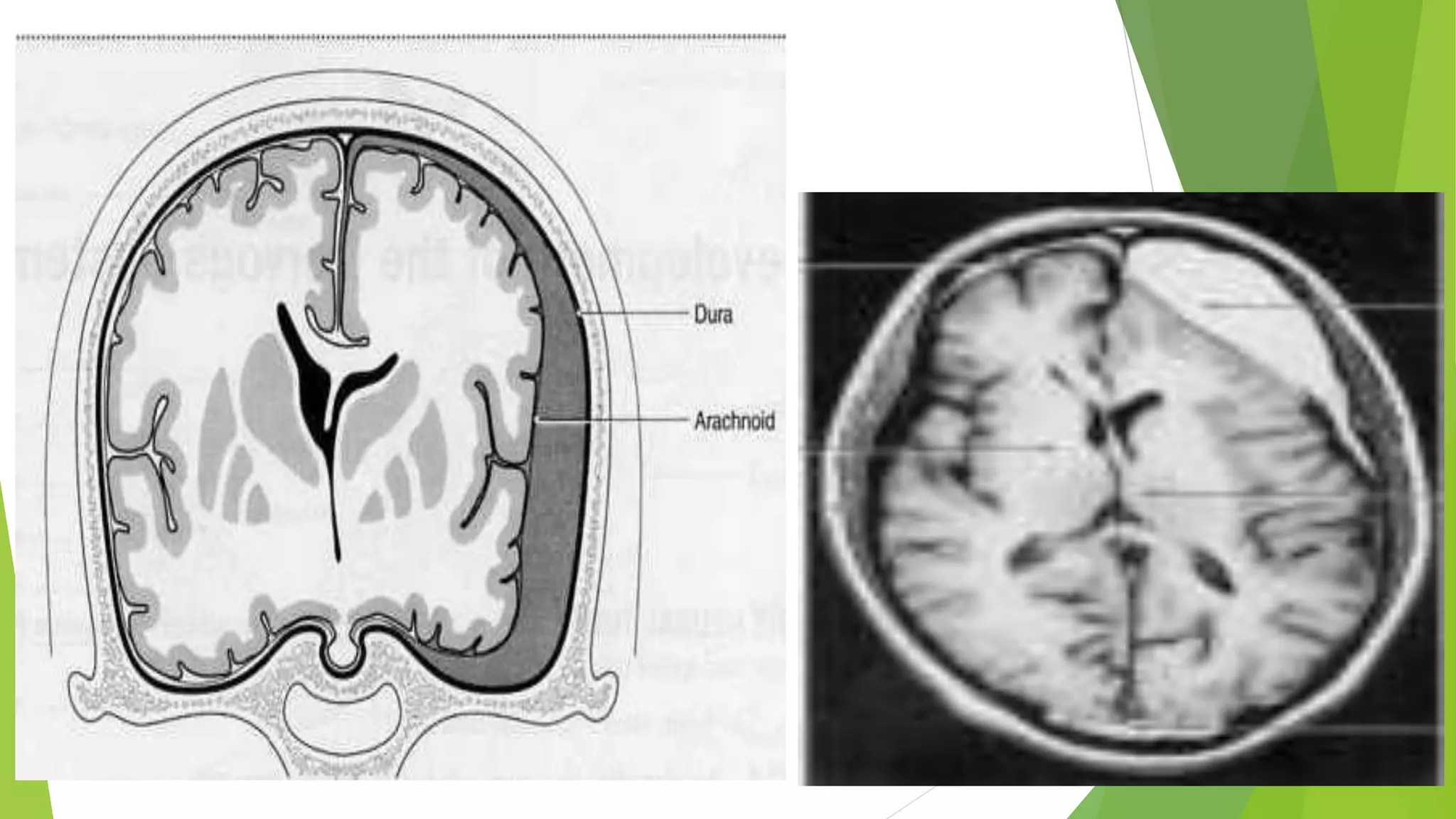
 EXTRA DURAL AND SUBDURAL HAEMORRHAGES
 Common
 Distinguished by
 Extradural Haemorrhage is arterial (injury to middle
meningeal artery) Subdural Haemorrhage- venous
 Extradural Haemorrhage - symptoms of cerebral
compression are late
 Extradural Haemorrhage- paralysis appears first in the
face and then spreads to lower parts of the body. Subdural
Haemorrhage - haphazard
 Extradural Haemorrhage- no blood in the CSF. - Subdural
Haemorrhage- it is a common feature.
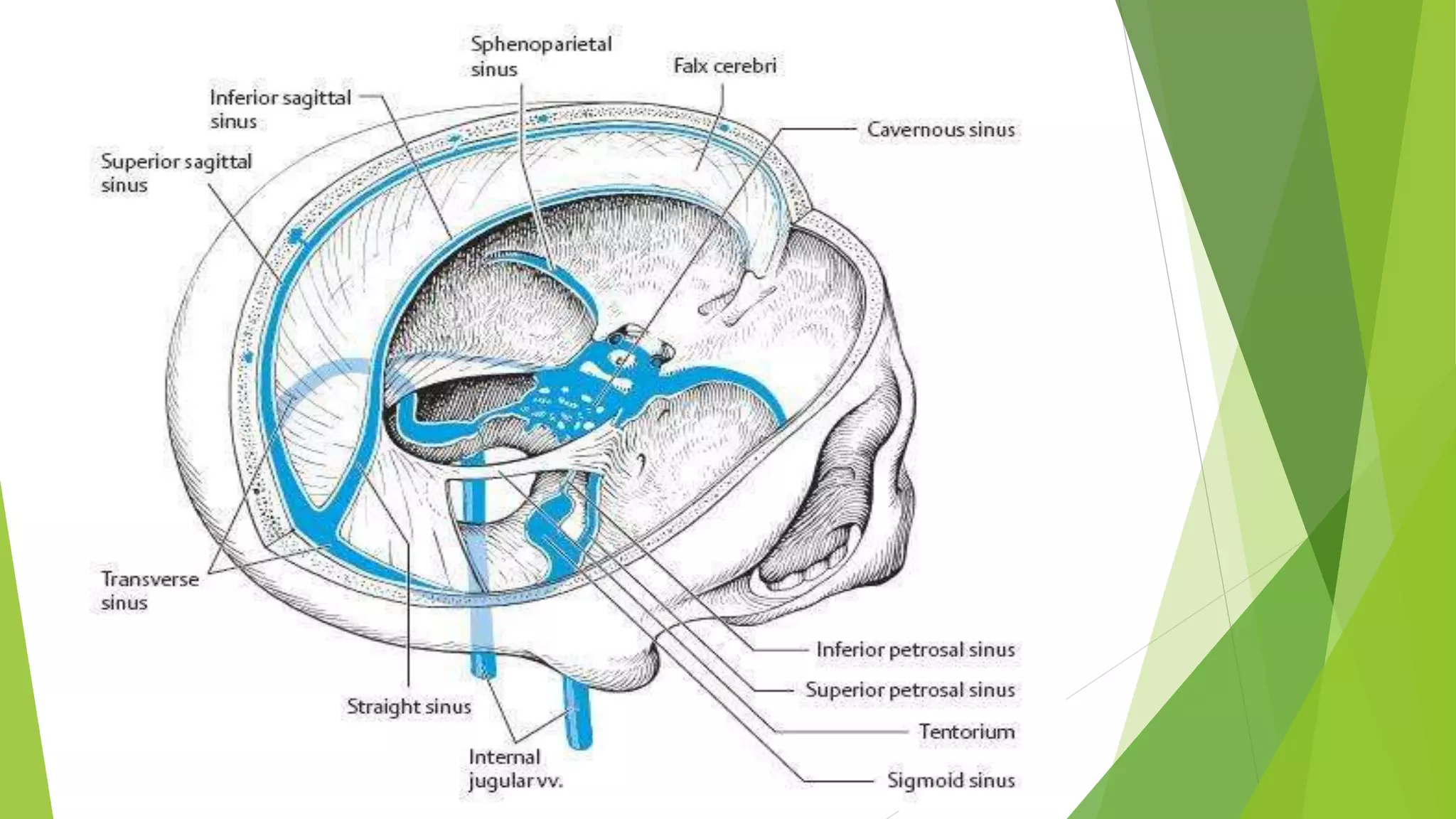
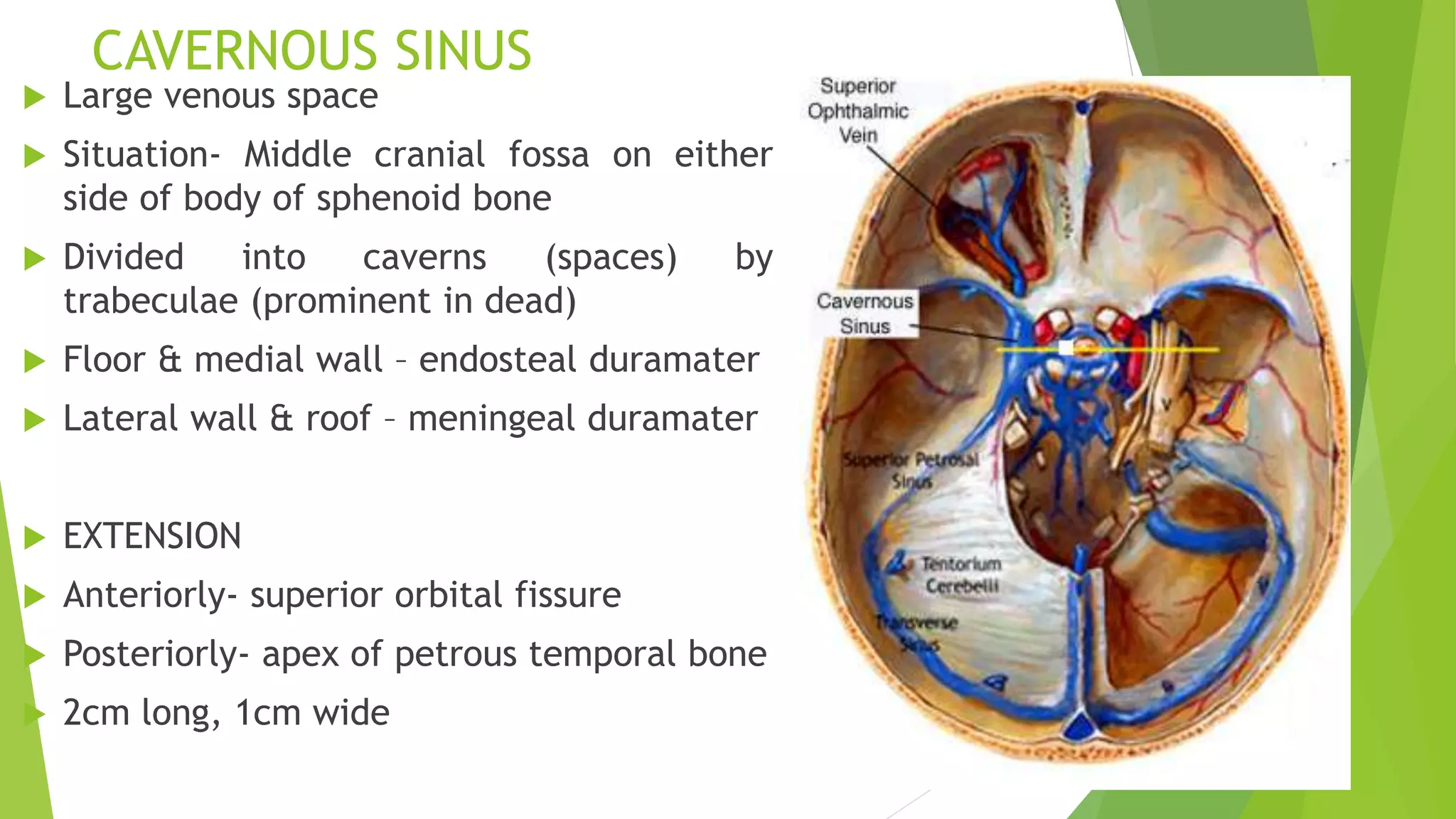
CAVERNOUS SINUS
 Large venous space
 Situation- Middle cranial fossa on either
side of body of sphenoid bone
 Divided into caverns (spaces) by
trabeculae (prominent in dead)
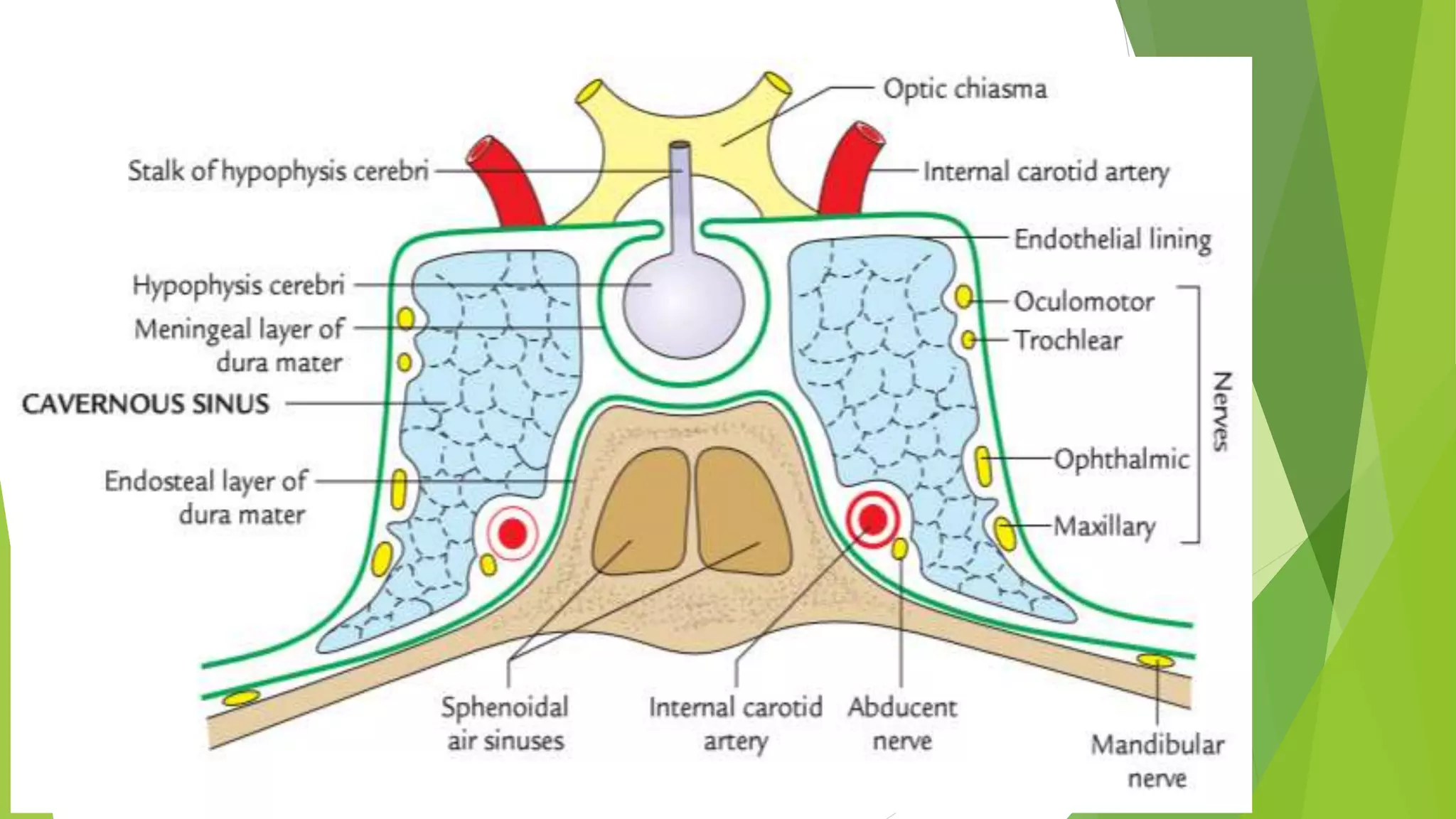
 Floor & medial wall – endosteal duramater
 Lateral wall & roof – meningeal duramater
 EXTENSION
 Anteriorly- superior orbital fissure
 Posteriorly- apex of petrous temporal bone
 2cm long, 1cm wide
RELATIONS
 SUPERIORLY
 Optic chiasma
 Optic tract
 Olfactory tract
 Internal carotid artery
 INFERIORLY
 Foramen lacerum
 Junction of the body and the greater
wing of sphenoid
 MEDIALLY
 Hypophysis cerebri
 Sphenoidal air sinus
 LATERALLY
 Temporal lobe with uncus
 BELOW LATERALLY
 Mandibular nerve
 ANTERIORLY
 Superior orbital fissure
 Apex of the orbit
 POSTERIORLY
 Apex of the petrous
temporal bone
 Crus cerebri of mid brain
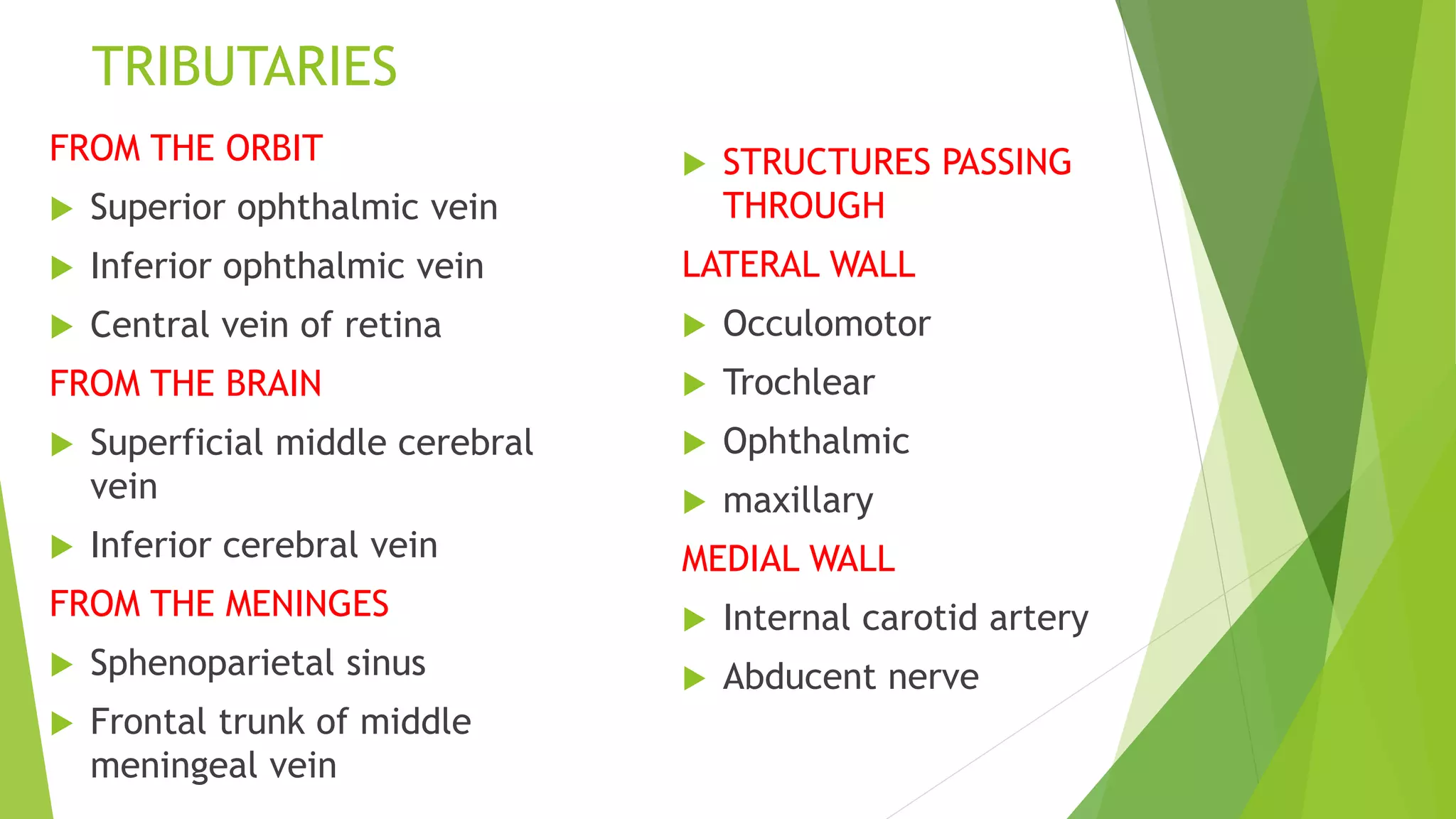
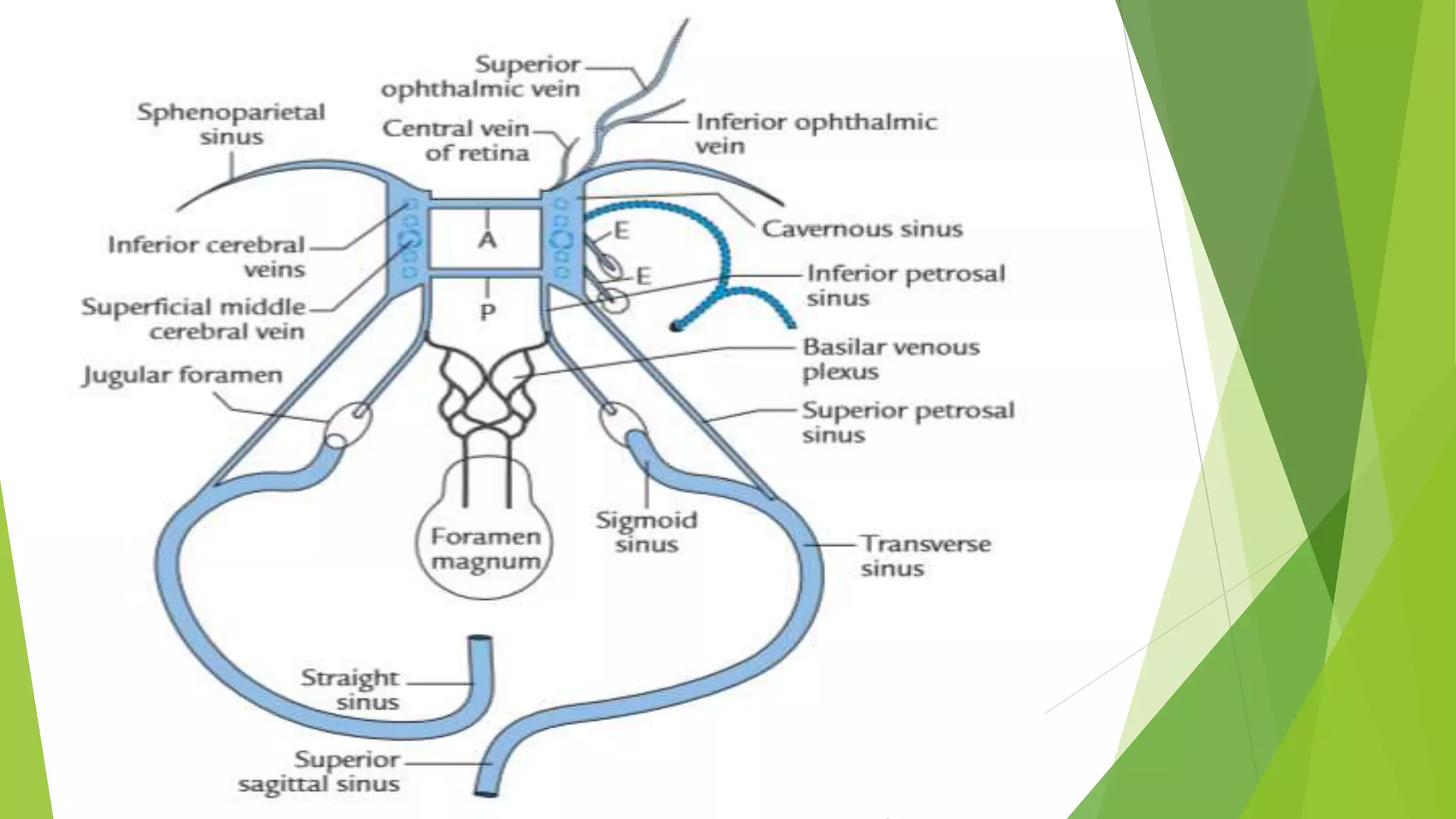
TRIBUTARIES
FROM THE ORBIT
 Superior ophthalmic vein
 Inferior ophthalmic vein
 Central vein of retina
FROM THE BRAIN
 Superficial middle cerebral
vein
 Inferior cerebral vein
FROM THE MENINGES
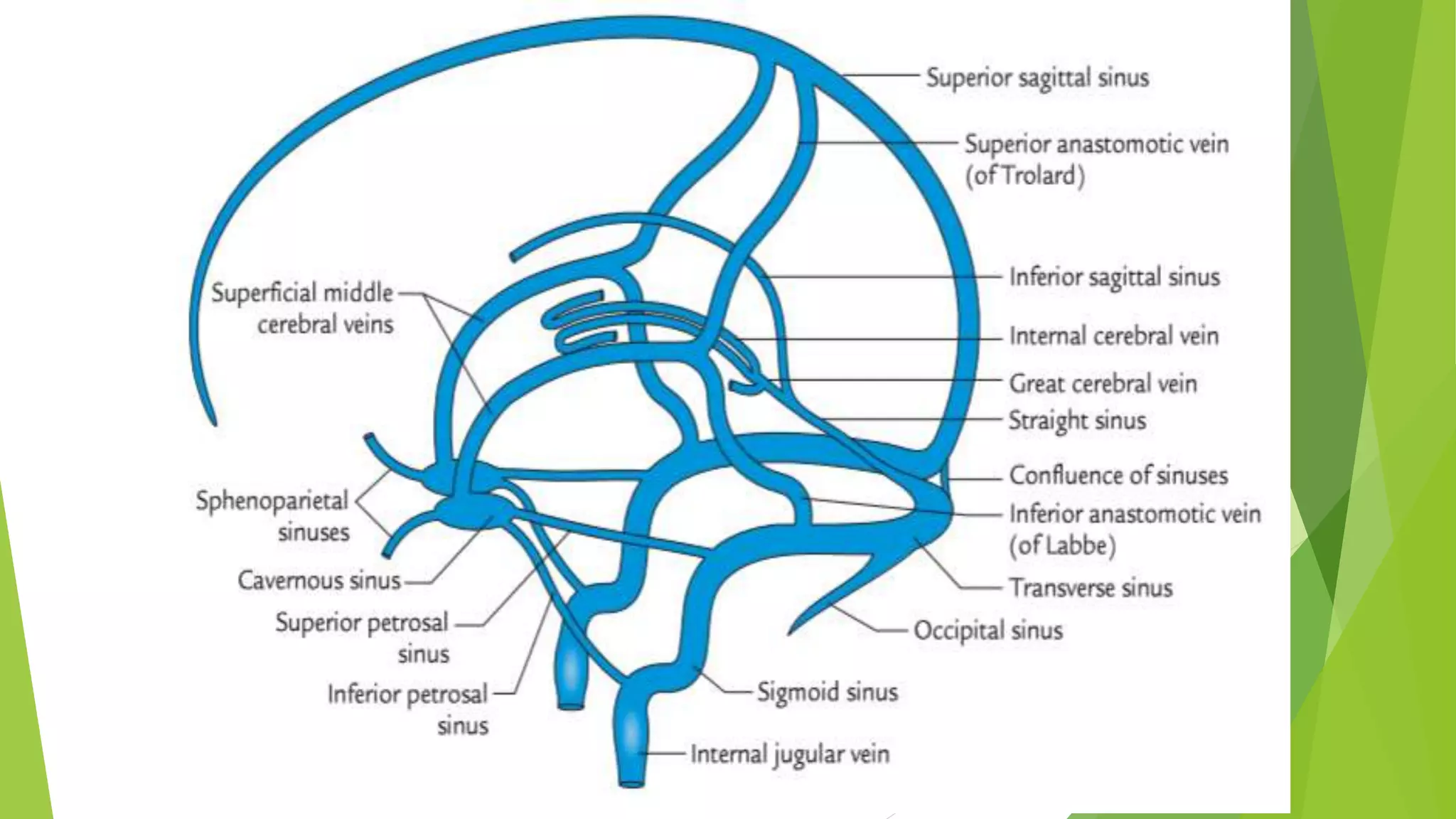
 Sphenoparietal sinus
 Frontal trunk of middle
meningeal vein
 STRUCTURES PASSING
THROUGH
LATERAL WALL
 Occulomotor
 Trochlear
 Ophthalmic
 maxillary
MEDIAL WALL
 Internal carotid artery
 Abducent nerve
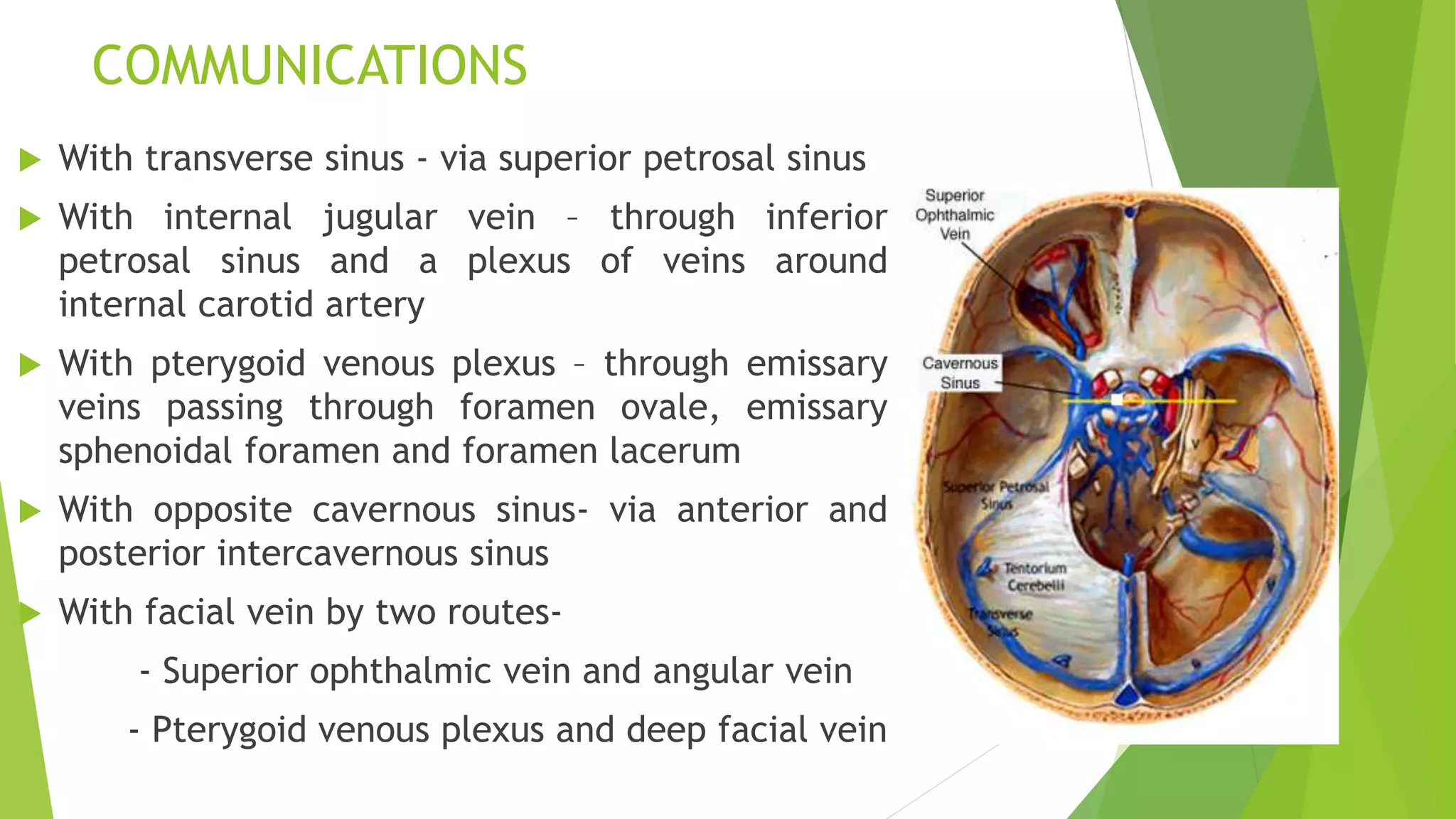
COMMUNICATIONS
 With transverse sinus - via superior petrosal sinus
 With internal jugular vein – through inferior
petrosal sinus and a plexus of veins around
internal carotid artery
 With pterygoid venous plexus – through emissary
veins passing through foramen ovale, emissary
sphenoidal foramen and foramen lacerum
 With opposite cavernous sinus- via anterior and
posterior intercavernous sinus
 With facial vein by two routes-
- Superior ophthalmic vein and angular vein
- Pterygoid venous plexus and deep facial vein
CAVERNOUS SINUS THROMBOSIS
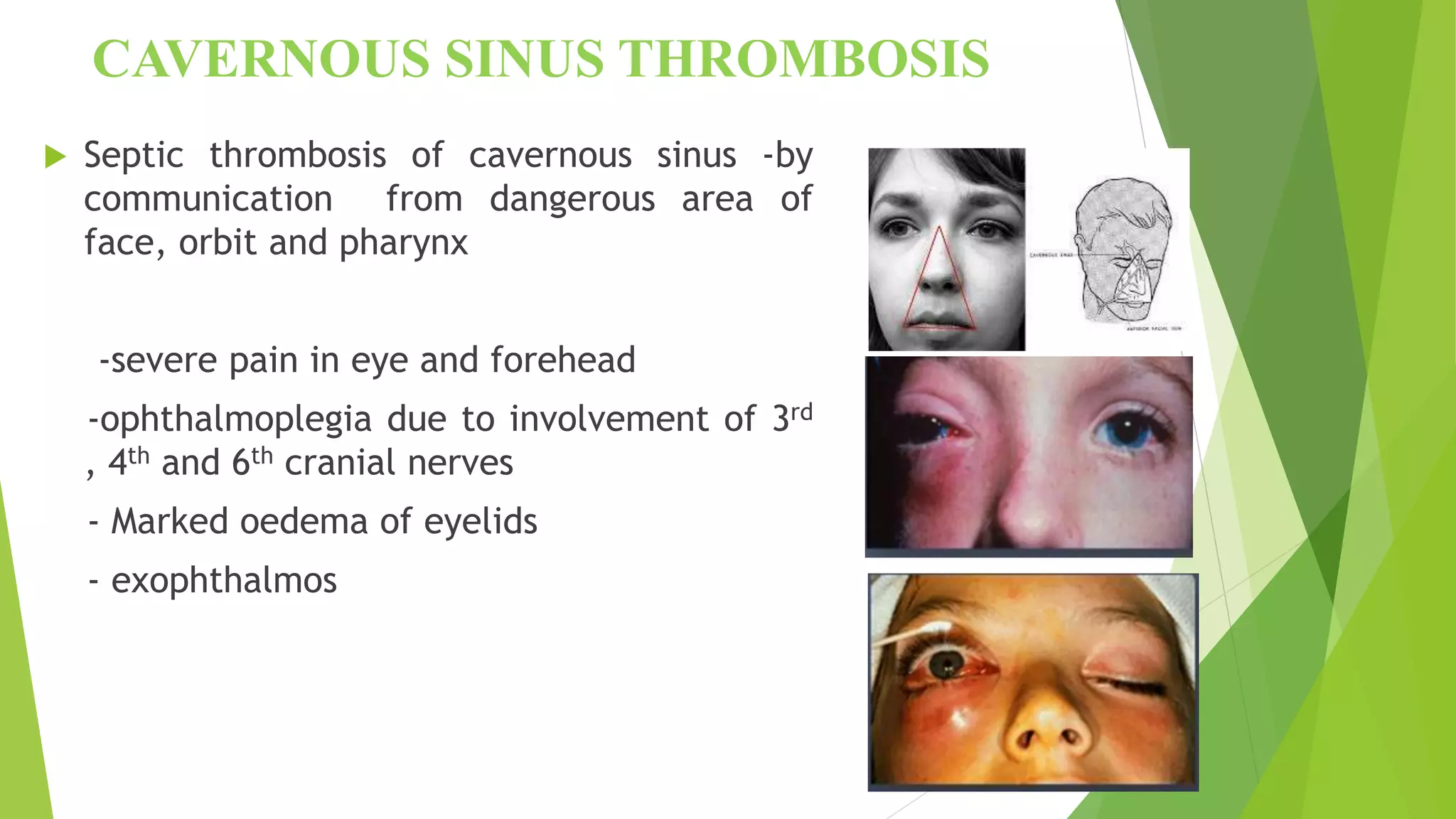
 Septic thrombosis of cavernous sinus -by
communication from dangerous area of
face, orbit and pharynx
-severe pain in eye and forehead
-ophthalmoplegia due to involvement of 3rd
, 4th and 6th cranial nerves
- Marked oedema of eyelids
- exophthalmos
PULSATING EXOPHTHALMOS
 Pulsating exophthalmos- internal carotid artery is
ruptured as a result of fracture of base of skull – arterio-
venous communication is established
- ligation of inernal carotid artery may be helpful, but
patient may develop contralateral hemiplegia

Dural folds and cavernous sinus

  • 1.
    DURAL FOLDS ANDCAVERNOUS SINUS  M.ARAVIND
  • 2.
    MENINGES  The interiorof the cranial cavity is lined by the durameter.  The surface of the brain is covered by the piameter.  The dura is separated from the arachnoid by subdural space.  The arachnoid is separated from the pia by subarachnoid space. (CSF)  Between these two lies the arachnoid mater.  These three together constitute the meninges of the brain.
  • 3.
    DURAMATER  The cerebralduramater consisting of the outermost thickest and toughest membrane consisting of two layers.  Outer endosteal layer (endocranium) periosteum lining the inner surfaces of the skull bones.  Inner meningeal layer (duramater proper) encloses the brain and at the foramen magnum becomes continuous with the duramater surrounding the spinal cord.
  • 4.
    DURAL FOLDS  Atplaces, the meningeal layer is folded on itself to form dural folds(dural septa).  Falx cerebri  Tentorium cerebelli  Falx cerebelli  Diaphragma sella
  • 7.
    Falx cerebri Tentoriumcerebelli Falx cerebelli Diaphragma sella Shape & location Large sickle shaped Median longitudinal fissure Tent shaped Cerebellum & occipital lobes Sickle shaped Posterior cerebellar notch Small circular Roof of the hypophyseal fossa Attach ments Crista galli Median plane of upper surface of tentorium cerebelli Transverse sulcus Petrous temporal bone, post. Clinoid process Inf surface of tentorium cerebelli on median plane Tuberculum sellae, dorsum sellae Dura middle cranial fossa Margins Upper-Convex saggital sulcus Lower-Concave free U-shaped ant free margin ant clinoid process. bears tentorial notch Apex -foramen magnum convex-internal occipital crest -------- Surface Medial surface of cerebral hemisphere Superiorly –occipital lobe of cerebrum inferiorly-superior cerebellum ------- hypophysis cerebri Sinus Superior & inferior Transverse Occippital ---------
  • 12.
    TRIGEMINAL OR MECKEL’SCAVE  It is a recess of the dura mater present in relation to the attached outer margin of the tentorium cerebelli  It is formed by the evagination of the meningeal layer of duramater by two roots of the trigeminal nerve below the superior petrosal sinus over the trigeminal impression on the anterior surface of the petrous temporal bone near its apex
  • 13.
    BLOOD SUPPLY OFDURA  The vault- supplied by middle meningeal artery  The anterior cranial fossa and the dural lining- supplied by anterior ethmoidal, posterior ethmoidal and ophthalmic arteries  The middle cranial fossa- supplied by middle meningeal arteries, accessory meningeal and internal carotid arteries, and meningeal branches of ascending pharyngeal artery.  The posterior cranial fossa- supplied by meningeal branches of vertebral, occipital and ascending pharyngeal arteries
  • 15.
    NERVE SUPPLY OFDURA  The dura of the vault is supplied by sensory nerves derived from ophthalmic division of trigeminal nerve  The dura of the floor has rich nerve supply and is sensitive to pain: - anterior cranial fossa- supplied by anterior ethmoidal nerve and partly by maxillary nerve - middle cranial fossa- supplied by maxillary nerve in the anterior part and by branches of mandibular nerve and from the trigeminal ganglion in the posterior part - posterior cranial fossa- supplied by recurrent branches of 1st, 2nd and 3rd cervical spinal nerves and by meningeal branches of 9th and 10th cranial nerves
  • 17.
    CLINICAL ANATOMY  EXTRADURAL AND SUBDURAL HAEMORRHAGES  Common  Distinguished by  Extradural Haemorrhage is arterial (injury to middle meningeal artery) Subdural Haemorrhage- venous  Extradural Haemorrhage - symptoms of cerebral compression are late  Extradural Haemorrhage- paralysis appears first in the face and then spreads to lower parts of the body. Subdural Haemorrhage - haphazard  Extradural Haemorrhage- no blood in the CSF. - Subdural Haemorrhage- it is a common feature.
  • 19.
    CAVERNOUS SINUS  Largevenous space  Situation- Middle cranial fossa on either side of body of sphenoid bone  Divided into caverns (spaces) by trabeculae (prominent in dead)  Floor & medial wall – endosteal duramater  Lateral wall & roof – meningeal duramater  EXTENSION  Anteriorly- superior orbital fissure  Posteriorly- apex of petrous temporal bone  2cm long, 1cm wide
  • 20.
    RELATIONS  SUPERIORLY  Opticchiasma  Optic tract  Olfactory tract  Internal carotid artery  INFERIORLY  Foramen lacerum  Junction of the body and the greater wing of sphenoid  MEDIALLY  Hypophysis cerebri  Sphenoidal air sinus  LATERALLY  Temporal lobe with uncus  BELOW LATERALLY  Mandibular nerve  ANTERIORLY  Superior orbital fissure  Apex of the orbit  POSTERIORLY  Apex of the petrous temporal bone  Crus cerebri of mid brain
  • 22.
    TRIBUTARIES FROM THE ORBIT Superior ophthalmic vein  Inferior ophthalmic vein  Central vein of retina FROM THE BRAIN  Superficial middle cerebral vein  Inferior cerebral vein FROM THE MENINGES  Sphenoparietal sinus  Frontal trunk of middle meningeal vein  STRUCTURES PASSING THROUGH LATERAL WALL  Occulomotor  Trochlear  Ophthalmic  maxillary MEDIAL WALL  Internal carotid artery  Abducent nerve
  • 24.
    COMMUNICATIONS  With transversesinus - via superior petrosal sinus  With internal jugular vein – through inferior petrosal sinus and a plexus of veins around internal carotid artery  With pterygoid venous plexus – through emissary veins passing through foramen ovale, emissary sphenoidal foramen and foramen lacerum  With opposite cavernous sinus- via anterior and posterior intercavernous sinus  With facial vein by two routes- - Superior ophthalmic vein and angular vein - Pterygoid venous plexus and deep facial vein
  • 27.
    CAVERNOUS SINUS THROMBOSIS Septic thrombosis of cavernous sinus -by communication from dangerous area of face, orbit and pharynx -severe pain in eye and forehead -ophthalmoplegia due to involvement of 3rd , 4th and 6th cranial nerves - Marked oedema of eyelids - exophthalmos
  • 28.
    PULSATING EXOPHTHALMOS  Pulsatingexophthalmos- internal carotid artery is ruptured as a result of fracture of base of skull – arterio- venous communication is established - ligation of inernal carotid artery may be helpful, but patient may develop contralateral hemiplegia