BASIC CONCEPT OF
CHROMATOGRAPHY
Name –Prashant Sharma
Department of biotechnology
seminar
INTRODUCTION
TO CHROMATOGRAPHY
• Defination - chromatography is a separation technique based on the different
interactions of compound with two phases , a mobile phase and a stationary phase ,as
the compound travel through the a supporting medium.
• COMPONENTS :
Mobile phase- a solvent that flows through the supporting medium .
Stationary phase – a layer or coating on the supporting medium that interacts
with the analytes .
Supporting medium - a solid surface on which the stationary phase is bound or coated .
1. chromatography is a technique used to separate and identify
the components of the mixture.
2. Works by allowing the molecule present in the mixture to
distribute themselves b/w a stationary and a mobile medium .
3. Chroma means “color” and graphien means “to write”.
4.Colour bands –separation of individual compounds.
HISTORY
. 1903 Tswett –plant pigment separated on chalk columns .
. 1931 Lederer & Kuhn – LC on caretonoids .
. 1938 TLC and ion exchange
. 1950 reverse phase LC
. 1954 martin & synge ( nobel prize)
. 1959 gel permeation
. 1965 instrumental LC ( waters)
CHROMATOGRAPHY TERMS
1. Chromatograph – equipment that enables a sophisticated separation of Eg: gas
chromatography or liquid chromatography
2. ELUENT – fluid entering column /solvent that carries the analyte .
3. Eluate – mobile phase leaving the column .
4. Stationary phase – immobilized phase
. Immobilized on the support partical or on the inner wall of the column tubing.
. Eg. Silica layer – thin layer chromatography
• To be continued chromatographic terms –
• Mobile phase – moves in a definite direction . Liquid (LC), GAS (GC)
. The mobile phase moves through the chromatography column
(stationary phase ) where the sample interacts with the stationary
phase and is separated.
• RETENTION TIME: time takes for a particular analyte to pass
through the system (from the column inlet to the detector) under
set condition .
• SAMPLE- substance analyzed in chromatography .
• SOLVENT- any substance capable of solubilizing another substance .
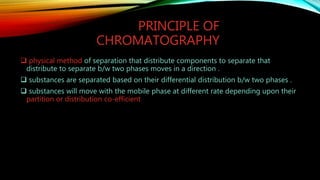
PRINCIPLE OF
CHROMATOGRAPHY
 physical method of separation that distribute components to separate that
distribute to separate b/w two phases moves in a direction .
 substances are separated based on their differential distribution b/w two phases .
 substances will move with the mobile phase at different rate depending upon their
partition or distribution co-efficient
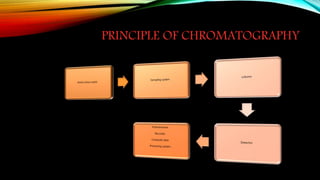
PRINCIPLE OF CHROMATOGRAPHY
.
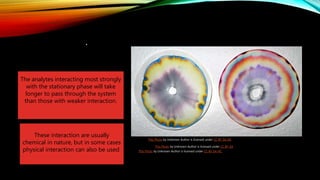
The analytes interacting most strongly
with the stationary phase will take
longer to pass through the system
than those with weaker interaction.
These interaction are usually
chemical in nature, but in some cases
physical interaction can also be used.
This Photo by Unknown Author is licensed under CC BY-SA
This Photo by Unknown Author is licensed under CC BY-SA-NC
CHROMATOGRAM
. Visual output of the
chromatograph
. separation –different peaks
or patterns on the
chromatogram correspond
to different components of
the to the separated mixture
This Photo by Unknown Author is licensed under CC BY-NC
H
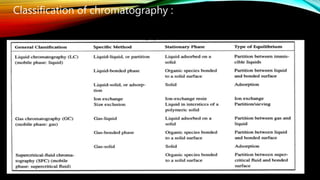
Classification of chromatography :
CLASSIFICATION OF
CHROMATOGRAPHY
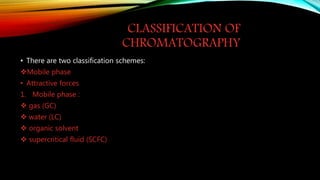
• There are two classification schemes:
Mobile phase
• Attractive forces
1. Mobile phase :
 gas (GC)
 water (LC)
 organic solvent
 supercritical fluid (SCFC)
CLASSIFICATION OF
CHROMATOGRAPHY
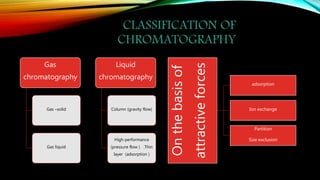
Onthebasisof
attractiveforces
adsorption
Ion exchange
Partition
Size exclusion
Gas
chromatography
Gas –solid
Gas liquid
Liquid
chromatography
Column (gravity flow)
High performance
(pressure flow ) .Thin
layer (adsorption )
CLASSIFICATION OF
CHROMATOGRAPHY
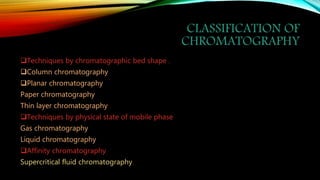
Techniques by chromatographic bed shape .
Column chromatography
Planar chromatography
Paper chromatography
Thin layer chromatography
Techniques by physical state of mobile phase
Gas chromatography
Liquid chromatography
Affinity chromatography
Supercritical fluid chromatography
COLUMN
CHROMATOGRAPHY
 Adsorption /retention of substances on
stationary phase
 Separation of absorbed substance using
mobile phase
 Recovery of individual components by
continuous flow of mobile phase .
 Quantitative and qualitative analysis of solute
and the components which are recovered.
This Photo by Unknown Author is licensed under CC BY-SA-NC
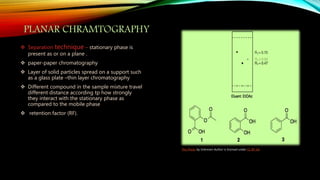
PLANAR CHRAMTOGRAPHY
 Separation technique – stationary phase is
present as or on a plane .
 paper-paper chromatography
 Layer of solid particles spread on a support such
as a glass plate –thin layer chromatography
 Different compound in the sample mixture travel
different distance according tp how strongly
they interact with the stationary phase as
compared to the mobile phase
 retention factor (RF).
This Photo by Unknown Author is licensed under CC BY-SA
PAPER CHROMATOGRAPHY
 Principle
 This paper is made up of cellulose ,a
polar substance ,and the compounds
within a mixture travel farther if they are
non polar
 More polar substances bond with the
cellulose paper more quickly ,and
therefore do not travel as far .
 Retention factor (rf): distance
travelled by a solute /distance travelled
by the solvent
 Rf= zero ,-solute remains in the
stationary phase and thus it is immobile
.
 RF=1 , -solute has no affinity for the
stationary phase and travels with the
solvent front.
This Photo by Unknown Author is licensed under CC BY-SA-NC
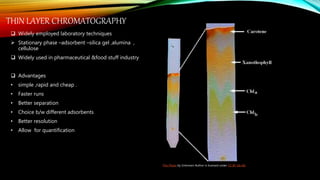
THIN LAYER CHROMATOGRAPHY
 Widely employed laboratory techniques
 Stationary phase –adsorbent –silica gel ,alumina ,
cellulose
 Widely used in pharmaceutical &food stuff industry
 Advantages
• simple ,rapid and cheap .
• Faster runs
• Better separation
• Choice b/w different adsorbents
• Better resolution
• Allow for quantification
This Photo by Unknown Author is licensed under CC BY-SA-NC
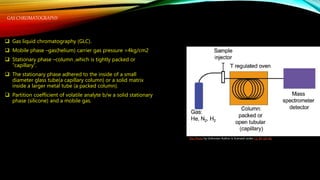
GAS CHROMATOGRAPHY
 Gas liquid chromatography (GLC).
 Mobile phase –gas(helium) carrier gas pressure =4kg/cm2
 Stationary phase –column ,which is tightly packed or
“capillary”.
 The stationary phase adhered to the inside of a small
diameter glass tube(a capillary column) or a solid matrix
inside a larger metal tube (a packed column).
 Partition coefficient of volatile analyte b/w a solid stationary
phase (silicone) and a mobile gas.
This Photo by Unknown Author is licensed under CC BY-SA-NC
GAS CHROMATOGRAPHY
 ADVANTAGES :
 High sensitivity
 High resolution
 High speed
 High accuracy
 Highly quantitative
 APPRATUS:
 Gas chromatograph ,GC analyzer , normal
syringes and one micro syringe ,beakers , sample
bottles and electronic weight.
 CHEMICALS:
 Methanol ,isopropyl alcohol and water .
 SAMPLE :
 Gases ,liquid ,solids .
 M.wt: 2-800
 volatile
This Photo by Unknown Author is licensed under CC BY-SA
APPLICATION OF GAS CHROMATOGRAPHY
 Quantitative &qualitative analysis of low polarity compounds .
 Analytical chemistry ,biochemistry ,petrochemical , environmental monitoring .
 Measures picomoles of a substance in a 1 ml liquid samples or part per billion concentration in gaseous samples .
 Measuring toxic substances in soil ,air or water.
 Environmental monitoring
 Criminal forensics
 Law enforcement
 Forensic toxicology
 Sport anti doping analysis
 Security
 Food ,beverages and perfume
 Medicine
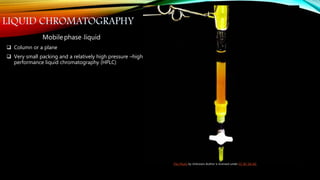
LIQUID CHROMATOGRAPHY
Mobilephase–liquid
 Column or a plane
 Very small packing and a relatively high pressure –high
performance liquid chromatography (HPLC)
This Photo by Unknown Author is licensed under CC BY-SA-NC
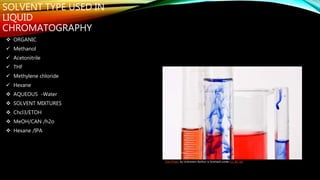
SOLVENT TYPE USED IN
LIQUID
CHROMATOGRAPHY
 ORGANIC
 Methanol
 Acetonitrile
 THF
 Methylene chloride
 Hexane
 AQUEOUS -Water
 SOLVENT MIXTURES
 Chcl3/ETOH
 MeOH/CAN /h2o
 Hexane /IPA
This Photo by Unknown Author is licensed under CC BY-SA
ADSORPTION
CHROMATOGRAPHY
 Adsorption chromatography is probably one
of the oldest types of chromatography around
.
 It utilizes a mobile liquid or gaseous phase
that is adsorbed onto the surface of a
stationary solid phase .
 The equilibration b/w the mobile and
stationary phase accounts for the separation of
different solutes .
This Photo by Unknown Author is licensed under CC BY-SA
ION EXCHANGE
CHROMATOGRAPHY
 In this type of chromatography ,the use of a
resin (the stationary) is used to covalently attach
anions or cations onto it.
 Solute ions of the opposite charge in the mobile
liquid phase are attracted to the resin by
electrostatic forces .
This Photo by Unknown Author is licensed under CC BY-SA-NC
PARTITION CHROMATOGRAPHY
 THIS form of chromatography is based on a thin film formed on the surface of a solid support by a
liquid stationary phase .solute equilibrates b/w the mobile phase and a stationary liquid.
This Photo by Unknown Author is licensed under CC BY
THANK YOU
If you have any query plz e mail me

Basic concept of chromatography

  • 1.
    BASIC CONCEPT OF CHROMATOGRAPHY Name–Prashant Sharma Department of biotechnology seminar
  • 2.
    INTRODUCTION TO CHROMATOGRAPHY • Defination- chromatography is a separation technique based on the different interactions of compound with two phases , a mobile phase and a stationary phase ,as the compound travel through the a supporting medium. • COMPONENTS : Mobile phase- a solvent that flows through the supporting medium . Stationary phase – a layer or coating on the supporting medium that interacts with the analytes . Supporting medium - a solid surface on which the stationary phase is bound or coated .
  • 3.
    1. chromatography isa technique used to separate and identify the components of the mixture. 2. Works by allowing the molecule present in the mixture to distribute themselves b/w a stationary and a mobile medium . 3. Chroma means “color” and graphien means “to write”. 4.Colour bands –separation of individual compounds.
  • 4.
    HISTORY . 1903 Tswett–plant pigment separated on chalk columns . . 1931 Lederer & Kuhn – LC on caretonoids . . 1938 TLC and ion exchange . 1950 reverse phase LC . 1954 martin & synge ( nobel prize) . 1959 gel permeation . 1965 instrumental LC ( waters)
  • 5.
    CHROMATOGRAPHY TERMS 1. Chromatograph– equipment that enables a sophisticated separation of Eg: gas chromatography or liquid chromatography 2. ELUENT – fluid entering column /solvent that carries the analyte . 3. Eluate – mobile phase leaving the column . 4. Stationary phase – immobilized phase . Immobilized on the support partical or on the inner wall of the column tubing. . Eg. Silica layer – thin layer chromatography
  • 6.
    • To becontinued chromatographic terms – • Mobile phase – moves in a definite direction . Liquid (LC), GAS (GC) . The mobile phase moves through the chromatography column (stationary phase ) where the sample interacts with the stationary phase and is separated. • RETENTION TIME: time takes for a particular analyte to pass through the system (from the column inlet to the detector) under set condition . • SAMPLE- substance analyzed in chromatography . • SOLVENT- any substance capable of solubilizing another substance .
  • 7.
    PRINCIPLE OF CHROMATOGRAPHY  physicalmethod of separation that distribute components to separate that distribute to separate b/w two phases moves in a direction .  substances are separated based on their differential distribution b/w two phases .  substances will move with the mobile phase at different rate depending upon their partition or distribution co-efficient
  • 8.
  • 9.
    . The analytes interactingmost strongly with the stationary phase will take longer to pass through the system than those with weaker interaction. These interaction are usually chemical in nature, but in some cases physical interaction can also be used. This Photo by Unknown Author is licensed under CC BY-SA This Photo by Unknown Author is licensed under CC BY-SA-NC This Photo by Unknown Author is licensed under CC BY-SA-NC
  • 10.
    CHROMATOGRAM . Visual outputof the chromatograph . separation –different peaks or patterns on the chromatogram correspond to different components of the to the separated mixture This Photo by Unknown Author is licensed under CC BY-NC
  • 11.
  • 12.
    CLASSIFICATION OF CHROMATOGRAPHY • Thereare two classification schemes: Mobile phase • Attractive forces 1. Mobile phase :  gas (GC)  water (LC)  organic solvent  supercritical fluid (SCFC)
  • 13.
    CLASSIFICATION OF CHROMATOGRAPHY Onthebasisof attractiveforces adsorption Ion exchange Partition Sizeexclusion Gas chromatography Gas –solid Gas liquid Liquid chromatography Column (gravity flow) High performance (pressure flow ) .Thin layer (adsorption )
  • 14.
    CLASSIFICATION OF CHROMATOGRAPHY Techniques bychromatographic bed shape . Column chromatography Planar chromatography Paper chromatography Thin layer chromatography Techniques by physical state of mobile phase Gas chromatography Liquid chromatography Affinity chromatography Supercritical fluid chromatography
  • 15.
    COLUMN CHROMATOGRAPHY  Adsorption /retentionof substances on stationary phase  Separation of absorbed substance using mobile phase  Recovery of individual components by continuous flow of mobile phase .  Quantitative and qualitative analysis of solute and the components which are recovered. This Photo by Unknown Author is licensed under CC BY-SA-NC
  • 16.
    PLANAR CHRAMTOGRAPHY  Separationtechnique – stationary phase is present as or on a plane .  paper-paper chromatography  Layer of solid particles spread on a support such as a glass plate –thin layer chromatography  Different compound in the sample mixture travel different distance according tp how strongly they interact with the stationary phase as compared to the mobile phase  retention factor (RF). This Photo by Unknown Author is licensed under CC BY-SA
  • 17.
    PAPER CHROMATOGRAPHY  Principle This paper is made up of cellulose ,a polar substance ,and the compounds within a mixture travel farther if they are non polar  More polar substances bond with the cellulose paper more quickly ,and therefore do not travel as far .  Retention factor (rf): distance travelled by a solute /distance travelled by the solvent  Rf= zero ,-solute remains in the stationary phase and thus it is immobile .  RF=1 , -solute has no affinity for the stationary phase and travels with the solvent front. This Photo by Unknown Author is licensed under CC BY-SA-NC
  • 18.
    THIN LAYER CHROMATOGRAPHY Widely employed laboratory techniques  Stationary phase –adsorbent –silica gel ,alumina , cellulose  Widely used in pharmaceutical &food stuff industry  Advantages • simple ,rapid and cheap . • Faster runs • Better separation • Choice b/w different adsorbents • Better resolution • Allow for quantification This Photo by Unknown Author is licensed under CC BY-SA-NC
  • 19.
    GAS CHROMATOGRAPHY  Gasliquid chromatography (GLC).  Mobile phase –gas(helium) carrier gas pressure =4kg/cm2  Stationary phase –column ,which is tightly packed or “capillary”.  The stationary phase adhered to the inside of a small diameter glass tube(a capillary column) or a solid matrix inside a larger metal tube (a packed column).  Partition coefficient of volatile analyte b/w a solid stationary phase (silicone) and a mobile gas. This Photo by Unknown Author is licensed under CC BY-SA-NC
  • 20.
    GAS CHROMATOGRAPHY  ADVANTAGES:  High sensitivity  High resolution  High speed  High accuracy  Highly quantitative  APPRATUS:  Gas chromatograph ,GC analyzer , normal syringes and one micro syringe ,beakers , sample bottles and electronic weight.  CHEMICALS:  Methanol ,isopropyl alcohol and water .  SAMPLE :  Gases ,liquid ,solids .  M.wt: 2-800  volatile This Photo by Unknown Author is licensed under CC BY-SA
  • 21.
    APPLICATION OF GASCHROMATOGRAPHY  Quantitative &qualitative analysis of low polarity compounds .  Analytical chemistry ,biochemistry ,petrochemical , environmental monitoring .  Measures picomoles of a substance in a 1 ml liquid samples or part per billion concentration in gaseous samples .  Measuring toxic substances in soil ,air or water.  Environmental monitoring  Criminal forensics  Law enforcement  Forensic toxicology  Sport anti doping analysis  Security  Food ,beverages and perfume  Medicine
  • 22.
    LIQUID CHROMATOGRAPHY Mobilephase–liquid  Columnor a plane  Very small packing and a relatively high pressure –high performance liquid chromatography (HPLC) This Photo by Unknown Author is licensed under CC BY-SA-NC
  • 23.
    SOLVENT TYPE USEDIN LIQUID CHROMATOGRAPHY  ORGANIC  Methanol  Acetonitrile  THF  Methylene chloride  Hexane  AQUEOUS -Water  SOLVENT MIXTURES  Chcl3/ETOH  MeOH/CAN /h2o  Hexane /IPA This Photo by Unknown Author is licensed under CC BY-SA
  • 24.
    ADSORPTION CHROMATOGRAPHY  Adsorption chromatographyis probably one of the oldest types of chromatography around .  It utilizes a mobile liquid or gaseous phase that is adsorbed onto the surface of a stationary solid phase .  The equilibration b/w the mobile and stationary phase accounts for the separation of different solutes . This Photo by Unknown Author is licensed under CC BY-SA
  • 25.
    ION EXCHANGE CHROMATOGRAPHY  Inthis type of chromatography ,the use of a resin (the stationary) is used to covalently attach anions or cations onto it.  Solute ions of the opposite charge in the mobile liquid phase are attracted to the resin by electrostatic forces . This Photo by Unknown Author is licensed under CC BY-SA-NC
  • 26.
    PARTITION CHROMATOGRAPHY  THISform of chromatography is based on a thin film formed on the surface of a solid support by a liquid stationary phase .solute equilibrates b/w the mobile phase and a stationary liquid. This Photo by Unknown Author is licensed under CC BY
  • 27.
    THANK YOU If youhave any query plz e mail me