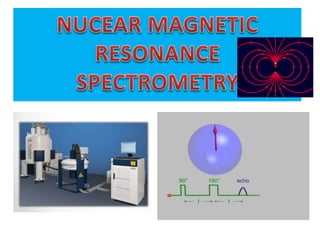
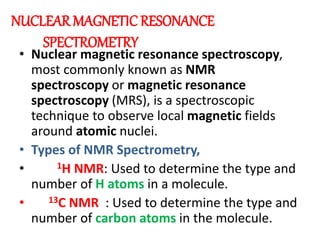
NUCLEAR MAGNETIC RESONANCE
SPECTROMETRY
• Nuclear magnetic resonance spectroscopy,
most commonly known as NMR
spectroscopy or magnetic resonance
spectroscopy (MRS), is a spectroscopic
technique to observe local magnetic fields
around atomic nuclei.
• Types of NMR Spectrometry,
• 1H NMR: Used to determine the type and
number of H atoms in a molecule.
• 13C NMR : Used to determine the type and
number of carbon atoms in the molecule.
Principle Of NMR Spectrometry:
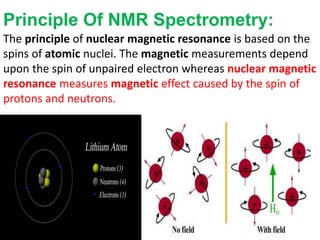
The principle of nuclear magnetic resonance is based on the
spins of atomic nuclei. The magnetic measurements depend
upon the spin of unpaired electron whereas nuclear magnetic
resonance measures magnetic effect caused by the spin of
protons and neutrons.
Principle (contd………)
Protons in different environment absorbs at slightly different
frequencies, so they are distinguishable by NMR.
The frequency at which a particular proton absorbs is
determined by its electronic environment.
The size of the magnetic field generated by the electrons
around a proton determinates where it absorbs.
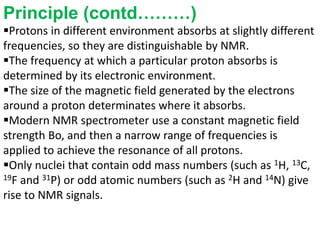
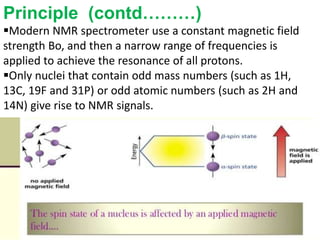
Modern NMR spectrometer use a constant magnetic field
strength Bo, and then a narrow range of frequencies is
applied to achieve the resonance of all protons.
Only nuclei that contain odd mass numbers (such as 1H, 13C,
19F and 31P) or odd atomic numbers (such as 2H and 14N) give
rise to NMR signals.
Principle (contd………)
Modern NMR spectrometer use a constant magnetic field
strength Bo, and then a narrow range of frequencies is
applied to achieve the resonance of all protons.
Only nuclei that contain odd mass numbers (such as 1H,
13C, 19F and 31P) or odd atomic numbers (such as 2H and
14N) give rise to NMR signals.
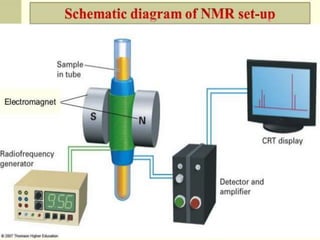
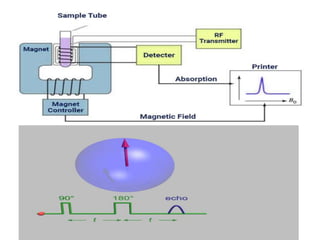
NMR Instrumentation
1.Sample holder
2.Permanent magnet
3.Magnetic coils
4.Sweep generator
5.Radio frequency transmitter
6.Radio frequency receiver
7.Read out systems
1. Sample holder : glass tube with 8.5cm long and
0.3cm in diameter
2. Permanent magnet : it prov ides homogenous magnetic
field at 60-100 MHz
3. Magnetic coils : these coil induce magnetic field
when the current fows
through them.
4. Sweep generator : to produce the equal amount of
magnetic field pass through
the sample.
5. Radio frequency transmitter :a radio transmitter coil that
produces a short powerful
pulse of radio waves.
6. Radio frequency receiver : A radio receiver coil that
detects radio frequencies
emitted as nuclei
relax to lower energy level.
7. Read out systems : a computer that
analyses and record the data.
Solvents used in NMR
The following solvents are normally used in
which hydrogen is replaced by deuterium.
CCl4 - carbon tetrachloride
CS2 - carbon disulfide
CDCl3 - Deuterio chloroform
C6D6 - Hexa deuteriobenzene
D2O - Deuterium oxide
Major steps in NMR
The sample is dissolved in a solvent, usually
CDCl3(deutero-chloroform ), and placed in a
magnetic field.
 A radio frequency generator then irradiates
the sample wit a short pulse of radiation,
causing resonance.
 When the nuclei fall back to their lower
energy state, the detector measures the energy
released and a spectrum is recorded.
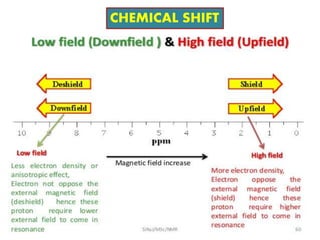
Chemical shift
The relative energy of a particular nucleus resulting from its
local environment is called chemical shift.
NMR spectra show the applied field strength increasing
from left to right.
Left part is downfield, the right is upfield.
Nuclei that absorb on upfield side are strongly shielded
where nuclei that absorb on downfield side is weakly
shielded.
Chart caliberated versus a reference point, set as 0,
tetramethylsilane [TMS]
CHEMICAL SHIFT
Nmr spectrometry
Nmr spectrometry
Nmr spectrometry
Nmr spectrometry

Nmr spectrometry

  • 2.
    NUCLEAR MAGNETIC RESONANCE SPECTROMETRY •Nuclear magnetic resonance spectroscopy, most commonly known as NMR spectroscopy or magnetic resonance spectroscopy (MRS), is a spectroscopic technique to observe local magnetic fields around atomic nuclei. • Types of NMR Spectrometry, • 1H NMR: Used to determine the type and number of H atoms in a molecule. • 13C NMR : Used to determine the type and number of carbon atoms in the molecule.
  • 3.
    Principle Of NMRSpectrometry: The principle of nuclear magnetic resonance is based on the spins of atomic nuclei. The magnetic measurements depend upon the spin of unpaired electron whereas nuclear magnetic resonance measures magnetic effect caused by the spin of protons and neutrons.
  • 4.
    Principle (contd………) Protons indifferent environment absorbs at slightly different frequencies, so they are distinguishable by NMR. The frequency at which a particular proton absorbs is determined by its electronic environment. The size of the magnetic field generated by the electrons around a proton determinates where it absorbs. Modern NMR spectrometer use a constant magnetic field strength Bo, and then a narrow range of frequencies is applied to achieve the resonance of all protons. Only nuclei that contain odd mass numbers (such as 1H, 13C, 19F and 31P) or odd atomic numbers (such as 2H and 14N) give rise to NMR signals.
  • 5.
    Principle (contd………) Modern NMRspectrometer use a constant magnetic field strength Bo, and then a narrow range of frequencies is applied to achieve the resonance of all protons. Only nuclei that contain odd mass numbers (such as 1H, 13C, 19F and 31P) or odd atomic numbers (such as 2H and 14N) give rise to NMR signals.
  • 6.
    NMR Instrumentation 1.Sample holder 2.Permanentmagnet 3.Magnetic coils 4.Sweep generator 5.Radio frequency transmitter 6.Radio frequency receiver 7.Read out systems
  • 7.
    1. Sample holder: glass tube with 8.5cm long and 0.3cm in diameter 2. Permanent magnet : it prov ides homogenous magnetic field at 60-100 MHz 3. Magnetic coils : these coil induce magnetic field when the current fows through them. 4. Sweep generator : to produce the equal amount of magnetic field pass through the sample. 5. Radio frequency transmitter :a radio transmitter coil that produces a short powerful pulse of radio waves.
  • 8.
    6. Radio frequencyreceiver : A radio receiver coil that detects radio frequencies emitted as nuclei relax to lower energy level. 7. Read out systems : a computer that analyses and record the data.
  • 10.
    Solvents used inNMR The following solvents are normally used in which hydrogen is replaced by deuterium. CCl4 - carbon tetrachloride CS2 - carbon disulfide CDCl3 - Deuterio chloroform C6D6 - Hexa deuteriobenzene D2O - Deuterium oxide
  • 12.
    Major steps inNMR The sample is dissolved in a solvent, usually CDCl3(deutero-chloroform ), and placed in a magnetic field.  A radio frequency generator then irradiates the sample wit a short pulse of radiation, causing resonance.  When the nuclei fall back to their lower energy state, the detector measures the energy released and a spectrum is recorded.
  • 13.
    Chemical shift The relativeenergy of a particular nucleus resulting from its local environment is called chemical shift. NMR spectra show the applied field strength increasing from left to right. Left part is downfield, the right is upfield. Nuclei that absorb on upfield side are strongly shielded where nuclei that absorb on downfield side is weakly shielded. Chart caliberated versus a reference point, set as 0, tetramethylsilane [TMS]
  • 14.