1H NMR SPECTROSCOPY
Tushar Prakash Naiknaware
M.Pharmacy
(Quality Assurance)
Roll No.14
Under the Guidance of
Prof. Mukesh Patil
Shri. D.D Vispute College Of Pharmacy & Research
Center
2020-2021
1
1. Quantum Numbers & their Role in NMR
2. Principle of NMR
3. Relaxation Process
4. Instrumentation of NMR
5. Solvent Requirement in NMR
6. Chemical Shift
7. Factors Influencing Chemical Shift
8. NMR Signals in Various Compounds
9. Spin-Spin Coupling
10. Coupling Constant
11. Applications of NMR Spectroscopy
Content
2
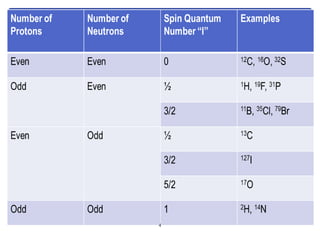
 We all know that all Nuclei(Protons Neutrons) carry a charge.
 Generally, all Nuclei spins on the Nuclear Axis.
 This Spinning of Nuclear Charge generates a Magnetic Dipole along
the Axis.
Quantum Numbers & their Role
in NMR
 The Angular Momentum of the
Spinning Charge i.e. Spinning
Nucleus can be describe in
terms of Quantum Spin
Number “I”.
 Spin Number “I” can have
values of 0, ½, 1, 3/2, and so
on.
 I=0 Denotes no Spin
3
4
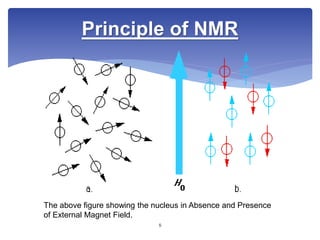
Principle of NMR
The above figure showing the nucleus in Absence and Presence
of External Magnet Field.
5
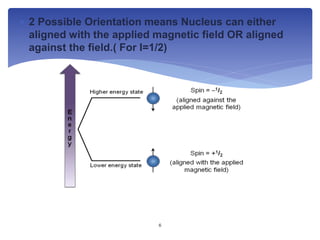
 2 Possible Orientation means Nucleus can either
aligned with the applied magnetic field OR aligned
against the field.( For I=1/2)
6
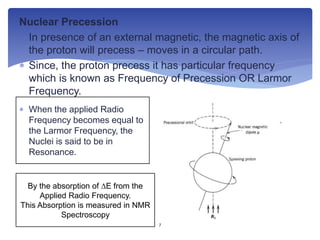
Nuclear Precession
 In presence of an external magnetic, the magnetic axis of
the proton will precess – moves in a circular path.
 Since, the proton precess it has particular frequency
which is known as Frequency of Precession OR Larmor
Frequency.
 When the applied Radio
Frequency becomes equal to
the Larmor Frequency, the
Nuclei is said to be in
Resonance.
By the absorption of ∆E from the
Applied Radio Frequency.
This Absorption is measured in NMR
Spectroscopy
7
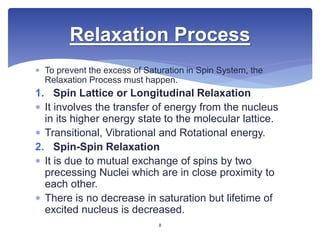
 To prevent the excess of Saturation in Spin System, the
Relaxation Process must happen.
1. Spin Lattice or Longitudinal Relaxation
 It involves the transfer of energy from the nucleus
in its higher energy state to the molecular lattice.
 Transitional, Vibrational and Rotational energy.
2. Spin-Spin Relaxation
 It is due to mutual exchange of spins by two
precessing Nuclei which are in close proximity to
each other.
 There is no decrease in saturation but lifetime of
excited nucleus is decreased.
Relaxation Process
8
Instrumentation of NMR
9
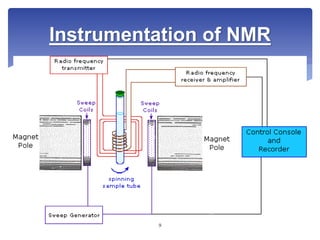
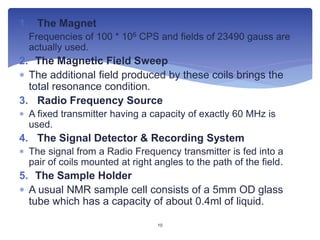
1. The Magnet
 Frequencies of 100 * 106 CPS and fields of 23490 gauss are
actually used.
2. The Magnetic Field Sweep
 The additional field produced by these coils brings the
total resonance condition.
3. Radio Frequency Source
 A fixed transmitter having a capacity of exactly 60 MHz is
used.
4. The Signal Detector & Recording System
 The signal from a Radio Frequency transmitter is fed into a
pair of coils mounted at right angles to the path of the field.
5. The Sample Holder
 A usual NMR sample cell consists of a 5mm OD glass
tube which has a capacity of about 0.4ml of liquid.
10
 The chosen Solvent must not
interrupt with the general
spectral study of the
component.
 The following characteristic
are checked before choosing
the NMR solvent:
- Solubility
- Purity
- Solvent Viscosity
- Moisture Content
- Price
 Deuterated Chloroform, CDCl3
is most commonly used
because of its low price.
 Apart from CDCl3 other
deuterated solvents in
common use are:
- Deuterated Water (D2O)
- DMSO-d_6
- Methanol-d_4
- Methylene Chloride-d_2
- Pyridine-d_5
- THF-d_8
- Acetic acid-d_4
- Acetone-d_6
Solvent Used in NMR
11
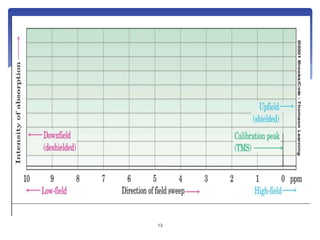
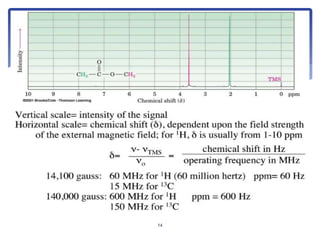
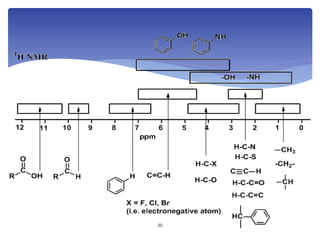
 Chemical Shift ( δ, in ppm) is the position of an peak relative to that of a
Reference Substance such as TMS ( Tetra methyl Silane).
 Shielded Protons
- A Proton is Shielded when it is surrounded by electrons whose Induced
Magnetic Field opposes the externally applied magnetic field and shields the
proton from its influence.
 Deshielded Protons
- A Proton is Deshielded when bonded to a group which withdraws part of the
shielding electron density from around the proton.
Chemical Shift
12
13
14
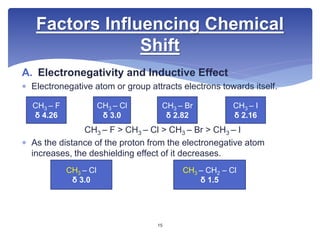
A. Electronegativity and Inductive Effect
 Electronegative atom or group attracts electrons towards itself.
CH3 – F > CH3 – Cl > CH3 – Br > CH3 – I
 As the distance of the proton from the electronegative atom
increases, the deshielding effect of it decreases.
Factors Influencing Chemical
Shift
CH3 – F
δ 4.26
CH3 – Cl
δ 3.0
CH3 – Br
δ 2.82
CH3 – I
δ 2.16
CH3 – Cl
δ 3.0
CH3 – CH2 – Cl
δ 1.5
15
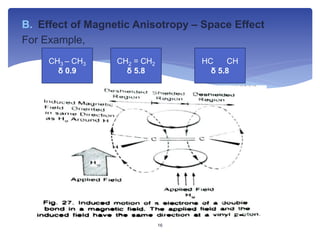
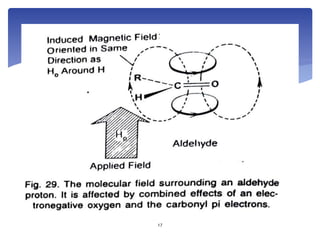
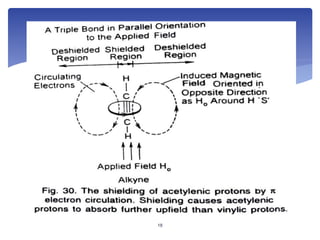
B. Effect of Magnetic Anisotropy – Space Effect
For Example,
CH3 – CH3
δ 0.9
CH2 = CH2
δ 5.8
HC CH
δ 5.8
16
17
18
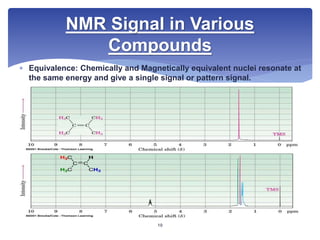
 Equivalence: Chemically and Magnetically equivalent nuclei resonate at
the same energy and give a single signal or pattern signal.
NMR Signal in Various
Compounds
19
20
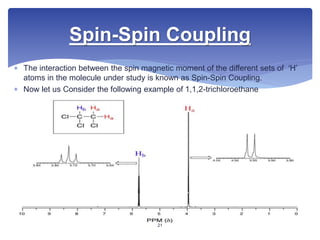
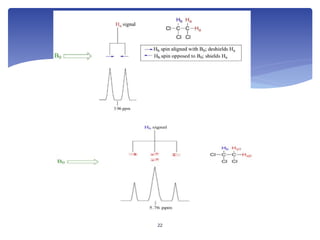
 The interaction between the spin magnetic moment of the different sets of ‘H’
atoms in the molecule under study is known as Spin-Spin Coupling.
 Now let us Consider the following example of 1,1,2-trichloroethane
Spin-Spin Coupling
21
22
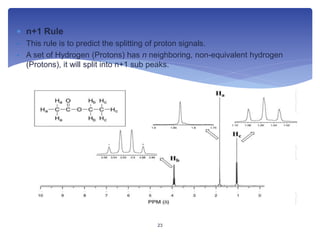
 n+1 Rule
- This rule is to predict the splitting of proton signals.
- A set of Hydrogen (Protons) has n neighboring, non-equivalent hydrogen
(Protons), it will split into n+1 sub peaks.
23
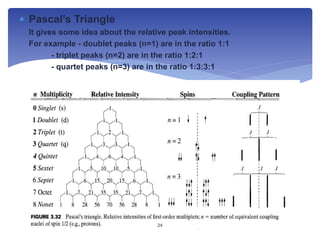
 Pascal’s Triangle
- It gives some idea about the relative peak intensities.
- For example - doublet peaks (n=1) are in the ratio 1:1
- triplet peaks (n=2) are in the ratio 1:2:1
- quartet peaks (n=3) are in the ratio 1:3:3:1
24
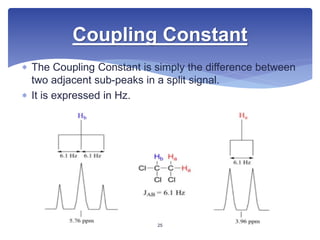
 The Coupling Constant is simply the difference between
two adjacent sub-peaks in a split signal.
 It is expressed in Hz.
Coupling Constant
25
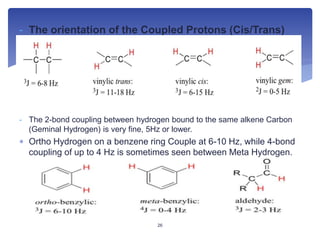
- The orientation of the Coupled Protons (Cis/Trans)
- The 2-bond coupling between hydrogen bound to the same alkene Carbon
(Geminal Hydrogen) is very fine, 5Hz or lower.
 Ortho Hydrogen on a benzene ring Couple at 6-10 Hz, while 4-bond
coupling of up to 4 Hz is sometimes seen between Meta Hydrogen.
26
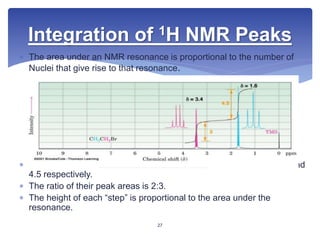
 The area under an NMR resonance is proportional to the number of
Nuclei that give rise to that resonance.
 The relative areas under the resonances at δ=3.4 and δ=1.6 are 3 and
4.5 respectively.
 The ratio of their peak areas is 2:3.
 The height of each “step” is proportional to the area under the
resonance.
Integration of 1H NMR Peaks
27
 A careful study of NMR spectra reveals:
 The presence of particular functional groups.
 Relative number of Nuclei present in the group
 The relative position of these groups from the multiplicities of
the lines.
 Identification of Compounds
 1H NMR is widely used for structure elucidation
 Hydrogen Bonding
 The Hydrogen Bonding in Organic Compounds as well as in
Metal Chelates has been successfully studied
Applications of NMR
Spectroscopy
28
 Clinical and scientific research In vivo NMR studies –
 Concerned with 'H NMR spectroscopy of human brain.
 Many studies are concerned with altered levels of
metabolites in various brain diseases.
 To determine the spatial distribution of any given
metabolite detected spectroscopical IS (Image Selected in
vivo spectroscopy).
29
 Instrumental Method of Chemical Analysis - B. K. Sharma, Published by
Krishna Prakashan Media (P) Ltd., 2014, Page no. S-621 – S-651; S-653 –
S-654; S-703 – S-704.
 Spectrometric Identification of Organic Compounds - Robert M. Silverstein,
Seventh Edition, John Wiley & Sons, 2005, Page no.127-128.
 https://www2.chemistry.msu.edu/faculty/reusch/virttxtjml/spectrpy/nmr/nmr1.
htm
 https://www.vanderbilt.edu/AnS/Chemistry/Rizzo/chem220a/Ch13slides.pdf
 https://lab-training.com/2015/12/22/desirable-characteristics-of-solvents-
used-for-nmr-studies/
 https://chem.libretexts.org/Bookshelves/Organic_Chemistry/Book%3A_Org
anic_Chemistry_with_a_Biological_Emphasis_v2.0_(Soderberg)/05%3A_St
ructure_Determination_Part_II_-
_Nuclear_Magnetic_Resonance_Spectroscopy/5.06%3A_Spin-
Spin_Coupling
 https://www.slideshare.net/solairajananant/nmr-spectroscopy-13887430
References
30

Nmr spectroscopy

  • 1.
    1H NMR SPECTROSCOPY TusharPrakash Naiknaware M.Pharmacy (Quality Assurance) Roll No.14 Under the Guidance of Prof. Mukesh Patil Shri. D.D Vispute College Of Pharmacy & Research Center 2020-2021 1
  • 2.
    1. Quantum Numbers& their Role in NMR 2. Principle of NMR 3. Relaxation Process 4. Instrumentation of NMR 5. Solvent Requirement in NMR 6. Chemical Shift 7. Factors Influencing Chemical Shift 8. NMR Signals in Various Compounds 9. Spin-Spin Coupling 10. Coupling Constant 11. Applications of NMR Spectroscopy Content 2
  • 3.
     We allknow that all Nuclei(Protons Neutrons) carry a charge.  Generally, all Nuclei spins on the Nuclear Axis.  This Spinning of Nuclear Charge generates a Magnetic Dipole along the Axis. Quantum Numbers & their Role in NMR  The Angular Momentum of the Spinning Charge i.e. Spinning Nucleus can be describe in terms of Quantum Spin Number “I”.  Spin Number “I” can have values of 0, ½, 1, 3/2, and so on.  I=0 Denotes no Spin 3
  • 4.
  • 5.
    Principle of NMR Theabove figure showing the nucleus in Absence and Presence of External Magnet Field. 5
  • 6.
     2 PossibleOrientation means Nucleus can either aligned with the applied magnetic field OR aligned against the field.( For I=1/2) 6
  • 7.
    Nuclear Precession  Inpresence of an external magnetic, the magnetic axis of the proton will precess – moves in a circular path.  Since, the proton precess it has particular frequency which is known as Frequency of Precession OR Larmor Frequency.  When the applied Radio Frequency becomes equal to the Larmor Frequency, the Nuclei is said to be in Resonance. By the absorption of ∆E from the Applied Radio Frequency. This Absorption is measured in NMR Spectroscopy 7
  • 8.
     To preventthe excess of Saturation in Spin System, the Relaxation Process must happen. 1. Spin Lattice or Longitudinal Relaxation  It involves the transfer of energy from the nucleus in its higher energy state to the molecular lattice.  Transitional, Vibrational and Rotational energy. 2. Spin-Spin Relaxation  It is due to mutual exchange of spins by two precessing Nuclei which are in close proximity to each other.  There is no decrease in saturation but lifetime of excited nucleus is decreased. Relaxation Process 8
  • 9.
  • 10.
    1. The Magnet Frequencies of 100 * 106 CPS and fields of 23490 gauss are actually used. 2. The Magnetic Field Sweep  The additional field produced by these coils brings the total resonance condition. 3. Radio Frequency Source  A fixed transmitter having a capacity of exactly 60 MHz is used. 4. The Signal Detector & Recording System  The signal from a Radio Frequency transmitter is fed into a pair of coils mounted at right angles to the path of the field. 5. The Sample Holder  A usual NMR sample cell consists of a 5mm OD glass tube which has a capacity of about 0.4ml of liquid. 10
  • 11.
     The chosenSolvent must not interrupt with the general spectral study of the component.  The following characteristic are checked before choosing the NMR solvent: - Solubility - Purity - Solvent Viscosity - Moisture Content - Price  Deuterated Chloroform, CDCl3 is most commonly used because of its low price.  Apart from CDCl3 other deuterated solvents in common use are: - Deuterated Water (D2O) - DMSO-d_6 - Methanol-d_4 - Methylene Chloride-d_2 - Pyridine-d_5 - THF-d_8 - Acetic acid-d_4 - Acetone-d_6 Solvent Used in NMR 11
  • 12.
     Chemical Shift( δ, in ppm) is the position of an peak relative to that of a Reference Substance such as TMS ( Tetra methyl Silane).  Shielded Protons - A Proton is Shielded when it is surrounded by electrons whose Induced Magnetic Field opposes the externally applied magnetic field and shields the proton from its influence.  Deshielded Protons - A Proton is Deshielded when bonded to a group which withdraws part of the shielding electron density from around the proton. Chemical Shift 12
  • 13.
  • 14.
  • 15.
    A. Electronegativity andInductive Effect  Electronegative atom or group attracts electrons towards itself. CH3 – F > CH3 – Cl > CH3 – Br > CH3 – I  As the distance of the proton from the electronegative atom increases, the deshielding effect of it decreases. Factors Influencing Chemical Shift CH3 – F δ 4.26 CH3 – Cl δ 3.0 CH3 – Br δ 2.82 CH3 – I δ 2.16 CH3 – Cl δ 3.0 CH3 – CH2 – Cl δ 1.5 15
  • 16.
    B. Effect ofMagnetic Anisotropy – Space Effect For Example, CH3 – CH3 δ 0.9 CH2 = CH2 δ 5.8 HC CH δ 5.8 16
  • 17.
  • 18.
  • 19.
     Equivalence: Chemicallyand Magnetically equivalent nuclei resonate at the same energy and give a single signal or pattern signal. NMR Signal in Various Compounds 19
  • 20.
  • 21.
     The interactionbetween the spin magnetic moment of the different sets of ‘H’ atoms in the molecule under study is known as Spin-Spin Coupling.  Now let us Consider the following example of 1,1,2-trichloroethane Spin-Spin Coupling 21
  • 22.
  • 23.
     n+1 Rule -This rule is to predict the splitting of proton signals. - A set of Hydrogen (Protons) has n neighboring, non-equivalent hydrogen (Protons), it will split into n+1 sub peaks. 23
  • 24.
     Pascal’s Triangle -It gives some idea about the relative peak intensities. - For example - doublet peaks (n=1) are in the ratio 1:1 - triplet peaks (n=2) are in the ratio 1:2:1 - quartet peaks (n=3) are in the ratio 1:3:3:1 24
  • 25.
     The CouplingConstant is simply the difference between two adjacent sub-peaks in a split signal.  It is expressed in Hz. Coupling Constant 25
  • 26.
    - The orientationof the Coupled Protons (Cis/Trans) - The 2-bond coupling between hydrogen bound to the same alkene Carbon (Geminal Hydrogen) is very fine, 5Hz or lower.  Ortho Hydrogen on a benzene ring Couple at 6-10 Hz, while 4-bond coupling of up to 4 Hz is sometimes seen between Meta Hydrogen. 26
  • 27.
     The areaunder an NMR resonance is proportional to the number of Nuclei that give rise to that resonance.  The relative areas under the resonances at δ=3.4 and δ=1.6 are 3 and 4.5 respectively.  The ratio of their peak areas is 2:3.  The height of each “step” is proportional to the area under the resonance. Integration of 1H NMR Peaks 27
  • 28.
     A carefulstudy of NMR spectra reveals:  The presence of particular functional groups.  Relative number of Nuclei present in the group  The relative position of these groups from the multiplicities of the lines.  Identification of Compounds  1H NMR is widely used for structure elucidation  Hydrogen Bonding  The Hydrogen Bonding in Organic Compounds as well as in Metal Chelates has been successfully studied Applications of NMR Spectroscopy 28
  • 29.
     Clinical andscientific research In vivo NMR studies –  Concerned with 'H NMR spectroscopy of human brain.  Many studies are concerned with altered levels of metabolites in various brain diseases.  To determine the spatial distribution of any given metabolite detected spectroscopical IS (Image Selected in vivo spectroscopy). 29
  • 30.
     Instrumental Methodof Chemical Analysis - B. K. Sharma, Published by Krishna Prakashan Media (P) Ltd., 2014, Page no. S-621 – S-651; S-653 – S-654; S-703 – S-704.  Spectrometric Identification of Organic Compounds - Robert M. Silverstein, Seventh Edition, John Wiley & Sons, 2005, Page no.127-128.  https://www2.chemistry.msu.edu/faculty/reusch/virttxtjml/spectrpy/nmr/nmr1. htm  https://www.vanderbilt.edu/AnS/Chemistry/Rizzo/chem220a/Ch13slides.pdf  https://lab-training.com/2015/12/22/desirable-characteristics-of-solvents- used-for-nmr-studies/  https://chem.libretexts.org/Bookshelves/Organic_Chemistry/Book%3A_Org anic_Chemistry_with_a_Biological_Emphasis_v2.0_(Soderberg)/05%3A_St ructure_Determination_Part_II_- _Nuclear_Magnetic_Resonance_Spectroscopy/5.06%3A_Spin- Spin_Coupling  https://www.slideshare.net/solairajananant/nmr-spectroscopy-13887430 References 30