- BY SAVITA G
1H NMR
SPECTROSCOPY
CONTENTS
• Introduction
• Basic mechanism
• 1H NMR
• Chemical shift
• Factors affecting chemical shift
• Integrals and integration
• SPIN-SPIN Coupling
• Coupling constant
•SPECTROSCOPY is the study of interaction of EMR with
matter, which may result in absorption, emmision, reflection etc
• Spectroscopy determines the physical and chemical properties of
atoms and provides a detailed information about the structure,
molecular formula, chemical environment of molecules etc
• NUCLEAR MAGNETIC RESONANCE ,most commonly known as
NMR SPECTROSCOPY
• NMR is a spectroscopic technique which is based on the
absorption of electromagnetic radiation in the radio frequency
region(4 to 900MHz) by nuclei of atom.
BASIC MECHANISM OF NMR SPECTROSCOPY
• We know that Spinning
charged nucleus produces
magnetic field.thus the
nucleus can be considered to
be a tiny magnet
ABSENCE OF EXTERNAL PRESENCE OF EXTERNAL
MAGNETIC FIELD MAGNETIC FIELD
BASIC MECHANISM
• When the electromagnetic radiation in the radio frequency
region is supplied, the spinning nucleus in the lower energy state
absorbs the required energy and shifts to the higher energy state
• Flipping up of the Nucleus from higher energy state to Lower
energy state is called RESONANCE .hence the name nuclear
magnetic resonance spectroscopy
• During Return of the nuclei to lower energy state, it emits the
energy and is measured in the form of spectrum
• Emitted energy is the characteric of spinning element
• How energy differs from one type of atom
to other???
•Spinning nuclie is said to be
shielded if it is surrounded
by more number of electrons
•Shielded nuclie experiences
lesser external magnetic
field and requires less
energy to Flipp for lower
energy state than a
deshielded nuclie
•Spinning nuclie is said to be
deshielded if it surrounded by
less no of electrons
•Deshielded nuclie experIences
higher external magnetic field
and requires higher magnetic
field for flipping to lower
energy state
BASIC REQUIRMENT FOR NMR SPECTROSCOPY
• Not all the nuclei are “NMR ACTIVE”
• Only those whose spin quantum no is greater than zero are NMR
ACTIVE
• NMR ACTIVE NUCLEUS
• Spin Quantum number is associated by no of Protons and
neutrons present in the nuclei of the atom
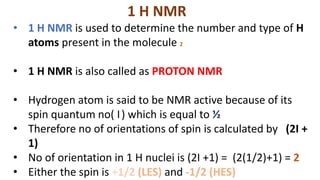
1 H NMR
• 1 H NMR is used to determine the number and type of H
atoms present in the molecule 2
• 1 H NMR is also called as PROTON NMR
• Hydrogen atom is said to be NMR active because of its
spin quantum no( I) which is equal to ½
• Therefore no of orientations of spin is calculated by (2I +
1)
• No of orientation in 1 H nuclei is (2I +1) = (2(1/2)+1) = 2
• Either the spin is +1/2 (LES) and -1/2 (HES)
WORKING OF H1 NMR
PRECESSIONAL MOTION
• Because the Proton is behaving as a tiny
magnet, it not only aligned in or
opposite to the direction of external
magnetic field but also moves in a
characteric way
• Consider the behavior of the spinning
top, further continues spinning of top, it
also performs a slowly waltz like motion
in which the spinning axis of the top
moves slowly around the vertical, this
motion is called PRECISIONAL MOTION
PRECESSIONAL FREQUENCY
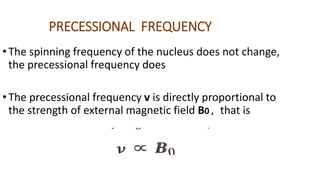
•The spinning frequency of the nucleus does not change,
the precessional frequency does
•The precessional frequency v is directly proportional to
the strength of external magnetic field B0 , that is
• Precessing proton will only absorb energy
from the radiofrequency source if the
Precessing frequency is same as that of
frequency of radio wave
• When this occurs, Precessing nuclei
absorbs the energy and flipping to the
lower energy state with the Emission of
Energy and measured in the form of
spectrum
Why tetramethysilane is used as internal
standard???
• Highly Shielded
• Gives intense sharp peaks
even at Low concentrations
• Chemically inert
• Low boiling point
• Soluble in most of the
organic solvents
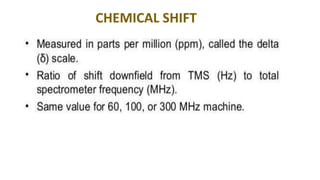
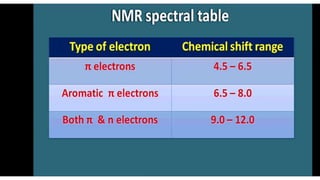
CHEMICAL SHIFT
FACTORS AFFECTING CHEMICAL SHIFT
• Electro negativity groups
• Magnetic anisotropy of Pi systems
• Hydrogen bonding
• Hybridization
ELECTRONEGATIVITY GROUPS
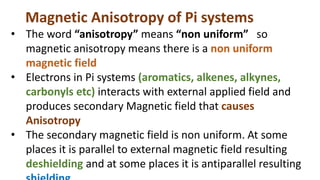
Magnetic Anisotropy of Pi systems
• The word “anisotropy” means “non uniform” so
magnetic anisotropy means there is a non uniform
magnetic field
• Electrons in Pi systems (aromatics, alkenes, alkynes,
carbonyls etc) interacts with external applied field and
produces secondary Magnetic field that causes
Anisotropy
• The secondary magnetic field is non uniform. At some
places it is parallel to external magnetic field resulting
deshielding and at some places it is antiparallel resulting
Hydrogen bonding: Protons undergoing hydrogen bonding
exhibit extremely variable absorption positions over a wide
range. More the hydrogen bonding takes place, more
deshielded a proton becomes and results in shift to higher
delta scale
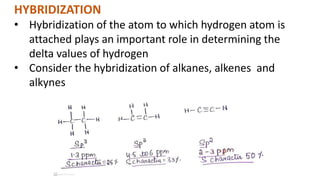
HYBRIDIZATION
• Hybridization of the atom to which hydrogen atom is
attached plays an important role in determining the
delta values of hydrogen
• Consider the hybridization of alkanes, alkenes and
alkynes
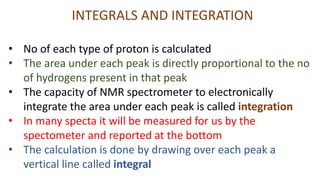
INTEGRALS AND INTEGRATION
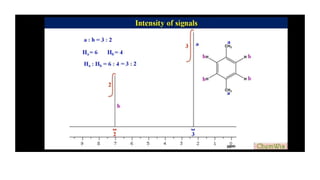
• No of each type of proton is calculated
• The area under each peak is directly proportional to the no
of hydrogens present in that peak
• The capacity of NMR spectrometer to electronically
integrate the area under each peak is called integration
• In many specta it will be measured for us by the
spectometer and reported at the bottom
• The calculation is done by drawing over each peak a
vertical line called integral
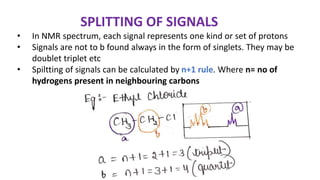
SPLITTING OF SIGNALS
• In NMR spectrum, each signal represents one kind or set of protons
• Signals are not to b found always in the form of singlets. They may be
doublet triplet etc
• Spiltting of signals can be calculated by n+1 rule. Where n= no of
hydrogens present in neighbouring carbons
SPIN-SPIN COUPLING
• Spilting of signals is mainly due to the spin – spin
coupling
• It is nothing but spin of one type of proton couples
with spin of neighbouring proton
• Important to understand no of protons present in
adjacent carbon
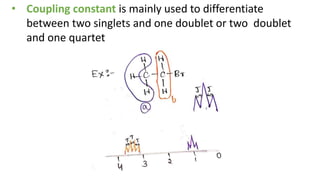
COUPLING CONSTANT
• The distance between the centers of the two
adjacent peaks in a multiple is constant irrespective
of external magnetic field and I’d known as coupling
constant. It is denoted by “J”
• Coupling constant is mainly used to differentiate
between two singlets and one doublet or two doublet
and one quartet
REREFERENCES
• Organic Spectroscopy by william kemp(3rd edition)
• Organic chemistry by Clayden and Warren
• www.google.com
• You tube videos by pushpendra classes
NMR Spectroscopy.pptx

NMR Spectroscopy.pptx

  • 1.
    - BY SAVITAG 1H NMR SPECTROSCOPY
  • 2.
    CONTENTS • Introduction • Basicmechanism • 1H NMR • Chemical shift • Factors affecting chemical shift • Integrals and integration • SPIN-SPIN Coupling • Coupling constant
  • 3.
    •SPECTROSCOPY is thestudy of interaction of EMR with matter, which may result in absorption, emmision, reflection etc • Spectroscopy determines the physical and chemical properties of atoms and provides a detailed information about the structure, molecular formula, chemical environment of molecules etc • NUCLEAR MAGNETIC RESONANCE ,most commonly known as NMR SPECTROSCOPY • NMR is a spectroscopic technique which is based on the absorption of electromagnetic radiation in the radio frequency region(4 to 900MHz) by nuclei of atom.
  • 4.
    BASIC MECHANISM OFNMR SPECTROSCOPY • We know that Spinning charged nucleus produces magnetic field.thus the nucleus can be considered to be a tiny magnet
  • 5.
    ABSENCE OF EXTERNALPRESENCE OF EXTERNAL MAGNETIC FIELD MAGNETIC FIELD
  • 6.
  • 7.
    • When theelectromagnetic radiation in the radio frequency region is supplied, the spinning nucleus in the lower energy state absorbs the required energy and shifts to the higher energy state • Flipping up of the Nucleus from higher energy state to Lower energy state is called RESONANCE .hence the name nuclear magnetic resonance spectroscopy • During Return of the nuclei to lower energy state, it emits the energy and is measured in the form of spectrum • Emitted energy is the characteric of spinning element
  • 8.
    • How energydiffers from one type of atom to other??? •Spinning nuclie is said to be shielded if it is surrounded by more number of electrons •Shielded nuclie experiences lesser external magnetic field and requires less energy to Flipp for lower energy state than a deshielded nuclie
  • 10.
    •Spinning nuclie issaid to be deshielded if it surrounded by less no of electrons •Deshielded nuclie experIences higher external magnetic field and requires higher magnetic field for flipping to lower energy state
  • 12.
    BASIC REQUIRMENT FORNMR SPECTROSCOPY • Not all the nuclei are “NMR ACTIVE” • Only those whose spin quantum no is greater than zero are NMR ACTIVE • NMR ACTIVE NUCLEUS
  • 13.
    • Spin Quantumnumber is associated by no of Protons and neutrons present in the nuclei of the atom
  • 14.
    1 H NMR •1 H NMR is used to determine the number and type of H atoms present in the molecule 2 • 1 H NMR is also called as PROTON NMR • Hydrogen atom is said to be NMR active because of its spin quantum no( I) which is equal to ½ • Therefore no of orientations of spin is calculated by (2I + 1) • No of orientation in 1 H nuclei is (2I +1) = (2(1/2)+1) = 2 • Either the spin is +1/2 (LES) and -1/2 (HES)
  • 15.
  • 16.
    PRECESSIONAL MOTION • Becausethe Proton is behaving as a tiny magnet, it not only aligned in or opposite to the direction of external magnetic field but also moves in a characteric way • Consider the behavior of the spinning top, further continues spinning of top, it also performs a slowly waltz like motion in which the spinning axis of the top moves slowly around the vertical, this motion is called PRECISIONAL MOTION
  • 17.
    PRECESSIONAL FREQUENCY •The spinningfrequency of the nucleus does not change, the precessional frequency does •The precessional frequency v is directly proportional to the strength of external magnetic field B0 , that is
  • 18.
    • Precessing protonwill only absorb energy from the radiofrequency source if the Precessing frequency is same as that of frequency of radio wave • When this occurs, Precessing nuclei absorbs the energy and flipping to the lower energy state with the Emission of Energy and measured in the form of spectrum
  • 20.
    Why tetramethysilane isused as internal standard??? • Highly Shielded • Gives intense sharp peaks even at Low concentrations • Chemically inert • Low boiling point • Soluble in most of the organic solvents
  • 22.
  • 23.
    FACTORS AFFECTING CHEMICALSHIFT • Electro negativity groups • Magnetic anisotropy of Pi systems • Hydrogen bonding • Hybridization
  • 24.
  • 25.
    Magnetic Anisotropy ofPi systems • The word “anisotropy” means “non uniform” so magnetic anisotropy means there is a non uniform magnetic field • Electrons in Pi systems (aromatics, alkenes, alkynes, carbonyls etc) interacts with external applied field and produces secondary Magnetic field that causes Anisotropy • The secondary magnetic field is non uniform. At some places it is parallel to external magnetic field resulting deshielding and at some places it is antiparallel resulting
  • 27.
    Hydrogen bonding: Protonsundergoing hydrogen bonding exhibit extremely variable absorption positions over a wide range. More the hydrogen bonding takes place, more deshielded a proton becomes and results in shift to higher delta scale
  • 28.
    HYBRIDIZATION • Hybridization ofthe atom to which hydrogen atom is attached plays an important role in determining the delta values of hydrogen • Consider the hybridization of alkanes, alkenes and alkynes
  • 33.
    INTEGRALS AND INTEGRATION •No of each type of proton is calculated • The area under each peak is directly proportional to the no of hydrogens present in that peak • The capacity of NMR spectrometer to electronically integrate the area under each peak is called integration • In many specta it will be measured for us by the spectometer and reported at the bottom • The calculation is done by drawing over each peak a vertical line called integral
  • 36.
    SPLITTING OF SIGNALS •In NMR spectrum, each signal represents one kind or set of protons • Signals are not to b found always in the form of singlets. They may be doublet triplet etc • Spiltting of signals can be calculated by n+1 rule. Where n= no of hydrogens present in neighbouring carbons
  • 37.
    SPIN-SPIN COUPLING • Spiltingof signals is mainly due to the spin – spin coupling • It is nothing but spin of one type of proton couples with spin of neighbouring proton • Important to understand no of protons present in adjacent carbon COUPLING CONSTANT • The distance between the centers of the two adjacent peaks in a multiple is constant irrespective of external magnetic field and I’d known as coupling constant. It is denoted by “J”
  • 38.
    • Coupling constantis mainly used to differentiate between two singlets and one doublet or two doublet and one quartet
  • 39.
    REREFERENCES • Organic Spectroscopyby william kemp(3rd edition) • Organic chemistry by Clayden and Warren • www.google.com • You tube videos by pushpendra classes