OSMOTIC PUMP DRUG
DELIVERY SYSTEM
PRESENTED BY:
ROHIT KUMAR
M.PHARM(PHARMACEUTICS)
2ND SEMESTER
INTRODUCTION
• Osmosis refers to the process of movement of solvent from lower concentration of solute
towards higher concentration of solute across a semi permeable membrane till the
equilibrium achieved.
• Osmotic pressure is the pressure which, if applied to the more concentrated solution,
would prevent transport of water across the semipermeable membrane.
• Osmotic drug delivery uses the osmotic pressure of drug or other solutes (osmogens or
osmagents) for controlled delivery of drugs. Osmotic drug delivery has come a long way
since Australian physiologists Rose and Nelson developed an implantable pump in
1955.
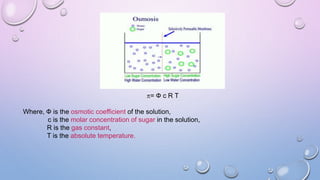
= Ф c R T
Where, Ф is the osmotic coefficient of the solution,
c is the molar concentration of sugar in the solution,
R is the gas constant,
T is the absolute temperature.
• Osmotic pressure for concentrated solution of soluble solutes commonly used in
controlled release formulation are extremely high ranging from 30 atm for sodium
phosphate up to 500 atm for a Lactose-Fructose mixture, as their osmotic pressure can
produce high water flow across semi permeable membrane.
• The osmotic water flow through a membrane is given by the equation
dv/dt = A Q Δ /L
• Where dvdt is water flow across the membrane of area A, thickness L, and the
permeability Q in cm2 , Δ  is the osmotic pressure difference between the two
solutions on either side of the membrane.
BASIC COMPONENTS
• Drug
• Osmotic agent
• Semipermeable membrane
• Wicking agent
• Pore forming agent
• Coating agent
CRITERIA FOR SELECTION OF DRUG
• Short biological half-life (2- 6 hrs)
• High potency
• Required for prolonged treatment
• (e.G: nifedipine, glipizide, verapamil and chlorpromazine hydrochloride).
OSMOTIC AGENTS
• These are also known as osmogens or osmogents and are used to create osmotic
pressure inside the system.
• When the solubility of drug is low then the drug will show zero order release but at a
slow rate. To enhance the release rate osmotic agent is added in the formulation.
• Osmotic agent creates a very high osmotic pressure gradient inside the system and
increases release rate of drug.
• Osmotic pressures for concentrated solution of soluble solutes commonly used in
controlled release formulations are extremely high, ranging from 30 atm for sodium
phosphate up to 500 atm for a Lactose-Fructose mixture.
Contd…
• Some of the commercially used osmotic agents
Sodium chloride, Fructose, Sucrose, potassium chloride, xylitol, sorbitol, citric acid, Dextrose,
mannitol and Lactose.
• Some mixture used as a osmotic agent
o Dextrose +Fructose
o Lactose +Fructose
o Sucrose+ Fructose
o Lactose +Dextrose
o Mannitol +Fructose
o Mannitol +Dextrose
o Dextrose +Sucrose
o Mannitol +Sucrose
SEMIPERMEABLE MEMBRANE
• The membrane must possess certain performance criteria such as:
o Sufficient wet strength and water permeability
o Should be biocompatible
o Rigid and non-swelling
o Should be sufficient thick to withstand the pressure within the device.
• Any polymer that is permeable to water but impermeable to solute can be used as a
coating material in osmotic devices.
• Some of the polymers that can be used for above purpose include cellulose esters such
as cellulose acetate, cellulose diacetate, cellulose triacetate, cellulose propionate,
cellulose acetate butyrate, and cellulose ethers like ethyl cellulose.
WICKING AGENT
• The wicking agents are those agents which help to increase the contact surface area of
the drug with the incoming aqueous fluid.
• The use of the wicking agent help to enhance the rate of drug released from the orifice
of the drug.
• Examples are colloidal silicon dioxide, kaolin, titanium dioxide, alumina, niacinamide,
sodium lauryl sulphate (sls), low molecular weight polyvinyl pyrrolidone (pvp), bentonite,
magnesium aluminium silicate, polyester and polyethylene, etc.
PORE FORMING AGENTS
• The pore-forming agents cause the formation of micro porous membrane. The micro
porous wall may be formed in situ by a pore-former by its leaching during the operation
of the system.
• The pore formers can be inorganic or organic and solid or liquid in nature. Like,
• Alkaline metal salts such as sodium chloride, sodium bromide, potassium chloride, etc.
• Alkaline earth metals such as calcium chloride and calcium nitrate
• Carbohydrates such as glucose, fructose, lactose, etc.
COATING AGENTS
• The primary function of solvent system is to dissolved or dispersed the polymer and
other additive and convey them to substrate surface.
• Solvent used to prepare polymeric solution include inert inorganic and organic solvents
that do not adversely harm the core ,wall and other material .The various types of
solvents and their combinations are as follows: methylene chloride, methanol, isopropyl
alcohol, dichloromethane, ethyl acetate, acetone, carbon tetrachloride, cyclohexane,
butyl alcohol, water etc
• The mixture of solvents such as acetone-methanol(80:20), methylene chloride -
methanol (79:21), acetone-ethanol(80:20), methylene chloride-methanol-water (75:22:3)
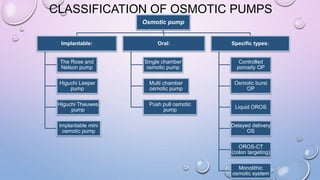
CLASSIFICATION OF OSMOTIC PUMPS
Osmotic pump
Implantable:
The Rose and
Nelson pump
Higuchi Leeper
pump
Higuchi Theuwes
pump
Implantable mini
osmotic pump
Oral:
Single chamber
osmotic pump
Multi chamber
osmotic pump
Push pull osmotic
pump
Specific types:
Controlled
porosity OP
Osmotic burst
OP
Liquid OROS
Delayed delivery
OS
OROS-CT
(colon targeting)
Monolithic
osmotic system
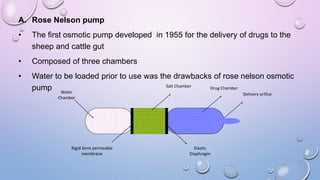
A. Rose Nelson pump
• The first osmotic pump developed in 1955 for the delivery of drugs to the
sheep and cattle gut
• Composed of three chambers
• Water to be loaded prior to use was the drawbacks of rose nelson osmotic
pump Water
Chamber
Rigid Semi permeable
membrane
Elastic
Diaphragm
Delivery orifice
Drug ChamberSalt Chamber
• The difference in osmotic pressure across the membrane moves water
from the water chamber in to the salt chamber.
• The volume of chamber increases because of this water flow, which
distends the latex diaphragm separating the salt and drug chambers,
thereby pumping drug out of the device.
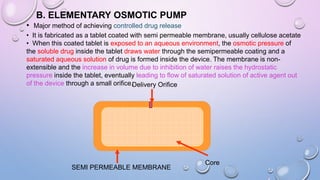
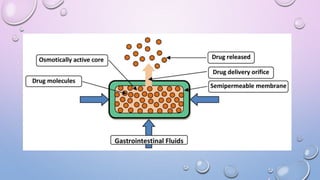
B. ELEMENTARY OSMOTIC PUMP
SEMI PERMEABLE MEMBRANE
Core
Delivery Orifice
• Major method of achieving controlled drug release
• It is fabricated as a tablet coated with semi permeable membrane, usually cellulose acetate
• When this coated tablet is exposed to an aqueous environment, the osmotic pressure of
the soluble drug inside the tablet draws water through the semipermeable coating and a
saturated aqueous solution of drug is formed inside the device. The membrane is non-
extensible and the increase in volume due to inhibition of water raises the hydrostatic
pressure inside the tablet, eventually leading to flow of saturated solution of active agent out
of the device through a small orifice.
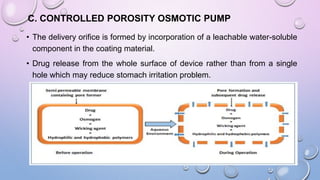
C. CONTROLLED POROSITY OSMOTIC PUMP
• The delivery orifice is formed by incorporation of a leachable water-soluble
component in the coating material.
• Drug release from the whole surface of device rather than from a single
hole which may reduce stomach irritation problem.
• The pump can be made with single or multicompartment dosage form, in
either form, the delivery system
• Comprises a core with the drug surrounded by a semipermeable
membrane which has an asymmetric structure. When exposed to water,
low levels of water-soluble additive are leached from polymer materials
that were permeable to water yet remained insoluble.
• Then resulting sponge like structure formed the controlled porosity walls
of interest and was substantially permeable to both water and dissolved
drug agents.
EVALUATION PARAMETERS:
• PORE DIAMETER
• COATING THICKNESS
• HARDNESS
• FRIABILITY
• WEIGHT VARIATION
• IN VITRO EVALUATION
• IN VIVO EVALUATION
20/60
osmotic pump

osmotic pump

  • 1.
    OSMOTIC PUMP DRUG DELIVERYSYSTEM PRESENTED BY: ROHIT KUMAR M.PHARM(PHARMACEUTICS) 2ND SEMESTER
  • 2.
    INTRODUCTION • Osmosis refersto the process of movement of solvent from lower concentration of solute towards higher concentration of solute across a semi permeable membrane till the equilibrium achieved. • Osmotic pressure is the pressure which, if applied to the more concentrated solution, would prevent transport of water across the semipermeable membrane. • Osmotic drug delivery uses the osmotic pressure of drug or other solutes (osmogens or osmagents) for controlled delivery of drugs. Osmotic drug delivery has come a long way since Australian physiologists Rose and Nelson developed an implantable pump in 1955.
  • 3.
    = Ф cR T Where, Ф is the osmotic coefficient of the solution, c is the molar concentration of sugar in the solution, R is the gas constant, T is the absolute temperature.
  • 4.
    • Osmotic pressurefor concentrated solution of soluble solutes commonly used in controlled release formulation are extremely high ranging from 30 atm for sodium phosphate up to 500 atm for a Lactose-Fructose mixture, as their osmotic pressure can produce high water flow across semi permeable membrane. • The osmotic water flow through a membrane is given by the equation dv/dt = A Q Δ /L • Where dvdt is water flow across the membrane of area A, thickness L, and the permeability Q in cm2 , Δ  is the osmotic pressure difference between the two solutions on either side of the membrane.
  • 5.
    BASIC COMPONENTS • Drug •Osmotic agent • Semipermeable membrane • Wicking agent • Pore forming agent • Coating agent
  • 6.
    CRITERIA FOR SELECTIONOF DRUG • Short biological half-life (2- 6 hrs) • High potency • Required for prolonged treatment • (e.G: nifedipine, glipizide, verapamil and chlorpromazine hydrochloride).
  • 7.
    OSMOTIC AGENTS • Theseare also known as osmogens or osmogents and are used to create osmotic pressure inside the system. • When the solubility of drug is low then the drug will show zero order release but at a slow rate. To enhance the release rate osmotic agent is added in the formulation. • Osmotic agent creates a very high osmotic pressure gradient inside the system and increases release rate of drug. • Osmotic pressures for concentrated solution of soluble solutes commonly used in controlled release formulations are extremely high, ranging from 30 atm for sodium phosphate up to 500 atm for a Lactose-Fructose mixture.
  • 8.
    Contd… • Some ofthe commercially used osmotic agents Sodium chloride, Fructose, Sucrose, potassium chloride, xylitol, sorbitol, citric acid, Dextrose, mannitol and Lactose. • Some mixture used as a osmotic agent o Dextrose +Fructose o Lactose +Fructose o Sucrose+ Fructose o Lactose +Dextrose o Mannitol +Fructose o Mannitol +Dextrose o Dextrose +Sucrose o Mannitol +Sucrose
  • 9.
    SEMIPERMEABLE MEMBRANE • Themembrane must possess certain performance criteria such as: o Sufficient wet strength and water permeability o Should be biocompatible o Rigid and non-swelling o Should be sufficient thick to withstand the pressure within the device. • Any polymer that is permeable to water but impermeable to solute can be used as a coating material in osmotic devices. • Some of the polymers that can be used for above purpose include cellulose esters such as cellulose acetate, cellulose diacetate, cellulose triacetate, cellulose propionate, cellulose acetate butyrate, and cellulose ethers like ethyl cellulose.
  • 10.
    WICKING AGENT • Thewicking agents are those agents which help to increase the contact surface area of the drug with the incoming aqueous fluid. • The use of the wicking agent help to enhance the rate of drug released from the orifice of the drug. • Examples are colloidal silicon dioxide, kaolin, titanium dioxide, alumina, niacinamide, sodium lauryl sulphate (sls), low molecular weight polyvinyl pyrrolidone (pvp), bentonite, magnesium aluminium silicate, polyester and polyethylene, etc.
  • 11.
    PORE FORMING AGENTS •The pore-forming agents cause the formation of micro porous membrane. The micro porous wall may be formed in situ by a pore-former by its leaching during the operation of the system. • The pore formers can be inorganic or organic and solid or liquid in nature. Like, • Alkaline metal salts such as sodium chloride, sodium bromide, potassium chloride, etc. • Alkaline earth metals such as calcium chloride and calcium nitrate • Carbohydrates such as glucose, fructose, lactose, etc.
  • 12.
    COATING AGENTS • Theprimary function of solvent system is to dissolved or dispersed the polymer and other additive and convey them to substrate surface. • Solvent used to prepare polymeric solution include inert inorganic and organic solvents that do not adversely harm the core ,wall and other material .The various types of solvents and their combinations are as follows: methylene chloride, methanol, isopropyl alcohol, dichloromethane, ethyl acetate, acetone, carbon tetrachloride, cyclohexane, butyl alcohol, water etc • The mixture of solvents such as acetone-methanol(80:20), methylene chloride - methanol (79:21), acetone-ethanol(80:20), methylene chloride-methanol-water (75:22:3)
  • 13.
    CLASSIFICATION OF OSMOTICPUMPS Osmotic pump Implantable: The Rose and Nelson pump Higuchi Leeper pump Higuchi Theuwes pump Implantable mini osmotic pump Oral: Single chamber osmotic pump Multi chamber osmotic pump Push pull osmotic pump Specific types: Controlled porosity OP Osmotic burst OP Liquid OROS Delayed delivery OS OROS-CT (colon targeting) Monolithic osmotic system
  • 14.
    A. Rose Nelsonpump • The first osmotic pump developed in 1955 for the delivery of drugs to the sheep and cattle gut • Composed of three chambers • Water to be loaded prior to use was the drawbacks of rose nelson osmotic pump Water Chamber Rigid Semi permeable membrane Elastic Diaphragm Delivery orifice Drug ChamberSalt Chamber
  • 15.
    • The differencein osmotic pressure across the membrane moves water from the water chamber in to the salt chamber. • The volume of chamber increases because of this water flow, which distends the latex diaphragm separating the salt and drug chambers, thereby pumping drug out of the device.
  • 16.
    B. ELEMENTARY OSMOTICPUMP SEMI PERMEABLE MEMBRANE Core Delivery Orifice • Major method of achieving controlled drug release • It is fabricated as a tablet coated with semi permeable membrane, usually cellulose acetate • When this coated tablet is exposed to an aqueous environment, the osmotic pressure of the soluble drug inside the tablet draws water through the semipermeable coating and a saturated aqueous solution of drug is formed inside the device. The membrane is non- extensible and the increase in volume due to inhibition of water raises the hydrostatic pressure inside the tablet, eventually leading to flow of saturated solution of active agent out of the device through a small orifice.
  • 18.
    C. CONTROLLED POROSITYOSMOTIC PUMP • The delivery orifice is formed by incorporation of a leachable water-soluble component in the coating material. • Drug release from the whole surface of device rather than from a single hole which may reduce stomach irritation problem.
  • 19.
    • The pumpcan be made with single or multicompartment dosage form, in either form, the delivery system • Comprises a core with the drug surrounded by a semipermeable membrane which has an asymmetric structure. When exposed to water, low levels of water-soluble additive are leached from polymer materials that were permeable to water yet remained insoluble. • Then resulting sponge like structure formed the controlled porosity walls of interest and was substantially permeable to both water and dissolved drug agents.
  • 20.
    EVALUATION PARAMETERS: • POREDIAMETER • COATING THICKNESS • HARDNESS • FRIABILITY • WEIGHT VARIATION • IN VITRO EVALUATION • IN VIVO EVALUATION 20/60

Editor's Notes

  • #17 The EOP was developed by Alza undre the name OROS for controlled release oral drug delivery formulations