PARENTERALS
1HINDU COLLEGE OF PHARMACY
NARESH GORANTLA M.Pharm., (Ph.D)
Assoc. Professor,
Dept of Pharmaceutics,
Balaji college of Pharmacy,
Ananthapuramu
CONTENTS
• Introduction
• Routes of administration
• Advantages
• Disadvantages
• Formulation
• Manufacture
• Filling
• Packaging
• Sealing
• Sterilization
• Quality control
2
INTRODUCTION
DEFINITION
“ Introduced other than by way of the intestine”
According to IP “Parenterals are injectable preparations,
sterile preparations intended for administration by injection,
infusion or implantation into the body.
3
A BRIEF ABOUT PARENTERALS :
• para: outside
enteron: intestine
• Any drug or fluid whose delivery does not utilize the
alimentary canal for entry into body tissues.
• Parenteral products are injected through the skin or
mucous membranes into the internal body
compartments.
• These are the preparations which are given other than
oral routes.
4
Requirements of Parenterals
 Sterility
 Non pyrogenicity
 Clarity
 Isotonicity
 Stability
5
ROUTES OF ADMINISTRATION
Three primary
routes of
parenteral
administration
• Subcutaneous
• Intramuscular
• Intravenous
6
Other routes :
• Intra arterial
• Intra thecal
• Intra articular
• Intra cardial
• Intra dermal (Intracutaneous)
• Intra pleural
• Intra spinal
• Intra cesternal
Parenteral Injection Sites
subcutanously
intramuscularly
intravenously
Subcutaneous Route
 NMT 2 ml
 Aspiration
 Absorption depending on blood flow
 Constant & slow absorption
 Prolonged effect
Drugs
 Insulin
 Local Anaesthetics
 Vaccines
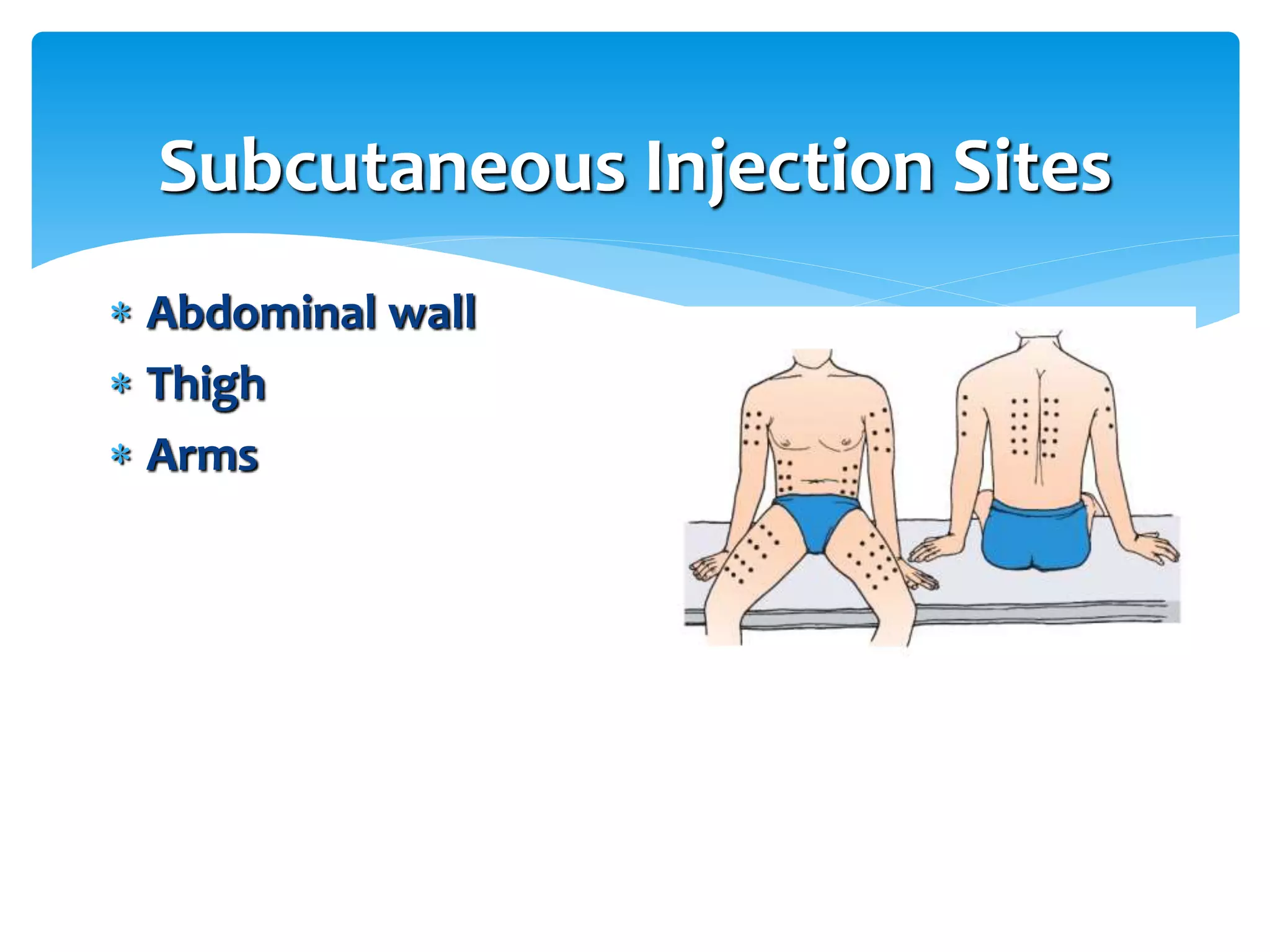
Subcutaneous Injection Sites
 Abdominal wall
 Thigh
 Arms
Intramuscular Route
 Solutions, emulsions, suspensions and powders
 0.5 to 2 ml and upto 4 ml.
 Absorption depending on blood flow
 Slower onset & slower absorption
 Longer duration of action
 Drugs
 Glucagons
 Adrenaline
Intramuscular Injection Sites
 Gluteal muscles
 Deltoid muscles
 Triceps and thigh
muscles
Intravenous Route
 Drugs in aqueous solutions, Hydro alcoholic solutions,
Emulsions and Liposomes.
 1 to 1000 ml
 Rapid immediate onset
 Administer slowly to avoid irritation.
 Drugs with shorter half life- IV Infusion
 Drugs that are too irritating in other routes- Nitrogen
mustards.
Intravenous Injection Sites
 Large proximal veins
In the side fore arm
• Parentrals are classified into two types. They are
1. Small Volume Parenterals (upto 100ml)
Single / multiple doses
Primary uses of SVP
• Therapeutic injections
• Opthalmic products
• Diagnostic agents
• Allergenic extracts
14
2. Large Volume Parenterals (100-1000ml)
Clinical Utilization of LVP
• Basic Nutrition
• Restoration of Electrolyte balance
• Fluid replacement
• Blood and blood products
• Drug carriers
15
ADVANTAGES
• Quick onset of action and complete bioavailability
• Suitable for the drugs which are not administered by oral route
• Useful for unconscious or vomiting patients.
• Useful for patients who cannot take drugs orally
• Useful for emergency situations
• Duration of action can be prolonged by modifying formulation.
• Can be done in hospitals, ambulatory infusion centers, and home
health care
16
DISADVANTAGES
• Pain on injection.
• Difficult to reverse an administered drug’s effects.
• Sensitivity or allergic reaction at the site of injection.
• Requires strict control of sterility & non pyrogenicity than other
formulation.
• Only trained person is required
• Require specialized equipment, devices, and techniques to prepare
and administer drugs.
• More expensive and costly to produce.
17
FORMULATION
18
1. Vehicles
2. Preservatives
3. Buffers
4. Tonicity adjusting agents
5. Surfactants
6. Chelating agents
19
Aqueous vehicle :
Water For Injection(WFI) USP :
• Highly purified water used as a vehicle for injectable preparations which wil
be subsequently sterilized.
• USP requirement include not more than 10 parts per million of total solids.
• pH of 5.0 to 7.0
• WFI may prepared by either distillation or reverse osmosis.
• Stored for less than 24hr at RT or for longer times at specific temperatures.
• It may not contain any added substances.
• Stored in chemically resistant tank.
Bacteriostatic Water for Injection (BWFI) :
• This type of water used for making parenteral solutions prepared under
aseptic conditions and not terminally sterilized.
• Need to meet USP sterility test.
• It can contain an added bacteriostatic agent when in containers of 30ml
or less
20
Sterile Water for Injection USP
• SWFI containing one or more suitable bacteriostatic agents.
• Multiple-dose containers not exceeding 30 ml.
• They are permitted to contain higher levels of than WFI because of the
possible leaching of glass container.
• Wash wounds, surgical incisions, or body tissues.
21
Water-miscible vehicles :
 primarily to effect solubility of drugs and/or reduce hydrolysis
Non-aqueous vehicles :
Fixed oils (vegetable origin, liquid, and rancid resistance, unsaturated,
free fatty acid content)
– Peanut oil
– Corn oil
– Cotton seed oil (depo-testosterone)
– Sesame oil
– Soybean oil (source of fat in intralipid)
– Ethyl oleate
– Isopropyl myristate
22
OTHER ADDITIVES
Antibacterial Agents
• Limited concentration of agents
- Phenylmercuric nitrate and Thiomersol 0.01%
• Required to prevent microorganism growth
- Benzethonium chloride and benzalkonium chloride 0.01%
- Phenol or cresol 0.5%
- Chlorobutanol 0.5%
Buffers
• Added to maintain pH
• Results in stability
• Effective range, concentration, chemical effect
– Citrate and Acetate buffer
– Sodium benzoate and benzoic acid
– Sodium titrate and tartaric acid
– Phosphate buffer
23
Tonicity Agents Chelating agents
 Reduce pain of injection – ethylenediamine tetraacetic acid
 Can include buffers
- Sodium chloride
- Potassium chloride Inert Gases
- Dextrose N2 (gentamycin sulfate injection)
- mannitol
- sorbitol CO2 (sodium bicarbonate
injection)
Surfactants
polyoxyethylene sorbitan monooleate
sorbitan monooleate
24
MANUFACTURING STEPS
 1.clening containers, closures & equipment
 2.collection of materials
 3.preparation of parenteral products
 4.filtration
 5.filling the preparation in final containers
 6.sealing the containers
 7.sterilization
 8.evalution
 9.packing
FILLING
1. Filling of liquids
A. Small volume parentrals
 Syringe based system
 Retraction device
B. Large volume parentrals
 By gravity
 By pressure
 By vaccum
26
2. Filling of solids
 Scoop method
 Machine (Auger) method
Problems
 Stratification
 Electrostatic charges
 Air pockets
 Clumping
27
28
Types of Filling Equipment
vial, ampoules, plastic
containers, bottles
syringe cartridges,
plastic mini bags
,,
vials, bottles, plastic
mini bags.
,,
Liquid products such as
solutions, suspensions
emulsions and solutions
,,
Powders
,,
Piston type (Cozzoli)
Rotary chemical pump
Time or pressure type
Auger
Vacuum Pressure
displacement
types of packageTypes of product filledMechanism of filling
PACKAGING
 Glass containers :
29
Type Description Type of
Test
General Use
I
II
III
NP
Highly resistant
Borosilicate
Treated Soda
Lime glass
Soda lime glass
General
purpose Soda
lime
Powdered Glass
Water Attack
Powdered Glass
Powdered Glass
Buffered and unbuffered
aqueous solutions All other
uses
Buffered aqueous solutions
pH<7.0, Dry powders,
Oleaginous solutions
Dry powders, Oleaginous
solutions
Not for Parenterals. For
tablets, oral solutions and
suspensions, ointments and
external liquids
Plastic containers
: Closures
:
30
Thermoplastic Thermosetting
Polyethylene
(Polyethene)High
Density
Polyethene Polyvinyl
chloride (PVC)
Poly methyl
methacrylate
Polystyrene
Polypropylene
Polyamides
Polycarbonates
Phenol Formaldehyde
Urea Formaldehyde
Melamine Formaldehyde
Pharmaceutical
rubbers
Butyl Rubbers
Natural Rubbers
Neoprene Rubbers
Polyisoprene
rubbers
Silicone Rubbers
PREFILLED SYRINGES :
• Administration is more
convenient for healthcare
professionals and end users.
• Reduction of medication
errors, better dose accuracy.
• Better use of controlled drugs
such as narcotics.
• easy storage and disposal.
31
SEALING
Sealing Ampoules
 Ampoules are unique in that the primary and secondary seal are the
same.
 Ampoules are sealed by melting a portion of glass in a flame.
 Pull seal – Slow, Reliable, powder or other types with wide opening
 Roll or Tip seal
32
Sealing of Bottles, Cartridges and Vials
 Primary seal consisting of a tight rubber or plastic closure and
secondary seal that holds the primary seal in place.
 Secondary seals are usually aluminum caps that are crimped on to a
thread less container.
33
STERILIZATION
 Dry heat sterilization
 Steam sterilization
 Sterilization by filtration
 Gas sterilization
 Sterilization by ionizing radiation
34
QUALITY CONTROL
 Sterility testing
 Pyrogen test
 Clarity test
 Leakage test
35
Flow of Materials Through the
Production Department
Product
storage
PackagingFilling
Sealing
Sterilization
Sterilization
Cleaning
Cleaning
Compounding Filtration
of Product Solution
Ingredients
Vehicles
Solutes
Processing
Equipment
Container
Components
36
1. STERILITY TESTING
A . Membrane filtration
37
38
B. Direct inoculation of culture
media
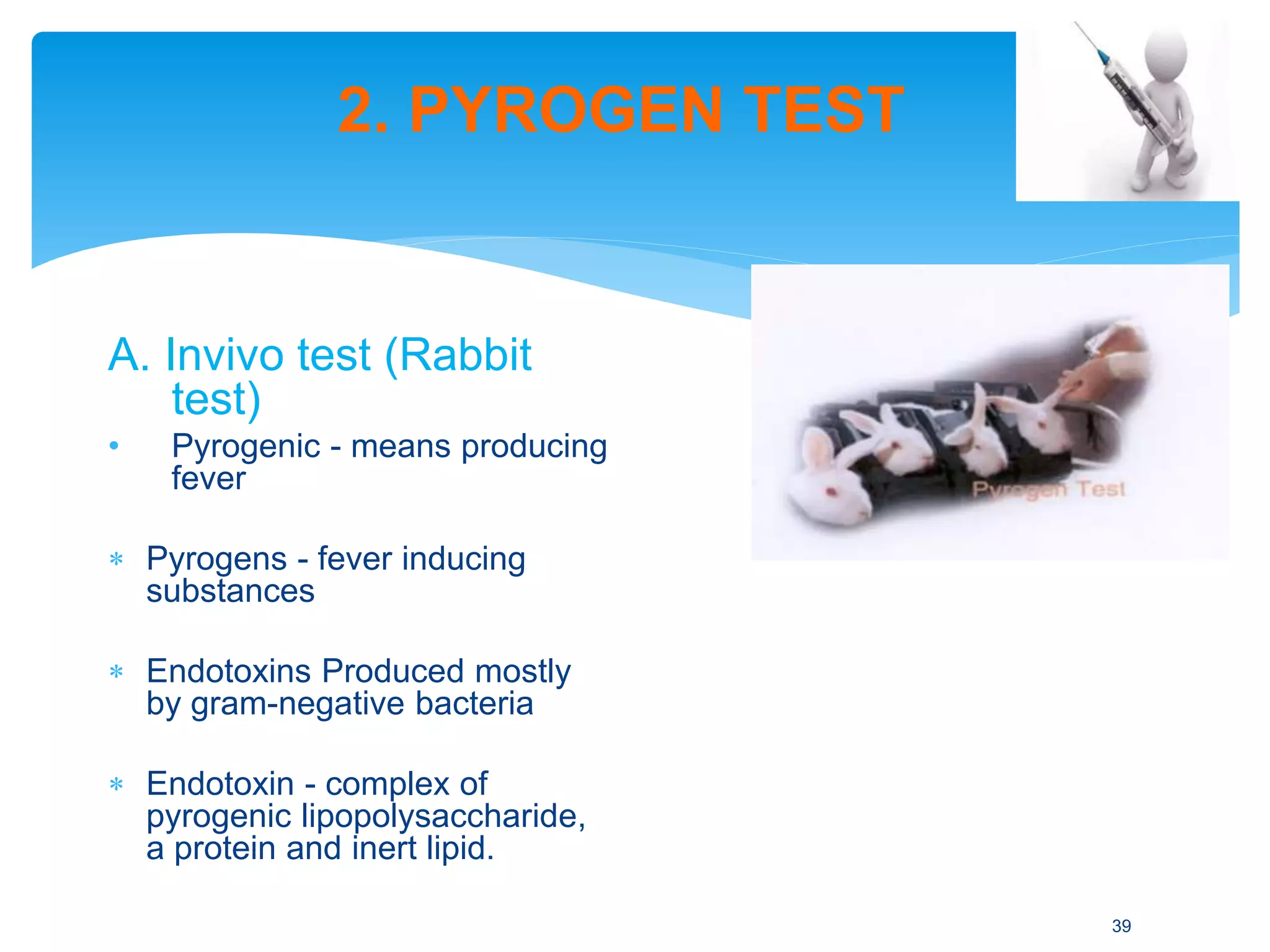
A. Invivo test (Rabbit
test)
• Pyrogenic - means producing
fever
 Pyrogens - fever inducing
substances
 Endotoxins Produced mostly
by gram-negative bacteria
 Endotoxin - complex of
pyrogenic lipopolysaccharide,
a protein and inert lipid.
39
2. PYROGEN TEST
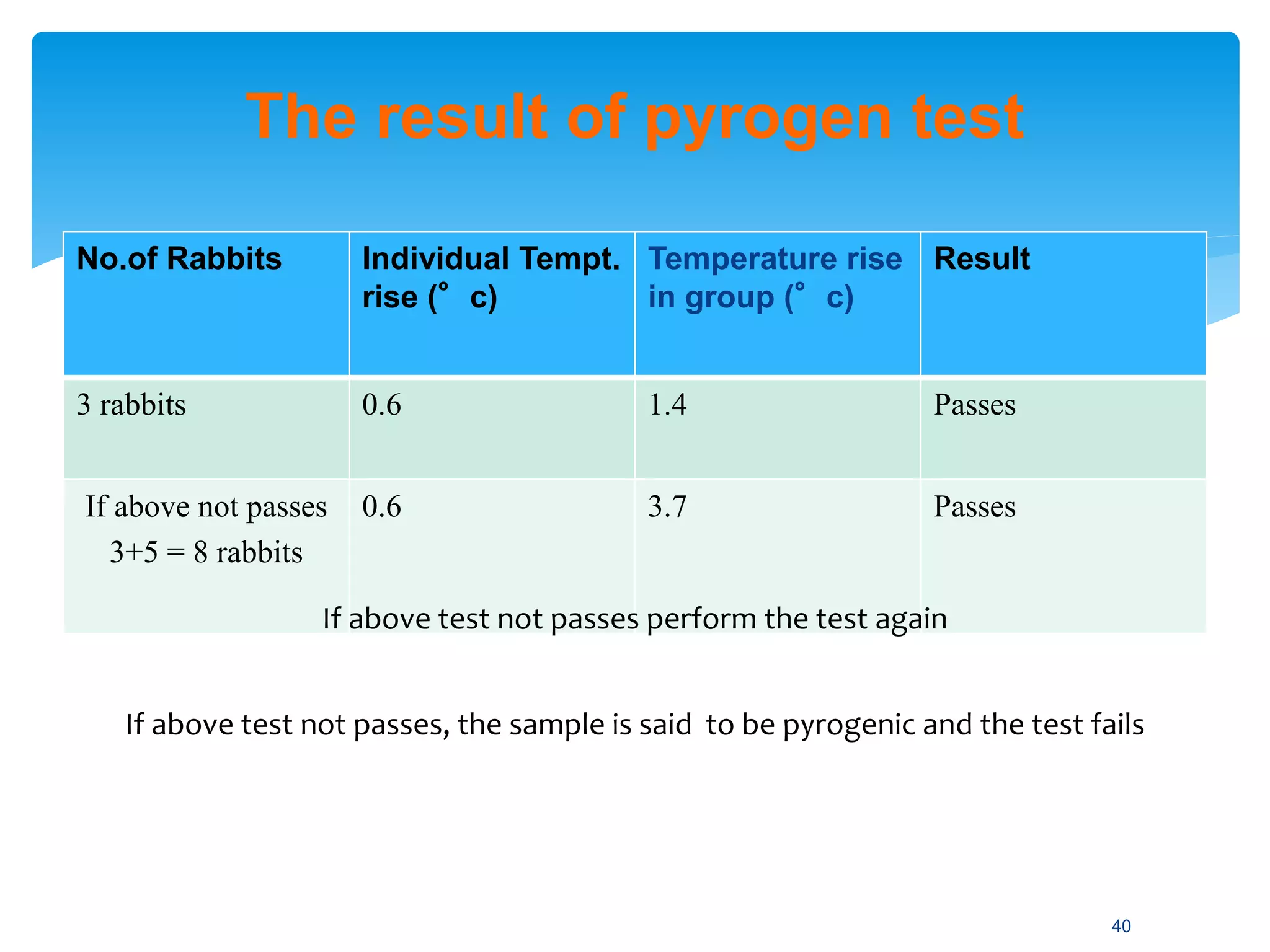
The result of pyrogen test
No.of Rabbits Individual Tempt.
rise (°c)
Temperature rise
in group (°c)
Result
3 rabbits 0.6 1.4 Passes
If above not passes
3+5 = 8 rabbits
0.6 3.7 Passes
40
If above test not passes perform the test again
If above test not passes, the sample is said to be pyrogenic and the test fails
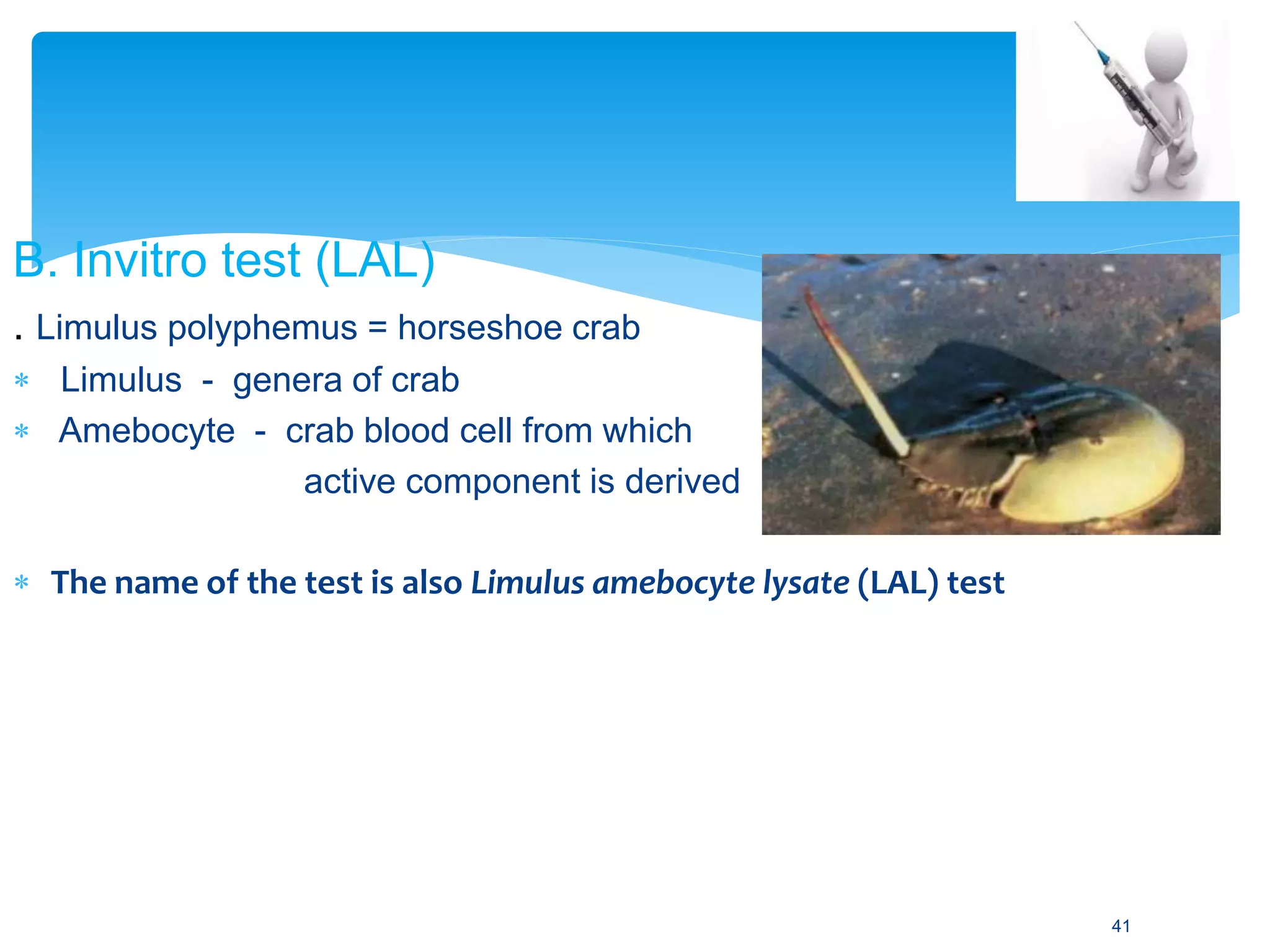
B. Invitro test (LAL)
. Limulus polyphemus = horseshoe crab
 Limulus - genera of crab
 Amebocyte - crab blood cell from which
active component is derived
 The name of the test is also Limulus amebocyte lysate (LAL) test
41
Mechanism of LAL
• The test is based on the primitive blood-
clotting mechanism of the horse
shoecrab
enzymes located with the crab's amebocyte
blood cells
+
endotoxins
(pyrogens)
↓ incubated at 37°c
initiation of an enzymatic coagulation
↓
proteinaceous gel (with in 60 mins)
42
 Lysate - component is obtained by separating amebocytes from the plasma and then
lysing them.
 The hearts of mature crabs are punctured and bled to collect the circulating
amebocyte blood cells.
 Since amebocytes act as activators of the coagulation mechanism in the crab, an
antiaggregating agent must be added to inhibit aggregation.
 N-Ethylmaleimade is the most commonly
used anti- aggregant.
 LAL test is the combinationof 0.1 ml test sample
with 0.1 ml LAL reagent.
 After 1 hour incubation at 37°C, the mixture is
analyzed for the presence of a gel clot.
43
Commercially derived LAL
reagents
 Unwanted mobile insoluble matter other than gas bubbles present in
the given product.
 It may be dangerous when the particle size is larger than R.B.C. & may
block the blood vessel.
 It can be done by the following methods.
A. Visual method
B. Light scattering & Light
absorption
C. Light blockage method
D. Coulter current method
44
3. CLARITY TEST
A. Dye test (Ampoules)
 Immersing the ampoules in a dye solution
 1% metylene blue solution
 The vacuum on the tank is then released as rapidly as possible to put
maximum stress on weak seals.
 Defective ampoules will contain blue solution.
B. Spark tester probe (Vials & Bottles)
• Water hammer sound
• When the space is evacuated then it releases blue spark
45
4. Leakage Test
CONCLUSION
 A wide variety of devices and new
methods of drug delivery employed.
Each has its advantage and
disadvantages, which have to be
carefully considered by the therapist.
 Parenteral dosage forms differ from
all other drug dosage forms because
they are injected directly into body
tissues through primary protective
systems of human body the skin and
mucous membranes.
 They must be free of contaminating
microorganism, harmful substances,
free of pyrogenic contamination, free
of particulate matter.
 In coming future we can expect
much more advance technology in
utilizing parenteral products for
safety desirable effects in human
being.
46
• Theory and practice of Industrial pharmacy. Lieberman, Herbert A.
Vol.1.Lachman, Third edition
 Pharmaceutical Dosage Forms. Avis, Kenneth E. Vol. 2: Parenteral
Medications
 Pharmaceutical Dosage Forms. Avis, Kenneth E Vol. 3 : Parenteral
Medications
 Pharmaceutical packaging technology. D A Deam , E R Evans, I H Hall
 Modern Pharmaceutics. Gilbert S. Banker, Christopher T. Rhodes. Fourth
Edition.
 www.pharmaceuticalonline.com
47
REFERENCES
48

Parentrals

  • 1.
    PARENTERALS 1HINDU COLLEGE OFPHARMACY NARESH GORANTLA M.Pharm., (Ph.D) Assoc. Professor, Dept of Pharmaceutics, Balaji college of Pharmacy, Ananthapuramu
  • 2.
    CONTENTS • Introduction • Routesof administration • Advantages • Disadvantages • Formulation • Manufacture • Filling • Packaging • Sealing • Sterilization • Quality control 2
  • 3.
    INTRODUCTION DEFINITION “ Introduced otherthan by way of the intestine” According to IP “Parenterals are injectable preparations, sterile preparations intended for administration by injection, infusion or implantation into the body. 3
  • 4.
    A BRIEF ABOUTPARENTERALS : • para: outside enteron: intestine • Any drug or fluid whose delivery does not utilize the alimentary canal for entry into body tissues. • Parenteral products are injected through the skin or mucous membranes into the internal body compartments. • These are the preparations which are given other than oral routes. 4
  • 5.
    Requirements of Parenterals Sterility  Non pyrogenicity  Clarity  Isotonicity  Stability 5
  • 6.
    ROUTES OF ADMINISTRATION Threeprimary routes of parenteral administration • Subcutaneous • Intramuscular • Intravenous 6 Other routes : • Intra arterial • Intra thecal • Intra articular • Intra cardial • Intra dermal (Intracutaneous) • Intra pleural • Intra spinal • Intra cesternal
  • 7.
  • 8.
    Subcutaneous Route  NMT2 ml  Aspiration  Absorption depending on blood flow  Constant & slow absorption  Prolonged effect Drugs  Insulin  Local Anaesthetics  Vaccines
  • 9.
    Subcutaneous Injection Sites Abdominal wall  Thigh  Arms
  • 10.
    Intramuscular Route  Solutions,emulsions, suspensions and powders  0.5 to 2 ml and upto 4 ml.  Absorption depending on blood flow  Slower onset & slower absorption  Longer duration of action  Drugs  Glucagons  Adrenaline
  • 11.
    Intramuscular Injection Sites Gluteal muscles  Deltoid muscles  Triceps and thigh muscles
  • 12.
    Intravenous Route  Drugsin aqueous solutions, Hydro alcoholic solutions, Emulsions and Liposomes.  1 to 1000 ml  Rapid immediate onset  Administer slowly to avoid irritation.  Drugs with shorter half life- IV Infusion  Drugs that are too irritating in other routes- Nitrogen mustards.
  • 13.
    Intravenous Injection Sites Large proximal veins In the side fore arm
  • 14.
    • Parentrals areclassified into two types. They are 1. Small Volume Parenterals (upto 100ml) Single / multiple doses Primary uses of SVP • Therapeutic injections • Opthalmic products • Diagnostic agents • Allergenic extracts 14
  • 15.
    2. Large VolumeParenterals (100-1000ml) Clinical Utilization of LVP • Basic Nutrition • Restoration of Electrolyte balance • Fluid replacement • Blood and blood products • Drug carriers 15
  • 16.
    ADVANTAGES • Quick onsetof action and complete bioavailability • Suitable for the drugs which are not administered by oral route • Useful for unconscious or vomiting patients. • Useful for patients who cannot take drugs orally • Useful for emergency situations • Duration of action can be prolonged by modifying formulation. • Can be done in hospitals, ambulatory infusion centers, and home health care 16
  • 17.
    DISADVANTAGES • Pain oninjection. • Difficult to reverse an administered drug’s effects. • Sensitivity or allergic reaction at the site of injection. • Requires strict control of sterility & non pyrogenicity than other formulation. • Only trained person is required • Require specialized equipment, devices, and techniques to prepare and administer drugs. • More expensive and costly to produce. 17
  • 18.
    FORMULATION 18 1. Vehicles 2. Preservatives 3.Buffers 4. Tonicity adjusting agents 5. Surfactants 6. Chelating agents
  • 19.
    19 Aqueous vehicle : WaterFor Injection(WFI) USP : • Highly purified water used as a vehicle for injectable preparations which wil be subsequently sterilized. • USP requirement include not more than 10 parts per million of total solids. • pH of 5.0 to 7.0 • WFI may prepared by either distillation or reverse osmosis. • Stored for less than 24hr at RT or for longer times at specific temperatures. • It may not contain any added substances. • Stored in chemically resistant tank.
  • 20.
    Bacteriostatic Water forInjection (BWFI) : • This type of water used for making parenteral solutions prepared under aseptic conditions and not terminally sterilized. • Need to meet USP sterility test. • It can contain an added bacteriostatic agent when in containers of 30ml or less 20
  • 21.
    Sterile Water forInjection USP • SWFI containing one or more suitable bacteriostatic agents. • Multiple-dose containers not exceeding 30 ml. • They are permitted to contain higher levels of than WFI because of the possible leaching of glass container. • Wash wounds, surgical incisions, or body tissues. 21
  • 22.
    Water-miscible vehicles : primarily to effect solubility of drugs and/or reduce hydrolysis Non-aqueous vehicles : Fixed oils (vegetable origin, liquid, and rancid resistance, unsaturated, free fatty acid content) – Peanut oil – Corn oil – Cotton seed oil (depo-testosterone) – Sesame oil – Soybean oil (source of fat in intralipid) – Ethyl oleate – Isopropyl myristate 22
  • 23.
    OTHER ADDITIVES Antibacterial Agents •Limited concentration of agents - Phenylmercuric nitrate and Thiomersol 0.01% • Required to prevent microorganism growth - Benzethonium chloride and benzalkonium chloride 0.01% - Phenol or cresol 0.5% - Chlorobutanol 0.5% Buffers • Added to maintain pH • Results in stability • Effective range, concentration, chemical effect – Citrate and Acetate buffer – Sodium benzoate and benzoic acid – Sodium titrate and tartaric acid – Phosphate buffer 23
  • 24.
    Tonicity Agents Chelatingagents  Reduce pain of injection – ethylenediamine tetraacetic acid  Can include buffers - Sodium chloride - Potassium chloride Inert Gases - Dextrose N2 (gentamycin sulfate injection) - mannitol - sorbitol CO2 (sodium bicarbonate injection) Surfactants polyoxyethylene sorbitan monooleate sorbitan monooleate 24
  • 25.
    MANUFACTURING STEPS  1.cleningcontainers, closures & equipment  2.collection of materials  3.preparation of parenteral products  4.filtration  5.filling the preparation in final containers  6.sealing the containers  7.sterilization  8.evalution  9.packing
  • 26.
    FILLING 1. Filling ofliquids A. Small volume parentrals  Syringe based system  Retraction device B. Large volume parentrals  By gravity  By pressure  By vaccum 26
  • 27.
    2. Filling ofsolids  Scoop method  Machine (Auger) method Problems  Stratification  Electrostatic charges  Air pockets  Clumping 27
  • 28.
    28 Types of FillingEquipment vial, ampoules, plastic containers, bottles syringe cartridges, plastic mini bags ,, vials, bottles, plastic mini bags. ,, Liquid products such as solutions, suspensions emulsions and solutions ,, Powders ,, Piston type (Cozzoli) Rotary chemical pump Time or pressure type Auger Vacuum Pressure displacement types of packageTypes of product filledMechanism of filling
  • 29.
    PACKAGING  Glass containers: 29 Type Description Type of Test General Use I II III NP Highly resistant Borosilicate Treated Soda Lime glass Soda lime glass General purpose Soda lime Powdered Glass Water Attack Powdered Glass Powdered Glass Buffered and unbuffered aqueous solutions All other uses Buffered aqueous solutions pH<7.0, Dry powders, Oleaginous solutions Dry powders, Oleaginous solutions Not for Parenterals. For tablets, oral solutions and suspensions, ointments and external liquids
  • 30.
    Plastic containers : Closures : 30 ThermoplasticThermosetting Polyethylene (Polyethene)High Density Polyethene Polyvinyl chloride (PVC) Poly methyl methacrylate Polystyrene Polypropylene Polyamides Polycarbonates Phenol Formaldehyde Urea Formaldehyde Melamine Formaldehyde Pharmaceutical rubbers Butyl Rubbers Natural Rubbers Neoprene Rubbers Polyisoprene rubbers Silicone Rubbers
  • 31.
    PREFILLED SYRINGES : •Administration is more convenient for healthcare professionals and end users. • Reduction of medication errors, better dose accuracy. • Better use of controlled drugs such as narcotics. • easy storage and disposal. 31
  • 32.
    SEALING Sealing Ampoules  Ampoulesare unique in that the primary and secondary seal are the same.  Ampoules are sealed by melting a portion of glass in a flame.  Pull seal – Slow, Reliable, powder or other types with wide opening  Roll or Tip seal 32
  • 33.
    Sealing of Bottles,Cartridges and Vials  Primary seal consisting of a tight rubber or plastic closure and secondary seal that holds the primary seal in place.  Secondary seals are usually aluminum caps that are crimped on to a thread less container. 33
  • 34.
    STERILIZATION  Dry heatsterilization  Steam sterilization  Sterilization by filtration  Gas sterilization  Sterilization by ionizing radiation 34
  • 35.
    QUALITY CONTROL  Sterilitytesting  Pyrogen test  Clarity test  Leakage test 35
  • 36.
    Flow of MaterialsThrough the Production Department Product storage PackagingFilling Sealing Sterilization Sterilization Cleaning Cleaning Compounding Filtration of Product Solution Ingredients Vehicles Solutes Processing Equipment Container Components 36
  • 37.
    1. STERILITY TESTING A. Membrane filtration 37
  • 38.
    38 B. Direct inoculationof culture media
  • 39.
    A. Invivo test(Rabbit test) • Pyrogenic - means producing fever  Pyrogens - fever inducing substances  Endotoxins Produced mostly by gram-negative bacteria  Endotoxin - complex of pyrogenic lipopolysaccharide, a protein and inert lipid. 39 2. PYROGEN TEST
  • 40.
    The result ofpyrogen test No.of Rabbits Individual Tempt. rise (°c) Temperature rise in group (°c) Result 3 rabbits 0.6 1.4 Passes If above not passes 3+5 = 8 rabbits 0.6 3.7 Passes 40 If above test not passes perform the test again If above test not passes, the sample is said to be pyrogenic and the test fails
  • 41.
    B. Invitro test(LAL) . Limulus polyphemus = horseshoe crab  Limulus - genera of crab  Amebocyte - crab blood cell from which active component is derived  The name of the test is also Limulus amebocyte lysate (LAL) test 41
  • 42.
    Mechanism of LAL •The test is based on the primitive blood- clotting mechanism of the horse shoecrab enzymes located with the crab's amebocyte blood cells + endotoxins (pyrogens) ↓ incubated at 37°c initiation of an enzymatic coagulation ↓ proteinaceous gel (with in 60 mins) 42
  • 43.
     Lysate -component is obtained by separating amebocytes from the plasma and then lysing them.  The hearts of mature crabs are punctured and bled to collect the circulating amebocyte blood cells.  Since amebocytes act as activators of the coagulation mechanism in the crab, an antiaggregating agent must be added to inhibit aggregation.  N-Ethylmaleimade is the most commonly used anti- aggregant.  LAL test is the combinationof 0.1 ml test sample with 0.1 ml LAL reagent.  After 1 hour incubation at 37°C, the mixture is analyzed for the presence of a gel clot. 43 Commercially derived LAL reagents
  • 44.
     Unwanted mobileinsoluble matter other than gas bubbles present in the given product.  It may be dangerous when the particle size is larger than R.B.C. & may block the blood vessel.  It can be done by the following methods. A. Visual method B. Light scattering & Light absorption C. Light blockage method D. Coulter current method 44 3. CLARITY TEST
  • 45.
    A. Dye test(Ampoules)  Immersing the ampoules in a dye solution  1% metylene blue solution  The vacuum on the tank is then released as rapidly as possible to put maximum stress on weak seals.  Defective ampoules will contain blue solution. B. Spark tester probe (Vials & Bottles) • Water hammer sound • When the space is evacuated then it releases blue spark 45 4. Leakage Test
  • 46.
    CONCLUSION  A widevariety of devices and new methods of drug delivery employed. Each has its advantage and disadvantages, which have to be carefully considered by the therapist.  Parenteral dosage forms differ from all other drug dosage forms because they are injected directly into body tissues through primary protective systems of human body the skin and mucous membranes.  They must be free of contaminating microorganism, harmful substances, free of pyrogenic contamination, free of particulate matter.  In coming future we can expect much more advance technology in utilizing parenteral products for safety desirable effects in human being. 46
  • 47.
    • Theory andpractice of Industrial pharmacy. Lieberman, Herbert A. Vol.1.Lachman, Third edition  Pharmaceutical Dosage Forms. Avis, Kenneth E. Vol. 2: Parenteral Medications  Pharmaceutical Dosage Forms. Avis, Kenneth E Vol. 3 : Parenteral Medications  Pharmaceutical packaging technology. D A Deam , E R Evans, I H Hall  Modern Pharmaceutics. Gilbert S. Banker, Christopher T. Rhodes. Fourth Edition.  www.pharmaceuticalonline.com 47 REFERENCES
  • 48.