Microspheres and
Microcapsules
Prepared by.
Jay Bhavsar
M.Pharm (Pharmaceutics)
Sem-2
Roll No. MU006
Guided by.
Dinal Patel
(Assistant Professor)
Department of Pharmaceutics
Faculty of Pharmacy, DDU,
Nadiad
1
 Mono or
multinuclear
materials embedded
in spherical coating
matrix are called
microspheres.
 Microspheres are
small spherical
particles, with
diameters 1 μm to
1000 μm.
 Mono or
multinuclear
materials enclosed
by a coat or
membrane are
called as
microcapsules.
 which are
biodegradable in
nature and ideally
having a particle
size less than 200
Microspheres Microcapsules
2
Microspheres:
 The ability to incorporate reasonably high
concentrations of the drug.
 Stability of the preparation after synthesis with
a clinically acceptable shelf life.
 Controlled particle size and dispersability in
aqueous vehicles for injection.
 Release of active reagent with a good control
over a wide time scale.
 Biocompatibility with a controllable
biodegradability.
 Susceptibility to chemical modification.
3
1. Particle size reduction for enhancing solubility of the
poorly soluble drug.
2. Provide constant and prolonged therapeutic effect.
3. Provide constant drug concentration in blood there
by increasing patient compliance
4. Decrease dose and toxicity.
5. Protect the drug from enzymatic and photolytic
cleavage hence found to be best for drug delivery
of protein.
6. Better drug utilization will improve the bioavailability
and reduce the incidence or intensity of adverse
4
1. The costs of the materials and processing of the
controlled release preparation, are substantially higher
than those of standard formulations.
2. The destruction of polymer matrix and its effect on the
environment.
3. Reproducibility is less.
4. Process conditions like change in temperature, pH,
solvent addition, and evaporation/agitation may
influence the stability of core particles to be
encapsulated.
5. The environmental impact of the degradation products
of the polymer matrix produced in response to heat,
hydrolysis, oxidation, solar radiation or biological
5
Bioadhesive microspheres
Magnetic microspheres
Floating microspheres
Radioactive microspheres
Polymeric microspheres
• Biodegradable polymeric microspheres
• Synthetic polymeric microspheres
6
 Adhesion can be defined as sticking of drug to the
membrane by using the sticking property of the
water soluble polymers.
 Adhesion of drug delivery device to the mucosal
membrane such as buccal, ocular, rectal, nasal
etc. can be termed as bio adhesion.
 These kinds of microspheres exhibit a prolonged
residence time at the site of application and
causes intimate contact with the absorption site
and produces better therapeutic action.
7
 This kind of delivery system is very much important which
localizes the drug to the disease site.
 In this larger amount of freely circulating drug can be replaced
by smaller amount of magnetically targeted drug.
 Magnetic carriers receive magnetic responses to a magnetic field
from incorporated materials that are used for magnetic
microspheres are chitosan, dextran etc.
 The different types of A) Therapeutic magnetic microspheres
used to deliver chemotherapeutic agent to liver tumor. Drugs like
proteins and peptides can also be targeted through this system.
 B) Diagnostic microspheres, used for imaging liver metastases
and also can be used to distinguish bowel loops from other
abdominal structures by forming nano size particles
supramagnetic iron oxides.
8
 In floating types the bulk density is less than the
gastric fluid and so remains buoyant in stomach
without affecting gastric emptying rate.
 The drug is released slowly at the desired rate, and
the system is found to be floating on gastric content
and increases gastric residence.
 Moreover it also reduces chances of dose dumping. It
produces prolonged therapeutic effect and therefore
reduces dosing frequencies.
 Drug (ketoprofen) is given in the form of floating
microspheres.
9
 Radio embolization therapy microspheres sized 10-30
nm are of larger than the diameter of the capillaries
and gets trapped in first capillary bed when they come
across.
 They are injected in the arteries that leads them to
tumor of interest so all these conditions radioactive
microspheres deliver high radiation dose to the
targeted areas without damaging the normal
surrounding tissues.
 It differs from drug delivery system, as radio activity is
not released from microspheres but acts from within a
radioisotope typical distance and the different kinds of
radioactive microspheres are α emitters, β emitters, γ
emitters.
10
i) Biodegradable polymeric microspheres:
 Natural polymers such as starch are used with the concept
that they are biodegradable, biocompatible, and also bio
adhesive in nature.
 Biodegradable polymers prolongs the residence time when
contact with mucous membrane due to its high degree of
swelling property with aqueous medium , results gel
formation.
 The rate and extent of drug release is controlled by
concentration of polymer and the release pattern in a
sustained manner.
 The main drawback is, in clinical use drug loading
efficiency of biodegradable microspheres is complex and is
11
ii) Synthetic polymeric microspheres:
 Synthetic polymeric microspheres are widely
used in clinical application, moreover that also
used as bulking agent, fillers, embolic
particles, drug delivery vehicles etc. and
proved to be safe and biocompatible but the
main disadvantage of these kind of
microspheres, are tend to migrate away from
injection site and lead to potential risk,
embolism and further organ damage.
12
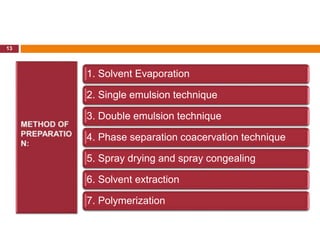
1. Solvent Evaporation
2. Single emulsion technique
3. Double emulsion technique
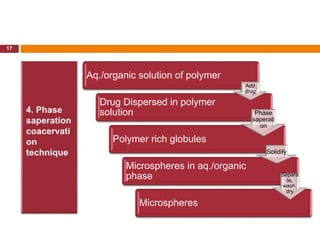
4. Phase separation coacervation technique
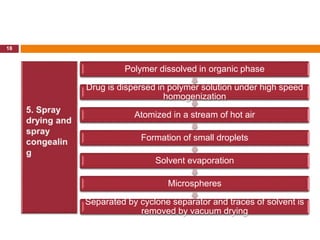
5. Spray drying and spray congealing
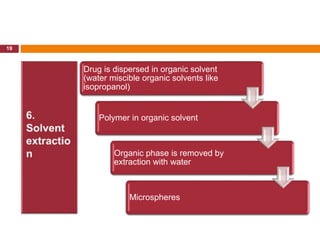
6. Solvent extraction
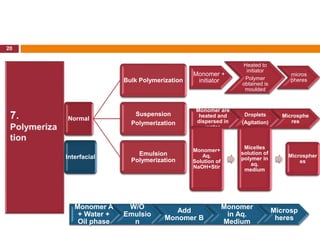
7. Polymerization
13
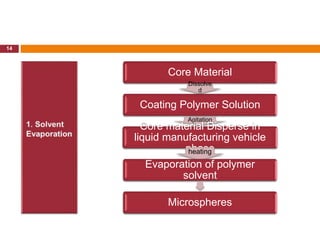
Core Material
Dissolve
d
Coating Polymer Solution
Agitation
Core material Disperse in
liquid manufacturing vehicle
phaseheating
Evaporation of polymer
solvent
Microspheres
14
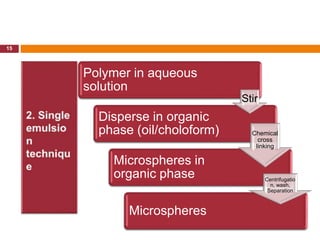
Polymer in aqueous
solution
Disperse in organic
phase (oil/choloform)
Microspheres in
organic phase
Microspheres
Stir
Chemical
cross
linking
Centrifugatio
n, wash,
Separation
15
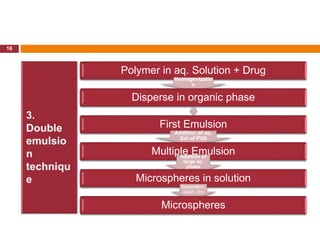
Polymer in aq. Solution + Drug
Homogenizatio
n
Disperse in organic phase
First Emulsion
Addition of aq.
Sol of PVA
Multiple EmulsionAddition of
large aq.
phase
Microspheres in solution
Separation,
wash, dry
Microspheres
16
Aq./organic solution of polymer
Drug Dispersed in polymer
solution
Polymer rich globules
Microspheres in aq./organic
phase
Microspheres
Add
drug
Phase
saperati
on
Solidify
Separa
te,
wash,
dry
17
Polymer dissolved in organic phase
Drug is dispersed in polymer solution under high speed
homogenization
Atomized in a stream of hot air
Formation of small droplets
Solvent evaporation
Microspheres
Separated by cyclone separator and traces of solvent is
removed by vacuum drying
18
Drug is dispersed in organic solvent
(water miscible organic solvents like
isopropanol)
Polymer in organic solvent
Organic phase is removed by
extraction with water
Microspheres
19
Normal
Bulk Polymerization
Suspension
Polymerization
Emulsion
Polymerization
Interfacial
Monomer are
heated and
dispersed in
water
Droplets
(Agitation)
Microsphe
res
Monomer+
Aq.
Solution of
NaOH+Stir
Micelles
solution of
polymer in
aq.
medium
Microspher
es
Monomer +
initiator
Heated to
initiator
Polymer
obtained is
moulded
micros
pheres
Monomer A
+ Water +
Oil phase
W/O
Emulsio
n
Add
Monomer B
Monomer
in Aq.
Medium
Microsp
heres
20
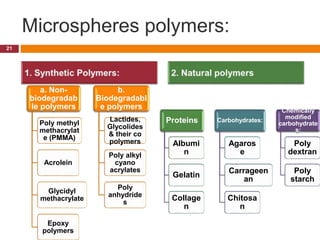
Microspheres polymers:
a. Non-
biodegradab
le polymers
Poly methyl
methacrylat
e (PMMA)
Acrolein
Glycidyl
methacrylate
Epoxy
polymers
b.
Biodegradabl
e polymers
Lactides,
Glycolides
& their co
polymers
Poly alkyl
cyano
acrylates
Poly
anhydride
s
Proteins
Albumi
n
Gelatin
Collage
n
Carbohydrates:
Agaros
e
Carrageen
an
Chitosa
n
Chemically
modified
carbohydrate
s:
Poly
dextran
Poly
starch
21
Microencapsulation:
 Microencapsulation is a process of
incorporating drugs into small size
multiparticulate units. This technique involve
coating of surfactants are sometimes added
to film coating particles ranging dimensionally
from several tenth of a micrometer to about
5000 micrometer.
Microencapsulation:
22
Fundamentals of
Microencapsulation.
 The core material can be
liquid or solid in nature. The
composition of the core
material can be varied as
liquid core which can be
include dispersed and/or
dissolved material and the
solid core can be diluents,
recipients and release rate
retardants or accelerators.
The shape of core should be
uniform and regular. In order
to obtain uniform coating on
regular microcapsules
spherical particles, polymer
type, shape and size core
 The selection of a specific
coating material is dependent
upon under to increase
segmental mobility, imparts
flexibility, reduce brittleness
and increase resistance of the
film coating to Failure
produced by mechanical
stress, substances such as
phthalate esters, fatty acid
esters and glycol derivatives.
23
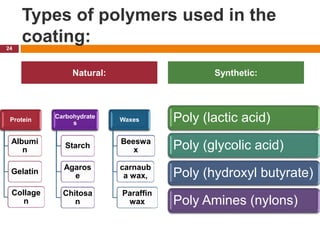
Types of polymers used in the
coating:
Protein
Albumi
n
Gelatin
Collage
n
Carbohydrate
s
Starch
Agaros
e
Chitosa
n
Waxes
Beeswa
x
carnaub
a wax,
Paraffin
wax
Natural: Synthetic:
Poly (lactic acid)
Poly (glycolic acid)
Poly (hydroxyl butyrate)
Poly Amines (nylons)
24
Microcapsules:
 Microcapsules are characteristically free
flowing powders consisting of proteins or
systemic polymers, which are biodegradable in
nature and ideally having a particle size less
than 200 μm.
 Microcapsules of biodegradable and non-
biodegradable polymers have been
investigated for sustained and controlled
fashion.
25
 Microcapsules are spherical, empty particles.
 Microcapsules are free flowing powders consisting
of proteins or synthetic polymers, which are
biodegradable in nature.
 They have a particle size less than 200 μm.
 Microcapsules also act as carriers for the
targeting of the anti-cancer drug to the tumor.
 Microcapsules incorporate reasonably high
concentration of drug.
 Stability of the microcapsules is high.
Characteristics:
26
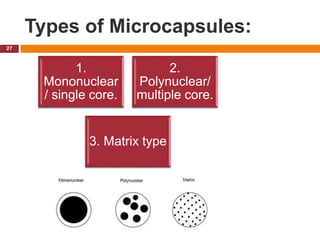
Types of Microcapsules:
1.
Mononuclear
/ single core.
2.
Polynuclear/
multiple core.
3. Matrix type
27
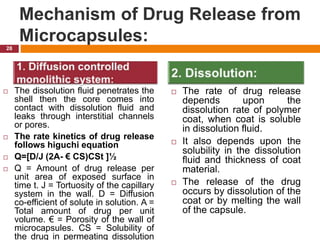
Mechanism of Drug Release from
Microcapsules:
 The dissolution fluid penetrates the
shell then the core comes into
contact with dissolution fluid and
leaks through interstitial channels
or pores.
 The rate kinetics of drug release
follows higuchi equation
 Q=[D/J (2A- € CS)CSt ]½
 Q = Amount of drug release per
unit area of exposed surface in
time t. J = Tortuosity of the capillary
system in the wall. D = Diffusion
co-efficient of solute in solution. A =
Total amount of drug per unit
volume. € = Porosity of the wall of
microcapsules. CS = Solubility of
the drug in permeating dissolution
 The rate of drug release
depends upon the
dissolution rate of polymer
coat, when coat is soluble
in dissolution fluid.
 It also depends upon the
solubility in the dissolution
fluid and thickness of coat
material.
 The release of the drug
occurs by dissolution of the
coat or by melting the wall
of the capsule.
28
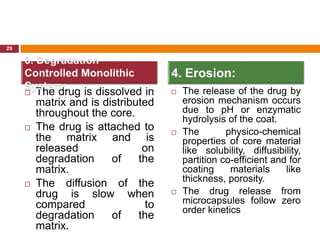
 The drug is dissolved in
matrix and is distributed
throughout the core.
 The drug is attached to
the matrix and is
released on
degradation of the
matrix.
 The diffusion of the
drug is slow when
compared to
degradation of the
matrix.
 The release of the drug by
erosion mechanism occurs
due to pH or enzymatic
hydrolysis of the coat.
 The physico-chemical
properties of core material
like solubility, diffusibility,
partition co-efficient and for
coating materials like
thickness, porosity.
 The drug release from
microcapsules follow zero
order kinetics
29
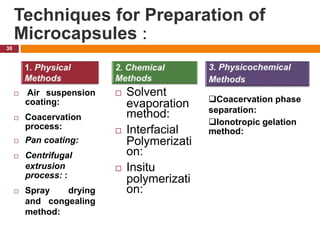
Techniques for Preparation of
Microcapsules :
 Air suspension
coating:
 Coacervation
process:
 Pan coating:
 Centrifugal
extrusion
process: :
 Spray drying
and congealing
method:
 Solvent
evaporation
method:
 Interfacial
Polymerizati
on:
 Insitu
polymerizati
on:
Coacervation phase
separation:
Ionotropic gelation
method:
30
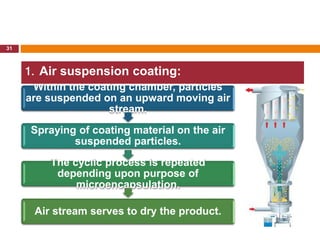
Within the coating chamber, particles
are suspended on an upward moving air
stream.
Spraying of coating material on the air
suspended particles.
The cyclic process is repeated
depending upon purpose of
microencapsulation.
Air stream serves to dry the product.
1. Air suspension coating:
31
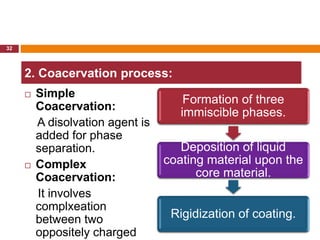
 Simple
Coacervation:
A disolvation agent is
added for phase
separation.
 Complex
Coacervation:
It involves
complxeation
between two
oppositely charged
2. Coacervation process:
Formation of three
immiscible phases.
Deposition of liquid
coating material upon the
core material.
Rigidization of coating.
32
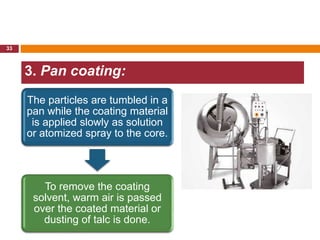
The particles are tumbled in a
pan while the coating material
is applied slowly as solution
or atomized spray to the core.
To remove the coating
solvent, warm air is passed
over the coated material or
dusting of talc is done.
3. Pan coating:
33
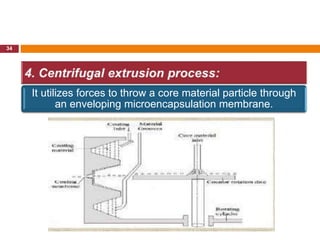
It utilizes forces to throw a core material particle through
an enveloping microencapsulation membrane.
34
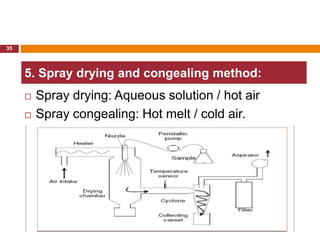
 Spray drying: Aqueous solution / hot air
 Spray congealing: Hot melt / cold air.
5. Spray drying and congealing method:
35
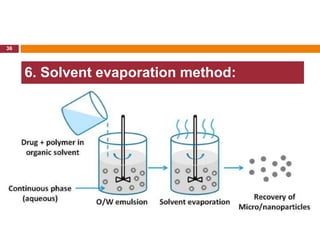
6. Solvent evaporation method:
36
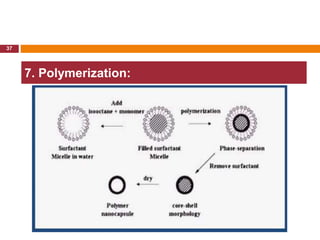
7. Polymerization:
37
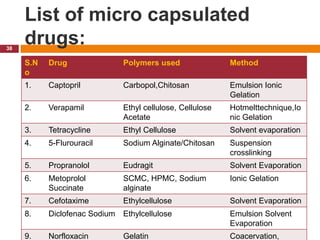
List of micro capsulated
drugs:38
S.N
o
Drug Polymers used Method
1. Captopril Carbopol,Chitosan Emulsion Ionic
Gelation
2. Verapamil Ethyl cellulose, Cellulose
Acetate
Hotmelttechnique,Io
nic Gelation
3. Tetracycline Ethyl Cellulose Solvent evaporation
4. 5-Flurouracil Sodium Alginate/Chitosan Suspension
crosslinking
5. Propranolol Eudragit Solvent Evaporation
6. Metoprolol
Succinate
SCMC, HPMC, Sodium
alginate
Ionic Gelation
7. Cefotaxime Ethylcellulose Solvent Evaporation
8. Diclofenac Sodium Ethylcellulose Emulsion Solvent
Evaporation
9. Norfloxacin Gelatin Coacervation,
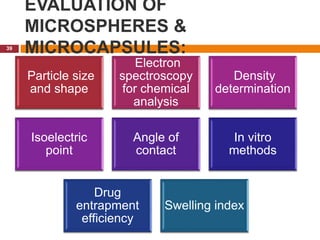
EVALUATION OF
MICROSPHERES &
MICROCAPSULES:
Particle size
and shape
Electron
spectroscopy
for chemical
analysis
Density
determination
Isoelectric
point
Angle of
contact
In vitro
methods
Drug
entrapment
efficiency
Swelling index
39
1. Particle size and shape : The most widely used procedures to visualize microparticles are
conventional light microscopy (LM) and scanning electron microscopy (SEM).
2. Electron spectroscopy for chemical analysis: The surface chemistry of the microspheres
can be determined using the electron spectroscopy for chemical analysis (ESCA).
3. Density determination: The density of the microspheres can be measured by using a multi
volume pycnometer.
4. Isoelectric point: The micro electrophoresis is used to measure the electrophoretic mobility of
microspheres from which the isoelectric point can be determined.
5. Angle of contact: The angle of contact is measured to determine the wetting property of a
micro particulate carrier.
6. In vitro methods: Release studies for different type of microspheres are carried out by using
different suitable dissolution media, mostly by rotating paddle apparatus (USP / BP).
7. Drug entrapment efficiency: Drug entrapment efficiency can be calculated using following
equation,
% Entrapment = Actual content/Theoretical content x 100.
8. Swelling index : The swelling index of the microsphere was calculated by using the formula,
Swelling index= (mass of swollen microspheres – mass of dry microspheres/mass of
dried microspheres) 100.
40
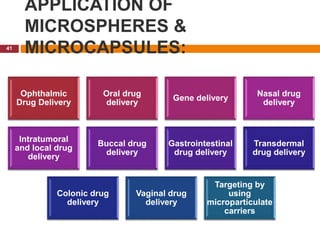
APPLICATION OF
MICROSPHERES &
MICROCAPSULES:
Ophthalmic
Drug Delivery
Oral drug
delivery
Gene delivery
Nasal drug
delivery
Intratumoral
and local drug
delivery
Buccal drug
delivery
Gastrointestinal
drug delivery
Transdermal
drug delivery
Colonic drug
delivery
Vaginal drug
delivery
Targeting by
using
microparticulate
carriers
41
REFERENCES:
 Kadam N. R. And Suvarna V, MICROSPHERES: A BRIEF
REVIEW, Review Article, 20/08/2015.
 Krishna Sailaja A. And Jyothika M., A REVIEW ON
MICROCAPSULES, Cibtech Journal Of Pharmaceutical
Sciences ISSN: 2319–3891, 2015 Vol.4 .
 Alagusundaram.M*, Madhu Sudana Chetty.C,
MICROSPHERES AS A NOVEL DRUG DELIVERY
SYSYTEM- A REVIEW, International Journal Of Chemtech
Research, CODEN( USA): IJCRGG ISSN : 0974-4290, Vol.1,
No.3 , Pp 526-534, July-sept 2009.
 Azagheswari, Binil Kuriokase, Sathireddy Padma And S.
Padma Priya, A Review On Microcapsules, Global Journal Of
Pharmacology 9 (1): 28-39, 2015, ISSN 1992-0075
 Miléna Lengyel 1, Nikolett Kállai-szabó 1, Vince Antal 1,
András József Laki 2,3 And István Antal 1,* Microparticles,
Microspheres, And Microcapsules For Advanced Drug
Delivery, Sci. Pharm., 9 August 2019.
42