Ashley Jacobi, Research Scientist
Integrated DNA Technologies
New RNA tools for optimized
CRISPR/Cas9 genome editing
October 7th
, 2015
1
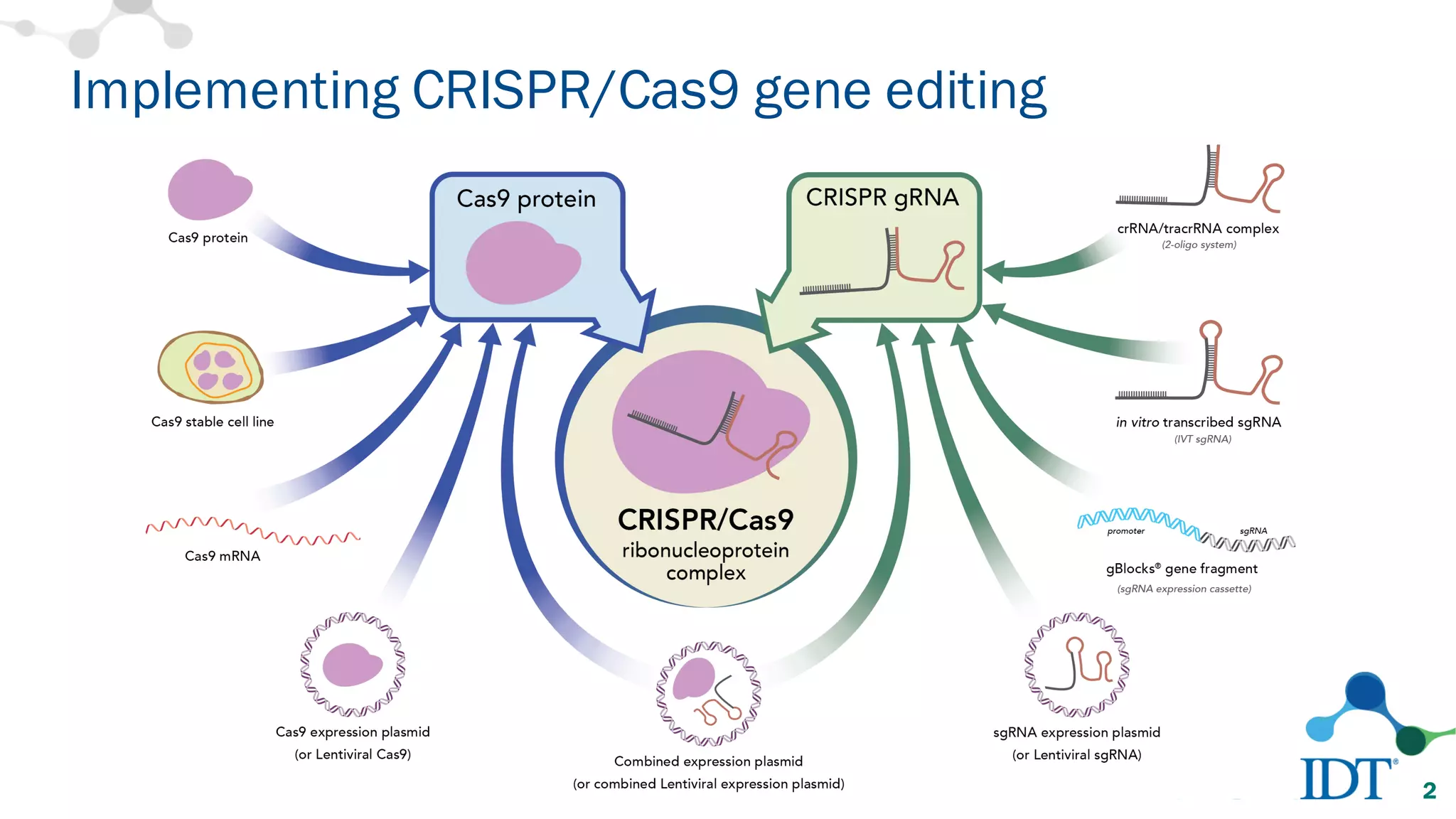
Implementing CRISPR/Cas9 gene editing
2
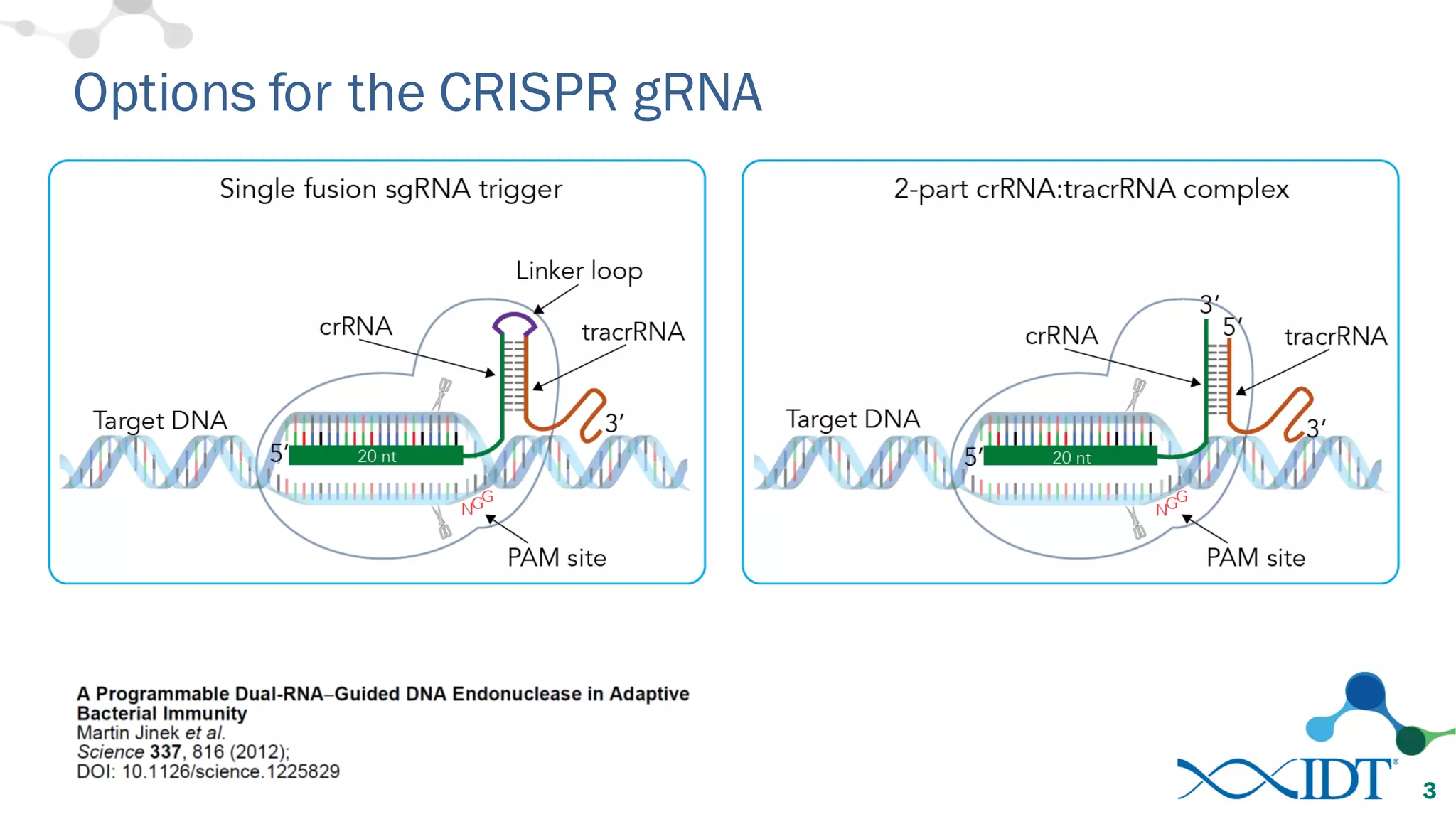
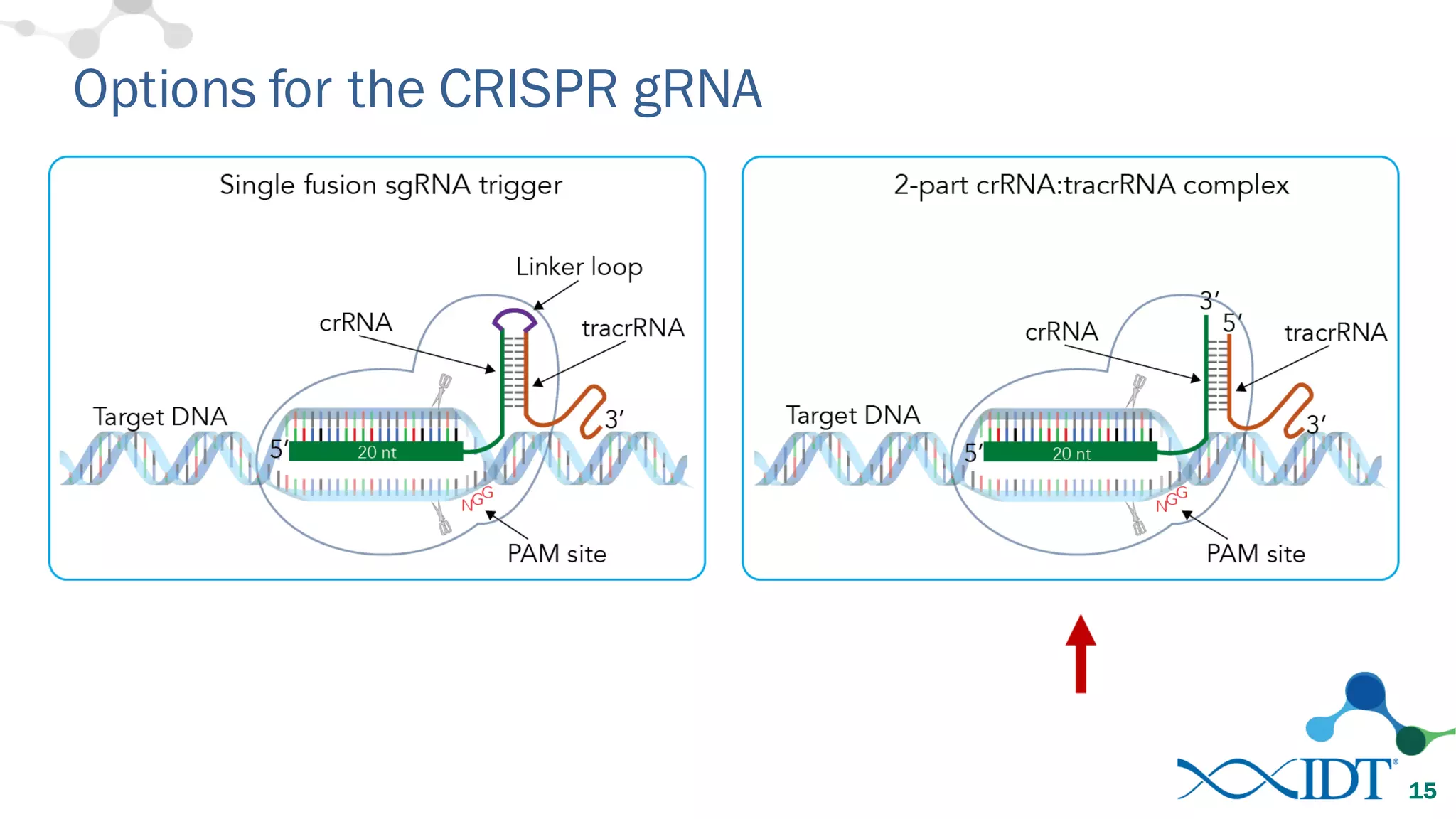
Options for the CRISPR gRNA
3
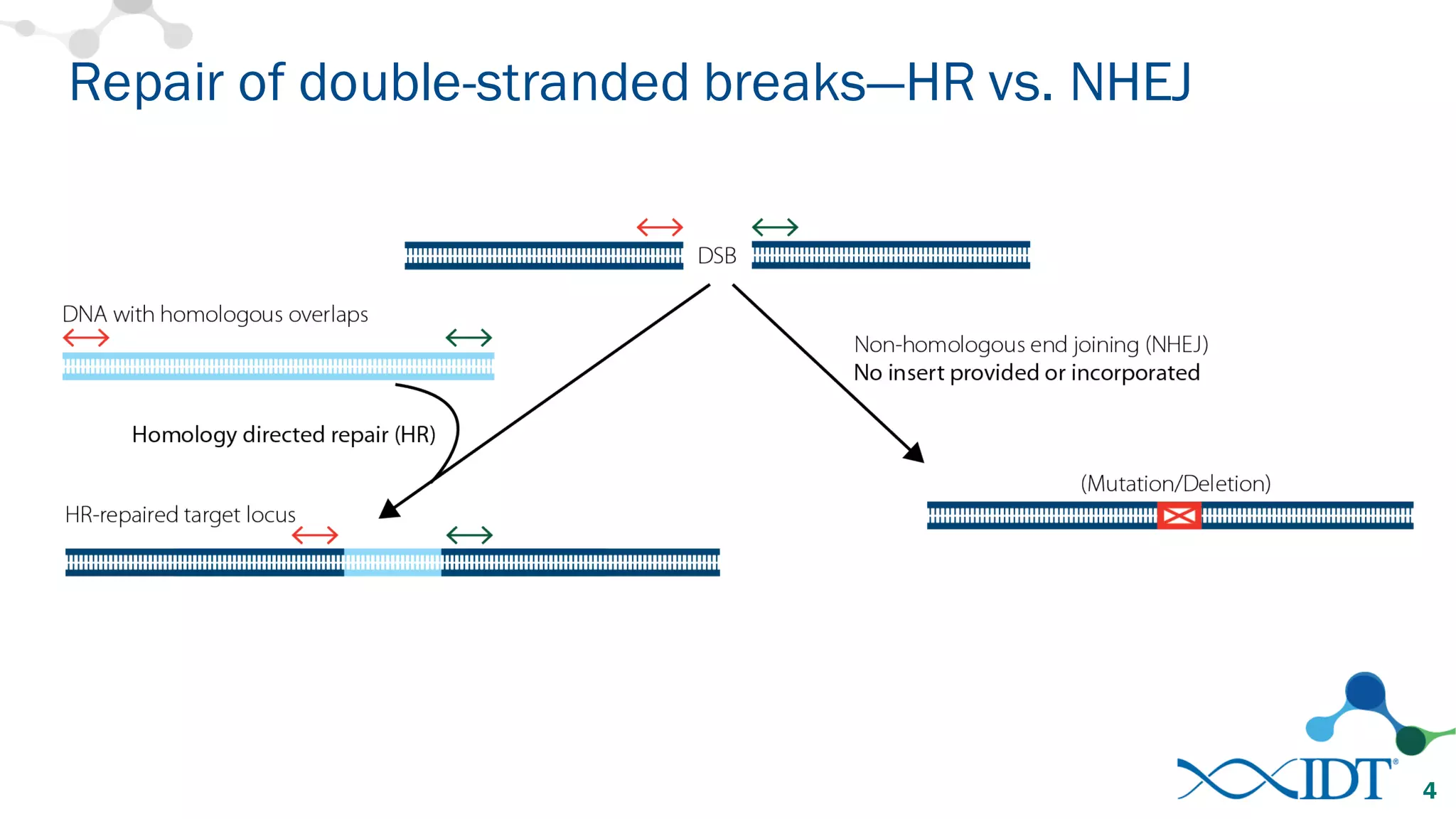
Repair of double-stranded breaks—HR vs. NHEJ
4
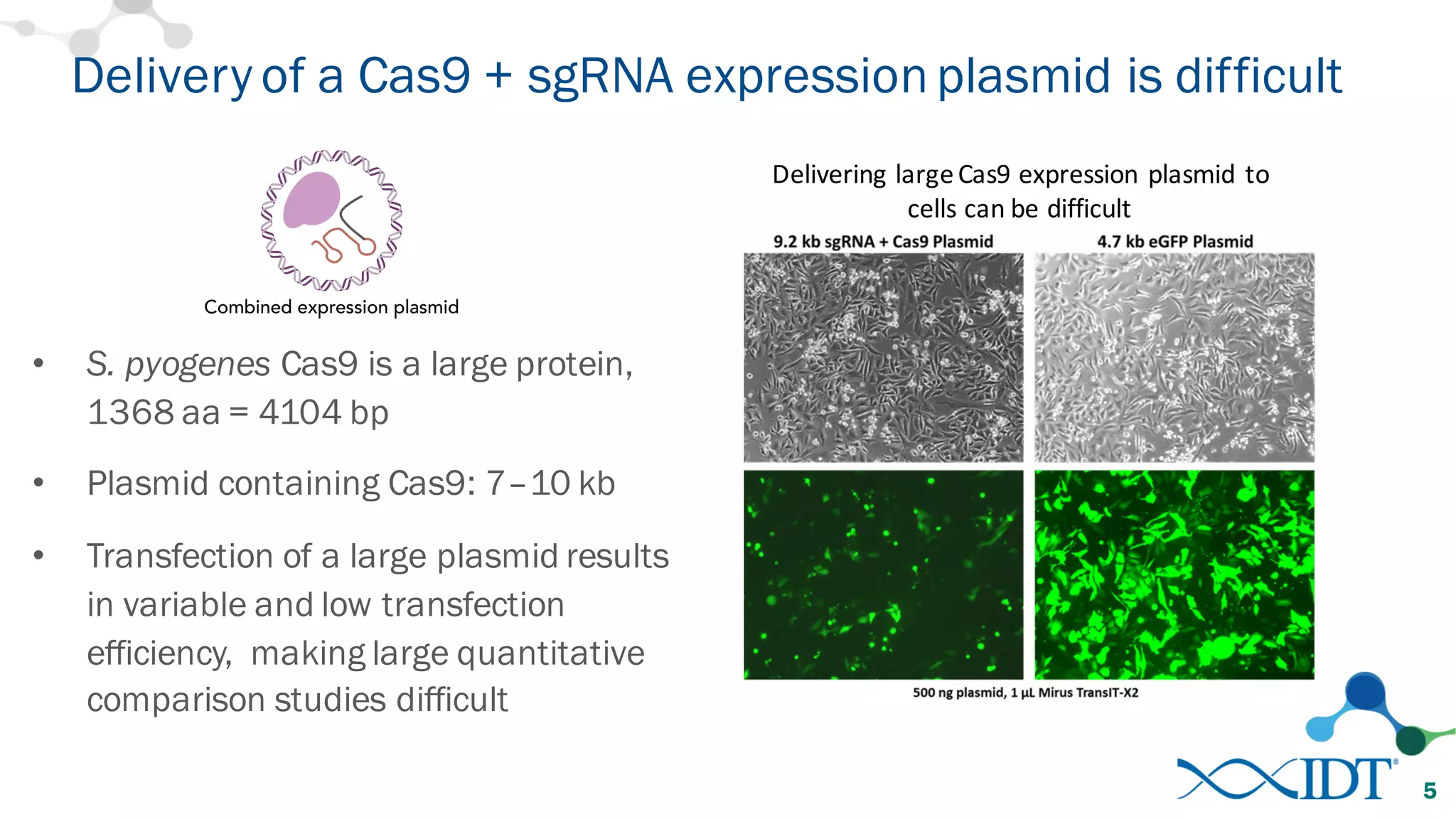
• S. pyogenes Cas9 is a large protein,
1368 aa = 4104 bp
• Plasmid containing Cas9: 7–10 kb
• Transfection of a large plasmid results
in variable and low transfection
efficiency, making large quantitative
comparison studies difficult
Delivery of a Cas9 + sgRNA expressionplasmid is difficult
5
Delivering	
  large	
  Cas9	
  expression	
  plasmid	
  to	
  
cells	
  can	
  be	
  difficult
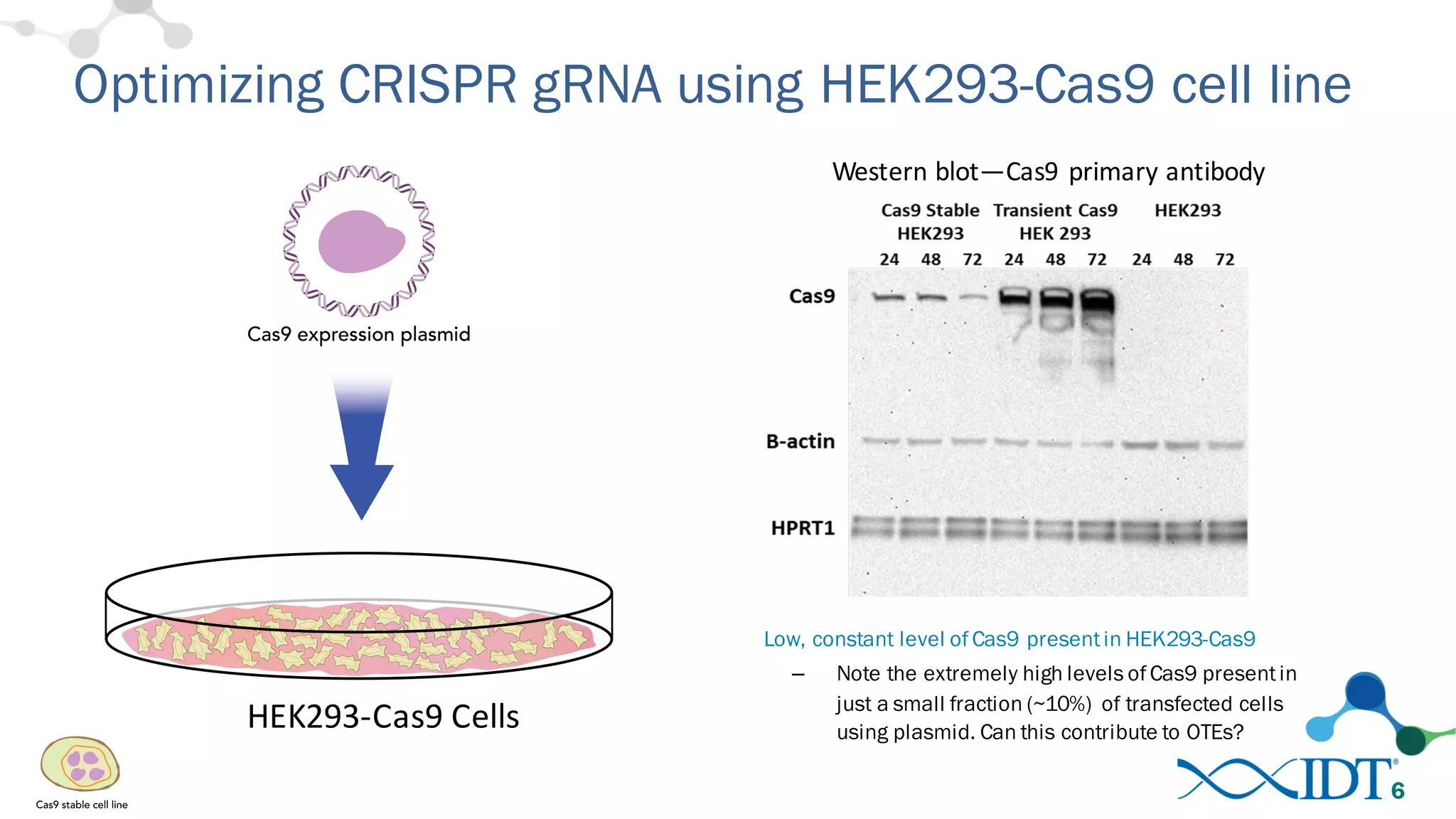
Optimizing CRISPR gRNA using HEK293-Cas9 cell line
6
Low, constant level of Cas9 presentin HEK293-Cas9
– Note the extremely high levels of Cas9 presentin
just a small fraction (~10%) of transfected cells
using plasmid. Can this contribute to OTEs?
HEK293-­‐Cas9	
  Cells
Western	
  blot—Cas9	
  primary	
  antibody	
  
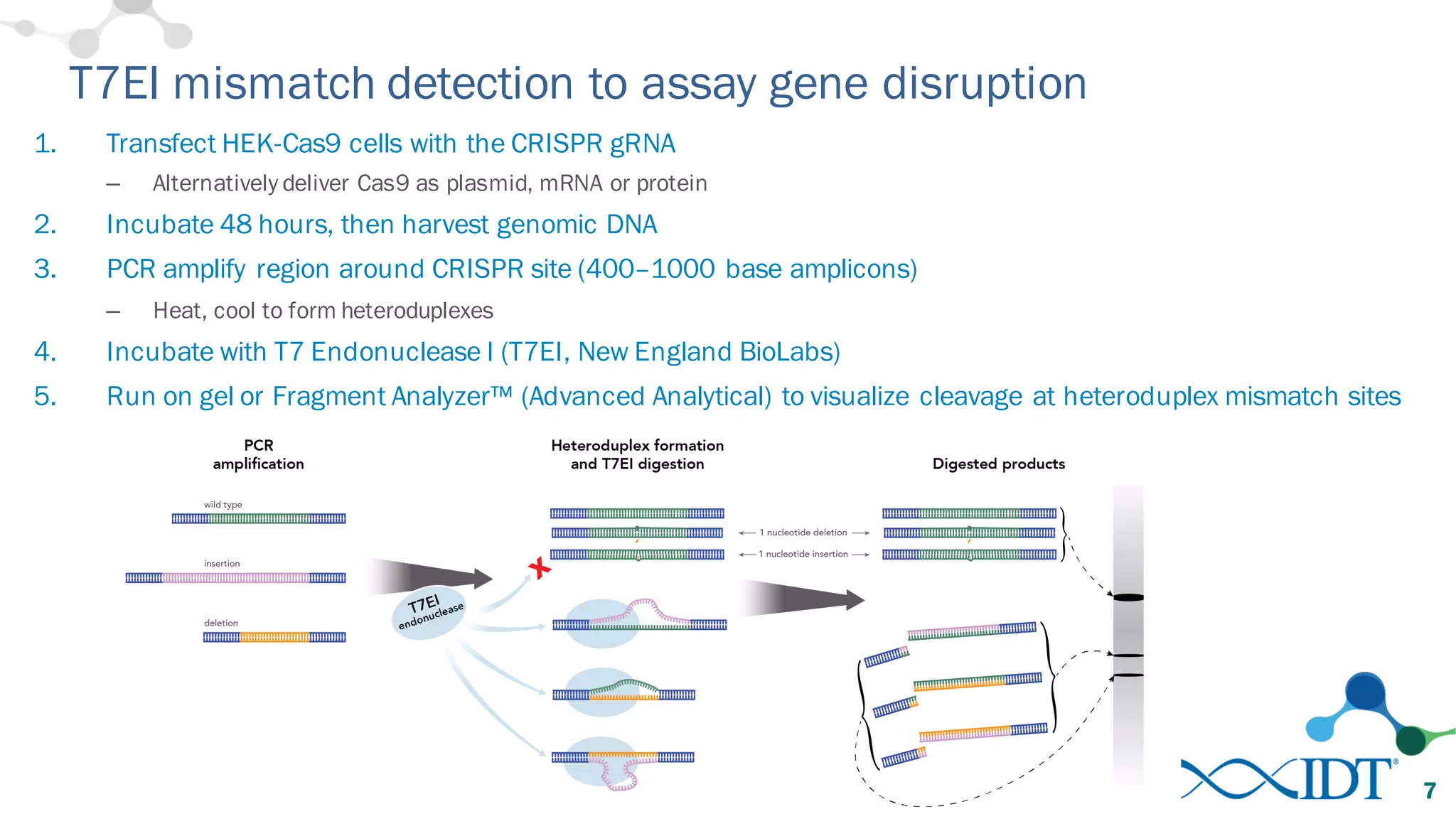
T7EI mismatch detection to assay gene disruption
1. Transfect HEK-Cas9 cells with the CRISPR gRNA
– Alternatively deliver Cas9 as plasmid, mRNA or protein
2. Incubate 48 hours, then harvest genomic DNA
3. PCR amplify region around CRISPR site (400–1000 base amplicons)
– Heat, cool to form heteroduplexes
4. Incubate with T7 Endonuclease I (T7EI, New England BioLabs)
5. Run on gel or Fragment Analyzer™ (Advanced Analytical) to visualize cleavage at heteroduplex mismatch sites
7
IDT CRISPR gene editing and mutation detection workflow
8
• The Fragment Analyzer™ (Advanced Analytical) provides reliable
quantification of T7EI heteroduplex cleavage assay with 96-channel CE
– High resolution analysis of fragments 10–40,000 bp
– Rapid 1 hr run
– 1/10th amount of DNA required to visualize
Transfect	
  2-­‐part	
  
RNA	
  at	
  30	
  nM or	
  
gBlocks	
  fragment	
  at	
  
3	
  nM into	
  Cas9	
  
expressing	
  cells
Extract	
  gDNA after	
  
48	
  hr with	
  
QuickExtract DNA	
  
Solution
Heat	
  gDNA extract	
  
at	
  65°C	
  for	
  15	
  min	
  
followed	
  by	
  95°C	
  
for	
  15	
  min
Amplify	
  gDNA with	
  
KAPA	
  HiFi
Polymerase	
  and	
  
PCR	
  assay	
  targeting	
  
region	
  of	
  interest
Add	
  NEB	
  buffer	
  2	
  to	
  
PCR,	
  heat	
  to	
  95°C	
  
and	
  slowly	
  cool	
  to	
  
allow	
  heteroduplex
formation
Digest	
  
heteroduplexes	
  
with	
  2	
  units	
  of	
  T7EI	
  
at	
  37°C	
  for	
  1	
  hr
Analyze	
  digestion	
  
on	
  Fragment	
  
Analyzer
Electropherogramand peaktableof separated sample on FragmentAnalyzer
52%	
  T7	
  cleavage
Options for the CRISPR gRNA
9
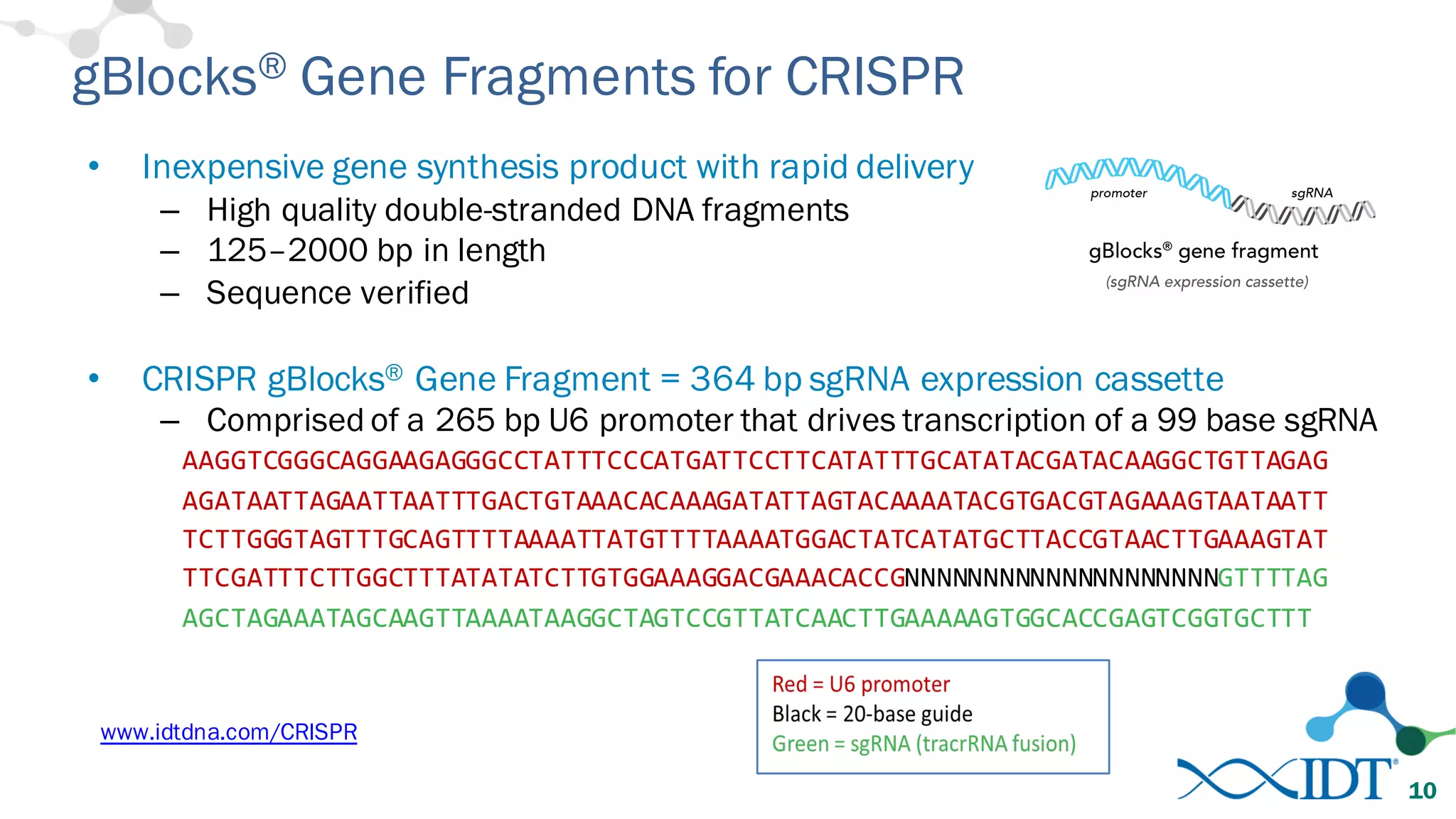
gBlocks® Gene Fragments for CRISPR
• Inexpensive gene synthesis product with rapid delivery
– High quality double-stranded DNA fragments
– 125–2000 bp in length
– Sequence verified
• CRISPR gBlocks® Gene Fragment = 364 bp sgRNA expression cassette
– Comprised of a 265 bp U6 promoter that drives transcription of a 99 base sgRNA
www.idtdna.com/CRISPR
10
AAGGTCGGGCAGGAAGAGGGCCTATTTCCCATGATTCCTTCATATTTGCATATACGATACAAGGCTGTTAGAG
AGATAATTAGAATTAATTTGACTGTAAACACAAAGATATTAGTACAAAATACGTGACGTAGAAAGTAATAATT
TCTTGGGTAGTTTGCAGTTTTAAAATTATGTTTTAAAATGGACTATCATATGCTTACCGTAACTTGAAAGTAT
TTCGATTTCTTGGCTTTATATATCTTGTGGAAAGGACGAAACACCGNNNNNNNNNNNNNNNNNNNNGTTTTAG
AGCTAGAAATAGCAAGTTAAAATAAGGCTAGTCCGTTATCAACTTGAAAAAGTGGCACCGAGTCGGTGCTTT
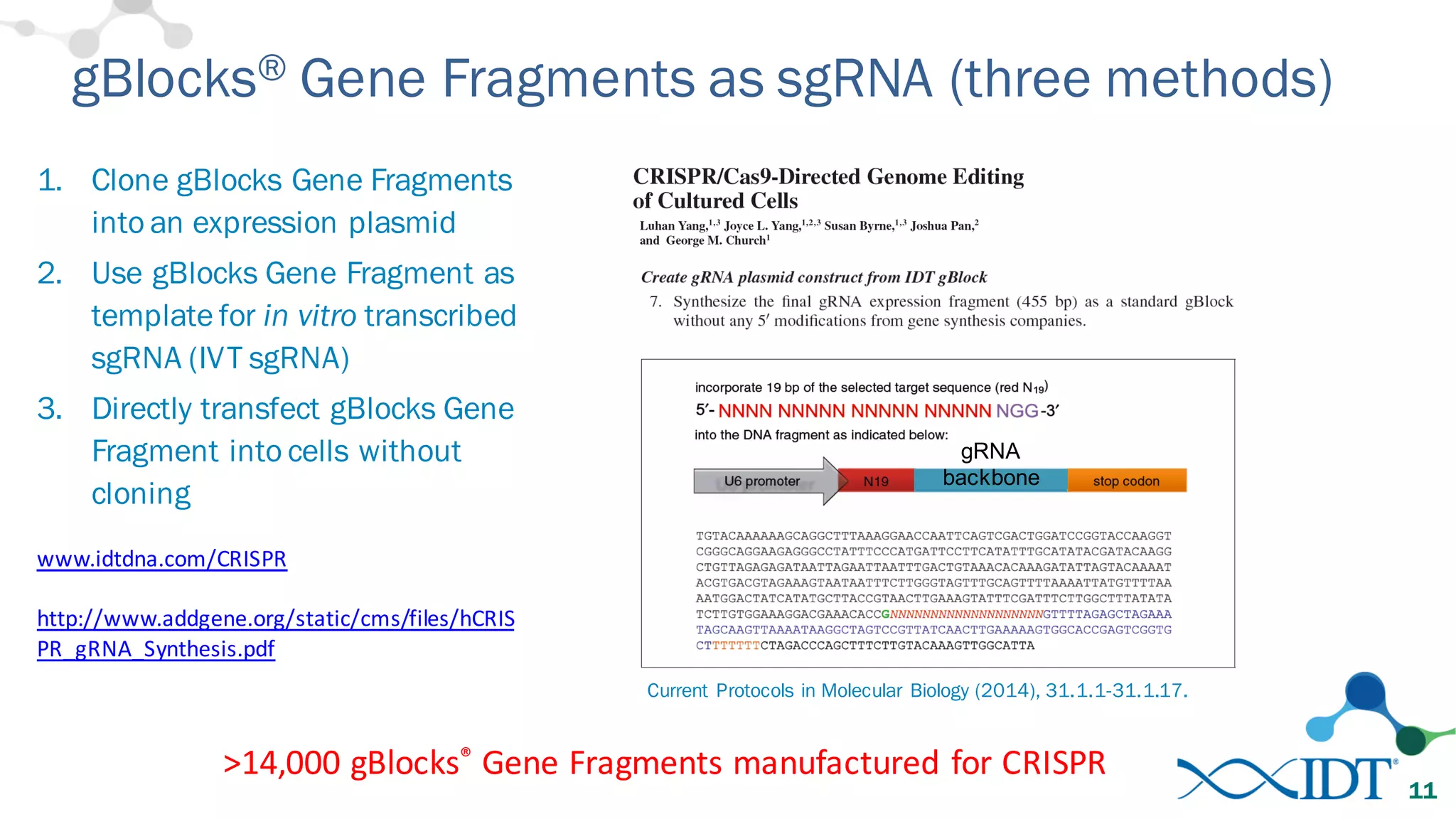
gBlocks® Gene Fragments as sgRNA (three methods)
1. Clone gBlocks Gene Fragments
into an expression plasmid
2. Use gBlocks Gene Fragment as
template for in vitro transcribed
sgRNA (IVT sgRNA)
3. Directly transfect gBlocks Gene
Fragment into cells without
cloning
11
www.idtdna.com/CRISPR
http://www.addgene.org/static/cms/files/hCRIS
PR_gRNA_Synthesis.pdf
gRNA
backbone
Current Protocols in Molecular Biology (2014), 31.1.1-31.1.17.
>14,000	
  gBlocks® Gene	
  Fragments	
  manufactured	
  for	
  CRISPR
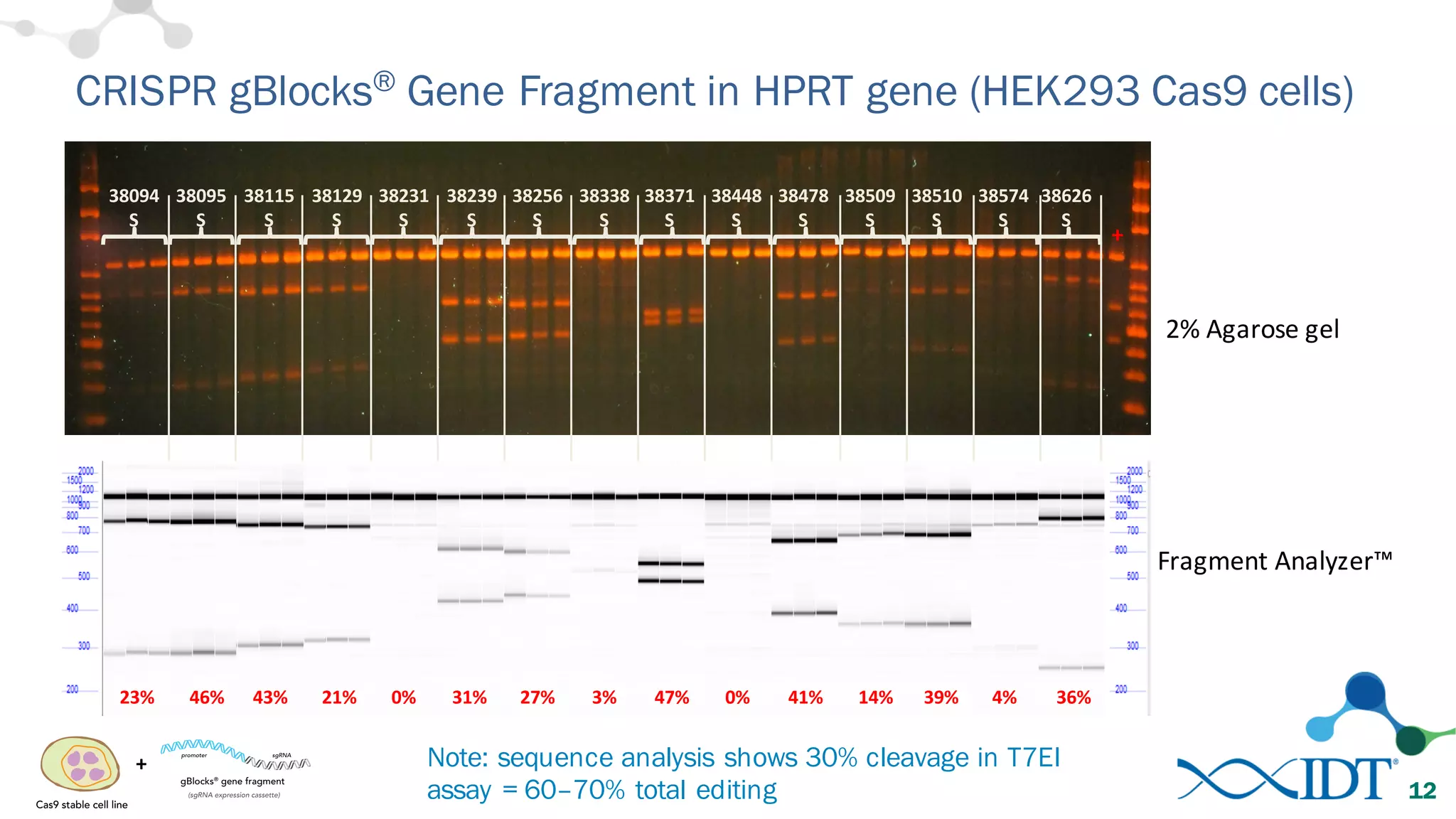
CRISPR gBlocks® Gene Fragment in HPRT gene (HEK293 Cas9 cells)
12
38094
S
38095
S
38115
S
38129
S
38231
S
38239
S
38256
S
38338
S
38371
S
38448
S
38478
S
38509
S
38510
S
38574
S
38626
S
+
23% 46% 21% 0% 31% 27% 3% 47% 0% 41% 14% 39% 4% 36%43%	
  
2%	
  Agarose	
  gel
Fragment	
  Analyzer™
Note: sequence analysis shows 30% cleavage in T7EI
assay = 60–70% total editing
+
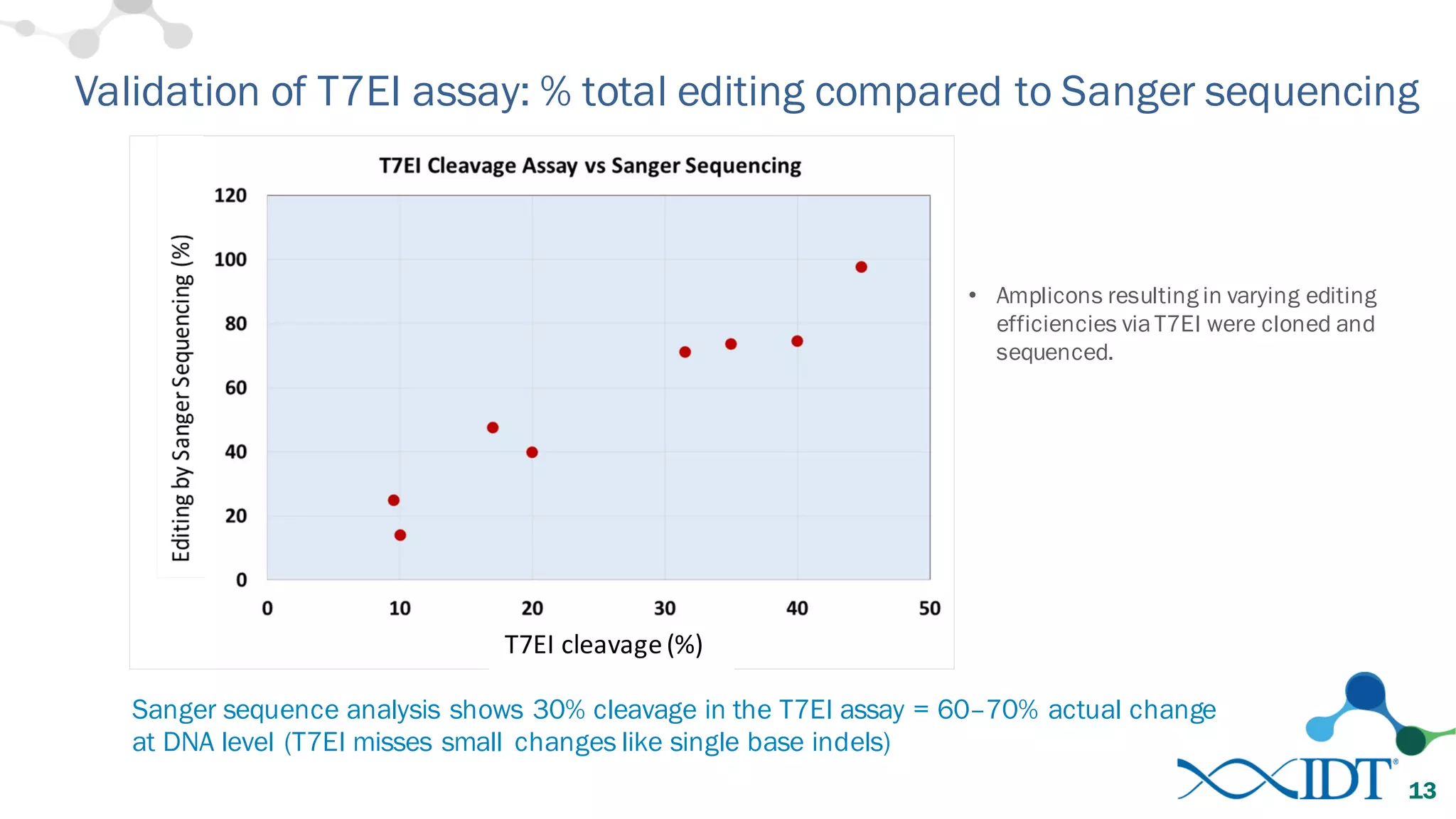
Validation of T7EI assay: % total editing compared to Sanger sequencing
Sanger sequence analysis shows 30% cleavage in the T7EI assay = 60–70% actual change
at DNA level (T7EI misses small changes like single base indels)
13
• Amplicons resulting in varying editing
efficiencies viaT7EI were cloned and
sequenced.
T7EI	
  cleavage	
  (%)
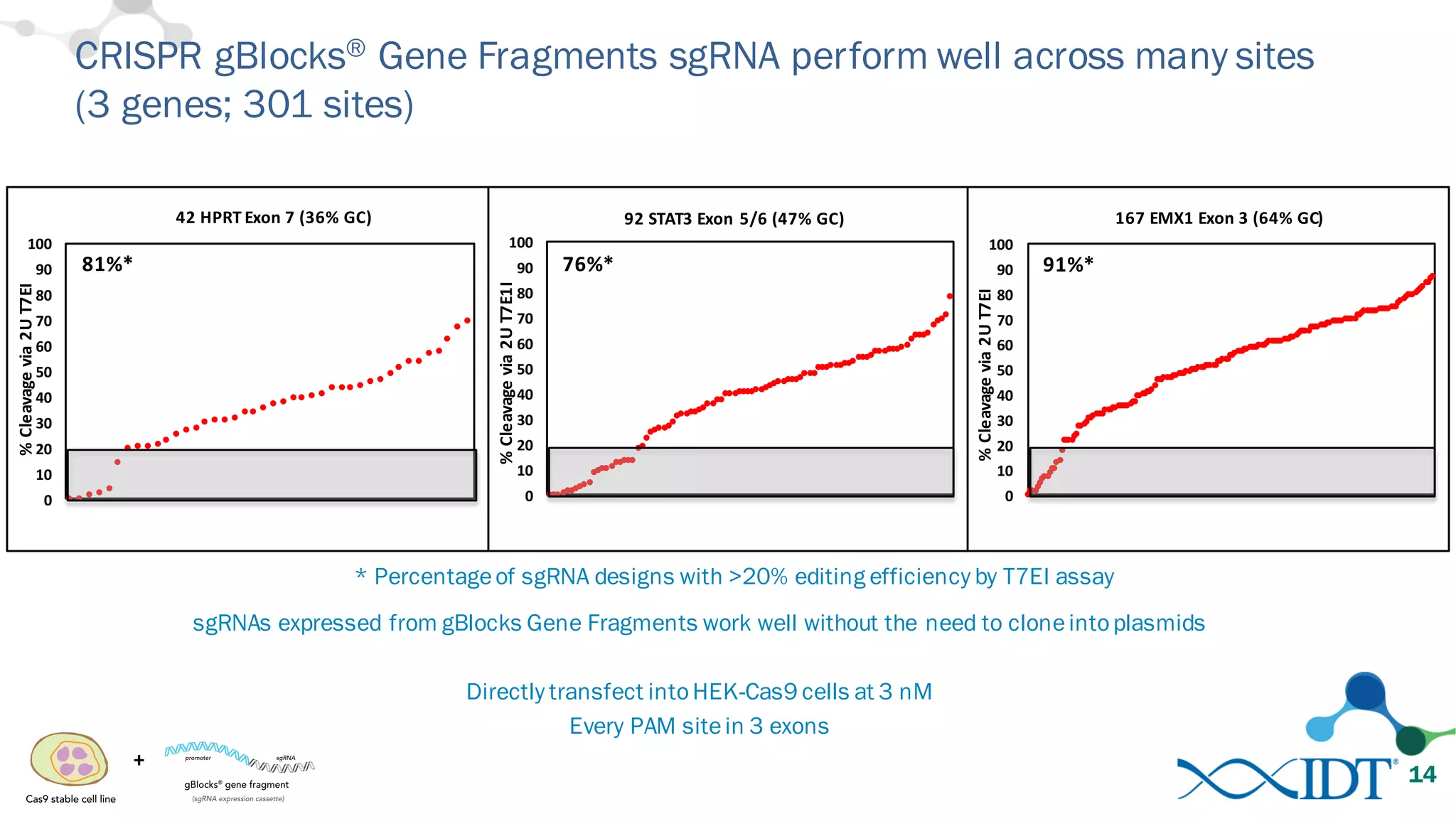
CRISPR gBlocks® Gene Fragments sgRNA perform well across many sites
(3 genes; 301 sites)
14
0
10
20
30
40
50
60
70
80
90
100
%	
  Cleavage	
  via	
  2U	
  T7EI	
  
167	
  EMX1	
  Exon	
  3	
  (64%	
  GC)
91%*
0
10
20
30
40
50
60
70
80
90
100
%	
  Cleavage	
  via	
  2U	
  T7E1I	
  
92	
  STAT3	
  Exon	
  5/6	
  (47%	
  GC)
76%*
0
10
20
30
40
50
60
70
80
90
100
%	
  Cleavage	
  via	
  2U	
  T7EI	
  
42	
  HPRT	
  Exon	
  7	
  (36%	
  GC)
81%*
sgRNAs expressed from gBlocks Gene Fragments work well without the need to cloneintoplasmids
Directly transfect intoHEK-Cas9 cells at 3 nM
Every PAM sitein 3 exons
* Percentageof sgRNA designs with >20% editing efficiency by T7EI assay
+
Options for the CRISPR gRNA
15
Options for the CRISPR gRNA
16
UUAUAUCCAACACUUCGUGGUUUUAGA-­‐-­‐GCUAG
|||||||      ||||  A
|||||||      ||||  A
C-­‐GGAAUAAAAUUGAACGAUA
U|  ||
A|  ||
GUCCGUUAUCAACUUG
||||  A
||||  A
AGCCACGGUGAAA
G  ||||||
UCGGUGCUUU
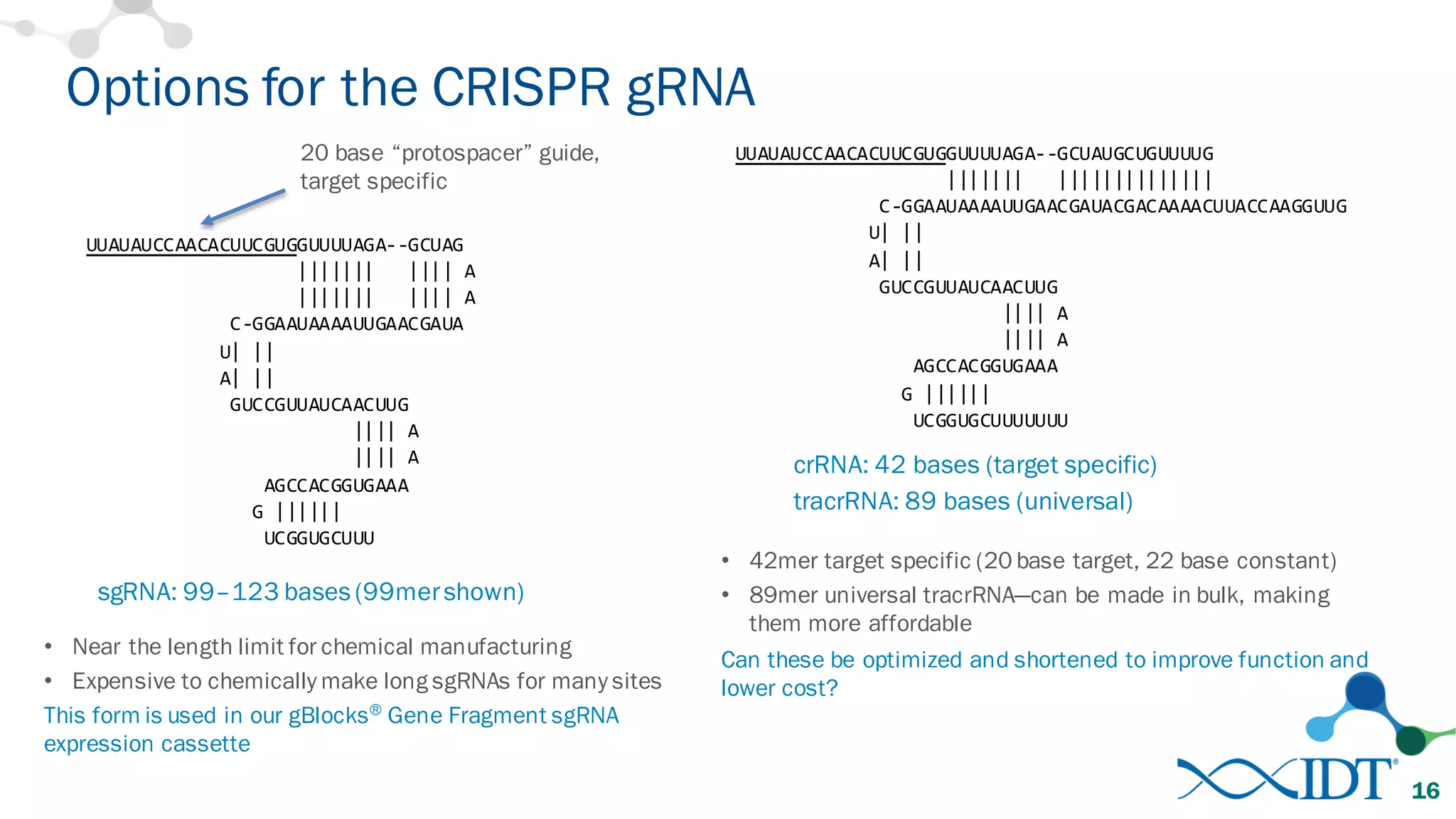
sgRNA: 99–123 bases (99mershown)
20 base “protospacer” guide,
target specific
• Near the length limit for chemical manufacturing
• Expensive to chemically make long sgRNAs for many sites
This form is used in our gBlocks®
Gene Fragment sgRNA
expression cassette
UUAUAUCCAACACUUCGUGGUUUUAGA-­‐-­‐GCUAUGCUGUUUUG
|||||||      ||||||||||||||
C-­‐GGAAUAAAAUUGAACGAUACGACAAAACUUACCAAGGUUG
U|  ||
A|  ||
GUCCGUUAUCAACUUG
||||  A
||||  A
AGCCACGGUGAAA
G  ||||||
UCGGUGCUUUUUUU
crRNA: 42 bases (target specific)
tracrRNA: 89 bases (universal)
• 42mer target specific (20 base target, 22 base constant)
• 89mer universal tracrRNA—can be made in bulk, making
them more affordable
Can these be optimized and shortened to improve function and
lower cost?
Optimized	
  length	
  of	
  crRNA	
  and	
  tracrRNA
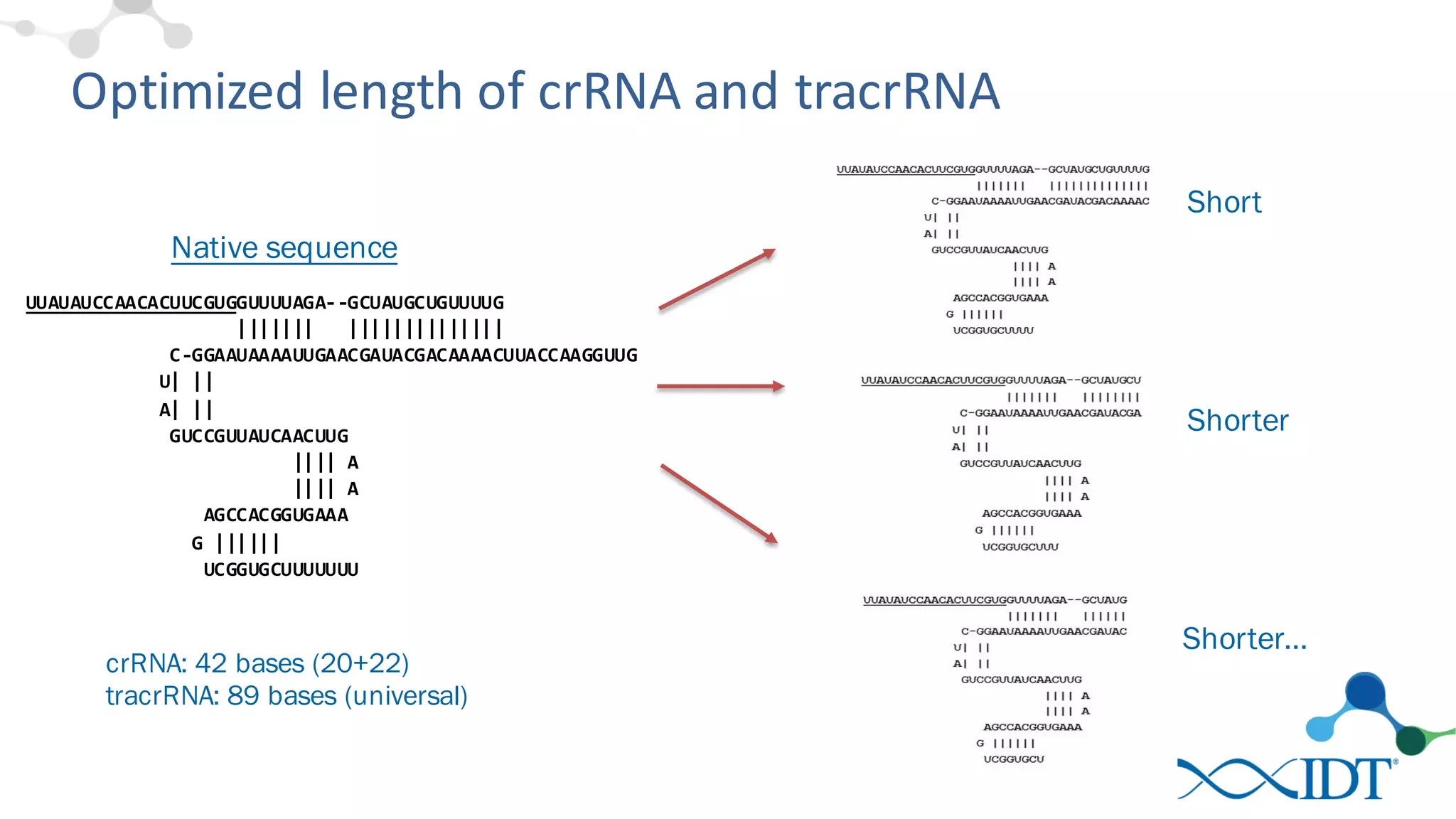
crRNA: 42 bases (20+22)
tracrRNA: 89 bases (universal)
UUAUAUCCAACACUUCGUGGUUUUAGA-­‐-­‐GCUAUGCUGUUUUG
|||||||      ||||||||||||||
C-­‐GGAAUAAAAUUGAACGAUACGACAAAACUUACCAAGGUUG
U|  ||
A|  ||
GUCCGUUAUCAACUUG
||||  A
||||  A
AGCCACGGUGAAA
G  ||||||
UCGGUGCUUUUUUU
Native sequence
Shorter
Shorter…
Short
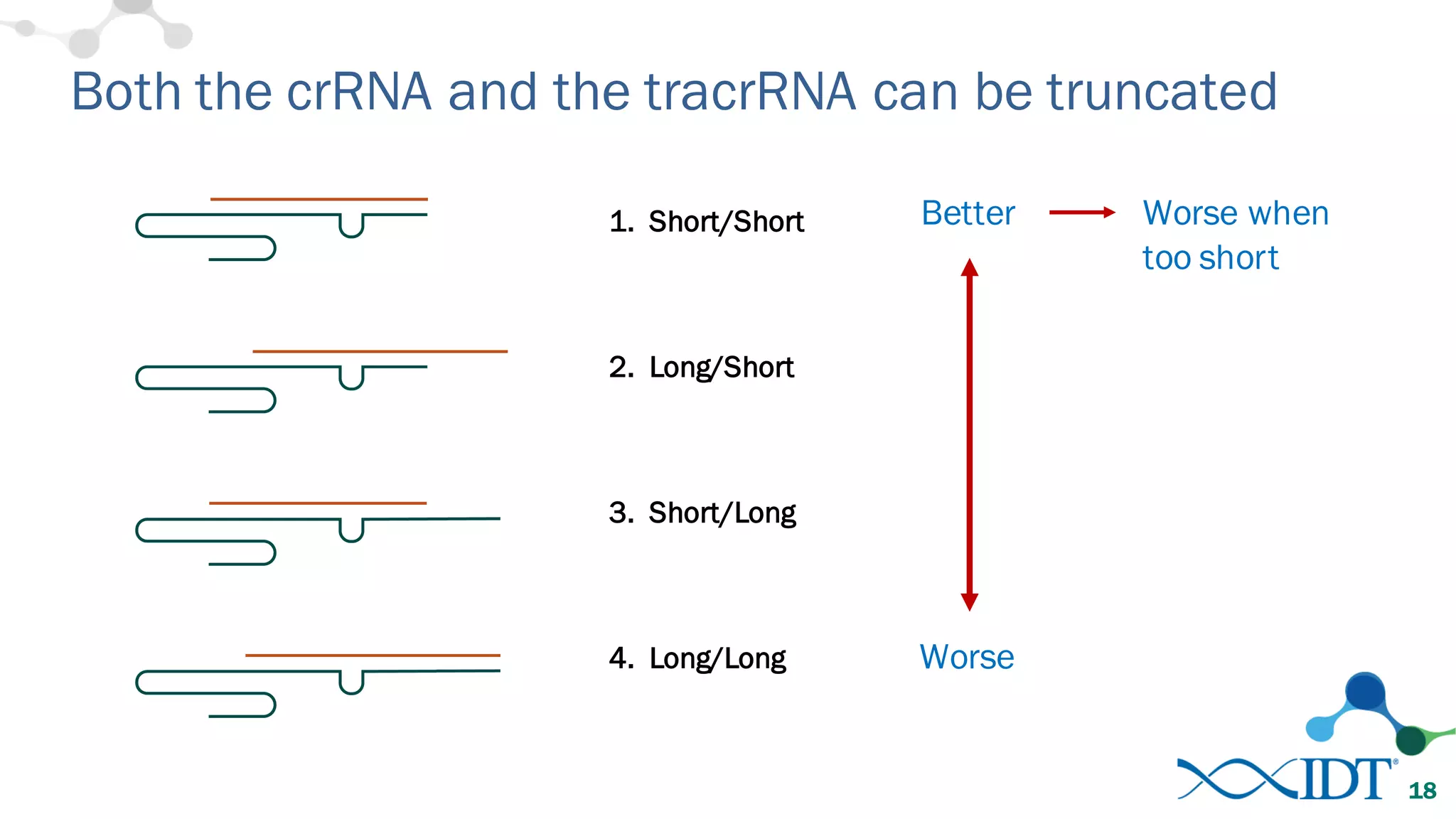
Both the crRNA and the tracrRNA can be truncated
18
1. Short/Short
2. Long/Short
3. Short/Long
4. Long/Long Worse
Worse when
too short
Better
19
0
10
20
30
40
50
60
70
80
90
100
89	
  nt	
  tracrRNA 74	
  nt	
  tracrRNA 70	
  nt	
  tracrRNA 67	
  nt	
  tracrRNA 65	
  nt	
  tracrRNA 63	
  nt	
  tracrRNA
T7EI	
  cleavage	
  (%)
42-­‐nt	
  crRNA
39-­‐nt	
  crRNA
36-­‐nt	
  crRNA
34-­‐nt	
  crRNA
Length optimization of crRNA & tracrRNA
HPRT 38285 gRNA (HEK293 Cas9 Cells)
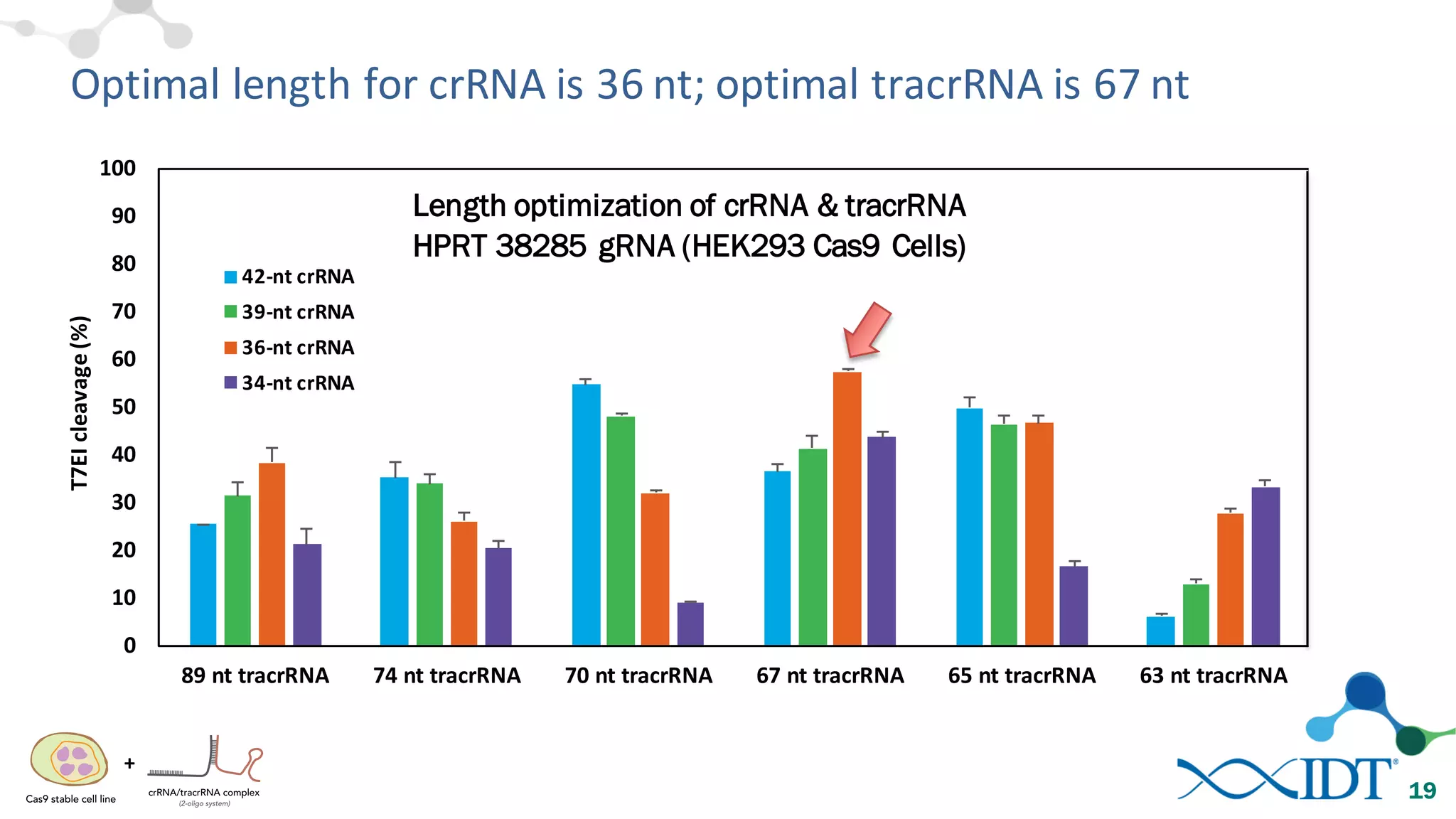
Optimal	
  length	
  for	
  crRNA	
  is	
  36	
  nt;	
  optimal	
  tracrRNA	
  is	
  67	
  nt
+
0
10
20
30
40
50
60
70
80
90
100
HPRT	
  
38094	
  S
HPRT	
  
38231	
  S
HPRT	
  
38371	
  S
HPRT	
  
38509	
  S
HPRT	
  
38574	
  S
HPRT	
  
38087	
  AS
HPRT	
  
38133	
  AS
HPRT	
  
38285	
  AS
HPRT	
  
38287	
  AS
HPRT	
  
38358	
  AS
HPRT	
  
38636	
  AS	
  
HPRT	
  
38673	
  AS	
  
T7EI	
  cleavage	
  (%)
CRISPR	
  gRNA	
  Comparison—12	
  gRNAs	
  Targeting	
  HPRT
(HEK293-­‐Cas9	
  Cells)
2-­‐part	
  RNA	
  (36/67)
Native	
  RNA	
  (42/89)
In	
  vitro	
  transcribed	
  sgRNA
sgRNA	
  Expression	
  Plasmid	
  (2.7	
  kb)
gBlocks	
  Gene	
  Fragments	
  sgRNA
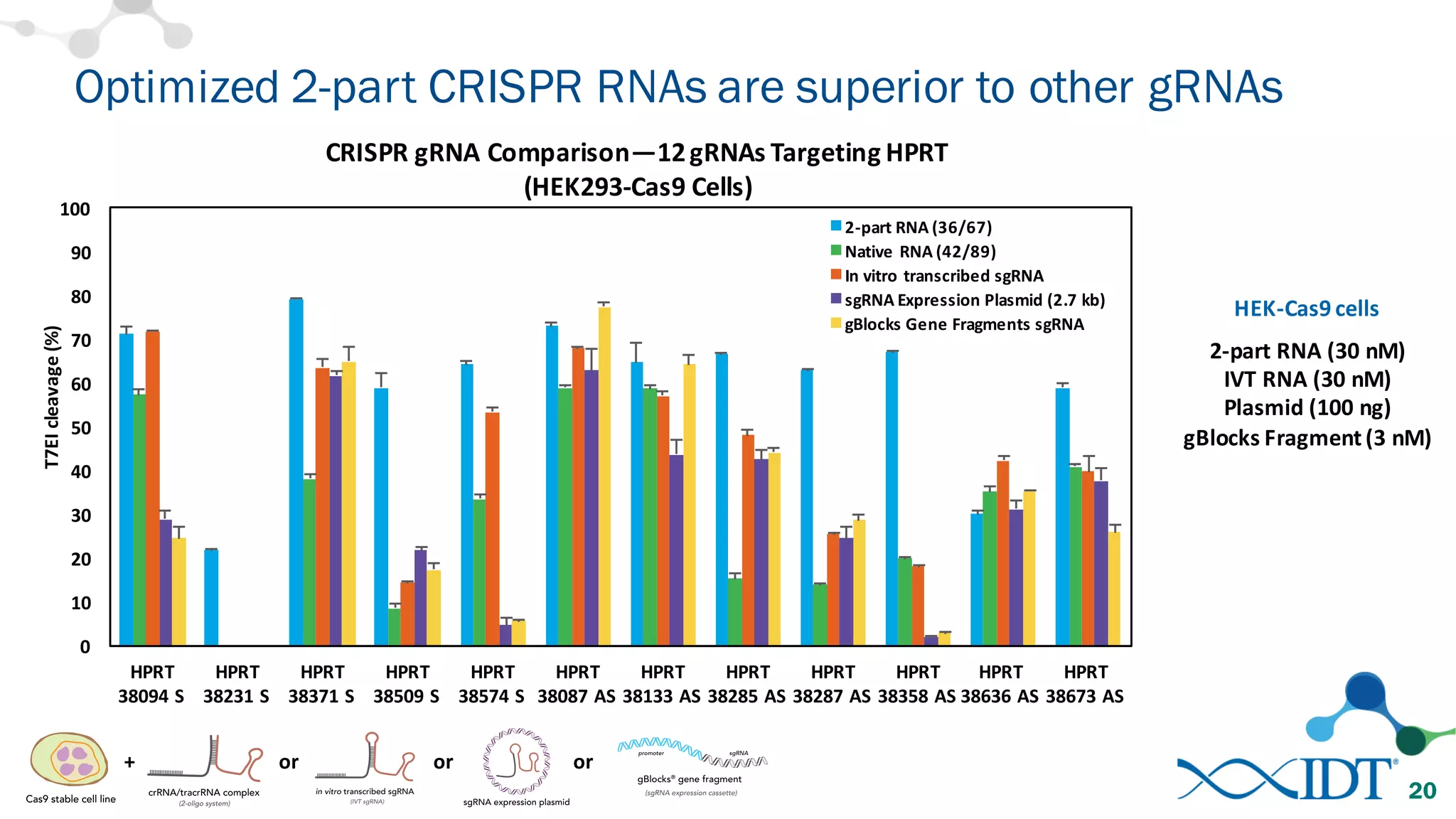
Optimized 2-part CRISPR RNAs are superior to other gRNAs
20
HEK-­‐Cas9	
  cells
2-­‐part	
  RNA	
  (30	
  nM)
IVT	
  RNA	
  (30	
  nM)
Plasmid	
  (100	
  ng)
gBlocks	
  Fragment	
  (3	
  nM)
+ or or or
Highly purified oligos are necessary for longer tracrRNAs
21
HEK-­‐Cas9	
  cells
2-­‐part	
  RNA,	
  30	
  nM
Desalt	
  crRNA
Desalt	
  vs.	
  HPLC	
  
tracrRNA
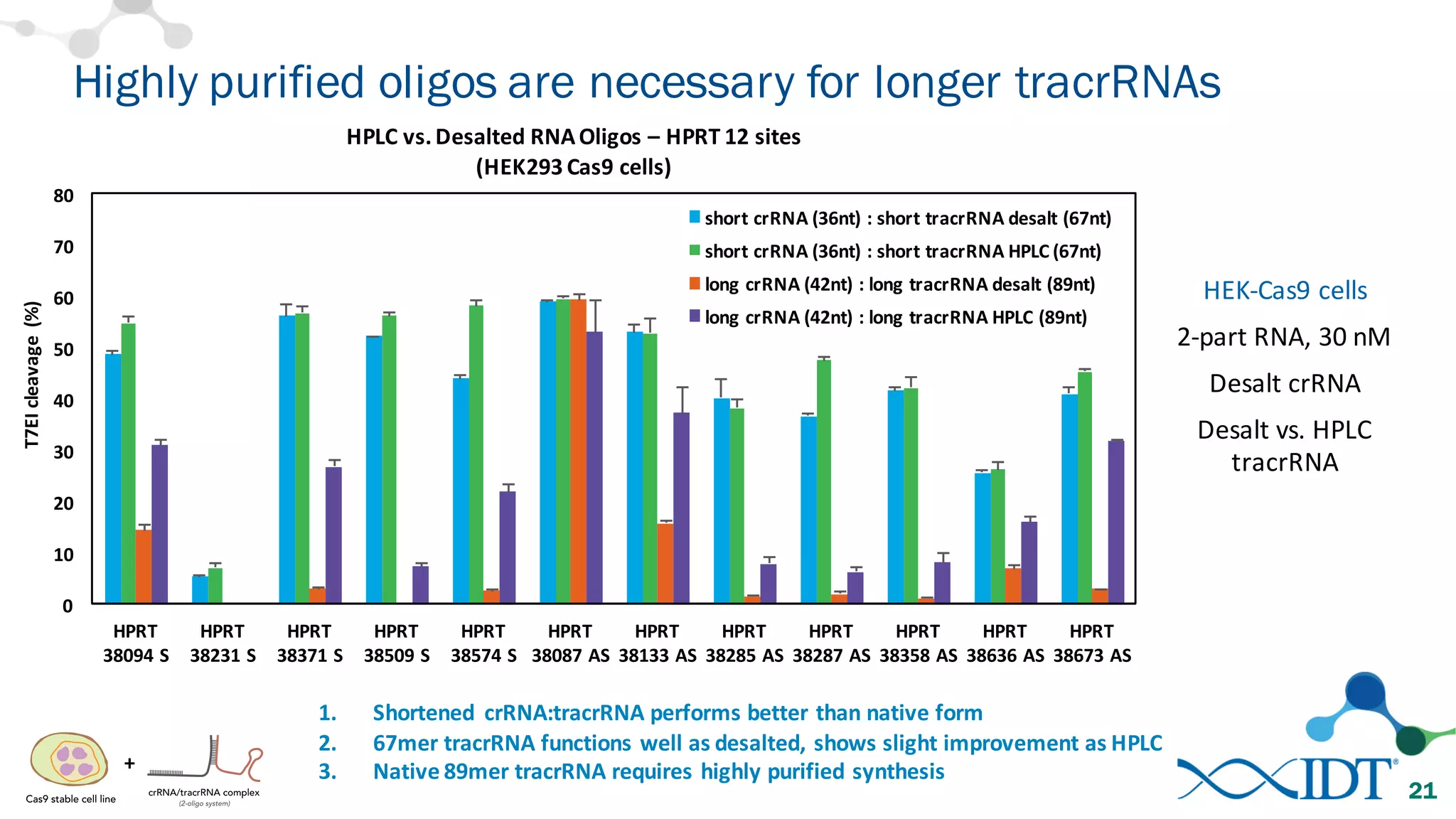
1. Shortened	
   crRNA:tracrRNA performs	
  better	
  than	
  native	
  form
2. 67mer	
  tracrRNA	
  functions	
  well	
  as	
  desalted,	
  shows	
  slight	
  improvement	
  as	
  HPLC
3. Native	
  89mer	
  tracrRNA	
  requires	
  highly	
  purified	
  synthesis
0
10
20
30
40
50
60
70
80
HPRT	
  
38094	
  S
HPRT	
  
38231	
  S
HPRT	
  
38371	
  S
HPRT	
  
38509	
  S
HPRT	
  
38574	
  S
HPRT	
  
38087	
  AS
HPRT	
  
38133	
  AS
HPRT	
  
38285	
  AS
HPRT	
  
38287	
  AS
HPRT	
  
38358	
  AS
HPRT	
  
38636	
  AS
HPRT	
  
38673	
  AS
T7EI	
  cleavage	
  	
  (%)
HPLC	
  vs.	
  Desalted	
  RNA	
  Oligos	
  – HPRT	
  12	
  sites
(HEK293	
  Cas9	
  cells)
short	
  crRNA	
  (36nt)	
  :	
  short	
  tracrRNA	
  desalt	
  (67nt)
short	
  crRNA	
  (36nt)	
  :	
  short	
  tracrRNA	
  HPLC	
  (67nt)
long	
  crRNA	
  (42nt)	
  :	
  long	
  tracrRNA	
  desalt	
  (89nt)
long	
  crRNA	
  (42nt)	
  :	
  long	
  tracrRNA	
  HPLC	
  (89nt)
+
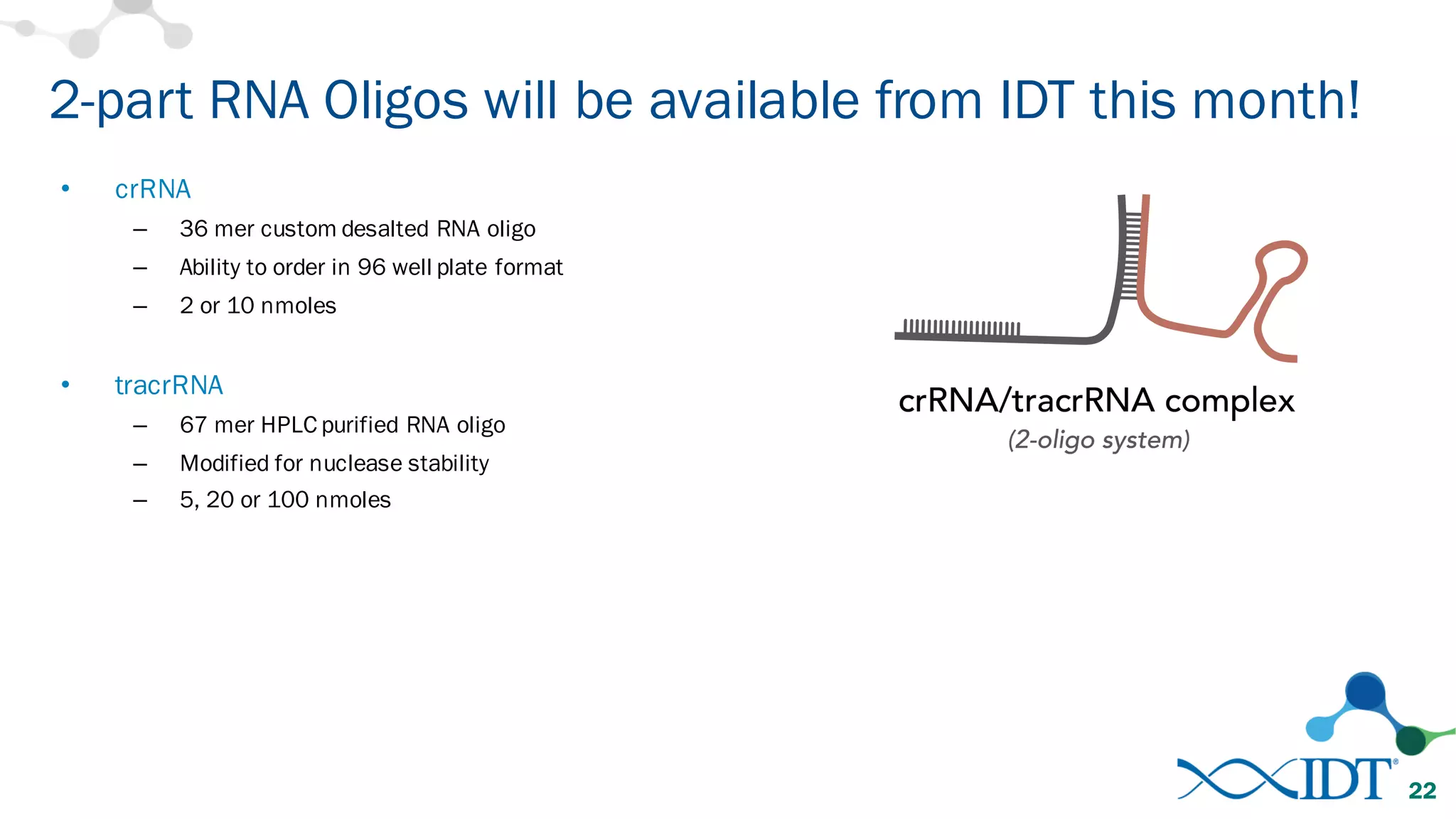
2-part RNA oligos will be available from IDT this month!
• crRNA
– 36 nt custom desalted RNA oligo
– Ability to order in 96-well plate format
– 2 or 10 nmol
• tracrRNA
– 67 nt HPLC purified RNA oligo
– Modified for nuclease stability
– 5, 20, or 100 nmol
22
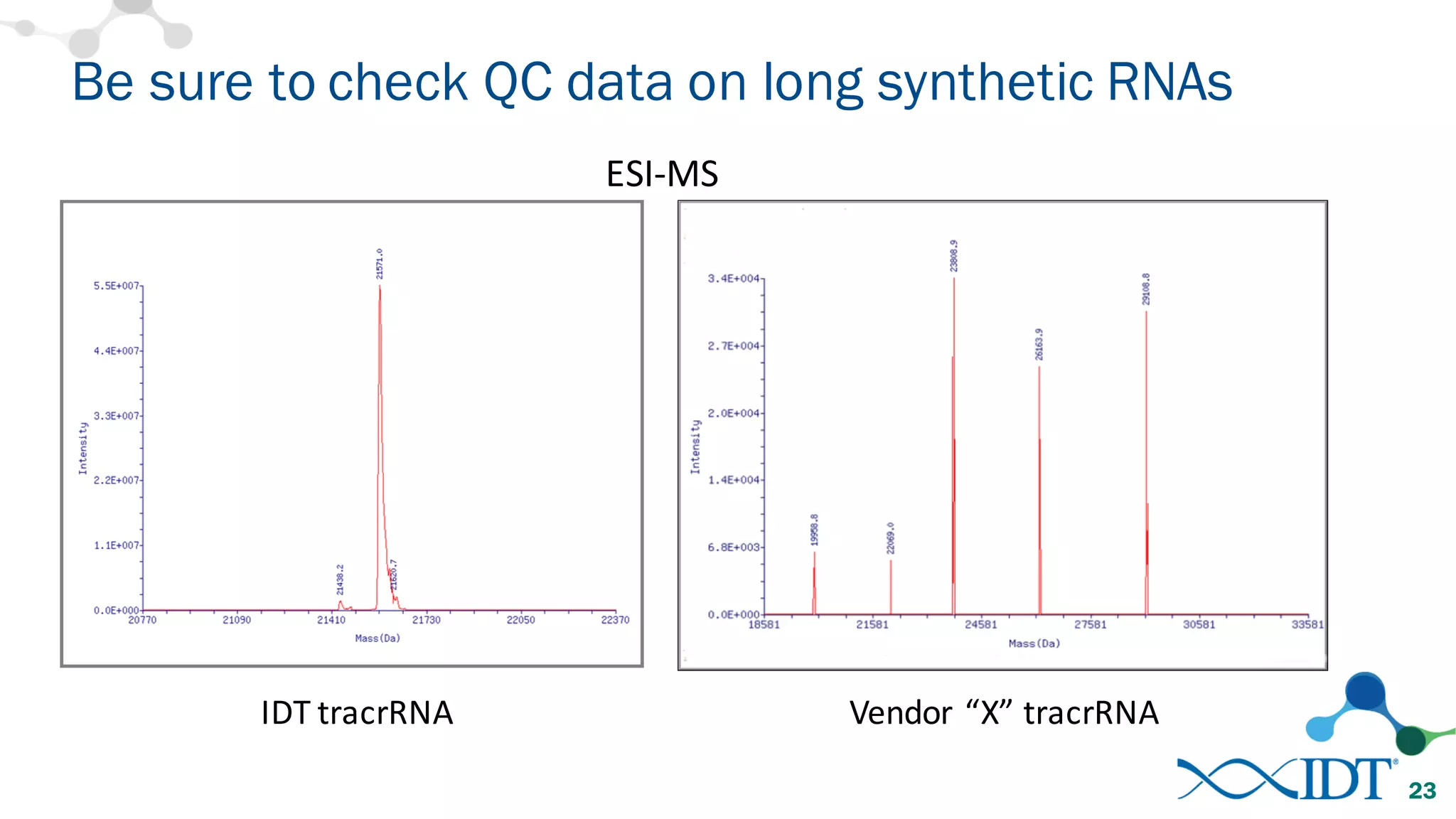
Be sure to check QC data on long synthetic RNAs
23
IDT	
  tracrRNA Vendor	
  “X”	
  tracrRNA
ESI-­‐MS	
  
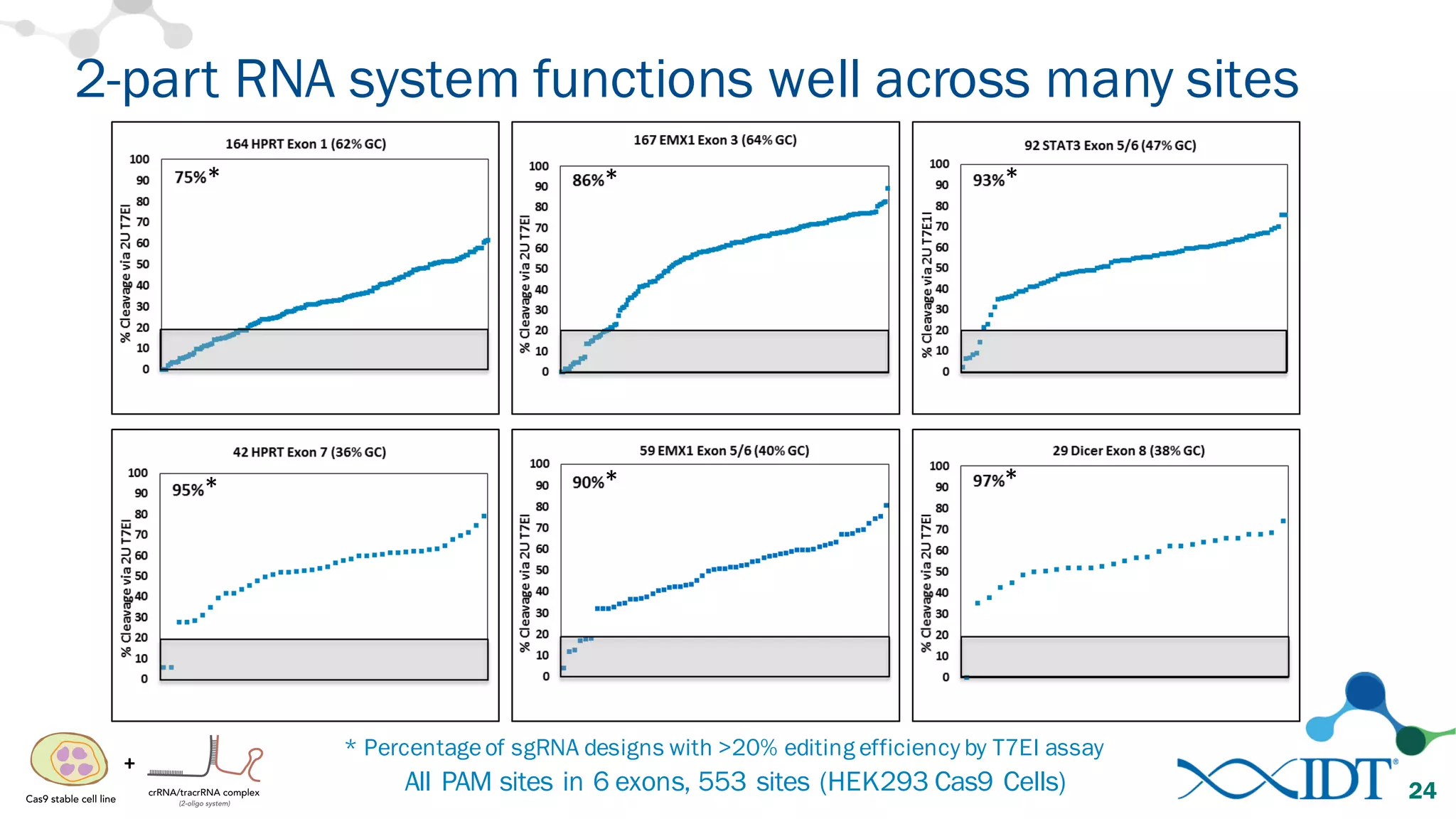
2-part RNA system functions well across many sites
24All PAM sites in 6 exons, 553 sites (HEK293 Cas9 Cells)
* **
* * *
* Percentageof sgRNA designs with >20% editing efficiency by T7EI assay
+
Summary of 2-part RNA functional performance in HEK-Cas9 cells
553 guide sites in 6 exons from 4 human genes
25
Target amplicon Number ofsites % >15% T7 cleavage % >20% T7 cleavage
HPRT exon 7 (36% GC) 42 40/42 = 95% 40/42 = 95%
HPRT exon 1 (62% GC) 164 135/164 = 82% 123/164 = 75%
EMX1 exon 3 (64% GC) 167 151/167 = 90% 143/167 = 86%
EMX1 exon 5/6 (40% GC) 59 56/59 = 95% 53/59 = 90%
STAT3 exon 5/6 (47% GC) 92 86/92 = 93% 86/92 = 93%
DICER exon 8 (38% GC) 29 28/29 = 97% 28/29 = 97%
Total 553 496/553 = 90% 473/553 = 86%
+
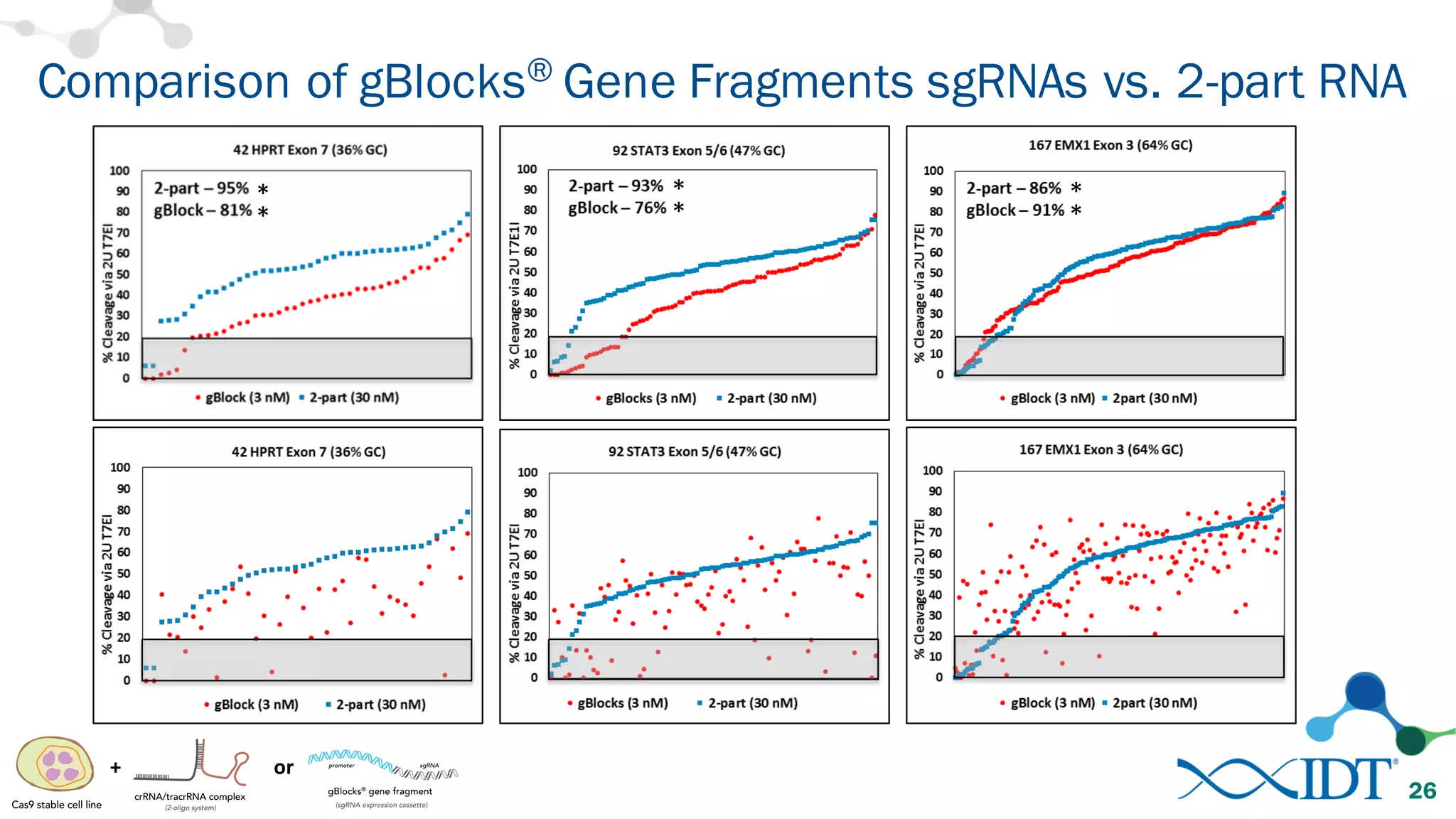
Comparison of gBlocks® Gene Fragments sgRNAs vs. 2-part RNA
26
+ or
*
*
*
*
*
*
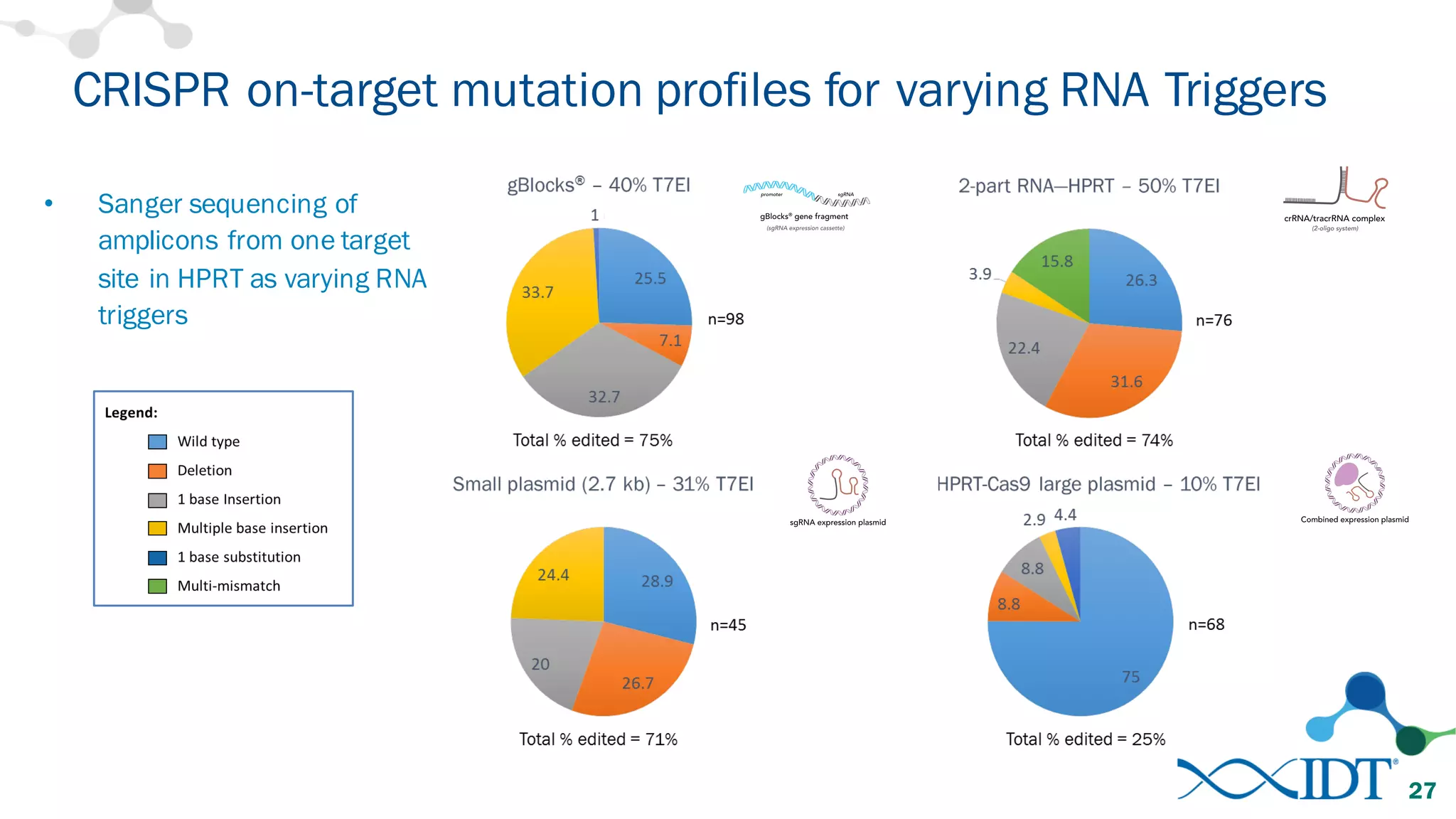
CRISPR on-target mutation profiles for varying RNA Triggers
27
• Sanger sequencing of
amplicons from one target
site in HPRT as varying RNA
triggers
Although use of shorter
17mer guides has been
reported toreduce off-
target effects, 17mer
guides can result in far
worse on-target results.
Other design features to consider — shorter protospacer?
28
0
10
20
30
40
50
60
70
80
90
100
HPRT	
  
38094	
  S	
  
HPRT	
  
38231	
  S	
  
HPRT	
  
38371	
  S
HPRT	
  
38509	
  S	
  
HPRT	
  
38574	
  S	
  
HPRT	
  
38087	
  
AS	
  
HPRT	
  
38133	
  
AS
HPRT	
  
38285	
  
AS	
  
HPRT	
  
38287	
  
AS	
  
HPRT	
  
38358	
  
AS	
  
HPRT	
  
38636	
  
AS	
  
HPRT	
  
38673	
  
AS	
  
T7EI	
  cleavage	
  (%)
Guide	
  RNA	
  length	
  study—20	
  vs.	
  19	
  vs.	
  18	
  vs.	
  17	
  nt
(HEK293	
  Cas9	
  Cells)
20	
  nt 19	
  nt 18	
  nt 17	
  nt
+
• Transfection of in vitro transcribed sgRNAs sometimes resulted in
large scale cell death.
Comparison of in vitro transcribed sgRNAs to 2-part RNAs
29
MEGAshortscript T7	


IVT	
  Kit	
  (Ambion)
HiScribe T7	
  High	
  Yield	
  
IVT	
  Kit	
  (NEB)
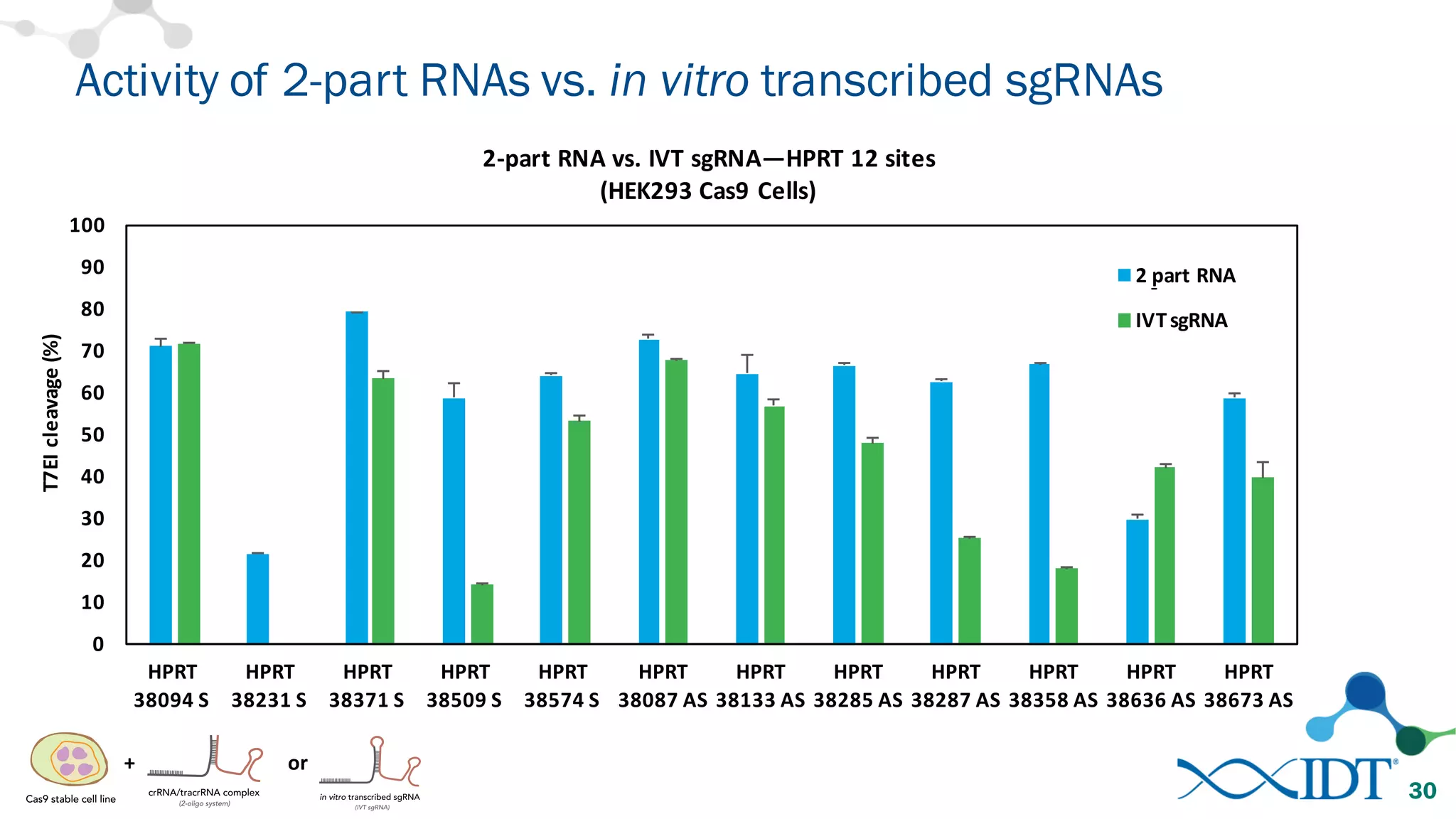
Activity of 2-part RNAs vs. in vitro transcribed sgRNAs
30
0
10
20
30
40
50
60
70
80
90
100
HPRT	
  
38094	
  S	
  
HPRT	
  
38231	
  S	
  
HPRT	
  
38371	
  S	
  
HPRT	
  
38509	
  S	
  
HPRT	
  
38574	
  S	
  
HPRT	
  
38087	
  AS
HPRT	
  
38133	
  AS
HPRT	
  
38285	
  AS
HPRT	
  
38287	
  AS
HPRT	
  
38358	
  AS
HPRT	
  
38636	
  AS
HPRT	
  
38673	
  AS
T7EI	
  cleavage	
  (%)
2-­‐part	
  RNA	
  vs.	
  IVT	
  sgRNA—HPRT	
  12	
  sites
(HEK293	
  Cas9	
  Cells)	
  
2	
  part	
  RNA	
  
IVT	
  sgRNA
-­‐
+ or
In vitro transcribed sgRNAs trigger immune response, 2-part RNA oligos do
not (HEK-Cas9 cells)
31
• IFITM1, RIGI, and OAS2 had similarly high induction when treated with in vitro transcribed
sgRNA (triphosphate removed)
• No inductions were detected when treated with 2-part RNA oligos
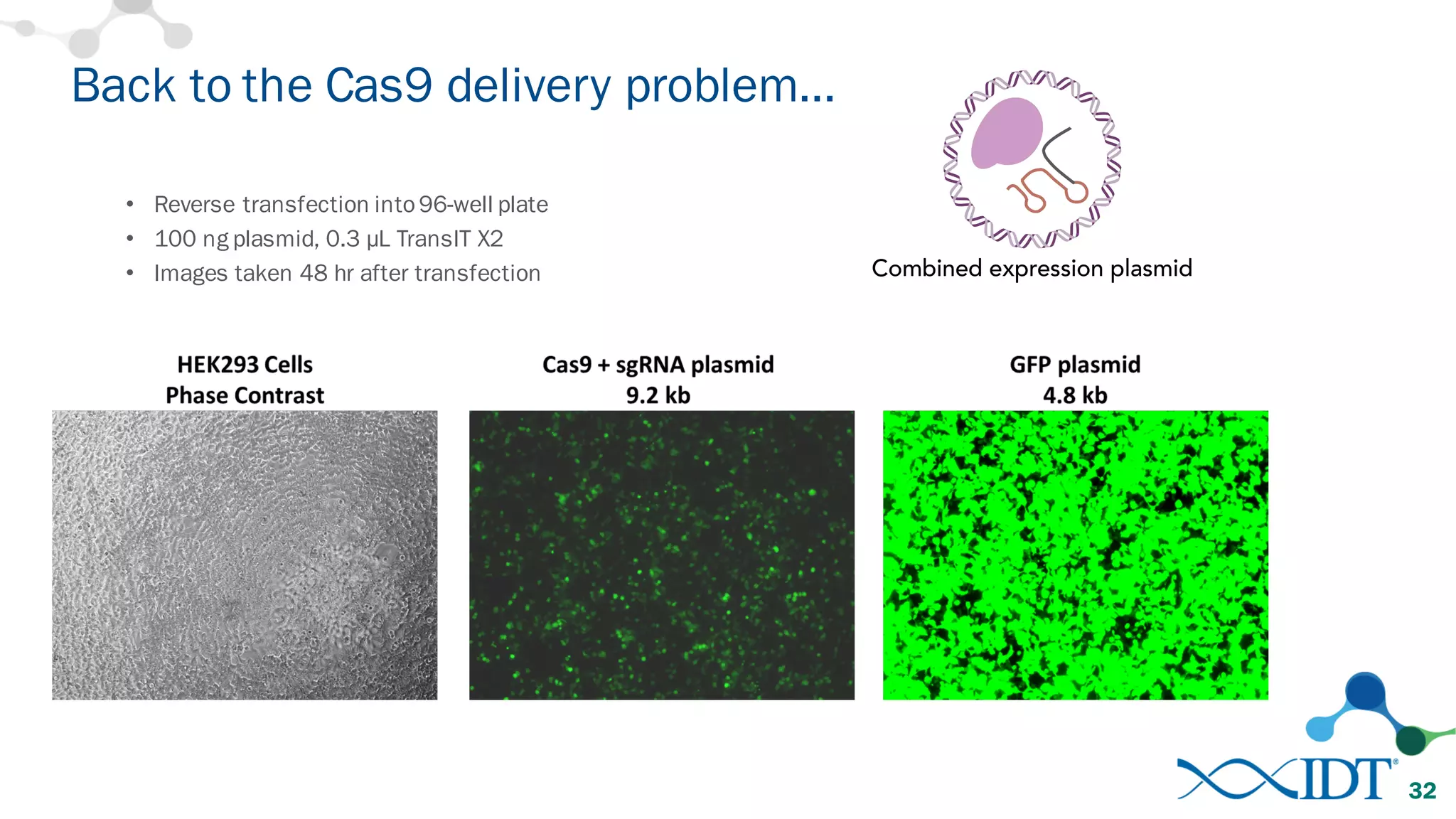
+ or
• Reverse transfection into96-well plate
• 100 ng plasmid, 0.3 µL TransIT X2
• Images taken 48 hr after transfection
Back to the Cas9 delivery problem…
32
IDT Cas9 Expression Plasmid—minimal vector
• Minimal vector (7.3 kb)
– Origin of replication
– Ampicillin resistance
– No selection marker
• Deliver Cas9 expression plasmid, followed by delivery of 2-part RNA
• Improvements in editing, other plasmid associated problems remain
33
• Simple, fast, and robust delivery
– Complex gRNA & Cas9 protein
– Deliver directly to cells using lipofection or
electroporation
• Cas9 RNP = preferred method
– Protection of RNA—reduced risk of degradation
– Higher editing compared to plasmid delivery
– No DNA present—no integration events
– Tight control of Cas9 (on/off, nothing present in the cell
that can make more)
– Reduced risk of mosaicism in animal embryo studies
34
Delivery of CRISPR gRNA + Cas9 protein as ribonucleoprotein complex (RNP)
+
2 part gRNA delivered into HEK-Cas9 cells and RNP delivered into
normal HEK cells result in identical editing efficiency
35
0
10
20
30
40
50
60
70
80
90
100
HPRT	
  
38094	
  S
HPRT	
  
38231	
  S
HPRT	
  
38371	
  S
HPRT	
  
38509	
  S
HPRT	
  
38574	
  S
HPRT	
  
38087	
  AS
HPRT	
  
38133	
  AS
HPRT	
  
38285	
  AS
HPRT	
  
38287	
  AS
HPRT	
  
38358	
  AS
HPRT	
  
38636	
  AS
HPRT	
  
38673	
  AS
T7EI	
  cleavage	
  (%)
HPRT	
  12	
  Sites	
  -­‐2	
  part	
  RNA	
  (30	
  nM)	
  into	
  HEK293-­‐Cas9	
  Cells	
  –0.75	
  µL	
  RNAiMAX

2	
  part	
  RNA	
  +	
  Cas9	
  protein	
  into	
  HEK293	
  Cells
10	
  nM gRNA,	
  10	
  nM Cas9	
  protein	
  –1.2	
  µL	
  RNAiMAX
HEK293-­‐Cas9	
  Cells HEK293	
  cells	
  +	
  Ribonucleoprotein	
  Complex
+or
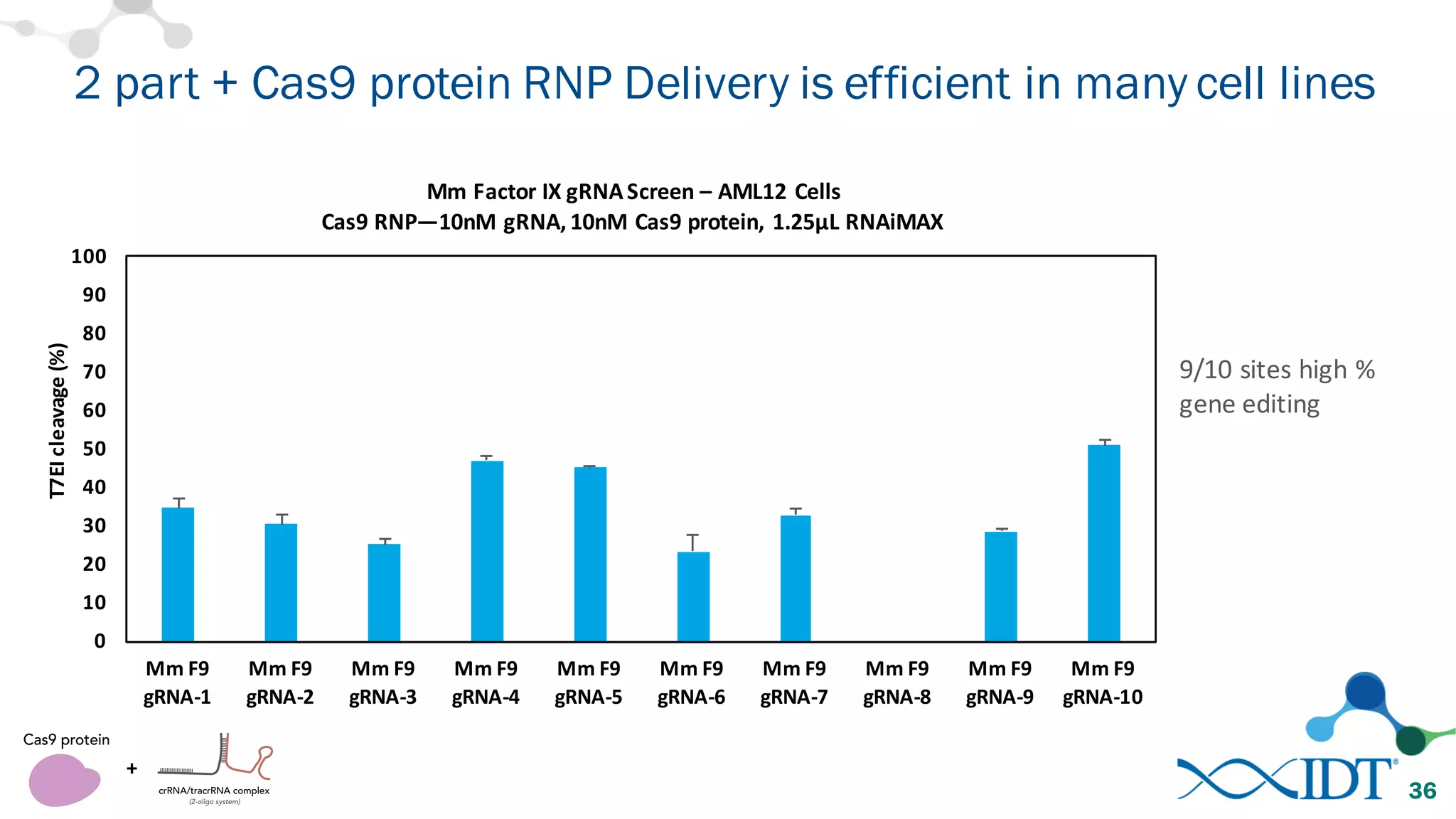
2 part + Cas9 protein RNP Delivery is efficient in many cell lines
36
0
10
20
30
40
50
60
70
80
90
100
Mm	
  F9	
  
gRNA-­‐1
Mm	
  F9	
  
gRNA-­‐2
Mm	
  F9	
  
gRNA-­‐3
Mm	
  F9	
  
gRNA-­‐4
Mm	
  F9	
  
gRNA-­‐5
Mm	
  F9	
  
gRNA-­‐6
Mm	
  F9	
  
gRNA-­‐7
Mm	
  F9	
  
gRNA-­‐8
Mm	
  F9	
  
gRNA-­‐9
Mm	
  F9	
  
gRNA-­‐10
T7EI	
  cleavage	
  (%)
Mm	
  Factor	
  IX	
  gRNA	
  Screen	
  – AML12	
  Cells
Cas9	
  RNP—10nM	
  gRNA,	
  10nM	
  Cas9	
  protein,	
  1.25µL	
  RNAiMAX
9/10	
  sites	
  high	
  %	
  
gene	
  editing
+
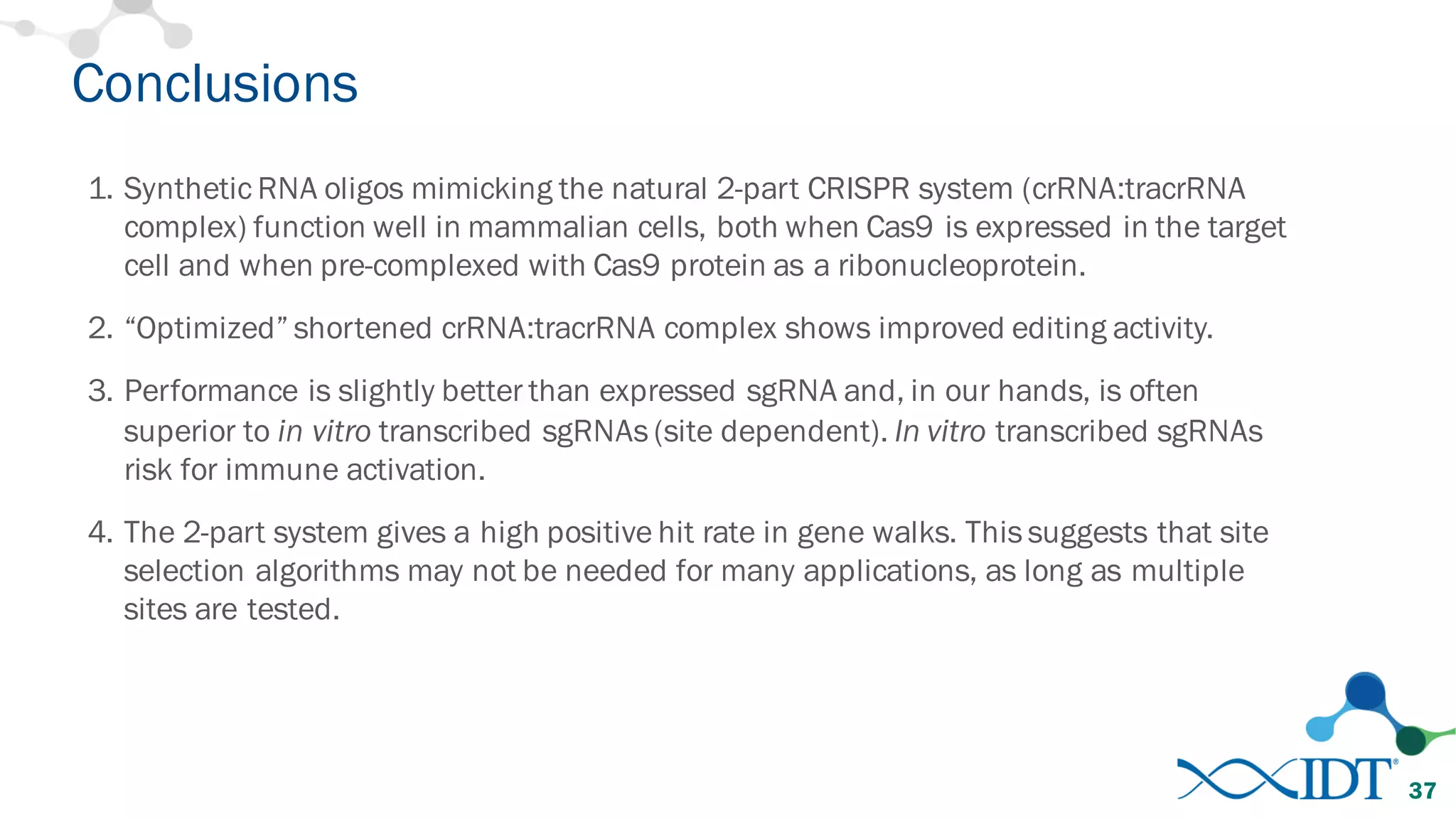
Conclusions
1. Synthetic RNA oligos mimicking the natural 2-part CRISPR system (crRNA:tracrRNA
complex) function well in mammalian cells, both when Cas9 is expressed in the target
cell and when pre-complexed with Cas9 protein as a ribonucleoprotein.
2. “Optimized” shortened crRNA:tracrRNA complex shows improved editing activity.
3. In vitro transcribed sgRNAs have a risk for immune activation.
4. The 2-part system & gBlocks® Gene Fragments both give a high positive hit rate in
gene walks. This suggests that site selection algorithms may not be needed for many
applications, as long as multiple sites are tested.
37
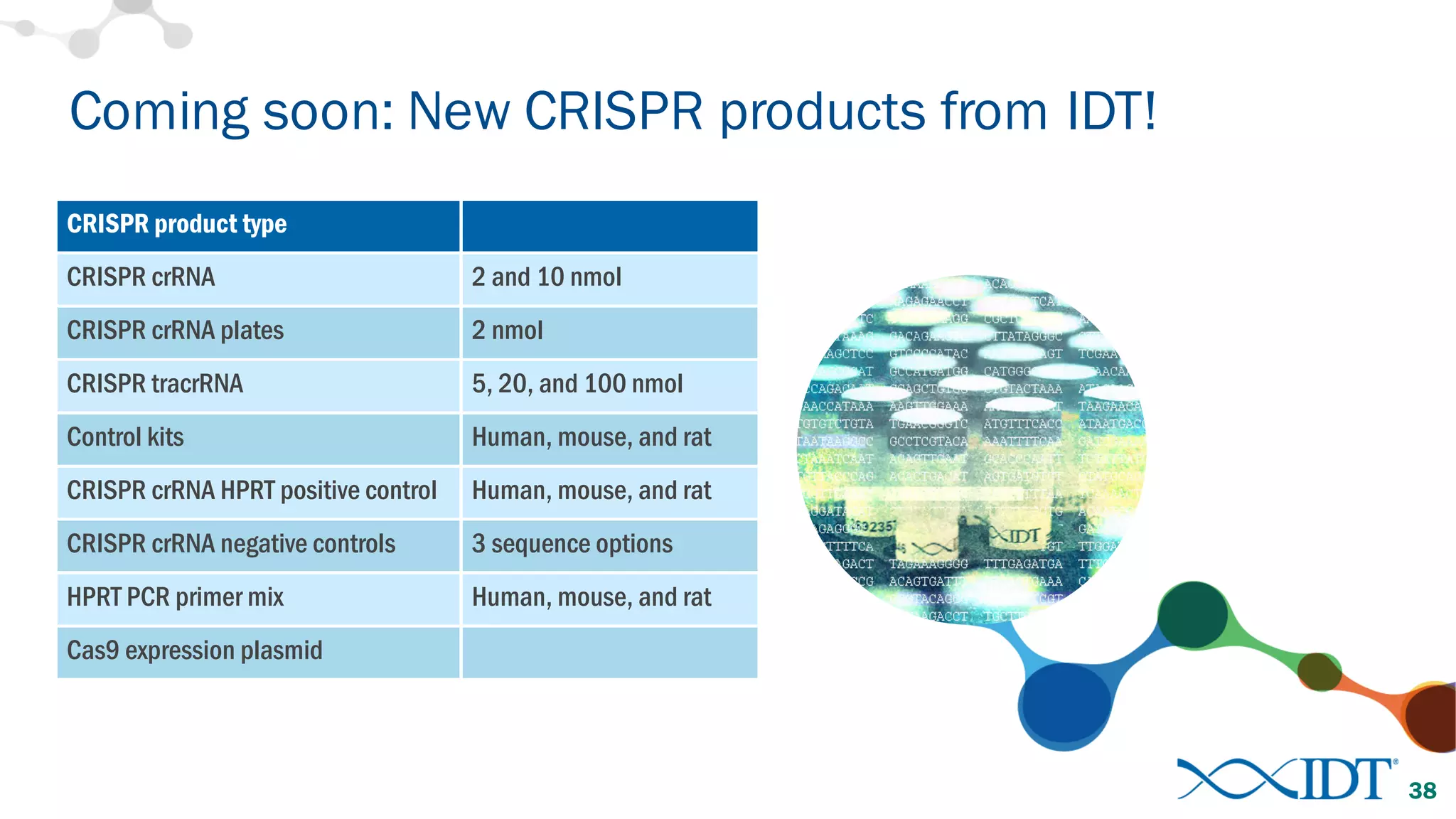
Coming soon: New CRISPR products from IDT!
38
CRISPR product type
CRISPR crRNA 2 and 10 nmol
CRISPR crRNA plates 2 nmol
CRISPR tracrRNA 5, 20, and 100 nmol
Control kits Human, mouse, and rat
CRISPR crRNA HPRT positive control Human, mouse, and rat
CRISPR crRNA negative controls 3 sequence options
HPRT PCR primer mix Human, mouse, and rat
Cas9 expression plasmid
“Best tech
support ever,
@idtdna!”
Questions?
TALK TO A PERSON.
Lauren SakowskiOur experts are availablefor consultation.
“The people
at @idtdna are
awesome. A+ for
customer service.”
Nikolai Braun
Contact us by web chat, email, or phone.
Find local contact details at: www.idtdna.com
Or email: applicationsupport@idtdna.com
This image cannot currently be displayed.
THANK YOU!
We will email you the webinar
recording and slides next week.

New RNA tools for optimized CRISPR/Cas9 genome editing

  • 1.
    Ashley Jacobi, ResearchScientist Integrated DNA Technologies New RNA tools for optimized CRISPR/Cas9 genome editing October 7th , 2015 1
  • 2.
  • 3.
    Options for theCRISPR gRNA 3
  • 4.
    Repair of double-strandedbreaks—HR vs. NHEJ 4
  • 5.
    • S. pyogenesCas9 is a large protein, 1368 aa = 4104 bp • Plasmid containing Cas9: 7–10 kb • Transfection of a large plasmid results in variable and low transfection efficiency, making large quantitative comparison studies difficult Delivery of a Cas9 + sgRNA expressionplasmid is difficult 5 Delivering  large  Cas9  expression  plasmid  to   cells  can  be  difficult
  • 6.
    Optimizing CRISPR gRNAusing HEK293-Cas9 cell line 6 Low, constant level of Cas9 presentin HEK293-Cas9 – Note the extremely high levels of Cas9 presentin just a small fraction (~10%) of transfected cells using plasmid. Can this contribute to OTEs? HEK293-­‐Cas9  Cells Western  blot—Cas9  primary  antibody  
  • 7.
    T7EI mismatch detectionto assay gene disruption 1. Transfect HEK-Cas9 cells with the CRISPR gRNA – Alternatively deliver Cas9 as plasmid, mRNA or protein 2. Incubate 48 hours, then harvest genomic DNA 3. PCR amplify region around CRISPR site (400–1000 base amplicons) – Heat, cool to form heteroduplexes 4. Incubate with T7 Endonuclease I (T7EI, New England BioLabs) 5. Run on gel or Fragment Analyzer™ (Advanced Analytical) to visualize cleavage at heteroduplex mismatch sites 7
  • 8.
    IDT CRISPR geneediting and mutation detection workflow 8 • The Fragment Analyzer™ (Advanced Analytical) provides reliable quantification of T7EI heteroduplex cleavage assay with 96-channel CE – High resolution analysis of fragments 10–40,000 bp – Rapid 1 hr run – 1/10th amount of DNA required to visualize Transfect  2-­‐part   RNA  at  30  nM or   gBlocks  fragment  at   3  nM into  Cas9   expressing  cells Extract  gDNA after   48  hr with   QuickExtract DNA   Solution Heat  gDNA extract   at  65°C  for  15  min   followed  by  95°C   for  15  min Amplify  gDNA with   KAPA  HiFi Polymerase  and   PCR  assay  targeting   region  of  interest Add  NEB  buffer  2  to   PCR,  heat  to  95°C   and  slowly  cool  to   allow  heteroduplex formation Digest   heteroduplexes   with  2  units  of  T7EI   at  37°C  for  1  hr Analyze  digestion   on  Fragment   Analyzer Electropherogramand peaktableof separated sample on FragmentAnalyzer 52%  T7  cleavage
  • 9.
    Options for theCRISPR gRNA 9
  • 10.
    gBlocks® Gene Fragmentsfor CRISPR • Inexpensive gene synthesis product with rapid delivery – High quality double-stranded DNA fragments – 125–2000 bp in length – Sequence verified • CRISPR gBlocks® Gene Fragment = 364 bp sgRNA expression cassette – Comprised of a 265 bp U6 promoter that drives transcription of a 99 base sgRNA www.idtdna.com/CRISPR 10 AAGGTCGGGCAGGAAGAGGGCCTATTTCCCATGATTCCTTCATATTTGCATATACGATACAAGGCTGTTAGAG AGATAATTAGAATTAATTTGACTGTAAACACAAAGATATTAGTACAAAATACGTGACGTAGAAAGTAATAATT TCTTGGGTAGTTTGCAGTTTTAAAATTATGTTTTAAAATGGACTATCATATGCTTACCGTAACTTGAAAGTAT TTCGATTTCTTGGCTTTATATATCTTGTGGAAAGGACGAAACACCGNNNNNNNNNNNNNNNNNNNNGTTTTAG AGCTAGAAATAGCAAGTTAAAATAAGGCTAGTCCGTTATCAACTTGAAAAAGTGGCACCGAGTCGGTGCTTT
  • 11.
    gBlocks® Gene Fragmentsas sgRNA (three methods) 1. Clone gBlocks Gene Fragments into an expression plasmid 2. Use gBlocks Gene Fragment as template for in vitro transcribed sgRNA (IVT sgRNA) 3. Directly transfect gBlocks Gene Fragment into cells without cloning 11 www.idtdna.com/CRISPR http://www.addgene.org/static/cms/files/hCRIS PR_gRNA_Synthesis.pdf gRNA backbone Current Protocols in Molecular Biology (2014), 31.1.1-31.1.17. >14,000  gBlocks® Gene  Fragments  manufactured  for  CRISPR
  • 12.
    CRISPR gBlocks® GeneFragment in HPRT gene (HEK293 Cas9 cells) 12 38094 S 38095 S 38115 S 38129 S 38231 S 38239 S 38256 S 38338 S 38371 S 38448 S 38478 S 38509 S 38510 S 38574 S 38626 S + 23% 46% 21% 0% 31% 27% 3% 47% 0% 41% 14% 39% 4% 36%43%   2%  Agarose  gel Fragment  Analyzer™ Note: sequence analysis shows 30% cleavage in T7EI assay = 60–70% total editing +
  • 13.
    Validation of T7EIassay: % total editing compared to Sanger sequencing Sanger sequence analysis shows 30% cleavage in the T7EI assay = 60–70% actual change at DNA level (T7EI misses small changes like single base indels) 13 • Amplicons resulting in varying editing efficiencies viaT7EI were cloned and sequenced. T7EI  cleavage  (%)
  • 14.
    CRISPR gBlocks® GeneFragments sgRNA perform well across many sites (3 genes; 301 sites) 14 0 10 20 30 40 50 60 70 80 90 100 %  Cleavage  via  2U  T7EI   167  EMX1  Exon  3  (64%  GC) 91%* 0 10 20 30 40 50 60 70 80 90 100 %  Cleavage  via  2U  T7E1I   92  STAT3  Exon  5/6  (47%  GC) 76%* 0 10 20 30 40 50 60 70 80 90 100 %  Cleavage  via  2U  T7EI   42  HPRT  Exon  7  (36%  GC) 81%* sgRNAs expressed from gBlocks Gene Fragments work well without the need to cloneintoplasmids Directly transfect intoHEK-Cas9 cells at 3 nM Every PAM sitein 3 exons * Percentageof sgRNA designs with >20% editing efficiency by T7EI assay +
  • 15.
    Options for theCRISPR gRNA 15
  • 16.
    Options for theCRISPR gRNA 16 UUAUAUCCAACACUUCGUGGUUUUAGA-­‐-­‐GCUAG |||||||      ||||  A |||||||      ||||  A C-­‐GGAAUAAAAUUGAACGAUA U|  || A|  || GUCCGUUAUCAACUUG ||||  A ||||  A AGCCACGGUGAAA G  |||||| UCGGUGCUUU sgRNA: 99–123 bases (99mershown) 20 base “protospacer” guide, target specific • Near the length limit for chemical manufacturing • Expensive to chemically make long sgRNAs for many sites This form is used in our gBlocks® Gene Fragment sgRNA expression cassette UUAUAUCCAACACUUCGUGGUUUUAGA-­‐-­‐GCUAUGCUGUUUUG |||||||      |||||||||||||| C-­‐GGAAUAAAAUUGAACGAUACGACAAAACUUACCAAGGUUG U|  || A|  || GUCCGUUAUCAACUUG ||||  A ||||  A AGCCACGGUGAAA G  |||||| UCGGUGCUUUUUUU crRNA: 42 bases (target specific) tracrRNA: 89 bases (universal) • 42mer target specific (20 base target, 22 base constant) • 89mer universal tracrRNA—can be made in bulk, making them more affordable Can these be optimized and shortened to improve function and lower cost?
  • 17.
    Optimized  length  of  crRNA  and  tracrRNA crRNA: 42 bases (20+22) tracrRNA: 89 bases (universal) UUAUAUCCAACACUUCGUGGUUUUAGA-­‐-­‐GCUAUGCUGUUUUG |||||||      |||||||||||||| C-­‐GGAAUAAAAUUGAACGAUACGACAAAACUUACCAAGGUUG U|  || A|  || GUCCGUUAUCAACUUG ||||  A ||||  A AGCCACGGUGAAA G  |||||| UCGGUGCUUUUUUU Native sequence Shorter Shorter… Short
  • 18.
    Both the crRNAand the tracrRNA can be truncated 18 1. Short/Short 2. Long/Short 3. Short/Long 4. Long/Long Worse Worse when too short Better
  • 19.
    19 0 10 20 30 40 50 60 70 80 90 100 89  nt  tracrRNA74  nt  tracrRNA 70  nt  tracrRNA 67  nt  tracrRNA 65  nt  tracrRNA 63  nt  tracrRNA T7EI  cleavage  (%) 42-­‐nt  crRNA 39-­‐nt  crRNA 36-­‐nt  crRNA 34-­‐nt  crRNA Length optimization of crRNA & tracrRNA HPRT 38285 gRNA (HEK293 Cas9 Cells) Optimal  length  for  crRNA  is  36  nt;  optimal  tracrRNA  is  67  nt +
  • 20.
    0 10 20 30 40 50 60 70 80 90 100 HPRT   38094  S HPRT   38231  S HPRT   38371  S HPRT   38509  S HPRT   38574  S HPRT   38087  AS HPRT   38133  AS HPRT   38285  AS HPRT   38287  AS HPRT   38358  AS HPRT   38636  AS   HPRT   38673  AS   T7EI  cleavage  (%) CRISPR  gRNA  Comparison—12  gRNAs  Targeting  HPRT (HEK293-­‐Cas9  Cells) 2-­‐part  RNA  (36/67) Native  RNA  (42/89) In  vitro  transcribed  sgRNA sgRNA  Expression  Plasmid  (2.7  kb) gBlocks  Gene  Fragments  sgRNA Optimized 2-part CRISPR RNAs are superior to other gRNAs 20 HEK-­‐Cas9  cells 2-­‐part  RNA  (30  nM) IVT  RNA  (30  nM) Plasmid  (100  ng) gBlocks  Fragment  (3  nM) + or or or
  • 21.
    Highly purified oligosare necessary for longer tracrRNAs 21 HEK-­‐Cas9  cells 2-­‐part  RNA,  30  nM Desalt  crRNA Desalt  vs.  HPLC   tracrRNA 1. Shortened   crRNA:tracrRNA performs  better  than  native  form 2. 67mer  tracrRNA  functions  well  as  desalted,  shows  slight  improvement  as  HPLC 3. Native  89mer  tracrRNA  requires  highly  purified  synthesis 0 10 20 30 40 50 60 70 80 HPRT   38094  S HPRT   38231  S HPRT   38371  S HPRT   38509  S HPRT   38574  S HPRT   38087  AS HPRT   38133  AS HPRT   38285  AS HPRT   38287  AS HPRT   38358  AS HPRT   38636  AS HPRT   38673  AS T7EI  cleavage    (%) HPLC  vs.  Desalted  RNA  Oligos  – HPRT  12  sites (HEK293  Cas9  cells) short  crRNA  (36nt)  :  short  tracrRNA  desalt  (67nt) short  crRNA  (36nt)  :  short  tracrRNA  HPLC  (67nt) long  crRNA  (42nt)  :  long  tracrRNA  desalt  (89nt) long  crRNA  (42nt)  :  long  tracrRNA  HPLC  (89nt) +
  • 22.
    2-part RNA oligoswill be available from IDT this month! • crRNA – 36 nt custom desalted RNA oligo – Ability to order in 96-well plate format – 2 or 10 nmol • tracrRNA – 67 nt HPLC purified RNA oligo – Modified for nuclease stability – 5, 20, or 100 nmol 22
  • 23.
    Be sure tocheck QC data on long synthetic RNAs 23 IDT  tracrRNA Vendor  “X”  tracrRNA ESI-­‐MS  
  • 24.
    2-part RNA systemfunctions well across many sites 24All PAM sites in 6 exons, 553 sites (HEK293 Cas9 Cells) * ** * * * * Percentageof sgRNA designs with >20% editing efficiency by T7EI assay +
  • 25.
    Summary of 2-partRNA functional performance in HEK-Cas9 cells 553 guide sites in 6 exons from 4 human genes 25 Target amplicon Number ofsites % >15% T7 cleavage % >20% T7 cleavage HPRT exon 7 (36% GC) 42 40/42 = 95% 40/42 = 95% HPRT exon 1 (62% GC) 164 135/164 = 82% 123/164 = 75% EMX1 exon 3 (64% GC) 167 151/167 = 90% 143/167 = 86% EMX1 exon 5/6 (40% GC) 59 56/59 = 95% 53/59 = 90% STAT3 exon 5/6 (47% GC) 92 86/92 = 93% 86/92 = 93% DICER exon 8 (38% GC) 29 28/29 = 97% 28/29 = 97% Total 553 496/553 = 90% 473/553 = 86% +
  • 26.
    Comparison of gBlocks®Gene Fragments sgRNAs vs. 2-part RNA 26 + or * * * * * *
  • 27.
    CRISPR on-target mutationprofiles for varying RNA Triggers 27 • Sanger sequencing of amplicons from one target site in HPRT as varying RNA triggers
  • 28.
    Although use ofshorter 17mer guides has been reported toreduce off- target effects, 17mer guides can result in far worse on-target results. Other design features to consider — shorter protospacer? 28 0 10 20 30 40 50 60 70 80 90 100 HPRT   38094  S   HPRT   38231  S   HPRT   38371  S HPRT   38509  S   HPRT   38574  S   HPRT   38087   AS   HPRT   38133   AS HPRT   38285   AS   HPRT   38287   AS   HPRT   38358   AS   HPRT   38636   AS   HPRT   38673   AS   T7EI  cleavage  (%) Guide  RNA  length  study—20  vs.  19  vs.  18  vs.  17  nt (HEK293  Cas9  Cells) 20  nt 19  nt 18  nt 17  nt +
  • 29.
    • Transfection ofin vitro transcribed sgRNAs sometimes resulted in large scale cell death. Comparison of in vitro transcribed sgRNAs to 2-part RNAs 29 MEGAshortscript T7                                   IVT  Kit  (Ambion) HiScribe T7  High  Yield   IVT  Kit  (NEB)
  • 30.
    Activity of 2-partRNAs vs. in vitro transcribed sgRNAs 30 0 10 20 30 40 50 60 70 80 90 100 HPRT   38094  S   HPRT   38231  S   HPRT   38371  S   HPRT   38509  S   HPRT   38574  S   HPRT   38087  AS HPRT   38133  AS HPRT   38285  AS HPRT   38287  AS HPRT   38358  AS HPRT   38636  AS HPRT   38673  AS T7EI  cleavage  (%) 2-­‐part  RNA  vs.  IVT  sgRNA—HPRT  12  sites (HEK293  Cas9  Cells)   2  part  RNA   IVT  sgRNA -­‐ + or
  • 31.
    In vitro transcribedsgRNAs trigger immune response, 2-part RNA oligos do not (HEK-Cas9 cells) 31 • IFITM1, RIGI, and OAS2 had similarly high induction when treated with in vitro transcribed sgRNA (triphosphate removed) • No inductions were detected when treated with 2-part RNA oligos + or
  • 32.
    • Reverse transfectioninto96-well plate • 100 ng plasmid, 0.3 µL TransIT X2 • Images taken 48 hr after transfection Back to the Cas9 delivery problem… 32
  • 33.
    IDT Cas9 ExpressionPlasmid—minimal vector • Minimal vector (7.3 kb) – Origin of replication – Ampicillin resistance – No selection marker • Deliver Cas9 expression plasmid, followed by delivery of 2-part RNA • Improvements in editing, other plasmid associated problems remain 33
  • 34.
    • Simple, fast,and robust delivery – Complex gRNA & Cas9 protein – Deliver directly to cells using lipofection or electroporation • Cas9 RNP = preferred method – Protection of RNA—reduced risk of degradation – Higher editing compared to plasmid delivery – No DNA present—no integration events – Tight control of Cas9 (on/off, nothing present in the cell that can make more) – Reduced risk of mosaicism in animal embryo studies 34 Delivery of CRISPR gRNA + Cas9 protein as ribonucleoprotein complex (RNP) +
  • 35.
    2 part gRNAdelivered into HEK-Cas9 cells and RNP delivered into normal HEK cells result in identical editing efficiency 35 0 10 20 30 40 50 60 70 80 90 100 HPRT   38094  S HPRT   38231  S HPRT   38371  S HPRT   38509  S HPRT   38574  S HPRT   38087  AS HPRT   38133  AS HPRT   38285  AS HPRT   38287  AS HPRT   38358  AS HPRT   38636  AS HPRT   38673  AS T7EI  cleavage  (%) HPRT  12  Sites  -­‐2  part  RNA  (30  nM)  into  HEK293-­‐Cas9  Cells  –0.75  µL  RNAiMAX 2  part  RNA  +  Cas9  protein  into  HEK293  Cells 10  nM gRNA,  10  nM Cas9  protein  –1.2  µL  RNAiMAX HEK293-­‐Cas9  Cells HEK293  cells  +  Ribonucleoprotein  Complex +or
  • 36.
    2 part +Cas9 protein RNP Delivery is efficient in many cell lines 36 0 10 20 30 40 50 60 70 80 90 100 Mm  F9   gRNA-­‐1 Mm  F9   gRNA-­‐2 Mm  F9   gRNA-­‐3 Mm  F9   gRNA-­‐4 Mm  F9   gRNA-­‐5 Mm  F9   gRNA-­‐6 Mm  F9   gRNA-­‐7 Mm  F9   gRNA-­‐8 Mm  F9   gRNA-­‐9 Mm  F9   gRNA-­‐10 T7EI  cleavage  (%) Mm  Factor  IX  gRNA  Screen  – AML12  Cells Cas9  RNP—10nM  gRNA,  10nM  Cas9  protein,  1.25µL  RNAiMAX 9/10  sites  high  %   gene  editing +
  • 37.
    Conclusions 1. Synthetic RNAoligos mimicking the natural 2-part CRISPR system (crRNA:tracrRNA complex) function well in mammalian cells, both when Cas9 is expressed in the target cell and when pre-complexed with Cas9 protein as a ribonucleoprotein. 2. “Optimized” shortened crRNA:tracrRNA complex shows improved editing activity. 3. In vitro transcribed sgRNAs have a risk for immune activation. 4. The 2-part system & gBlocks® Gene Fragments both give a high positive hit rate in gene walks. This suggests that site selection algorithms may not be needed for many applications, as long as multiple sites are tested. 37
  • 38.
    Coming soon: NewCRISPR products from IDT! 38 CRISPR product type CRISPR crRNA 2 and 10 nmol CRISPR crRNA plates 2 nmol CRISPR tracrRNA 5, 20, and 100 nmol Control kits Human, mouse, and rat CRISPR crRNA HPRT positive control Human, mouse, and rat CRISPR crRNA negative controls 3 sequence options HPRT PCR primer mix Human, mouse, and rat Cas9 expression plasmid
  • 39.
    “Best tech support ever, @idtdna!” Questions? TALKTO A PERSON. Lauren SakowskiOur experts are availablefor consultation. “The people at @idtdna are awesome. A+ for customer service.” Nikolai Braun Contact us by web chat, email, or phone. Find local contact details at: www.idtdna.com Or email: applicationsupport@idtdna.com
  • 40.
    This image cannotcurrently be displayed. THANK YOU! We will email you the webinar recording and slides next week.