CRISPR cas : A new genome editing tool
Presented by
Surbhaiyya shobha devidas
Ph.D Scholar
Dr. PDKV, Akola
1
1. Introduction
2. History
3. CRISPR in bacteria
4. Classification of CRISPR
5. General structure of cas9 protein
6. Mechanism of CRISPR cas9
7. Applications
8. Data base of CRISPR
9. Case study
10. Conclusion
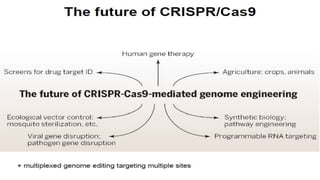
11. Future aspects
Content…
• Genome editing, or genome editing with engineered nucleases (GEEN) is a type
of genetic engineering in which DNA is inserted, replaced, or removed from
a genome using artificially engineered nucleases, or "molecular scissors”.
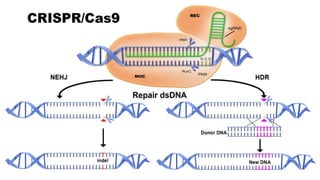
• The nucleases create specific double-strand breaks (DSBs) at desired locations in the
genome and harness the cell’s endogenous mechanisms to repair the induced break by
natural processes of homologous recombination (HR) and non-homologous end-
joining (NHEJ).
3
introduction…
To understand the function of a gene or a protein, one interferes with it in a sequence-specific way and
monitors its effects on the organism.
In some organisms, it is difficult or impossible to perform site-specific mutagenesis, and therefore more
indirect methods must be used, such as silencing the gene of interest by short RNA interference (siRNA).
But sometime gene disruption by siRNA can be variable or incomplete.
Nucleases such as CRISPR can cut any targeted position in the genome and introduce a modification of the
endogenous sequences for genes that are impossible to specifically target using conventional RNAi.
4
Why genome editing?
5
5
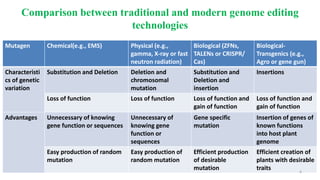
Comparison between traditional and modern genome editing
technologies
Mutagen Chemical(e.g., EMS) Physical (e.g.,
gamma, X-ray or fast
neutron radiation)
Biological (ZFNs,
TALENs or CRISPR/
Cas)
Biological-
Transgenics (e.g.,
Agro or gene gun)
Characteristi
cs of genetic
variation
Substitution and Deletion Deletion and
chromosomal
mutation
Substitution and
Deletion and
insertion
Insertions
Loss of function Loss of function Loss of function and
gain of function
Loss of function and
gain of function
Advantages Unnecessary of knowing
gene function or sequences
Unnecessary of
knowing gene
function or
sequences
Gene specific
mutation
Insertion of genes of
known functions
into host plant
genome
Easy production of random
mutation
Easy production of
random mutation
Efficient production
of desirable
mutation
Efficient creation of
plants with desirable
traits 6
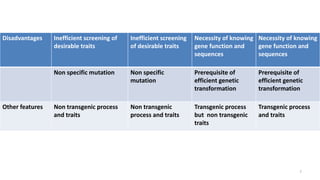
Disadvantages Inefficient screening of
desirable traits
Inefficient screening
of desirable traits
Necessity of knowing
gene function and
sequences
Necessity of knowing
gene function and
sequences
Non specific mutation Non specific
mutation
Prerequisite of
efficient genetic
transformation
Prerequisite of
efficient genetic
transformation
Other features Non transgenic process
and traits
Non transgenic
process and traits
Transgenic process
but non transgenic
traits
Transgenic process
and traits
7
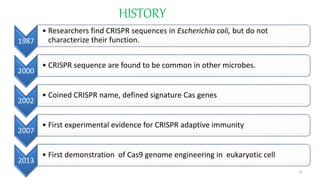
1987
• Researchers find CRISPR sequences in Escherichia coli, but do not
characterize their function.
2000
• CRISPR sequence are found to be common in other microbes.
2002
• Coined CRISPR name, defined signature Cas genes
2007
• First experimental evidence for CRISPR adaptive immunity
2013
• First demonstration of Cas9 genome engineering in eukaryotic cell
HISTORY
8
CRISPR – Cas systems
• These are the part of the Bacterial immune system which detects
and recognize the foreign DNA and cleaves it.
1. THE CRISPR (Clustered Regularly Interspaced Short Palindromic Repeats)
loci
2. Cas (CRISPR- associated) proteins can target and cleave invading DNA in a
sequence – specific manner.
A CRISPR array is composed of a series of repeats interspaced by
spacer sequences acquired from invading genomes.
9
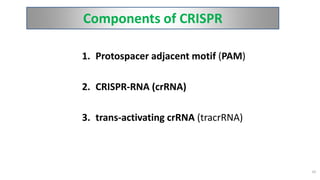
Components of CRISPR
1. Protospacer adjacent motif (PAM)
2. CRISPR-RNA (crRNA)
3. trans-activating crRNA (tracrRNA)
10
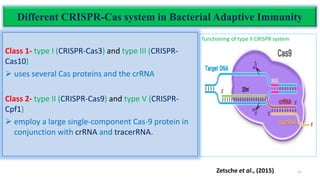
Different CRISPR-Cas system in Bacterial Adaptive Immunity
Class 1- type I (CRISPR-Cas3) and type III (CRISPR-
Cas10)
 uses several Cas proteins and the crRNA
Class 2- type II (CRISPR-Cas9) and type V (CRISPR-
Cpf1)
 employ a large single-component Cas-9 protein in
conjunction with crRNA and tracerRNA.
11Zetsche et al., (2015)
functioning of type II CRISPR system
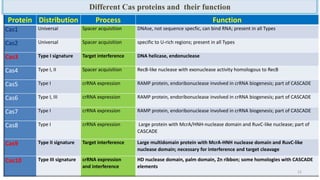
Different Cas proteins and their function
Protein Distribution Process Function
Cas1 Universal Spacer acquisition DNAse, not sequence specfic, can bind RNA; present in all Types
Cas2 Universal Spacer acquisition specific to U-rich regions; present in all Types
Cas3 Type I signature Target interference DNA helicase, endonuclease
Cas4 Type I, II Spacer acquisition RecB-like nuclease with exonuclease activity homologous to RecB
Cas5 Type I crRNA expression RAMP protein, endoribonuclease involved in crRNA biogenesis; part of CASCADE
Cas6 Type I, III crRNA expression RAMP protein, endoribonuclease involved in crRNA biogenesis; part of CASCADE
Cas7 Type I crRNA expression RAMP protein, endoribonuclease involved in crRNA biogenesis; part of CASCADE
Cas8 Type I crRNA expression Large protein with McrA/HNH-nuclease domain and RuvC-like nuclease; part of
CASCADE
Cas9 Type II signature Target interference Large multidomain protein with McrA-HNH nuclease domain and RuvC-like
nuclease domain; necessary for interference and target cleavage
Cas10 Type III signature crRNA expression
and interference
HD nuclease domain, palm domain, Zn ribbon; some homologies with CASCADE
elements
12
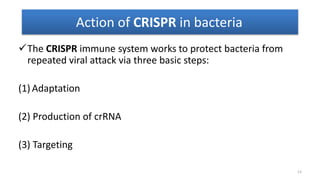
Action of CRISPR in bacteria
The CRISPR immune system works to protect bacteria from
repeated viral attack via three basic steps:
(1) Adaptation
(2) Production of crRNA
(3) Targeting
13
14
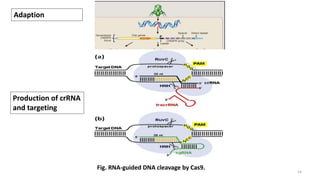
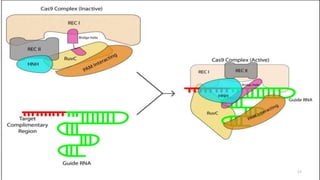
Fig. RNA-guided DNA cleavage by Cas9.
Adaption
Production of crRNA
and targeting
15
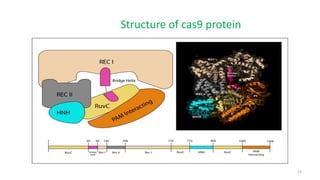
Structure of cas9 protein
16
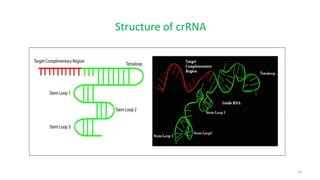
Structure of crRNA
17
18
19
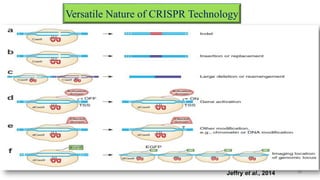
Versatile Nature of CRISPR Technology
20Jeffry et al., 2014
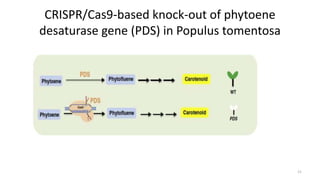
CRISPR/Cas9-based knock-out of phytoene
desaturase gene (PDS) in Populus tomentosa
21
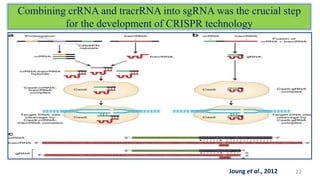
Combining crRNA and tracrRNA into sgRNA was the crucial step
for the development of CRISPR technology
22Joung et al., 2012
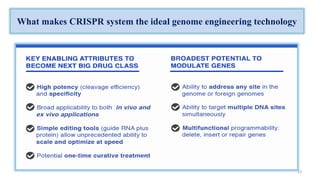
What makes CRISPR system the ideal genome engineering technology
23
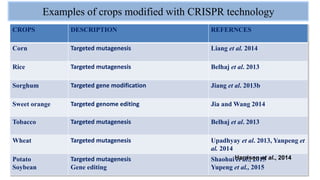
Examples of crops modified with CRISPR technology
24
CROPS DESCRIPTION REFERNCES
Corn Targeted mutagenesis Liang et al. 2014
Rice Targeted mutagenesis Belhaj et al. 2013
Sorghum Targeted gene modification Jiang et al. 2013b
Sweet orange Targeted genome editing Jia and Wang 2014
Tobacco Targeted mutagenesis Belhaj et al. 2013
Wheat Targeted mutagenesis Upadhyay et al. 2013, Yanpeng et
al. 2014
Potato
Soybean
Targeted mutagenesis
Gene editing
Shaohui et al., 2015
Yupeng et al., 2015
Harrison et al., 2014
Genome editing
tool
Transformation
method
Crops Targeted genes
25
26
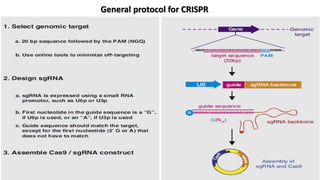
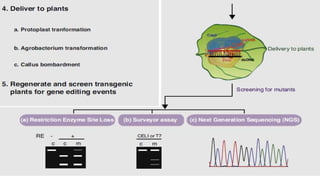
General protocol for CRISPR
27
RECENT ADVANCES
Discovery of new version of Cas9
28
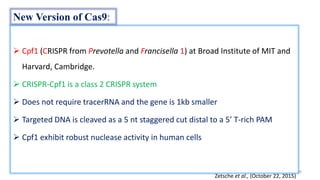
 Cpf1 (CRISPR from Prevotella and Francisella 1) at Broad Institute of MIT and
Harvard, Cambridge.
 CRISPR-Cpf1 is a class 2 CRISPR system
 Does not require tracerRNA and the gene is 1kb smaller
 Targeted DNA is cleaved as a 5 nt staggered cut distal to a 5’ T-rich PAM
 Cpf1 exhibit robust nuclease activity in human cells
29
Zetsche et al., (October 22, 2015)
New Version of Cas9:
30
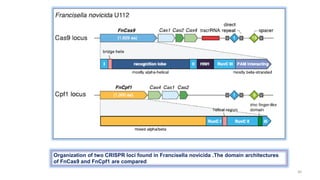
Organization of two CRISPR loci found in Francisella novicida .The domain architectures
of FnCas9 and FnCpf1 are compared
Application in Agriculture
 Can be used to create high degree of genetic variability at precise locus in the
genome of the crop plants.
 Potential tool for multiplexed reverse and forward genetic study.
 Precise transgene integration at specific loci.
 Developing biotic and abiotic resistant traits in crop plants.
 Potential tool for developing virus resistant crop varieties.
 Can be used to eradicate unwanted species like herbicide resistant weeds,
insect pest.
 Potential tool for improving polyploidy crops like potato and wheat.
31
sgRNA designing tools
 Optimized CRISPR Design (Feng Zhang's Lab at MIT/BROAD, USA)
 sgRNA Scorer (George Church's Lab at Harvard, USA)
 sgRNA Designer (BROAD Institute)
 ChopChop web tool (George Church's Lab at Harvard, USA)
 E-CRISP (Michael Boutros' lab at DKFZ, Germany)
 CRISPR Finder (Wellcome Trust Sanger Institute, Hinxton, UK)
 RepeatMasker (Institute for Systems Biology) to double check and avoid selecting target sites
with repeated sequences
32
33
34
Case Studies
35
Targeted genome modifications in soybean with
CRISPR/Cas9
Jacobs et al.(2015) USA
Case study-1
MATERIALS AND METHODS
• Plant material – Soybean line
• Plasmid construction of cas9 and sgRNA
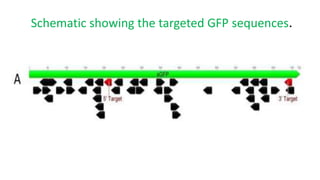
Two GFP-targeting gRNA vectors were designed;
one gRNA was designed to target the 5′ end of GFP (5′- target) and a second was
designed to target the 3′ end (3′-target)
• Hairy root transformation of soybean by A. rhizogenes (strain K599)
• GFP imaging via Olympus MVX10 microscope with a GFP filter
• sequencing and analysis
37
Schematic showing the targeted GFP sequences.
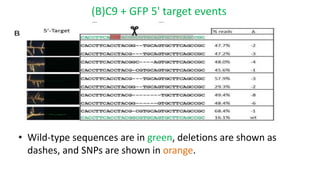
(B)C9 + GFP 5' target events
• Wild-type sequences are in green, deletions are shown as
dashes, and SNPs are shown in orange.
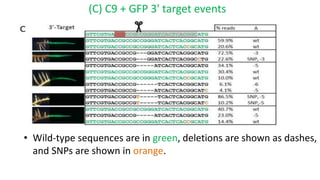
(C) C9 + GFP 3' target events
• Wild-type sequences are in green, deletions are shown as dashes,
and SNPs are shown in orange.
Conclusion…
Genome editing tools provide new strategies for genetic manipulation in
plants and are likely to assist in engineering desired plant traits by
modifying endogenous genes.
Genome editing technology will have a major impact in applied crop
improvement and commercial product development .
In gene modification, these targetable nucleases have potential
applications to become alternatives to standard breeding methods to
identify novel traits in economically important plants and more valuable in
biotechnology as modifying specific site rather than whole gene.
41
43

Crisper Cas system

  • 1.
    CRISPR cas :A new genome editing tool Presented by Surbhaiyya shobha devidas Ph.D Scholar Dr. PDKV, Akola 1
  • 2.
    1. Introduction 2. History 3.CRISPR in bacteria 4. Classification of CRISPR 5. General structure of cas9 protein 6. Mechanism of CRISPR cas9 7. Applications 8. Data base of CRISPR 9. Case study 10. Conclusion 11. Future aspects Content…
  • 3.
    • Genome editing,or genome editing with engineered nucleases (GEEN) is a type of genetic engineering in which DNA is inserted, replaced, or removed from a genome using artificially engineered nucleases, or "molecular scissors”. • The nucleases create specific double-strand breaks (DSBs) at desired locations in the genome and harness the cell’s endogenous mechanisms to repair the induced break by natural processes of homologous recombination (HR) and non-homologous end- joining (NHEJ). 3 introduction…
  • 4.
    To understand thefunction of a gene or a protein, one interferes with it in a sequence-specific way and monitors its effects on the organism. In some organisms, it is difficult or impossible to perform site-specific mutagenesis, and therefore more indirect methods must be used, such as silencing the gene of interest by short RNA interference (siRNA). But sometime gene disruption by siRNA can be variable or incomplete. Nucleases such as CRISPR can cut any targeted position in the genome and introduce a modification of the endogenous sequences for genes that are impossible to specifically target using conventional RNAi. 4 Why genome editing?
  • 5.
  • 6.
    Comparison between traditionaland modern genome editing technologies Mutagen Chemical(e.g., EMS) Physical (e.g., gamma, X-ray or fast neutron radiation) Biological (ZFNs, TALENs or CRISPR/ Cas) Biological- Transgenics (e.g., Agro or gene gun) Characteristi cs of genetic variation Substitution and Deletion Deletion and chromosomal mutation Substitution and Deletion and insertion Insertions Loss of function Loss of function Loss of function and gain of function Loss of function and gain of function Advantages Unnecessary of knowing gene function or sequences Unnecessary of knowing gene function or sequences Gene specific mutation Insertion of genes of known functions into host plant genome Easy production of random mutation Easy production of random mutation Efficient production of desirable mutation Efficient creation of plants with desirable traits 6
  • 7.
    Disadvantages Inefficient screeningof desirable traits Inefficient screening of desirable traits Necessity of knowing gene function and sequences Necessity of knowing gene function and sequences Non specific mutation Non specific mutation Prerequisite of efficient genetic transformation Prerequisite of efficient genetic transformation Other features Non transgenic process and traits Non transgenic process and traits Transgenic process but non transgenic traits Transgenic process and traits 7
  • 8.
    1987 • Researchers findCRISPR sequences in Escherichia coli, but do not characterize their function. 2000 • CRISPR sequence are found to be common in other microbes. 2002 • Coined CRISPR name, defined signature Cas genes 2007 • First experimental evidence for CRISPR adaptive immunity 2013 • First demonstration of Cas9 genome engineering in eukaryotic cell HISTORY 8
  • 9.
    CRISPR – Cassystems • These are the part of the Bacterial immune system which detects and recognize the foreign DNA and cleaves it. 1. THE CRISPR (Clustered Regularly Interspaced Short Palindromic Repeats) loci 2. Cas (CRISPR- associated) proteins can target and cleave invading DNA in a sequence – specific manner. A CRISPR array is composed of a series of repeats interspaced by spacer sequences acquired from invading genomes. 9
  • 10.
    Components of CRISPR 1.Protospacer adjacent motif (PAM) 2. CRISPR-RNA (crRNA) 3. trans-activating crRNA (tracrRNA) 10
  • 11.
    Different CRISPR-Cas systemin Bacterial Adaptive Immunity Class 1- type I (CRISPR-Cas3) and type III (CRISPR- Cas10)  uses several Cas proteins and the crRNA Class 2- type II (CRISPR-Cas9) and type V (CRISPR- Cpf1)  employ a large single-component Cas-9 protein in conjunction with crRNA and tracerRNA. 11Zetsche et al., (2015) functioning of type II CRISPR system
  • 12.
    Different Cas proteinsand their function Protein Distribution Process Function Cas1 Universal Spacer acquisition DNAse, not sequence specfic, can bind RNA; present in all Types Cas2 Universal Spacer acquisition specific to U-rich regions; present in all Types Cas3 Type I signature Target interference DNA helicase, endonuclease Cas4 Type I, II Spacer acquisition RecB-like nuclease with exonuclease activity homologous to RecB Cas5 Type I crRNA expression RAMP protein, endoribonuclease involved in crRNA biogenesis; part of CASCADE Cas6 Type I, III crRNA expression RAMP protein, endoribonuclease involved in crRNA biogenesis; part of CASCADE Cas7 Type I crRNA expression RAMP protein, endoribonuclease involved in crRNA biogenesis; part of CASCADE Cas8 Type I crRNA expression Large protein with McrA/HNH-nuclease domain and RuvC-like nuclease; part of CASCADE Cas9 Type II signature Target interference Large multidomain protein with McrA-HNH nuclease domain and RuvC-like nuclease domain; necessary for interference and target cleavage Cas10 Type III signature crRNA expression and interference HD nuclease domain, palm domain, Zn ribbon; some homologies with CASCADE elements 12
  • 13.
    Action of CRISPRin bacteria The CRISPR immune system works to protect bacteria from repeated viral attack via three basic steps: (1) Adaptation (2) Production of crRNA (3) Targeting 13
  • 14.
    14 Fig. RNA-guided DNAcleavage by Cas9. Adaption Production of crRNA and targeting
  • 15.
  • 16.
  • 17.
  • 18.
  • 19.
  • 20.
    Versatile Nature ofCRISPR Technology 20Jeffry et al., 2014
  • 21.
    CRISPR/Cas9-based knock-out ofphytoene desaturase gene (PDS) in Populus tomentosa 21
  • 22.
    Combining crRNA andtracrRNA into sgRNA was the crucial step for the development of CRISPR technology 22Joung et al., 2012
  • 23.
    What makes CRISPRsystem the ideal genome engineering technology 23
  • 24.
    Examples of cropsmodified with CRISPR technology 24 CROPS DESCRIPTION REFERNCES Corn Targeted mutagenesis Liang et al. 2014 Rice Targeted mutagenesis Belhaj et al. 2013 Sorghum Targeted gene modification Jiang et al. 2013b Sweet orange Targeted genome editing Jia and Wang 2014 Tobacco Targeted mutagenesis Belhaj et al. 2013 Wheat Targeted mutagenesis Upadhyay et al. 2013, Yanpeng et al. 2014 Potato Soybean Targeted mutagenesis Gene editing Shaohui et al., 2015 Yupeng et al., 2015 Harrison et al., 2014
  • 25.
  • 26.
  • 27.
  • 28.
    RECENT ADVANCES Discovery ofnew version of Cas9 28
  • 29.
     Cpf1 (CRISPRfrom Prevotella and Francisella 1) at Broad Institute of MIT and Harvard, Cambridge.  CRISPR-Cpf1 is a class 2 CRISPR system  Does not require tracerRNA and the gene is 1kb smaller  Targeted DNA is cleaved as a 5 nt staggered cut distal to a 5’ T-rich PAM  Cpf1 exhibit robust nuclease activity in human cells 29 Zetsche et al., (October 22, 2015) New Version of Cas9:
  • 30.
    30 Organization of twoCRISPR loci found in Francisella novicida .The domain architectures of FnCas9 and FnCpf1 are compared
  • 31.
    Application in Agriculture Can be used to create high degree of genetic variability at precise locus in the genome of the crop plants.  Potential tool for multiplexed reverse and forward genetic study.  Precise transgene integration at specific loci.  Developing biotic and abiotic resistant traits in crop plants.  Potential tool for developing virus resistant crop varieties.  Can be used to eradicate unwanted species like herbicide resistant weeds, insect pest.  Potential tool for improving polyploidy crops like potato and wheat. 31
  • 32.
    sgRNA designing tools Optimized CRISPR Design (Feng Zhang's Lab at MIT/BROAD, USA)  sgRNA Scorer (George Church's Lab at Harvard, USA)  sgRNA Designer (BROAD Institute)  ChopChop web tool (George Church's Lab at Harvard, USA)  E-CRISP (Michael Boutros' lab at DKFZ, Germany)  CRISPR Finder (Wellcome Trust Sanger Institute, Hinxton, UK)  RepeatMasker (Institute for Systems Biology) to double check and avoid selecting target sites with repeated sequences 32
  • 33.
  • 34.
  • 35.
  • 36.
    Targeted genome modificationsin soybean with CRISPR/Cas9 Jacobs et al.(2015) USA Case study-1
  • 37.
    MATERIALS AND METHODS •Plant material – Soybean line • Plasmid construction of cas9 and sgRNA Two GFP-targeting gRNA vectors were designed; one gRNA was designed to target the 5′ end of GFP (5′- target) and a second was designed to target the 3′ end (3′-target) • Hairy root transformation of soybean by A. rhizogenes (strain K599) • GFP imaging via Olympus MVX10 microscope with a GFP filter • sequencing and analysis 37
  • 38.
    Schematic showing thetargeted GFP sequences.
  • 39.
    (B)C9 + GFP5' target events • Wild-type sequences are in green, deletions are shown as dashes, and SNPs are shown in orange.
  • 40.
    (C) C9 +GFP 3' target events • Wild-type sequences are in green, deletions are shown as dashes, and SNPs are shown in orange.
  • 41.
    Conclusion… Genome editing toolsprovide new strategies for genetic manipulation in plants and are likely to assist in engineering desired plant traits by modifying endogenous genes. Genome editing technology will have a major impact in applied crop improvement and commercial product development . In gene modification, these targetable nucleases have potential applications to become alternatives to standard breeding methods to identify novel traits in economically important plants and more valuable in biotechnology as modifying specific site rather than whole gene. 41
  • 43.