Clustered regularly interspaced
short palindromic repeats
(CRISPRs) and CRISPR-
associated (Cas) proteins
CRISPR/Cas9 System
LOPAMUDRA NAYAK
04ABT/14
What is Gene/Genome Editing?
• A process whereby researchers can
introduce a modification into an
endogenous gene
• Disruption, Insertion, Replacement at a
locus in the genome
– Control gene expression
– Create SNP
– Create Reporter fusions while maintaining
endogenous gene regulation
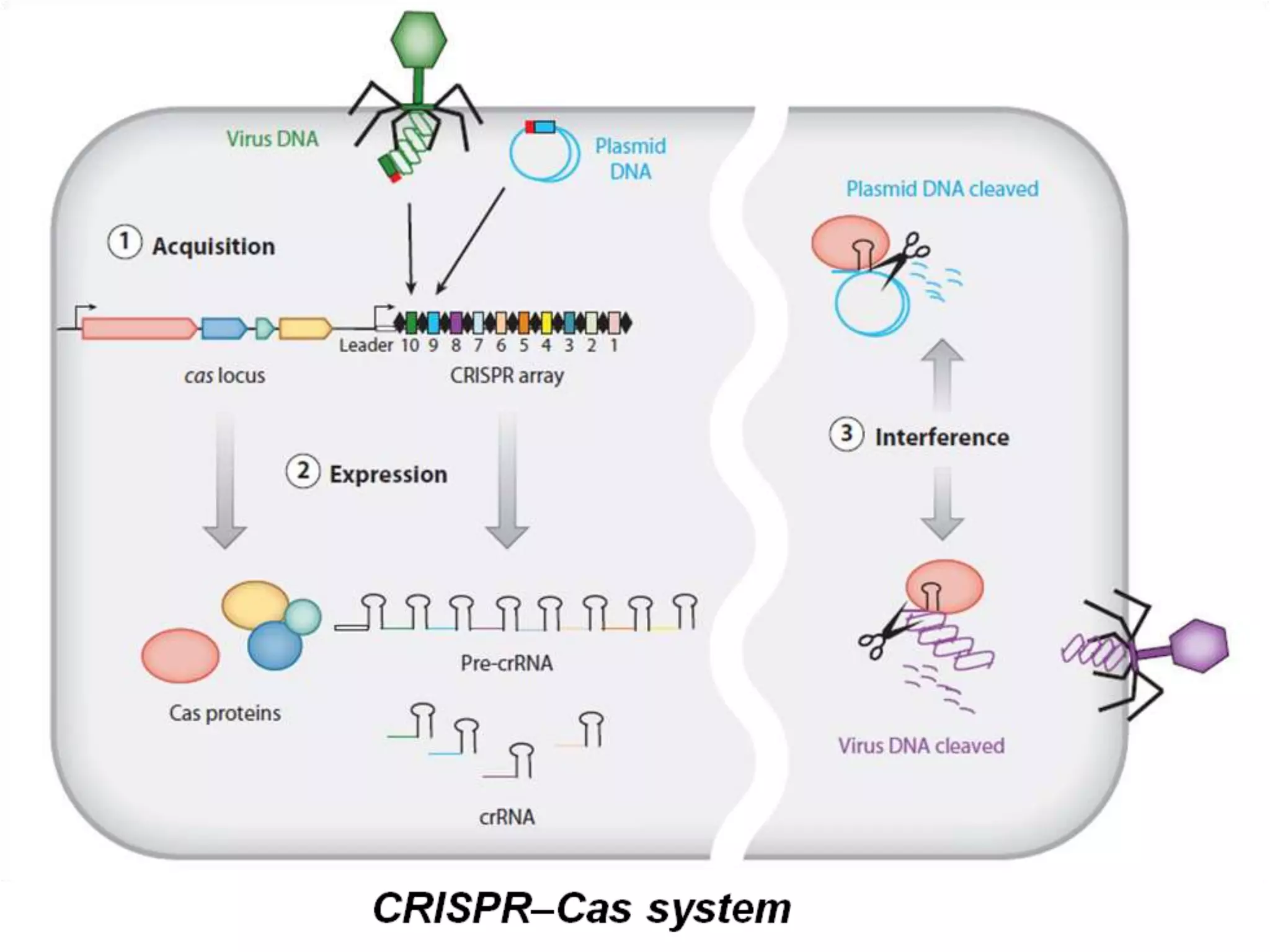
What is CRISPR (CRISPR-Cas; CRISPR-
Cas9)?
• Mechanism of adaptive immunity in
bacteria and archaea
• Evolved to adapt and defend against
foreign genetic material (e.g. phage)
• Several different types of CRISPR
pathways in bacteria and archaea
• Type II: CRISPR-Cas9. Creates a double-
strand break in the targeted DNA
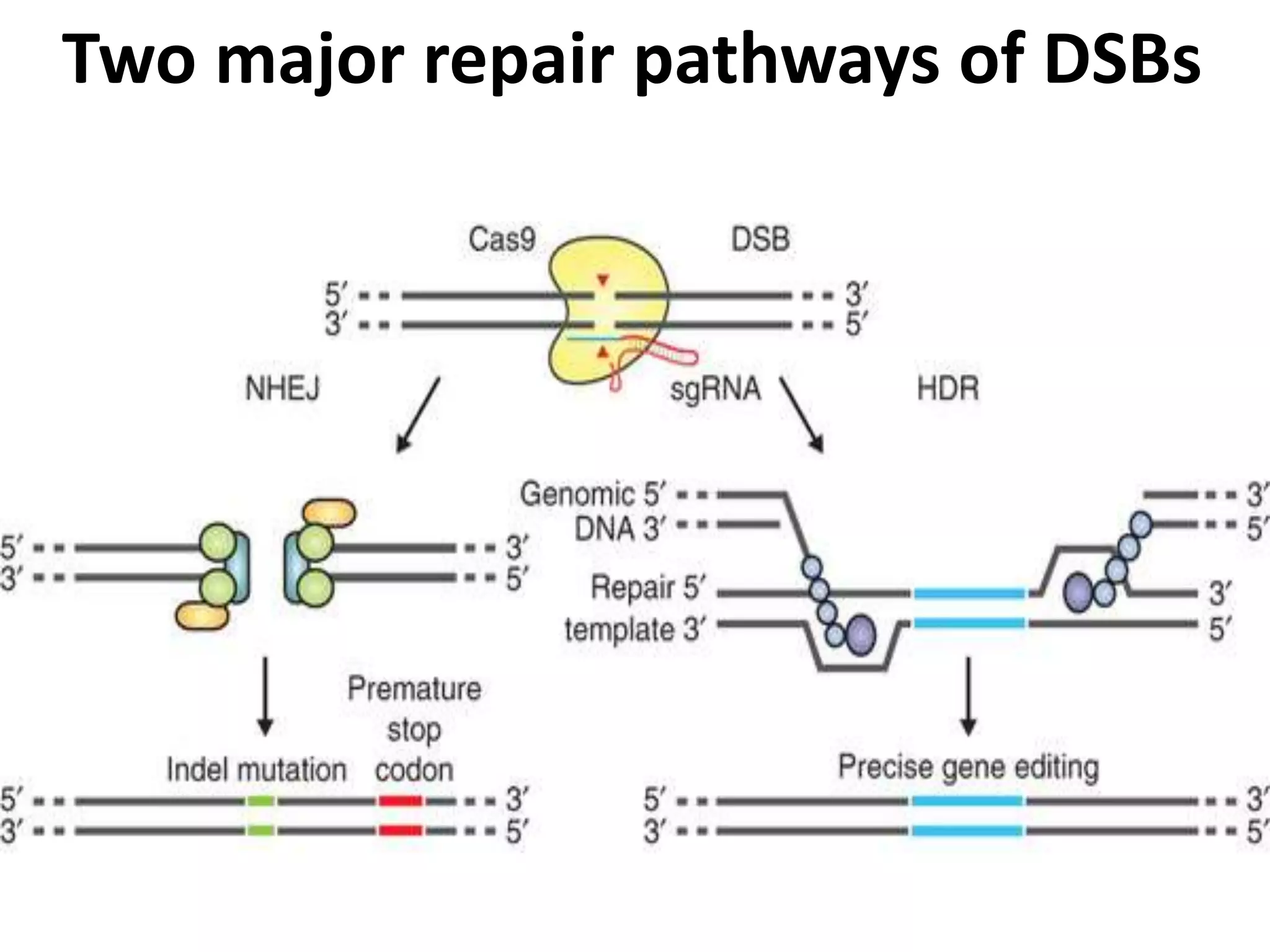
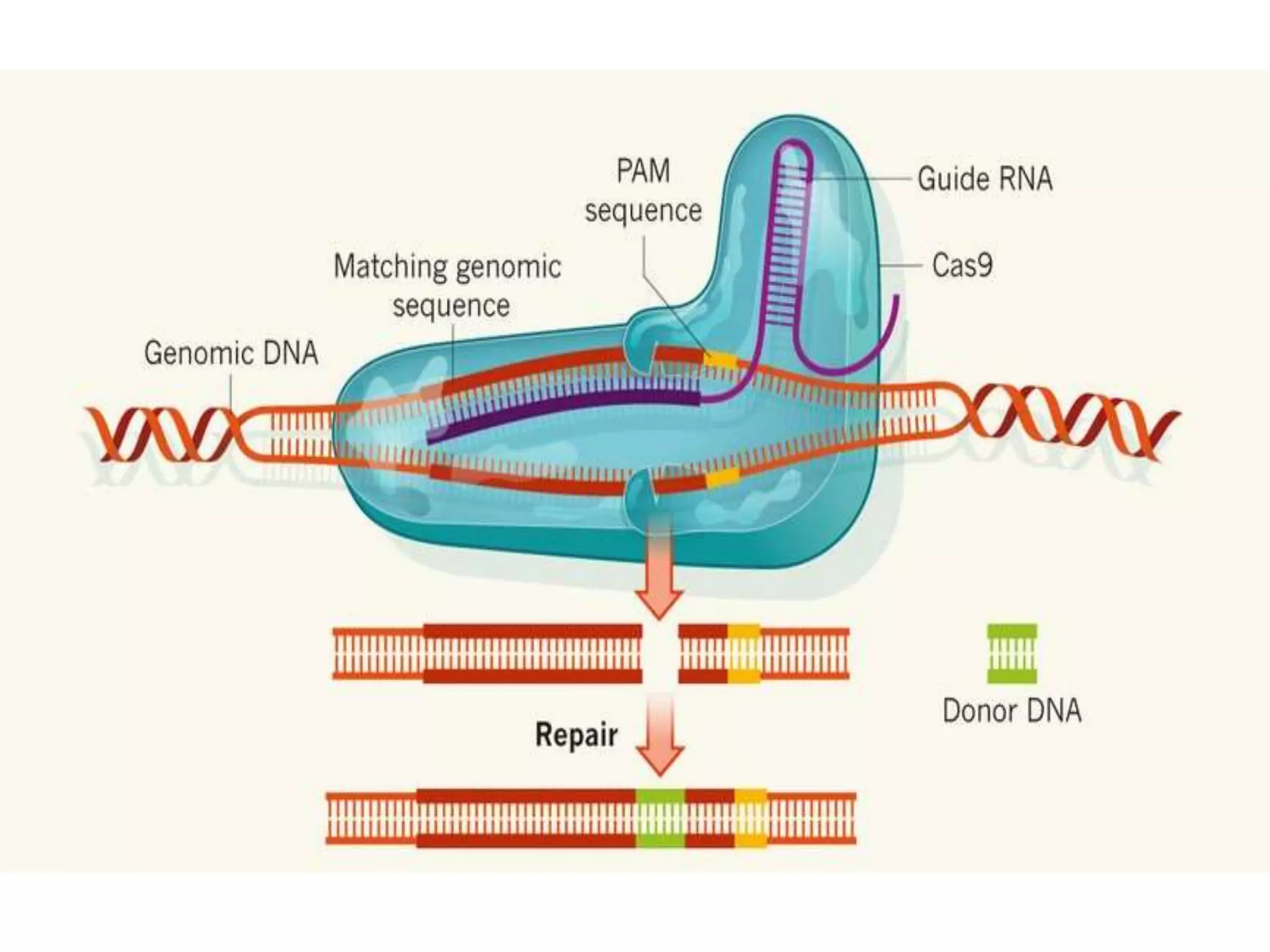
Two major repair pathways of DSBs
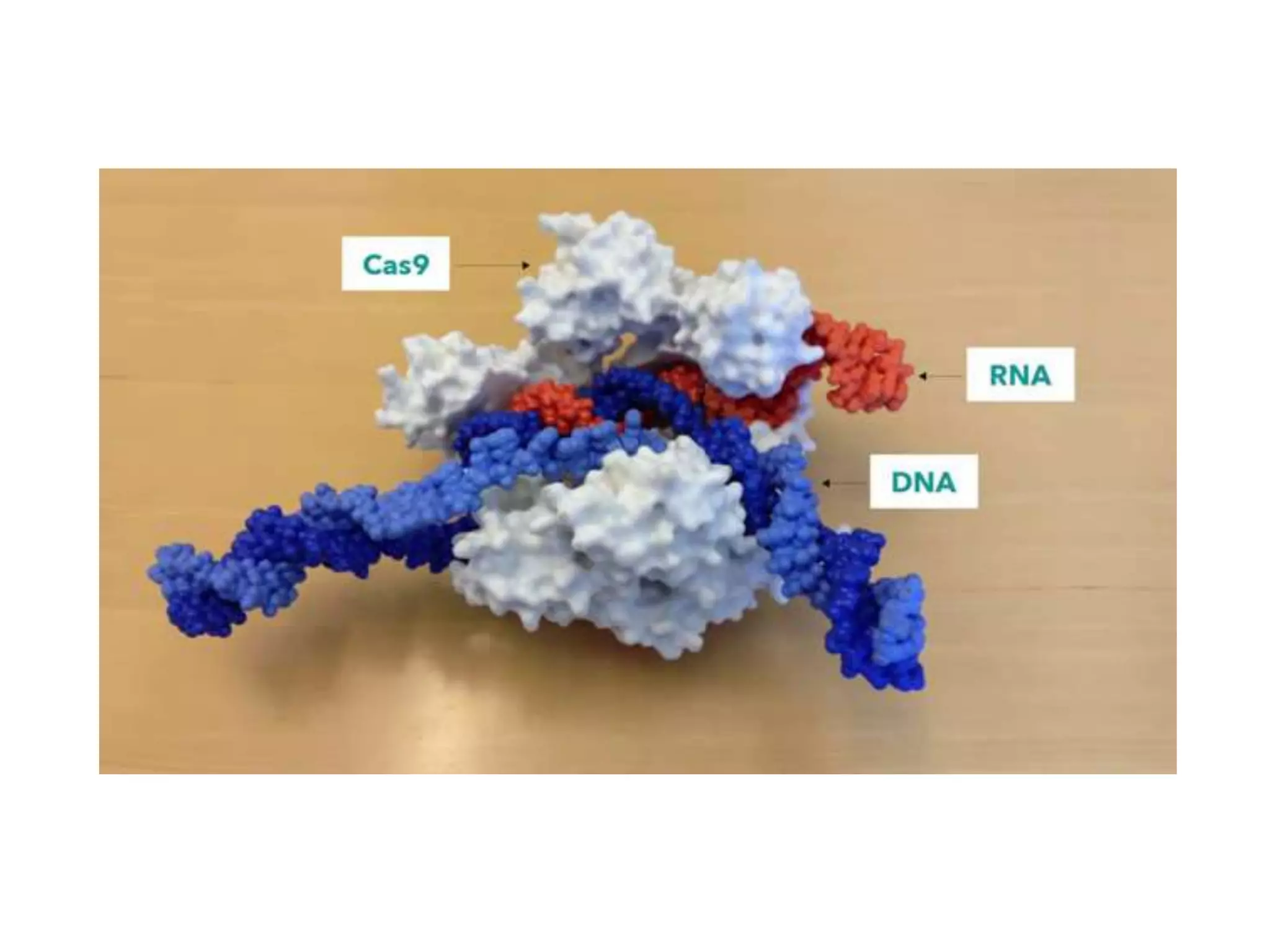
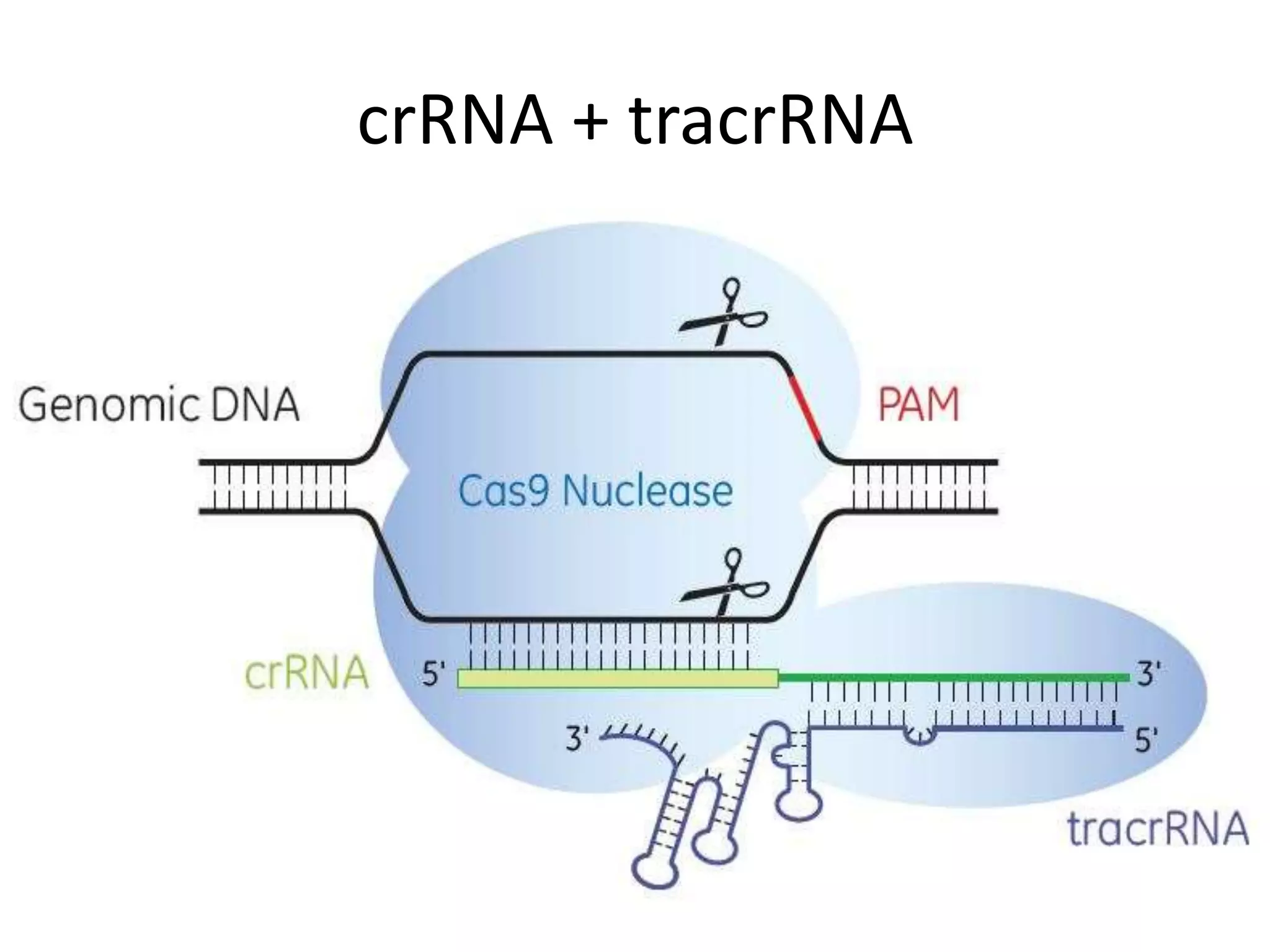
THE CRISPR/CAS9 TEAM
crRNA + tracrRNA
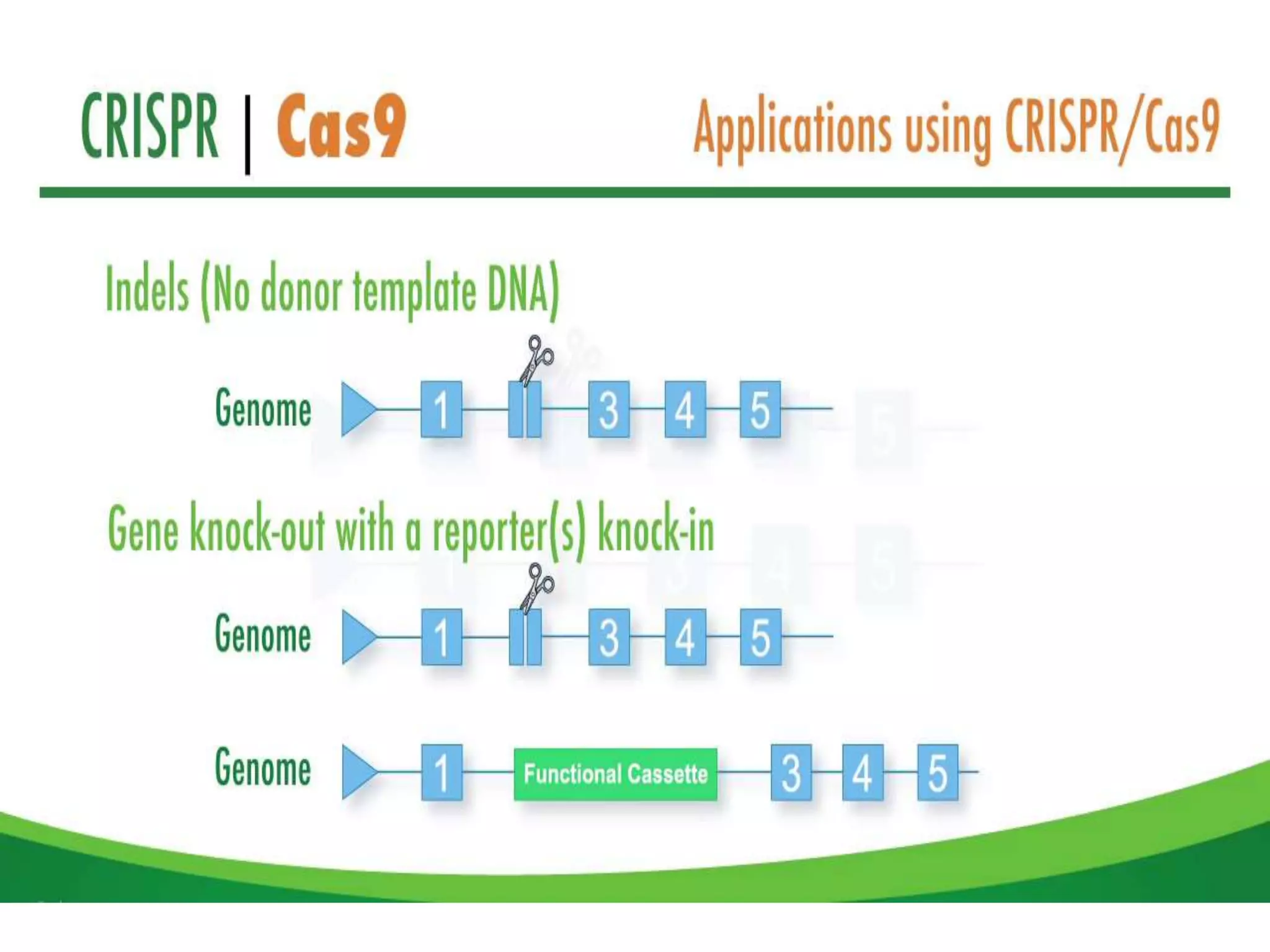
Applications using
CRISPR/Cas9 system
Non-protein Coding Gene
disruption
Applications using CRISPR/Cas9 system
Conditional knockout
- For essential genes or tissue-specific study inserting LoxP sites
around the exon to be knocked-out
Large
chromosomal
deletions
- using two sgRNAs
to induce DSBs at
sites that flank
the region of
interest
Nucl. Acids Res. June 6 (2013)
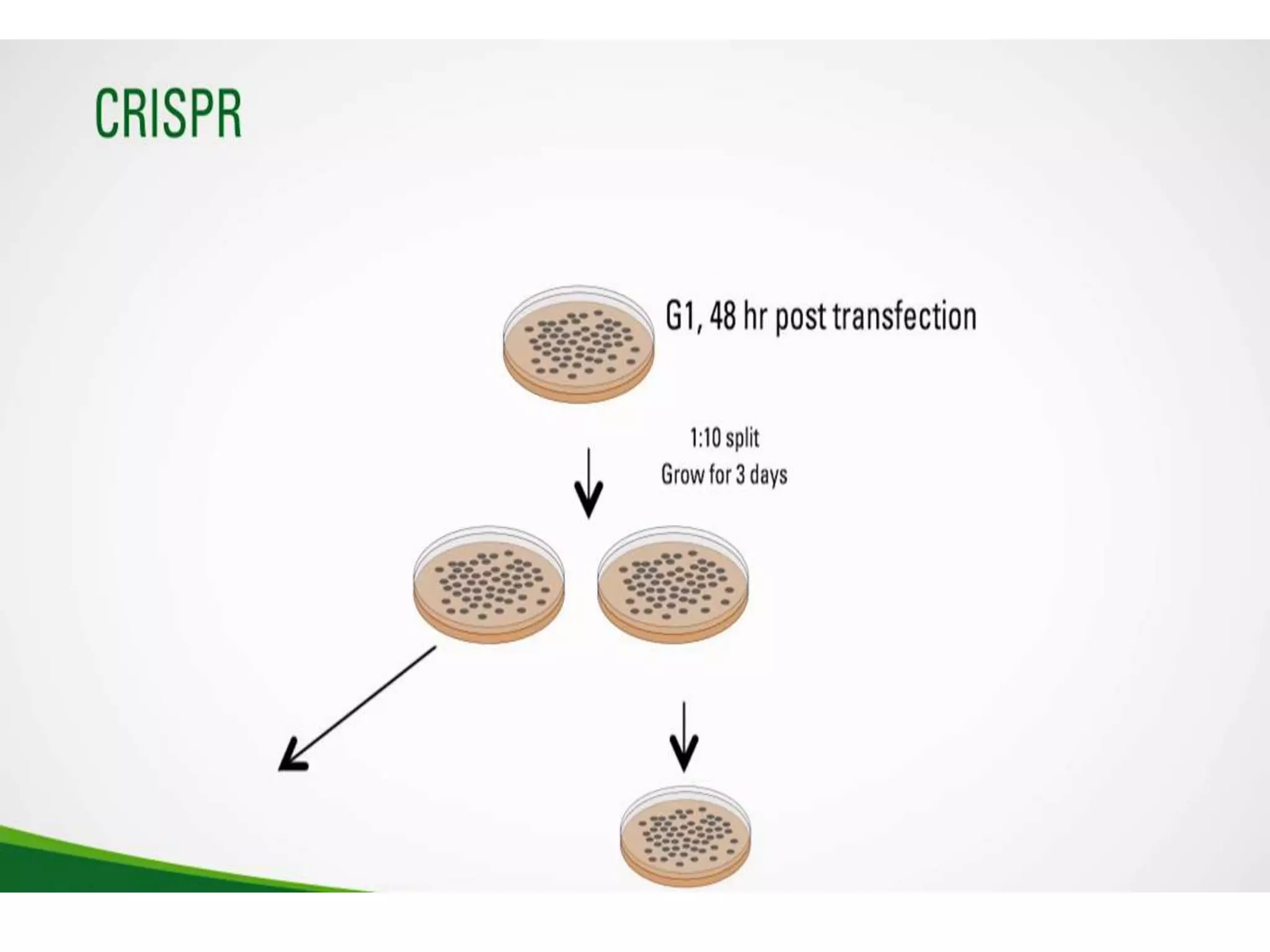
Methods of
Transfection
NON VIRAL DNA DELIVERY
1.CHEMICAL METHODS
2.PHYSICAL METHOD
LIPID MEDIATED TRANSFECTION
DNA
LIPOSOME
Pro- High efficiency
Con- Optimization required
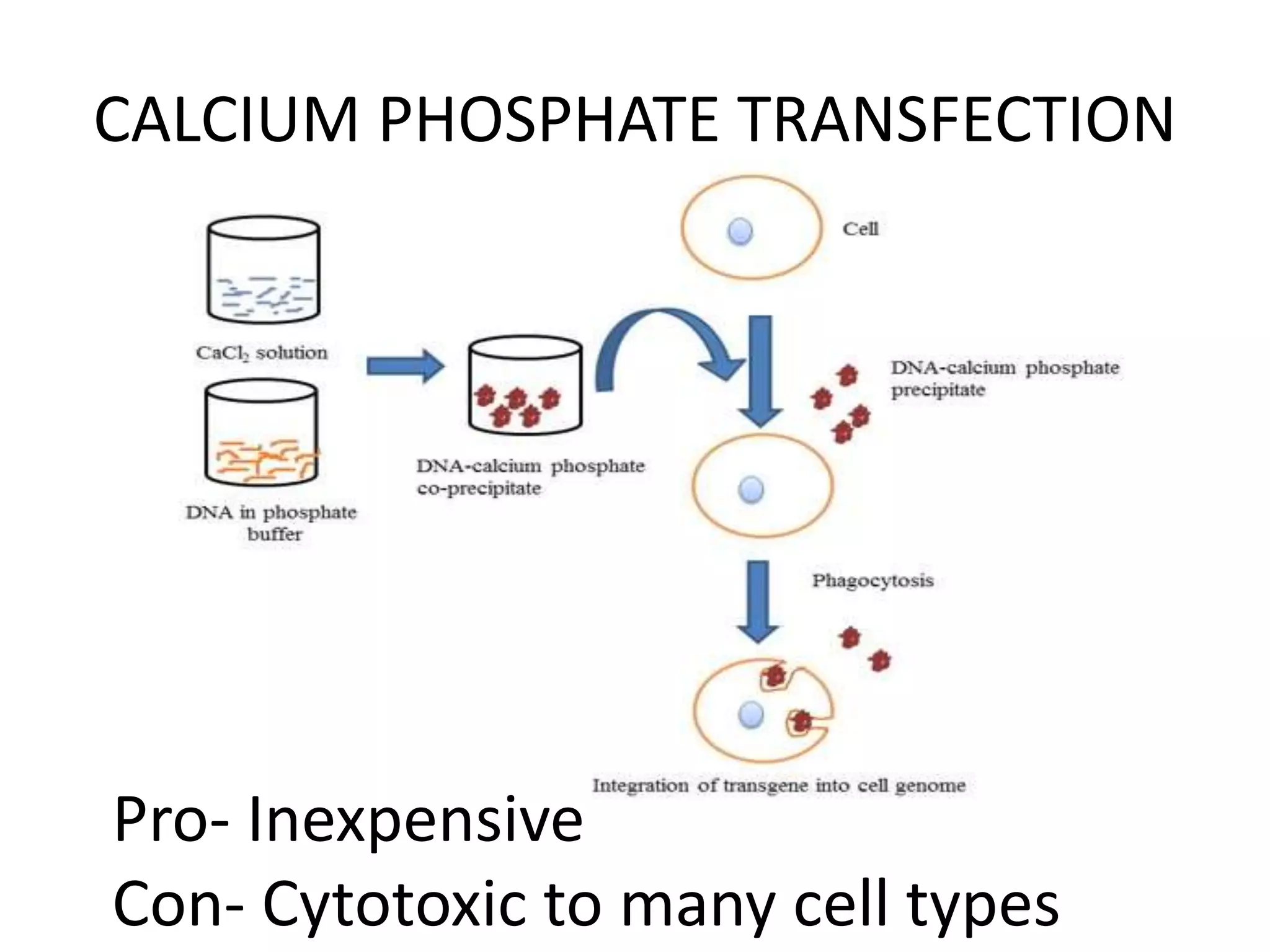
CALCIUM PHOSPHATE TRANSFECTION
Pro- Inexpensive
Con- Cytotoxic to many cell types
Electroporation
Pro- Fast; No limitation of DNA size
Con- Substantial cell death
VIRAL DNA DELIVERY METHOD
-Modified replication
deficient viruses
Lentivirus
Adenovirus
Adenovirus Associated Virus(AAV)
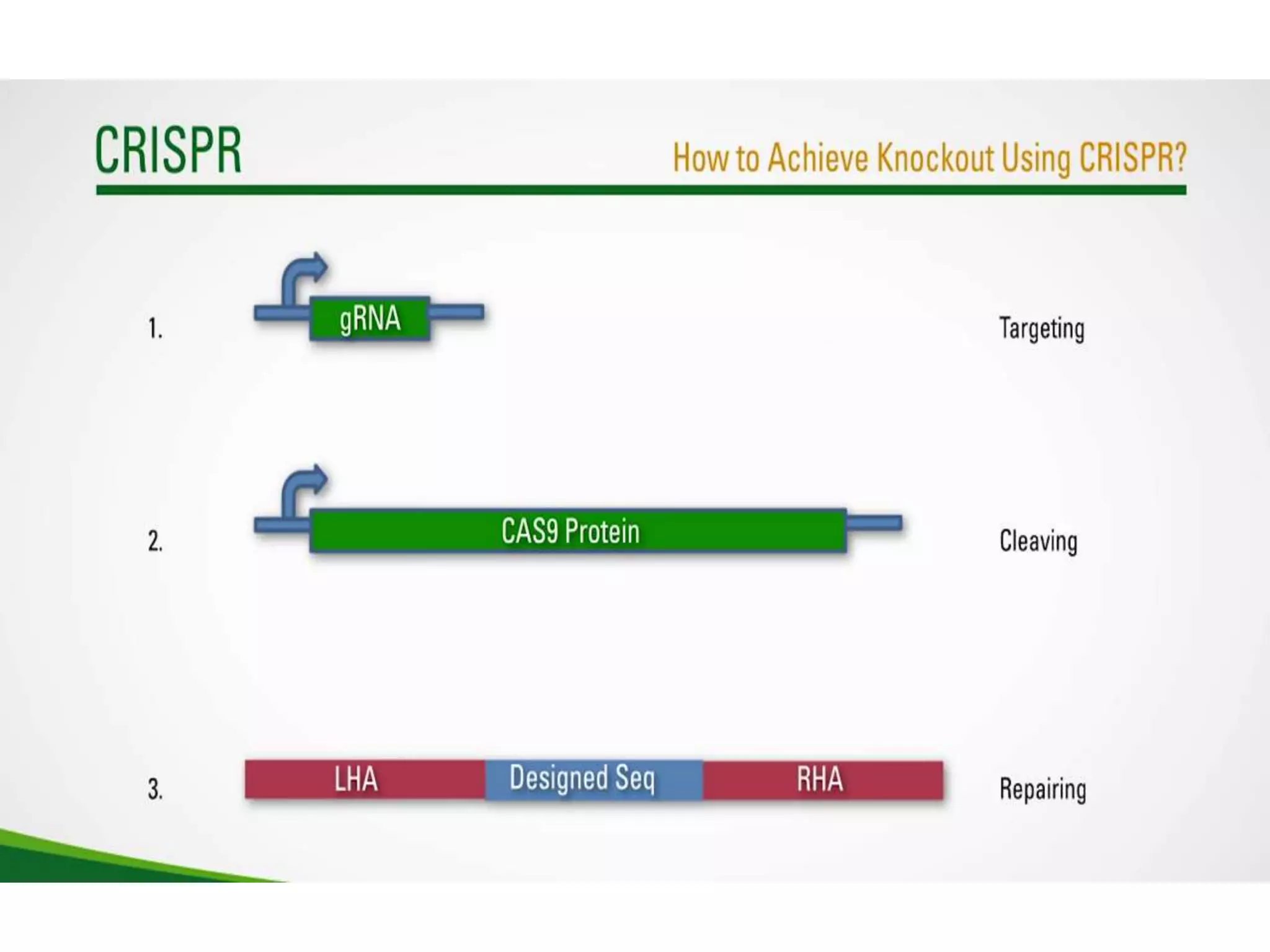
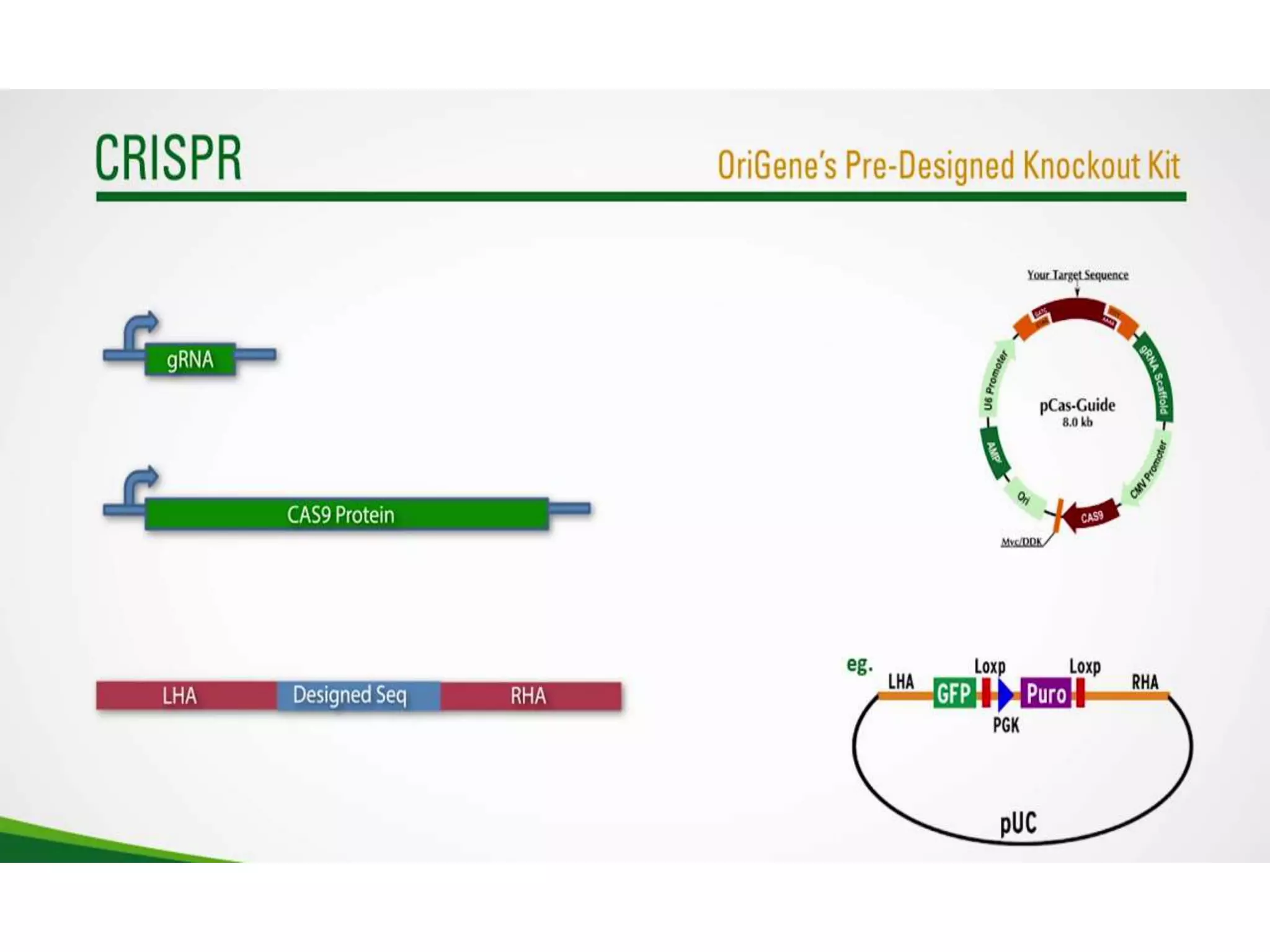
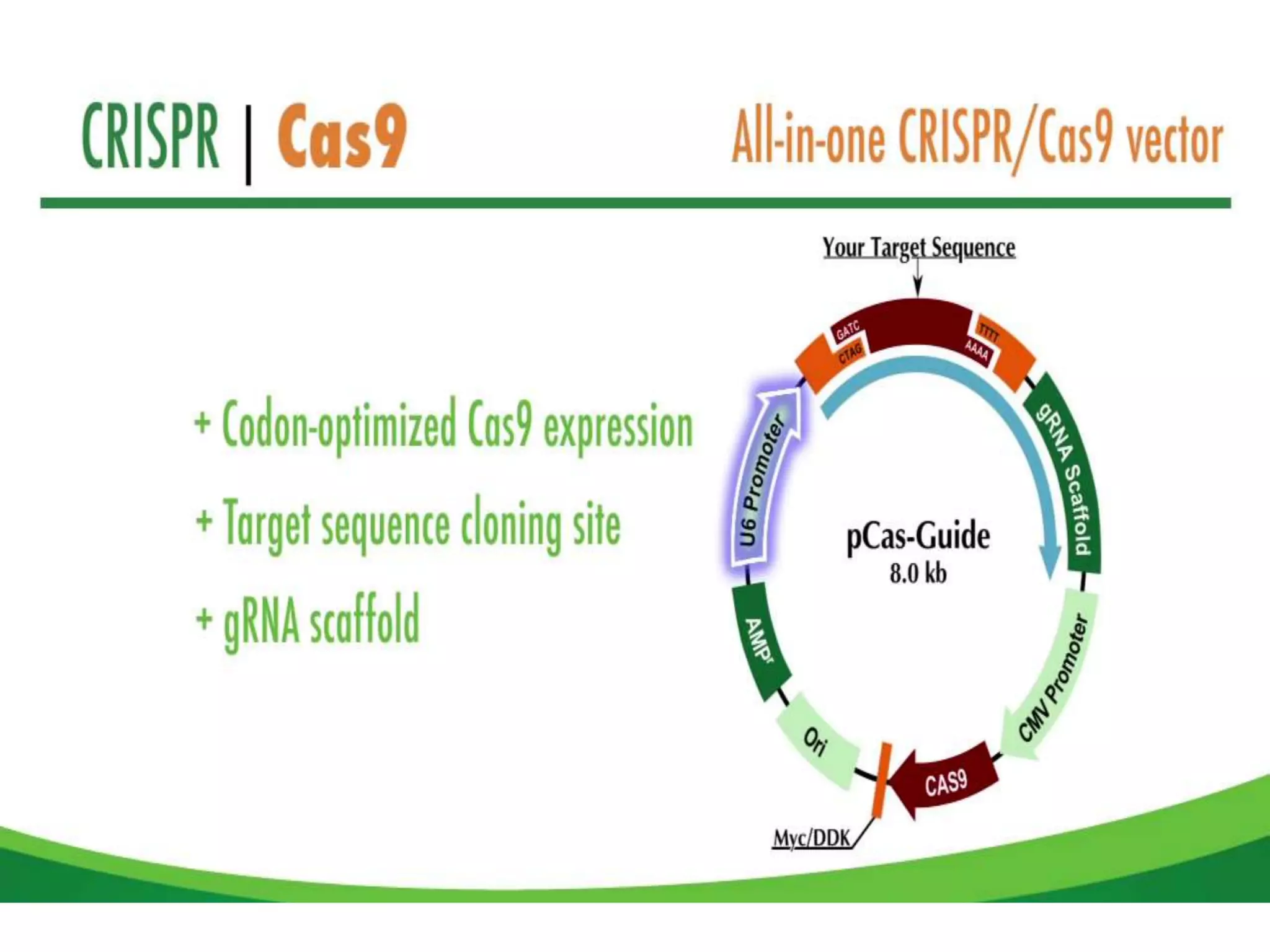
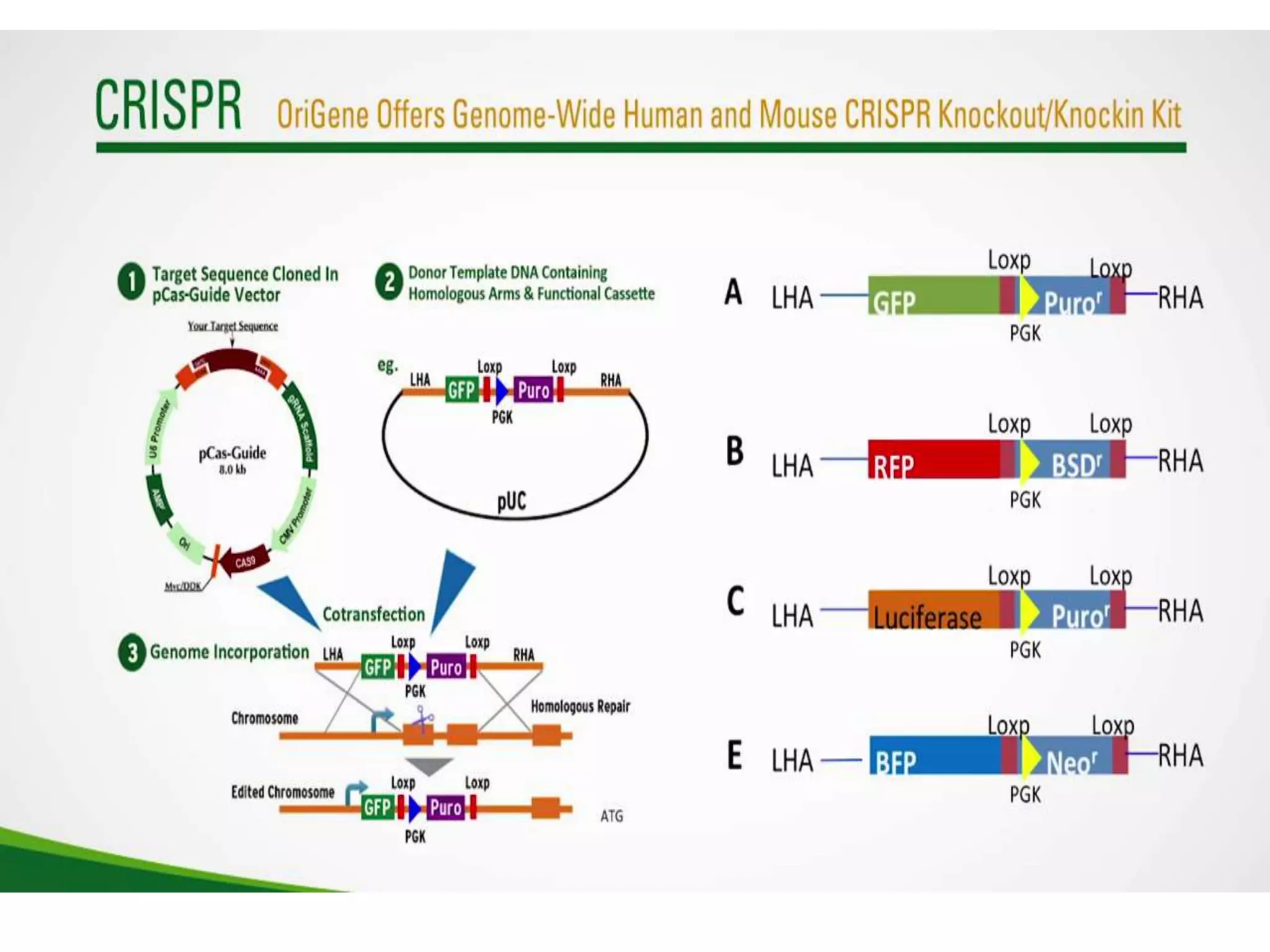
COMPONENTS OF CRISPR/Cas9 SYSTEM
• The CRISPR /Cas9 system requires several
components,
the nuclease,
the guide RNA,
and usually a selectable marker to enable plants
containing the components to be identified.
• These components can be delivered in a similar
way to the introduction of genes in genetic
modification.
• Components using Agrobacterium-mediated
transformation is a preferred delivery method
because it leads to introduction of single copies
of the genes in 50% of cases.
Sanger sequencing
197 nt deletion
1 nt insertion
68
(A)
(B)
Why is there a “CRISPR Craze”?
• Cas9 can be programmed to
perform gene editing in
“mammalian cells”.
• Changing a short RNA sequence
can easily target to a different site
in the genome
• Simpler and easier than other
genome editing technologies (ZFN,
TALENs)
• “unprecedented efficiency and
stunning ease of use”
~ Science (2014) 344(6185):707-8
• Gene therapy is back!
SCIENCE VOL 341 23 AUGUST 2013
2 0 | N AT U R E | VO L 5 2 2 | 4 J U N E 2 0 1 5
The patent war intensied
CASE STUDY
Background: The CRISPR/Cas9 system provides bacteria and archaea with
molecular immunity against invading phages and conjugative plasmids. Recently,
CRISPR/Cas9 has been used for targeted genome editing in diverse eukaryotic
species.
Results:
 The CRISPR/Cas9 system could be used in plants to confer molecular immunity
against DNA viruses. The delivery of sgRNAs specific for coding and non-coding
sequences of tomato yellow leaf curl virus (TYLCV) into Nicotiana benthamiana
plants stably overexpressing the Cas9 endonuclease, and subsequently
challenge these plants with TYLCV.
 Data demonstrated that the CRISPR/Cas9 system targeted TYLCV for
degradation and introduced mutations at the target sequences.
 All tested sgRNAs exhibit interference activity, but those targeting the stem-loop
sequence within the TYLCV origin of replication in the intergenic region (IR) are
the most effective.
 N. benthamiana plants expressing CRISPR/Cas9 exhibit delayed or reduced
accumulation of viral DNA, abolishing or significantly attenuating symptoms of
infection. Moreover, this system could simultaneously target multiple DNA
viruses.
Conclusions: These data establish the efficacy of the CRISPR/Cas9 system for viral
An anti-browning mushroom developed by
plant pathologist Yinong Yang using
CRISPR-Cas9 gene-editing technology will
have a longer shelf life and resist blemishes
from handling and mechanical harvesting.
USDA has ruled that the mushroom is not
subject to the agency's regulatory process
DNA-free CRISPR
Conventionally, researchers get CRISPR/Cas9 working in a
plant cell by first shuttling in the gene that codes for the Cas9
enzyme. The gene is introduced on a plasmid — a circular
packet of DNA — which is usually carried into a plant by the
bacterial pest Agrobacterium tumefaciens. As a
result, Agrobacterium DNA can end up in the plant’s genome.
Even if the pest is not used, fragments of the Cas9 gene may
themselves be incorporated into the plant's genome.
 Avoiding gene-shuttling altogether. Assembling the Cas9
enzyme together with its guide RNA sequences (which the
enzyme requires to find its target) outside the plant, and use
solvents to get the resulting protein complex into the plant.
The technique works efficiently to knock out selected genes in
tobacco plants, rice, lettuce etc. thus reported in Nature
Biotechnology.
conclusion
The CRISPR/Cas 9 technique is one of a number
of gene‐editing tools.
Many favour the CRISPR/Cas9 technique
because of its high degree of flexibility and
accuracy in cutting and pasting DNA.
One of the reasons for its popularity is that it
makes it possible to carry out genetic
engineering on an unprecedented scale at a
very low cost.
How it differs from previous genetic engineering
techniques is that it allows for the
introduction or removal of more than one
gene at a time. Cas9 system is efficient , site-
specific, can be “multiplexed”.
This makes it possible to manipulate many
different genes in a cell line, plant or animal
very quickly, reducing the process from taking
a number of years to a matter of weeks.
It is also different in that it is not
species‐specific, so can be used on organisms
previously resistant to genetic engineering.
References
• Jinek M, Chylinski K, Fonfara I, Hauer M, Doudna JA, Charpentier E
(August 2012). "A programmable dualRNAguided DNA
endonuclease in adaptive bacterial immunity". Science 337 (6096):
816–821. Bibcode:2012Sci...337..816J.
doi:10.1126/science.1225829. PMID 22745249.
• Upadhyay, S.K., Kumar, J., Alok, A. & Tuli, R. RNA guided genome
editing for target gene mutations in wheat. G3 (Bethesda) 3, 2233–
2238 (2013).
• Feng, Z. et al. Efficient genome editing in plants using a CRISPR/Cas
system. Cell Res. 23, 1229–1232 (2013).
• Miao, J. et al. Targeted mutagenesis in rice using CRISPRCas system.
Cell Res. 23, 1233–1236 (2013).
• Jiang, W. et al. Demonstration of CRISPR/Cas9/sgRNAmediated
targeted gene modification in Arabidopsis, tobacco, sorghum and
rice. Nucleic acids Res. 41, e188 (2013).

Genome Editing with CRISPR-Cas9

  • 1.
    Clustered regularly interspaced shortpalindromic repeats (CRISPRs) and CRISPR- associated (Cas) proteins CRISPR/Cas9 System LOPAMUDRA NAYAK 04ABT/14
  • 3.
    What is Gene/GenomeEditing? • A process whereby researchers can introduce a modification into an endogenous gene • Disruption, Insertion, Replacement at a locus in the genome – Control gene expression – Create SNP – Create Reporter fusions while maintaining endogenous gene regulation
  • 4.
    What is CRISPR(CRISPR-Cas; CRISPR- Cas9)? • Mechanism of adaptive immunity in bacteria and archaea • Evolved to adapt and defend against foreign genetic material (e.g. phage) • Several different types of CRISPR pathways in bacteria and archaea • Type II: CRISPR-Cas9. Creates a double- strand break in the targeted DNA
  • 9.
    Two major repairpathways of DSBs
  • 13.
  • 16.
  • 23.
  • 28.
    Applications using CRISPR/Cas9system Conditional knockout - For essential genes or tissue-specific study inserting LoxP sites around the exon to be knocked-out Large chromosomal deletions - using two sgRNAs to induce DSBs at sites that flank the region of interest Nucl. Acids Res. June 6 (2013)
  • 29.
  • 30.
    NON VIRAL DNADELIVERY 1.CHEMICAL METHODS 2.PHYSICAL METHOD
  • 31.
  • 32.
  • 33.
    Pro- High efficiency Con-Optimization required
  • 34.
    CALCIUM PHOSPHATE TRANSFECTION Pro-Inexpensive Con- Cytotoxic to many cell types
  • 35.
    Electroporation Pro- Fast; Nolimitation of DNA size Con- Substantial cell death
  • 36.
    VIRAL DNA DELIVERYMETHOD -Modified replication deficient viruses
  • 37.
  • 38.
  • 39.
  • 40.
    COMPONENTS OF CRISPR/Cas9SYSTEM • The CRISPR /Cas9 system requires several components, the nuclease, the guide RNA, and usually a selectable marker to enable plants containing the components to be identified. • These components can be delivered in a similar way to the introduction of genes in genetic modification. • Components using Agrobacterium-mediated transformation is a preferred delivery method because it leads to introduction of single copies of the genes in 50% of cases.
  • 68.
    Sanger sequencing 197 ntdeletion 1 nt insertion 68 (A) (B)
  • 71.
    Why is therea “CRISPR Craze”? • Cas9 can be programmed to perform gene editing in “mammalian cells”. • Changing a short RNA sequence can easily target to a different site in the genome • Simpler and easier than other genome editing technologies (ZFN, TALENs) • “unprecedented efficiency and stunning ease of use” ~ Science (2014) 344(6185):707-8 • Gene therapy is back! SCIENCE VOL 341 23 AUGUST 2013
  • 72.
    2 0 |N AT U R E | VO L 5 2 2 | 4 J U N E 2 0 1 5 The patent war intensied
  • 75.
  • 78.
    Background: The CRISPR/Cas9system provides bacteria and archaea with molecular immunity against invading phages and conjugative plasmids. Recently, CRISPR/Cas9 has been used for targeted genome editing in diverse eukaryotic species. Results:  The CRISPR/Cas9 system could be used in plants to confer molecular immunity against DNA viruses. The delivery of sgRNAs specific for coding and non-coding sequences of tomato yellow leaf curl virus (TYLCV) into Nicotiana benthamiana plants stably overexpressing the Cas9 endonuclease, and subsequently challenge these plants with TYLCV.  Data demonstrated that the CRISPR/Cas9 system targeted TYLCV for degradation and introduced mutations at the target sequences.  All tested sgRNAs exhibit interference activity, but those targeting the stem-loop sequence within the TYLCV origin of replication in the intergenic region (IR) are the most effective.  N. benthamiana plants expressing CRISPR/Cas9 exhibit delayed or reduced accumulation of viral DNA, abolishing or significantly attenuating symptoms of infection. Moreover, this system could simultaneously target multiple DNA viruses. Conclusions: These data establish the efficacy of the CRISPR/Cas9 system for viral
  • 81.
    An anti-browning mushroomdeveloped by plant pathologist Yinong Yang using CRISPR-Cas9 gene-editing technology will have a longer shelf life and resist blemishes from handling and mechanical harvesting. USDA has ruled that the mushroom is not subject to the agency's regulatory process
  • 82.
    DNA-free CRISPR Conventionally, researchersget CRISPR/Cas9 working in a plant cell by first shuttling in the gene that codes for the Cas9 enzyme. The gene is introduced on a plasmid — a circular packet of DNA — which is usually carried into a plant by the bacterial pest Agrobacterium tumefaciens. As a result, Agrobacterium DNA can end up in the plant’s genome. Even if the pest is not used, fragments of the Cas9 gene may themselves be incorporated into the plant's genome.  Avoiding gene-shuttling altogether. Assembling the Cas9 enzyme together with its guide RNA sequences (which the enzyme requires to find its target) outside the plant, and use solvents to get the resulting protein complex into the plant. The technique works efficiently to knock out selected genes in tobacco plants, rice, lettuce etc. thus reported in Nature Biotechnology.
  • 83.
    conclusion The CRISPR/Cas 9technique is one of a number of gene‐editing tools. Many favour the CRISPR/Cas9 technique because of its high degree of flexibility and accuracy in cutting and pasting DNA. One of the reasons for its popularity is that it makes it possible to carry out genetic engineering on an unprecedented scale at a very low cost.
  • 84.
    How it differsfrom previous genetic engineering techniques is that it allows for the introduction or removal of more than one gene at a time. Cas9 system is efficient , site- specific, can be “multiplexed”. This makes it possible to manipulate many different genes in a cell line, plant or animal very quickly, reducing the process from taking a number of years to a matter of weeks. It is also different in that it is not species‐specific, so can be used on organisms previously resistant to genetic engineering.
  • 85.
    References • Jinek M,Chylinski K, Fonfara I, Hauer M, Doudna JA, Charpentier E (August 2012). "A programmable dualRNAguided DNA endonuclease in adaptive bacterial immunity". Science 337 (6096): 816–821. Bibcode:2012Sci...337..816J. doi:10.1126/science.1225829. PMID 22745249. • Upadhyay, S.K., Kumar, J., Alok, A. & Tuli, R. RNA guided genome editing for target gene mutations in wheat. G3 (Bethesda) 3, 2233– 2238 (2013). • Feng, Z. et al. Efficient genome editing in plants using a CRISPR/Cas system. Cell Res. 23, 1229–1232 (2013). • Miao, J. et al. Targeted mutagenesis in rice using CRISPRCas system. Cell Res. 23, 1233–1236 (2013). • Jiang, W. et al. Demonstration of CRISPR/Cas9/sgRNAmediated targeted gene modification in Arabidopsis, tobacco, sorghum and rice. Nucleic acids Res. 41, e188 (2013).
Editor's Notes

  • #5 Type I and III systems require only crRNA for targeting, while Type II systems also use trans-activating CRISPR RNA (tracrRNA).