Analyzing the exome—focusing your NGS
analysis with high performance target capture
Kristina Giorda, PhD
1
Outline
• Review
– Exome sequencing
– xGen® product portfolio
– Library preparation and target enrichment
• Exome performance
– Multiplexed capture
– Deep sequencing
– Exome sequencing vs. WGS
2
Exome sequencing
• Affordable approach to interrogate protein
coding portion of the genome and identify
disease-causing variants
• Mendelian disorders
– Prenatal diagnosis, preimplementation
genetic diagnosis, carrier/mutation detection
of heterogeneous disorders (e.g., hearing
loss), prognosis of preclinical individuals
• Personalized cancer therapy
– Diagnosis and prognosis, treatment,
discovery of new cancer-related genes,
address tumor heterogeneity and evolution
[http://www.dnalinkus.com/us/service/exome_sequencing.html]
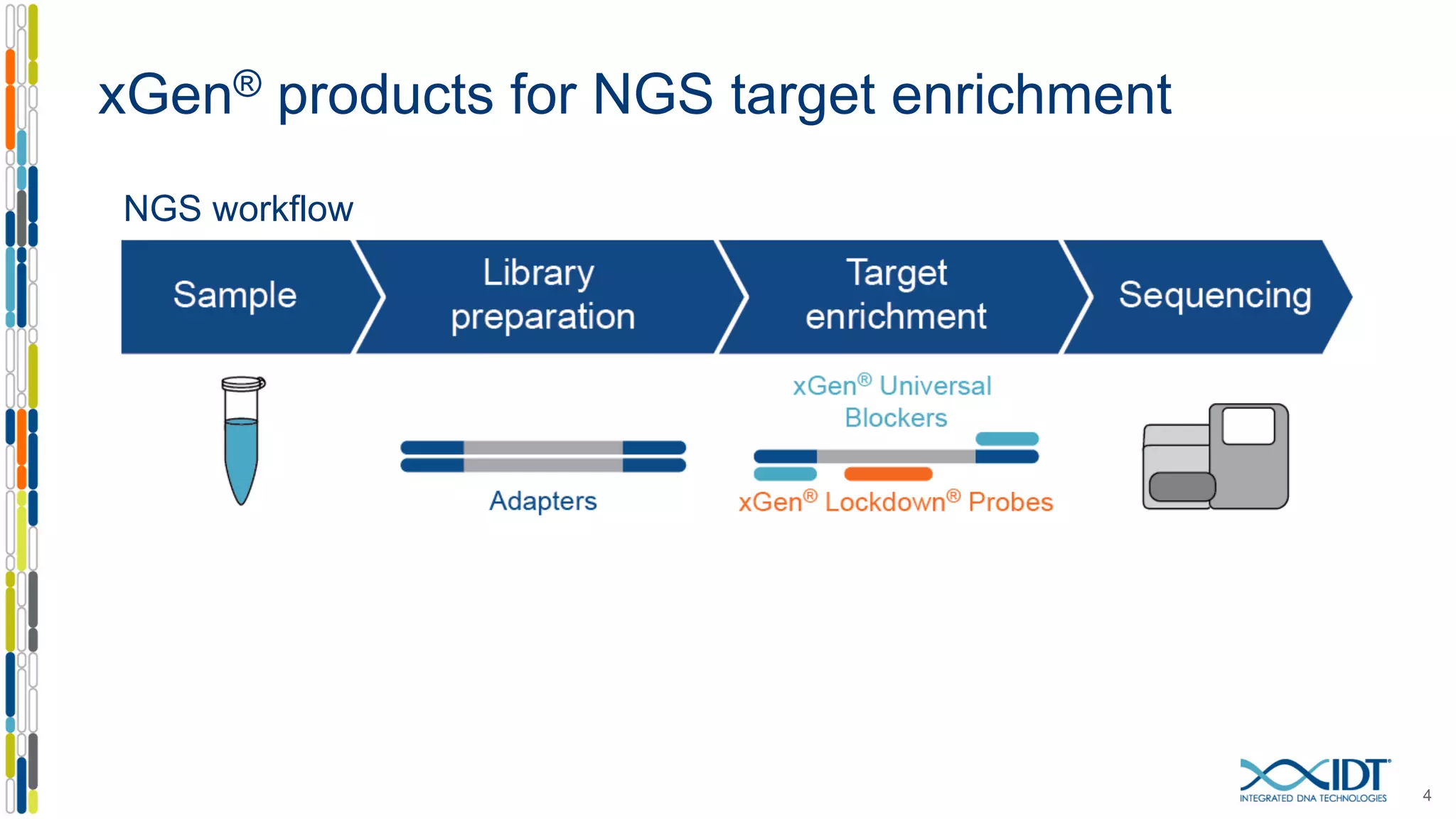
xGen® products for NGS target enrichment
4
NGS workflow
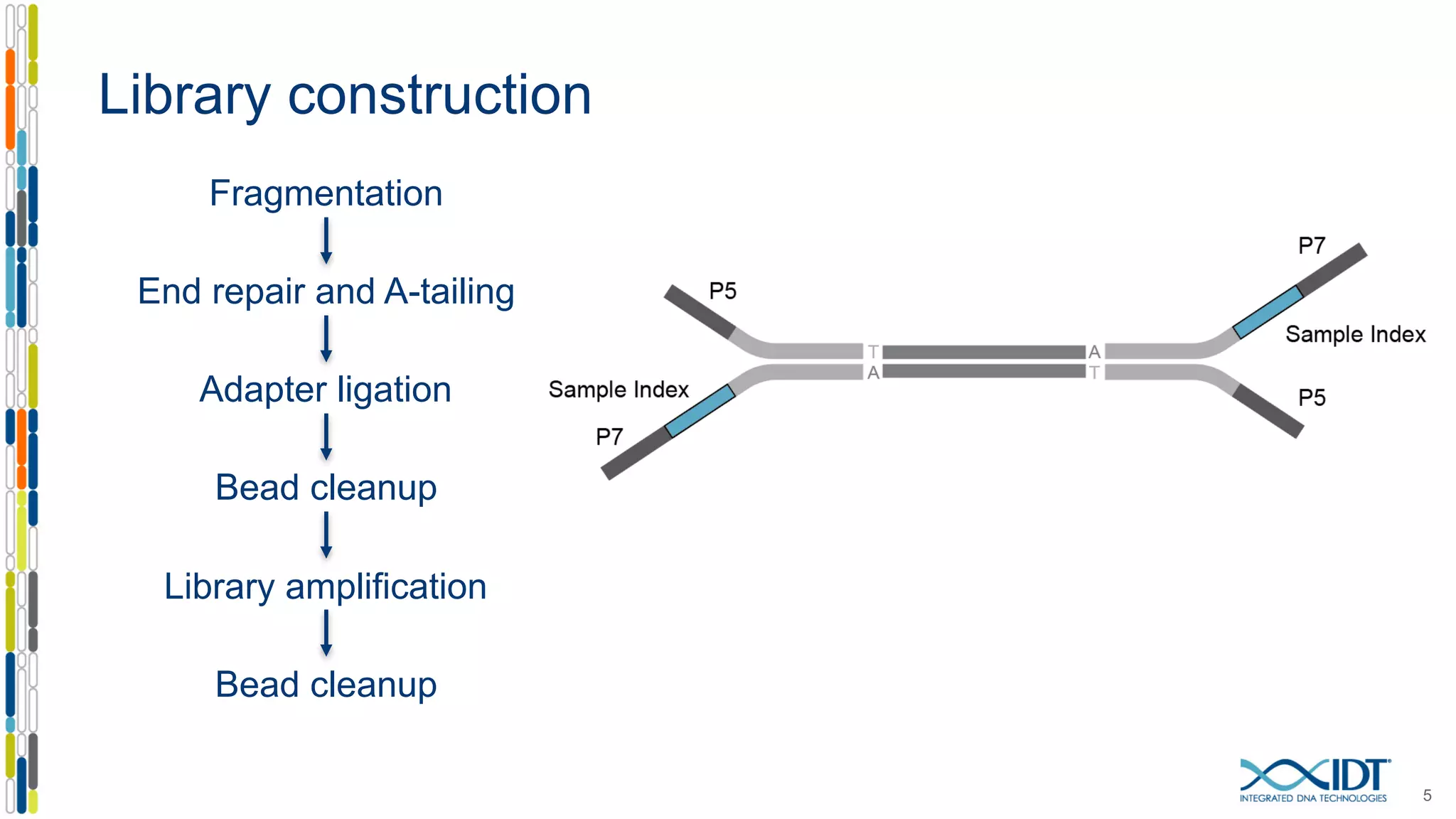
Library construction
5
Fragmentation
End repair and A-tailing
Adapter ligation
Bead cleanup
Library amplification
Bead cleanup
xGen products for NGS target enrichment
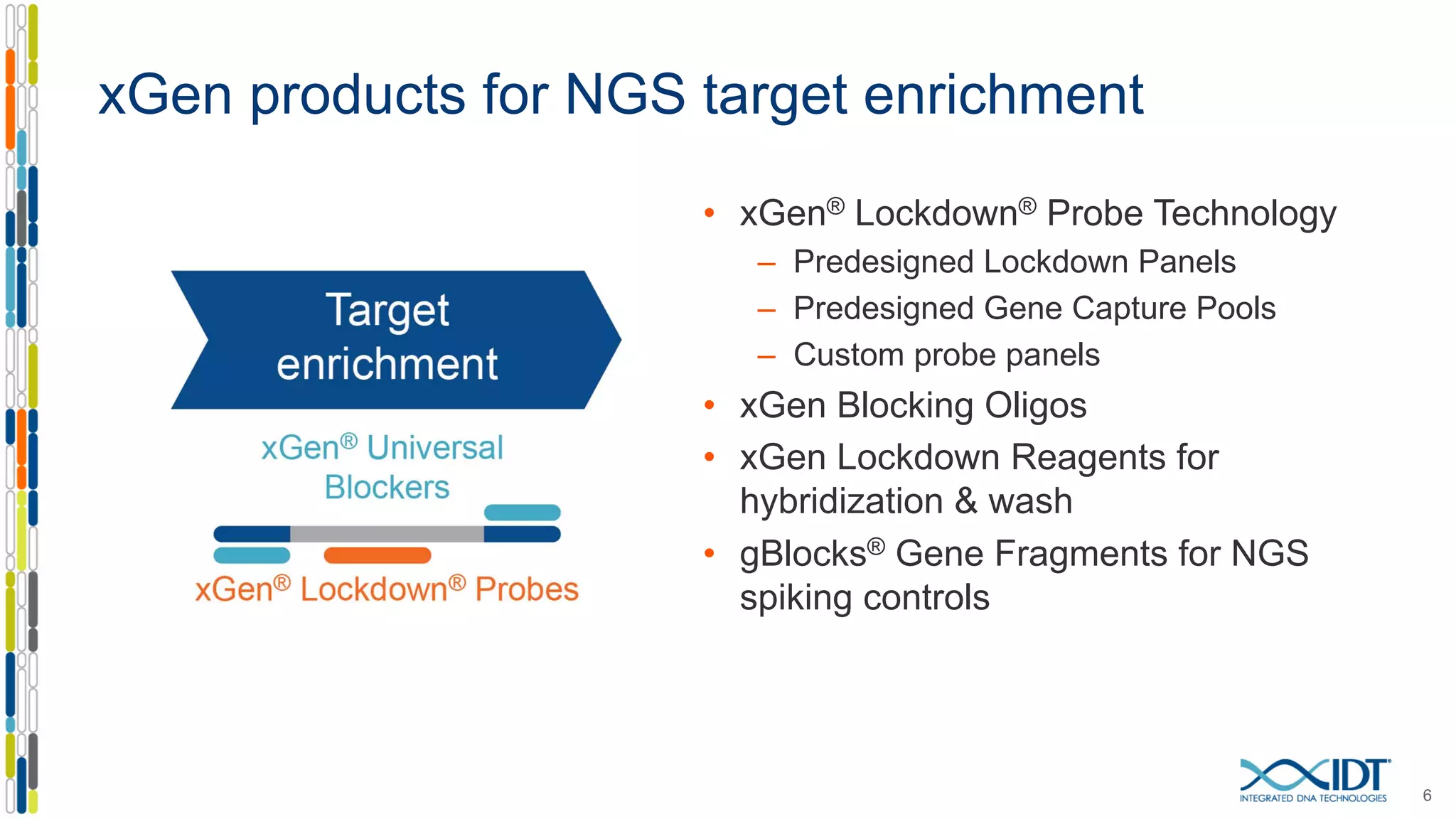
• xGen® Lockdown® Probe Technology
– Predesigned Lockdown Panels
– Predesigned Gene Capture Pools
– Custom probe panels
• xGen Blocking Oligos
• xGen Lockdown Reagents for
hybridization & wash
• gBlocks® Gene Fragments for NGS
spiking controls
6
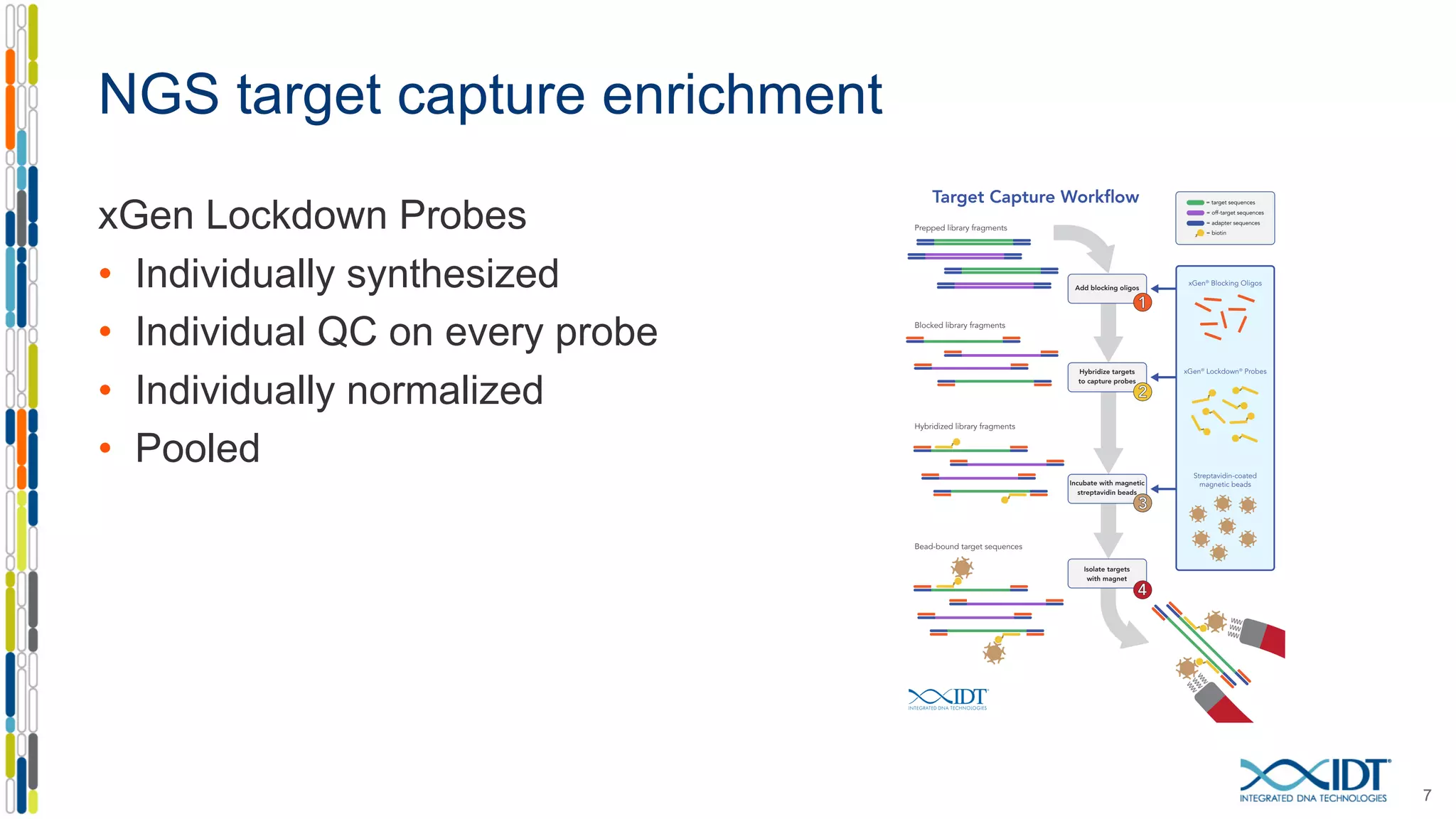
NGS target capture enrichment
xGen Lockdown Probes
• Individually synthesized
• Individual QC on every probe
• Individually normalized
• Pooled
7
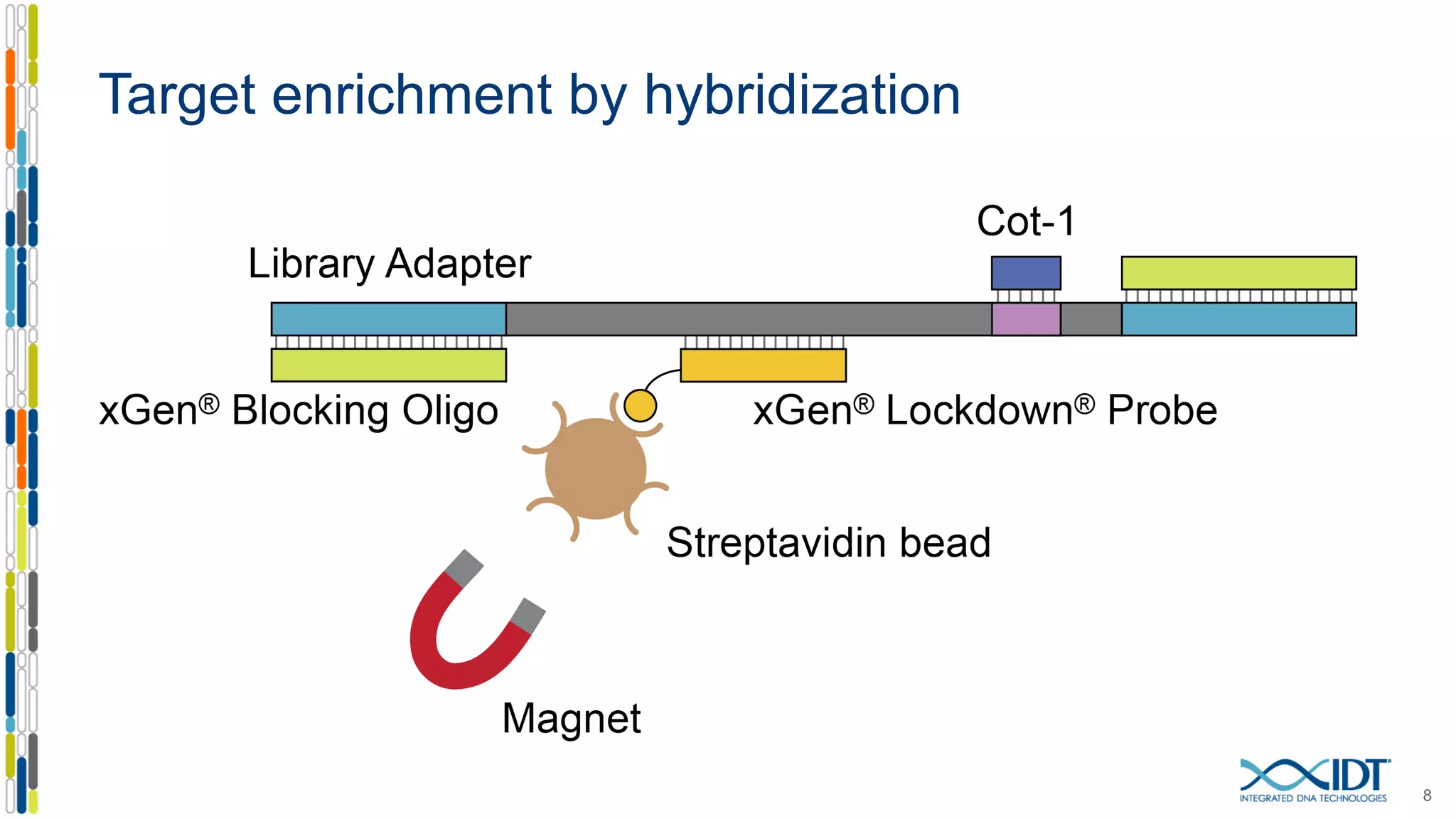
Target enrichment by hybridization
8
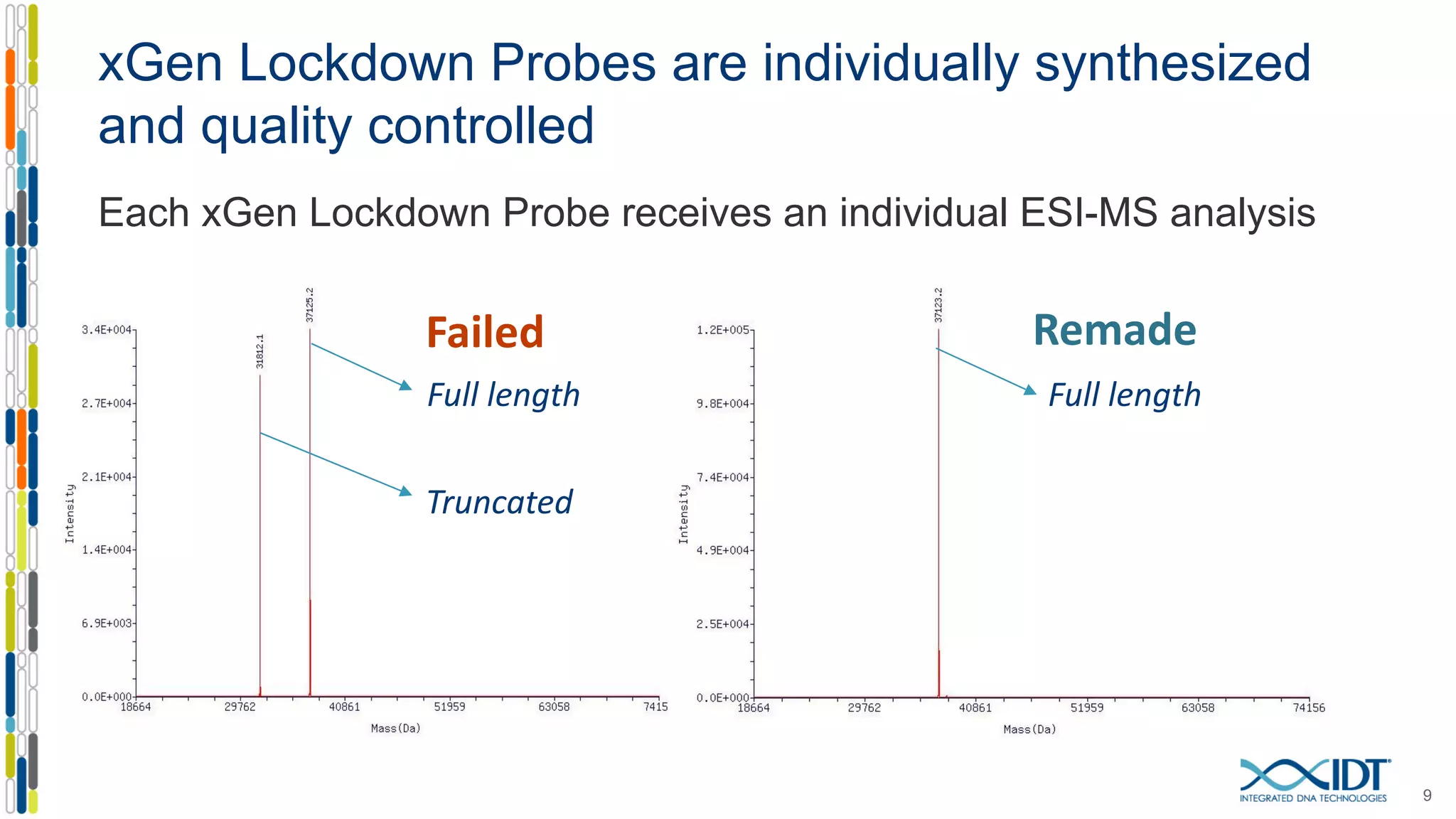
xGen Lockdown Probes are individually synthesized
and quality controlled
Each xGen Lockdown Probe receives an individual ESI-MS analysis
Failed Remade
Full	length
Truncated
Full	length
9
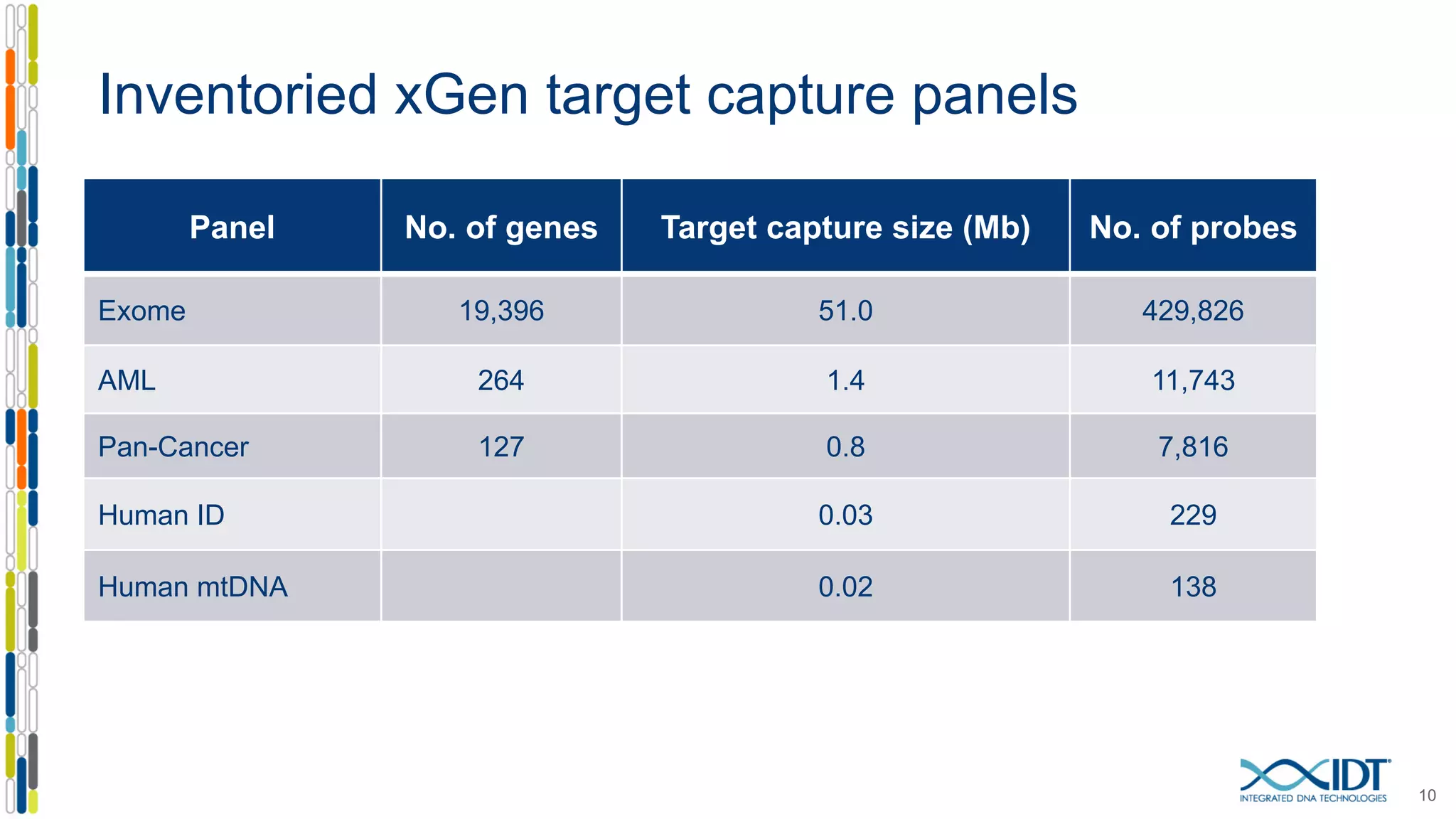
Inventoried xGen target capture panels
10
Panel No. of genes Target capture size (Mb) No. of probes
Exome 19,396 51.0 429,826
AML 264 1.4 11,743
Pan-Cancer 127 0.8 7,816
Human ID 0.03 229
Human mtDNA 0.02 138
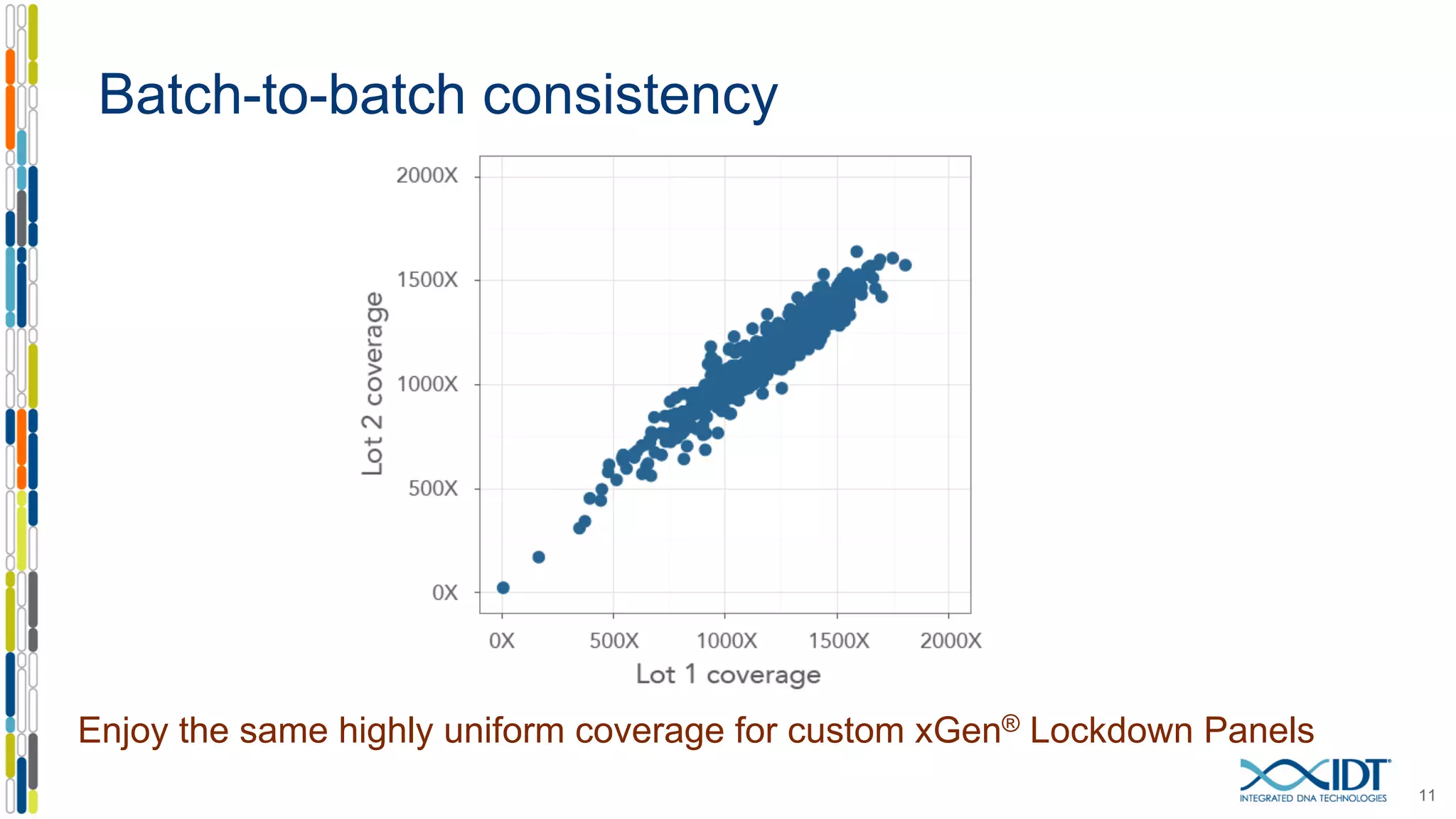
Batch-to-batch consistency
30,895
Enjoy the same highly uniform coverage for custom xGen® Lockdown Panels
11
Outline
• Review
– Exome sequencing
– xGen® product portfolio
– Library preparation and target enrichment
• Exome performance
– Multiplexed capture
– Deep sequencing
– Exome sequencing vs. WGS
12
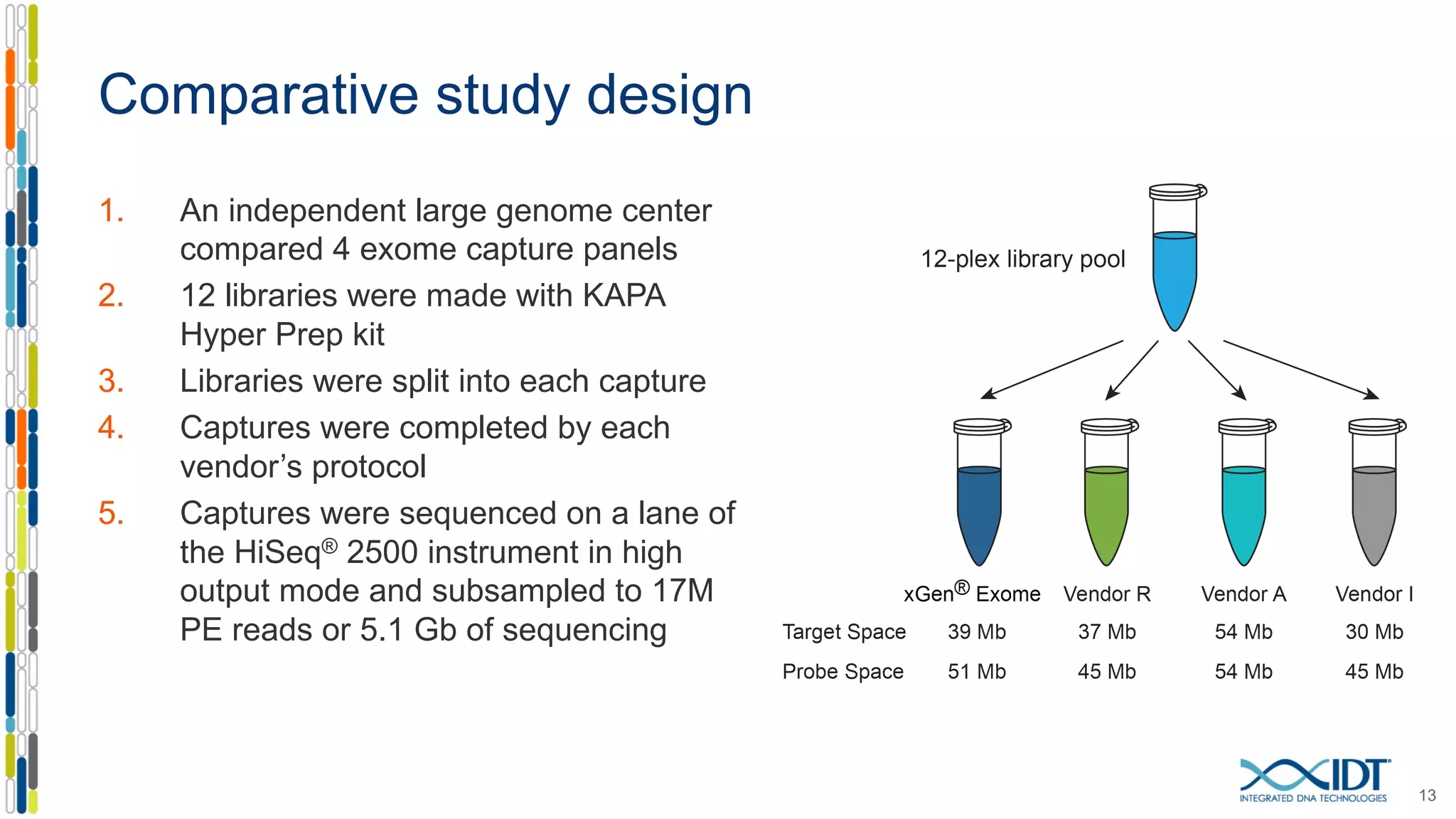
Comparative study design
13
1. An independent large genome center
compared 4 exome capture panels
2. 12 libraries were made with KAPA
Hyper Prep kit
3. Libraries were split into each capture
4. Captures were completed by each
vendor’s protocol
5. Captures were sequenced on a lane of
the HiSeq® 2500 instrument in high
output mode and subsampled to 17M
PE reads or 5.1 Gb of sequencing
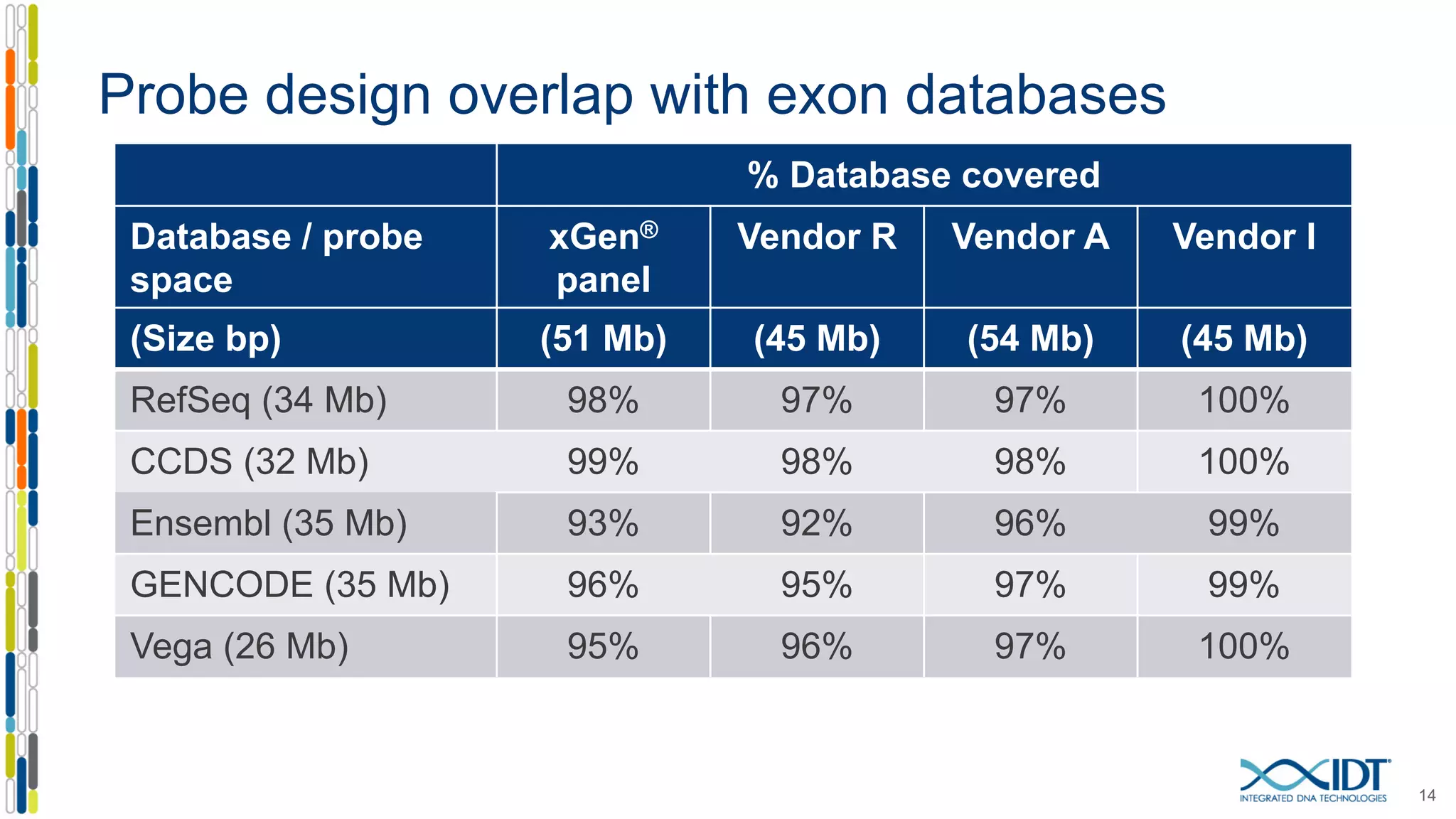
Probe design overlap with exon databases
14
% Database covered
Database / probe
space
xGen®
panel
Vendor R Vendor A Vendor I
(Size bp) (51 Mb) (45 Mb) (54 Mb) (45 Mb)
RefSeq (34 Mb) 98% 97% 97% 100%
CCDS (32 Mb) 99% 98% 98% 100%
Ensembl (35 Mb) 93% 92% 96% 99%
GENCODE (35 Mb) 96% 95% 97% 99%
Vega (26 Mb) 95% 96% 97% 100%
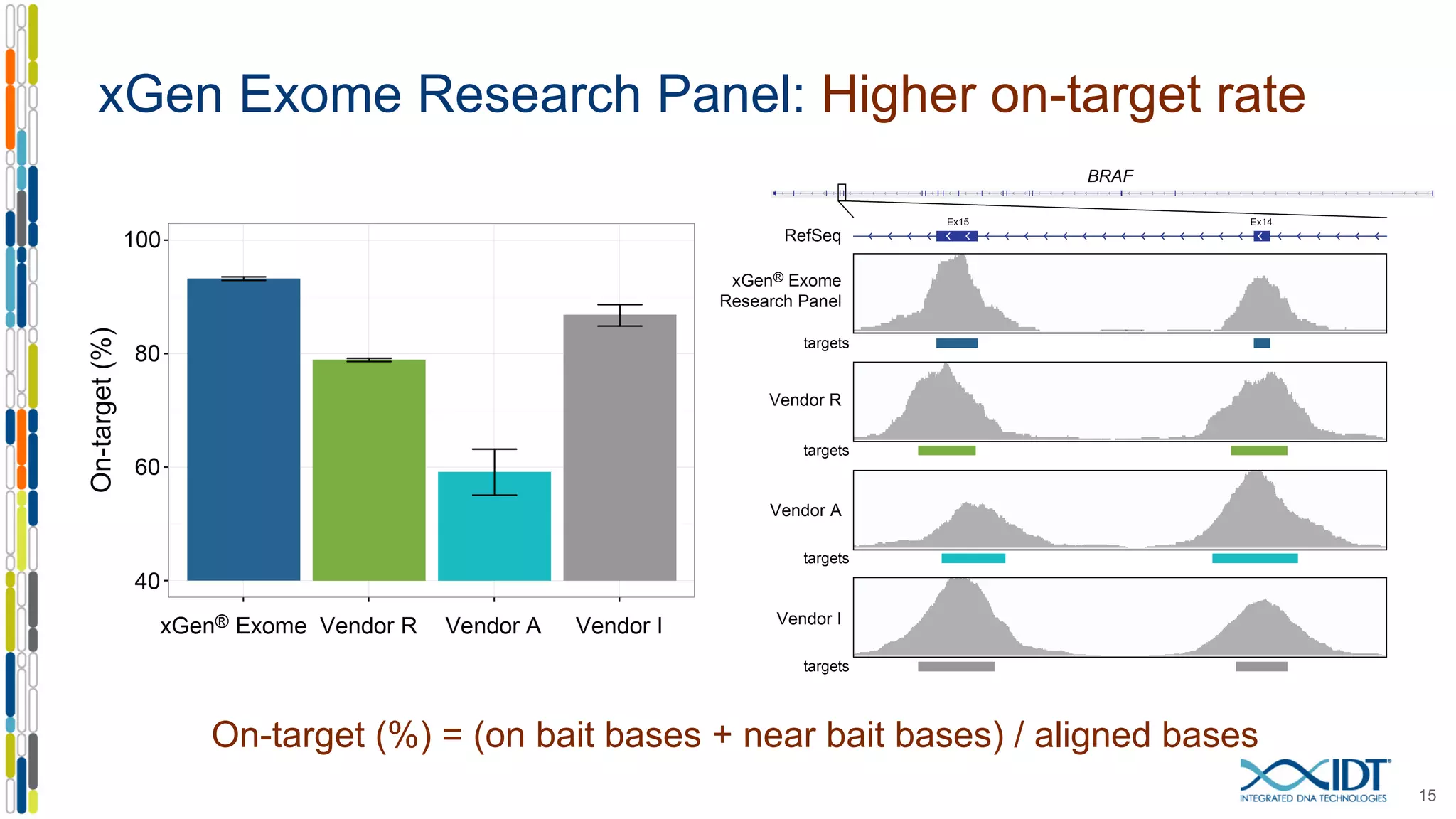
xGen Exome Research Panel: Higher on-target rate
15
On-target (%) = (on bait bases + near bait bases) / aligned bases
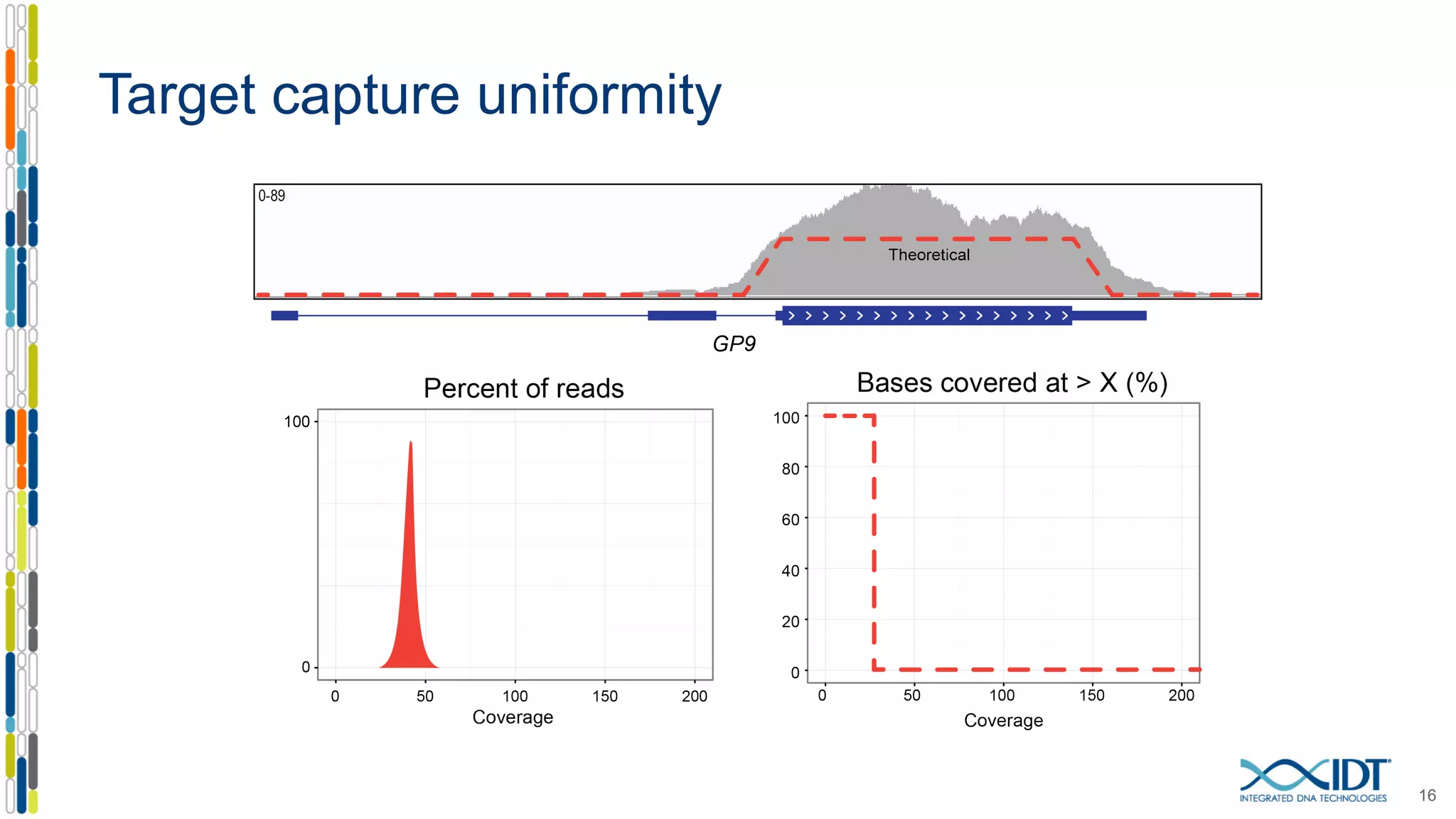
Target capture uniformity
16
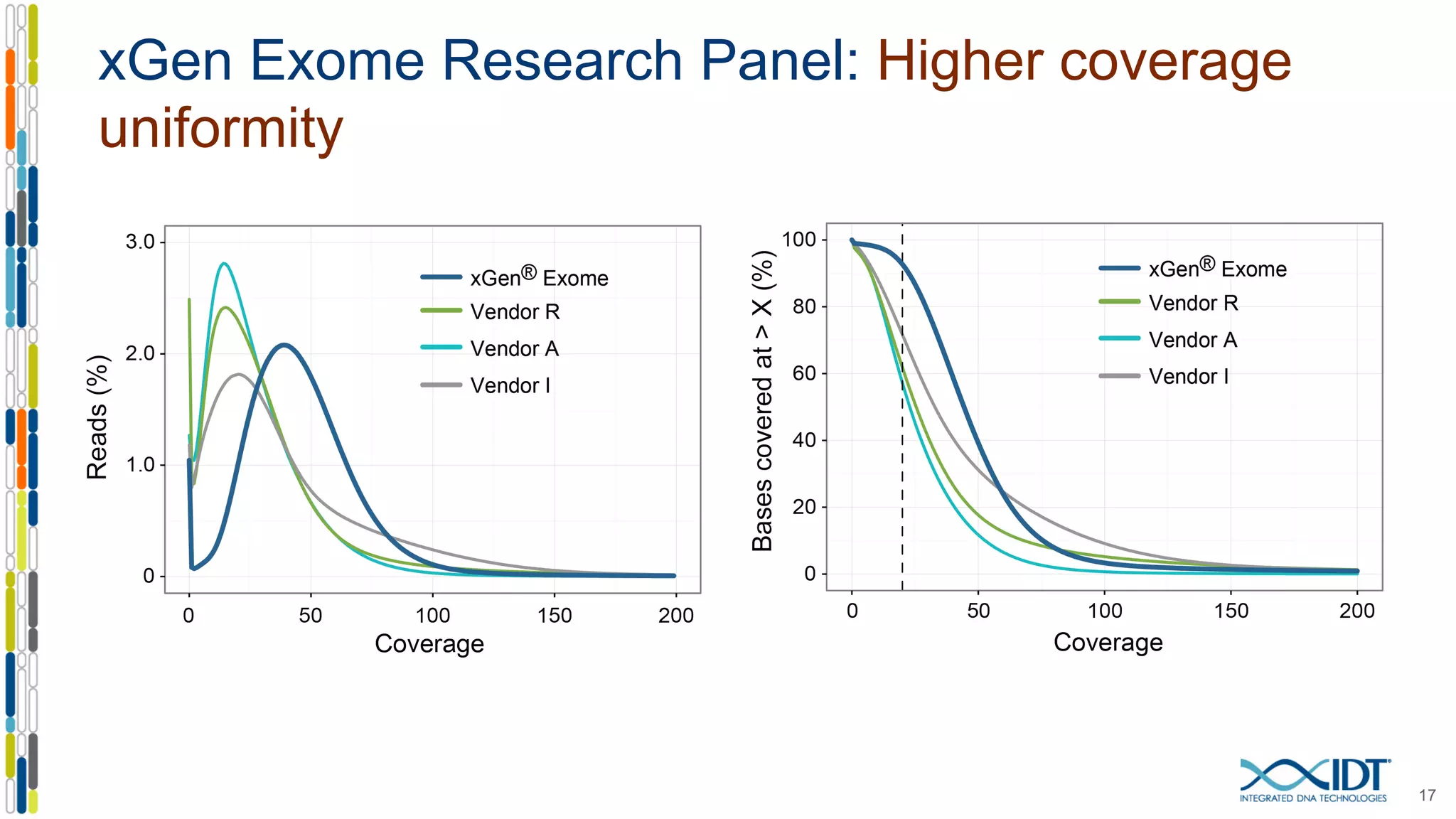
xGen Exome Research Panel: Higher coverage
uniformity
17
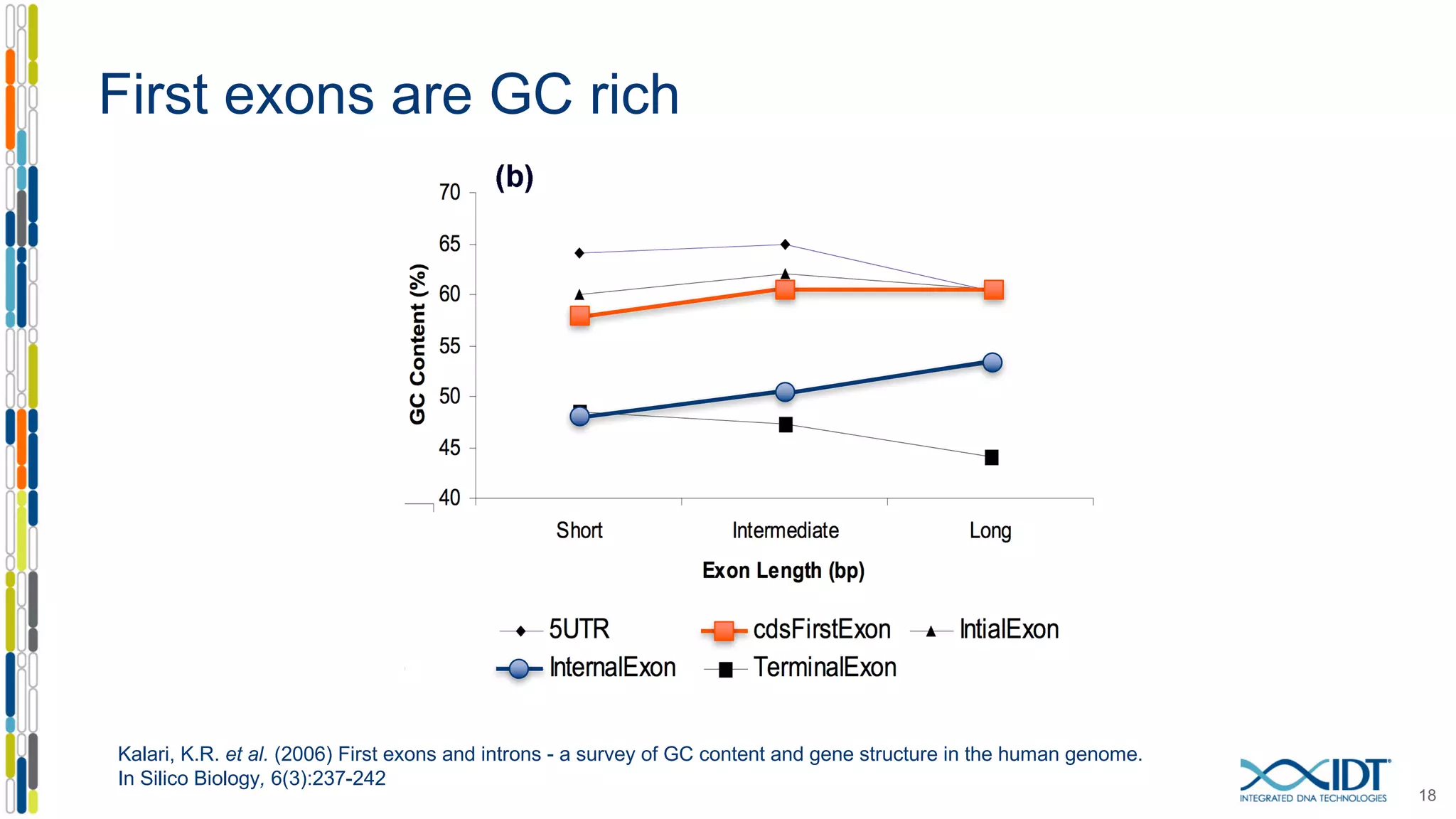
First exons are GC rich
18
Kalari, K.R. et al. (2006) First exons and introns - a survey of GC content and gene structure in the human genome.
In Silico Biology, 6(3):237-242
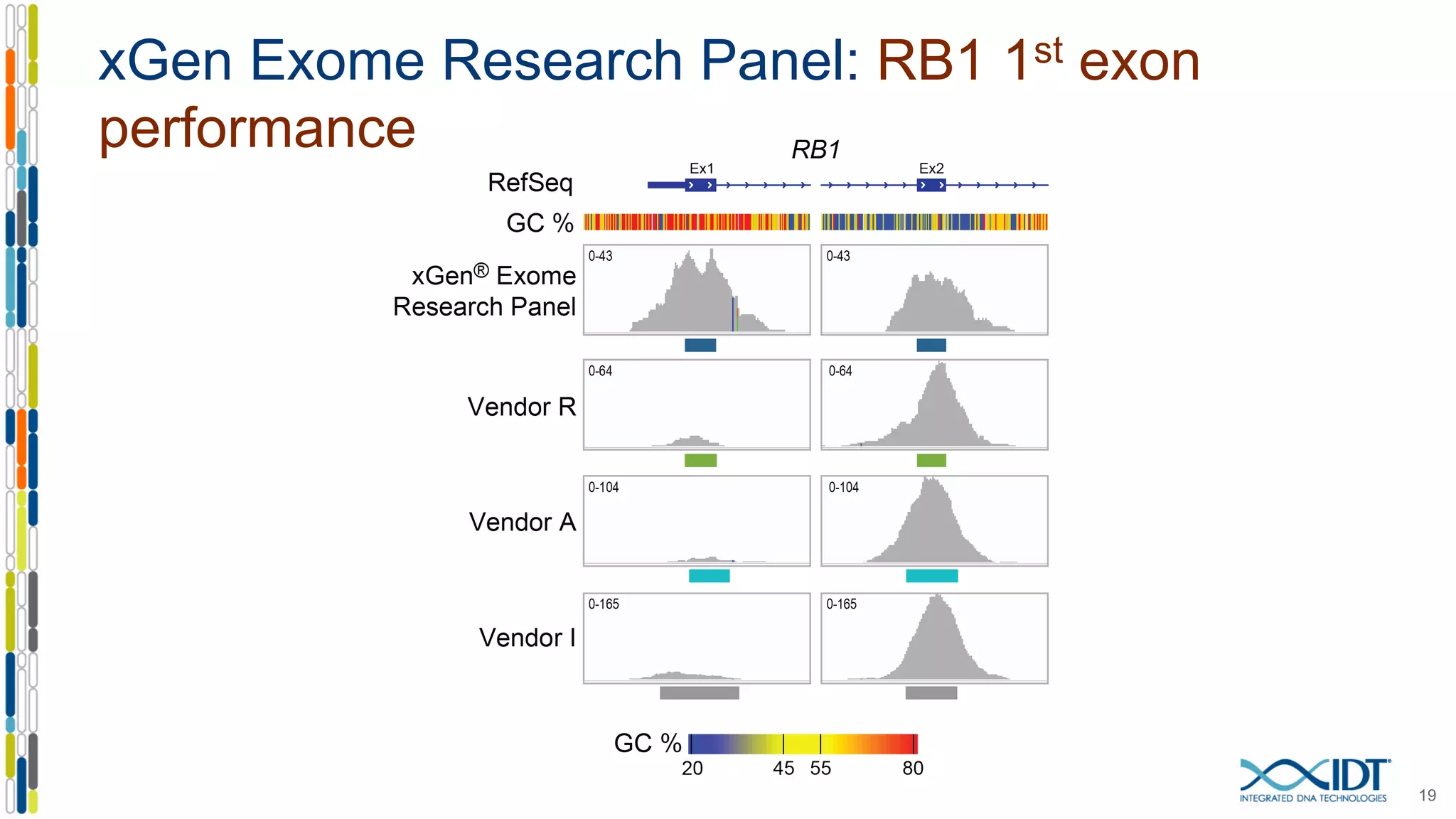
xGen Exome Research Panel: RB1 1st exon
performance
19
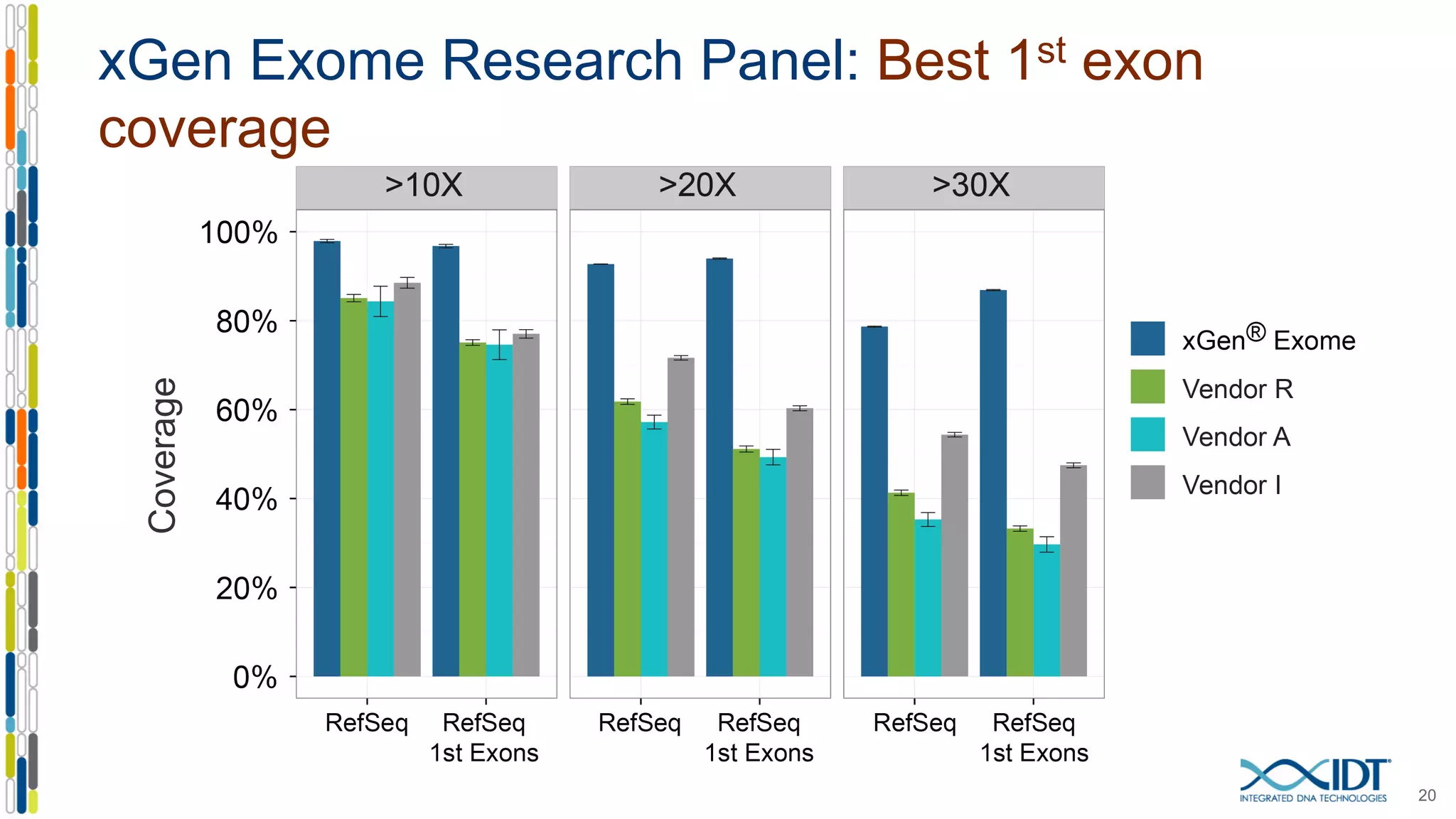
xGen Exome Research Panel: Best 1st exon
coverage
20
Coverage
Outline
• Review
– Exome sequencing
– xGen® product portfolio
– Library preparation and target enrichment
• Exome performance
– Multiplexed capture
– Deep sequencing
– Exome sequencing vs. WGS
21
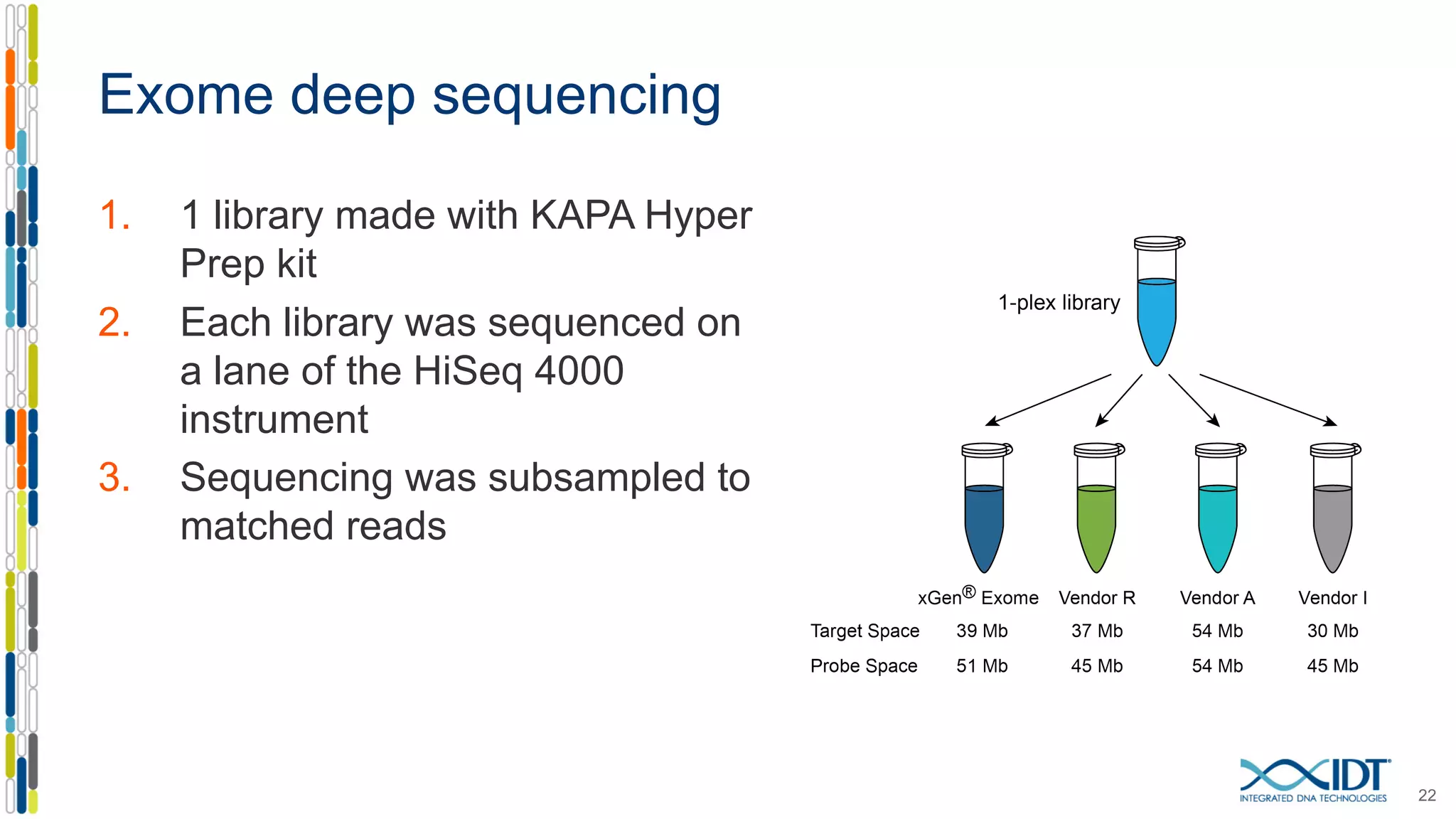
Exome deep sequencing
22
1. 1 library made with KAPA Hyper
Prep kit
2. Each library was sequenced on
a lane of the HiSeq 4000
instrument
3. Sequencing was subsampled to
matched reads
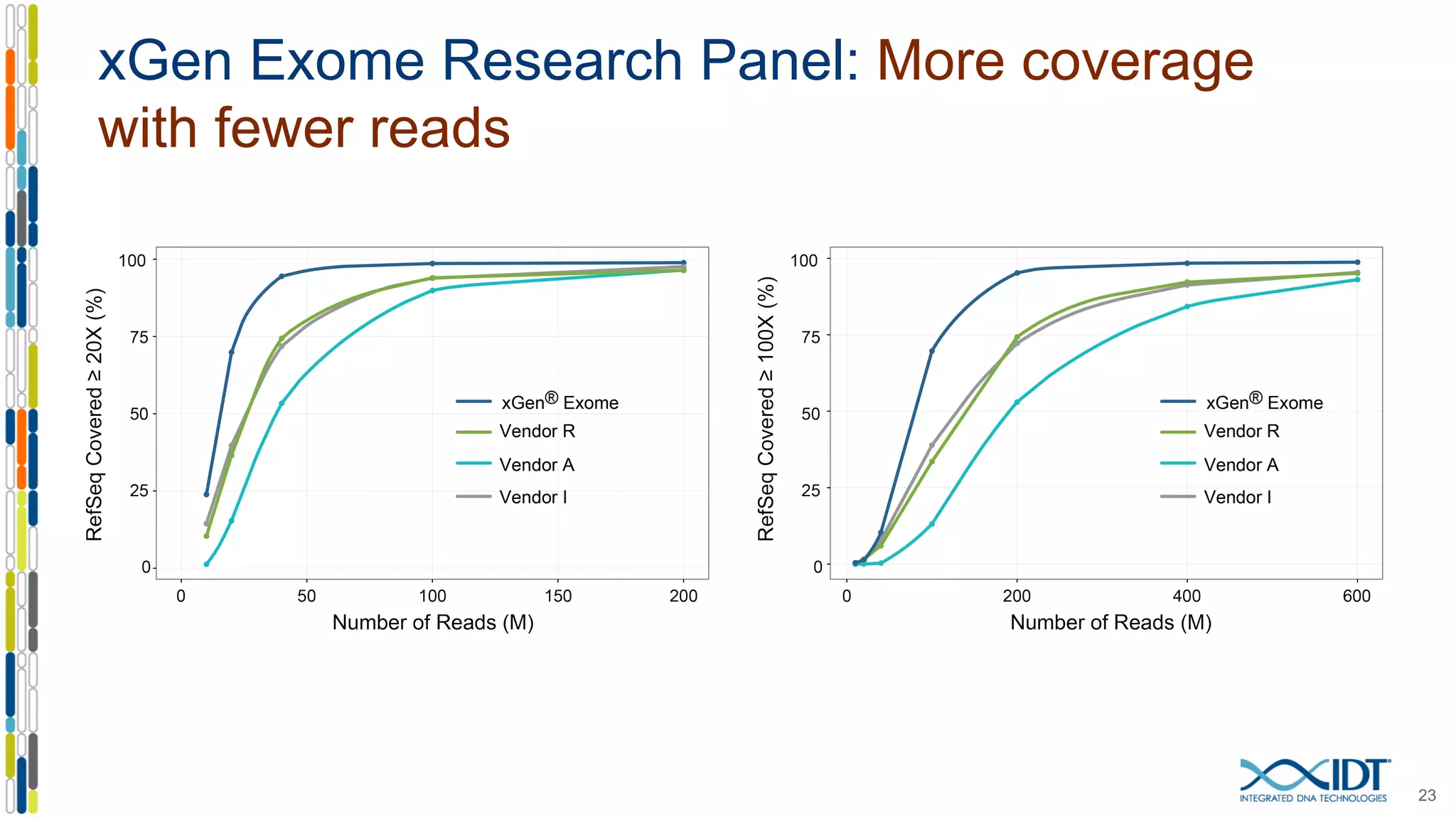
xGen Exome Research Panel: More coverage
with fewer reads
23
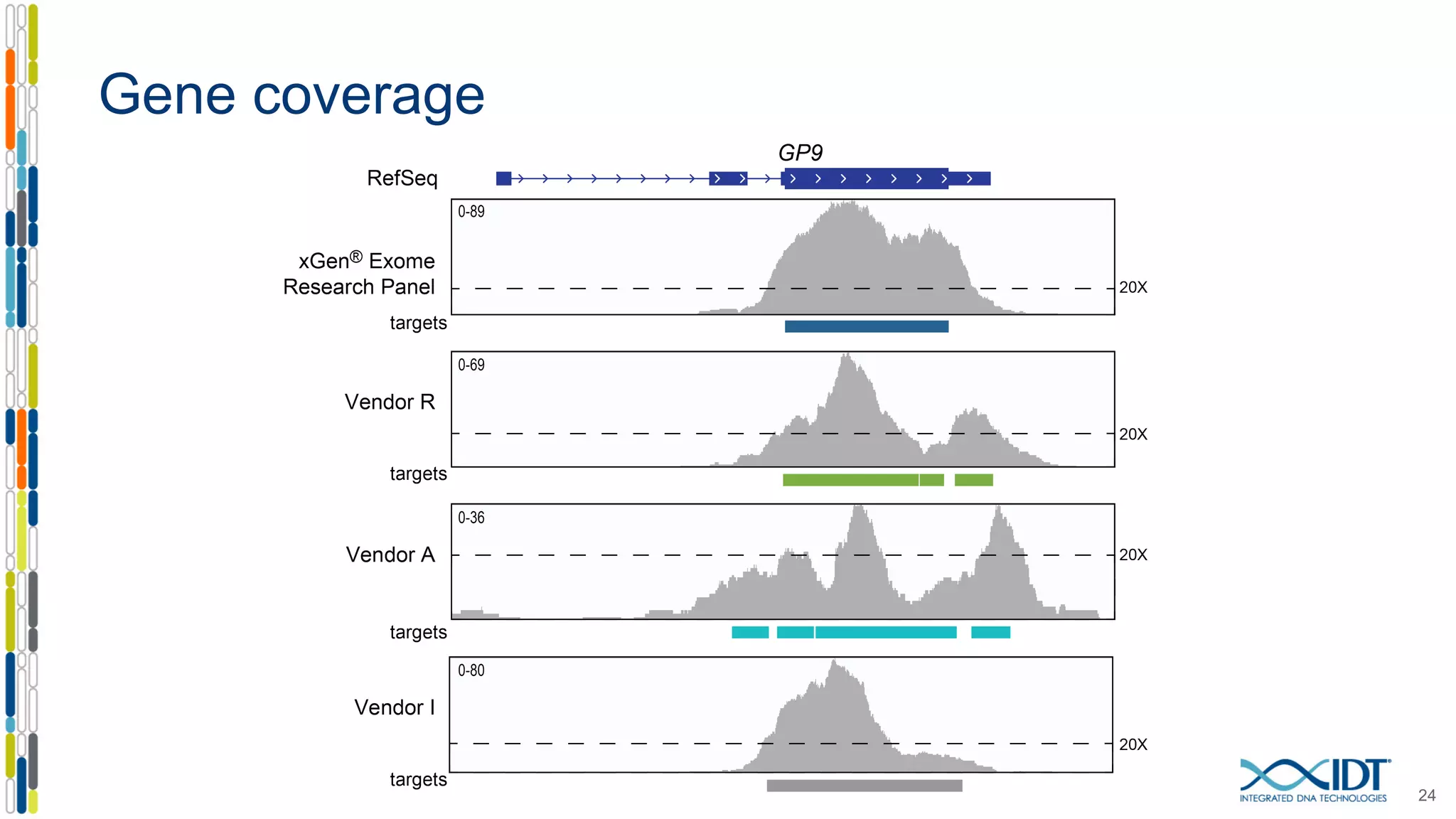
Gene coverage
24
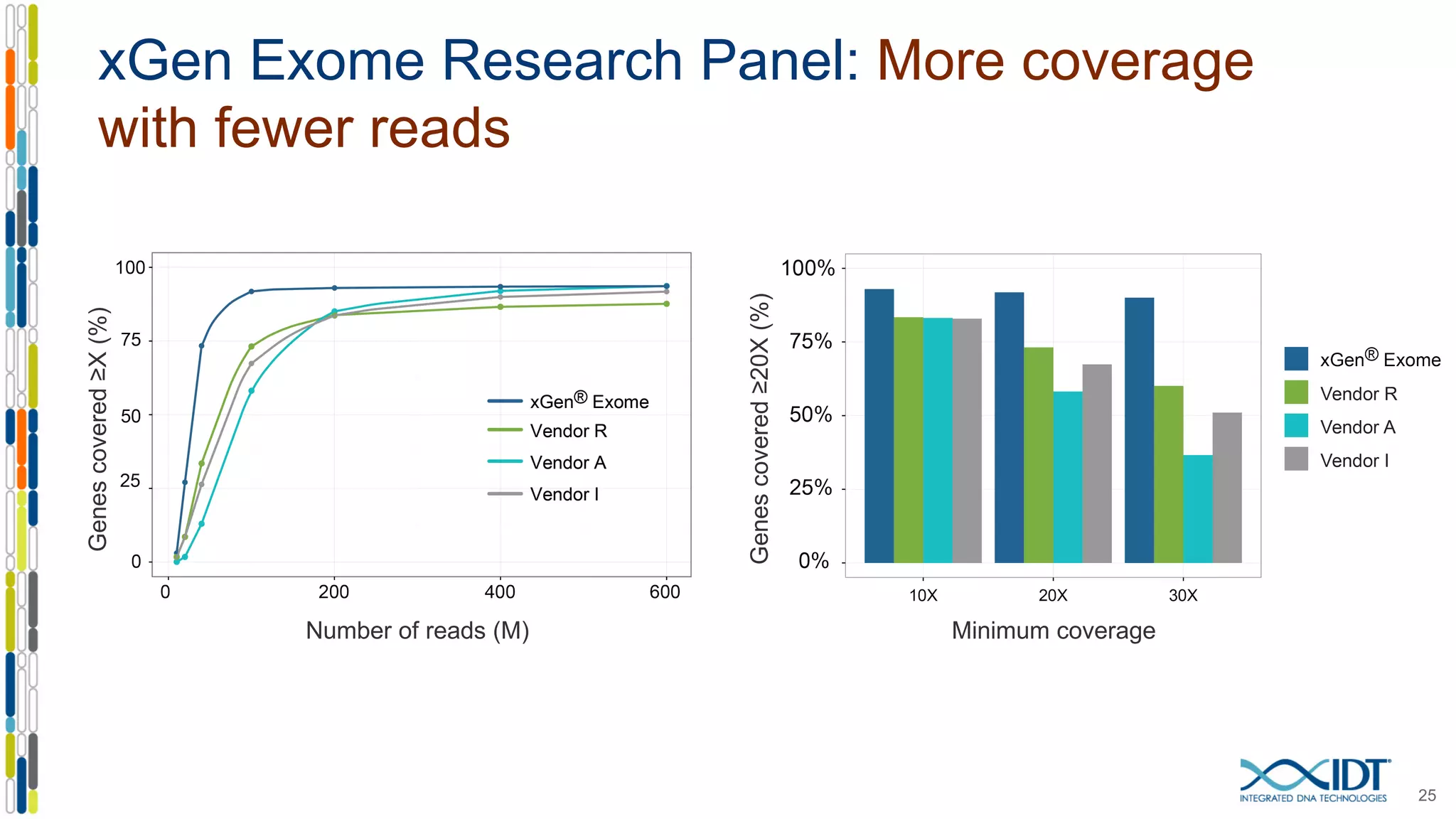
xGen Exome Research Panel: More coverage
with fewer reads
25
Genescovered≥X(%)
Genescovered≥20X(%)
Number of reads (M) Minimum coverage
Outline
• Review
– Exome sequencing
– xGen® product portfolio
– Library preparation and target enrichment
• Exome performance
– Multiplexed capture
– Deep sequencing
– Exome vs. WGS
26
Exome Aggregation Consortium (ExAC)
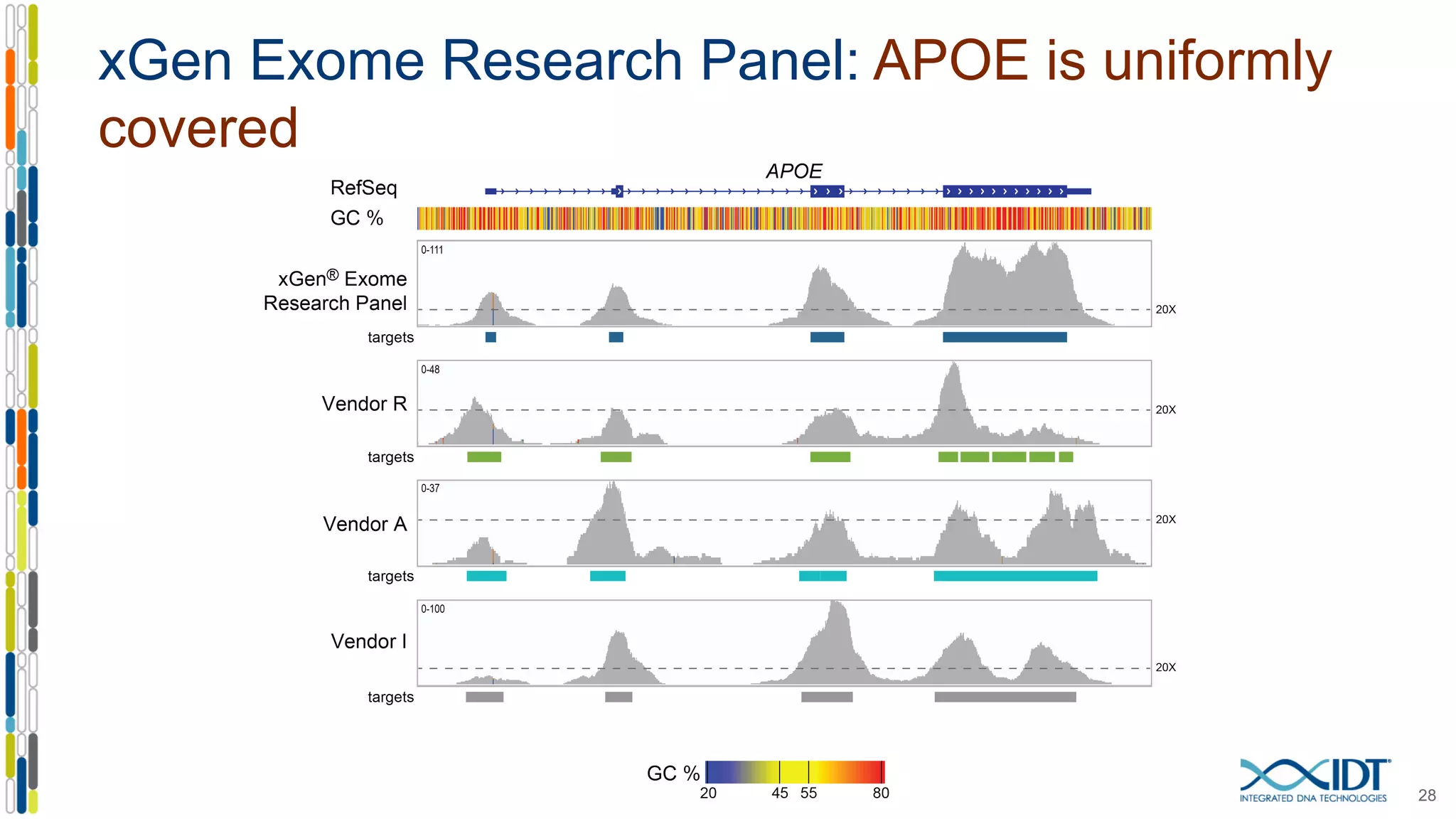
• APOE is typically poorly represented in exome capture
27
[http://exac.broadinstitute.org/gene/ENSG00000130203]
xGen Exome Research Panel: APOE is uniformly
covered
28
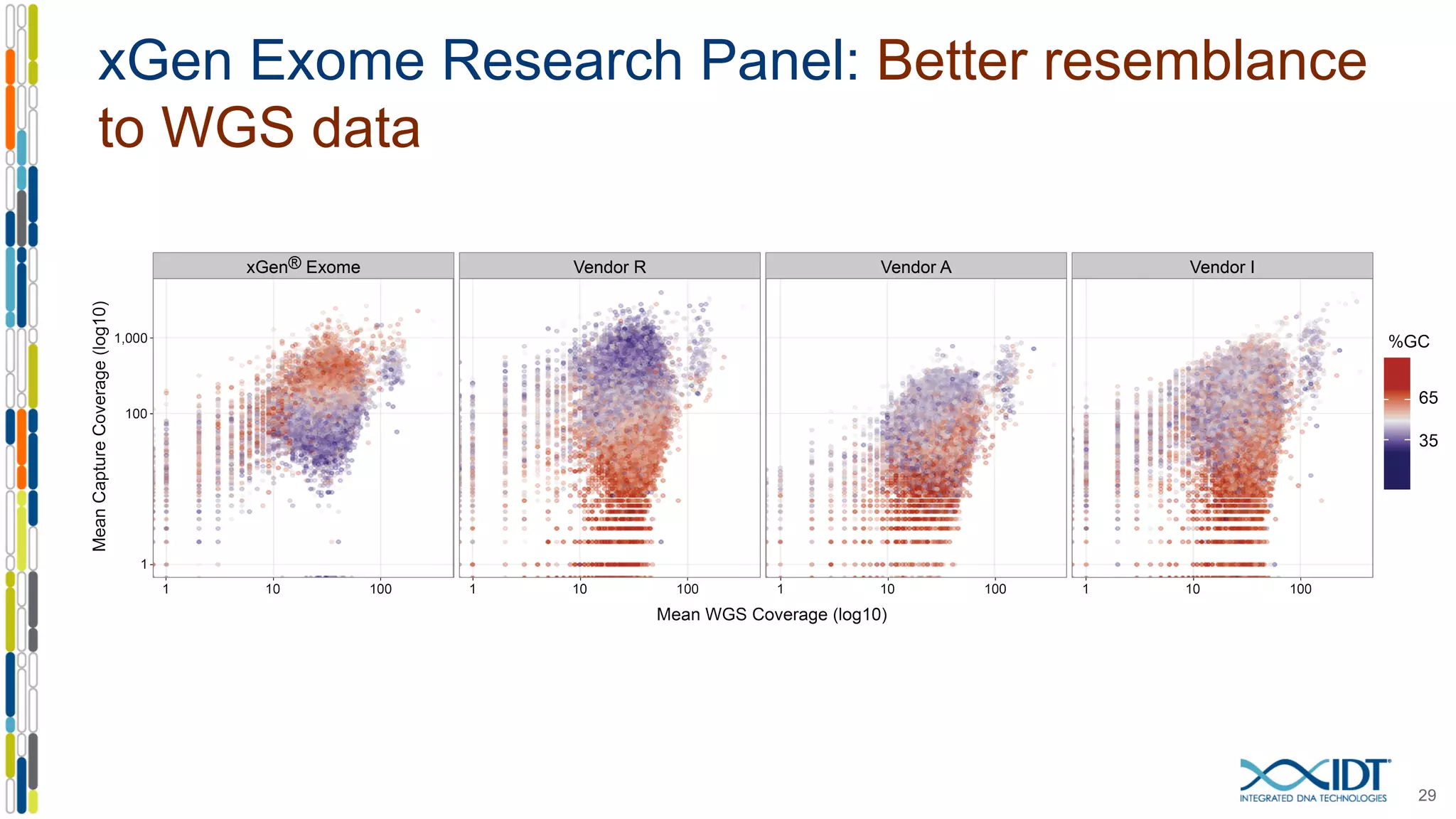
xGen Exome Research Panel: Better resemblance
to WGS data
29
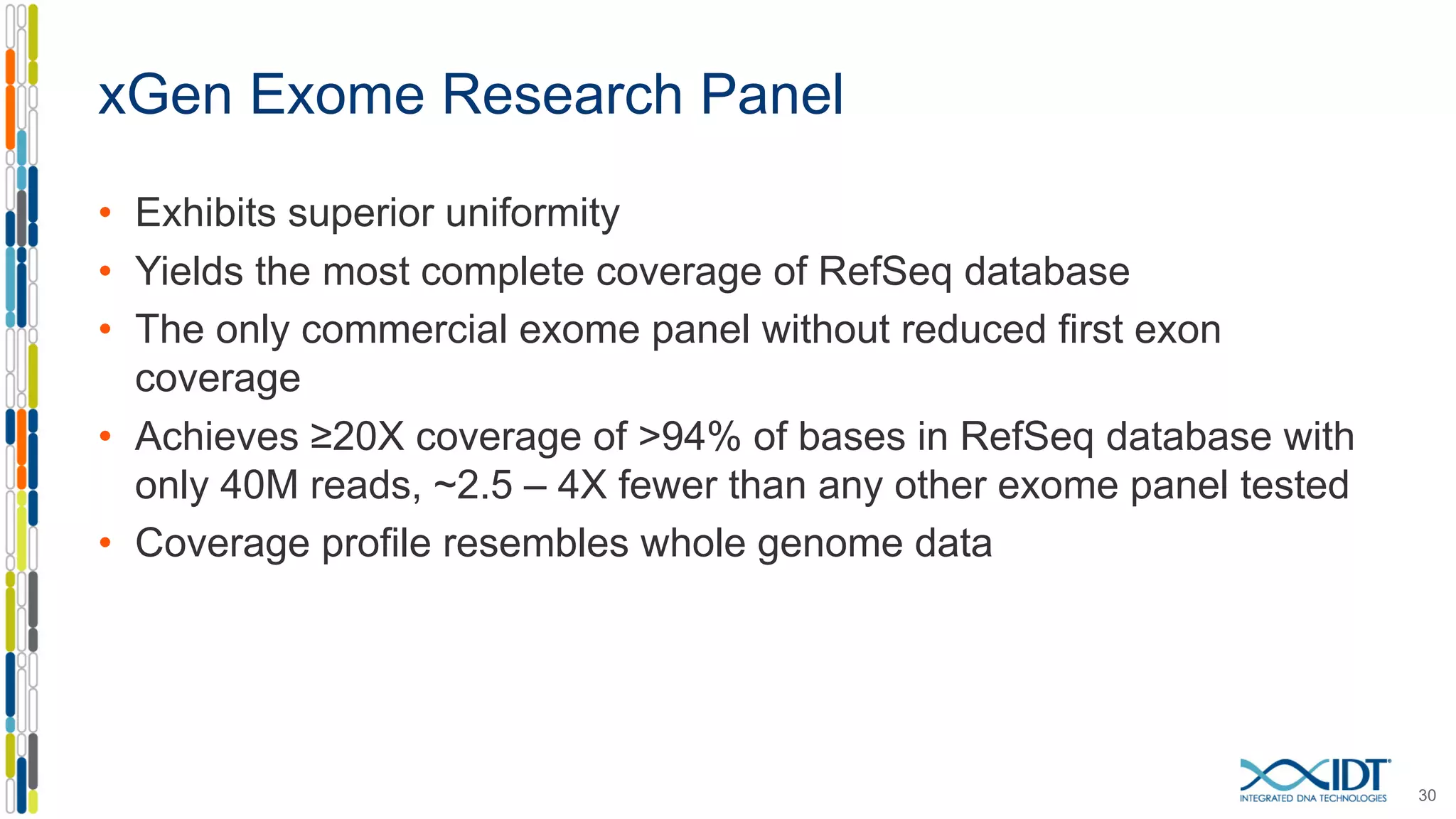
xGen Exome Research Panel
• Exhibits superior uniformity
• Yields the most complete coverage of RefSeq database
• The only commercial exome panel without reduced first exon
coverage
• Achieves ≥20X coverage of >94% of bases in RefSeq database with
only 40M reads, ~2.5 – 4X fewer than any other exome panel tested
• Coverage profile resembles whole genome data
30
THANK YOU
31

Analyzing the exome—focusing your NGS analysis with high performance target capture

  • 1.
    Analyzing the exome—focusingyour NGS analysis with high performance target capture Kristina Giorda, PhD 1
  • 2.
    Outline • Review – Exomesequencing – xGen® product portfolio – Library preparation and target enrichment • Exome performance – Multiplexed capture – Deep sequencing – Exome sequencing vs. WGS 2
  • 3.
    Exome sequencing • Affordableapproach to interrogate protein coding portion of the genome and identify disease-causing variants • Mendelian disorders – Prenatal diagnosis, preimplementation genetic diagnosis, carrier/mutation detection of heterogeneous disorders (e.g., hearing loss), prognosis of preclinical individuals • Personalized cancer therapy – Diagnosis and prognosis, treatment, discovery of new cancer-related genes, address tumor heterogeneity and evolution [http://www.dnalinkus.com/us/service/exome_sequencing.html]
  • 4.
    xGen® products forNGS target enrichment 4 NGS workflow
  • 5.
    Library construction 5 Fragmentation End repairand A-tailing Adapter ligation Bead cleanup Library amplification Bead cleanup
  • 6.
    xGen products forNGS target enrichment • xGen® Lockdown® Probe Technology – Predesigned Lockdown Panels – Predesigned Gene Capture Pools – Custom probe panels • xGen Blocking Oligos • xGen Lockdown Reagents for hybridization & wash • gBlocks® Gene Fragments for NGS spiking controls 6
  • 7.
    NGS target captureenrichment xGen Lockdown Probes • Individually synthesized • Individual QC on every probe • Individually normalized • Pooled 7
  • 8.
    Target enrichment byhybridization 8
  • 9.
    xGen Lockdown Probesare individually synthesized and quality controlled Each xGen Lockdown Probe receives an individual ESI-MS analysis Failed Remade Full length Truncated Full length 9
  • 10.
    Inventoried xGen targetcapture panels 10 Panel No. of genes Target capture size (Mb) No. of probes Exome 19,396 51.0 429,826 AML 264 1.4 11,743 Pan-Cancer 127 0.8 7,816 Human ID 0.03 229 Human mtDNA 0.02 138
  • 11.
    Batch-to-batch consistency 30,895 Enjoy thesame highly uniform coverage for custom xGen® Lockdown Panels 11
  • 12.
    Outline • Review – Exomesequencing – xGen® product portfolio – Library preparation and target enrichment • Exome performance – Multiplexed capture – Deep sequencing – Exome sequencing vs. WGS 12
  • 13.
    Comparative study design 13 1.An independent large genome center compared 4 exome capture panels 2. 12 libraries were made with KAPA Hyper Prep kit 3. Libraries were split into each capture 4. Captures were completed by each vendor’s protocol 5. Captures were sequenced on a lane of the HiSeq® 2500 instrument in high output mode and subsampled to 17M PE reads or 5.1 Gb of sequencing
  • 14.
    Probe design overlapwith exon databases 14 % Database covered Database / probe space xGen® panel Vendor R Vendor A Vendor I (Size bp) (51 Mb) (45 Mb) (54 Mb) (45 Mb) RefSeq (34 Mb) 98% 97% 97% 100% CCDS (32 Mb) 99% 98% 98% 100% Ensembl (35 Mb) 93% 92% 96% 99% GENCODE (35 Mb) 96% 95% 97% 99% Vega (26 Mb) 95% 96% 97% 100%
  • 15.
    xGen Exome ResearchPanel: Higher on-target rate 15 On-target (%) = (on bait bases + near bait bases) / aligned bases
  • 16.
  • 17.
    xGen Exome ResearchPanel: Higher coverage uniformity 17
  • 18.
    First exons areGC rich 18 Kalari, K.R. et al. (2006) First exons and introns - a survey of GC content and gene structure in the human genome. In Silico Biology, 6(3):237-242
  • 19.
    xGen Exome ResearchPanel: RB1 1st exon performance 19
  • 20.
    xGen Exome ResearchPanel: Best 1st exon coverage 20 Coverage
  • 21.
    Outline • Review – Exomesequencing – xGen® product portfolio – Library preparation and target enrichment • Exome performance – Multiplexed capture – Deep sequencing – Exome sequencing vs. WGS 21
  • 22.
    Exome deep sequencing 22 1.1 library made with KAPA Hyper Prep kit 2. Each library was sequenced on a lane of the HiSeq 4000 instrument 3. Sequencing was subsampled to matched reads
  • 23.
    xGen Exome ResearchPanel: More coverage with fewer reads 23
  • 24.
  • 25.
    xGen Exome ResearchPanel: More coverage with fewer reads 25 Genescovered≥X(%) Genescovered≥20X(%) Number of reads (M) Minimum coverage
  • 26.
    Outline • Review – Exomesequencing – xGen® product portfolio – Library preparation and target enrichment • Exome performance – Multiplexed capture – Deep sequencing – Exome vs. WGS 26
  • 27.
    Exome Aggregation Consortium(ExAC) • APOE is typically poorly represented in exome capture 27 [http://exac.broadinstitute.org/gene/ENSG00000130203]
  • 28.
    xGen Exome ResearchPanel: APOE is uniformly covered 28
  • 29.
    xGen Exome ResearchPanel: Better resemblance to WGS data 29
  • 30.
    xGen Exome ResearchPanel • Exhibits superior uniformity • Yields the most complete coverage of RefSeq database • The only commercial exome panel without reduced first exon coverage • Achieves ≥20X coverage of >94% of bases in RefSeq database with only 40M reads, ~2.5 – 4X fewer than any other exome panel tested • Coverage profile resembles whole genome data 30
  • 31.