functional genomics
By
KAUSHAL KUMAR SAHU
Assistant Professor (Ad Hoc)
Department of Biotechnology
Govt. Digvijay Autonomous P. G. College
Raj-Nandgaon ( C. G. )
Synopsis
• Introduction
• Definition
• History
• Goals of functional genomics
• Functional genomics approach :
• Reverse genetics
• Forward genetics
• Tools for forward and reverse genetics
• Limitations
• Conclusion
• reference
Introduction
• Functional genomics is a field of molecular
biology or a branch of genomics that attempts to
make use of the vast wealth of data produced by
genomic projects (such as genome sequencing
projects) to describe gene (and protein) functions
and interactions.
• It involves the function of all specific gene and
their expression in the time and space in an
organism. Once new gene is located and
sequenced then the next question is what
function it controls.
Definition of functional genomics
• Functional genomics is the branch of
genomics in which we study the function of
genes, and their products (proteins), and the
role played by those proteins in
the organism's biochemical processes.
Functional genomics also involves
understanding the genetic control
mechanisms.
History
• Genetics began in the 1860s with Gregor Mendel, an Augustinian monk
who performed experiments that suggested the existence of genes
(Griffiths et al. 2000).
• The discovery of the structure of DNA by James Watson and Francis Crick
in the 1950s (Watson and Crick 1953),
• followed by the development of di-deoxy terminator sequencing by
Sanger in the late 1970s (Sanger, Nicklen, and Coulson 1977)
• and then of PCR (polymerase chain reaction) technology by Kary Mullis in
the 1980s (Mullis and Faloona 1987; Saiki et al. 1985) set off a genetic
revolution.
• Technological advances in sequencing have greatly accelerated our
accumulation of genetic sequence data to the point now where whole
genome sequences are publicly available for a large number of organisms
including plant pathogens. The toolbox for genetic research is expanding
rapidly, and this overview presents a suite of tools generally referred to as
reverse genetics that can be used to investigate gene function.
Goals of functional genomics
• To understand the relationship between an organism’s
genome and its phenotype
• To helps in understanding of the dynamic properties of an
organism at cellular and / or organism levels.
• It provides a more complete picture of how biological
function arises from the information encoded in an
organism’s genome.
• How a particular mutation leads to a given phenotype has
important implications for human genetic diseases.
• Attempt are being made to find out the pattern of gene
expression, which genes are switched on and which are
switched off in different tissue during different
developmental stage..
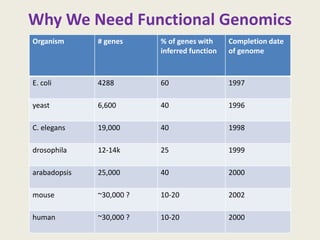
Why We Need Functional Genomics
Organism # genes % of genes with
inferred function
Completion date
of genome
E. coli 4288 60 1997
yeast 6,600 40 1996
C. elegans 19,000 40 1998
drosophila 12-14k 25 1999
arabadopsis 25,000 40 2000
mouse ~30,000 ? 10-20 2002
human ~30,000 ? 10-20 2000
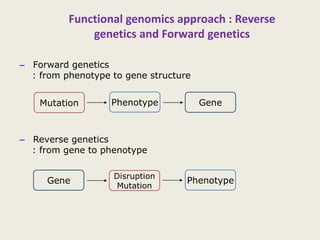
Functional genomics approach : Reverse
genetics and Forward genetics
– Forward genetics
: from phenotype to gene structure
– Reverse genetics
: from gene to phenotype
Mutation Phenotype Gene
Gene
Disruption
Mutation
Phenotype
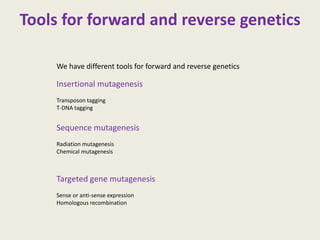
Tools for forward and reverse genetics
We have different tools for forward and reverse genetics
Insertional mutagenesis
Transposon tagging
T-DNA tagging
Sequence mutagenesis
Radiation mutagenesis
Chemical mutagenesis
Targeted gene mutagenesis
Sense or anti-sense expression
Homologous recombination
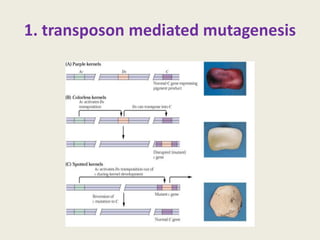
Transposon tagging
Transposable elements or Transposons are mobile genetic elements that can
relocate from one genomic location to another. They are DNA sequences
that can insert themselves at a new location in the genome without having
any sequence relationship with the target locus. DNA transposons flanked by
short inverted repeats move by excising from one chromosome site to
another.
Transposable elements are powerful mutagens for functional genomics
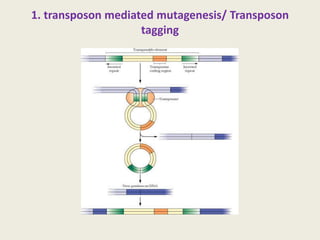
1. transposon mediated mutagenesis/ Transposon
tagging
1. transposon mediated mutagenesis
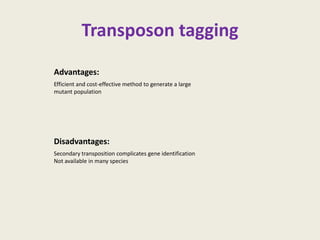
Transposon tagging
Advantages:
Efficient and cost-effective method to generate a large
mutant population
Disadvantages:
Secondary transposition complicates gene identification
Not available in many species
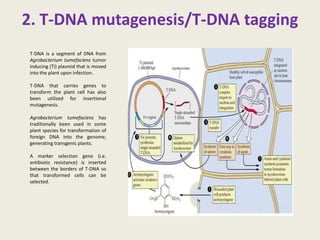
2. T-DNA mutagenesis/T-DNA tagging
T-DNA is a segment of DNA from
Agrobacterium tumefaciens tumor
inducing (Ti) plasmid that is moved
into the plant upon infection.
T-DNA that carries genes to
transform the plant cell has also
been utilized for insertional
mutagenesis.
Agrobacterium tumefaciens has
traditionally been used in some
plant species for transformation of
foreign DNA into the genome,
generating transgenic plants.
A marker selection gene (i.e.
antibiotic resistance) is inserted
between the borders of T-DNA so
that transformed cells can be
selected.
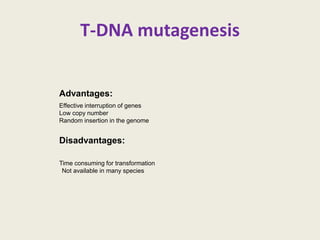
T-DNA mutagenesis
Advantages:
Effective interruption of genes
Low copy number
Random insertion in the genome
Disadvantages:
Time consuming for transformation
Not available in many species
Insertional mutagenesis
One drawback of insertional mutagenesis is
the low frequency of mutations,
necessitating the screening of large numbers of individuals to find
mutations in any given gene. Also,
insertions in essential genes will usually cause lethality, and
less severe mutations must be generated in these genes in order to
understand gene function.
SEQUENCE MUTAGENESIS
A mutation is a change of the nucleotide sequence of the gene or genome (typically caused by radiation or
chemical mutagens),
Mutations may or may not produce discernable changes in the observable characteristics (phenotype) of
an organism.
Random mutagen are used to generate mutations in sequences throughout the genome
 Radiation mutagenesis
 Chemical mutagenesis
1. Radiation mutagenesis
Ionizing radiation (i.e. fast neutron, gamma ray) are used to generate random mutations (breaks)
in DNA segments. For example, fast neutron breaks the chromosomes leading to loss of DNA
sequences (i.e. large deletions).
2. Chemical mutagenesis
Chemicals can also cause mutations in DNA sequences.
Etheylmethane sulfonate (EMS) induces point mutations in
DNA. EMS alkylates primarily guanine leading to
mispairing: alkylated G pairs to T instead of C. The resulting
mutations are mainly transitions (GC ® AT). Diepoxybutane
(DEB) and trimethylpsoralen + UV (TMP + UV) generally
cause small deletions (100 bp to 1.5kb). These last
chemicals generate DNA interstrand cross-links, which are
repaired by the replication machinery by removal of the
effected sequences.
TILLING
The Targeting Induced Local Lesions IN
Genomes (TILLING) strategy provides a high
throughput strategy to detect single base
changes within genetic targets and can be
applied to a wide variety of organisms.
TILLING Phytophthora
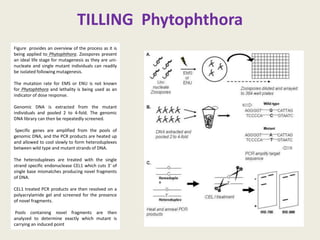
Figure provides an overview of the process as it is
being applied to Phytophthora. Zoospores present
an ideal life stage for mutagenesis as they are uni-
nucleate and single mutant individuals can readily
be isolated following mutagenesis.
The mutation rate for EMS or ENU is not known
for Phytophthora and lethality is being used as an
indicator of dose response.
Genomic DNA is extracted from the mutant
individuals and pooled 2 to 4-fold. The genomic
DNA library can then be repeatedly screened.
Specific genes are amplified from the pools of
genomic DNA, and the PCR products are heated up
and allowed to cool slowly to form heteroduplexes
between wild type and mutant strands of DNA.
The heteroduplexes are treated with the single
strand specific endonuclease CEL1 which cuts 3' of
single base mismatches producing novel fragments
of DNA.
CEL1 treated PCR products are then resolved on a
polyacrylamide gel and screened for the presence
of novel fragments.
Pools containing novel fragments are then
analyzed to determine exactly which mutant is
carrying an induced point
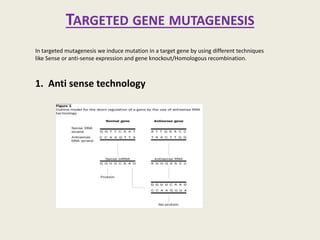
TARGETED GENE MUTAGENESIS
In targeted mutagenesis we induce mutation in a target gene by using different techniques
like Sense or anti-sense expression and gene knockout/Homologous recombination.
1. Anti sense technology
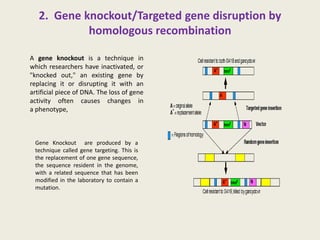
2. Gene knockout/Targeted gene disruption by
homologous recombination
A gene knockout is a technique in
which researchers have inactivated, or
"knocked out," an existing gene by
replacing it or disrupting it with an
artificial piece of DNA. The loss of gene
activity often causes changes in
a phenotype,
Gene Knockout are produced by a
technique called gene targeting. This is
the replacement of one gene sequence,
the sequence resident in the genome,
with a related sequence that has been
modified in the laboratory to contain a
mutation.
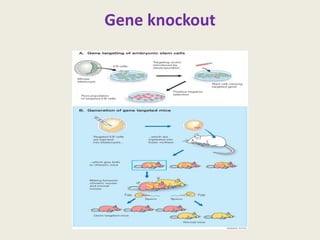
Gene knockout
Limitations/roadblocks to completing reverse genetics
Completing reverse genetics is not without its pitfalls, and not all techniques can be applied
to all organisms.
To be successful, there are several aspects that must be checked.
For organisms that do not have efficient transformation systems available techniques such
as TILLING that can be applied without transformation may be the only practical choice.
In these cases, the rate of mutagenesis is an important factor that can be difficult to
determine.
The load of mutations must be balanced with the recovery of mutants – in other words, the
genome can't be so riddled with mutations that it is impossible to see a mutant phenotype.
Also to be considered is the fertility of the mutagenized organism, especially in the first
generation, but also in subsequent generations, both before and after mutagenesis.
This is especially true for diploid organisms, because if the sexual machinery is not intact
and working properly, then it is impossible to obtain a homozygous mutant.
The mutagenized organisms must also be kept alive long enough to screen a mutant
population for a specific target. For some organisms,
like Arabidopsis or Phytophthora, this is not a problem as the seeds or cultures are relatively
easy to store. It presents a challenge for other organisms, such as zebrafish or rats, because
they must be stored and kept alive through the mutant screening stage.
Conclusion
Functional genomics is a field of molecular biology that attempts to
make use of the vast wealth of data produced by genomic projects
(such as genome sequencing projects) to describe gene (and protein)
functions and interactions. Unlike genomics, functional genomics
focuses on the dynamic aspects such as gene transcription, as opposed
to the static aspects of the genomic information such as DNA
sequence or structures. Functional genomics attempts to answer
questions about the function of DNA at the levels of genes, RNA
transcripts, and protein products. A key characteristic of functional
genomics studies is their genome-wide approach to these questions,
generally involving high-throughput methods rather than a more
traditional “gene-by-gene” approach.
Reference
Book
Principles of Gene Manipulation And Genomics-S.B. Primrose and R.M. Twyman.—7th ed.
Websites:
www.wikipedia.com
www.ncbi.nlm.nih.gov/pubmed
www.Plant functional genomics.com
www.kbiotech.com
www.sciencetechno.com

Functional genomics, a conceptual approach

  • 1.
    functional genomics By KAUSHAL KUMARSAHU Assistant Professor (Ad Hoc) Department of Biotechnology Govt. Digvijay Autonomous P. G. College Raj-Nandgaon ( C. G. )
  • 2.
    Synopsis • Introduction • Definition •History • Goals of functional genomics • Functional genomics approach : • Reverse genetics • Forward genetics • Tools for forward and reverse genetics • Limitations • Conclusion • reference
  • 3.
    Introduction • Functional genomicsis a field of molecular biology or a branch of genomics that attempts to make use of the vast wealth of data produced by genomic projects (such as genome sequencing projects) to describe gene (and protein) functions and interactions. • It involves the function of all specific gene and their expression in the time and space in an organism. Once new gene is located and sequenced then the next question is what function it controls.
  • 4.
    Definition of functionalgenomics • Functional genomics is the branch of genomics in which we study the function of genes, and their products (proteins), and the role played by those proteins in the organism's biochemical processes. Functional genomics also involves understanding the genetic control mechanisms.
  • 5.
    History • Genetics beganin the 1860s with Gregor Mendel, an Augustinian monk who performed experiments that suggested the existence of genes (Griffiths et al. 2000). • The discovery of the structure of DNA by James Watson and Francis Crick in the 1950s (Watson and Crick 1953), • followed by the development of di-deoxy terminator sequencing by Sanger in the late 1970s (Sanger, Nicklen, and Coulson 1977) • and then of PCR (polymerase chain reaction) technology by Kary Mullis in the 1980s (Mullis and Faloona 1987; Saiki et al. 1985) set off a genetic revolution. • Technological advances in sequencing have greatly accelerated our accumulation of genetic sequence data to the point now where whole genome sequences are publicly available for a large number of organisms including plant pathogens. The toolbox for genetic research is expanding rapidly, and this overview presents a suite of tools generally referred to as reverse genetics that can be used to investigate gene function.
  • 6.
    Goals of functionalgenomics • To understand the relationship between an organism’s genome and its phenotype • To helps in understanding of the dynamic properties of an organism at cellular and / or organism levels. • It provides a more complete picture of how biological function arises from the information encoded in an organism’s genome. • How a particular mutation leads to a given phenotype has important implications for human genetic diseases. • Attempt are being made to find out the pattern of gene expression, which genes are switched on and which are switched off in different tissue during different developmental stage..
  • 7.
    Why We NeedFunctional Genomics Organism # genes % of genes with inferred function Completion date of genome E. coli 4288 60 1997 yeast 6,600 40 1996 C. elegans 19,000 40 1998 drosophila 12-14k 25 1999 arabadopsis 25,000 40 2000 mouse ~30,000 ? 10-20 2002 human ~30,000 ? 10-20 2000
  • 8.
    Functional genomics approach: Reverse genetics and Forward genetics – Forward genetics : from phenotype to gene structure – Reverse genetics : from gene to phenotype Mutation Phenotype Gene Gene Disruption Mutation Phenotype
  • 9.
    Tools for forwardand reverse genetics We have different tools for forward and reverse genetics Insertional mutagenesis Transposon tagging T-DNA tagging Sequence mutagenesis Radiation mutagenesis Chemical mutagenesis Targeted gene mutagenesis Sense or anti-sense expression Homologous recombination
  • 10.
    Transposon tagging Transposable elementsor Transposons are mobile genetic elements that can relocate from one genomic location to another. They are DNA sequences that can insert themselves at a new location in the genome without having any sequence relationship with the target locus. DNA transposons flanked by short inverted repeats move by excising from one chromosome site to another. Transposable elements are powerful mutagens for functional genomics
  • 11.
    1. transposon mediatedmutagenesis/ Transposon tagging
  • 12.
  • 13.
    Transposon tagging Advantages: Efficient andcost-effective method to generate a large mutant population Disadvantages: Secondary transposition complicates gene identification Not available in many species
  • 14.
    2. T-DNA mutagenesis/T-DNAtagging T-DNA is a segment of DNA from Agrobacterium tumefaciens tumor inducing (Ti) plasmid that is moved into the plant upon infection. T-DNA that carries genes to transform the plant cell has also been utilized for insertional mutagenesis. Agrobacterium tumefaciens has traditionally been used in some plant species for transformation of foreign DNA into the genome, generating transgenic plants. A marker selection gene (i.e. antibiotic resistance) is inserted between the borders of T-DNA so that transformed cells can be selected.
  • 15.
    T-DNA mutagenesis Advantages: Effective interruptionof genes Low copy number Random insertion in the genome Disadvantages: Time consuming for transformation Not available in many species
  • 16.
    Insertional mutagenesis One drawbackof insertional mutagenesis is the low frequency of mutations, necessitating the screening of large numbers of individuals to find mutations in any given gene. Also, insertions in essential genes will usually cause lethality, and less severe mutations must be generated in these genes in order to understand gene function.
  • 17.
    SEQUENCE MUTAGENESIS A mutationis a change of the nucleotide sequence of the gene or genome (typically caused by radiation or chemical mutagens), Mutations may or may not produce discernable changes in the observable characteristics (phenotype) of an organism. Random mutagen are used to generate mutations in sequences throughout the genome  Radiation mutagenesis  Chemical mutagenesis 1. Radiation mutagenesis Ionizing radiation (i.e. fast neutron, gamma ray) are used to generate random mutations (breaks) in DNA segments. For example, fast neutron breaks the chromosomes leading to loss of DNA sequences (i.e. large deletions).
  • 18.
    2. Chemical mutagenesis Chemicalscan also cause mutations in DNA sequences. Etheylmethane sulfonate (EMS) induces point mutations in DNA. EMS alkylates primarily guanine leading to mispairing: alkylated G pairs to T instead of C. The resulting mutations are mainly transitions (GC ® AT). Diepoxybutane (DEB) and trimethylpsoralen + UV (TMP + UV) generally cause small deletions (100 bp to 1.5kb). These last chemicals generate DNA interstrand cross-links, which are repaired by the replication machinery by removal of the effected sequences.
  • 19.
    TILLING The Targeting InducedLocal Lesions IN Genomes (TILLING) strategy provides a high throughput strategy to detect single base changes within genetic targets and can be applied to a wide variety of organisms.
  • 20.
    TILLING Phytophthora Figure providesan overview of the process as it is being applied to Phytophthora. Zoospores present an ideal life stage for mutagenesis as they are uni- nucleate and single mutant individuals can readily be isolated following mutagenesis. The mutation rate for EMS or ENU is not known for Phytophthora and lethality is being used as an indicator of dose response. Genomic DNA is extracted from the mutant individuals and pooled 2 to 4-fold. The genomic DNA library can then be repeatedly screened. Specific genes are amplified from the pools of genomic DNA, and the PCR products are heated up and allowed to cool slowly to form heteroduplexes between wild type and mutant strands of DNA. The heteroduplexes are treated with the single strand specific endonuclease CEL1 which cuts 3' of single base mismatches producing novel fragments of DNA. CEL1 treated PCR products are then resolved on a polyacrylamide gel and screened for the presence of novel fragments. Pools containing novel fragments are then analyzed to determine exactly which mutant is carrying an induced point
  • 21.
    TARGETED GENE MUTAGENESIS Intargeted mutagenesis we induce mutation in a target gene by using different techniques like Sense or anti-sense expression and gene knockout/Homologous recombination. 1. Anti sense technology
  • 22.
    2. Gene knockout/Targetedgene disruption by homologous recombination A gene knockout is a technique in which researchers have inactivated, or "knocked out," an existing gene by replacing it or disrupting it with an artificial piece of DNA. The loss of gene activity often causes changes in a phenotype, Gene Knockout are produced by a technique called gene targeting. This is the replacement of one gene sequence, the sequence resident in the genome, with a related sequence that has been modified in the laboratory to contain a mutation.
  • 23.
  • 24.
    Limitations/roadblocks to completingreverse genetics Completing reverse genetics is not without its pitfalls, and not all techniques can be applied to all organisms. To be successful, there are several aspects that must be checked. For organisms that do not have efficient transformation systems available techniques such as TILLING that can be applied without transformation may be the only practical choice. In these cases, the rate of mutagenesis is an important factor that can be difficult to determine. The load of mutations must be balanced with the recovery of mutants – in other words, the genome can't be so riddled with mutations that it is impossible to see a mutant phenotype. Also to be considered is the fertility of the mutagenized organism, especially in the first generation, but also in subsequent generations, both before and after mutagenesis. This is especially true for diploid organisms, because if the sexual machinery is not intact and working properly, then it is impossible to obtain a homozygous mutant. The mutagenized organisms must also be kept alive long enough to screen a mutant population for a specific target. For some organisms, like Arabidopsis or Phytophthora, this is not a problem as the seeds or cultures are relatively easy to store. It presents a challenge for other organisms, such as zebrafish or rats, because they must be stored and kept alive through the mutant screening stage.
  • 25.
    Conclusion Functional genomics isa field of molecular biology that attempts to make use of the vast wealth of data produced by genomic projects (such as genome sequencing projects) to describe gene (and protein) functions and interactions. Unlike genomics, functional genomics focuses on the dynamic aspects such as gene transcription, as opposed to the static aspects of the genomic information such as DNA sequence or structures. Functional genomics attempts to answer questions about the function of DNA at the levels of genes, RNA transcripts, and protein products. A key characteristic of functional genomics studies is their genome-wide approach to these questions, generally involving high-throughput methods rather than a more traditional “gene-by-gene” approach.
  • 26.
    Reference Book Principles of GeneManipulation And Genomics-S.B. Primrose and R.M. Twyman.—7th ed. Websites: www.wikipedia.com www.ncbi.nlm.nih.gov/pubmed www.Plant functional genomics.com www.kbiotech.com www.sciencetechno.com