GENOME EDITING BY :
INTRODUCTION
 A number of genome editing technologies have emerged :
zinc-finger nucleases (ZFNs), transcription activator–like
effector nucleases (TALENs) and the RNA-guided CRISPR-
Cas nuclease system.
 The first two technologies use a strategy of tethering
endonuclease catalytic domains to modular DNA-binding
proteins for inducing targeted DNA double-stranded breaks
(DSBs) at specific genomic loci.
 By contrast, Cas9 is a nuclease guided by small RNAs through
Watson-Crick base pairing with target DNA representing a
system that is markedly easier to design, highly specific,
efficient and well-suited for high-throughput and multiplexed
gene editing for a variety of cell types and organisms.
DISCOVERY
 The first description of what would later be called
CRISPR is from Osaka University researcher
Yoshizumi Ishino and his colleagues in 1987.
 Jennifer Daudna and Emmanuelle Charpentier re-
engineered the Cas9 endonuclease into a more
manageable two-component system by fusing the
two RNA molecules into a "single-guide RNA" that,
when combined with Cas9, could find and cut the
DNA target specified by the guide RNA. By
manipulating the nucleotide sequence of the guide
RNA, the artificial Cas9 system could be
programmed to target any DNA sequence for
cleavage.
Emmanuelle charpentier (L) and Jennifer doudna (R)
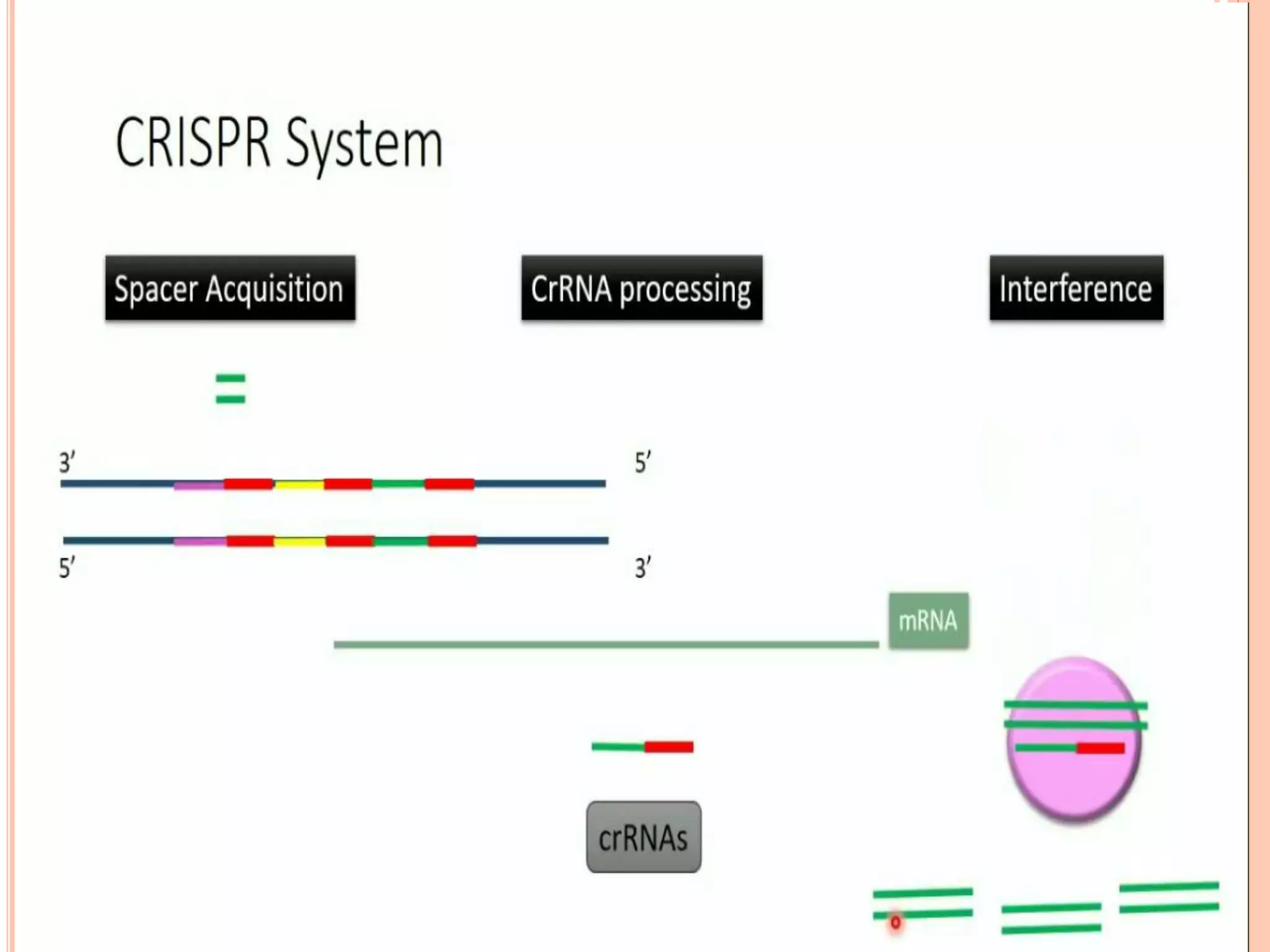
CRISPR- CAS SYSTEM AS A DEFENCE
MECHANISM OF BACTERIA AND
ARCHEA
GENOME EDITING WITH CRISPR/CAS9
TECHNOLOGY
KEY COMPONENTS
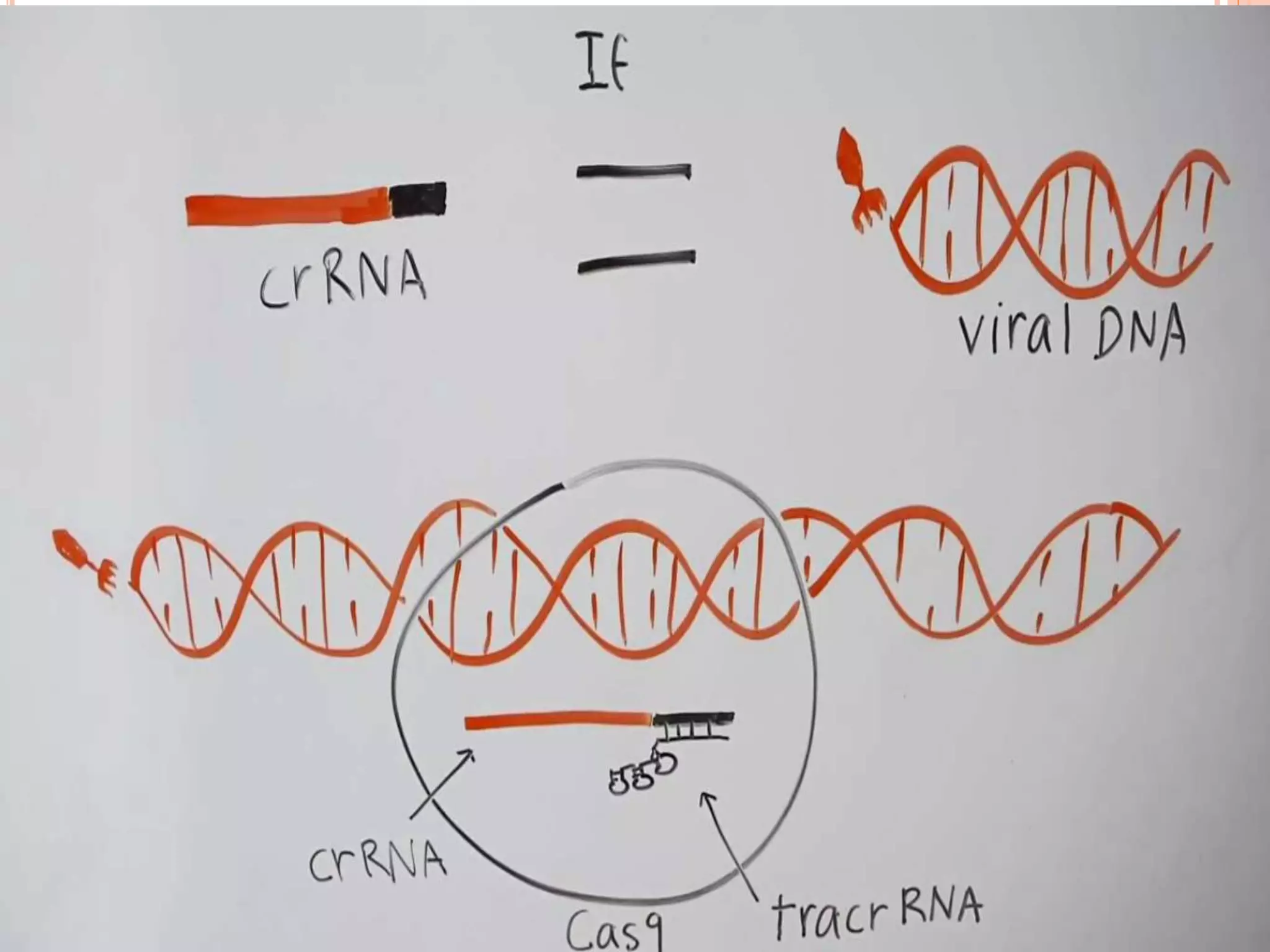
crRNA : Contains the guide RNA that locates the
correct section of host DNA along with a region that binds
to tracrRNA (generally in a hairpin loop form) forming an
active complex.
tracrRNA : Binds to crRNA and forms an active
complex.
sgRNA : Single guide RNAs are a combined RNA
consisting of a tracrRNA and a crRNA
Cas9 : Protein whose active form is able to modify
DNA. Many variants exist with differing functions (i.e.
single strand nicking, double strand break, DNA binding)
due to Cas9's DNA site recognition function.
MAINLY TWO STEPS ARE INVOLVED
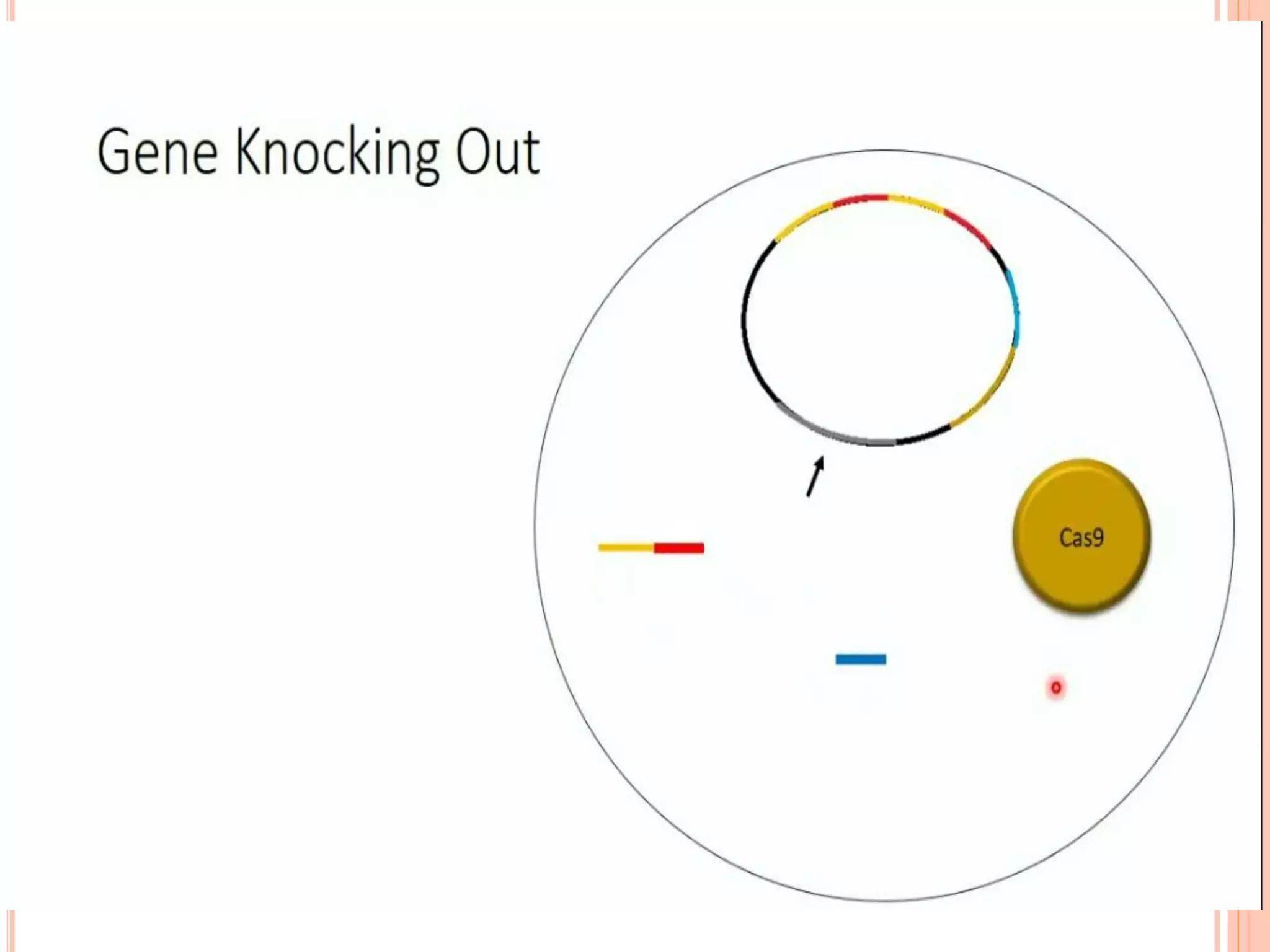
Gene knocking
out
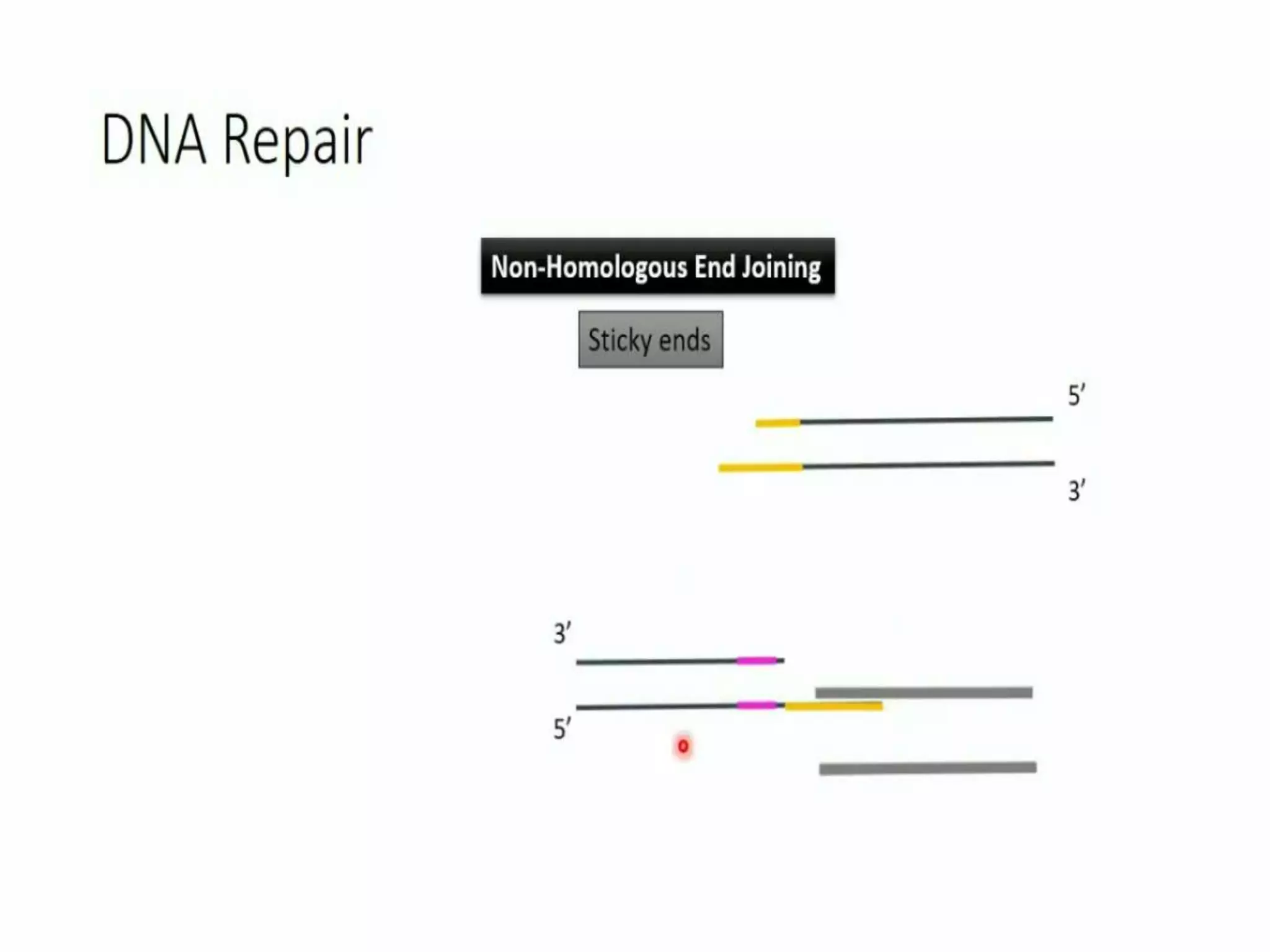
DNA Repair
CRISPR-CAS9: THE FUTURE OF GENE EDITING
AND GENETIC COUNSELING!!
THESE ARE THE OCEAN OF OPPORTUNITIES THAT CAN BE
EXPLORED WITH THE HELP OF THIS..!!
 Fighting cancer
 Extracting HIV
 Making diseases self destruct
 Improving IVF
 Eliminating malaria
 Protecting plants
 Producing food
 Creating biofuel
 Reviving extinct mammals
IN AGRICULTURE
 Can be used to create high degree of genetic variability
at precise locus in the genome of the crop plants.
 Potential tool for multiplexed reverse and forward
genetic study.
 Precise transgene integration at specific loci.
 Developing biotic and abiotic resistant traits in crop
plants.
 Potential tool for developing virus resistant crop
varieties.
 Can be used to eradicate unwanted species like
herbicide resistant weeds, insect pest.
 Potential tool for improving polyploid crops like potato
and wheat.
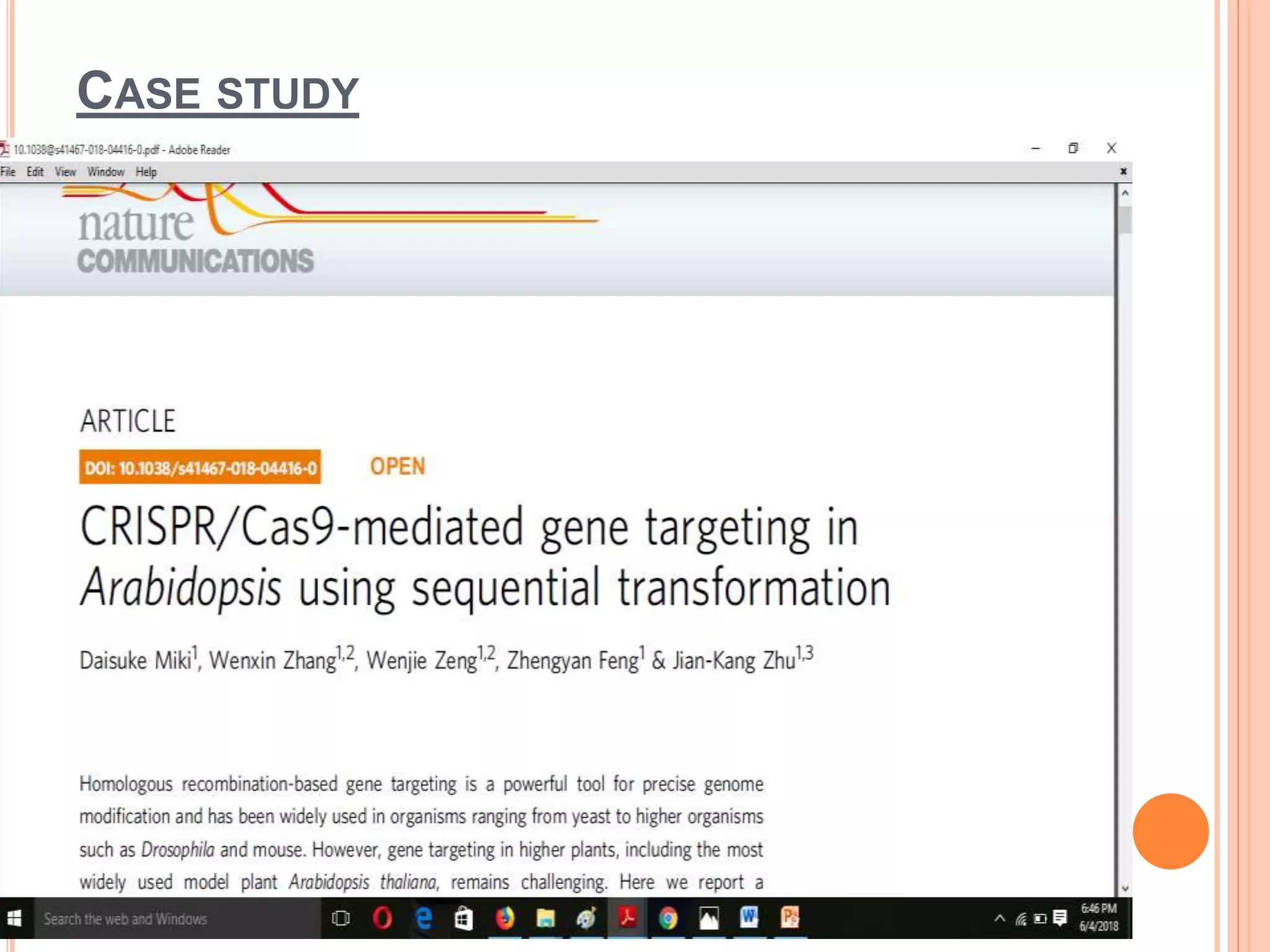
CASE STUDY
OVERVIEW
 Sequential transformation method for gene
targeting in Arabidopsis was adopted.
 Parental lines expressing the bacterial
endonuclease Cas9 from the egg cell- and early
embryospecific DD45 gene promoter can improve
the frequency of single-guide RNA-targeted gene
knock-ins and sequence replacements via
homologous recombination at several endogenous
sites in the Arabidopsis genome.
 PCR approach was used to identify the heritability
of the gene.
METHODS & MATERIALS
 Gene accession numbers: ROS1, At2g36490; DME,
At5g04560; GL2, At1g79840.
 Plant materials and growth condition.
Arabidopsis thaliana accession Col-0
MS media used, at 22 °C, 1% sucrose. hygromycin (25 mg/L) containing MS plates used to
selection
 Plasmid construction:The optimized coding sequence of
hSpCas9 (CRISPR/Cas9) plasmids for GL2 GT were constructed in pCambia1300. For all-in-
one GT constructs, donor sequence was added to the published CRISPR/Cas9 constructs. For
GT constructs for the sequential transformation strategy, AtU6 promoter-driven sgRNA and
donor sequence were constructed in pCambia330.
 DNA analysis.
 RNA analysis.
 Detection of GFP fluorescence and Luc
luminescence.
 DNA methylation analysis.
RESULTS AND CONCLUSION
 Precise knock-ins, generating ROS1-GFP, ROS1-Luc,
DME-GFP, and GFP-DME fusions were achieved.
 Only DD45 promoter-driven Cas9 lines yielded heritable
GT
 HDR may be more efficient in egg cells and/or early
embryos than in other germline tissues (e.g., pollen and
shoot apical meristem).
 Five GFP-DME heterozygous T2 plants showed
segregation from the Cas9 transgene , indicating that
heritable knock-in occurred in T1 plants.
 The GT efficiency by our method was 5.3% for DME
P1633A and was higher for other knock-ins or gene
replacement.
 Results show that GT events were not related to T-DNA
copy numbers of Cas9 or of the HDR donor transgene

Crispr/Cas9

  • 1.
  • 2.
    INTRODUCTION  A numberof genome editing technologies have emerged : zinc-finger nucleases (ZFNs), transcription activator–like effector nucleases (TALENs) and the RNA-guided CRISPR- Cas nuclease system.  The first two technologies use a strategy of tethering endonuclease catalytic domains to modular DNA-binding proteins for inducing targeted DNA double-stranded breaks (DSBs) at specific genomic loci.  By contrast, Cas9 is a nuclease guided by small RNAs through Watson-Crick base pairing with target DNA representing a system that is markedly easier to design, highly specific, efficient and well-suited for high-throughput and multiplexed gene editing for a variety of cell types and organisms.
  • 3.
    DISCOVERY  The firstdescription of what would later be called CRISPR is from Osaka University researcher Yoshizumi Ishino and his colleagues in 1987.  Jennifer Daudna and Emmanuelle Charpentier re- engineered the Cas9 endonuclease into a more manageable two-component system by fusing the two RNA molecules into a "single-guide RNA" that, when combined with Cas9, could find and cut the DNA target specified by the guide RNA. By manipulating the nucleotide sequence of the guide RNA, the artificial Cas9 system could be programmed to target any DNA sequence for cleavage.
  • 4.
    Emmanuelle charpentier (L)and Jennifer doudna (R)
  • 5.
    CRISPR- CAS SYSTEMAS A DEFENCE MECHANISM OF BACTERIA AND ARCHEA
  • 19.
    GENOME EDITING WITHCRISPR/CAS9 TECHNOLOGY
  • 20.
    KEY COMPONENTS crRNA :Contains the guide RNA that locates the correct section of host DNA along with a region that binds to tracrRNA (generally in a hairpin loop form) forming an active complex. tracrRNA : Binds to crRNA and forms an active complex. sgRNA : Single guide RNAs are a combined RNA consisting of a tracrRNA and a crRNA Cas9 : Protein whose active form is able to modify DNA. Many variants exist with differing functions (i.e. single strand nicking, double strand break, DNA binding) due to Cas9's DNA site recognition function.
  • 21.
    MAINLY TWO STEPSARE INVOLVED Gene knocking out DNA Repair
  • 37.
    CRISPR-CAS9: THE FUTUREOF GENE EDITING AND GENETIC COUNSELING!!
  • 38.
    THESE ARE THEOCEAN OF OPPORTUNITIES THAT CAN BE EXPLORED WITH THE HELP OF THIS..!!  Fighting cancer  Extracting HIV  Making diseases self destruct  Improving IVF  Eliminating malaria  Protecting plants  Producing food  Creating biofuel  Reviving extinct mammals
  • 39.
    IN AGRICULTURE  Canbe used to create high degree of genetic variability at precise locus in the genome of the crop plants.  Potential tool for multiplexed reverse and forward genetic study.  Precise transgene integration at specific loci.  Developing biotic and abiotic resistant traits in crop plants.  Potential tool for developing virus resistant crop varieties.  Can be used to eradicate unwanted species like herbicide resistant weeds, insect pest.  Potential tool for improving polyploid crops like potato and wheat.
  • 40.
  • 41.
    OVERVIEW  Sequential transformationmethod for gene targeting in Arabidopsis was adopted.  Parental lines expressing the bacterial endonuclease Cas9 from the egg cell- and early embryospecific DD45 gene promoter can improve the frequency of single-guide RNA-targeted gene knock-ins and sequence replacements via homologous recombination at several endogenous sites in the Arabidopsis genome.  PCR approach was used to identify the heritability of the gene.
  • 42.
    METHODS & MATERIALS Gene accession numbers: ROS1, At2g36490; DME, At5g04560; GL2, At1g79840.  Plant materials and growth condition. Arabidopsis thaliana accession Col-0 MS media used, at 22 °C, 1% sucrose. hygromycin (25 mg/L) containing MS plates used to selection  Plasmid construction:The optimized coding sequence of hSpCas9 (CRISPR/Cas9) plasmids for GL2 GT were constructed in pCambia1300. For all-in- one GT constructs, donor sequence was added to the published CRISPR/Cas9 constructs. For GT constructs for the sequential transformation strategy, AtU6 promoter-driven sgRNA and donor sequence were constructed in pCambia330.  DNA analysis.  RNA analysis.  Detection of GFP fluorescence and Luc luminescence.  DNA methylation analysis.
  • 43.
    RESULTS AND CONCLUSION Precise knock-ins, generating ROS1-GFP, ROS1-Luc, DME-GFP, and GFP-DME fusions were achieved.  Only DD45 promoter-driven Cas9 lines yielded heritable GT  HDR may be more efficient in egg cells and/or early embryos than in other germline tissues (e.g., pollen and shoot apical meristem).  Five GFP-DME heterozygous T2 plants showed segregation from the Cas9 transgene , indicating that heritable knock-in occurred in T1 plants.  The GT efficiency by our method was 5.3% for DME P1633A and was higher for other knock-ins or gene replacement.  Results show that GT events were not related to T-DNA copy numbers of Cas9 or of the HDR donor transgene