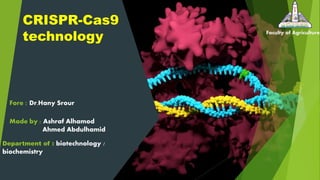
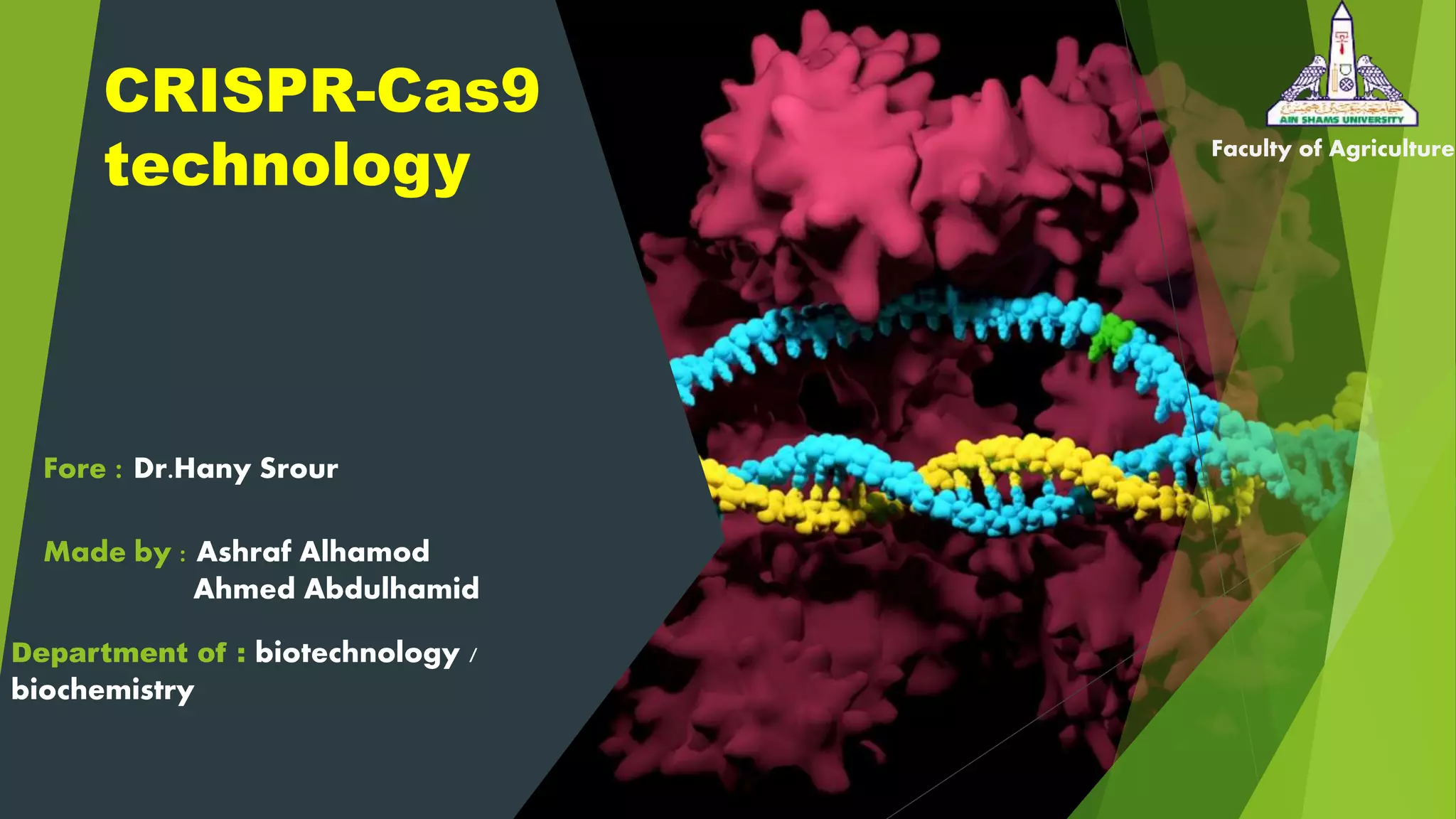
CRISPR-Cas9
technology Faculty of Agriculture
Fore : Dr.Hany Srour
Made by : Ashraf Alhamod
Ahmed Abdulhamid
Department of : biotechnology /
biochemistry
Outline:
 DIFFINATION OF CRISPR-CASE 9
 Contains of this system
 The mechanism
 Applications
DIFFINATION OF
CRISPR-CASE 9
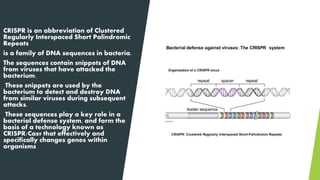
CRISPR is an abbreviation of Clustered
Regularly Interspaced Short Palindromic
Repeats
is a family of DNA sequences in bacteria.
The sequences contain snippets of DNA
from viruses that have attacked the
bacterium.
These snippets are used by the
bacterium to detect and destroy DNA
from similar viruses during subsequent
attacks.
These sequences play a key role in a
bacterial defense system, and form the
basis of a technology known as
CRISPR/Cas9 that effectively and
specifically changes genes within
organisms
Contains of
this system:
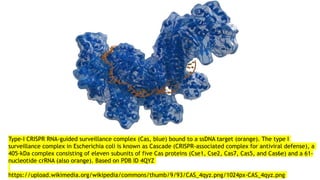
Type-I CRISPR RNA-guided surveillance complex (Cas, blue) bound to a ssDNA target (orange). The type I
surveillance complex in Escherichia coli is known as Cascade (CRISPR-associated complex for antiviral defense), a
405-kDa complex consisting of eleven subunits of five Cas proteins (Cse1, Cse2, Cas7, Cas5, and Cas6e) and a 61-
nucleotide crRNA (also orange). Based on PDB ID 4QYZ
https://upload.wikimedia.org/wikipedia/commons/thumb/9/93/CAS_4qyz.png/1024px-CAS_4qyz.png
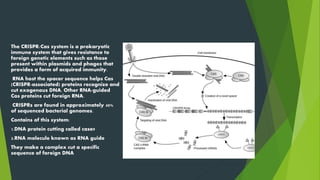
The CRISPR/Cas system is a prokaryotic
immune system that gives resistance to
foreign genetic elements such as those
present within plasmids and phages that
provides a form of acquired immunity.
RNA host the spacer sequence helps Cas
(CRISPR-associated) proteins recognize and
cut exogenous DNA. Other RNA-guided
Cas proteins cut foreign RNA.
CRISPRs are found in approximately 40%
of sequenced bacterial genomes.
Contains of this system:
1.DNA protein cutting called case9
2.RNA molecule known as RNA guide
They make a complex cut a specific
sequence of foreign DNA
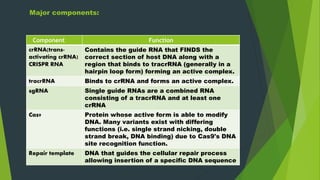
FunctionComponent
Contains the guide RNA that FINDS the
correct section of host DNA along with a
region that binds to tracrRNA (generally in a
hairpin loop form) forming an active complex.
crRNA(trans-
activating crRNA)
CRISPR RNA
Binds to crRNA and forms an active complex.tracrRNA
Single guide RNAs are a combined RNA
consisting of a tracrRNA and at least one
crRNA
sgRNA
Protein whose active form is able to modify
DNA. Many variants exist with differing
functions (i.e. single strand nicking, double
strand break, DNA binding) due to Cas9's DNA
site recognition function.
Cas9
DNA that guides the cellular repair process
allowing insertion of a specific DNA sequence
Repair template
Major components:
The
mechanism
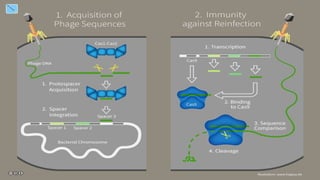
 When a microbe is invaded by a virus, the first stage
of the immune response is to catch viral DNA and
insert it into a CRISPR place in the form of a spacer.
Cas1 and Cas2 are found in all two types of CRISPR-
Cas immune systems, which indicates that they are
involved in spacer earning. Mutation studies
confirmed this hypothesis, showing that removal of
cas1 or cas2 stopped spacer earning, without affecting
CRISPR immune response
CRISPR-Cas immunity is a natural process of bacteria and archaea.
CRISPR-Cas prevents bacteriophage infection, conjugation and natural
transformation by degrading foreign nucleic acids that enter the cell
THE mechanism
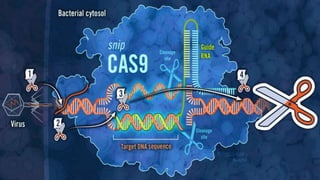
A simple version of the CRISPR/Cas system, CRISPR/Cas9, has been
modified to edit genomes. By delivering the Cas9 nuclease complexed
with a synthetic guide RNA (gRNA) into a cell, the cell's genome can be
cut at a required location, allowing existing genes to be removed
and/or new ones added
The Applications of
CRISPR technique
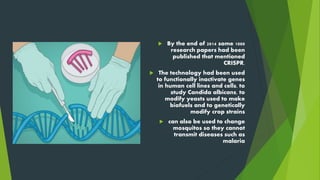
 By the end of 2014 some 1000
research papers had been
published that mentioned
CRISPR.
 The technology had been used
to functionally inactivate genes
in human cell lines and cells, to
study Candida albicans, to
modify yeasts used to make
biofuels and to genetically
modify crop strains
 can also be used to change
mosquitos so they cannot
transmit diseases such as
malaria
 Disease models
 CRISPR simplifies creation of animals for research that mimic disease or
show what happens when a gene is knocked down or mutated. CRISPR
may be used at the germline level to create animals where the gene is
changed everywhere, or it may be targeted at non-germline
As of 2016 CRISPR had been studied in animal models and cancer cell lines, to
learn if it can be used to repair or thwart mutated genes that cause cancer.
The first clinical trial involving CRISPR started in 2016. It involved removing
immune cells from people with lung cancer, using CRISPR to edit out the gene
expressed PD-1, then administering the altered cells back to the same person. 20
other trials were under way or nearly ready, mostly in China, as of 2017
In 2016 the United States Food and Drug Administration (FDA) approved a clinical
trial in which CRISPR would be used to alter T cells extracted from people with
different kinds of cancer and then administer those engineered T cells back to the
same people
 CRISPR in Cancer
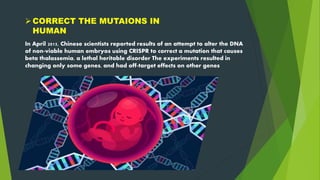
In April 2015, Chinese scientists reported results of an attempt to alter the DNA
of non-viable human embryos using CRISPR to correct a mutation that causes
beta thalassemia, a lethal heritable disorder The experiments resulted in
changing only some genes, and had off-target effects on other genes
CORRECT THE MUTAIONS IN
HUMAN
REFERENCES:
 https://en.wikipedia.org/wiki/CRISPR#cite_note-pmid20056882-1
 https://upload.wikimedia.org/wikipedia/commons/thumb/9/93/CAS_4qyz.png/1024px-
CAS_4qyz.png
 Type-I CRISPR RNA-guided surveillance complex (Cas, blue) bound to a ssDNA target
(orange). The type I surveillance complex in Escherichia coli is known as Cascade (CRISPR-
associated complex for antiviral defense), a 405-kDa complex consisting of eleven subunits
of five Cas proteins (Cse1, Cse2, Cas7, Cas5, and Cas6e) and a 61-nucleotide crRNA (also
orange). Based on PDB ID 4QYZ
 https://upload.wikimedia.org/wikipedia/commons/thumb/9/93/CAS_4qyz.png/1024px-
CAS_4qyz.png
 The CRISPR genetic locus provides bacteria with a defense mechanism to protect them from
repeated phage infections.
 https://upload.wikimedia.org/wikipedia/commons/thumb/0/08/12_Hegasy_Cas9_Immun_W
iki_E_CCBYSA.png/1024px-12_Hegasy_Cas9_Immun_Wiki_E_CCBYSA.png
 https://en.wikipedia.org/wiki/CRISPR#cite_note-pmid20056882-1
 https://magazine.jhsph.edu/2015/fall/briefings/snip-vs-shred/index.html
 https://en.wikipedia.org/wiki/CRISPR

Crispr cas9 technology

  • 1.
    CRISPR-Cas9 technology Faculty ofAgriculture Fore : Dr.Hany Srour Made by : Ashraf Alhamod Ahmed Abdulhamid Department of : biotechnology / biochemistry
  • 2.
    Outline:  DIFFINATION OFCRISPR-CASE 9  Contains of this system  The mechanism  Applications
  • 3.
  • 4.
    CRISPR is anabbreviation of Clustered Regularly Interspaced Short Palindromic Repeats is a family of DNA sequences in bacteria. The sequences contain snippets of DNA from viruses that have attacked the bacterium. These snippets are used by the bacterium to detect and destroy DNA from similar viruses during subsequent attacks. These sequences play a key role in a bacterial defense system, and form the basis of a technology known as CRISPR/Cas9 that effectively and specifically changes genes within organisms
  • 5.
  • 6.
    Type-I CRISPR RNA-guidedsurveillance complex (Cas, blue) bound to a ssDNA target (orange). The type I surveillance complex in Escherichia coli is known as Cascade (CRISPR-associated complex for antiviral defense), a 405-kDa complex consisting of eleven subunits of five Cas proteins (Cse1, Cse2, Cas7, Cas5, and Cas6e) and a 61- nucleotide crRNA (also orange). Based on PDB ID 4QYZ https://upload.wikimedia.org/wikipedia/commons/thumb/9/93/CAS_4qyz.png/1024px-CAS_4qyz.png
  • 7.
    The CRISPR/Cas systemis a prokaryotic immune system that gives resistance to foreign genetic elements such as those present within plasmids and phages that provides a form of acquired immunity. RNA host the spacer sequence helps Cas (CRISPR-associated) proteins recognize and cut exogenous DNA. Other RNA-guided Cas proteins cut foreign RNA. CRISPRs are found in approximately 40% of sequenced bacterial genomes. Contains of this system: 1.DNA protein cutting called case9 2.RNA molecule known as RNA guide They make a complex cut a specific sequence of foreign DNA
  • 8.
    FunctionComponent Contains the guideRNA that FINDS the correct section of host DNA along with a region that binds to tracrRNA (generally in a hairpin loop form) forming an active complex. crRNA(trans- activating crRNA) CRISPR RNA Binds to crRNA and forms an active complex.tracrRNA Single guide RNAs are a combined RNA consisting of a tracrRNA and at least one crRNA sgRNA Protein whose active form is able to modify DNA. Many variants exist with differing functions (i.e. single strand nicking, double strand break, DNA binding) due to Cas9's DNA site recognition function. Cas9 DNA that guides the cellular repair process allowing insertion of a specific DNA sequence Repair template Major components:
  • 9.
  • 11.
     When amicrobe is invaded by a virus, the first stage of the immune response is to catch viral DNA and insert it into a CRISPR place in the form of a spacer. Cas1 and Cas2 are found in all two types of CRISPR- Cas immune systems, which indicates that they are involved in spacer earning. Mutation studies confirmed this hypothesis, showing that removal of cas1 or cas2 stopped spacer earning, without affecting CRISPR immune response
  • 13.
    CRISPR-Cas immunity isa natural process of bacteria and archaea. CRISPR-Cas prevents bacteriophage infection, conjugation and natural transformation by degrading foreign nucleic acids that enter the cell THE mechanism A simple version of the CRISPR/Cas system, CRISPR/Cas9, has been modified to edit genomes. By delivering the Cas9 nuclease complexed with a synthetic guide RNA (gRNA) into a cell, the cell's genome can be cut at a required location, allowing existing genes to be removed and/or new ones added
  • 14.
  • 15.
     By theend of 2014 some 1000 research papers had been published that mentioned CRISPR.  The technology had been used to functionally inactivate genes in human cell lines and cells, to study Candida albicans, to modify yeasts used to make biofuels and to genetically modify crop strains  can also be used to change mosquitos so they cannot transmit diseases such as malaria
  • 16.
     Disease models CRISPR simplifies creation of animals for research that mimic disease or show what happens when a gene is knocked down or mutated. CRISPR may be used at the germline level to create animals where the gene is changed everywhere, or it may be targeted at non-germline As of 2016 CRISPR had been studied in animal models and cancer cell lines, to learn if it can be used to repair or thwart mutated genes that cause cancer. The first clinical trial involving CRISPR started in 2016. It involved removing immune cells from people with lung cancer, using CRISPR to edit out the gene expressed PD-1, then administering the altered cells back to the same person. 20 other trials were under way or nearly ready, mostly in China, as of 2017 In 2016 the United States Food and Drug Administration (FDA) approved a clinical trial in which CRISPR would be used to alter T cells extracted from people with different kinds of cancer and then administer those engineered T cells back to the same people  CRISPR in Cancer
  • 17.
    In April 2015,Chinese scientists reported results of an attempt to alter the DNA of non-viable human embryos using CRISPR to correct a mutation that causes beta thalassemia, a lethal heritable disorder The experiments resulted in changing only some genes, and had off-target effects on other genes CORRECT THE MUTAIONS IN HUMAN
  • 19.
    REFERENCES:  https://en.wikipedia.org/wiki/CRISPR#cite_note-pmid20056882-1  https://upload.wikimedia.org/wikipedia/commons/thumb/9/93/CAS_4qyz.png/1024px- CAS_4qyz.png Type-I CRISPR RNA-guided surveillance complex (Cas, blue) bound to a ssDNA target (orange). The type I surveillance complex in Escherichia coli is known as Cascade (CRISPR- associated complex for antiviral defense), a 405-kDa complex consisting of eleven subunits of five Cas proteins (Cse1, Cse2, Cas7, Cas5, and Cas6e) and a 61-nucleotide crRNA (also orange). Based on PDB ID 4QYZ  https://upload.wikimedia.org/wikipedia/commons/thumb/9/93/CAS_4qyz.png/1024px- CAS_4qyz.png  The CRISPR genetic locus provides bacteria with a defense mechanism to protect them from repeated phage infections.  https://upload.wikimedia.org/wikipedia/commons/thumb/0/08/12_Hegasy_Cas9_Immun_W iki_E_CCBYSA.png/1024px-12_Hegasy_Cas9_Immun_Wiki_E_CCBYSA.png  https://en.wikipedia.org/wiki/CRISPR#cite_note-pmid20056882-1  https://magazine.jhsph.edu/2015/fall/briefings/snip-vs-shred/index.html  https://en.wikipedia.org/wiki/CRISPR