1
WELCOME
6/21/2017
CRISPR FOR GENOME EDITING
Submitted to : Dr. Vikas Sharma Submitted by : Man Mohan soni
NB-2013-15-BIV
BTC -417
Department of Biotechnology
College of Horticulture and Forestery , Neri6/21/2017 2
In 1987 Ishino et al. first described a pattern of short
palindromic repeats of DNA interspaced with short,non
repititive “spacers” of DNA in E.coli bacteria
INTRODUCTION AND HISTORY OF CRISPR
With time more such patterns were observed in other
bacteria and archaea and in 2002 Jansen et al. named the
pattern CRISPR,short for “clustered regularly interspaced
short palindromic repeats” and also documented the
existence of a number of crispr-associated genes(named
the cas family)adjacent to these repeats.
6/21/2017
6/21/2017 4
2010- Garneau et al. show that the
CRISPR/Cas system can acquire new spacers
from foreign DNA
2007- Barrangou et al. showed that CRISPR
mediated by Cas proteins,provides bacterial
immunity against viruses by matching DNA in
spacer sequences with DNA from virus
6/21/2017 5
CRISPR as bacterial immune system
against bacteriophagy
The research was carried at by researchers in DANISCO.Inc
(acquired by DuPont at 2011)
Science 2007
6/21/2017 6
A generalised CRISPR-Cas locus
6/21/2017 7
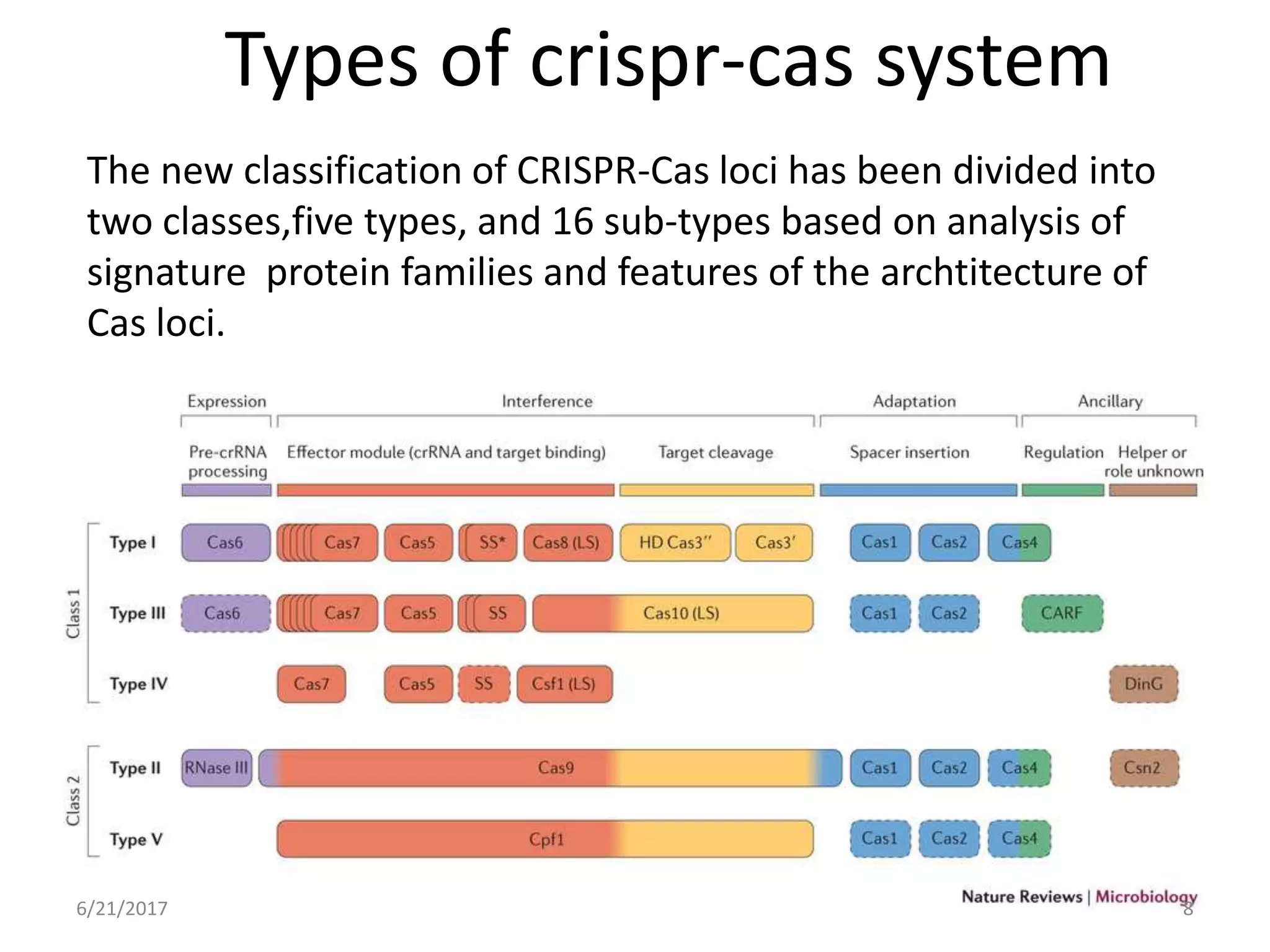
The new classification of CRISPR-Cas loci has been divided into
two classes,five types, and 16 sub-types based on analysis of
signature protein families and features of the archtitecture of
Cas loci.
Types of crispr-cas system
6/21/2017 8
SOME TERMS
• 1) Protospacer- sequence present in virus or
plasmid,adjacent to PAM,recognized by cas proteins as
their target.
• 2)Spacer- Novel sequences(protospacer) acquired by
bacteria and present between repeats
• 3)PAM-protospacer adjacent motif(PAM) is a 2-6 bp
DNA sequence immediately following the dna sequence
targeted by cas nucleases.PAM is a component of the
invading virus or plasmid,but is not a component of the
bacterial CRISPR locus
6/21/2017 9
6/21/2017 10
TERMS(cont.)
• 4) pre crRNA-the single RNA obtained by
trancription of repeats and spacers.
• 5)Trans activating crRNA(tracr RNA)- It is a small
trans-encoded RNA found in type-ii CRISPR
system. The 5-prime end of tracr-RNA sequence
has has homology with repeats present in CRISPR
locus,thus tracr-RNA and pre crRNA can make
RNA duplex into the region of homology.
• 6)Cas9- An RNA directed DNA endonuclease.
6/21/2017 11
Responsible
for binding
guide RNA
Crucial for initiating cleavage
activity upon binding of target
DNA
The PAM-Interacting
domain confers PAM
specificity
The HNH and
RuvC domains
are nuclease
domains that cut
single-stranded
DNA.
12
Cas9 structure
The target recognition and nuclease activity of Cas 9 are independent
6/21/2017
CRISPR–Cas systems function in three
general steps
1) Adaptation or immunization (involving the
acquisition of spacers
2) Biogenesis of CRISPR RNA (crRNA; encoded
by the repeat–spacer regions)
3) interference (cleavage of invading nucleic
acid).
6/21/2017 13
6/21/2017 14
Out of all the CRISPR systems ,type-ii is most well studied and most
simple requiring only three components.
6/21/2017 15
166/21/2017
6/21/2017 17
Combining crRNA and tarcerRNA into sgRNA was the crucial step
for the development of CRISPR technology
6/21/2017 18
6/21/2017 19
6/21/2017 20
21
General protocol for CRISPR
6/21/2017
226/21/2017
Examples of crops modified with CRISPR
technology
CROPS DESCRIPTION REFERNCES
Corn Targeted mutagenesis Liang et al. 2014
Rice Targeted mutagenesis Belhaj et al. 2013
Sorghum Targeted gene modification Jiang et al. 2013b
Sweet orange Targeted genome editing Jia and Wang 2014
Tobacco Targeted mutagenesis Belhaj et al. 2013
Wheat Targeted mutagenesis Upadhyay et al. 2013,
Yanpeng et al. 2014
Potato
Soybean
Targeted mutagenesis
Gene editing
Shaohui et al., 2015
Yupeng et al., 2015
Harrison et al., 2014
6/21/2017 23
6/21/2017 24
sgRNA designing tools
 Optimized CRISPR Design (Feng Zhang's Lab at MIT/BROAD,
USA)
 sgRNA Scorer (George Church's Lab at Harvard, USA)
 sgRNA Designer (BROAD Institute)
 ChopChop web tool (George Church's Lab at Harvard, USA)
 E-CRISP (Michael Boutros' lab at DKFZ, Germany)
 CRISPR Finder (Wellcome Trust Sanger Institute, Hinxton, UK)
 RepeatMasker (Institute for Systems Biology) to double check and
avoid selecting target sites with repeated sequences
256/21/2017
266/21/2017
276/21/2017
What makes CRISPR system the ideal genome engineering
technology
6/21/2017 28
The real secret for popularity of CRISPR/Cas9 system
6/21/2017 29
Cas9 Nuclease can be engineered for a variety of
applications.ex-In Cas9 nickase one nuclease
domain has been mutated and made non-
functional.
6/21/2017 30
6/21/2017 31
Tartgeted mutation/correction using paired Cas9 nickase by HDR
6/21/2017 32
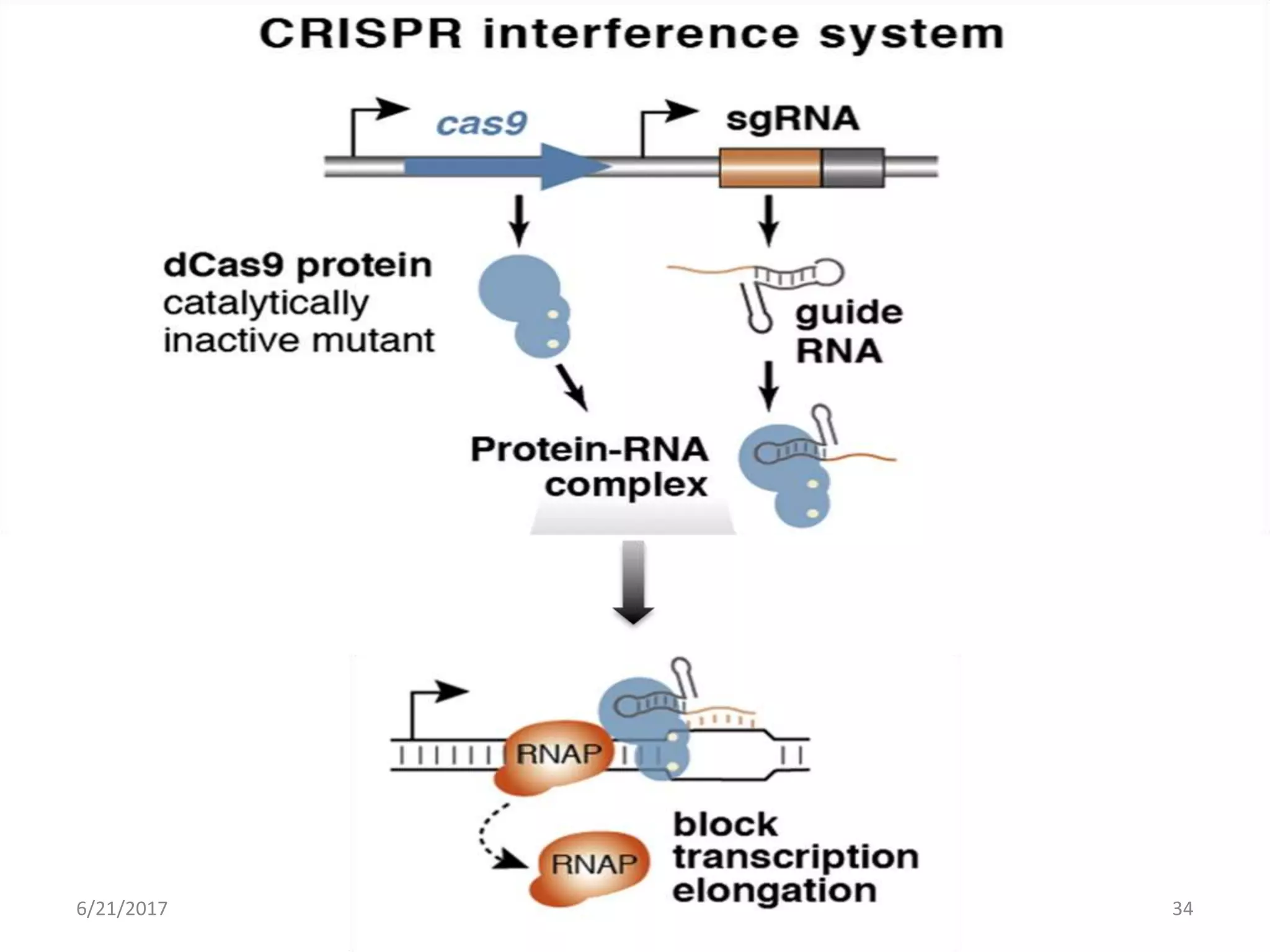
CRISPRi- CRISPR interference
6/21/2017 33
6/21/2017 34
Paired dCas9 to produce double strand break with less off-targets6/21/2017 35
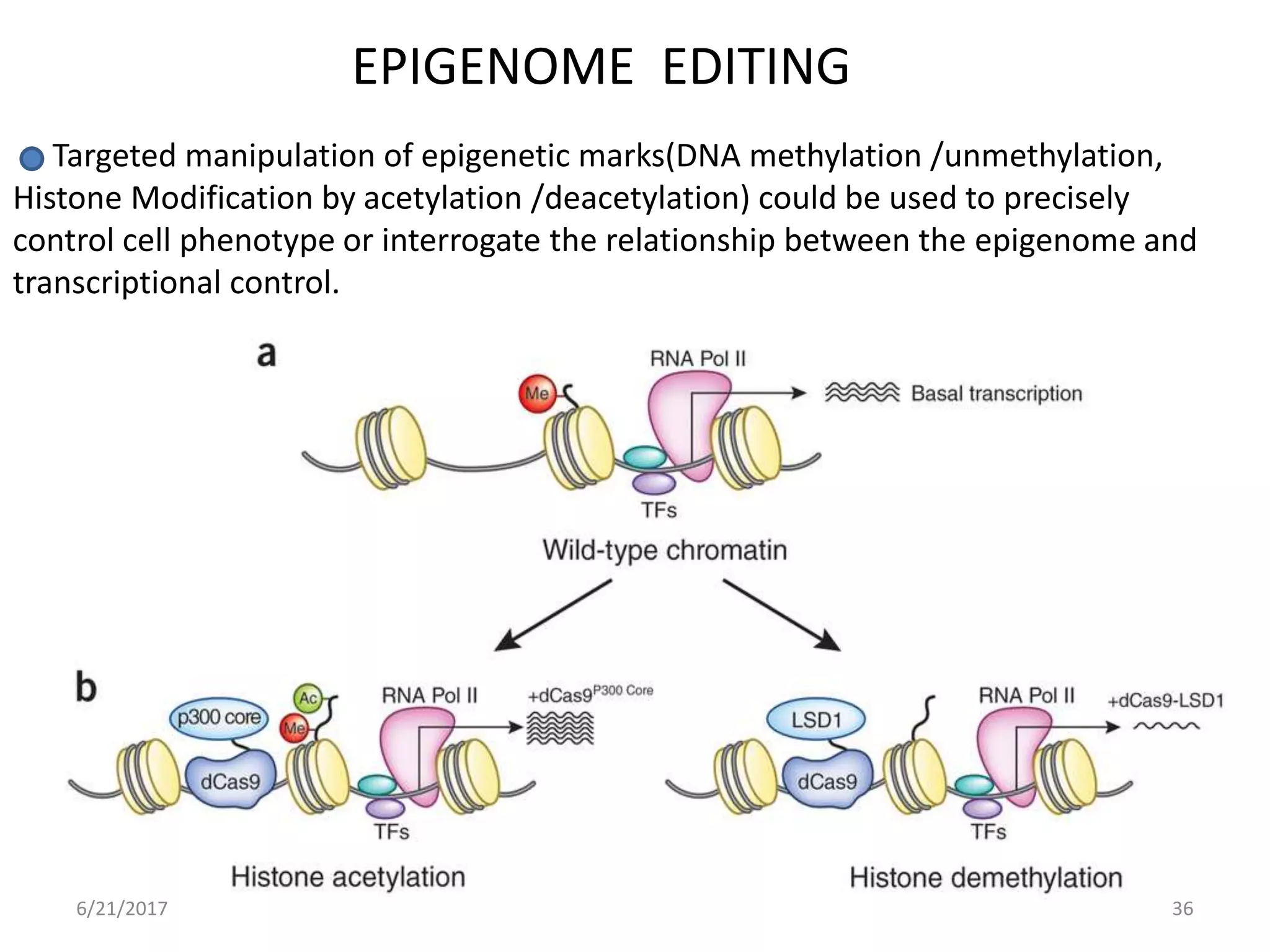
EPIGENOME EDITING
Targeted manipulation of epigenetic marks(DNA methylation /unmethylation,
Histone Modification by acetylation /deacetylation) could be used to precisely
control cell phenotype or interrogate the relationship between the epigenome and
transcriptional control.
6/21/2017 36
6/21/2017 37
Photoactivatable CRISPR-Cas9 for Optogenetic
Genome Editing
6/21/2017 38
Based on a recently developed photoinducible dimerization system named Magnets
6/21/2017 39
6/21/2017 40
The Mutagenic Chain Reaction: A method for
converting heterozygous mutation to homozygous mutations
Construction of gene drive
Gene Drive is a technique that promotes the inheritance of a particular gene to increase
its prevalance in a population
6/21/2017 41
Discovery of CRISPR/Cpf1
Discovery of CRISPR C2c2 system
Engineered Cas9 with altered PAM
specificity
Engineered Cas9 for better
specificity(eSpCas9,SpCas9-HF1)
6/21/2017 42
RECENT ADVANCES
6/21/2017 43
 Cpf1 (CRISPR from Prevotella and Francisella 1) discovered at Broad
Institute of MIT and Harvard, Cambridge.
 Does not require tracerRNA(two component system) and the gene is 1kb
smaller
 Targeted DNA is cleaved as a 5 nt staggered cut distal to a 5’ T-rich PAM
6/21/2017 44
In 2016 researchers demonstrated CRISPR from fusobacteria
Leptotrichia shahii can target RNA.By manipulating this system
we can develop RNA editing and tracking tools.
Some pitfalls of CRISPR
 Proper selection of gRNA
 Use dCas9 version of Cas9 protein
 Make sure that there is no mismatch within the seed
sequences(first 12 nt adjacent to PAM)
 Use smaller gRNA of 17 nt instead of 20 nt
 Sequence the organism first you want to work with
 Use NHEJ inhibitor in order to boost up HDR
6/21/2017 45
Solutions
Off target indels
Limited choice of PAM sequences
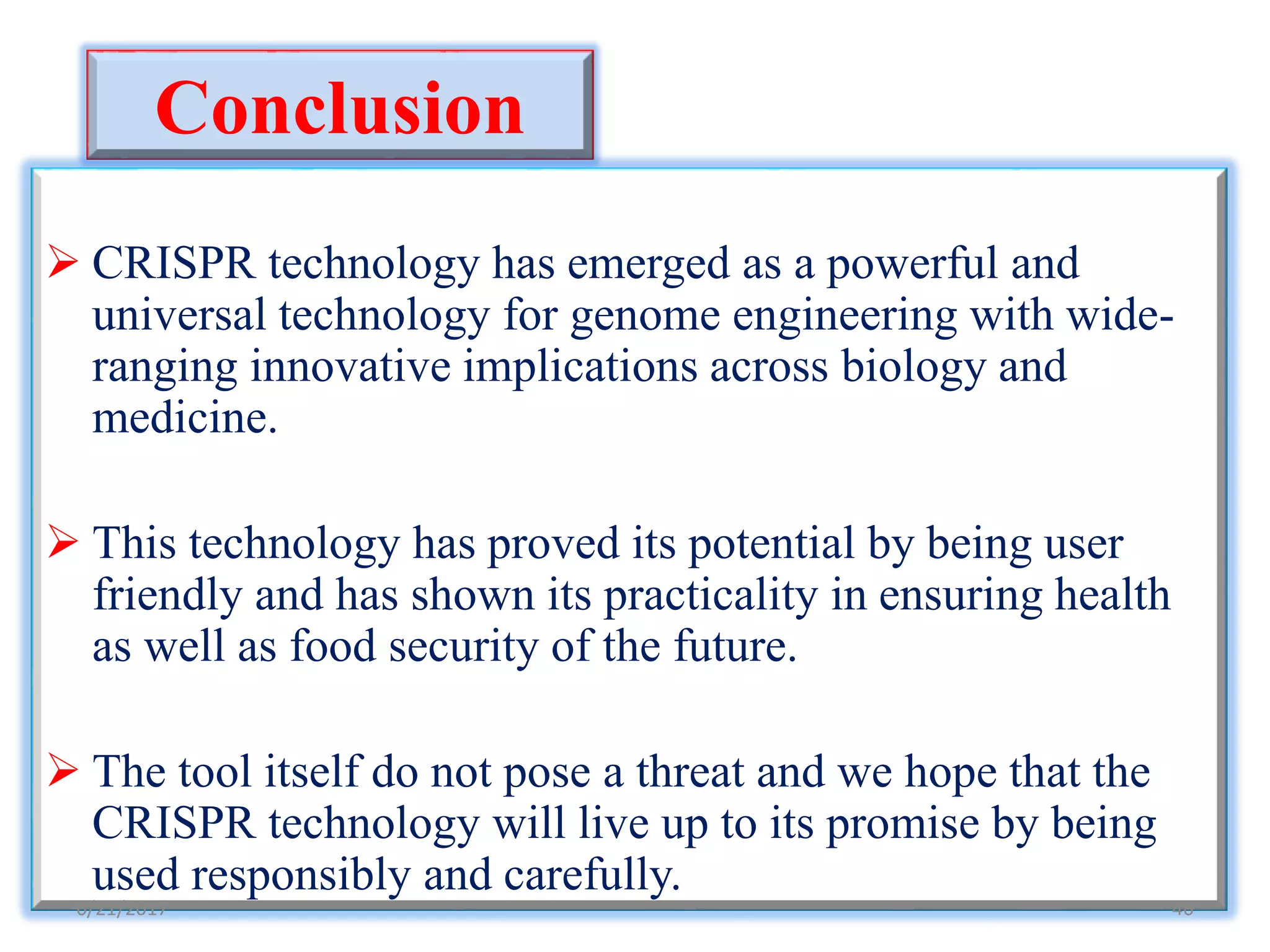
Conclusion
 CRISPR technology has emerged as a powerful and
universal technology for genome engineering with wide-
ranging innovative implications across biology and
medicine.
 This technology has proved its potential by being user
friendly and has shown its practicality in ensuring health
as well as food security of the future.
 The tool itself do not pose a threat and we hope that the
CRISPR technology will live up to its promise by being
used responsibly and carefully.
466/21/2017
Future Prospects
Realizing the promise of gene therapy
Development of personalized therapeutics
Presenting the new face of GE
6/21/2017 47
6/21/2017 48

SEMINAR ON CRISPR

  • 1.
  • 2.
    CRISPR FOR GENOMEEDITING Submitted to : Dr. Vikas Sharma Submitted by : Man Mohan soni NB-2013-15-BIV BTC -417 Department of Biotechnology College of Horticulture and Forestery , Neri6/21/2017 2
  • 3.
    In 1987 Ishinoet al. first described a pattern of short palindromic repeats of DNA interspaced with short,non repititive “spacers” of DNA in E.coli bacteria INTRODUCTION AND HISTORY OF CRISPR With time more such patterns were observed in other bacteria and archaea and in 2002 Jansen et al. named the pattern CRISPR,short for “clustered regularly interspaced short palindromic repeats” and also documented the existence of a number of crispr-associated genes(named the cas family)adjacent to these repeats. 6/21/2017
  • 4.
  • 5.
    2010- Garneau etal. show that the CRISPR/Cas system can acquire new spacers from foreign DNA 2007- Barrangou et al. showed that CRISPR mediated by Cas proteins,provides bacterial immunity against viruses by matching DNA in spacer sequences with DNA from virus 6/21/2017 5
  • 6.
    CRISPR as bacterialimmune system against bacteriophagy The research was carried at by researchers in DANISCO.Inc (acquired by DuPont at 2011) Science 2007 6/21/2017 6
  • 7.
    A generalised CRISPR-Caslocus 6/21/2017 7
  • 8.
    The new classificationof CRISPR-Cas loci has been divided into two classes,five types, and 16 sub-types based on analysis of signature protein families and features of the archtitecture of Cas loci. Types of crispr-cas system 6/21/2017 8
  • 9.
    SOME TERMS • 1)Protospacer- sequence present in virus or plasmid,adjacent to PAM,recognized by cas proteins as their target. • 2)Spacer- Novel sequences(protospacer) acquired by bacteria and present between repeats • 3)PAM-protospacer adjacent motif(PAM) is a 2-6 bp DNA sequence immediately following the dna sequence targeted by cas nucleases.PAM is a component of the invading virus or plasmid,but is not a component of the bacterial CRISPR locus 6/21/2017 9
  • 10.
  • 11.
    TERMS(cont.) • 4) precrRNA-the single RNA obtained by trancription of repeats and spacers. • 5)Trans activating crRNA(tracr RNA)- It is a small trans-encoded RNA found in type-ii CRISPR system. The 5-prime end of tracr-RNA sequence has has homology with repeats present in CRISPR locus,thus tracr-RNA and pre crRNA can make RNA duplex into the region of homology. • 6)Cas9- An RNA directed DNA endonuclease. 6/21/2017 11
  • 12.
    Responsible for binding guide RNA Crucialfor initiating cleavage activity upon binding of target DNA The PAM-Interacting domain confers PAM specificity The HNH and RuvC domains are nuclease domains that cut single-stranded DNA. 12 Cas9 structure The target recognition and nuclease activity of Cas 9 are independent 6/21/2017
  • 13.
    CRISPR–Cas systems functionin three general steps 1) Adaptation or immunization (involving the acquisition of spacers 2) Biogenesis of CRISPR RNA (crRNA; encoded by the repeat–spacer regions) 3) interference (cleavage of invading nucleic acid). 6/21/2017 13
  • 14.
  • 15.
    Out of allthe CRISPR systems ,type-ii is most well studied and most simple requiring only three components. 6/21/2017 15
  • 16.
  • 17.
  • 18.
    Combining crRNA andtarcerRNA into sgRNA was the crucial step for the development of CRISPR technology 6/21/2017 18
  • 19.
  • 20.
  • 21.
    21 General protocol forCRISPR 6/21/2017
  • 22.
  • 23.
    Examples of cropsmodified with CRISPR technology CROPS DESCRIPTION REFERNCES Corn Targeted mutagenesis Liang et al. 2014 Rice Targeted mutagenesis Belhaj et al. 2013 Sorghum Targeted gene modification Jiang et al. 2013b Sweet orange Targeted genome editing Jia and Wang 2014 Tobacco Targeted mutagenesis Belhaj et al. 2013 Wheat Targeted mutagenesis Upadhyay et al. 2013, Yanpeng et al. 2014 Potato Soybean Targeted mutagenesis Gene editing Shaohui et al., 2015 Yupeng et al., 2015 Harrison et al., 2014 6/21/2017 23
  • 24.
  • 25.
    sgRNA designing tools Optimized CRISPR Design (Feng Zhang's Lab at MIT/BROAD, USA)  sgRNA Scorer (George Church's Lab at Harvard, USA)  sgRNA Designer (BROAD Institute)  ChopChop web tool (George Church's Lab at Harvard, USA)  E-CRISP (Michael Boutros' lab at DKFZ, Germany)  CRISPR Finder (Wellcome Trust Sanger Institute, Hinxton, UK)  RepeatMasker (Institute for Systems Biology) to double check and avoid selecting target sites with repeated sequences 256/21/2017
  • 26.
  • 27.
  • 28.
    What makes CRISPRsystem the ideal genome engineering technology 6/21/2017 28
  • 29.
    The real secretfor popularity of CRISPR/Cas9 system 6/21/2017 29
  • 30.
    Cas9 Nuclease canbe engineered for a variety of applications.ex-In Cas9 nickase one nuclease domain has been mutated and made non- functional. 6/21/2017 30
  • 31.
  • 32.
    Tartgeted mutation/correction usingpaired Cas9 nickase by HDR 6/21/2017 32
  • 33.
  • 34.
  • 35.
    Paired dCas9 toproduce double strand break with less off-targets6/21/2017 35
  • 36.
    EPIGENOME EDITING Targeted manipulationof epigenetic marks(DNA methylation /unmethylation, Histone Modification by acetylation /deacetylation) could be used to precisely control cell phenotype or interrogate the relationship between the epigenome and transcriptional control. 6/21/2017 36
  • 37.
  • 38.
    Photoactivatable CRISPR-Cas9 forOptogenetic Genome Editing 6/21/2017 38 Based on a recently developed photoinducible dimerization system named Magnets
  • 39.
  • 40.
    6/21/2017 40 The MutagenicChain Reaction: A method for converting heterozygous mutation to homozygous mutations
  • 41.
    Construction of genedrive Gene Drive is a technique that promotes the inheritance of a particular gene to increase its prevalance in a population 6/21/2017 41
  • 42.
    Discovery of CRISPR/Cpf1 Discoveryof CRISPR C2c2 system Engineered Cas9 with altered PAM specificity Engineered Cas9 for better specificity(eSpCas9,SpCas9-HF1) 6/21/2017 42 RECENT ADVANCES
  • 43.
    6/21/2017 43  Cpf1(CRISPR from Prevotella and Francisella 1) discovered at Broad Institute of MIT and Harvard, Cambridge.  Does not require tracerRNA(two component system) and the gene is 1kb smaller  Targeted DNA is cleaved as a 5 nt staggered cut distal to a 5’ T-rich PAM
  • 44.
    6/21/2017 44 In 2016researchers demonstrated CRISPR from fusobacteria Leptotrichia shahii can target RNA.By manipulating this system we can develop RNA editing and tracking tools.
  • 45.
    Some pitfalls ofCRISPR  Proper selection of gRNA  Use dCas9 version of Cas9 protein  Make sure that there is no mismatch within the seed sequences(first 12 nt adjacent to PAM)  Use smaller gRNA of 17 nt instead of 20 nt  Sequence the organism first you want to work with  Use NHEJ inhibitor in order to boost up HDR 6/21/2017 45 Solutions Off target indels Limited choice of PAM sequences
  • 46.
    Conclusion  CRISPR technologyhas emerged as a powerful and universal technology for genome engineering with wide- ranging innovative implications across biology and medicine.  This technology has proved its potential by being user friendly and has shown its practicality in ensuring health as well as food security of the future.  The tool itself do not pose a threat and we hope that the CRISPR technology will live up to its promise by being used responsibly and carefully. 466/21/2017
  • 47.
    Future Prospects Realizing thepromise of gene therapy Development of personalized therapeutics Presenting the new face of GE 6/21/2017 47
  • 48.