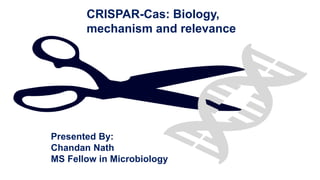
CRISPAR-Cas: Biology,
mechanism and relevance
Presented By:
Chandan Nath
MS Fellow in Microbiology
Advanced Systemic Virology 2
Enemies
Fighting for
existence
Advanced Systemic Virology 3
Advanced Systemic Virology 4
• These are the part of bacterial immune system which detects and
recognize the foreign DNAand cleaves it
1. The CRISPR(Clustered Regularly Interspaced Short Palindromic
Repeats) are DNA loci containing short repetitions of base sequences
which separated by short "spacer DNA" from previous exposures to a virus
or phage
2. Cas (CRISPR-associated) proteins can target and cleave invading DNA
in a sequence-specific manner
 It was first observed in Escherichia coli by Osaka University researcher
Yoshizumi Ishino in 1987.
 It represents a family of DNA repeats in most archaeal (~90%) and bacterial
• (~40%) genomes provides acquired immunity against viruses and
phages
CRISPR–Cassystems
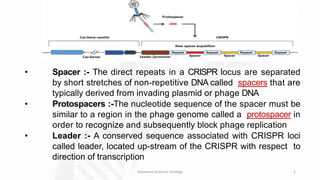
• Spacer :- The direct repeats in a CRISPR locus are separated
by short stretches of non-repetitive DNA called spacers that are
typically derived from invading plasmid or phage DNA
• Protospacers :-The nucleotide sequence of the spacer must be
similar to a region in the phage genome called a protospacer in
order to recognize and subsequently block phage replication
• Leader :- A conserved sequence associated with CRISPR loci
called leader, located up-stream of the CRISPR with respect to
direction of transcription
Advanced Systemic Virology 5
Advanced Systemic Virology 6
1987 Researcher youshizmi Ishano find CRISPR sequence in E.coli but
they don’t characterized their functions
2000 CRISPR sequence were found by Moica to be common in other
microbes
2002 Mr. Jansen Coined CRISPR name, defined, signature cas gene
2007 First experimental evidence for CRISPR adaptive immunity
2012 Idea of using CRISPR- Cas9 as a genomic engineering tool, was
published by Jennifer and Emmanuelle
2013 First demonstration of Cas9 genome engineering in Eukaryotic cell
2014 First CRISPR patent was granted to Feng Zheng
HISTORY
Advanced Systemic Virology 7
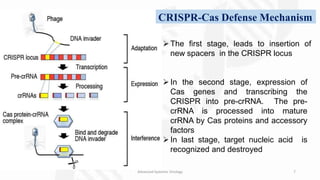
CRISPR-Cas Defense Mechanism
The first stage, leads to insertion of
new spacers in the CRISPR locus
In the second stage, expression of
Cas genes and transcribing the
CRISPR into pre-crRNA. The pre-
crRNA is processed into mature
crRNA by Cas proteins and accessory
factors
In last stage, target nucleic acid is
recognized and destroyed
Advanced Systemic Virology 8
ThreetypesofCRISPRSystem
Advanced Systemic Virology 9
Biological structureofCas-9
The REC I domain is the largest
andresponsible for binding guide
RNA
The role of the REC II domain is not
yet well understood
The arginine-rich bridge helix is
for initiating cleavage activity
The PAM-Interacting domain
responsible for initiating binding to target
DNA
The HNH and RuvC are nuclease
domains that cut single-stranded DNA
Advanced Systemic Virology 10
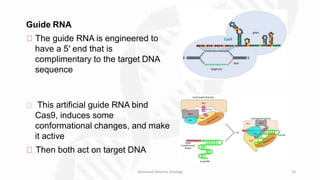
Guide RNA
The guide RNA is engineered to
have a 5′ end that is
complimentary to the target DNA
sequence
This artificial guide RNA bind
Cas9, induces some
conformational changes, and make
it active
Then both act on target DNA
Advanced Systemic Virology 11
ApplicationofCRISPR-Cas9 as Genome EditingTool
 Delivery of desiregene
 GeneEditing
 Knockdown/activation
 Disease modelsstudy
 Biomedicinedevelopment
 In vitro geneticdepletion
 MicrobiologyEtc.
Advanced Systemic Virology 12
Genome Editing
 Gene editing technique is Inserting ,
removing, or modifying DNA in a
genome
 By Using
Radiation, chemicals, Nucleases or
Molecular Scissor
 With CRISPR-Cas9 multiple genes can be targeted
simultaneously, referred to as genome editing
Advanced Systemic Virology 13
Cas9 PROTEIN
Searches for target DNA by binding with
sequences that match its protospacer
adjacent motif (PAM) sequence
GUIDE RNA
Have a 5′ end that is complimentary to the
target DNA sequence
 If the complementary region and the
target region pair properly, the RuvC and
HNH nuclease domains (domains of
Cas9) will cut the target DNA
Mechanism
Advanced Systemic Virology 14
A guiding piece of
genetic material
An enzyme that
cuts DNA
The guide RNA targets and
binds to a specific DNA
sequence and the attached
cas9 enzyme
Working
Advanced Systemic Virology 15
Repair
mechanism
Advanced Systemic Virology 16
CRISPR/dCas9-mediated protein imaging
Fluorescence in situ hybridization (FISH) use for understanding a variety
of chromosomal abnormalities and other genetic mutations
Mechanism of action of CRISPR:
dCas9+yellow/green FP Multicolor CRISPR Complex
This complex bind with genetic loci matching sgRNA
Labeling done
Microbiology
Advanced Systemic Virology 17
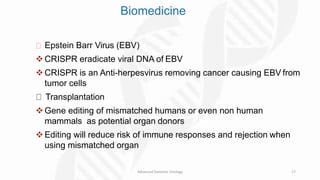
Epstein Barr Virus (EBV)
CRISPR eradicate viral DNA of EBV
CRISPR is an Anti-herpesvirus removing cancer causing EBV from
tumor cells
Transplantation
Gene editing of mismatched humans or even non human
mammals as potential organ donors
Editing will reduce risk of immune responses and rejection when
using mismatched organ
Biomedicine
Advanced Systemic Virology 18
Increased number of second
hair follicles
Enhanced fiber length
More cashmere produce
This change induced at
a. Morphological level
b. genetic level
kashmere goat
CRISPR/Cas9 system
Animals
FGF5 Gene
Advanced Systemic Virology 19
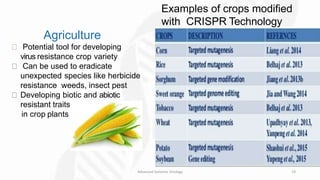
Agriculture
Potential tool for developing
virus resistance crop variety
Can be used to eradicate
unexpected species like herbicide
resistance weeds, insect pest
Developing biotic and abiotic
resistant traits
in crop plants
Examples of crops modified
with CRISPR Technology
Advanced Systemic Virology 20
It was stated that
“CRISPR is dramatically accelerating the pace
of research in nearly every biological field”
CRISPR Cas9 tool use in the Fixing of the Donor
Organ Shortage which one is a revolution in medical
sciences
An Alternative toPetroleum
Designer Pets and ServiceAnimals
Revolutionary Aspects Of CRISPR-Cas9
Advanced Systemic Virology 21
MOSAIC PROBLEM
 Safety
 Efficiency
in this unwanted gene sequence form during embryonic stage and
causes
cancer.
Its solution is adding new CRISPR mechaniery in the cell add
double standard DNA
 Wrong attachment (double stranded DNA is solution)
 Ethical barriers
 Bio weapons
Drawbacks, Problems And Their Solutions
Advanced Systemic Virology 22
Summing it all up, CRISPR has its advantages and disadvantages
ranging from ethical concerns
to being known as the fastest, cheapest and most precise way of
editing genes
This scientific breakthrough has the ability to eliminate diseases,
solve world hunger, provide unlimited clean energy but at the same
time get out of hand very easily
CRISPR has potentially given us direct access to the source code of
life and at thesame time given a great amount of hope to billions of
people
Conclusion
Advanced Systemic Virology 23
crRNA
• Contains the guide RNA that locates the correct section of host DNA
along witha region that binds to tracrRNA (generally in a hairpin loop
form) forming an active complex
tracrRNA
• Binds to crRNA and forms an active complex
sgRNA
• Single guide RNAs are a combined RNA consisting of a tracrRNA
and at leastone crRNA
Cas9
• Protein whose active form is able to modify DNA. Many variants exist
with differing functions (i.e. single strand nicking, double strand
break, DNAbinding) due to Cas9's DNA site recognition function
Key Components
Advanced Systemic Virology 24

CRISPR-Cas system

  • 1.
    CRISPAR-Cas: Biology, mechanism andrelevance Presented By: Chandan Nath MS Fellow in Microbiology
  • 2.
    Advanced Systemic Virology2 Enemies Fighting for existence
  • 3.
  • 4.
    Advanced Systemic Virology4 • These are the part of bacterial immune system which detects and recognize the foreign DNAand cleaves it 1. The CRISPR(Clustered Regularly Interspaced Short Palindromic Repeats) are DNA loci containing short repetitions of base sequences which separated by short "spacer DNA" from previous exposures to a virus or phage 2. Cas (CRISPR-associated) proteins can target and cleave invading DNA in a sequence-specific manner  It was first observed in Escherichia coli by Osaka University researcher Yoshizumi Ishino in 1987.  It represents a family of DNA repeats in most archaeal (~90%) and bacterial • (~40%) genomes provides acquired immunity against viruses and phages CRISPR–Cassystems
  • 5.
    • Spacer :-The direct repeats in a CRISPR locus are separated by short stretches of non-repetitive DNA called spacers that are typically derived from invading plasmid or phage DNA • Protospacers :-The nucleotide sequence of the spacer must be similar to a region in the phage genome called a protospacer in order to recognize and subsequently block phage replication • Leader :- A conserved sequence associated with CRISPR loci called leader, located up-stream of the CRISPR with respect to direction of transcription Advanced Systemic Virology 5
  • 6.
    Advanced Systemic Virology6 1987 Researcher youshizmi Ishano find CRISPR sequence in E.coli but they don’t characterized their functions 2000 CRISPR sequence were found by Moica to be common in other microbes 2002 Mr. Jansen Coined CRISPR name, defined, signature cas gene 2007 First experimental evidence for CRISPR adaptive immunity 2012 Idea of using CRISPR- Cas9 as a genomic engineering tool, was published by Jennifer and Emmanuelle 2013 First demonstration of Cas9 genome engineering in Eukaryotic cell 2014 First CRISPR patent was granted to Feng Zheng HISTORY
  • 7.
    Advanced Systemic Virology7 CRISPR-Cas Defense Mechanism The first stage, leads to insertion of new spacers in the CRISPR locus In the second stage, expression of Cas genes and transcribing the CRISPR into pre-crRNA. The pre- crRNA is processed into mature crRNA by Cas proteins and accessory factors In last stage, target nucleic acid is recognized and destroyed
  • 8.
    Advanced Systemic Virology8 ThreetypesofCRISPRSystem
  • 9.
    Advanced Systemic Virology9 Biological structureofCas-9 The REC I domain is the largest andresponsible for binding guide RNA The role of the REC II domain is not yet well understood The arginine-rich bridge helix is for initiating cleavage activity The PAM-Interacting domain responsible for initiating binding to target DNA The HNH and RuvC are nuclease domains that cut single-stranded DNA
  • 10.
    Advanced Systemic Virology10 Guide RNA The guide RNA is engineered to have a 5′ end that is complimentary to the target DNA sequence This artificial guide RNA bind Cas9, induces some conformational changes, and make it active Then both act on target DNA
  • 11.
    Advanced Systemic Virology11 ApplicationofCRISPR-Cas9 as Genome EditingTool  Delivery of desiregene  GeneEditing  Knockdown/activation  Disease modelsstudy  Biomedicinedevelopment  In vitro geneticdepletion  MicrobiologyEtc.
  • 12.
    Advanced Systemic Virology12 Genome Editing  Gene editing technique is Inserting , removing, or modifying DNA in a genome  By Using Radiation, chemicals, Nucleases or Molecular Scissor  With CRISPR-Cas9 multiple genes can be targeted simultaneously, referred to as genome editing
  • 13.
    Advanced Systemic Virology13 Cas9 PROTEIN Searches for target DNA by binding with sequences that match its protospacer adjacent motif (PAM) sequence GUIDE RNA Have a 5′ end that is complimentary to the target DNA sequence  If the complementary region and the target region pair properly, the RuvC and HNH nuclease domains (domains of Cas9) will cut the target DNA Mechanism
  • 14.
    Advanced Systemic Virology14 A guiding piece of genetic material An enzyme that cuts DNA The guide RNA targets and binds to a specific DNA sequence and the attached cas9 enzyme Working
  • 15.
    Advanced Systemic Virology15 Repair mechanism
  • 16.
    Advanced Systemic Virology16 CRISPR/dCas9-mediated protein imaging Fluorescence in situ hybridization (FISH) use for understanding a variety of chromosomal abnormalities and other genetic mutations Mechanism of action of CRISPR: dCas9+yellow/green FP Multicolor CRISPR Complex This complex bind with genetic loci matching sgRNA Labeling done Microbiology
  • 17.
    Advanced Systemic Virology17 Epstein Barr Virus (EBV) CRISPR eradicate viral DNA of EBV CRISPR is an Anti-herpesvirus removing cancer causing EBV from tumor cells Transplantation Gene editing of mismatched humans or even non human mammals as potential organ donors Editing will reduce risk of immune responses and rejection when using mismatched organ Biomedicine
  • 18.
    Advanced Systemic Virology18 Increased number of second hair follicles Enhanced fiber length More cashmere produce This change induced at a. Morphological level b. genetic level kashmere goat CRISPR/Cas9 system Animals FGF5 Gene
  • 19.
    Advanced Systemic Virology19 Agriculture Potential tool for developing virus resistance crop variety Can be used to eradicate unexpected species like herbicide resistance weeds, insect pest Developing biotic and abiotic resistant traits in crop plants Examples of crops modified with CRISPR Technology
  • 20.
    Advanced Systemic Virology20 It was stated that “CRISPR is dramatically accelerating the pace of research in nearly every biological field” CRISPR Cas9 tool use in the Fixing of the Donor Organ Shortage which one is a revolution in medical sciences An Alternative toPetroleum Designer Pets and ServiceAnimals Revolutionary Aspects Of CRISPR-Cas9
  • 21.
    Advanced Systemic Virology21 MOSAIC PROBLEM  Safety  Efficiency in this unwanted gene sequence form during embryonic stage and causes cancer. Its solution is adding new CRISPR mechaniery in the cell add double standard DNA  Wrong attachment (double stranded DNA is solution)  Ethical barriers  Bio weapons Drawbacks, Problems And Their Solutions
  • 22.
    Advanced Systemic Virology22 Summing it all up, CRISPR has its advantages and disadvantages ranging from ethical concerns to being known as the fastest, cheapest and most precise way of editing genes This scientific breakthrough has the ability to eliminate diseases, solve world hunger, provide unlimited clean energy but at the same time get out of hand very easily CRISPR has potentially given us direct access to the source code of life and at thesame time given a great amount of hope to billions of people Conclusion
  • 23.
    Advanced Systemic Virology23 crRNA • Contains the guide RNA that locates the correct section of host DNA along witha region that binds to tracrRNA (generally in a hairpin loop form) forming an active complex tracrRNA • Binds to crRNA and forms an active complex sgRNA • Single guide RNAs are a combined RNA consisting of a tracrRNA and at leastone crRNA Cas9 • Protein whose active form is able to modify DNA. Many variants exist with differing functions (i.e. single strand nicking, double strand break, DNAbinding) due to Cas9's DNA site recognition function Key Components
  • 24.