Genome Engineering Using the
CRISPR-Cas9 System
(Ran FA et al Nature Protocols Vol.8 No.11 2013)
May 6th, 2014
Yudha Nur Patria
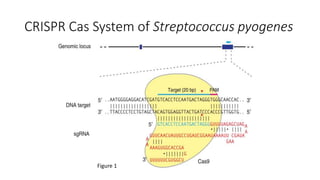
CRISPR Cas System of Streptococcus pyogenes
Figure 1
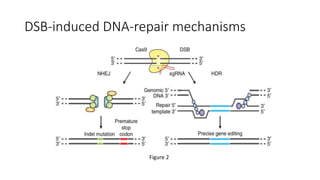
DSB-induced DNA-repair mechanisms
Figure 2
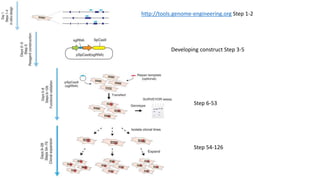
http://tools.genome-engineering.org Step 1-2
Developing construct Step 3-5
Step 6-53
Step 54-126
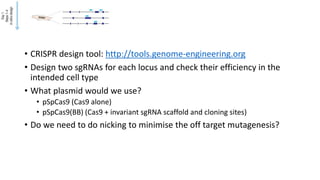
• CRISPR design tool: http://tools.genome-engineering.org
• Design two sgRNAs for each locus and check their efficiency in the
intended cell type
• What plasmid would we use?
• pSpCas9 (Cas9 alone)
• pSpCas9(BB) (Cas9 + invariant sgRNA scaffold and cloning sites)
• Do we need to do nicking to minimise the off target mutagenesis?
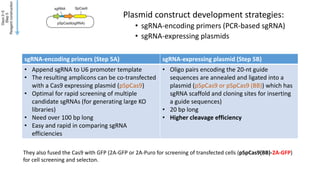
Plasmid construct development strategies:
• sgRNA-encoding primers (PCR-based sgRNA)
• sgRNA-expressing plasmids
sgRNA-encoding primers (Step 5A) sgRNA-expressing plasmid (Step 5B)
• Append sgRNA to U6 promoter template
• The resulting amplicons can be co-transfected
with a Cas9 expressing plasmid (pSpCas9)
• Optimal for rapid screening of multiple
candidate sgRNAs (for generating large KO
libraries)
• Need over 100 bp long
• Easy and rapid in comparing sgRNA
efficiencies
• Oligo pairs encoding the 20-nt guide
sequences are annealed and ligated into a
plasmid (pSpCas9 or pSpCas9 (BB)) which has
sgRNA scaffold and cloning sites for inserting
a guide sequences)
• 20 bp long
• Higher cleavage efficiency
They also fused the Cas9 with GFP (2A-GFP or 2A-Puro for screening of transfected cells (pSpCas9(BB)-2A-GFP)
for cell screening and selecton.
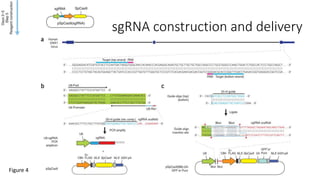
sgRNA construction and delivery
Figure 4
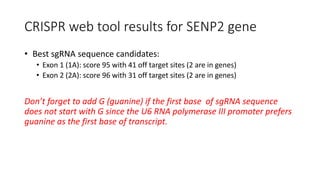
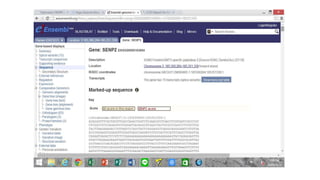
CRISPR web tool results for SENP2 gene
• Best sgRNA sequence candidates:
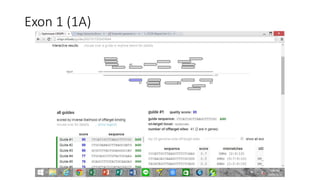
• Exon 1 (1A): score 95 with 41 off target sites (2 are in genes)
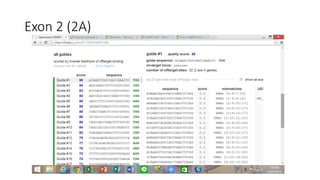
• Exon 2 (2A): score 96 with 31 off target sites (2 are in genes)
Don’t forget to add G (guanine) if the first base of sgRNA sequence
does not start with G since the U6 RNA polymerase III promoter prefers
guanine as the first base of transcript.
Exon 1 (1A)
Exon 2 (2A)
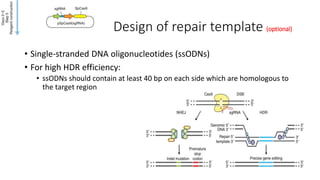
Design of repair template (optional)
• Single-stranded DNA oligonucleotides (ssODNs)
• For high HDR efficiency:
• ssODNs should contain at least 40 bp on each side which are homologous to
the target region
Plasmid construct validations
• Step 5B xii
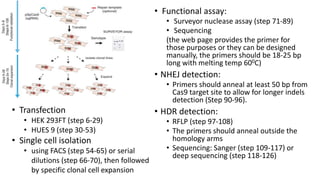
• Functional assay:
• Surveyor nuclease assay (step 71-89)
• Sequencing
(the web page provides the primer for
those purposes or they can be designed
manually, the primers should be 18-25 bp
long with melting temp 600C)
• NHEJ detection:
• Primers should anneal at least 50 bp from
Cas9 target site to allow for longer indels
detection (Step 90-96).
• HDR detection:
• RFLP (step 97-108)
• The primers should anneal outside the
homology arms
• Sequencing: Sanger (step 109-117) or
deep sequencing (step 118-126)
• Transfection
• HEK 293FT (step 6-29)
• HUES 9 (step 30-53)
• Single cell isolation
• using FACS (step 54-65) or serial
dilutions (step 66-70), then followed
by specific clonal cell expansion
Transfections
• What cells would we use?
• Methods: Lipofectamine 2000 or Amaxa SF cell line 4D-Nucleofector X
kit?
• Recommendation: triplicates + controls (eg. GFP plasmid)
Clonal cell isolation and expansion
• FACS or serial dilution?
Transfection efficiency validations
• Surveyor nuclease assay (step 71-89)
• NHEJ detection:
• Primers should anneal at least 50 bp from Cas9 target site to allow for longer
indels detection (Step 90-96).
• HDR detection:
• RFLP (step 97-108)
• The primers should anneal outside the homology arms
• Sequencing: Sanger (step 109-117) or deep sequencing (step 118-126)

Crispr

  • 1.
    Genome Engineering Usingthe CRISPR-Cas9 System (Ran FA et al Nature Protocols Vol.8 No.11 2013) May 6th, 2014 Yudha Nur Patria
  • 2.
    CRISPR Cas Systemof Streptococcus pyogenes Figure 1
  • 3.
  • 4.
    http://tools.genome-engineering.org Step 1-2 Developingconstruct Step 3-5 Step 6-53 Step 54-126
  • 5.
    • CRISPR designtool: http://tools.genome-engineering.org • Design two sgRNAs for each locus and check their efficiency in the intended cell type • What plasmid would we use? • pSpCas9 (Cas9 alone) • pSpCas9(BB) (Cas9 + invariant sgRNA scaffold and cloning sites) • Do we need to do nicking to minimise the off target mutagenesis?
  • 6.
    Plasmid construct developmentstrategies: • sgRNA-encoding primers (PCR-based sgRNA) • sgRNA-expressing plasmids sgRNA-encoding primers (Step 5A) sgRNA-expressing plasmid (Step 5B) • Append sgRNA to U6 promoter template • The resulting amplicons can be co-transfected with a Cas9 expressing plasmid (pSpCas9) • Optimal for rapid screening of multiple candidate sgRNAs (for generating large KO libraries) • Need over 100 bp long • Easy and rapid in comparing sgRNA efficiencies • Oligo pairs encoding the 20-nt guide sequences are annealed and ligated into a plasmid (pSpCas9 or pSpCas9 (BB)) which has sgRNA scaffold and cloning sites for inserting a guide sequences) • 20 bp long • Higher cleavage efficiency They also fused the Cas9 with GFP (2A-GFP or 2A-Puro for screening of transfected cells (pSpCas9(BB)-2A-GFP) for cell screening and selecton.
  • 7.
    sgRNA construction anddelivery Figure 4
  • 8.
    CRISPR web toolresults for SENP2 gene • Best sgRNA sequence candidates: • Exon 1 (1A): score 95 with 41 off target sites (2 are in genes) • Exon 2 (2A): score 96 with 31 off target sites (2 are in genes) Don’t forget to add G (guanine) if the first base of sgRNA sequence does not start with G since the U6 RNA polymerase III promoter prefers guanine as the first base of transcript.
  • 10.
  • 11.
  • 12.
    Design of repairtemplate (optional) • Single-stranded DNA oligonucleotides (ssODNs) • For high HDR efficiency: • ssODNs should contain at least 40 bp on each side which are homologous to the target region
  • 13.
  • 14.
    • Functional assay: •Surveyor nuclease assay (step 71-89) • Sequencing (the web page provides the primer for those purposes or they can be designed manually, the primers should be 18-25 bp long with melting temp 600C) • NHEJ detection: • Primers should anneal at least 50 bp from Cas9 target site to allow for longer indels detection (Step 90-96). • HDR detection: • RFLP (step 97-108) • The primers should anneal outside the homology arms • Sequencing: Sanger (step 109-117) or deep sequencing (step 118-126) • Transfection • HEK 293FT (step 6-29) • HUES 9 (step 30-53) • Single cell isolation • using FACS (step 54-65) or serial dilutions (step 66-70), then followed by specific clonal cell expansion
  • 15.
    Transfections • What cellswould we use? • Methods: Lipofectamine 2000 or Amaxa SF cell line 4D-Nucleofector X kit? • Recommendation: triplicates + controls (eg. GFP plasmid)
  • 16.
    Clonal cell isolationand expansion • FACS or serial dilution?
  • 17.
    Transfection efficiency validations •Surveyor nuclease assay (step 71-89) • NHEJ detection: • Primers should anneal at least 50 bp from Cas9 target site to allow for longer indels detection (Step 90-96). • HDR detection: • RFLP (step 97-108) • The primers should anneal outside the homology arms • Sequencing: Sanger (step 109-117) or deep sequencing (step 118-126)