CRISPRCas9 based system for
therapeutics
Presented by:
Abhishek Kiran Tiwatane
Department of Biotechnology
M.S. 1st Year
Reg no:BT/2018-IX/072
Contents :
 Introduction
 History
 Apart from CRISPR
 Basic Terminology
 Mechanism
 Applications
 Software's
 References
What is crispr /Cas9 ?
 CRISPR stands for “Clustered Regularly Interspaced Short Palindromic
Repeats”.
 CRISPRs in conjugation with CRISPR associated (cas) protein.
 The Cas9 creates a gap in the target DNA or RNA sequences.
 Cas9 is the nuclease guided by the crRNA and tracrRNA to cleave
specific DNA sequences.
 It is currently the simplest,most varsatile and precise genome editing
tool.
History
 Ishino Yoshizumi(1987) identified CRISPR in Escherichai coli.
 They found that these zones have a specific barcode called spacers with
matches originate from viral or plasmid genomes.
 In other words, the spacer sequence is formed in the bacterial genome
during exposure to phages, and the level of bacterial sensitivity to be
infections by phages depends on the contents of the spacer sequence.
 After that Jennifer Dodna , discover CRISPR as precise and gene editing
tool to cut genome with the help of nuclease activity of Cas9 protein.
cont…
1978
• IDENTIFICATION – By YOSHIZUMI ISHINO
• Ishino accidentally clones part of a CRIPR sequence and notes that is
unusual,since most repeated DNA sequence are consecutive , not
interspaced.
2005
• DISCOVERED PURPOSE - By FRANCISCO MOJICA
• CRISPR is a form of adaptive immunity in bacteria that allows them
to defend against invading Bacteriophage DNA .
2012
• CRIPR BECOME A TOOL – BY JENNIFER DOUDNA
• She found CAS9 protein in CRISPR process and demonstrated that if
paired with different guiding RNA , it could be used as genomic
scissors , cheaply and accurately slicing specific section of DNA.
cont…
APR,2015
• CRISPR EMBRYO CONTROVERSY -
• Team of chinese scientist SUN YAT-SEN UNIVERSITY , uses
CRISPR on inviable human embryo cells.they found that gene editing
getting out of hand and being used in dangerous human application.
DEC,2015
• INTERNATIONAL CONFERENCE N HUMAN GENE EDITING
-
• So that all scientist community from all over the world like NAS
,NAM,Chinese Academy of sciences and U K Royal Society ,conclude
that ISHGE is that germline gene editing should be avoided until safety
and efficacy are proven .
2017
• NATIONALACADEMIES REPORT -
• “Human Genome Editing : Science ,Ethics and Governance.” review
the current status of gnome editing research . It concludes that
researchers should proceed with caution to consider editing human
embryos ‘for compelling purpose of treating or prventing serious
disease or disabilities.”the first recommendation to edit the human
germline.
MILSTONES OF CRISPR :
EMMANAUELLE CHARPENTIER
JENNIFER DODNA
YOSHIZUMI ISHINO
Apart from CRISPR :
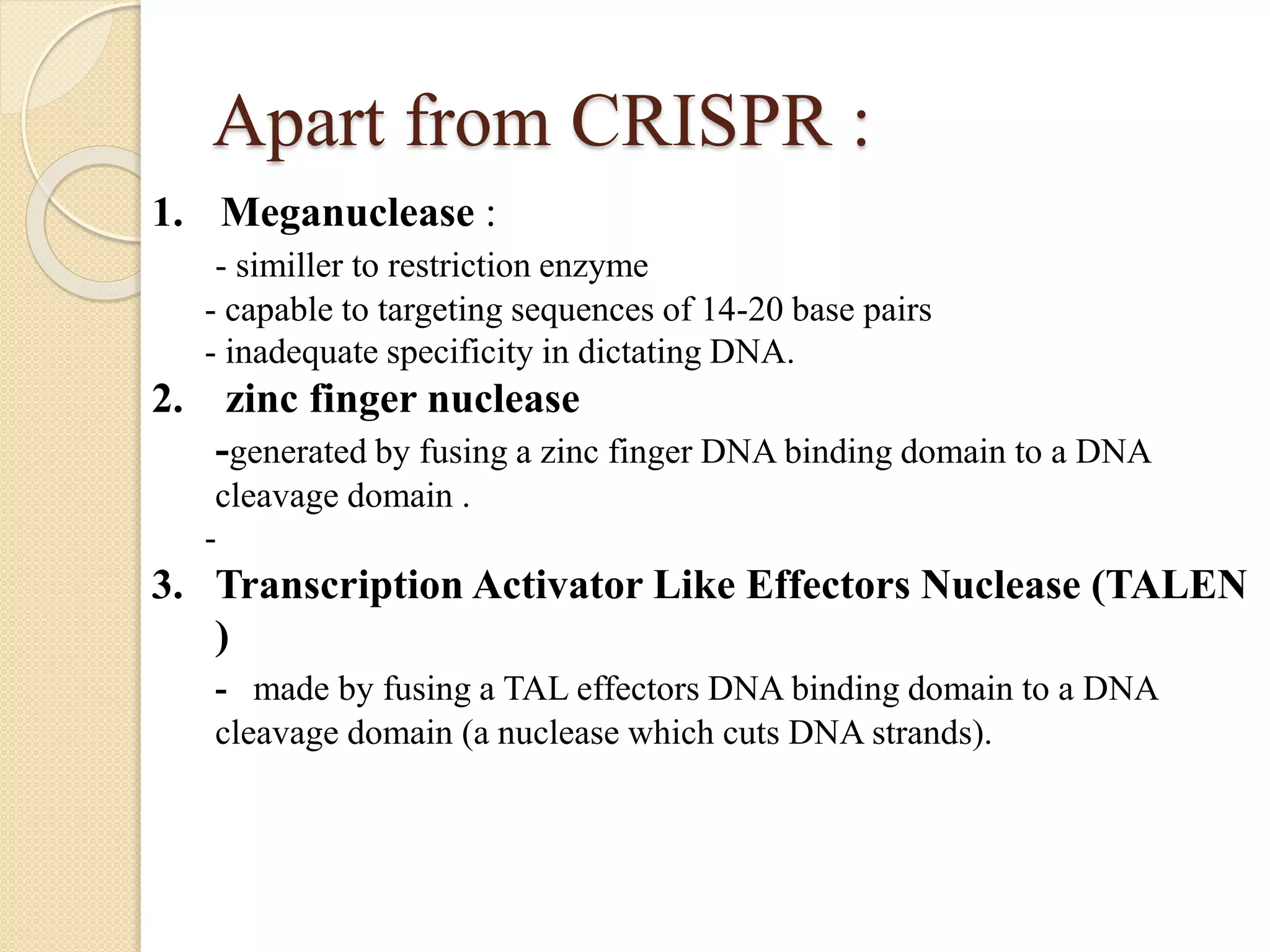
1. Meganuclease :
- similler to restriction enzyme
- capable to targeting sequences of 14-20 base pairs
- inadequate specificity in dictating DNA.
2. zinc finger nuclease
-generated by fusing a zinc finger DNA binding domain to a DNA
cleavage domain .
-
3. Transcription Activator Like Effectors Nuclease (TALEN
)
- made by fusing a TAL effectors DNA binding domain to a DNA
cleavage domain (a nuclease which cuts DNA strands).
Basic terminologies :
crRNA
- CRISPR RNA.
- The sequence of RNA which guides the CRISPR/Cas complex
to the target site for cleavage.
- Typically a crRNA sequence must be a minimum of 20 bp long for
efficient site cleavage.
- In type II (Cas9) systems crRNA must interact with tracrRNA for to
form a complex with the Cas9 protein.
gRNA
- Guide RNA.
- This term should be synonymous with crRNA.
- In practice however, gRNA is more commonly used as a synonym for
sgRNA, which refers to the crRNA/tracrRNA fusion transcript used in
engineered CRISPR/Cas9 systems.
cont…
CAS :
- CRISPR associated protein. There are many different Cas proteins,
corresponding to different types and subtypes of the CRISPR system
present in different species.
- Class 1 CRISPR systems employ a complex of different Cas proteins to
degrade foreign nucleic acids whereas Class2 CRISPR systems
employ a
single large Cas protein.
CAS9 :
- The Class 2 type II Cas protein first used to demonstrate how the
CRISPR system could be used to mediate gene editing by engineering
synthetic guide proteins targeted to specific sites.
- Cas9 remains the best characterised and widely used Cas protein.
- Cas9 causes blunt ended double stranded breaks at the target site (3 bp
upstream of the PAM).
- The most commonly used variant of Cas9 is that derived from
Streptococcus pyogenes, which has a PAM of 5’-NGG-3’
cont…
PAM :
- Protospacer Adjacent Motif.
- The downstream presence of the particular PAM specific to the Cas
protein employed in a CRISPR system is essential for binding of
the Cas protein to the target DNA and cleavage of the target side if
the necessary PAM is not present the Cas protein will not bind.
- In bacterial systems, the PAM will be present on foreign DNA but
not the bacterial CRISPR locus – by this means the CRISPR
system is able to distinguish and selectively target foreign DNA
for destruction.
sgRNA :
- Single Guide RNA.
- An RNA sequence which combines at least one crRNA and a
tracrRNA in the one sequence, thereby simplifying the transfection
and expression of the necessary components for the CRISPR system.
- A small hairpin loop RNA sequence which plays a role in the
maturation of crRNA and formation of the crRNA-Cas9 complex
(in type II CRISPR systems).
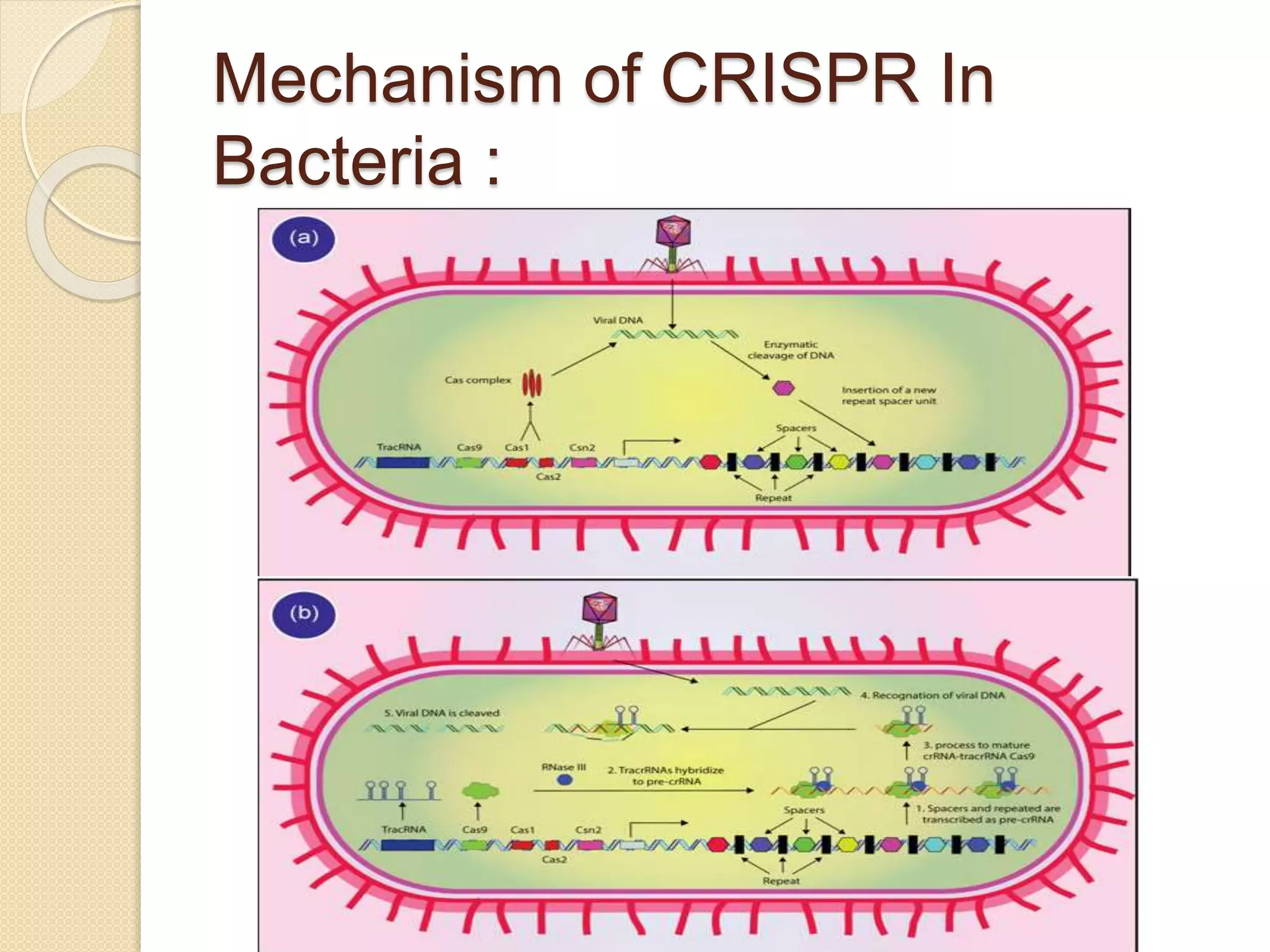
Mechanism of CRISPR In
Bacteria :
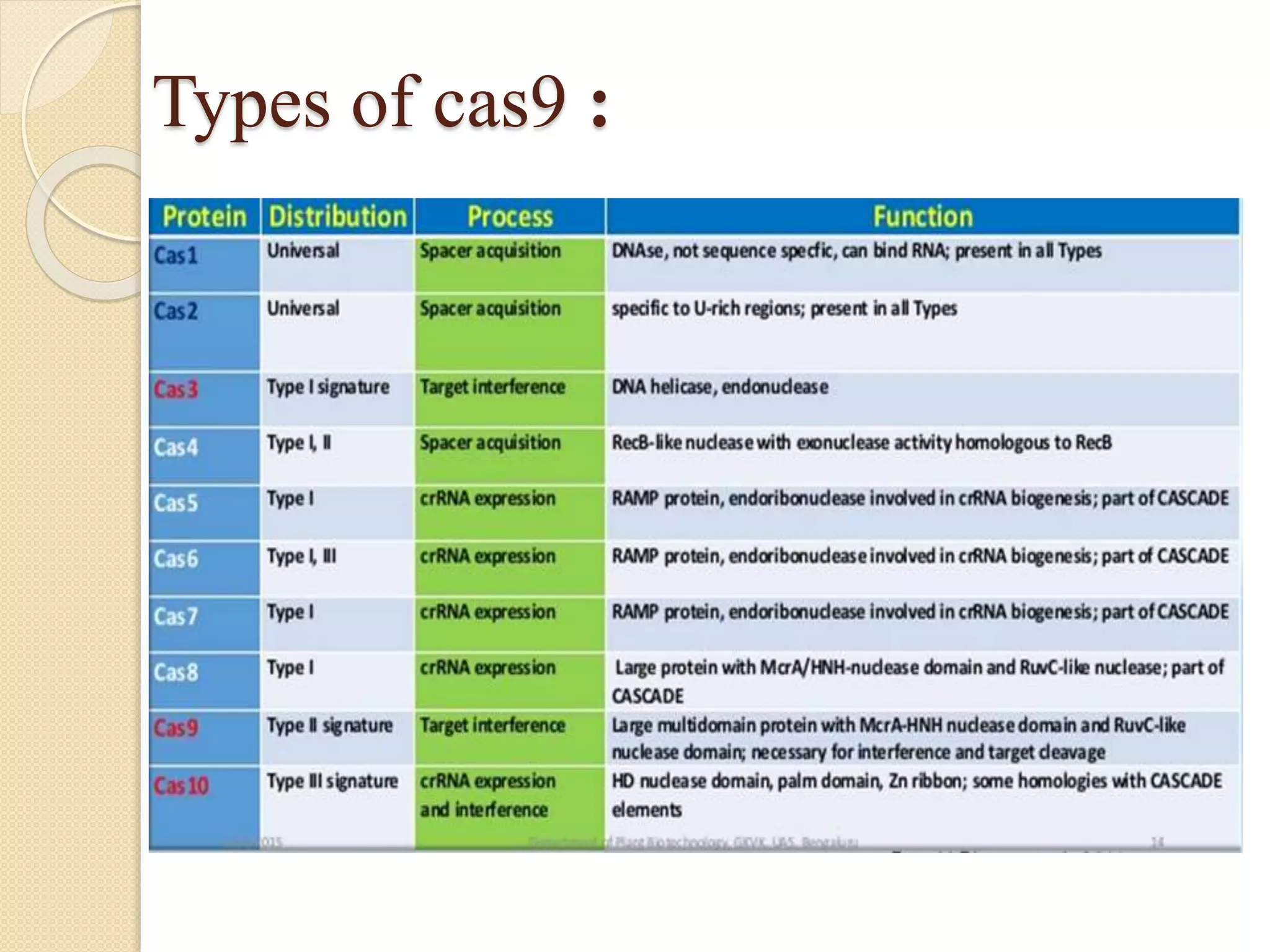
Types of cas9 :
CRISPR–Cas9 TECHNOLOGY
FOR :
 CANCER IMMUNOTHERAPY :
The screening for 2368 genes via the CRISPR–Cas9 system in
melanoma cells revealed a new targeted therapy for immunotherapy of
cancer using PD‐1 inhibitors.
Also a new targeted therapy called Ptpn2 was identified for for
cancer immunotherapy .
• INHIBITING RETINAL ANGIOGENESIS :
The vascular endothelial growth factor receptor 2 plays a
major role in the angiogenesis process. Using the CRISPR–Cas9 system
and the adeno‐associated virus (AAV) viral vector, researchers were able
to prevent the angiogenesis in the clinical model for the first time,
resulting in loss of vision.
cont…
 HEART FAILURE :
A study was conducted to investigate the correction of a
pathogenic gene mutation (MYBPC3) in a human embryo with hypertrophic
cardiomyopathy (a disease that ultimately causes heart failure).
 Programmable Nucleases as Tools for Efficient and
Precise Genome Editing :
CRISPR is very precise tool for the specific cleavage the target
sequence of DNA so use in the various genetic disorders like sickel cell
anemia .
 Knockdown/activation :
some disease causing gene can be knock out or change by the knock
in therapy using CRISPR.
Software's for CRISPR Editing :
cont..
Reference
 https://medium.com/genaerrative/a-comprehensive-timeline-of-
human-gene-editing-664a93bed8cf
 https://www.researchgate.net/List-of-software-tools-available-for-
CRISPR-sgRNA-design_tbl1_304456106 [accessed 3 Nov, 2018]
 https://www.frontiersin.org/articles/10.3389/fpls.2016.00506/full
 http://www.allenovery.com/publications/engb/CRISPRsite/CRISPR
glossary/Pages/default.aspx
 Khadempar S, Familghadakchi S, Motlagh RA, et al. CRISPR–
Cas9 in genome editing: Its function and medical applications. J
Cell Physiol. 2018;1–11. https://doi.org/10.1002/jcp.27476

Crispr cas9 based system for therapeutics

  • 1.
    CRISPRCas9 based systemfor therapeutics Presented by: Abhishek Kiran Tiwatane Department of Biotechnology M.S. 1st Year Reg no:BT/2018-IX/072
  • 2.
    Contents :  Introduction History  Apart from CRISPR  Basic Terminology  Mechanism  Applications  Software's  References
  • 3.
    What is crispr/Cas9 ?  CRISPR stands for “Clustered Regularly Interspaced Short Palindromic Repeats”.  CRISPRs in conjugation with CRISPR associated (cas) protein.  The Cas9 creates a gap in the target DNA or RNA sequences.  Cas9 is the nuclease guided by the crRNA and tracrRNA to cleave specific DNA sequences.  It is currently the simplest,most varsatile and precise genome editing tool.
  • 4.
    History  Ishino Yoshizumi(1987)identified CRISPR in Escherichai coli.  They found that these zones have a specific barcode called spacers with matches originate from viral or plasmid genomes.  In other words, the spacer sequence is formed in the bacterial genome during exposure to phages, and the level of bacterial sensitivity to be infections by phages depends on the contents of the spacer sequence.  After that Jennifer Dodna , discover CRISPR as precise and gene editing tool to cut genome with the help of nuclease activity of Cas9 protein.
  • 5.
    cont… 1978 • IDENTIFICATION –By YOSHIZUMI ISHINO • Ishino accidentally clones part of a CRIPR sequence and notes that is unusual,since most repeated DNA sequence are consecutive , not interspaced. 2005 • DISCOVERED PURPOSE - By FRANCISCO MOJICA • CRISPR is a form of adaptive immunity in bacteria that allows them to defend against invading Bacteriophage DNA . 2012 • CRIPR BECOME A TOOL – BY JENNIFER DOUDNA • She found CAS9 protein in CRISPR process and demonstrated that if paired with different guiding RNA , it could be used as genomic scissors , cheaply and accurately slicing specific section of DNA.
  • 6.
    cont… APR,2015 • CRISPR EMBRYOCONTROVERSY - • Team of chinese scientist SUN YAT-SEN UNIVERSITY , uses CRISPR on inviable human embryo cells.they found that gene editing getting out of hand and being used in dangerous human application. DEC,2015 • INTERNATIONAL CONFERENCE N HUMAN GENE EDITING - • So that all scientist community from all over the world like NAS ,NAM,Chinese Academy of sciences and U K Royal Society ,conclude that ISHGE is that germline gene editing should be avoided until safety and efficacy are proven . 2017 • NATIONALACADEMIES REPORT - • “Human Genome Editing : Science ,Ethics and Governance.” review the current status of gnome editing research . It concludes that researchers should proceed with caution to consider editing human embryos ‘for compelling purpose of treating or prventing serious disease or disabilities.”the first recommendation to edit the human germline.
  • 7.
    MILSTONES OF CRISPR: EMMANAUELLE CHARPENTIER JENNIFER DODNA YOSHIZUMI ISHINO
  • 8.
    Apart from CRISPR: 1. Meganuclease : - similler to restriction enzyme - capable to targeting sequences of 14-20 base pairs - inadequate specificity in dictating DNA. 2. zinc finger nuclease -generated by fusing a zinc finger DNA binding domain to a DNA cleavage domain . - 3. Transcription Activator Like Effectors Nuclease (TALEN ) - made by fusing a TAL effectors DNA binding domain to a DNA cleavage domain (a nuclease which cuts DNA strands).
  • 9.
    Basic terminologies : crRNA -CRISPR RNA. - The sequence of RNA which guides the CRISPR/Cas complex to the target site for cleavage. - Typically a crRNA sequence must be a minimum of 20 bp long for efficient site cleavage. - In type II (Cas9) systems crRNA must interact with tracrRNA for to form a complex with the Cas9 protein. gRNA - Guide RNA. - This term should be synonymous with crRNA. - In practice however, gRNA is more commonly used as a synonym for sgRNA, which refers to the crRNA/tracrRNA fusion transcript used in engineered CRISPR/Cas9 systems.
  • 10.
    cont… CAS : - CRISPRassociated protein. There are many different Cas proteins, corresponding to different types and subtypes of the CRISPR system present in different species. - Class 1 CRISPR systems employ a complex of different Cas proteins to degrade foreign nucleic acids whereas Class2 CRISPR systems employ a single large Cas protein. CAS9 : - The Class 2 type II Cas protein first used to demonstrate how the CRISPR system could be used to mediate gene editing by engineering synthetic guide proteins targeted to specific sites. - Cas9 remains the best characterised and widely used Cas protein. - Cas9 causes blunt ended double stranded breaks at the target site (3 bp upstream of the PAM). - The most commonly used variant of Cas9 is that derived from Streptococcus pyogenes, which has a PAM of 5’-NGG-3’
  • 11.
    cont… PAM : - ProtospacerAdjacent Motif. - The downstream presence of the particular PAM specific to the Cas protein employed in a CRISPR system is essential for binding of the Cas protein to the target DNA and cleavage of the target side if the necessary PAM is not present the Cas protein will not bind. - In bacterial systems, the PAM will be present on foreign DNA but not the bacterial CRISPR locus – by this means the CRISPR system is able to distinguish and selectively target foreign DNA for destruction. sgRNA : - Single Guide RNA. - An RNA sequence which combines at least one crRNA and a tracrRNA in the one sequence, thereby simplifying the transfection and expression of the necessary components for the CRISPR system. - A small hairpin loop RNA sequence which plays a role in the maturation of crRNA and formation of the crRNA-Cas9 complex (in type II CRISPR systems).
  • 12.
    Mechanism of CRISPRIn Bacteria :
  • 13.
  • 14.
    CRISPR–Cas9 TECHNOLOGY FOR : CANCER IMMUNOTHERAPY : The screening for 2368 genes via the CRISPR–Cas9 system in melanoma cells revealed a new targeted therapy for immunotherapy of cancer using PD‐1 inhibitors. Also a new targeted therapy called Ptpn2 was identified for for cancer immunotherapy . • INHIBITING RETINAL ANGIOGENESIS : The vascular endothelial growth factor receptor 2 plays a major role in the angiogenesis process. Using the CRISPR–Cas9 system and the adeno‐associated virus (AAV) viral vector, researchers were able to prevent the angiogenesis in the clinical model for the first time, resulting in loss of vision.
  • 15.
    cont…  HEART FAILURE: A study was conducted to investigate the correction of a pathogenic gene mutation (MYBPC3) in a human embryo with hypertrophic cardiomyopathy (a disease that ultimately causes heart failure).  Programmable Nucleases as Tools for Efficient and Precise Genome Editing : CRISPR is very precise tool for the specific cleavage the target sequence of DNA so use in the various genetic disorders like sickel cell anemia .  Knockdown/activation : some disease causing gene can be knock out or change by the knock in therapy using CRISPR.
  • 16.
  • 17.
  • 18.
    Reference  https://medium.com/genaerrative/a-comprehensive-timeline-of- human-gene-editing-664a93bed8cf  https://www.researchgate.net/List-of-software-tools-available-for- CRISPR-sgRNA-design_tbl1_304456106[accessed 3 Nov, 2018]  https://www.frontiersin.org/articles/10.3389/fpls.2016.00506/full  http://www.allenovery.com/publications/engb/CRISPRsite/CRISPR glossary/Pages/default.aspx  Khadempar S, Familghadakchi S, Motlagh RA, et al. CRISPR– Cas9 in genome editing: Its function and medical applications. J Cell Physiol. 2018;1–11. https://doi.org/10.1002/jcp.27476