Optimized methods to use Cas9 nickases
in genome editing
Mollie Schubert, MS, Research Scientist
Shuqi Yan, MS, Research Scientist
1
Outline: Using Alt-R® Cas9 nickases for genome editing
• Background: Genome editing using the Alt-R CRISPR-Cas9 system
• Introduction of Alt-R Cas9 D10A and Cas9 H840A Nickases
• Using Cas9 nickases for genome editing
- How to design gRNA pair
- How to design donor template for homology directed repair (HDR)
• Workflow: Doing genome editing with Cas9 nickases
2
Outline: Using Alt-R Cas9 nickases for genome editing
• Background: Genome editing using the Alt-R CRISPR-Cas9 system
• Introduction of Alt-R Cas9 D10A and Cas9 H840A Nickases
• Using Cas9 nickases for genome editing
- How to design gRNA pair
- How to design donor template for homology directed repair (HDR)
• Workflow: Doing genome editing with Cas9 nickases
3
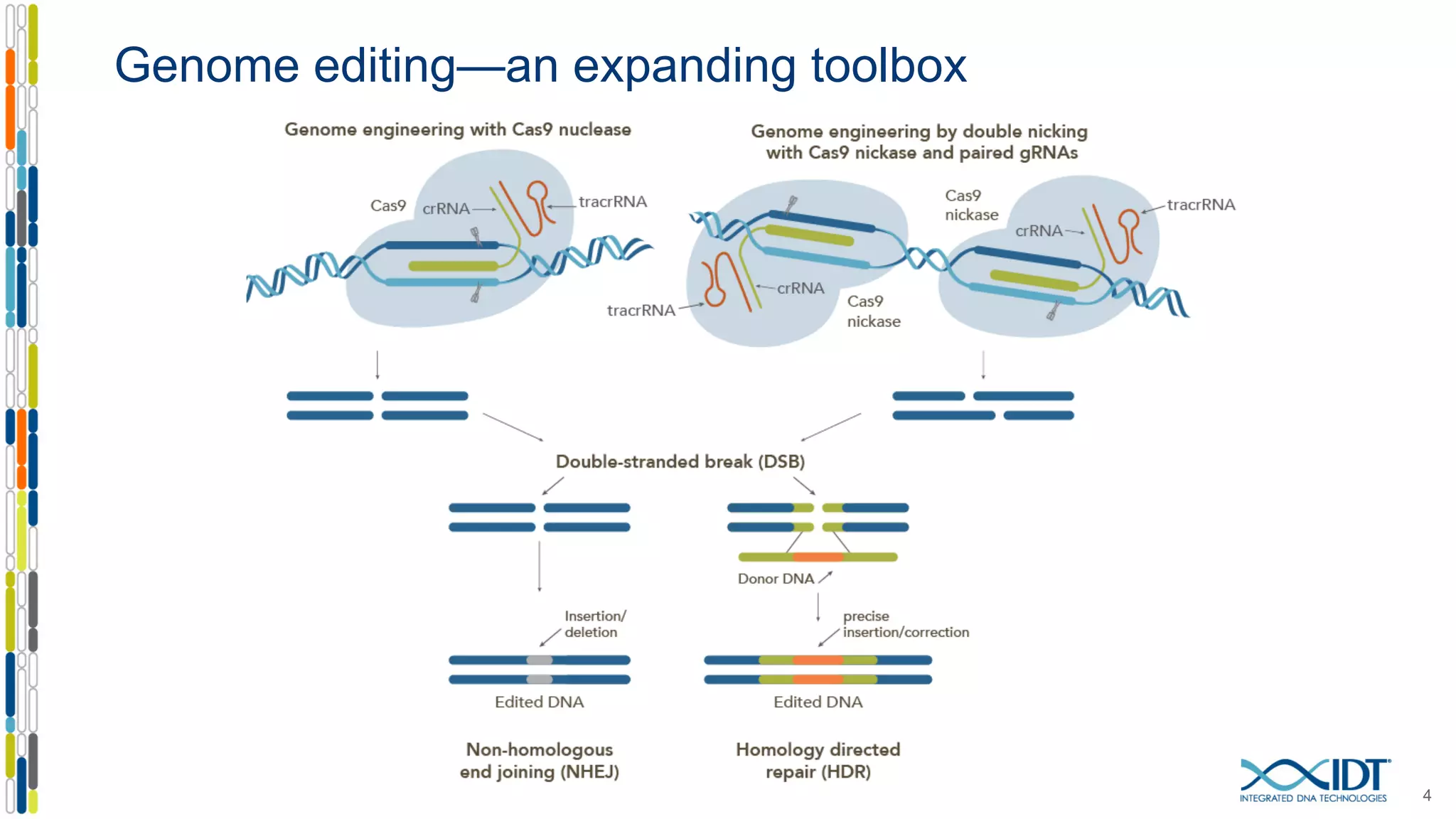
Genome editing—an expanding toolbox
4
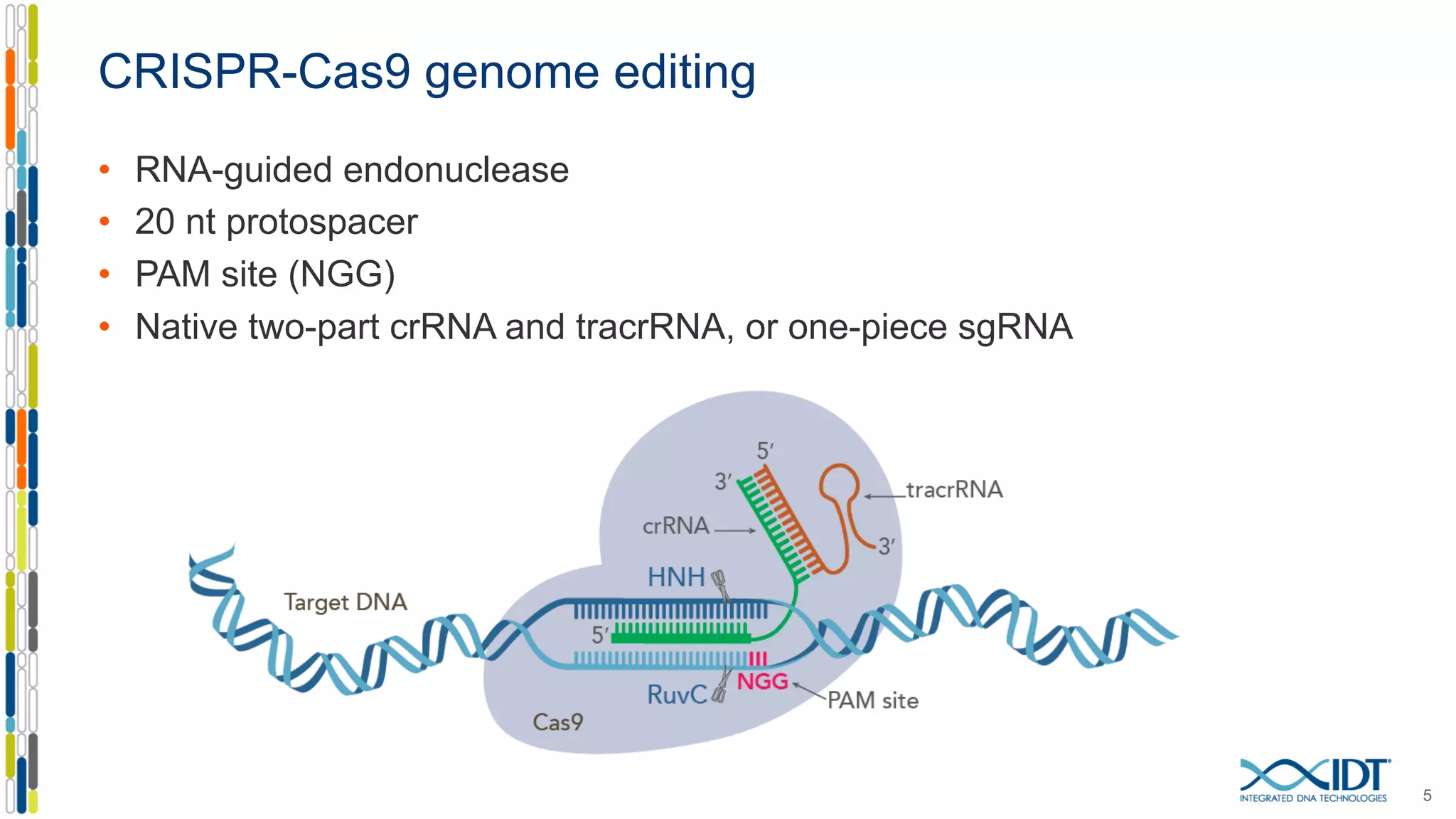
CRISPR-Cas9 genome editing
• RNA-guided endonuclease
• 20 nt protospacer
• PAM site (NGG)
• Native two-part crRNA and tracrRNA, or one-piece sgRNA
5
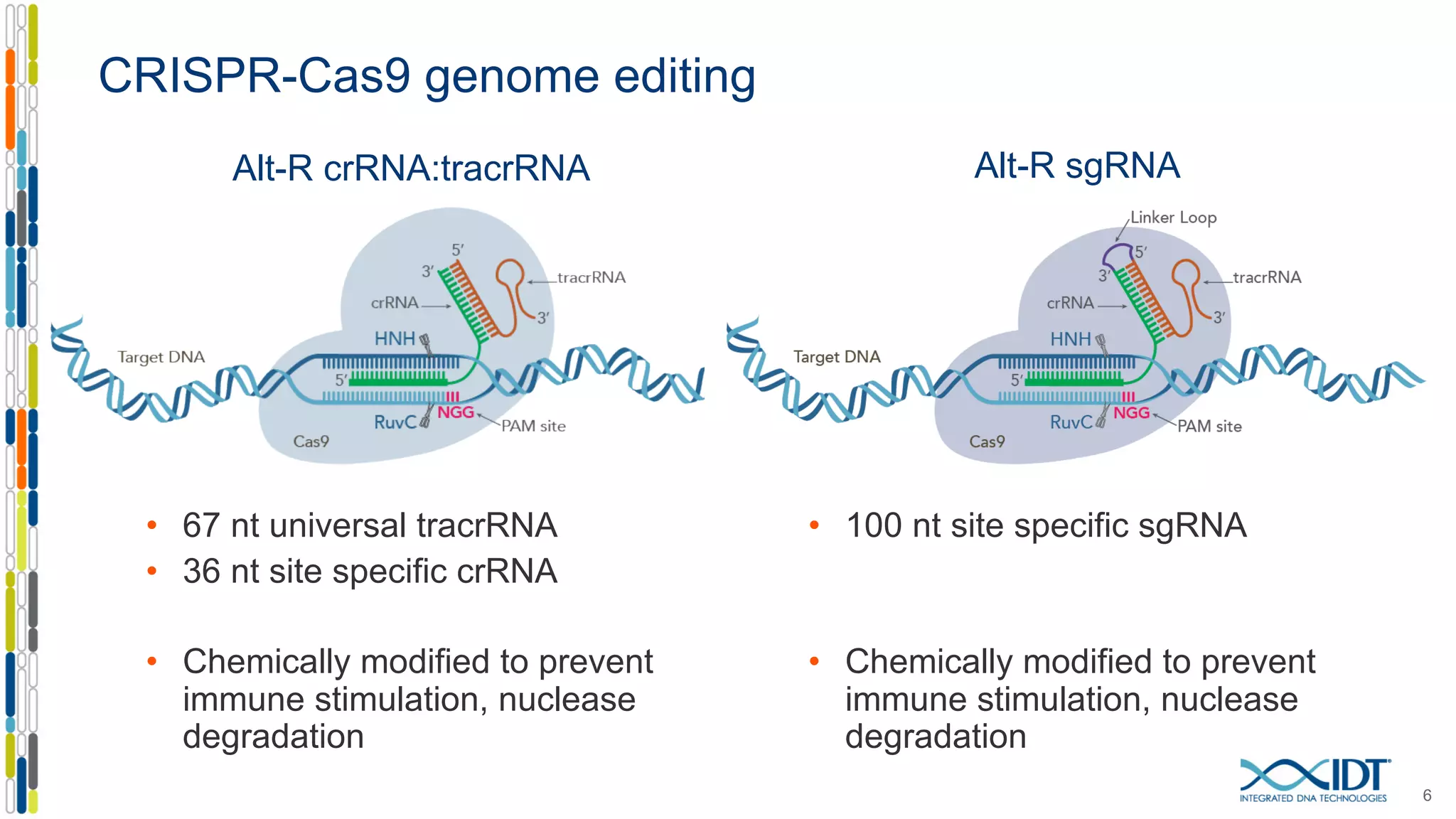
CRISPR-Cas9 genome editing
• 67 nt universal tracrRNA
• 36 nt site specific crRNA
• Chemically modified to prevent
immune stimulation, nuclease
degradation
6
Alt-R crRNA:tracrRNA Alt-R sgRNA
• 100 nt site specific sgRNA
• Chemically modified to prevent
immune stimulation, nuclease
degradation
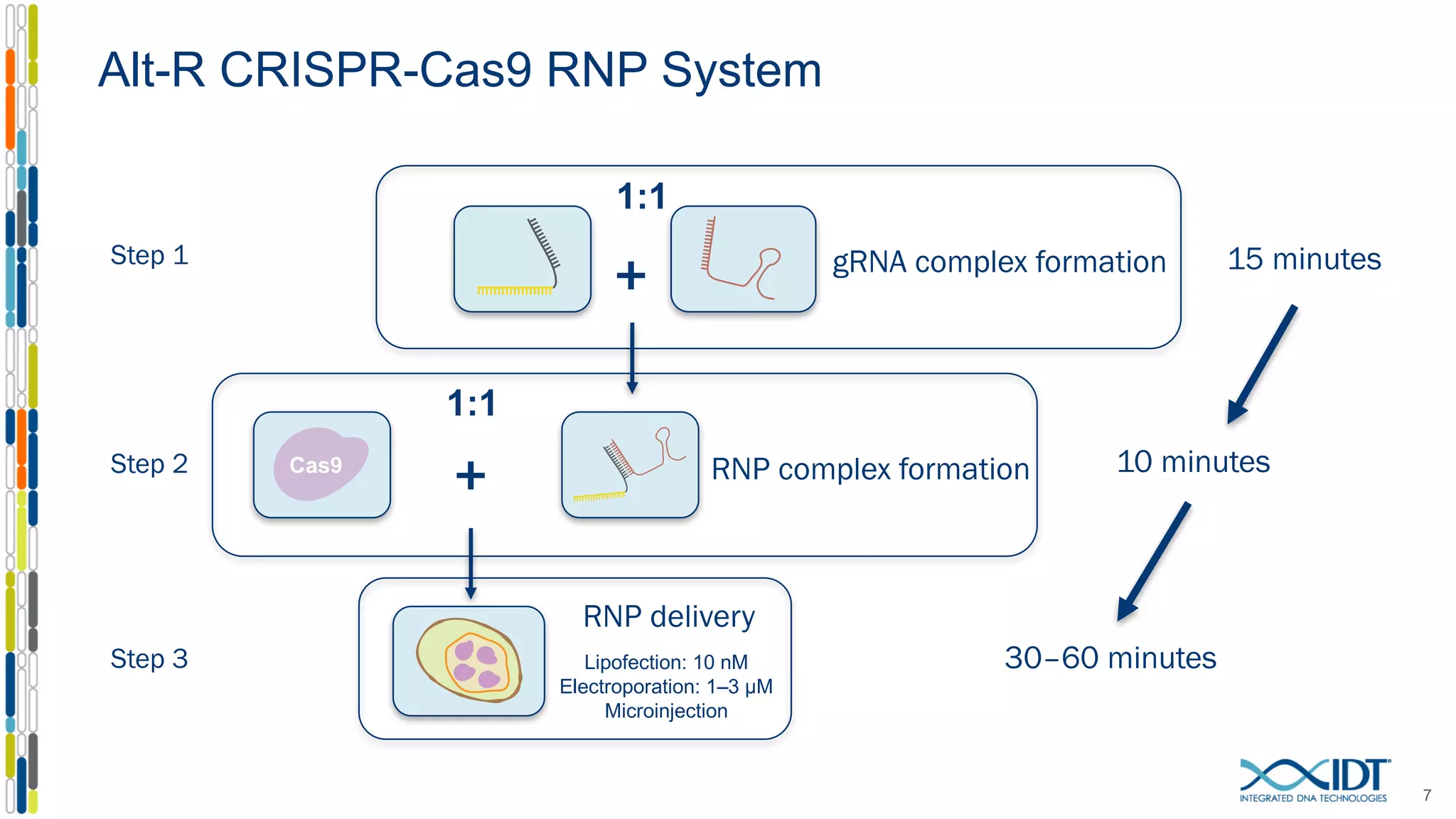
Alt-R CRISPR-Cas9 RNP System
7
+
+
gRNA complex formation
RNP complex formation
RNP delivery
Step 1
Step 2
Step 3
15 minutes
10 minutes
30–60 minutes
1:1
1:1
Lipofection: 10 nM
Electroporation: 1–3 µM
Microinjection
Cas9
8
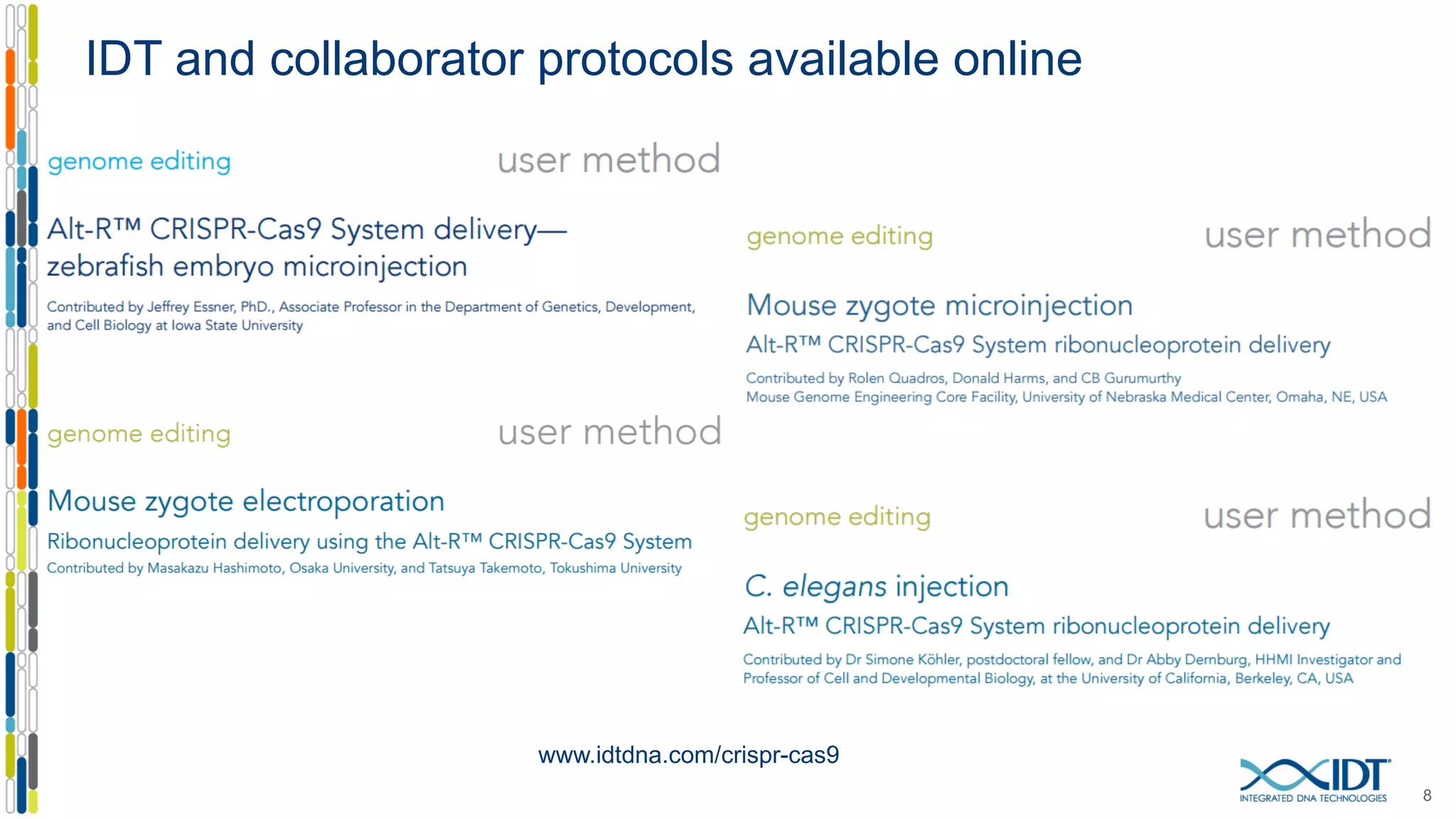
IDT and collaborator protocols available online
www.idtdna.com/crispr-cas9
Outline: Using Alt-R Cas9 nickases for genome editing
• Background: Genome editing using the Alt-R CRISPR-Cas9 system
• Introduction of Alt-R Cas9 D10A and Cas9 H840A Nickases
• Using Cas9 nickases for genome editing
- How to design gRNA pair
- How to design donor template for homology directed repair (HDR)
• Workflow: Doing genome editing with Cas9 nickases
9
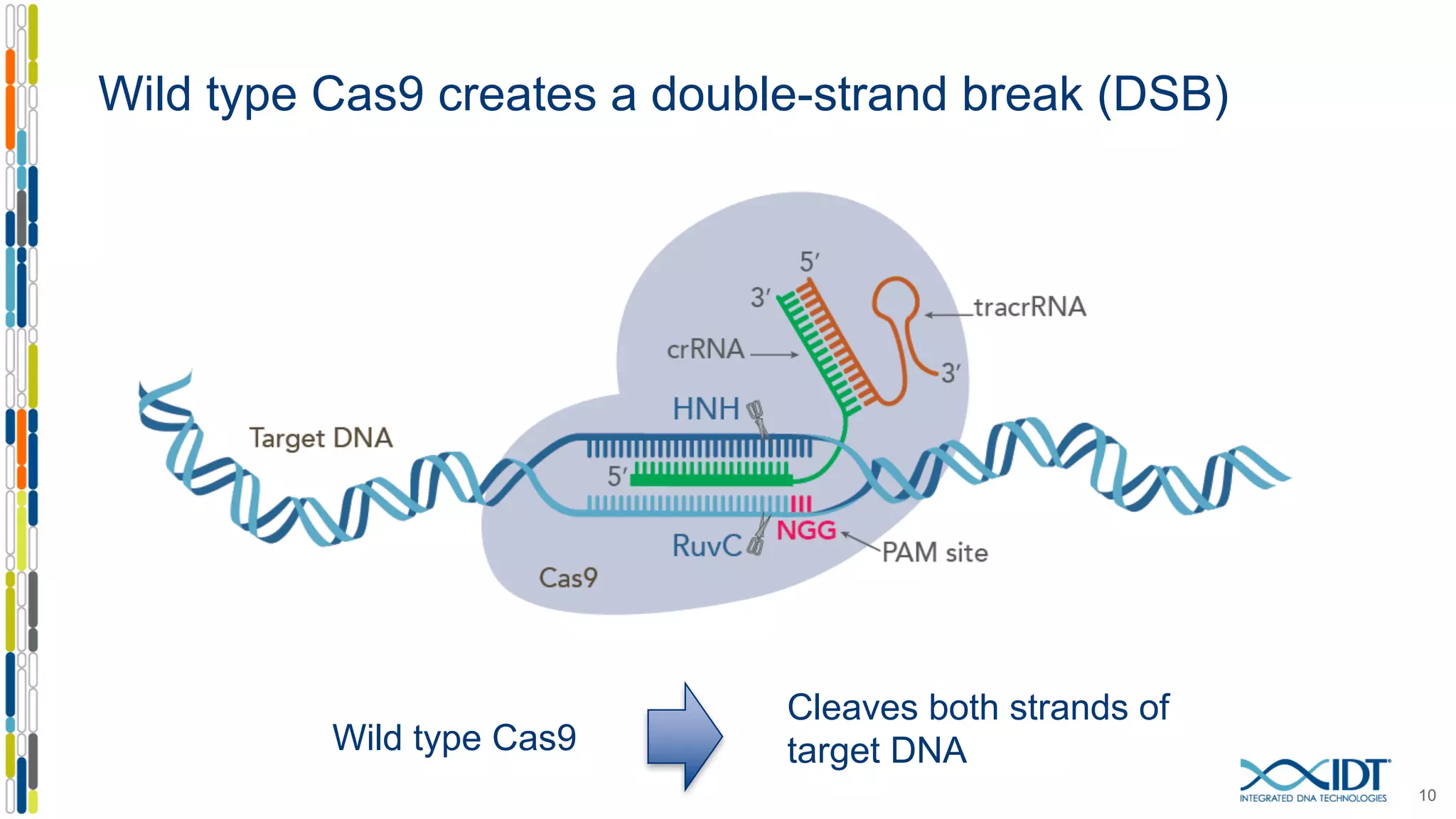
Wild type Cas9 creates a double-strand break (DSB)
10
Cleaves both strands of
target DNAWild type Cas9
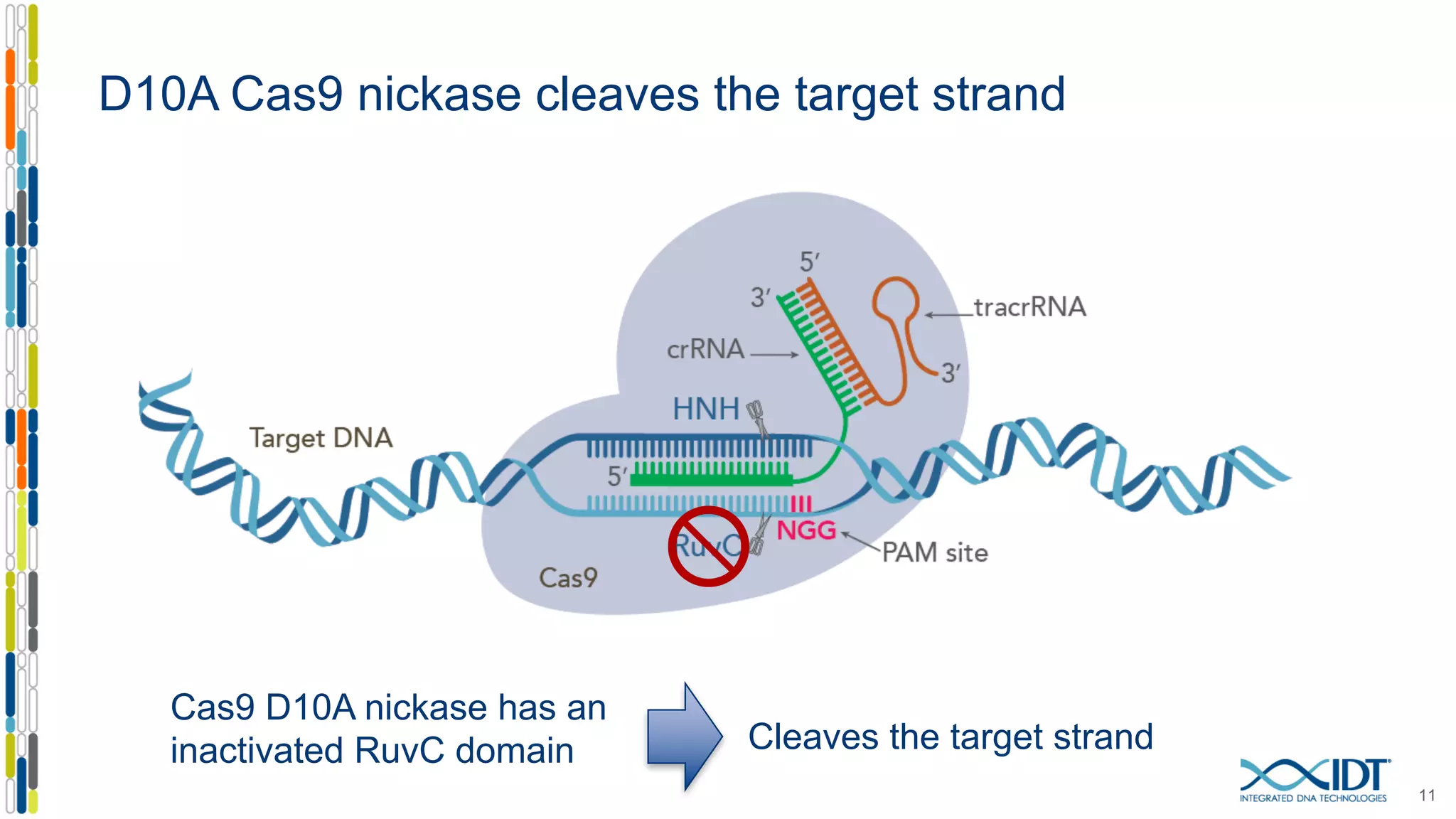
D10A Cas9 nickase cleaves the target strand
11
Cleaves the target strand
Cas9 D10A nickase has an
inactivated RuvC domain
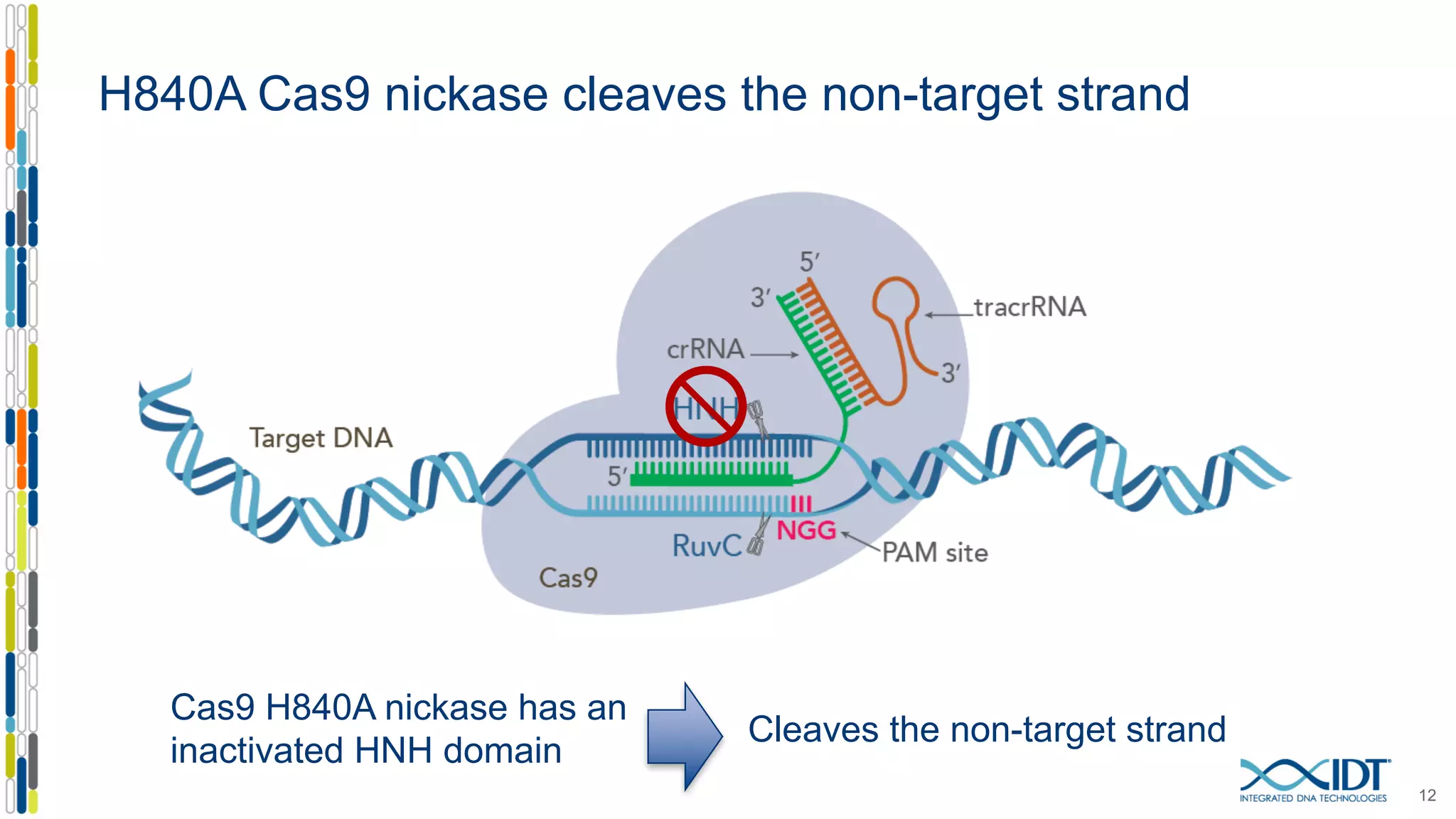
H840A Cas9 nickase cleaves the non-target strand
12
Cleaves the non-target strand
Cas9 H840A nickase has an
inactivated HNH domain
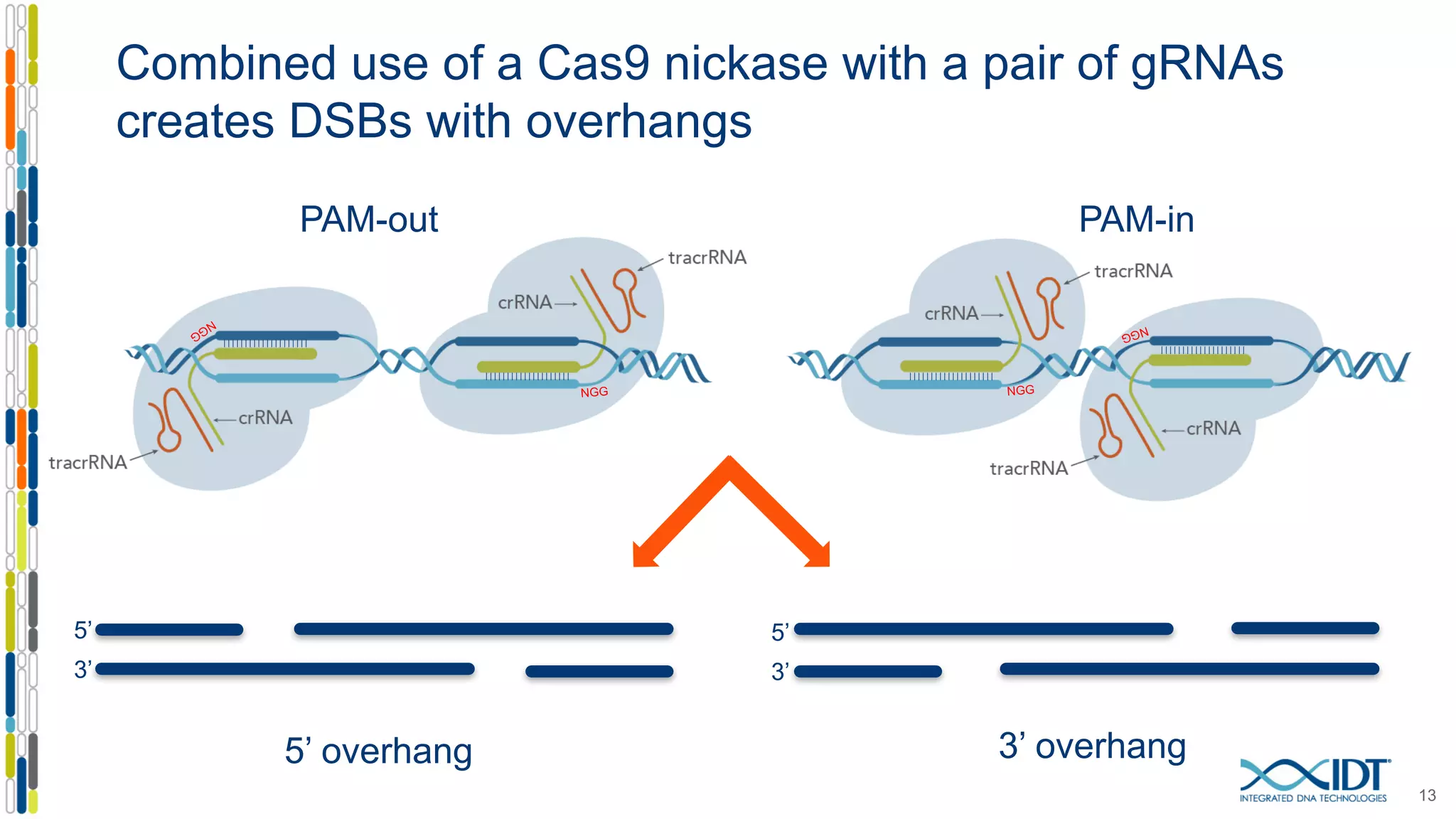
Combined use of a Cas9 nickase with a pair of gRNAs
creates DSBs with overhangs
13
5’
3’
5’
3’
5’ overhang 3’ overhang
PAM-out PAM-in
| | | | | | | | | | | | | | | | | | | |
| | | | | | | | | | | | | | | | | | | | | | | | | | | | | | | | | | | | | | | |
| | | | | | | | | | | | | | | | | | | |
Outline: Using Alt-R Cas9 nickases for genome editing
• Background: Genome editing using the Alt-R CRISPR-Cas9 system
• Introduction of Alt-R Cas9 D10A and Cas9 H840A Nickases
• Using Cas9 nickases for genome editing
- How to design gRNA pair
- How to design donor template for homology directed repair (HDR)
• Workflow: Doing genome editing with Cas9 nickases
14
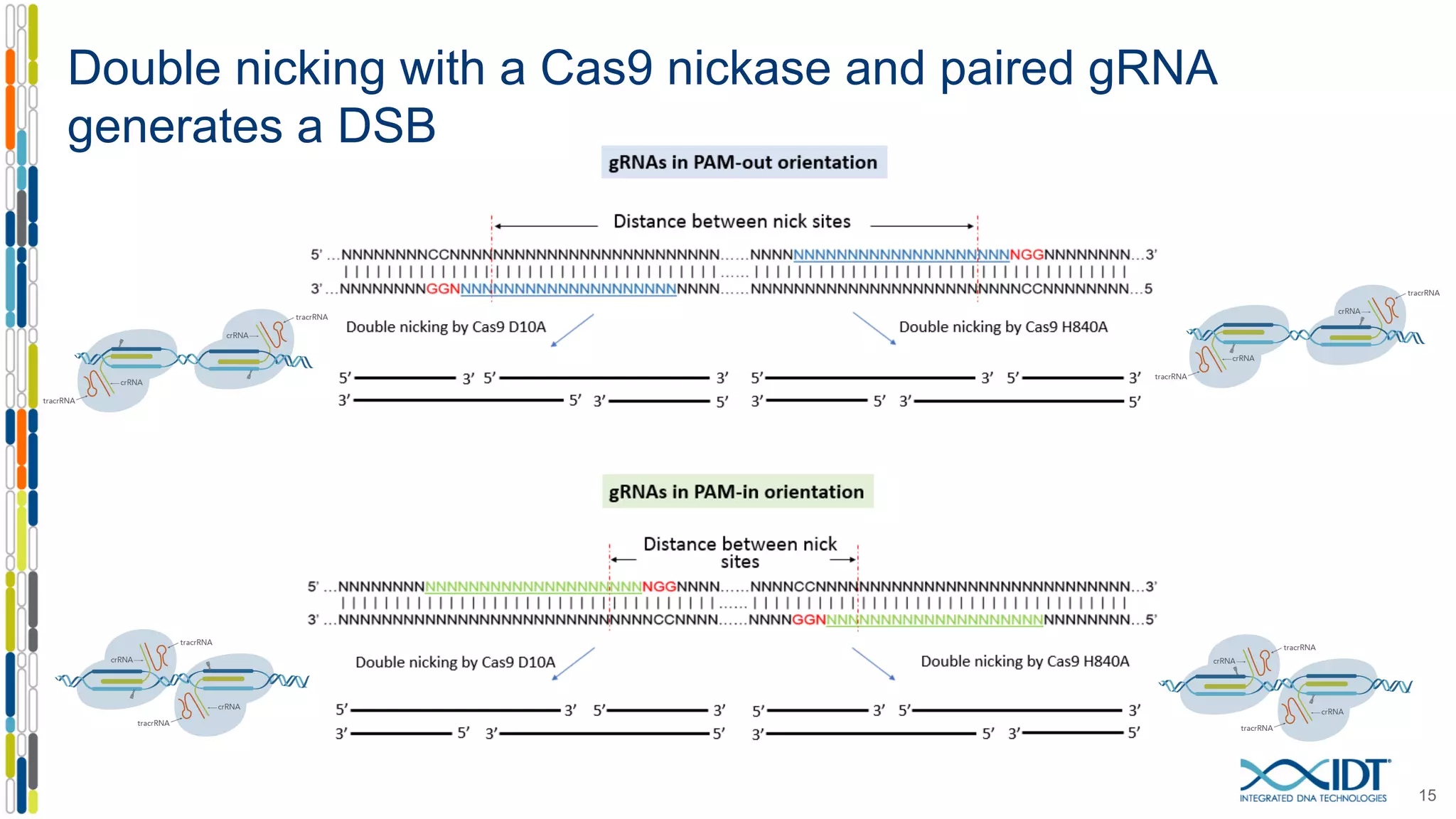
Double nicking with a Cas9 nickase and paired gRNA
generates a DSB
15
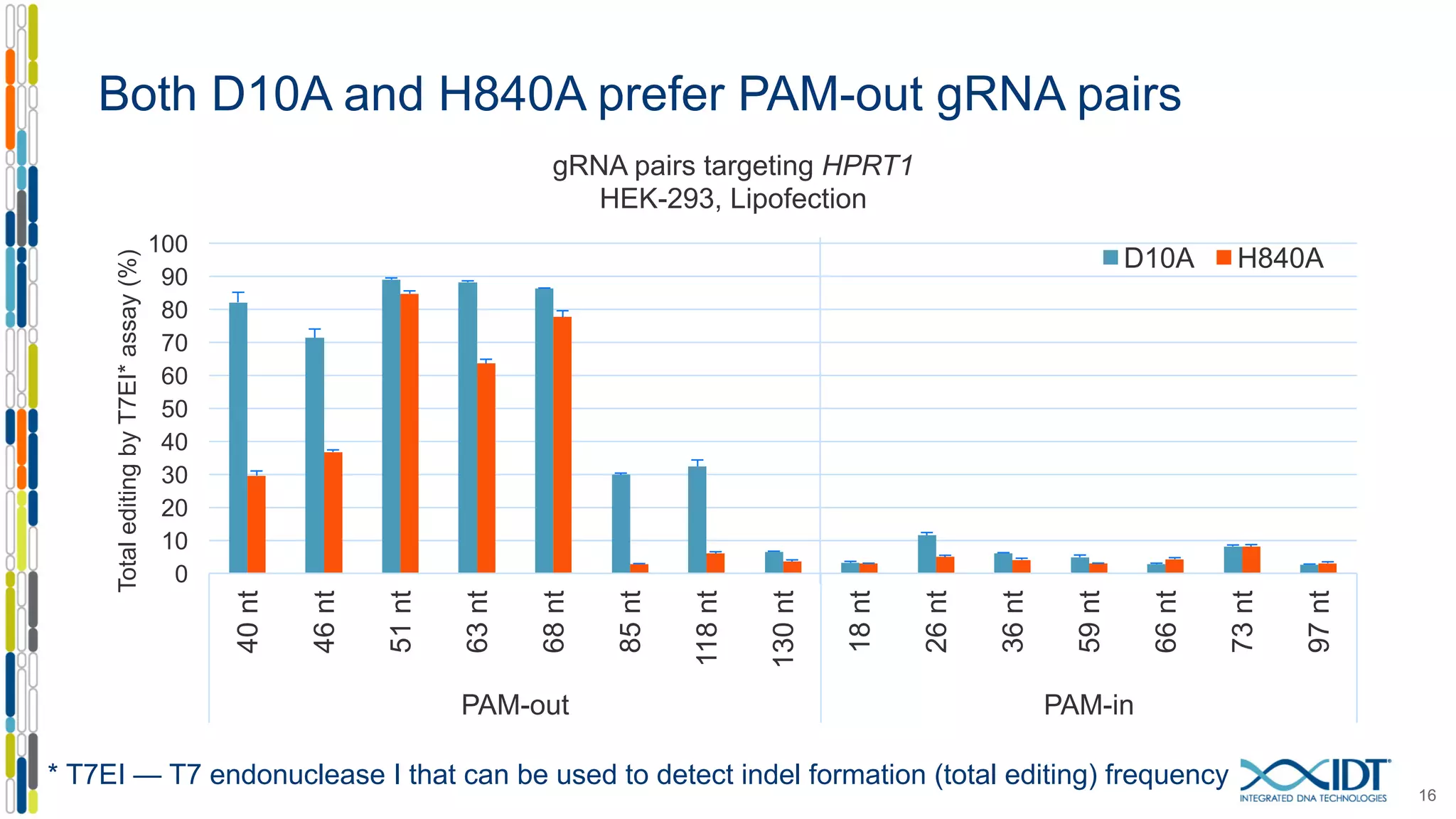
Both D10A and H840A prefer PAM-out gRNA pairs
16
0
10
20
30
40
50
60
70
80
90
100 40nt
46nt
51nt
63nt
68nt
85nt
118nt
130nt
18nt
26nt
36nt
59nt
66nt
73nt
97nt
PAM-out PAM-in
TotaleditingbyT7EI*assay(%)
gRNA pairs targeting HPRT1
HEK-293, Lipofection
D10A H840A
* T7EI — T7 endonuclease I that can be used to detect indel formation (total editing) frequency
Efficiency drops when the gRNAs are too close
17
0
10
20
30
40
50
60
70
80
90
100
7nt
12nt
18nt
23nt
37nt
40nt
60nt
62nt
67nt
TotaleditingbyNGS(%)
PAM-out
Cas9 D10A with gRNA pairs targeting AAVS1 locus
HEK-293, Nucleofection
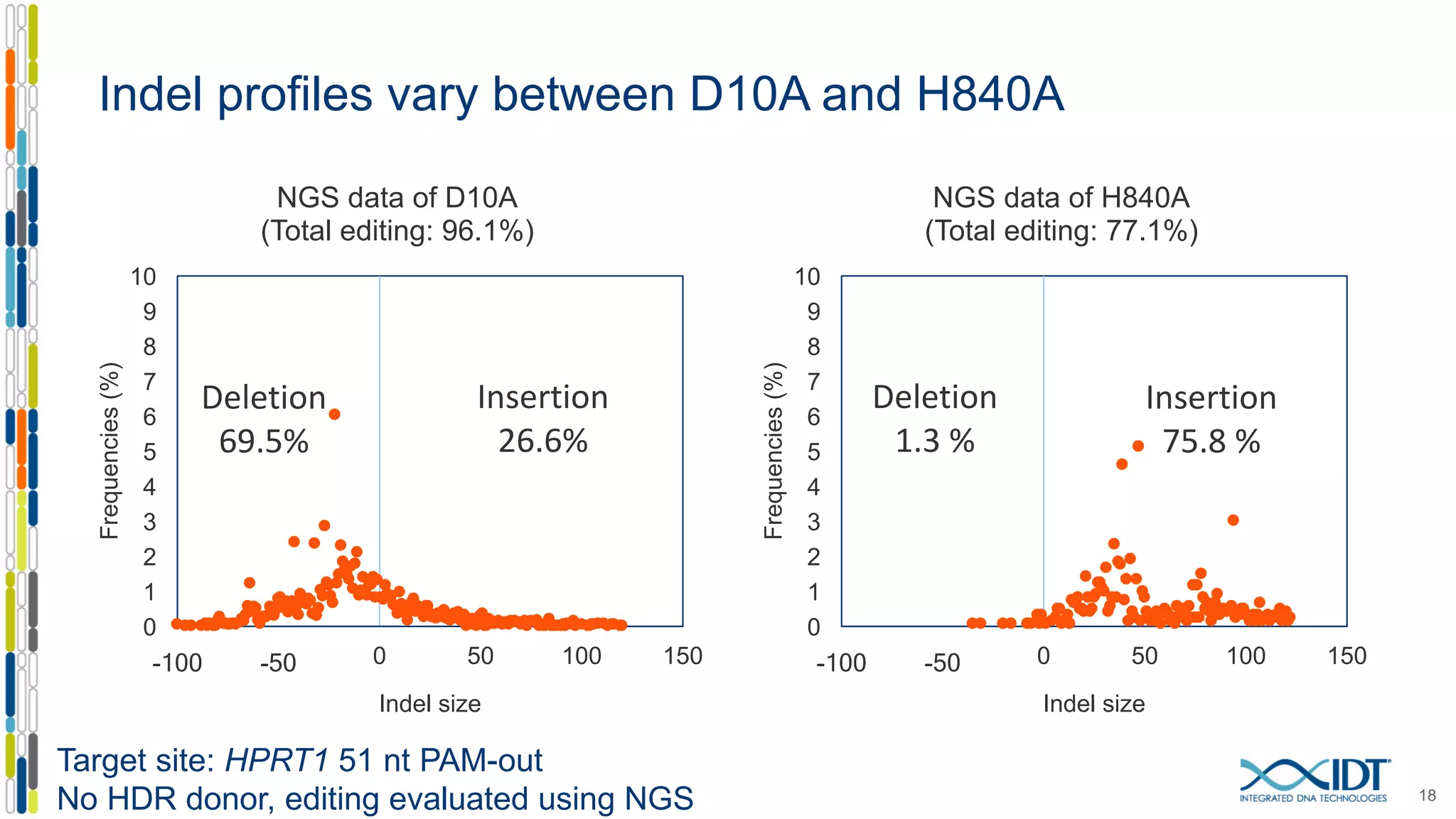
Indel profiles vary between D10A and H840A
18
0
1
2
3
4
5
6
7
8
9
10
-100 -50 0 50 100 150
Frequencies(%)
Indel size
NGS data of H840A
(Total editing: 77.1%)
Deletion
1.3	%
Insertion
75.8	%
0
1
2
3
4
5
6
7
8
9
10
-100 -50 0 50 100 150
Frequencies(%)
Indel size
NGS data of D10A
(Total editing: 96.1%)
Deletion
69.5%
Insertion
26.6%
Target site: HPRT1 51 nt PAM-out
No HDR donor, editing evaluated using NGS
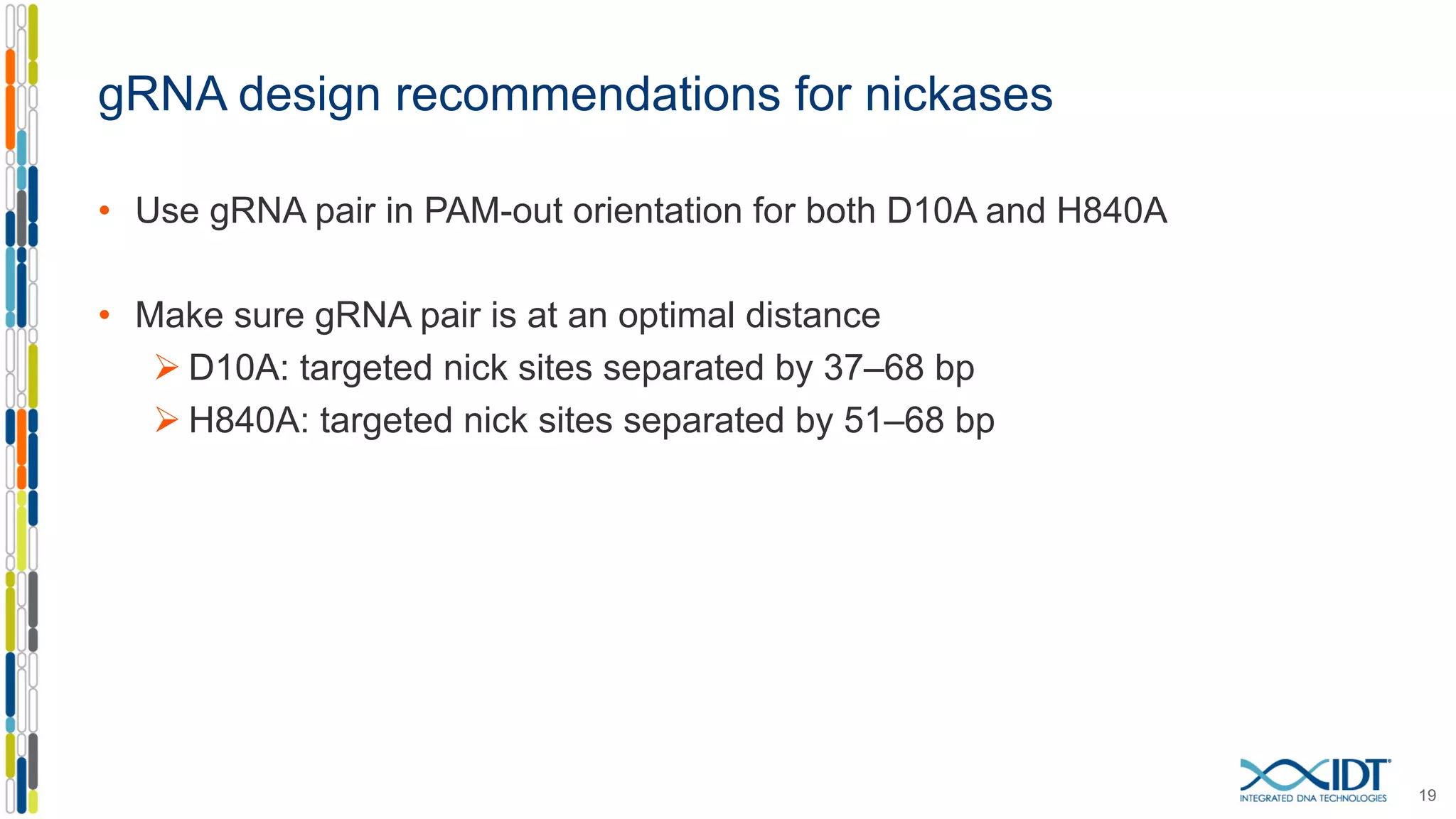
gRNA design recommendations for nickases
• Use gRNA pair in PAM-out orientation for both D10A and H840A
• Make sure gRNA pair is at an optimal distance
Ø D10A: targeted nick sites separated by 37–68 bp
Ø H840A: targeted nick sites separated by 51–68 bp
19
Outline: Using Alt-R Cas9 nickases for genome editing
• Background: Genome editing using the Alt-R CRISPR-Cas9 system
• Introduction of Alt-R Cas9 D10A and Cas9 H840A Nickases
• Using Cas9 nickases for genome editing
- How to design gRNA pair
- How to design donor template for homology directed repair (HDR)
• Workflow: Doing genome editing with Cas9 nickases
20
Using nickases for homology directed repair
• D10A vs H840A: which to choose?
• HDR donor design
Ø Small insertion (ssODN; IDT Ultramer® Oligonucleotides)
– What is the optimal homology arm length?
– Where to place the insert?
Ø Large insertion (long ssDNA; IDT Megamer® ssDNA Fragments)
– An example of inserting a ~800 bp fluorescent protein construct
21
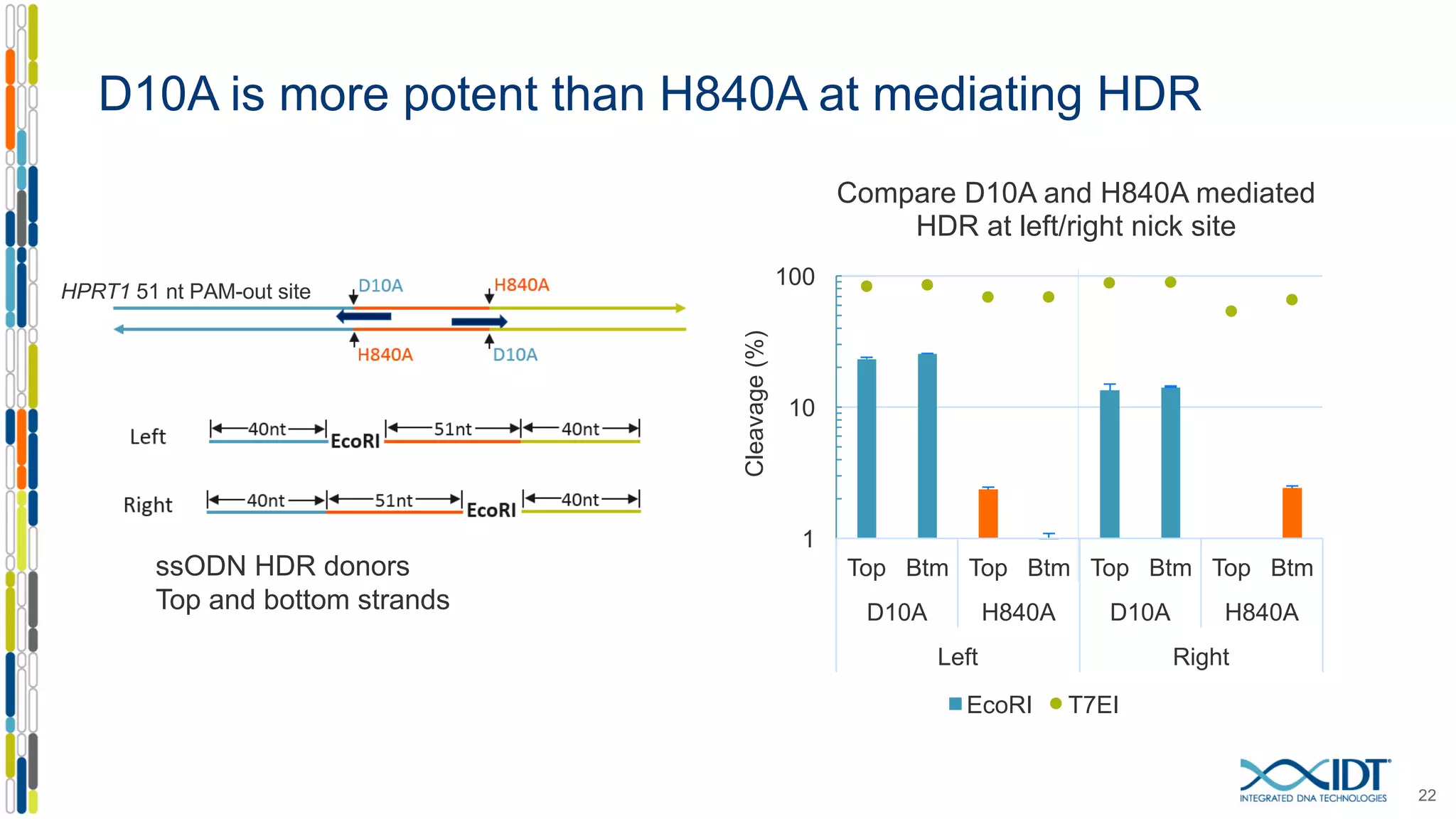
D10A is more potent than H840A at mediating HDR
22
ssODN HDR donors
Top and bottom strands
1
10
100
Top Btm Top Btm Top Btm Top Btm
D10A H840A D10A H840A
Left Right
Cleavage(%)
Compare D10A and H840A mediated
HDR at left/right nick site
EcoRI T7EI
HPRT1 51 nt PAM-out site
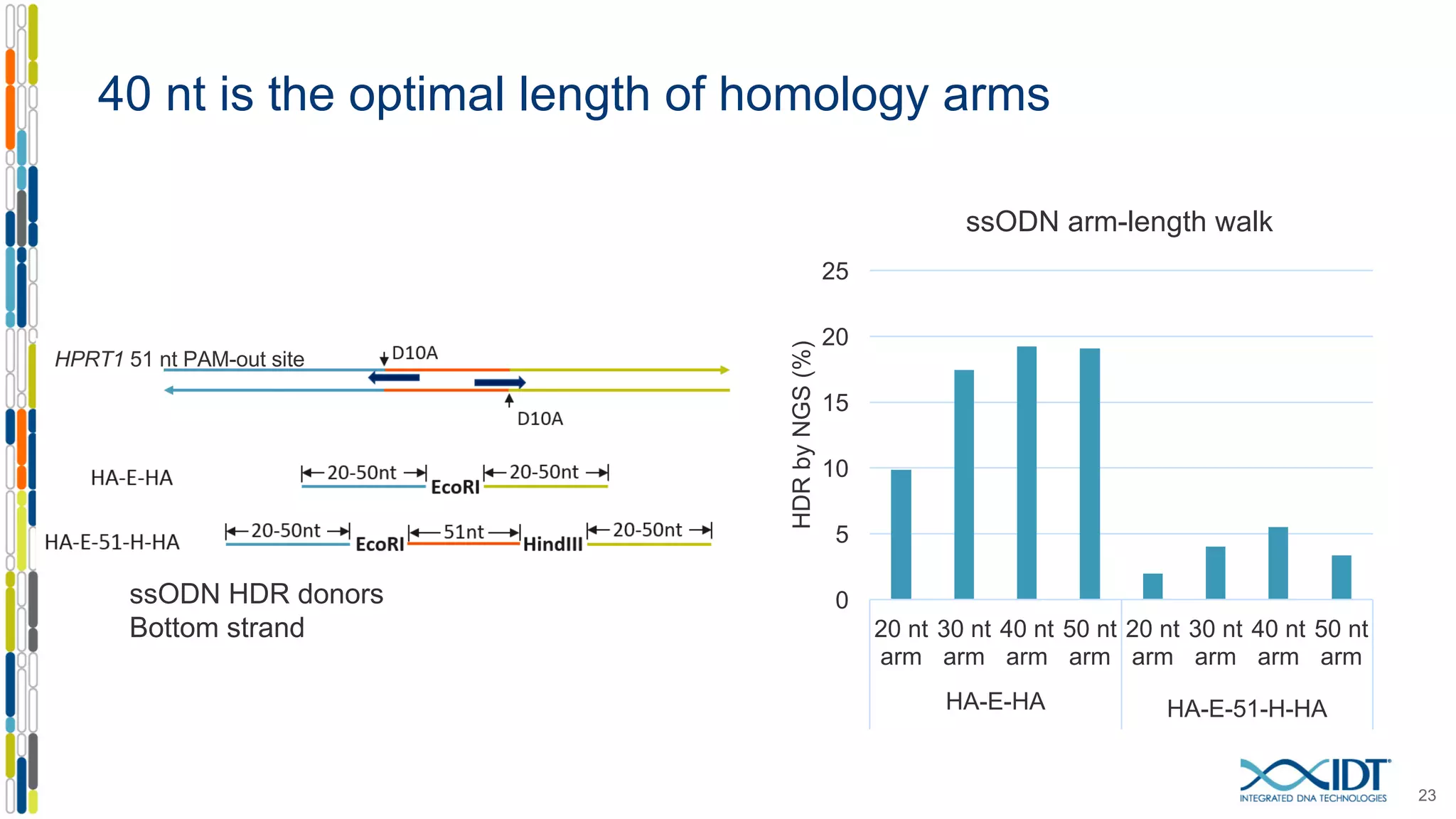
40 nt is the optimal length of homology arms
23
HPRT1 51 nt PAM-out site
0
5
10
15
20
25
20 nt
arm
30 nt
arm
40 nt
arm
50 nt
arm
20 nt
arm
30 nt
arm
40 nt
arm
50 nt
arm
HA-E-HA HA-E-51-H-HA
HDRbyNGS(%)
ssODN arm-length walk
ssODN HDR donors
Bottom strand
Insertion walk away from Cas9 site(s)
24
HPRT1 51 nt PAM-out site
ssODN HDR donors
Top and bottom strands
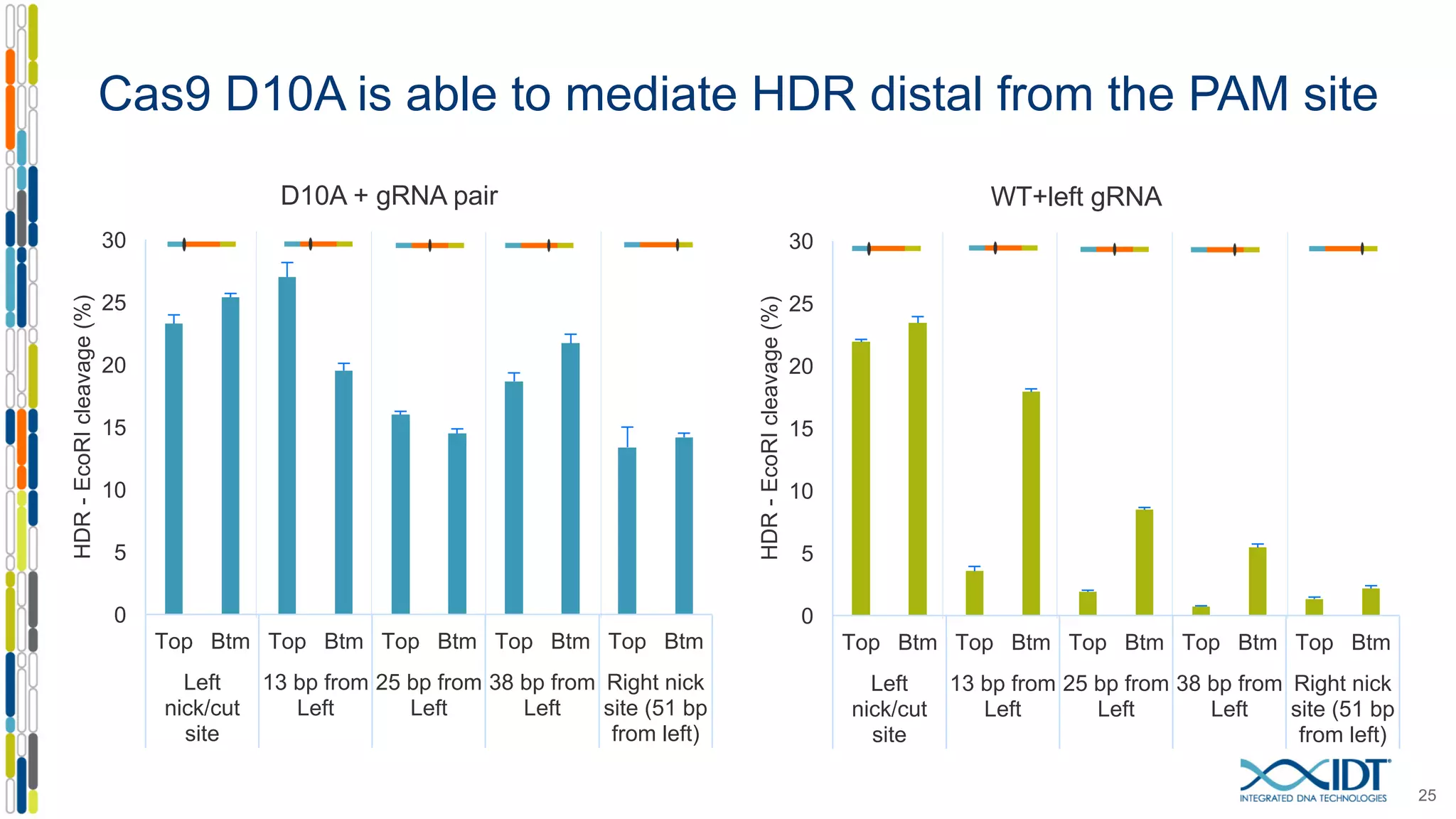
Cas9 D10A is able to mediate HDR distal from the PAM site
25
0
5
10
15
20
25
30
Top Btm Top Btm Top Btm Top Btm Top Btm
Left
nick/cut
site
13 bp from
Left
25 bp from
Left
38 bp from
Left
Right nick
site (51 bp
from left)
HDR-EcoRIcleavage(%)
D10A + gRNA pair
0
5
10
15
20
25
30
Top Btm Top Btm Top Btm Top Btm Top Btm
Left
nick/cut
site
13 bp from
Left
25 bp from
Left
38 bp from
Left
Right nick
site (51 bp
from left)
HDR-EcoRIcleavage(%)
WT+left gRNA
26
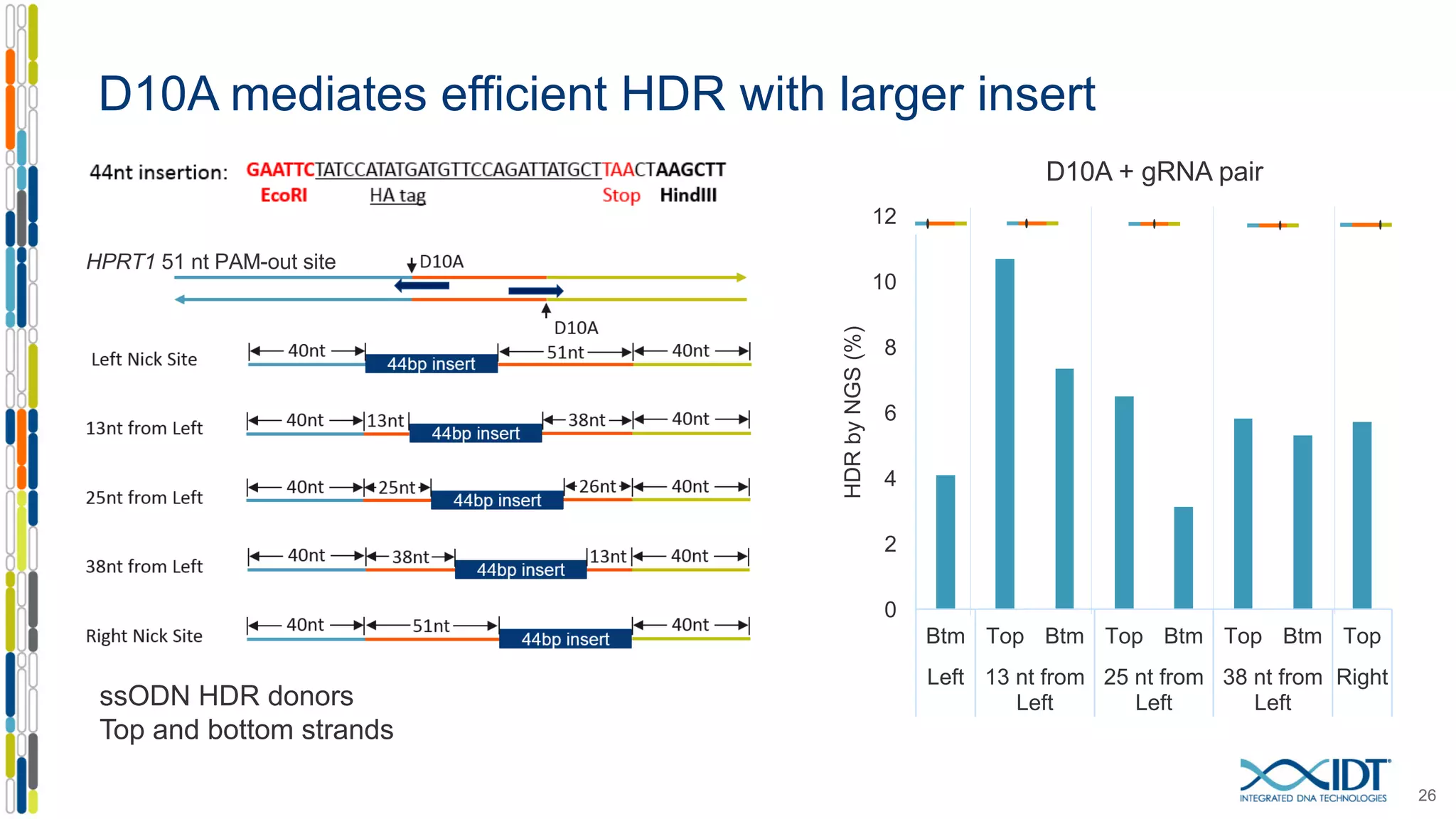
D10A mediates efficient HDR with larger insert
ssODN HDR donors
Top and bottom strands
HPRT1 51 nt PAM-out site
0
2
4
6
8
10
12
Btm Top Btm Top Btm Top Btm Top
Left 13 nt from
Left
25 nt from
Left
38 nt from
Left
Right
HDRbyNGS(%)
D10A + gRNA pair
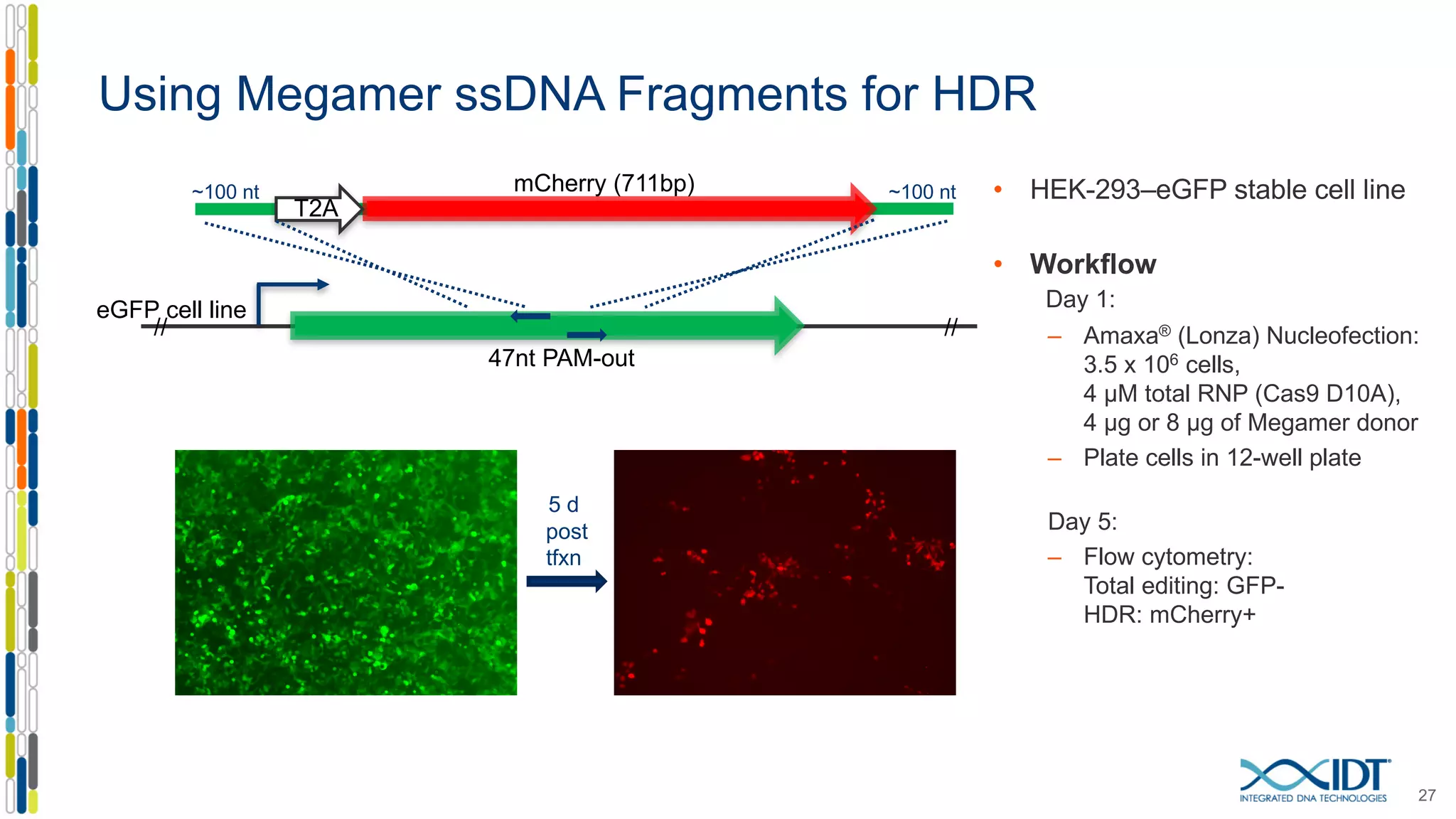
Using Megamer ssDNA Fragments for HDR
27
T2A
////
47nt PAM-out
eGFP cell line
mCherry (711bp)
5 d
post
tfxn
• HEK-293–eGFP stable cell line
• Workflow
Day 1:
– Amaxa® (Lonza) Nucleofection:
3.5 x 10⁶ cells,
4 µM total RNP (Cas9 D10A),
4 µg or 8 µg of Megamer donor
– Plate cells in 12-well plate
Day 5:
– Flow cytometry:
Total editing: GFP-
HDR: mCherry+
~100 nt ~100 nt
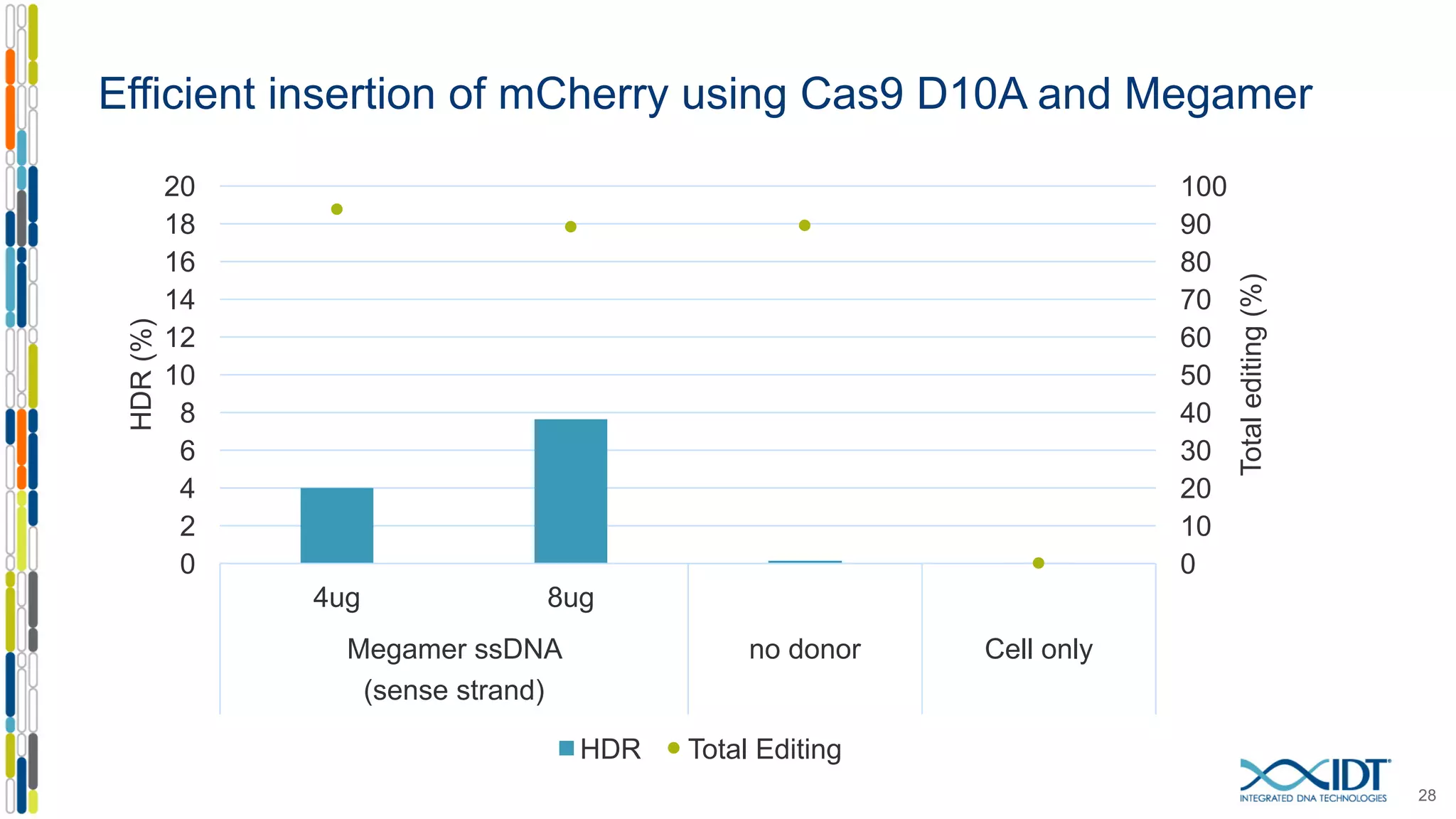
28
0
10
20
30
40
50
60
70
80
90
100
0
2
4
6
8
10
12
14
16
18
20
4ug 8ug
Megamer ssDNA
(sense strand)
no donor Cell only
Totalediting(%)
HDR(%)
HDR Total Editing
Efficient insertion of mCherry using Cas9 D10A and Megamer
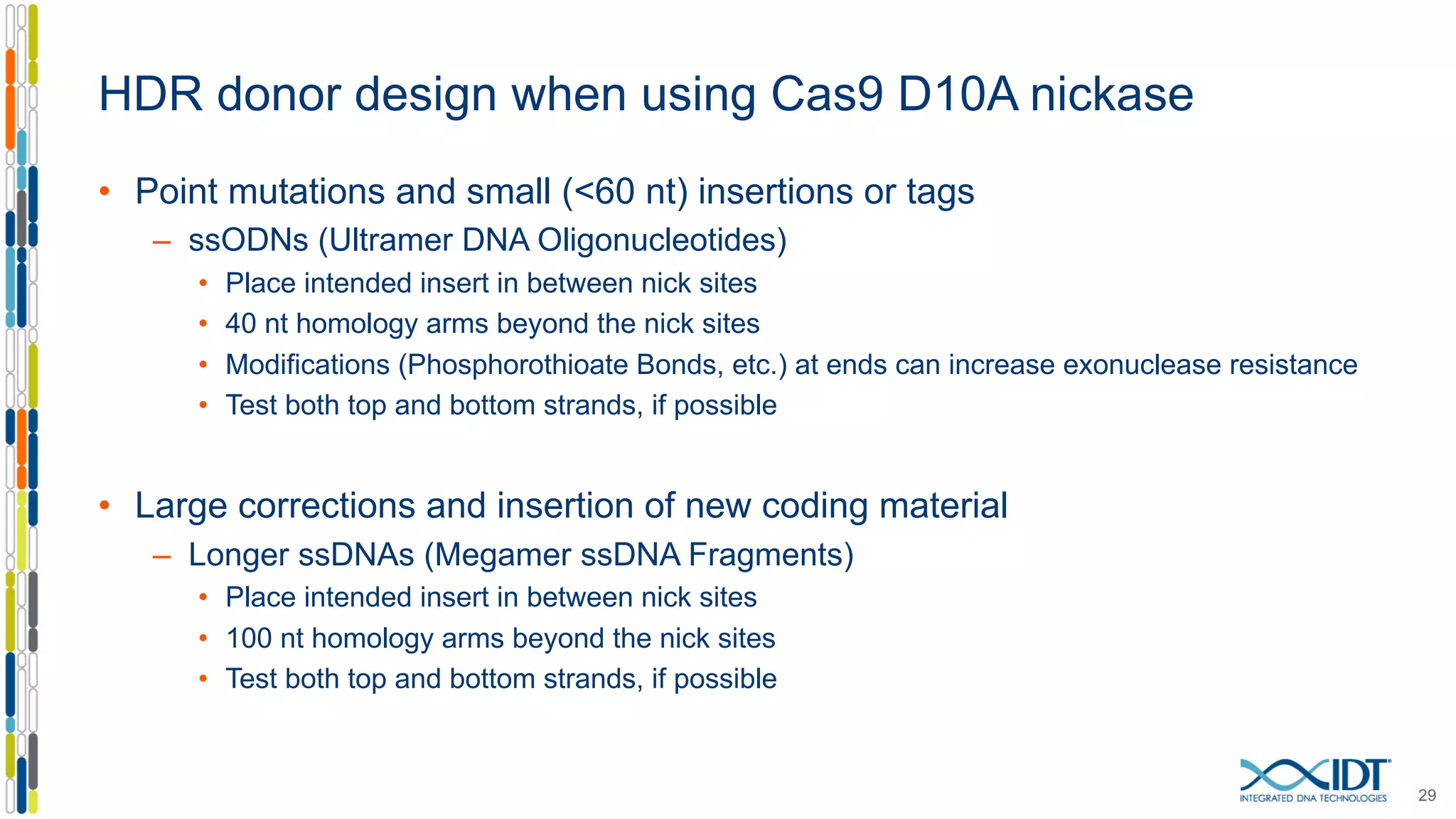
HDR donor design when using Cas9 D10A nickase
• Point mutations and small (<60 nt) insertions or tags
– ssODNs (Ultramer DNA Oligonucleotides)
• Place intended insert in between nick sites
• 40 nt homology arms beyond the nick sites
• Modifications (Phosphorothioate Bonds, etc.) at ends can increase exonuclease resistance
• Test both top and bottom strands, if possible
• Large corrections and insertion of new coding material
– Longer ssDNAs (Megamer ssDNA Fragments)
• Place intended insert in between nick sites
• 100 nt homology arms beyond the nick sites
• Test both top and bottom strands, if possible
29
Outline: Using Alt-R Cas9 nickases for genome editing
• Background: Genome editing using the Alt-R CRISPR-Cas9 system
• Introduction of Alt-R Cas9 D10A and Cas9 H840A Nickases
• Using Cas9 nickases for genome editing
- How to design gRNA pair
- How to design donor template for homology directed repair (HDR)
• Workflow: Doing genome editing with Cas9 nickases
30
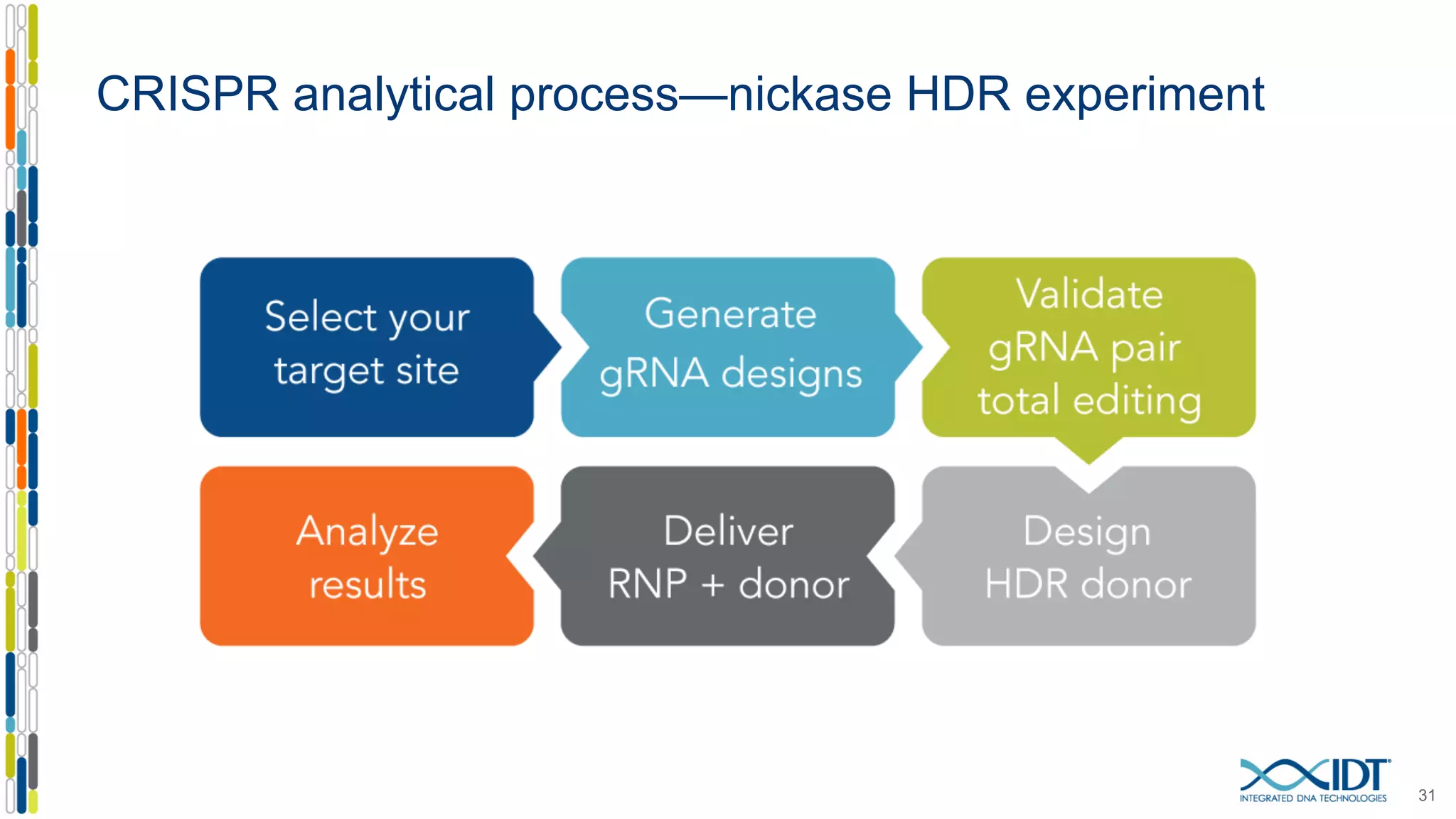
CRISPR analytical process—nickase HDR experiment
31
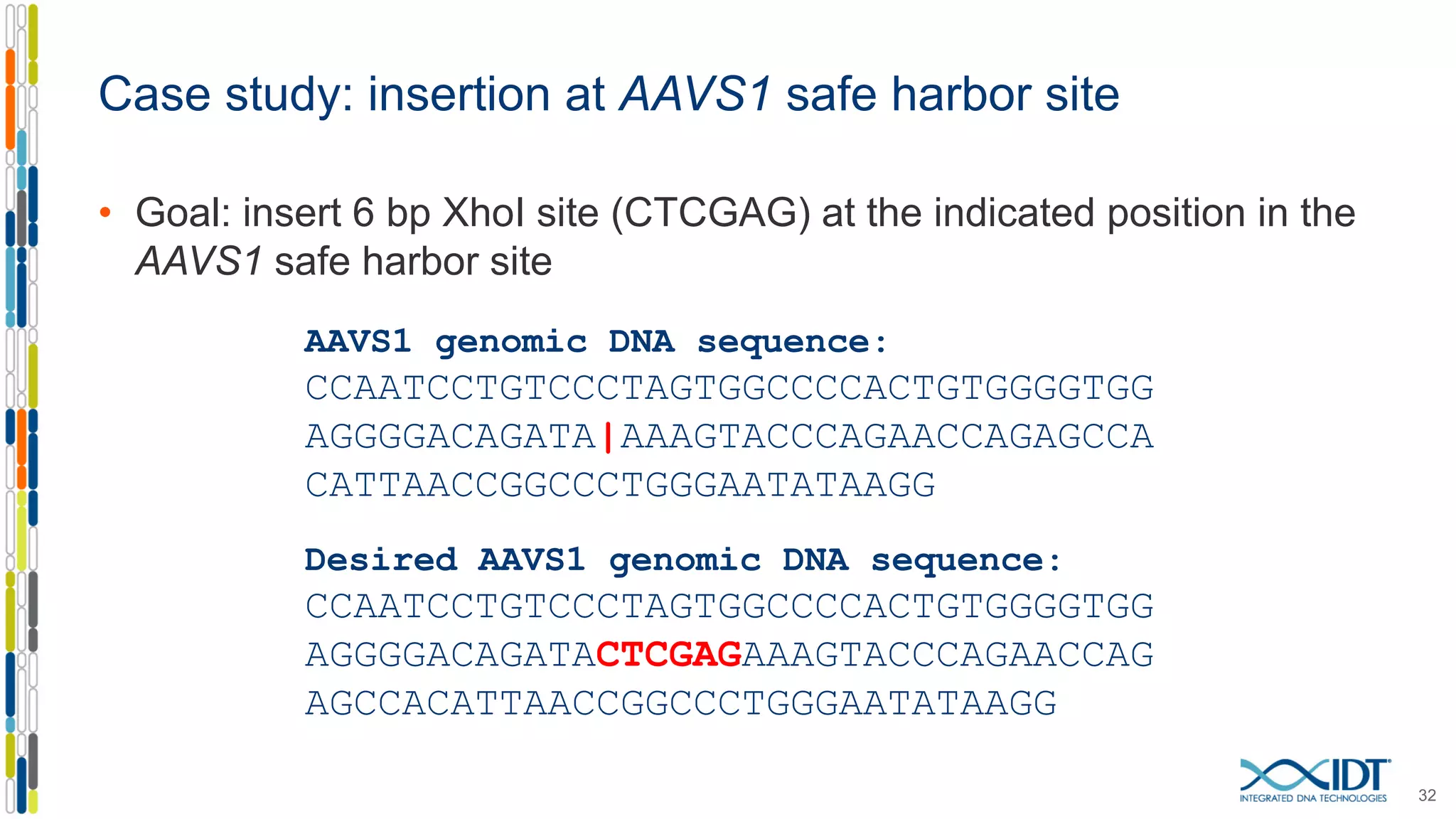
Case study: insertion at AAVS1 safe harbor site
• Goal: insert 6 bp XhoI site (CTCGAG) at the indicated position in the
AAVS1 safe harbor site
32
AAVS1 genomic DNA sequence:
CCAATCCTGTCCCTAGTGGCCCCACTGTGGGGTGG
AGGGGACAGATA|AAAGTACCCAGAACCAGAGCCA
CATTAACCGGCCCTGGGAATATAAGG
Desired AAVS1 genomic DNA sequence:
CCAATCCTGTCCCTAGTGGCCCCACTGTGGGGTGG
AGGGGACAGATACTCGAGAAAGTACCCAGAACCAG
AGCCACATTAACCGGCCCTGGGAATATAAGG
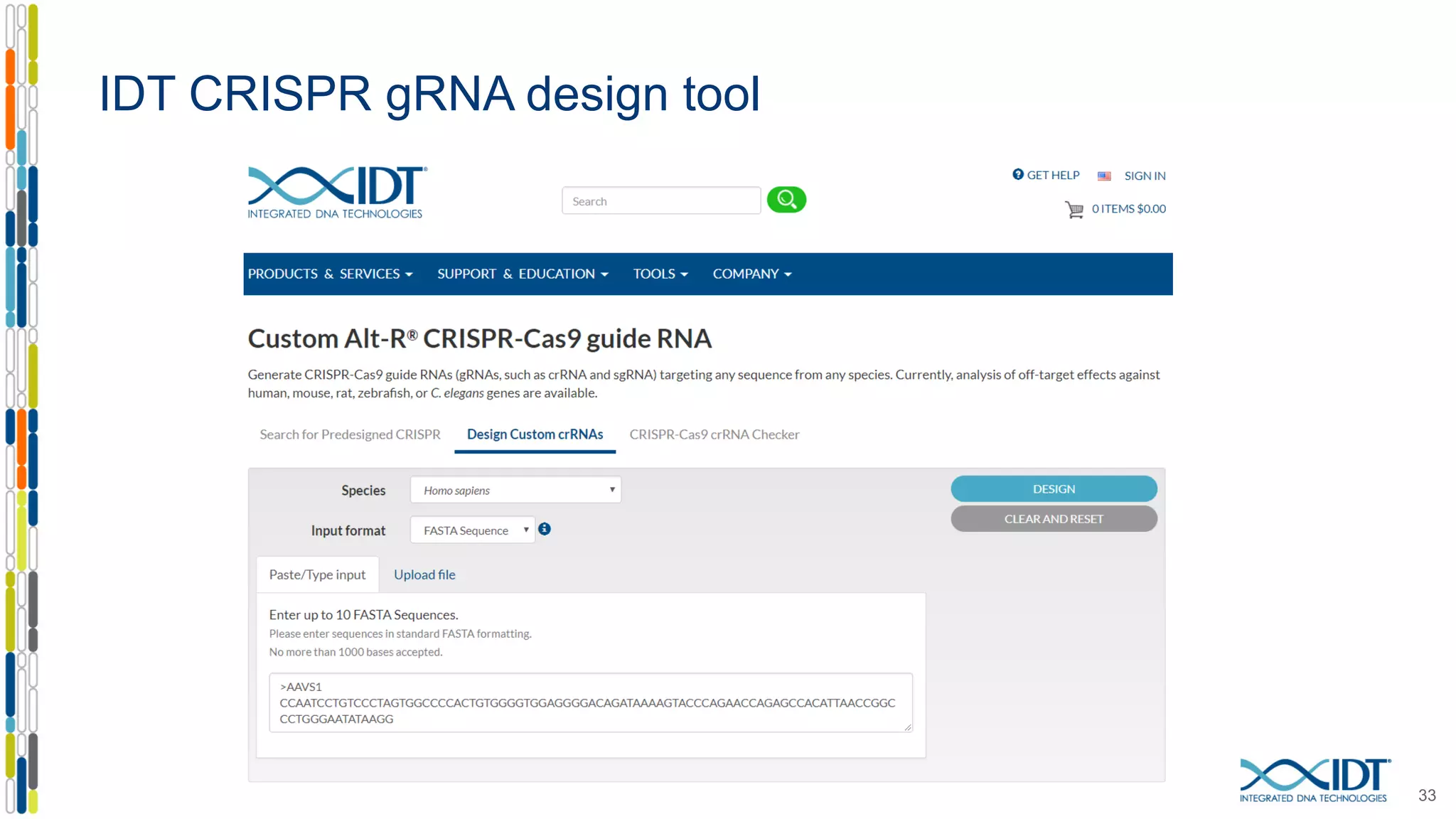
IDT CRISPR gRNA design tool
33
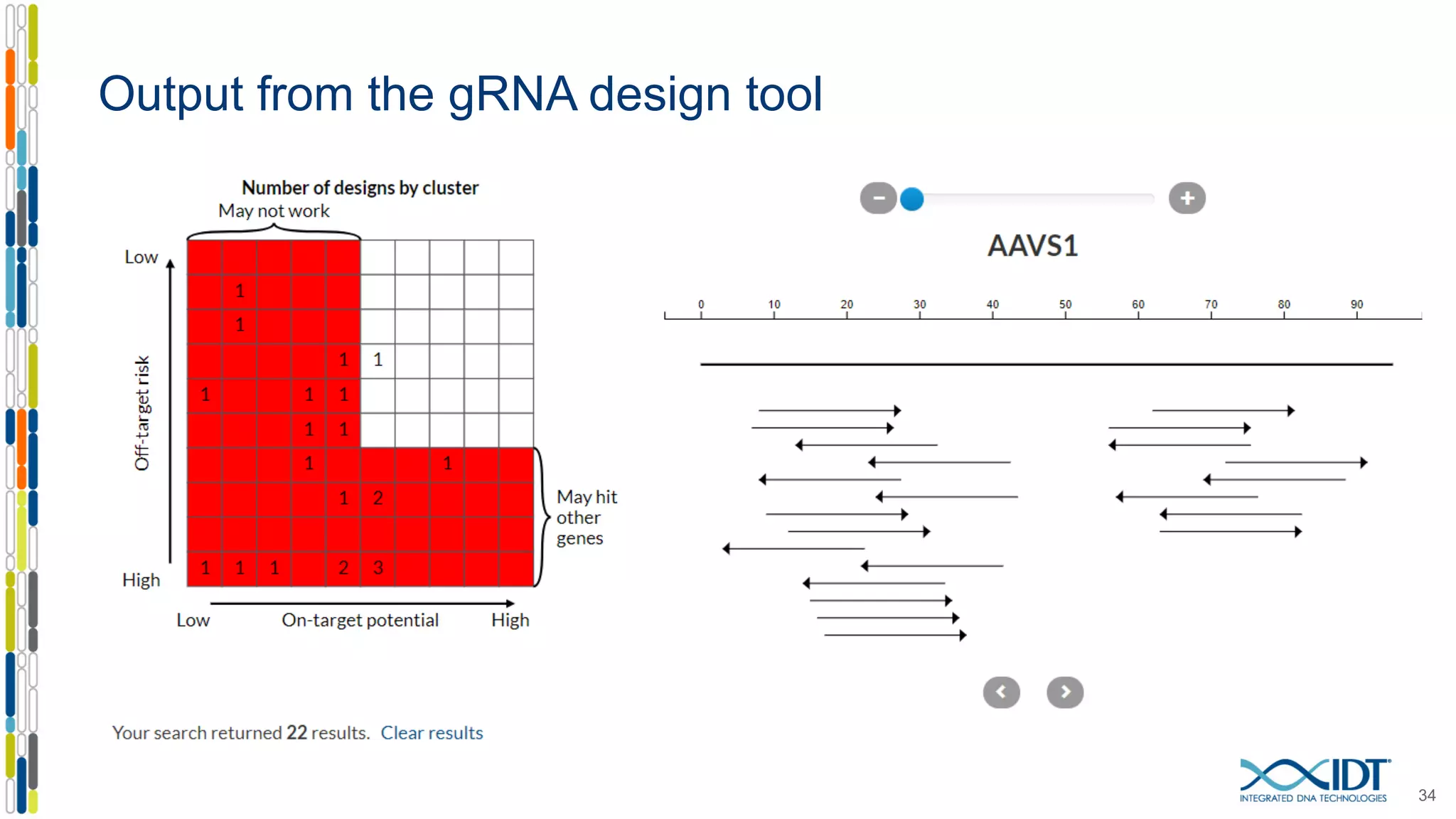
Output from the gRNA design tool
34
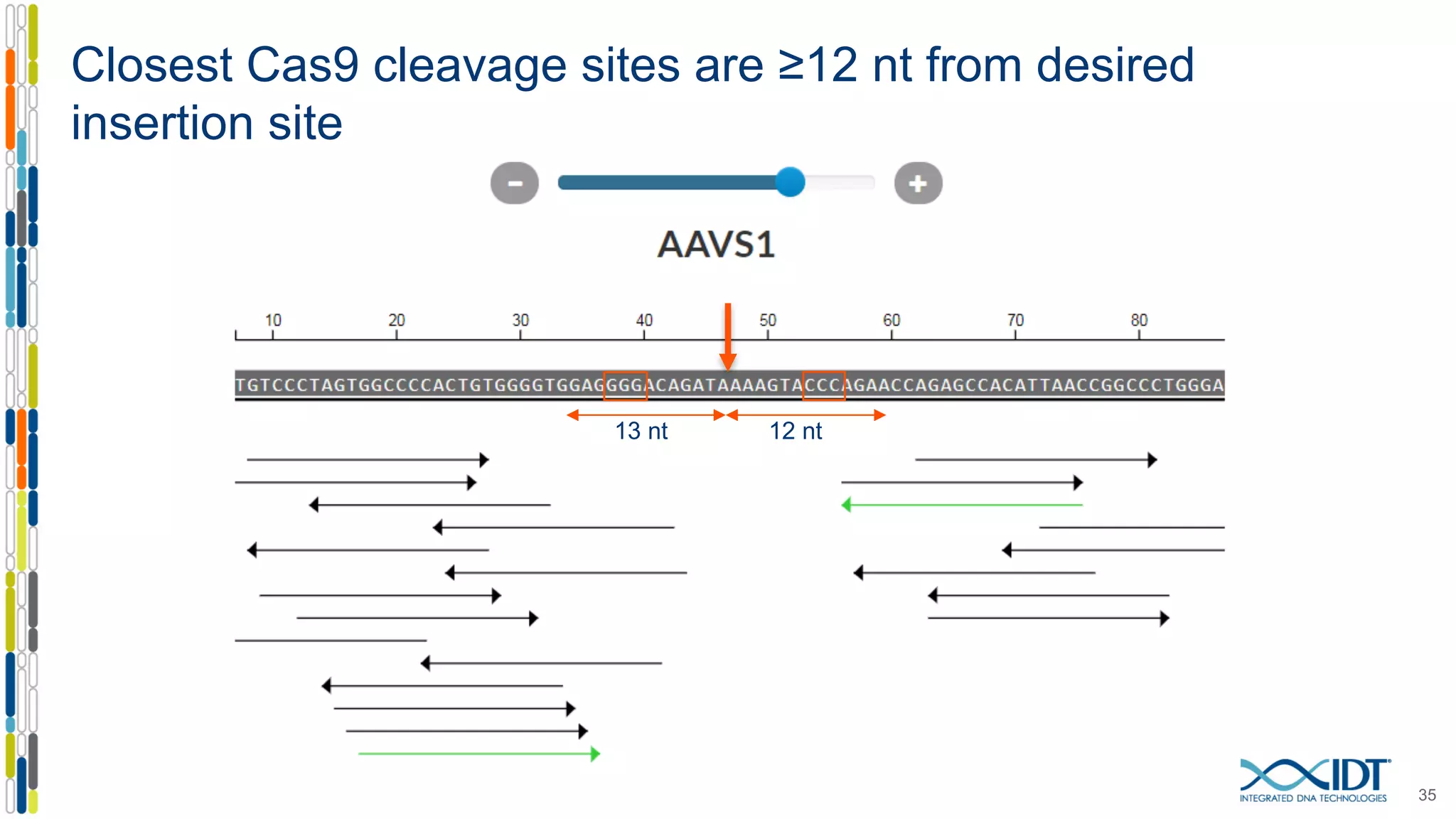
Closest Cas9 cleavage sites are ≥12 nt from desired
insertion site
35
13 nt 12 nt
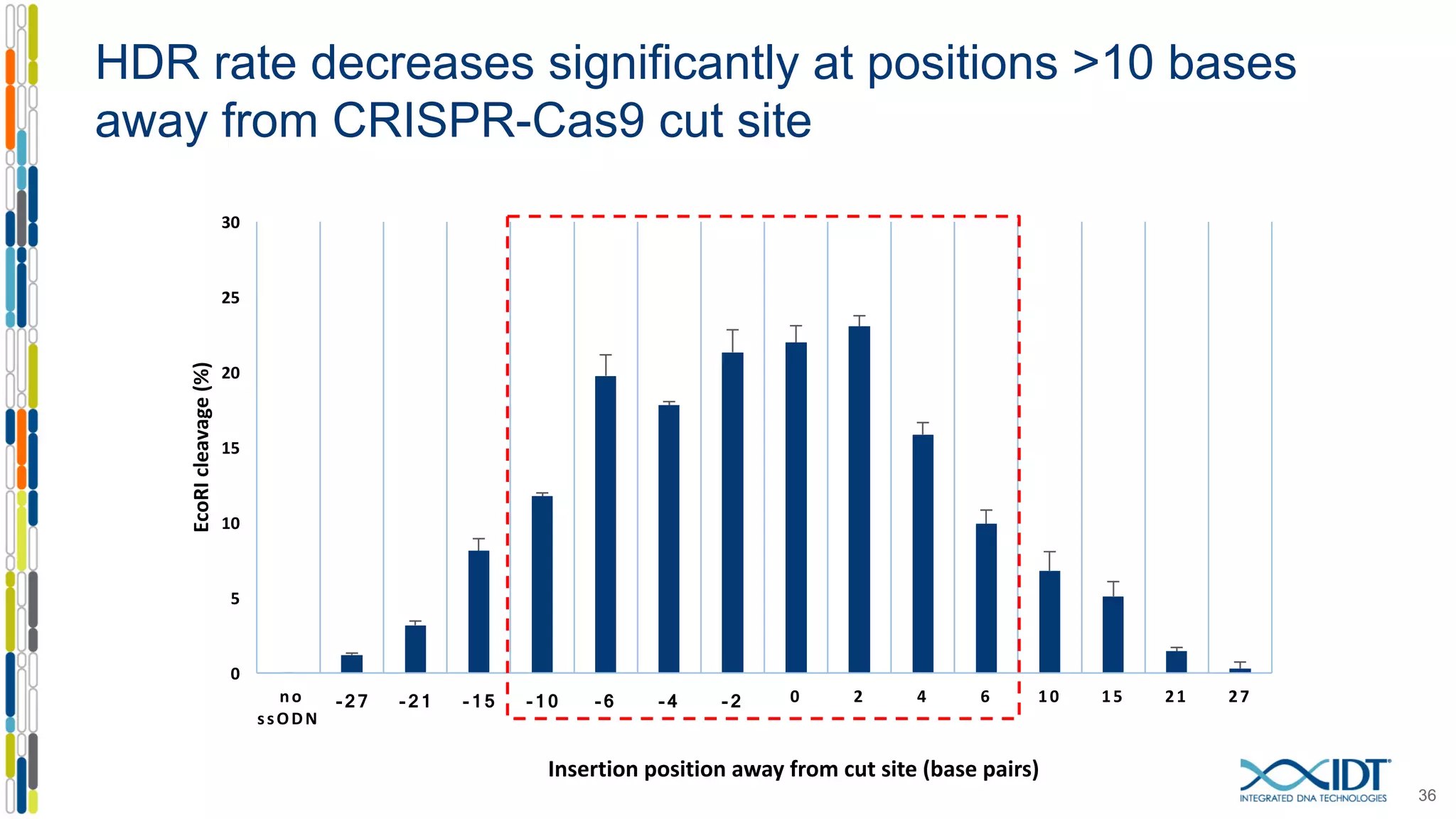
HDR rate decreases significantly at positions >10 bases
away from CRISPR-Cas9 cut site
36
0
5
10
15
20
25
30
no	
ssODN
-27 -21 -15 -10 -6 -4 -2 0 2 4 6 10 15 21 27
EcoRI	cleavage	(%)
Insertion	position	away	from	cut	site	(base	pairs)
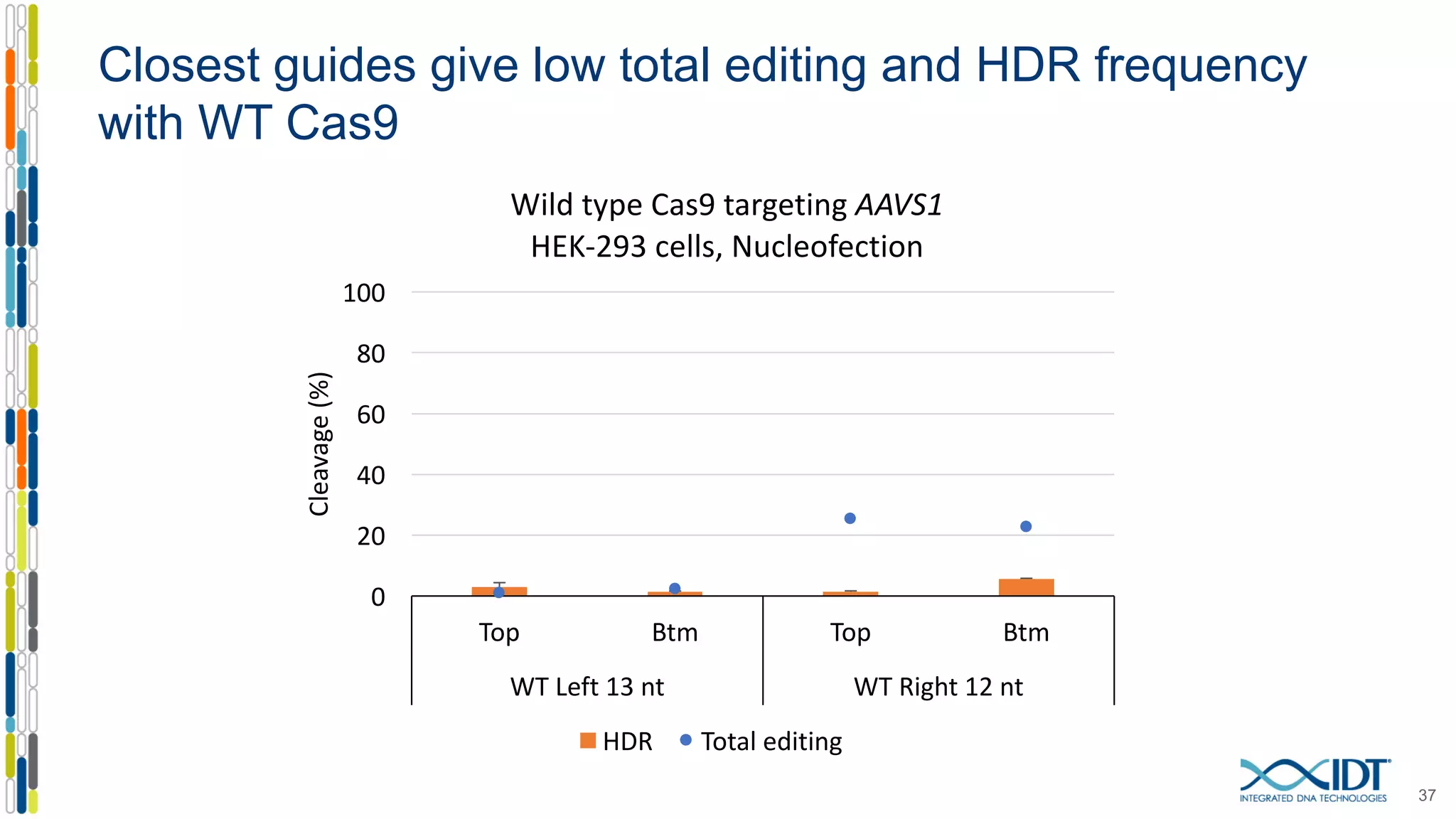
Closest guides give low total editing and HDR frequency
with WT Cas9
0
20
40
60
80
100
Top Btm Top Btm
WT	Left	13	nt WT	Right	12	nt
Cleavage	(%)
Wild	type	Cas9	targeting	AAVS1
HEK-293	cells,	Nucleofection
HDR Total	editing
37
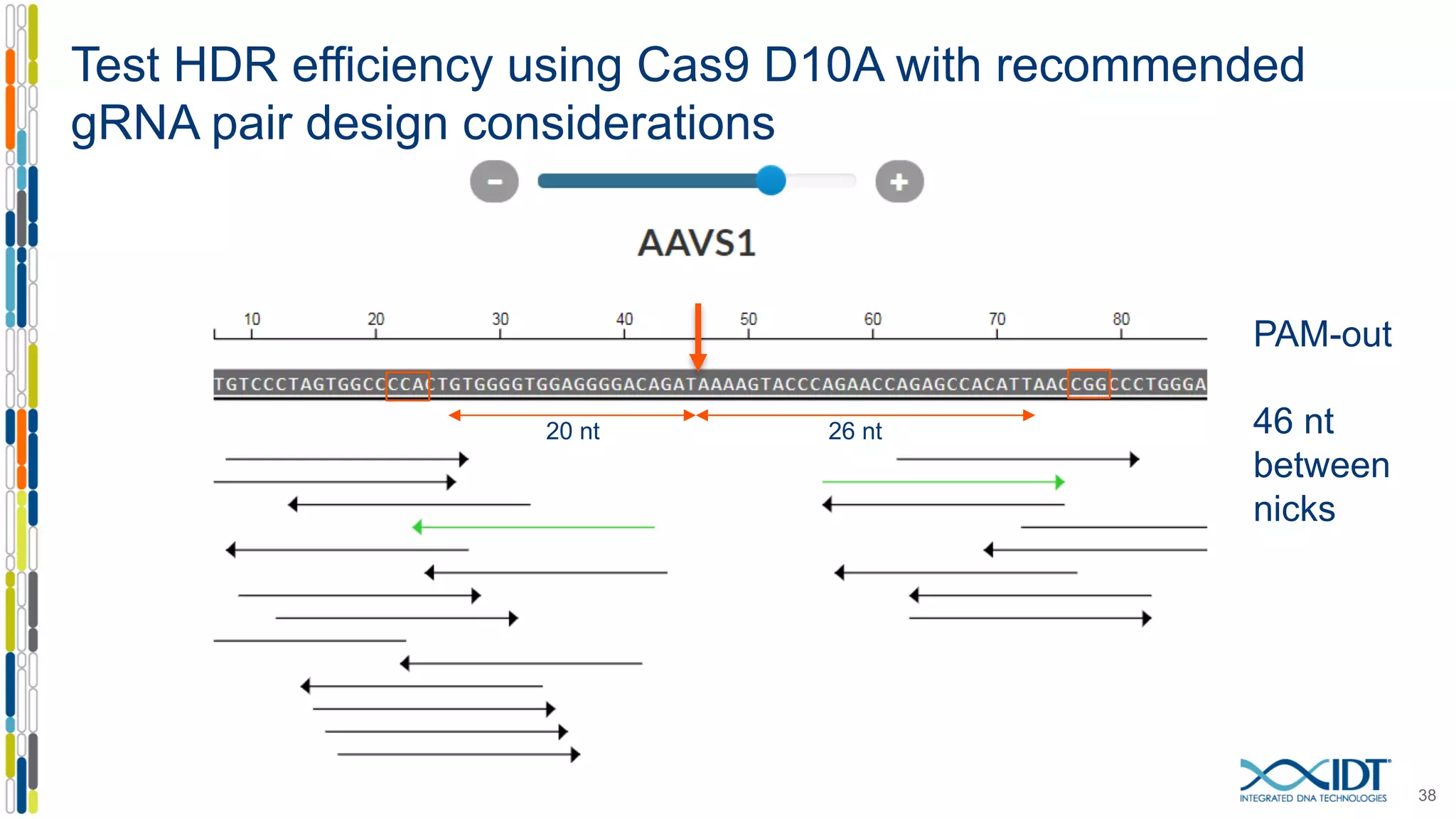
Test HDR efficiency using Cas9 D10A with recommended
gRNA pair design considerations
38
20 nt 26 nt
PAM-out
46 nt
between
nicks
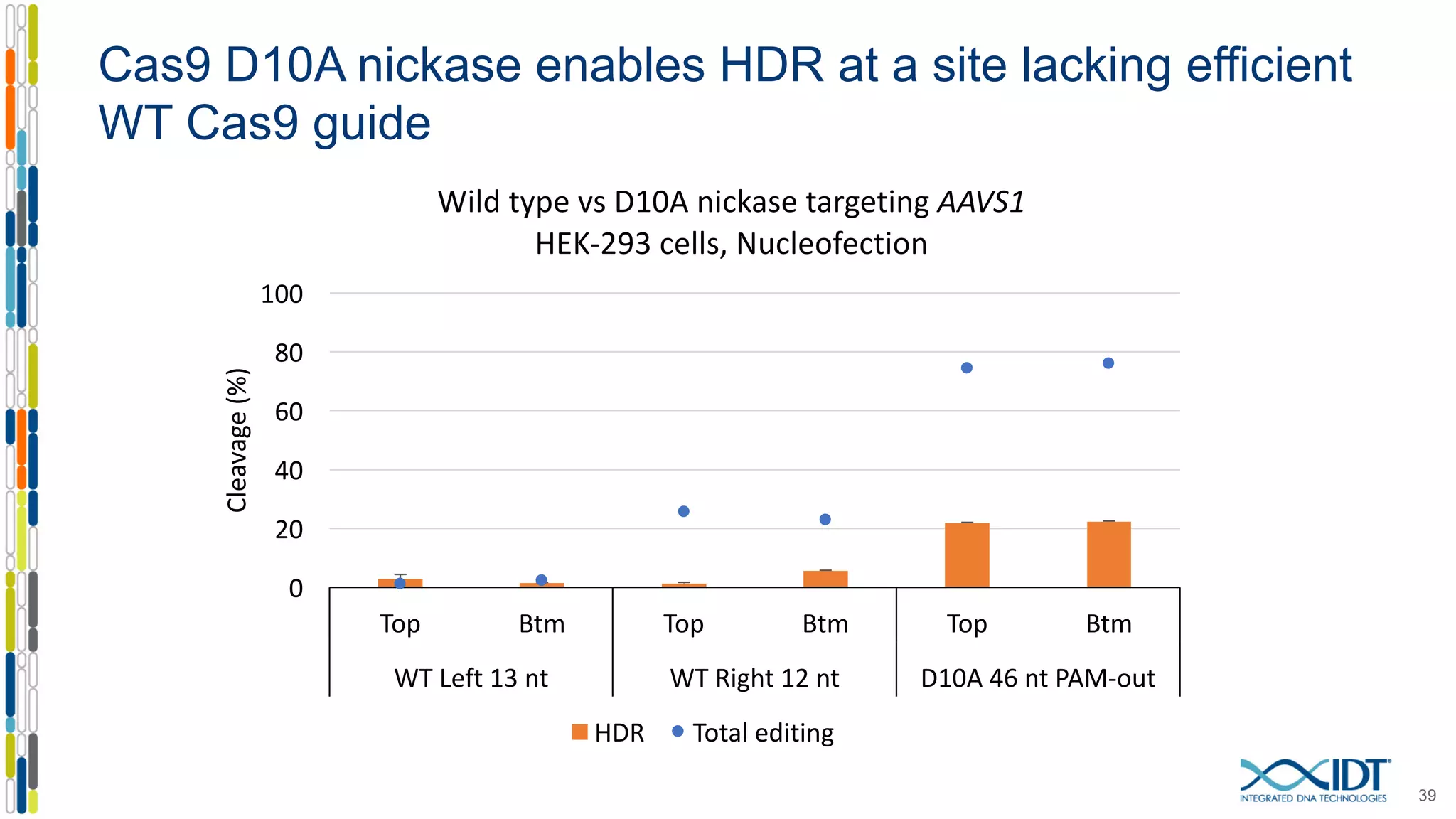
Cas9 D10A nickase enables HDR at a site lacking efficient
WT Cas9 guide
39
0
20
40
60
80
100
Top Btm Top Btm Top Btm
WT	Left	13	nt WT	Right	12	nt D10A	46	nt	PAM-out
Cleavage	(%)
Wild	type	vs	D10A	nickase targeting	AAVS1
HEK-293	cells,	Nucleofection
HDR Total	editing
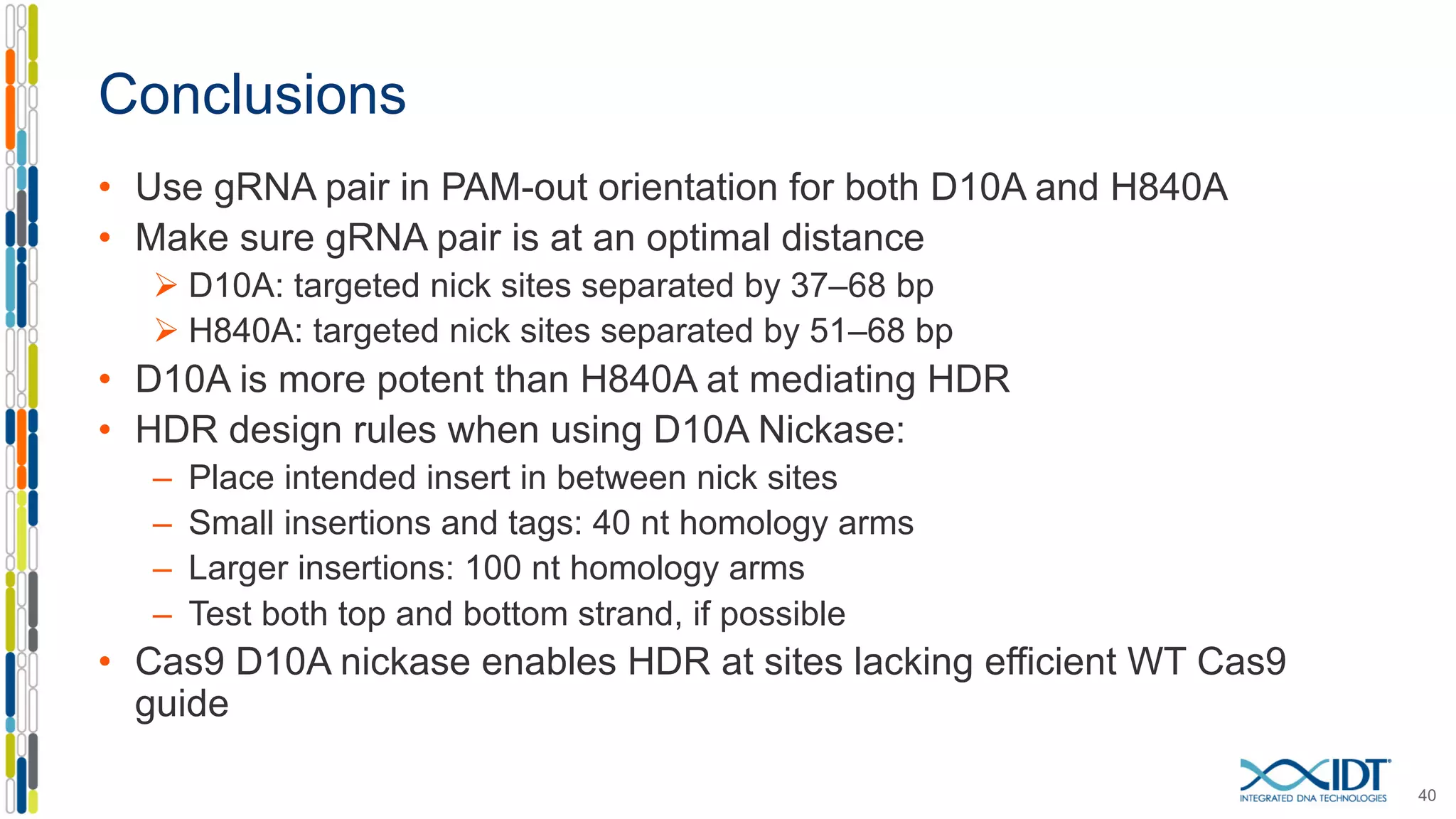
Conclusions
• Use gRNA pair in PAM-out orientation for both D10A and H840A
• Make sure gRNA pair is at an optimal distance
Ø D10A: targeted nick sites separated by 37–68 bp
Ø H840A: targeted nick sites separated by 51–68 bp
• D10A is more potent than H840A at mediating HDR
• HDR design rules when using D10A Nickase:
– Place intended insert in between nick sites
– Small insertions and tags: 40 nt homology arms
– Larger insertions: 100 nt homology arms
– Test both top and bottom strand, if possible
• Cas9 D10A nickase enables HDR at sites lacking efficient WT Cas9
guide
40
THANK YOU
41
Take home messages
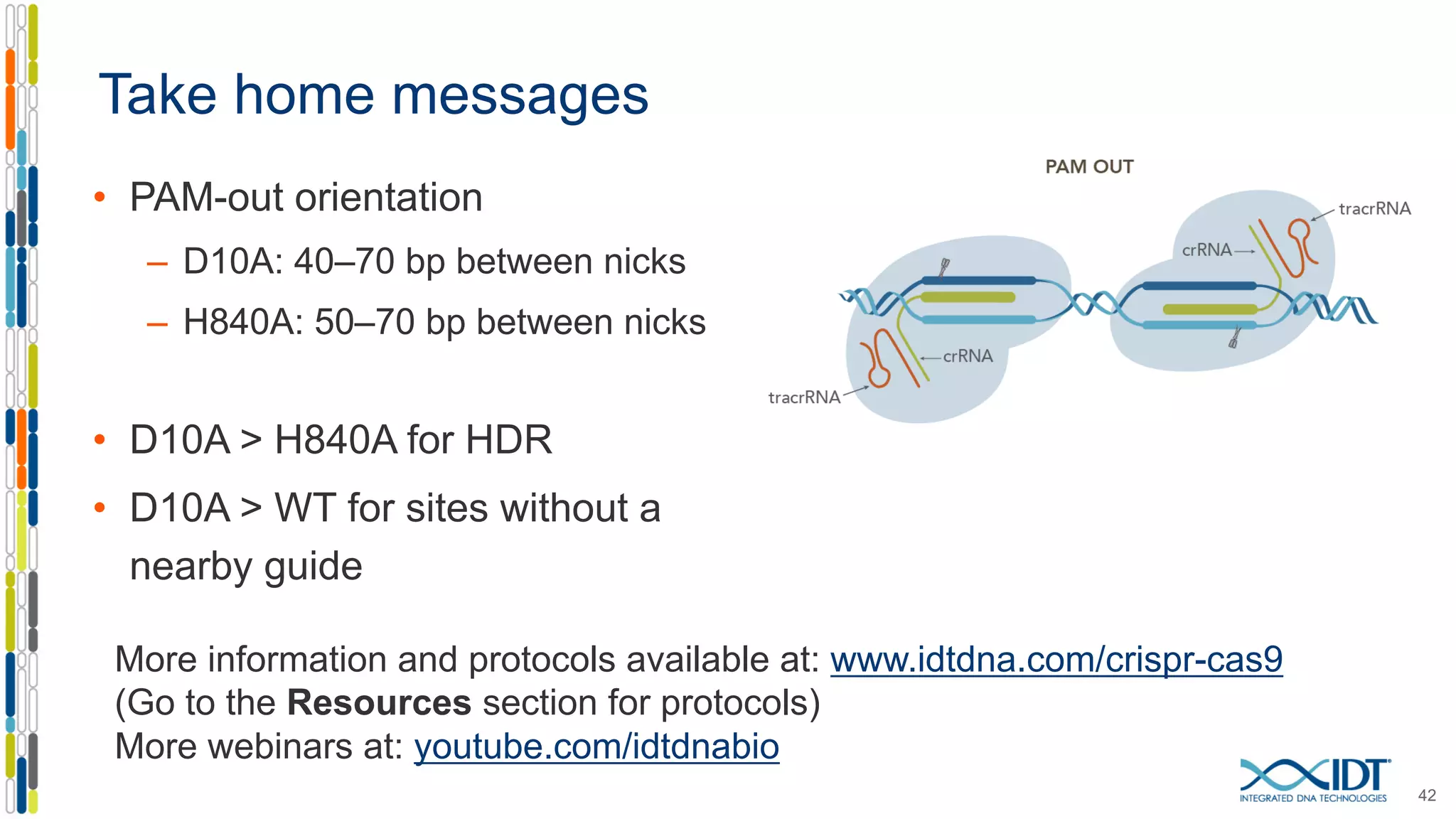
• PAM-out orientation
– D10A: 40–70 bp between nicks
– H840A: 50–70 bp between nicks
• D10A > H840A for HDR
• D10A > WT for sites without a
nearby guide
42
More information and protocols available at: www.idtdna.com/crispr-cas9
(Go to the Resources section for protocols)
More webinars at: youtube.com/idtdnabio

Optimized methods to use Cas9 nickases in genome editing

  • 1.
    Optimized methods touse Cas9 nickases in genome editing Mollie Schubert, MS, Research Scientist Shuqi Yan, MS, Research Scientist 1
  • 2.
    Outline: Using Alt-R®Cas9 nickases for genome editing • Background: Genome editing using the Alt-R CRISPR-Cas9 system • Introduction of Alt-R Cas9 D10A and Cas9 H840A Nickases • Using Cas9 nickases for genome editing - How to design gRNA pair - How to design donor template for homology directed repair (HDR) • Workflow: Doing genome editing with Cas9 nickases 2
  • 3.
    Outline: Using Alt-RCas9 nickases for genome editing • Background: Genome editing using the Alt-R CRISPR-Cas9 system • Introduction of Alt-R Cas9 D10A and Cas9 H840A Nickases • Using Cas9 nickases for genome editing - How to design gRNA pair - How to design donor template for homology directed repair (HDR) • Workflow: Doing genome editing with Cas9 nickases 3
  • 4.
  • 5.
    CRISPR-Cas9 genome editing •RNA-guided endonuclease • 20 nt protospacer • PAM site (NGG) • Native two-part crRNA and tracrRNA, or one-piece sgRNA 5
  • 6.
    CRISPR-Cas9 genome editing •67 nt universal tracrRNA • 36 nt site specific crRNA • Chemically modified to prevent immune stimulation, nuclease degradation 6 Alt-R crRNA:tracrRNA Alt-R sgRNA • 100 nt site specific sgRNA • Chemically modified to prevent immune stimulation, nuclease degradation
  • 7.
    Alt-R CRISPR-Cas9 RNPSystem 7 + + gRNA complex formation RNP complex formation RNP delivery Step 1 Step 2 Step 3 15 minutes 10 minutes 30–60 minutes 1:1 1:1 Lipofection: 10 nM Electroporation: 1–3 µM Microinjection Cas9
  • 8.
    8 IDT and collaboratorprotocols available online www.idtdna.com/crispr-cas9
  • 9.
    Outline: Using Alt-RCas9 nickases for genome editing • Background: Genome editing using the Alt-R CRISPR-Cas9 system • Introduction of Alt-R Cas9 D10A and Cas9 H840A Nickases • Using Cas9 nickases for genome editing - How to design gRNA pair - How to design donor template for homology directed repair (HDR) • Workflow: Doing genome editing with Cas9 nickases 9
  • 10.
    Wild type Cas9creates a double-strand break (DSB) 10 Cleaves both strands of target DNAWild type Cas9
  • 11.
    D10A Cas9 nickasecleaves the target strand 11 Cleaves the target strand Cas9 D10A nickase has an inactivated RuvC domain
  • 12.
    H840A Cas9 nickasecleaves the non-target strand 12 Cleaves the non-target strand Cas9 H840A nickase has an inactivated HNH domain
  • 13.
    Combined use ofa Cas9 nickase with a pair of gRNAs creates DSBs with overhangs 13 5’ 3’ 5’ 3’ 5’ overhang 3’ overhang PAM-out PAM-in | | | | | | | | | | | | | | | | | | | | | | | | | | | | | | | | | | | | | | | | | | | | | | | | | | | | | | | | | | | | | | | | | | | | | | | | | | | | | | | |
  • 14.
    Outline: Using Alt-RCas9 nickases for genome editing • Background: Genome editing using the Alt-R CRISPR-Cas9 system • Introduction of Alt-R Cas9 D10A and Cas9 H840A Nickases • Using Cas9 nickases for genome editing - How to design gRNA pair - How to design donor template for homology directed repair (HDR) • Workflow: Doing genome editing with Cas9 nickases 14
  • 15.
    Double nicking witha Cas9 nickase and paired gRNA generates a DSB 15
  • 16.
    Both D10A andH840A prefer PAM-out gRNA pairs 16 0 10 20 30 40 50 60 70 80 90 100 40nt 46nt 51nt 63nt 68nt 85nt 118nt 130nt 18nt 26nt 36nt 59nt 66nt 73nt 97nt PAM-out PAM-in TotaleditingbyT7EI*assay(%) gRNA pairs targeting HPRT1 HEK-293, Lipofection D10A H840A * T7EI — T7 endonuclease I that can be used to detect indel formation (total editing) frequency
  • 17.
    Efficiency drops whenthe gRNAs are too close 17 0 10 20 30 40 50 60 70 80 90 100 7nt 12nt 18nt 23nt 37nt 40nt 60nt 62nt 67nt TotaleditingbyNGS(%) PAM-out Cas9 D10A with gRNA pairs targeting AAVS1 locus HEK-293, Nucleofection
  • 18.
    Indel profiles varybetween D10A and H840A 18 0 1 2 3 4 5 6 7 8 9 10 -100 -50 0 50 100 150 Frequencies(%) Indel size NGS data of H840A (Total editing: 77.1%) Deletion 1.3 % Insertion 75.8 % 0 1 2 3 4 5 6 7 8 9 10 -100 -50 0 50 100 150 Frequencies(%) Indel size NGS data of D10A (Total editing: 96.1%) Deletion 69.5% Insertion 26.6% Target site: HPRT1 51 nt PAM-out No HDR donor, editing evaluated using NGS
  • 19.
    gRNA design recommendationsfor nickases • Use gRNA pair in PAM-out orientation for both D10A and H840A • Make sure gRNA pair is at an optimal distance Ø D10A: targeted nick sites separated by 37–68 bp Ø H840A: targeted nick sites separated by 51–68 bp 19
  • 20.
    Outline: Using Alt-RCas9 nickases for genome editing • Background: Genome editing using the Alt-R CRISPR-Cas9 system • Introduction of Alt-R Cas9 D10A and Cas9 H840A Nickases • Using Cas9 nickases for genome editing - How to design gRNA pair - How to design donor template for homology directed repair (HDR) • Workflow: Doing genome editing with Cas9 nickases 20
  • 21.
    Using nickases forhomology directed repair • D10A vs H840A: which to choose? • HDR donor design Ø Small insertion (ssODN; IDT Ultramer® Oligonucleotides) – What is the optimal homology arm length? – Where to place the insert? Ø Large insertion (long ssDNA; IDT Megamer® ssDNA Fragments) – An example of inserting a ~800 bp fluorescent protein construct 21
  • 22.
    D10A is morepotent than H840A at mediating HDR 22 ssODN HDR donors Top and bottom strands 1 10 100 Top Btm Top Btm Top Btm Top Btm D10A H840A D10A H840A Left Right Cleavage(%) Compare D10A and H840A mediated HDR at left/right nick site EcoRI T7EI HPRT1 51 nt PAM-out site
  • 23.
    40 nt isthe optimal length of homology arms 23 HPRT1 51 nt PAM-out site 0 5 10 15 20 25 20 nt arm 30 nt arm 40 nt arm 50 nt arm 20 nt arm 30 nt arm 40 nt arm 50 nt arm HA-E-HA HA-E-51-H-HA HDRbyNGS(%) ssODN arm-length walk ssODN HDR donors Bottom strand
  • 24.
    Insertion walk awayfrom Cas9 site(s) 24 HPRT1 51 nt PAM-out site ssODN HDR donors Top and bottom strands
  • 25.
    Cas9 D10A isable to mediate HDR distal from the PAM site 25 0 5 10 15 20 25 30 Top Btm Top Btm Top Btm Top Btm Top Btm Left nick/cut site 13 bp from Left 25 bp from Left 38 bp from Left Right nick site (51 bp from left) HDR-EcoRIcleavage(%) D10A + gRNA pair 0 5 10 15 20 25 30 Top Btm Top Btm Top Btm Top Btm Top Btm Left nick/cut site 13 bp from Left 25 bp from Left 38 bp from Left Right nick site (51 bp from left) HDR-EcoRIcleavage(%) WT+left gRNA
  • 26.
    26 D10A mediates efficientHDR with larger insert ssODN HDR donors Top and bottom strands HPRT1 51 nt PAM-out site 0 2 4 6 8 10 12 Btm Top Btm Top Btm Top Btm Top Left 13 nt from Left 25 nt from Left 38 nt from Left Right HDRbyNGS(%) D10A + gRNA pair
  • 27.
    Using Megamer ssDNAFragments for HDR 27 T2A //// 47nt PAM-out eGFP cell line mCherry (711bp) 5 d post tfxn • HEK-293–eGFP stable cell line • Workflow Day 1: – Amaxa® (Lonza) Nucleofection: 3.5 x 10⁶ cells, 4 µM total RNP (Cas9 D10A), 4 µg or 8 µg of Megamer donor – Plate cells in 12-well plate Day 5: – Flow cytometry: Total editing: GFP- HDR: mCherry+ ~100 nt ~100 nt
  • 28.
    28 0 10 20 30 40 50 60 70 80 90 100 0 2 4 6 8 10 12 14 16 18 20 4ug 8ug Megamer ssDNA (sensestrand) no donor Cell only Totalediting(%) HDR(%) HDR Total Editing Efficient insertion of mCherry using Cas9 D10A and Megamer
  • 29.
    HDR donor designwhen using Cas9 D10A nickase • Point mutations and small (<60 nt) insertions or tags – ssODNs (Ultramer DNA Oligonucleotides) • Place intended insert in between nick sites • 40 nt homology arms beyond the nick sites • Modifications (Phosphorothioate Bonds, etc.) at ends can increase exonuclease resistance • Test both top and bottom strands, if possible • Large corrections and insertion of new coding material – Longer ssDNAs (Megamer ssDNA Fragments) • Place intended insert in between nick sites • 100 nt homology arms beyond the nick sites • Test both top and bottom strands, if possible 29
  • 30.
    Outline: Using Alt-RCas9 nickases for genome editing • Background: Genome editing using the Alt-R CRISPR-Cas9 system • Introduction of Alt-R Cas9 D10A and Cas9 H840A Nickases • Using Cas9 nickases for genome editing - How to design gRNA pair - How to design donor template for homology directed repair (HDR) • Workflow: Doing genome editing with Cas9 nickases 30
  • 31.
  • 32.
    Case study: insertionat AAVS1 safe harbor site • Goal: insert 6 bp XhoI site (CTCGAG) at the indicated position in the AAVS1 safe harbor site 32 AAVS1 genomic DNA sequence: CCAATCCTGTCCCTAGTGGCCCCACTGTGGGGTGG AGGGGACAGATA|AAAGTACCCAGAACCAGAGCCA CATTAACCGGCCCTGGGAATATAAGG Desired AAVS1 genomic DNA sequence: CCAATCCTGTCCCTAGTGGCCCCACTGTGGGGTGG AGGGGACAGATACTCGAGAAAGTACCCAGAACCAG AGCCACATTAACCGGCCCTGGGAATATAAGG
  • 33.
    IDT CRISPR gRNAdesign tool 33
  • 34.
    Output from thegRNA design tool 34
  • 35.
    Closest Cas9 cleavagesites are ≥12 nt from desired insertion site 35 13 nt 12 nt
  • 36.
    HDR rate decreasessignificantly at positions >10 bases away from CRISPR-Cas9 cut site 36 0 5 10 15 20 25 30 no ssODN -27 -21 -15 -10 -6 -4 -2 0 2 4 6 10 15 21 27 EcoRI cleavage (%) Insertion position away from cut site (base pairs)
  • 37.
    Closest guides givelow total editing and HDR frequency with WT Cas9 0 20 40 60 80 100 Top Btm Top Btm WT Left 13 nt WT Right 12 nt Cleavage (%) Wild type Cas9 targeting AAVS1 HEK-293 cells, Nucleofection HDR Total editing 37
  • 38.
    Test HDR efficiencyusing Cas9 D10A with recommended gRNA pair design considerations 38 20 nt 26 nt PAM-out 46 nt between nicks
  • 39.
    Cas9 D10A nickaseenables HDR at a site lacking efficient WT Cas9 guide 39 0 20 40 60 80 100 Top Btm Top Btm Top Btm WT Left 13 nt WT Right 12 nt D10A 46 nt PAM-out Cleavage (%) Wild type vs D10A nickase targeting AAVS1 HEK-293 cells, Nucleofection HDR Total editing
  • 40.
    Conclusions • Use gRNApair in PAM-out orientation for both D10A and H840A • Make sure gRNA pair is at an optimal distance Ø D10A: targeted nick sites separated by 37–68 bp Ø H840A: targeted nick sites separated by 51–68 bp • D10A is more potent than H840A at mediating HDR • HDR design rules when using D10A Nickase: – Place intended insert in between nick sites – Small insertions and tags: 40 nt homology arms – Larger insertions: 100 nt homology arms – Test both top and bottom strand, if possible • Cas9 D10A nickase enables HDR at sites lacking efficient WT Cas9 guide 40
  • 41.
  • 42.
    Take home messages •PAM-out orientation – D10A: 40–70 bp between nicks – H840A: 50–70 bp between nicks • D10A > H840A for HDR • D10A > WT for sites without a nearby guide 42 More information and protocols available at: www.idtdna.com/crispr-cas9 (Go to the Resources section for protocols) More webinars at: youtube.com/idtdnabio