SNP genotyping on qPCR platforms:
Troubleshooting for amplification and cluster separation
Daniel Tsang, Research Scientist
1
• Background: Genotyping by qPCR
• Introduction of rhAmp™ SNP Genotyping System
• Common genotyping failure modes and solutions
– Benefits of IDT rhAmp SNP Genotyping System
2
Outline: SNP genotyping on qPCR platforms
• Background: Genotyping by qPCR
• Introduction of rhAmp SNP Genotyping System
• Common genotyping failure modes and solutions
– Benefits of IDT rhAmp SNP Genotyping System
3
Outline: SNP genotyping on qPCR platforms
Introduction to genotyping by qPCR
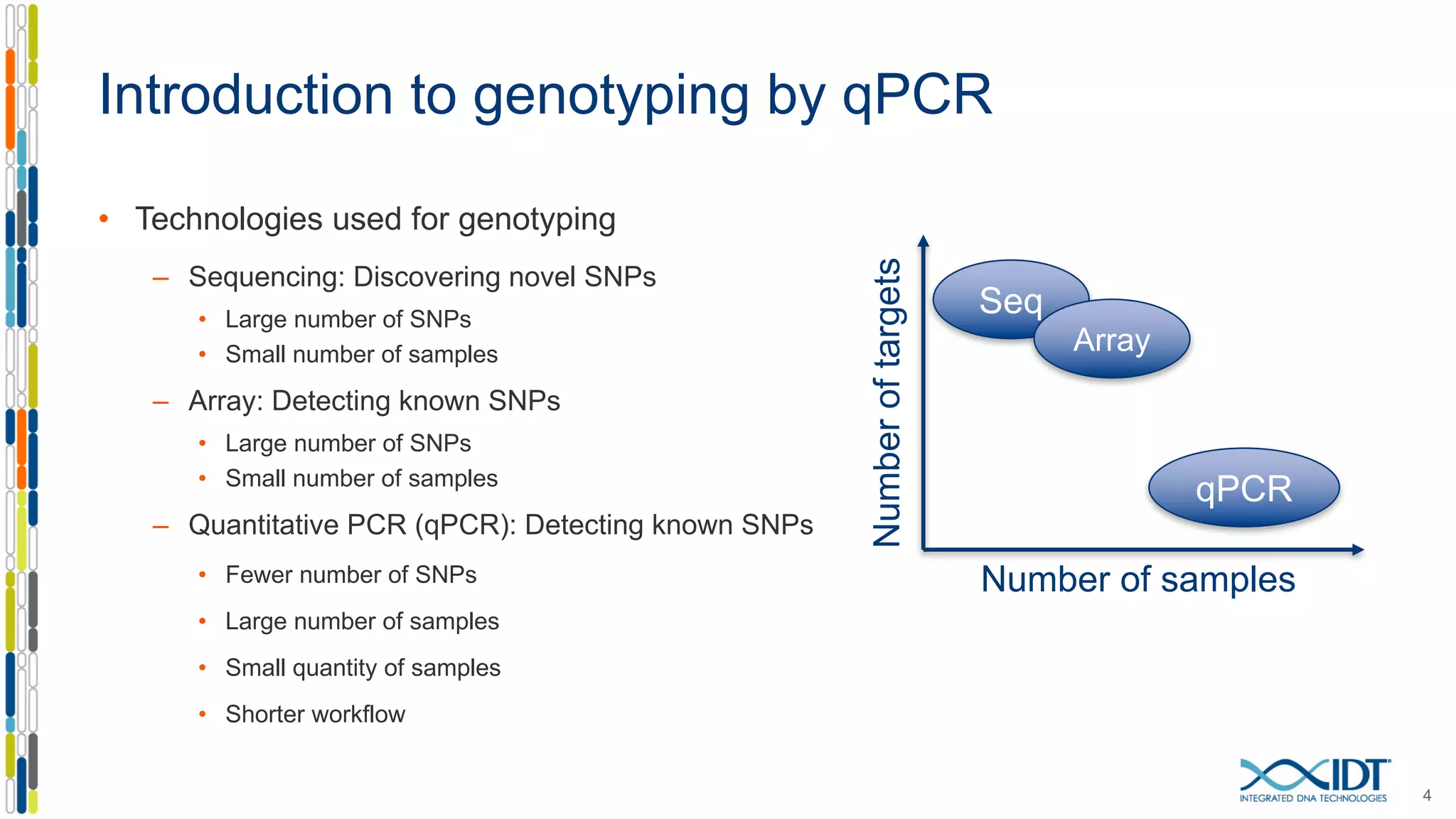
• Technologies used for genotyping
– Sequencing: Discovering novel SNPs
• Large number of SNPs
• Small number of samples
– Array: Detecting known SNPs
• Large number of SNPs
• Small number of samples
– Quantitative PCR (qPCR): Detecting known SNPs
• Fewer number of SNPs
• Large number of samples
• Small quantity of samples
• Shorter workflow
4
Number of samples
Numberoftargets
Seq
Array
qPCR
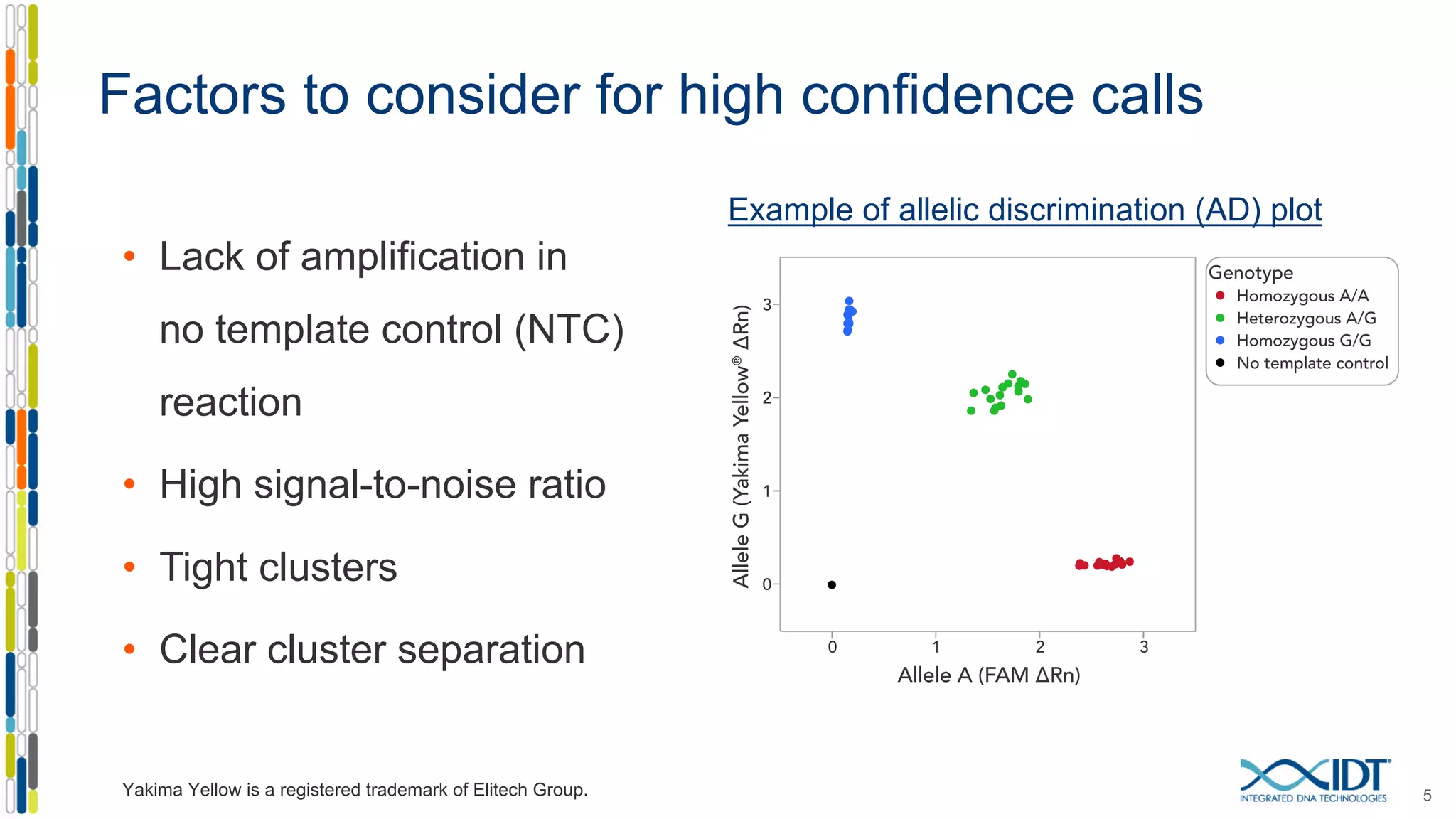
Factors to consider for high confidence calls
• Lack of amplification in
no template control (NTC)
reaction
• High signal-to-noise ratio
• Tight clusters
• Clear cluster separation
5
Example of allelic discrimination (AD) plot
Yakima Yellow is a registered trademark of Elitech Group.
• Background: Genotyping by qPCR
• Introduction of rhAmp SNP Genotyping System
• Common genotyping failure modes and solutions
– Benefits of IDT rhAmp SNP Genotyping System
6
Outline: SNP genotyping on qPCR platforms
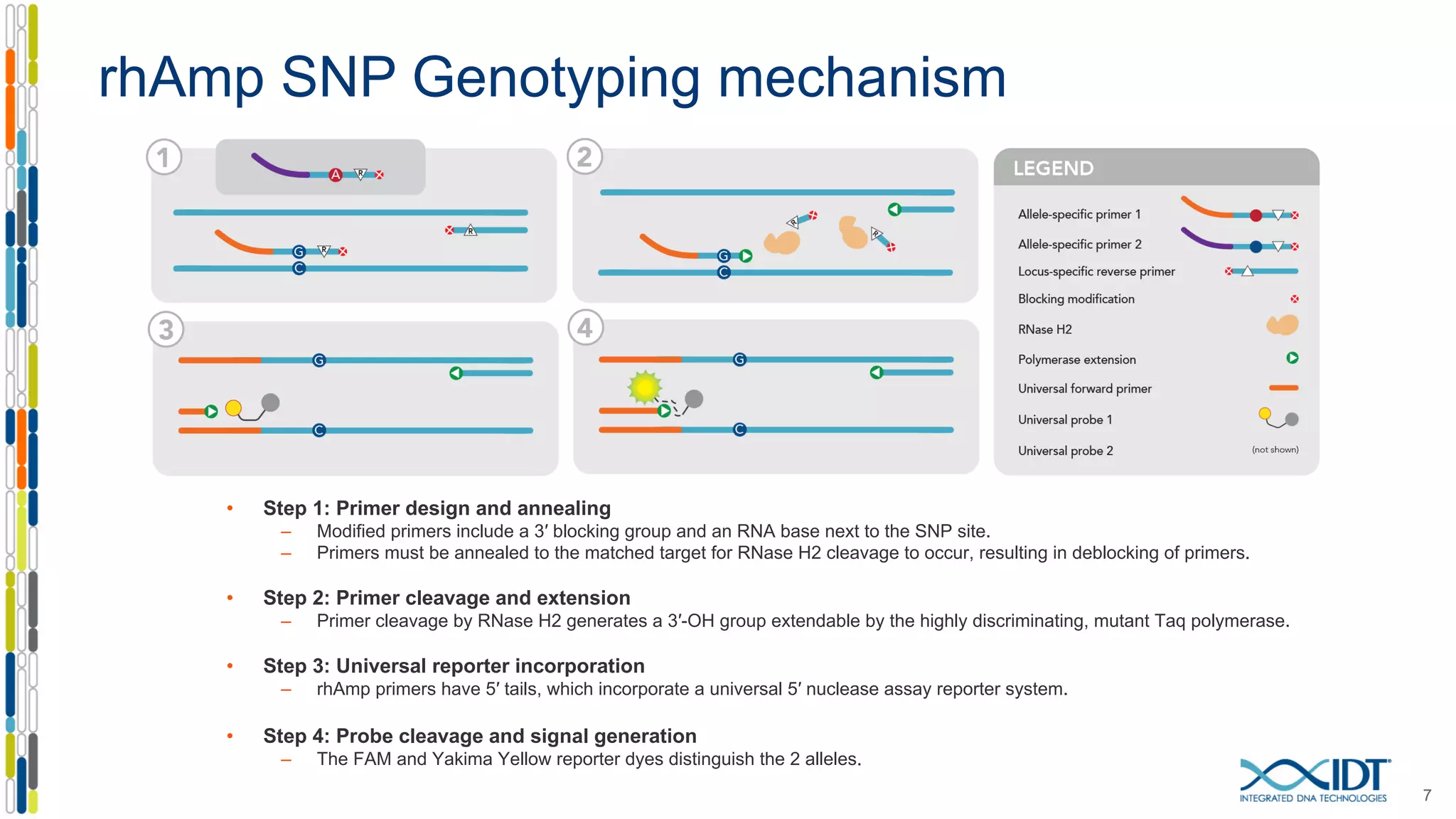
rhAmp SNP Genotyping mechanism
• Step 1: Primer design and annealing
– Modified primers include a 3′ blocking group and an RNA base next to the SNP site.
– Primers must be annealed to the matched target for RNase H2 cleavage to occur, resulting in deblocking of primers.
• Step 2: Primer cleavage and extension
– Primer cleavage by RNase H2 generates a 3′-OH group extendable by the highly discriminating, mutant Taq polymerase.
• Step 3: Universal reporter incorporation
– rhAmp primers have 5′ tails, which incorporate a universal 5′ nuclease assay reporter system.
• Step 4: Probe cleavage and signal generation
– The FAM and Yakima Yellow reporter dyes distinguish the 2 alleles.
7
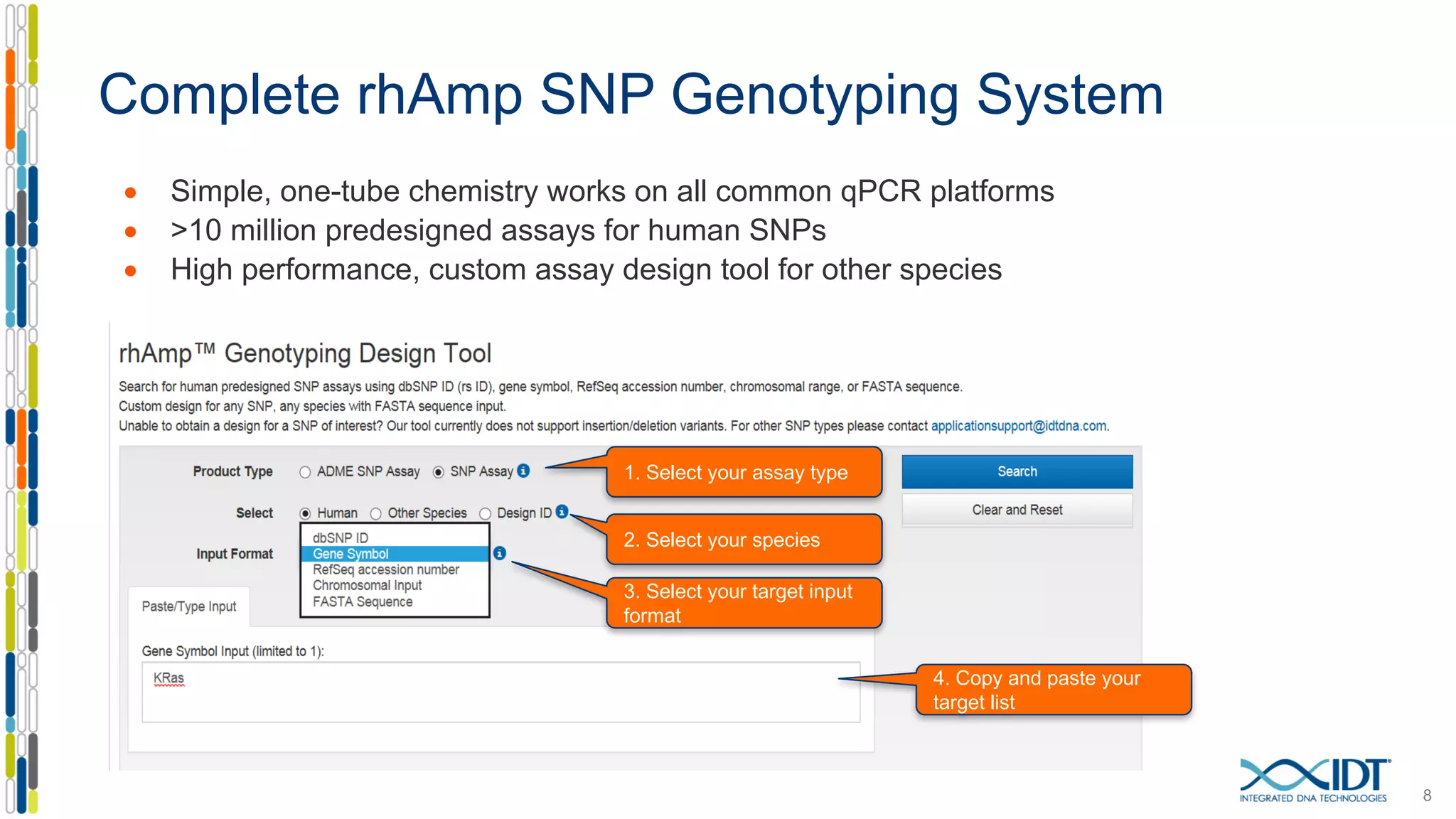
Complete rhAmp SNP Genotyping System
• Simple, one-tube chemistry works on all common qPCR platforms
• >10 million predesigned assays for human SNPs
• High performance, custom assay design tool for other species
8
1. Select your assay type
2. Select your species
3. Select your target input
format
4. Copy and paste your
target list
• Background: Genotyping by qPCR
• Introduction of rhAmp SNP Genotyping System
• Common genotyping failure modes and solutions
– Benefits of IDT rhAmp SNP Genotyping System
9
Outline: SNP genotyping on qPCR platforms
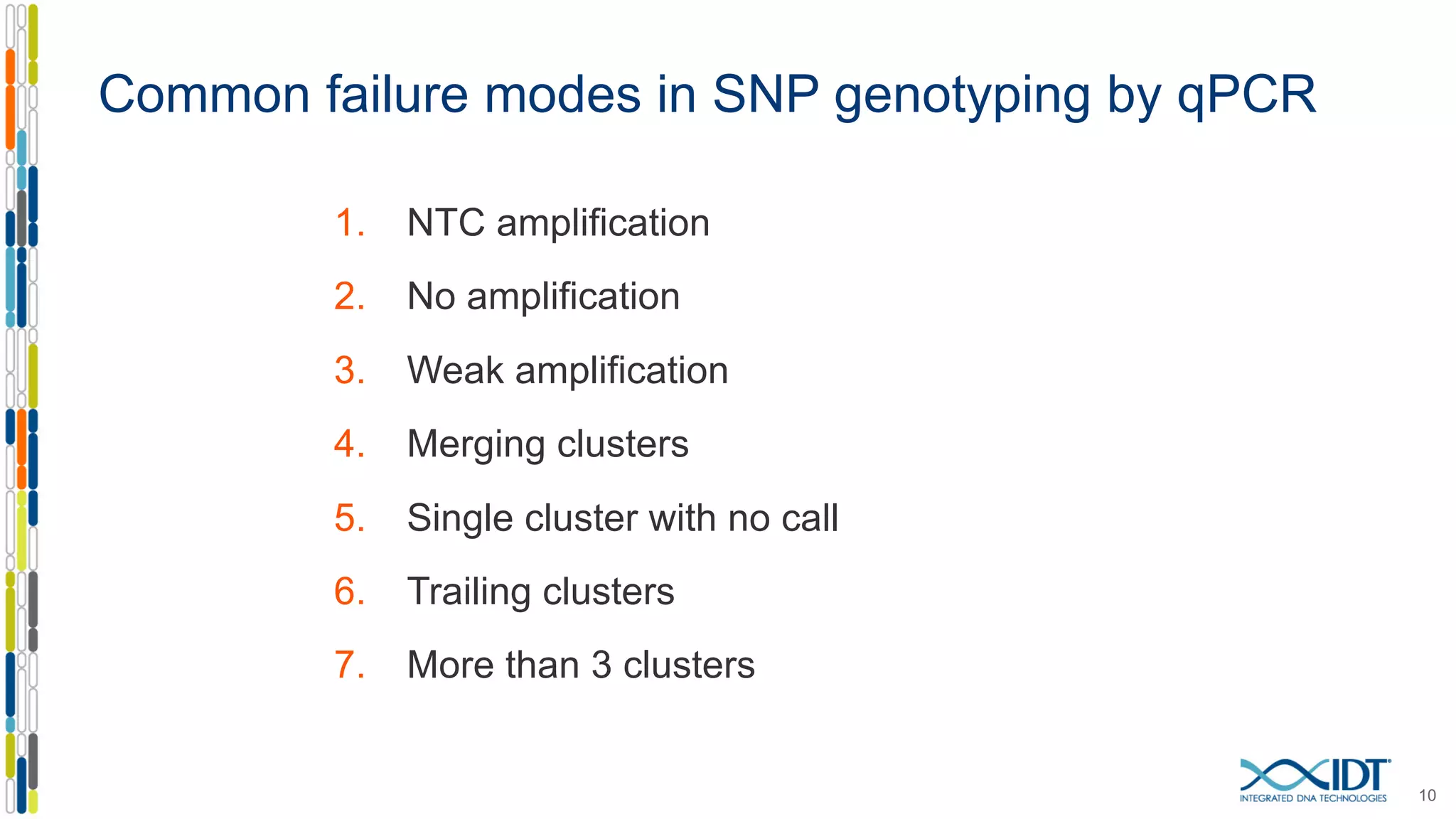
Common failure modes in SNP genotyping by qPCR
1. NTC amplification
2. No amplification
3. Weak amplification
4. Merging clusters
5. Single cluster with no call
6. Trailing clusters
7. More than 3 clusters
10
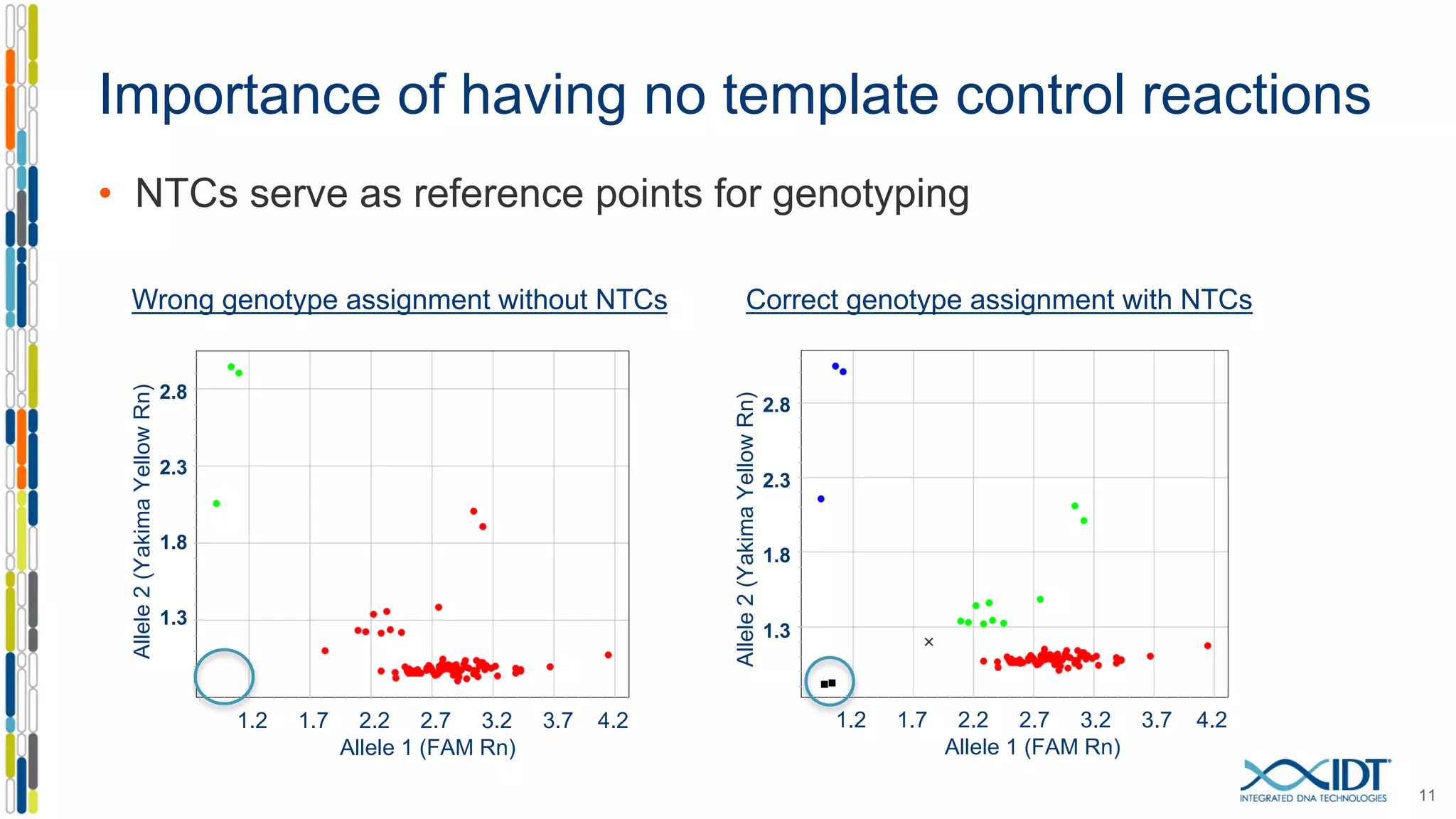
Importance of having no template control reactions
• NTCs serve as reference points for genotyping
11
1.2 1.7 2.2 2.7 3.2 3.7 4.2
Allele 1 (FAM Rn)
2.8
2.3
1.8
1.3
Wrong genotype assignment without NTCs Correct genotype assignment with NTCs
2.8
2.3
1.8
1.3
1.2 1.7 2.2 2.7 3.2 3.7 4.2
Allele 1 (FAM Rn)
Allele2(YakimaYellowRn)
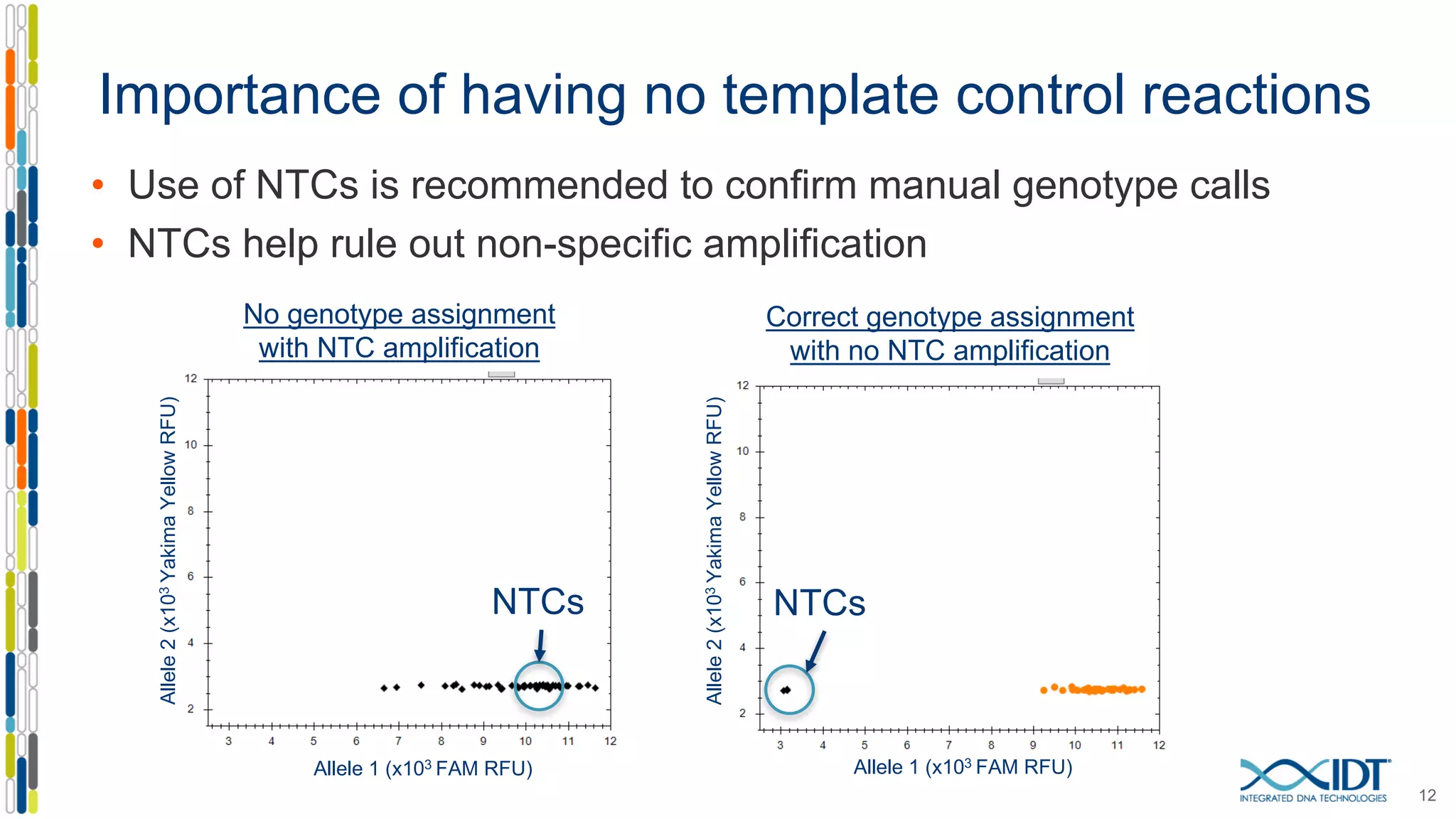
Importance of having no template control reactions
• Use of NTCs is recommended to confirm manual genotype calls
• NTCs help rule out non-specific amplification
12
Correct genotype assignment
with no NTC amplification
No genotype assignment
with NTC amplification
NTCs NTCs
Allele2(x103YakimaYellowRFU)
Allele 1 (x103 FAM RFU)Allele 1 (x103 FAM RFU)
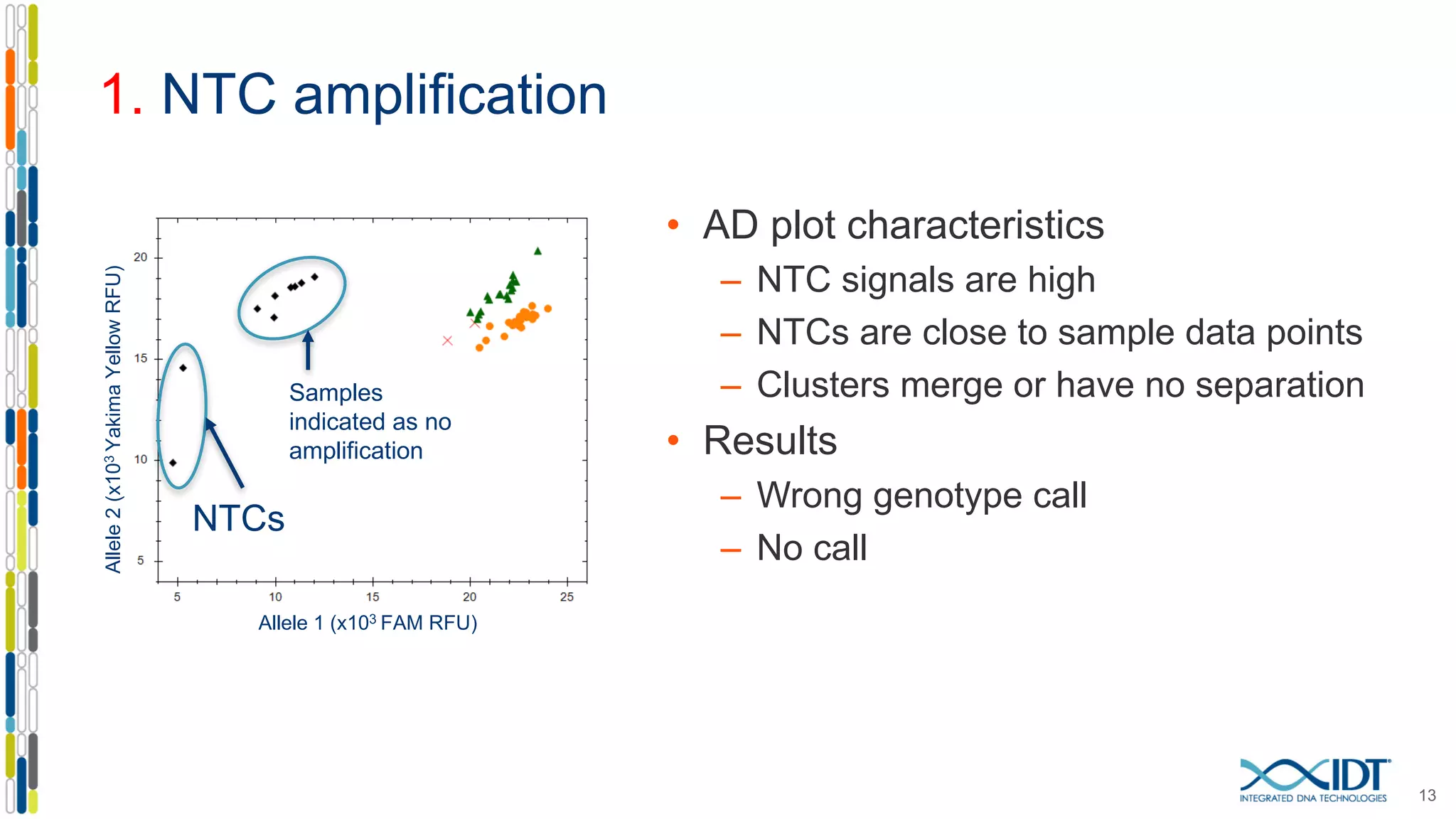
1. NTC amplification
• AD plot characteristics
– NTC signals are high
– NTCs are close to sample data points
– Clusters merge or have no separation
• Results
– Wrong genotype call
– No call
NTCs
Samples
indicated as no
amplification
Allele2(x103YakimaYellowRFU)
Allele 1 (x103 FAM RFU)
13
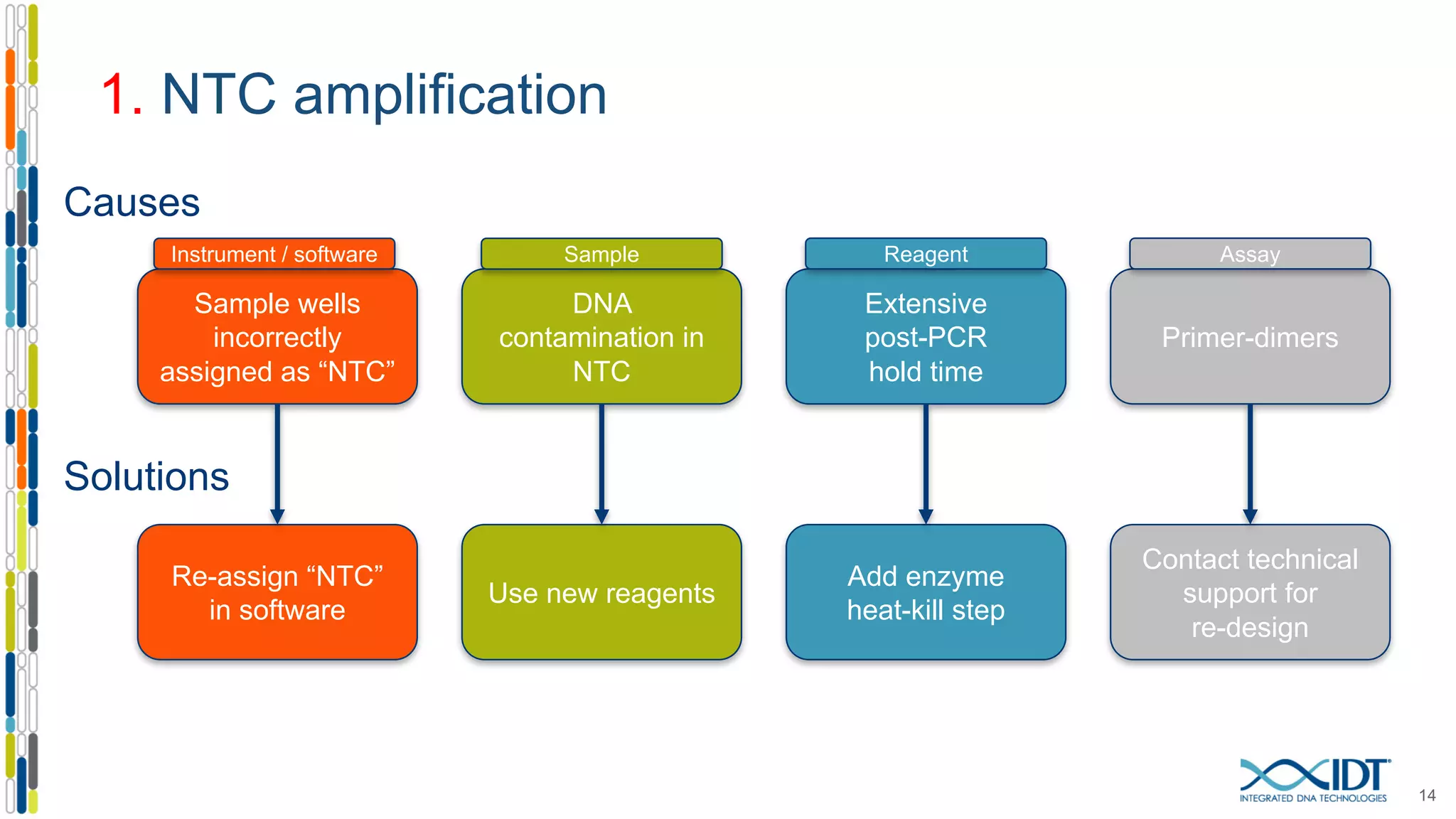
1. NTC amplification
14
DNA
contamination in
NTC
Primer-dimers
Extensive
post-PCR
hold time
Sample wells
incorrectly
assigned as “NTC”
Use new reagents
Contact technical
support for
re-design
Add enzyme
heat-kill step
Re-assign “NTC”
in software
Causes
Solutions
Instrument / software Sample Reagent Assay
15
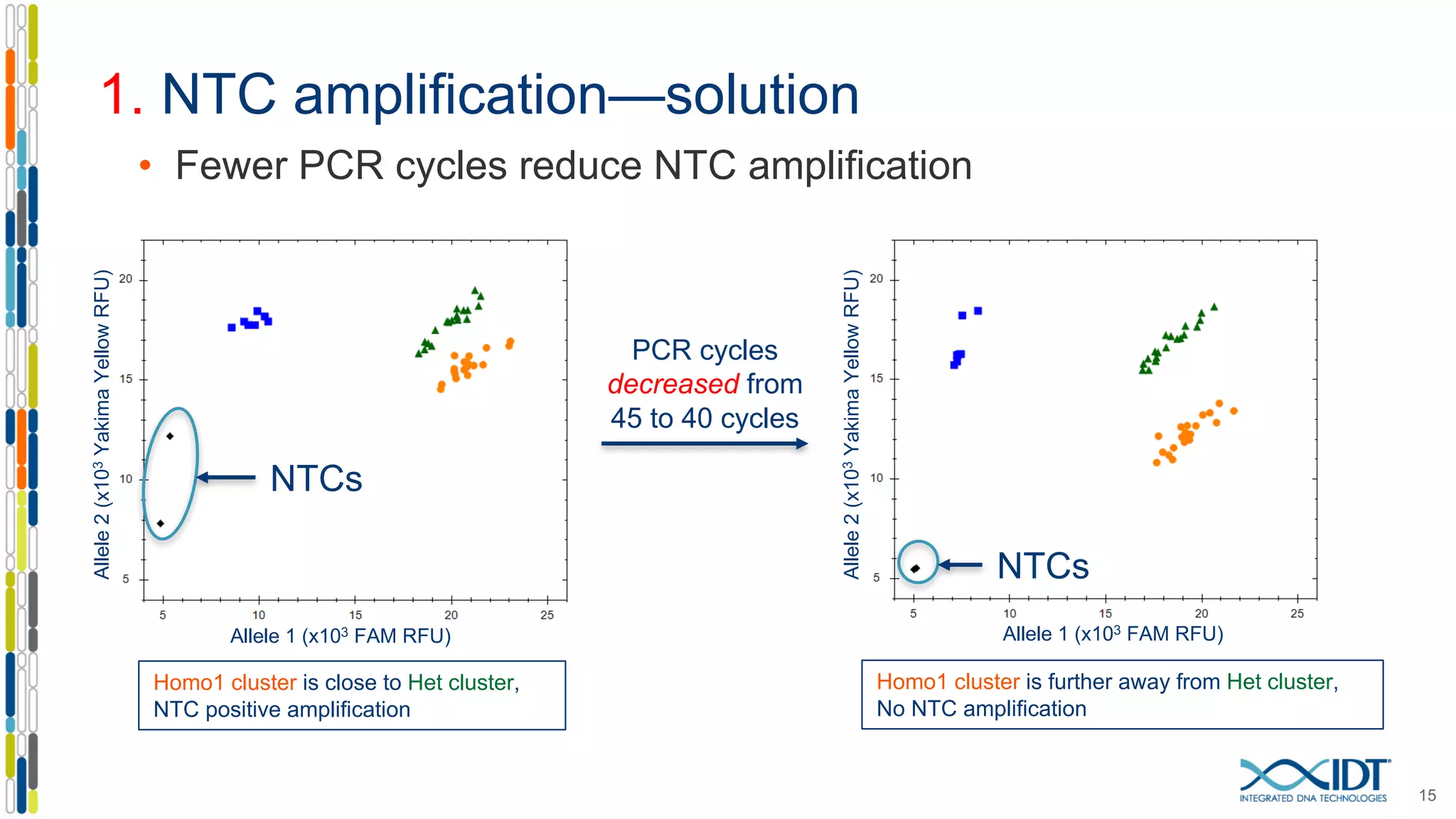
Homo1 cluster is close to Het cluster,
NTC positive amplification
1. NTC amplification—solution
Homo1 cluster is further away from Het cluster,
No NTC amplification
NTCs
NTCs
Allele2(x103YakimaYellowRFU)
Allele 1 (x103 FAM RFU) Allele 1 (x103 FAM RFU)
• Fewer PCR cycles reduce NTC amplification
PCR cycles
decreased from
45 to 40 cycles
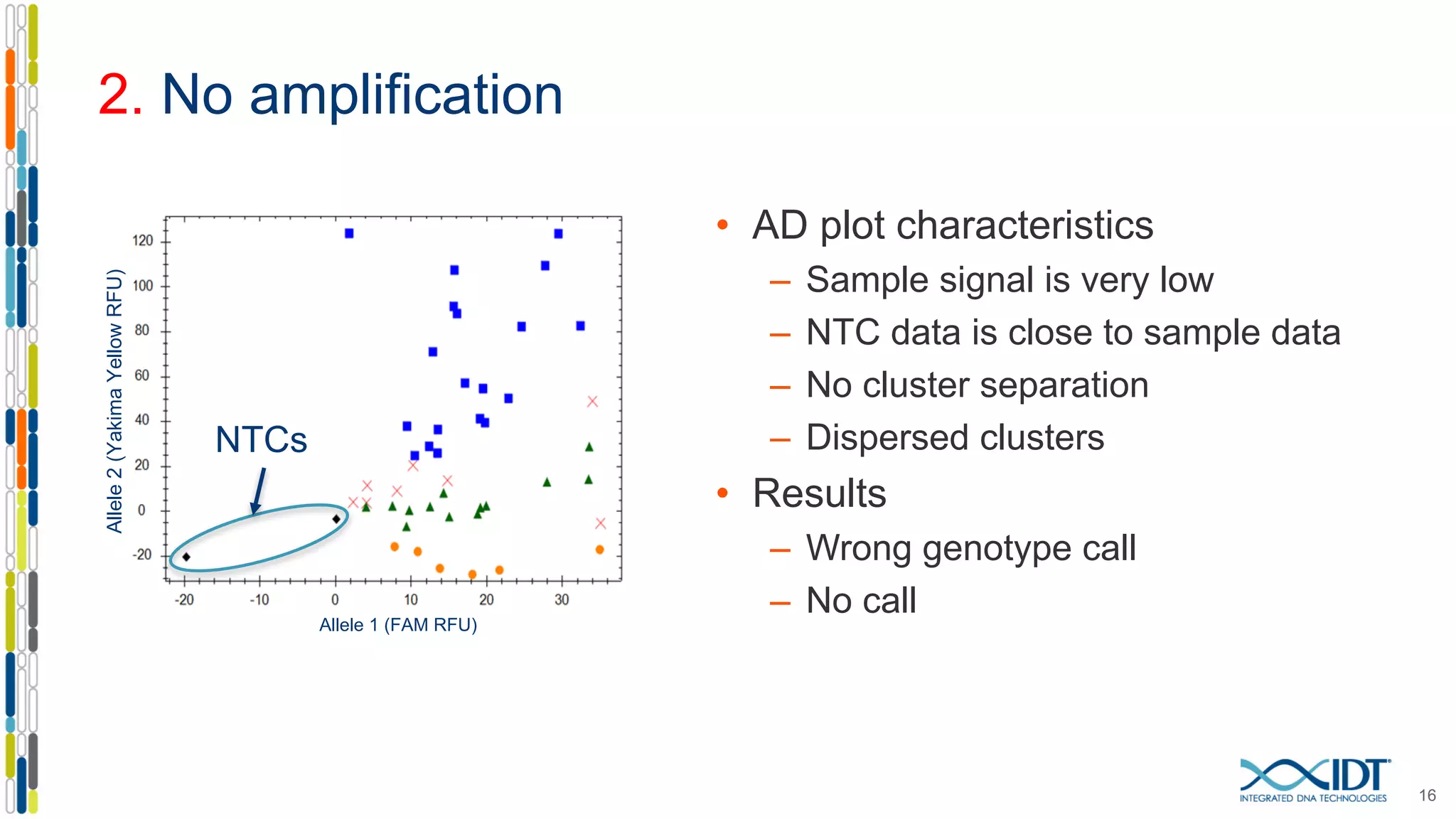
2. No amplification
• AD plot characteristics
– Sample signal is very low
– NTC data is close to sample data
– No cluster separation
– Dispersed clusters
• Results
– Wrong genotype call
– No call
16
NTCs
Allele2(YakimaYellowRFU)
Allele 1 (FAM RFU)
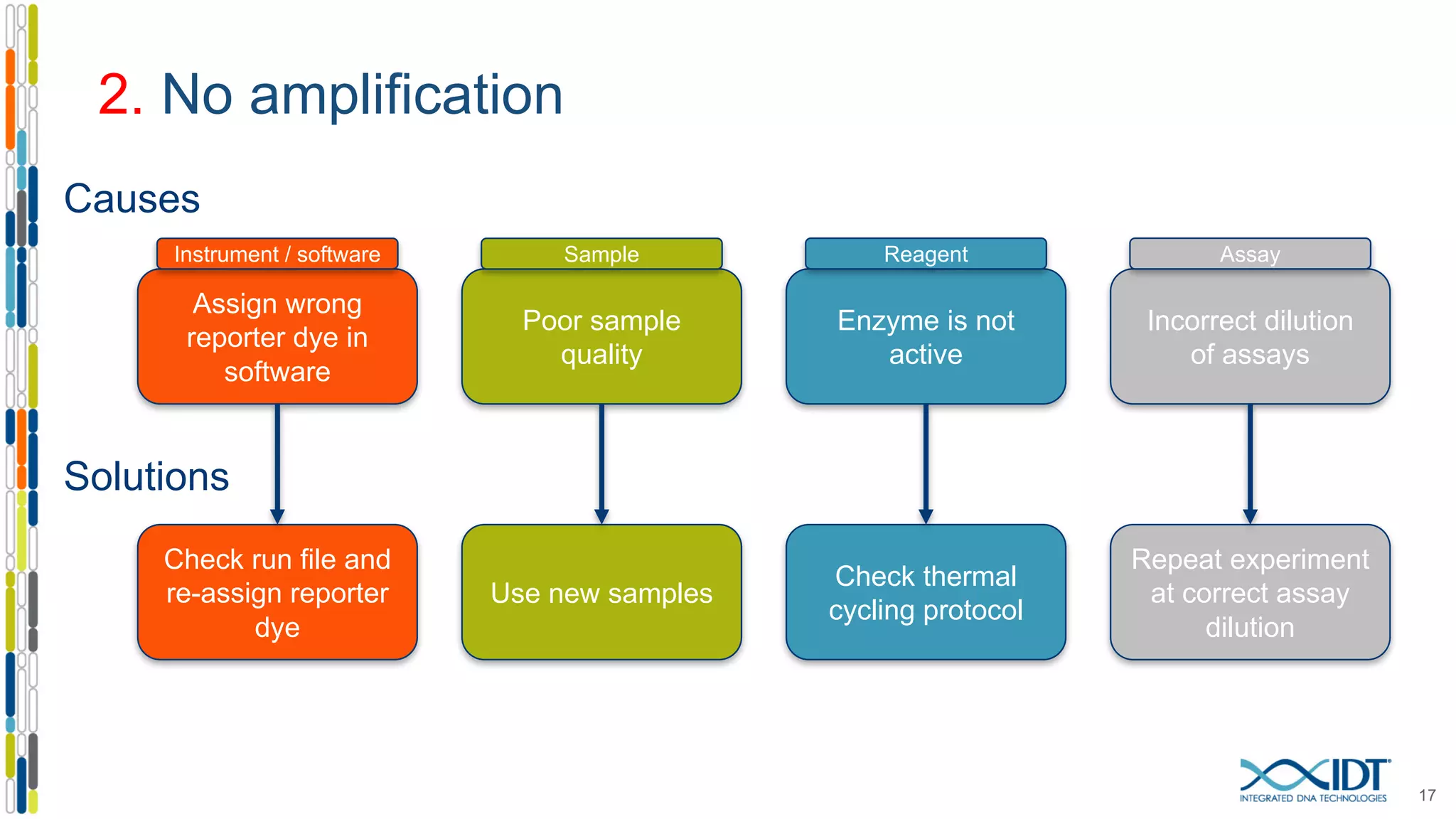
2. No amplification
17
Poor sample
quality
Incorrect dilution
of assays
Enzyme is not
active
Assign wrong
reporter dye in
software
Use new samples
Repeat experiment
at correct assay
dilution
Check thermal
cycling protocol
Check run file and
re-assign reporter
dye
Causes
Solutions
Instrument / software Sample Reagent Assay
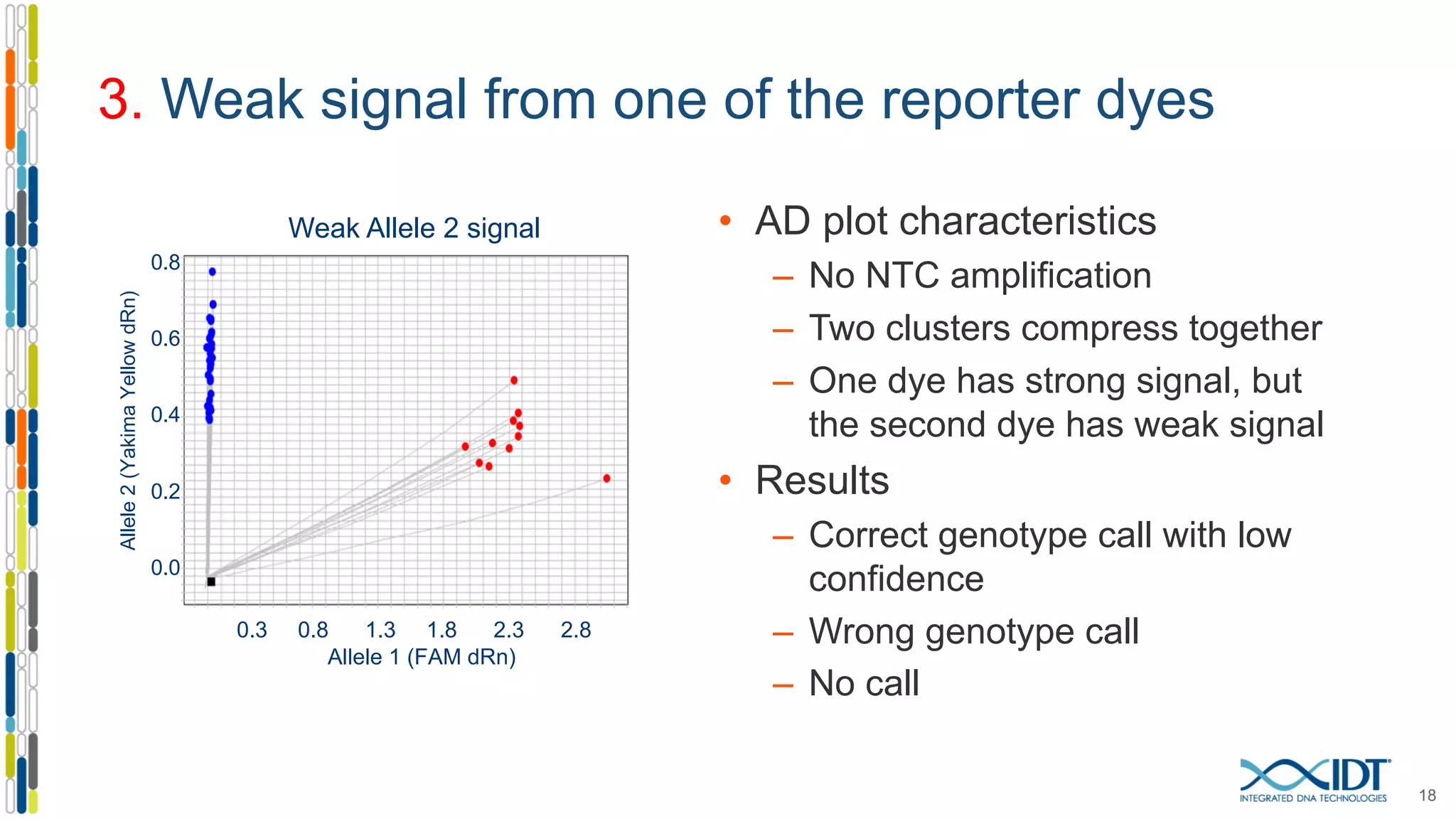
3. Weak signal from one of the reporter dyes
• AD plot characteristics
– No NTC amplification
– Two clusters compress together
– One dye has strong signal, but
the second dye has weak signal
• Results
– Correct genotype call with low
confidence
– Wrong genotype call
– No call
0.8
0.6
0.4
0.2
0.0
Allele2(YakimaYellowdRn)
0.3 0.8 1.3 1.8 2.3 2.8
Allele 1 (FAM dRn)
Weak Allele 2 signal
18
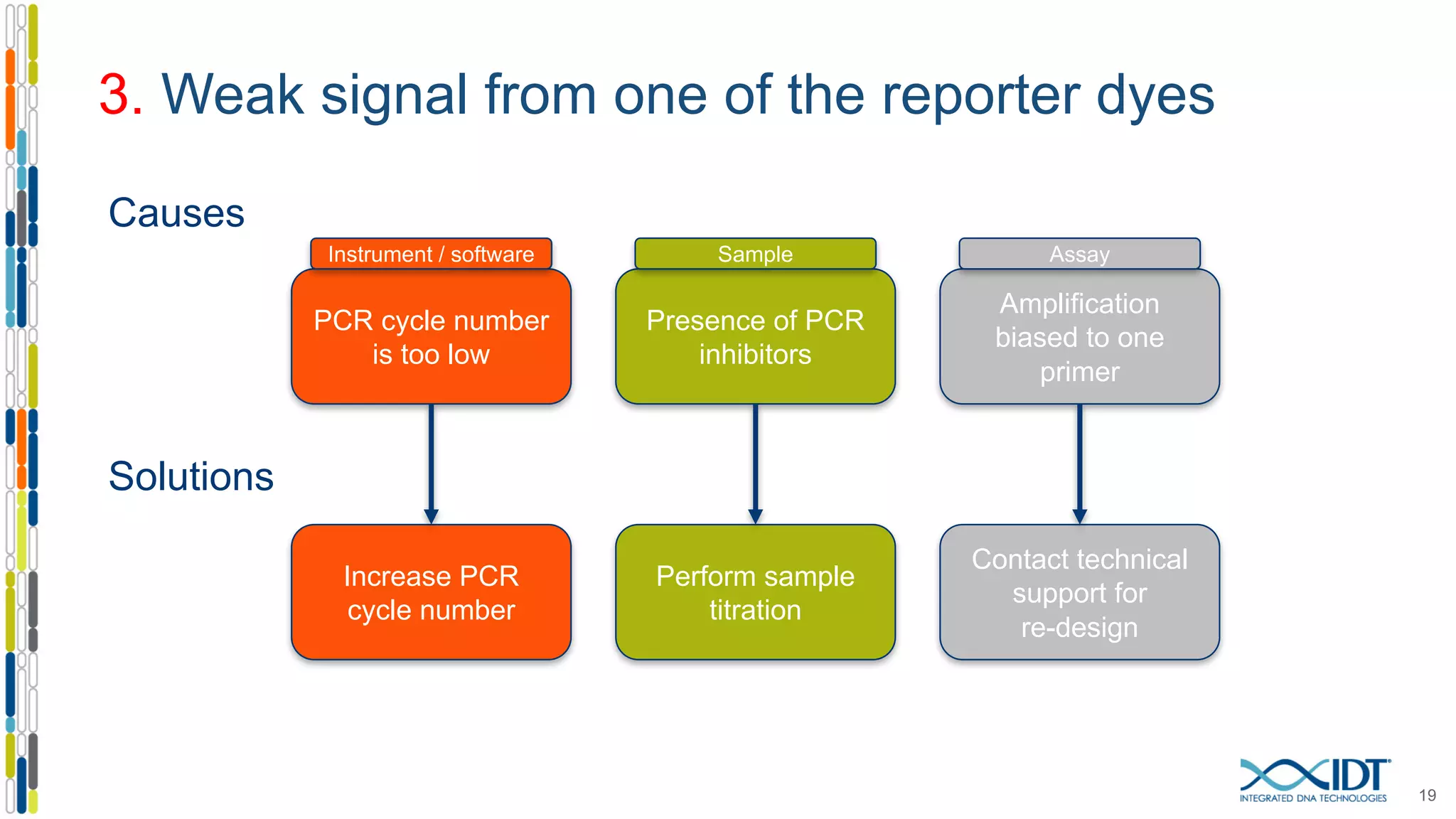
3. Weak signal from one of the reporter dyes
19
Presence of PCR
inhibitors
Amplification
biased to one
primer
PCR cycle number
is too low
Perform sample
titration
Contact technical
support for
re-design
Increase PCR
cycle number
Causes
Solutions
Instrument / software Sample Assay
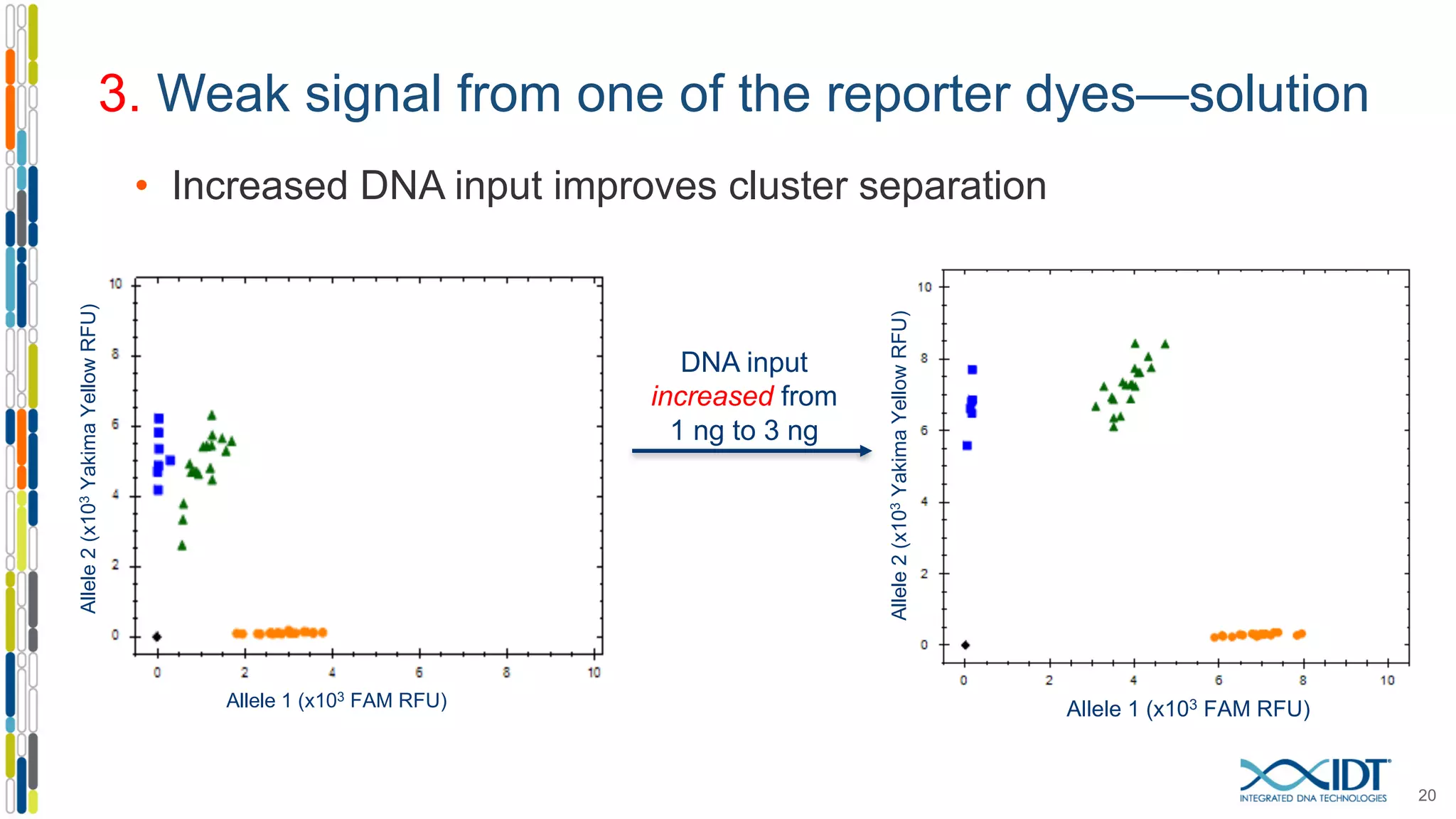
3. Weak signal from one of the reporter dyes—solution
DNA input
increased from
1 ng to 3 ng
• Increased DNA input improves cluster separation
Allele2(x103YakimaYellowRFU)
Allele 1 (x103 FAM RFU) Allele 1 (x103 FAM RFU)
20
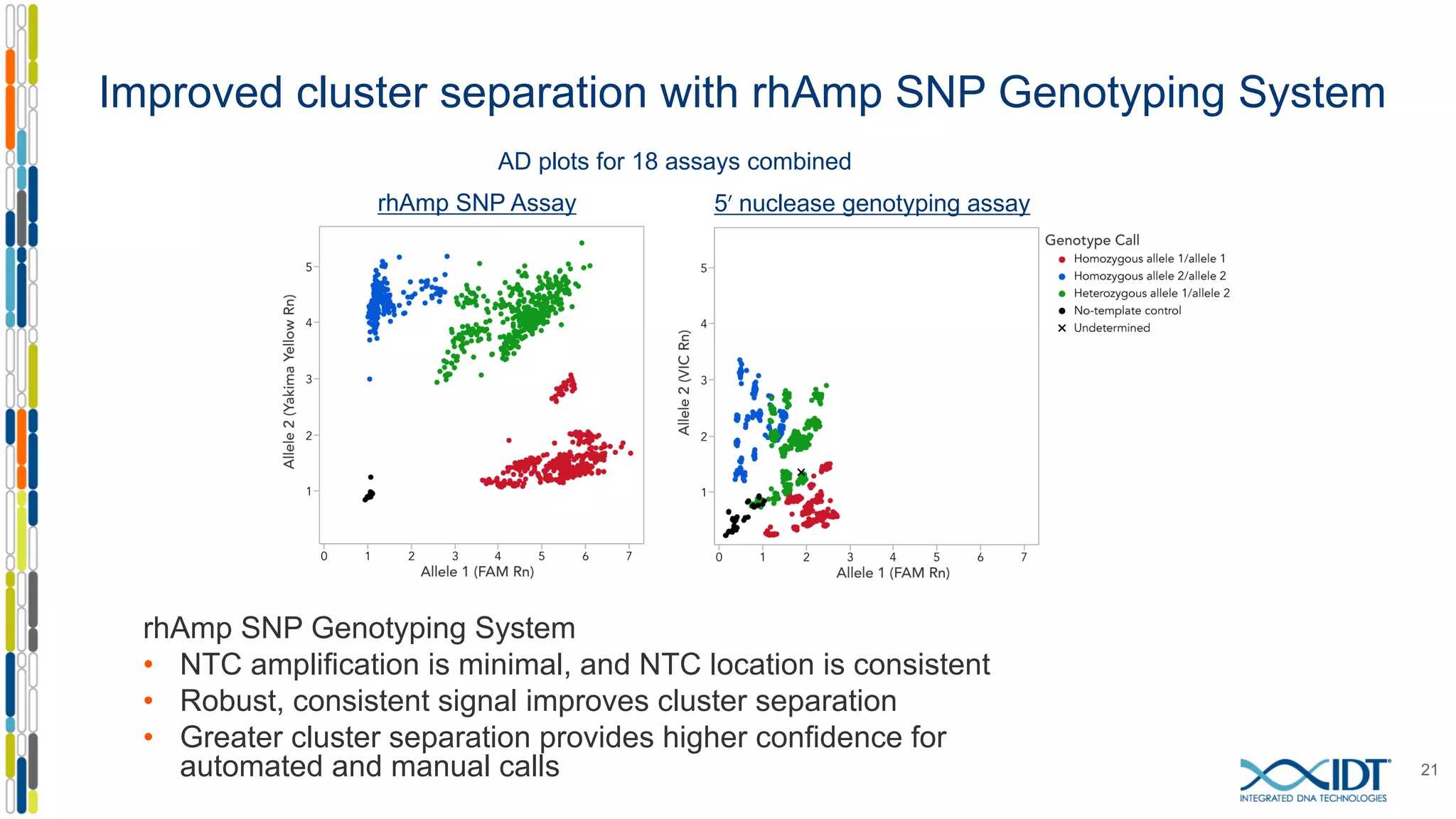
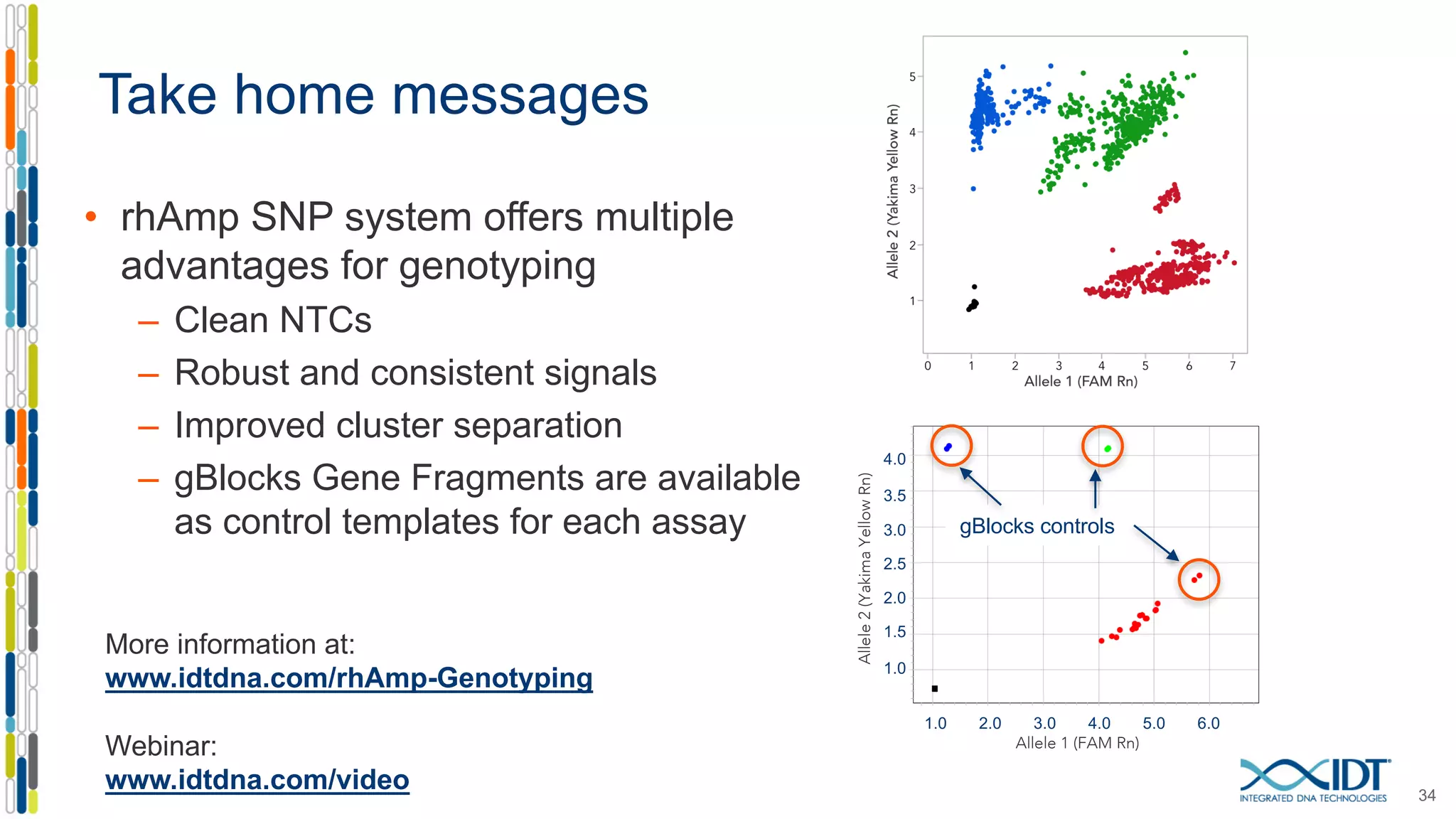
Improved cluster separation with rhAmp SNP Genotyping System
rhAmp SNP Genotyping System
• NTC amplification is minimal, and NTC location is consistent
• Robust, consistent signal improves cluster separation
• Greater cluster separation provides higher confidence for
automated and manual calls 21
AD plots for 18 assays combined
5′ nuclease genotyping assayrhAmp SNP Assay
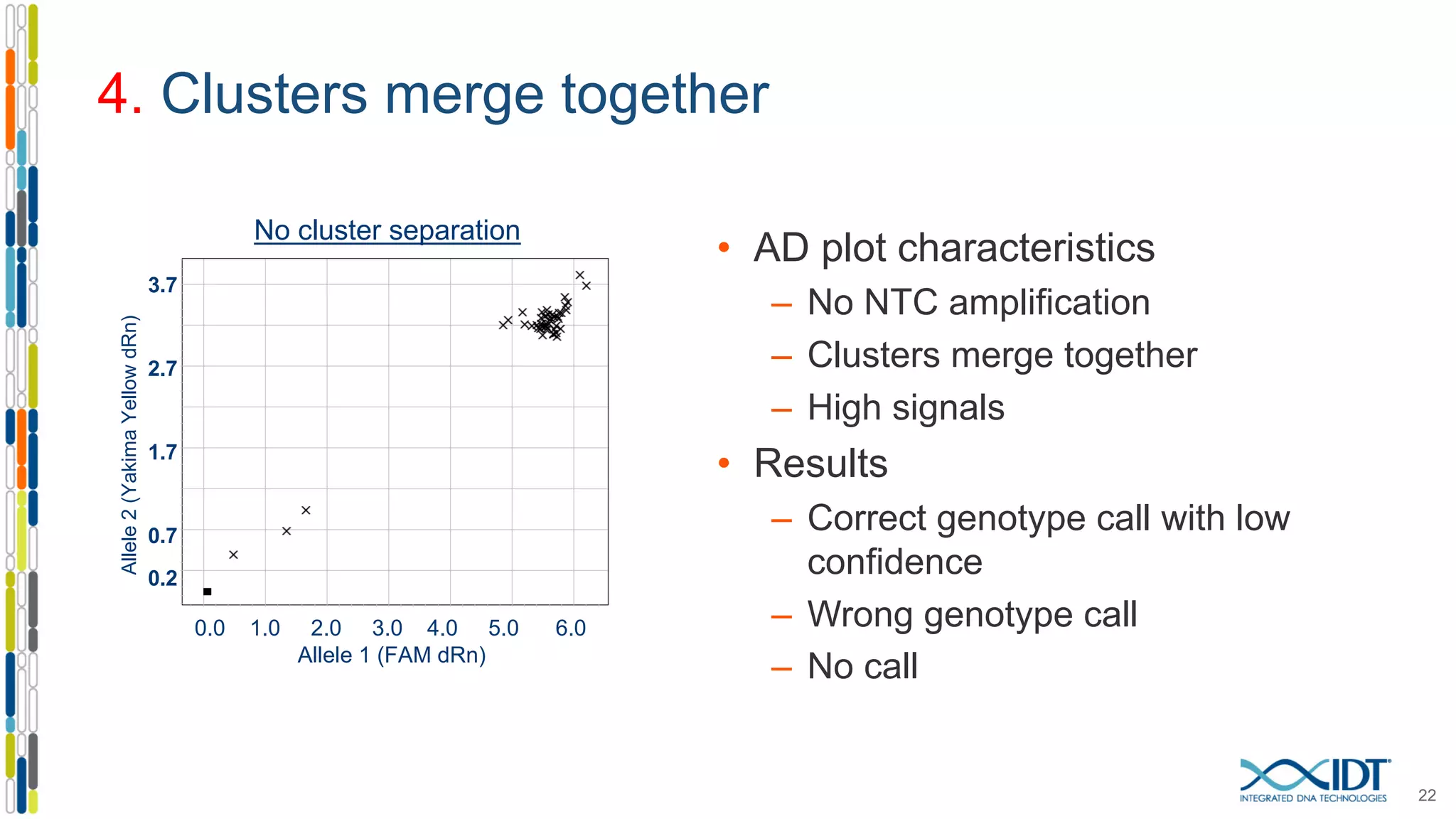
4. Clusters merge together
• AD plot characteristics
– No NTC amplification
– Clusters merge together
– High signals
• Results
– Correct genotype call with low
confidence
– Wrong genotype call
– No call
0.0 1.0 2.0 3.0 4.0 5.0 6.0
Allele 1 (FAM dRn)
3.7
2.7
1.7
0.7
0.2
Allele2(YakimaYellowdRn)
No cluster separation
22
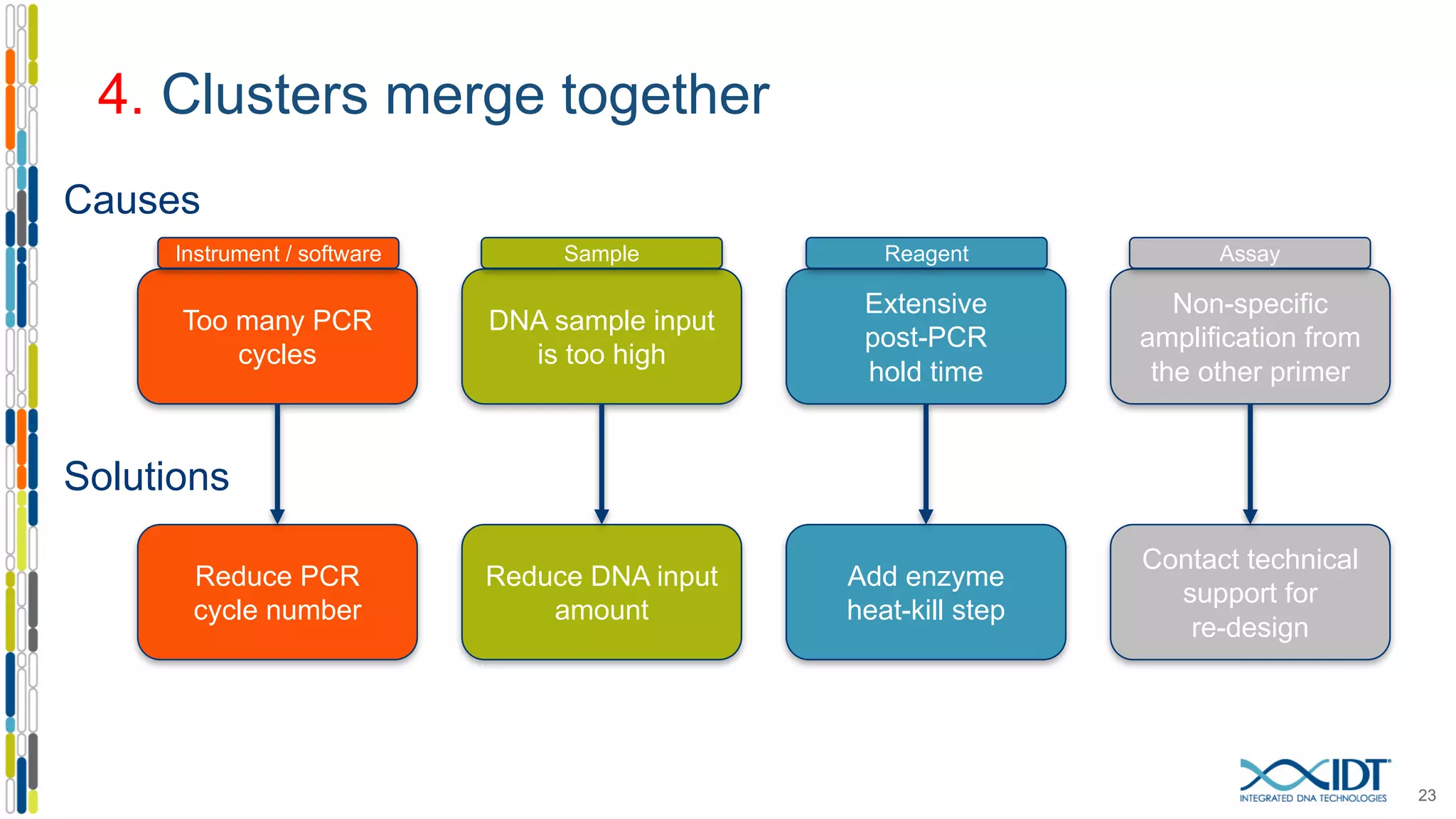
4. Clusters merge together
23
DNA sample input
is too high
Non-specific
amplification from
the other primer
Extensive
post-PCR
hold time
Too many PCR
cycles
Reduce DNA input
amount
Contact technical
support for
re-design
Add enzyme
heat-kill step
Reduce PCR
cycle number
Causes
Solutions
Instrument / software Sample Reagent Assay
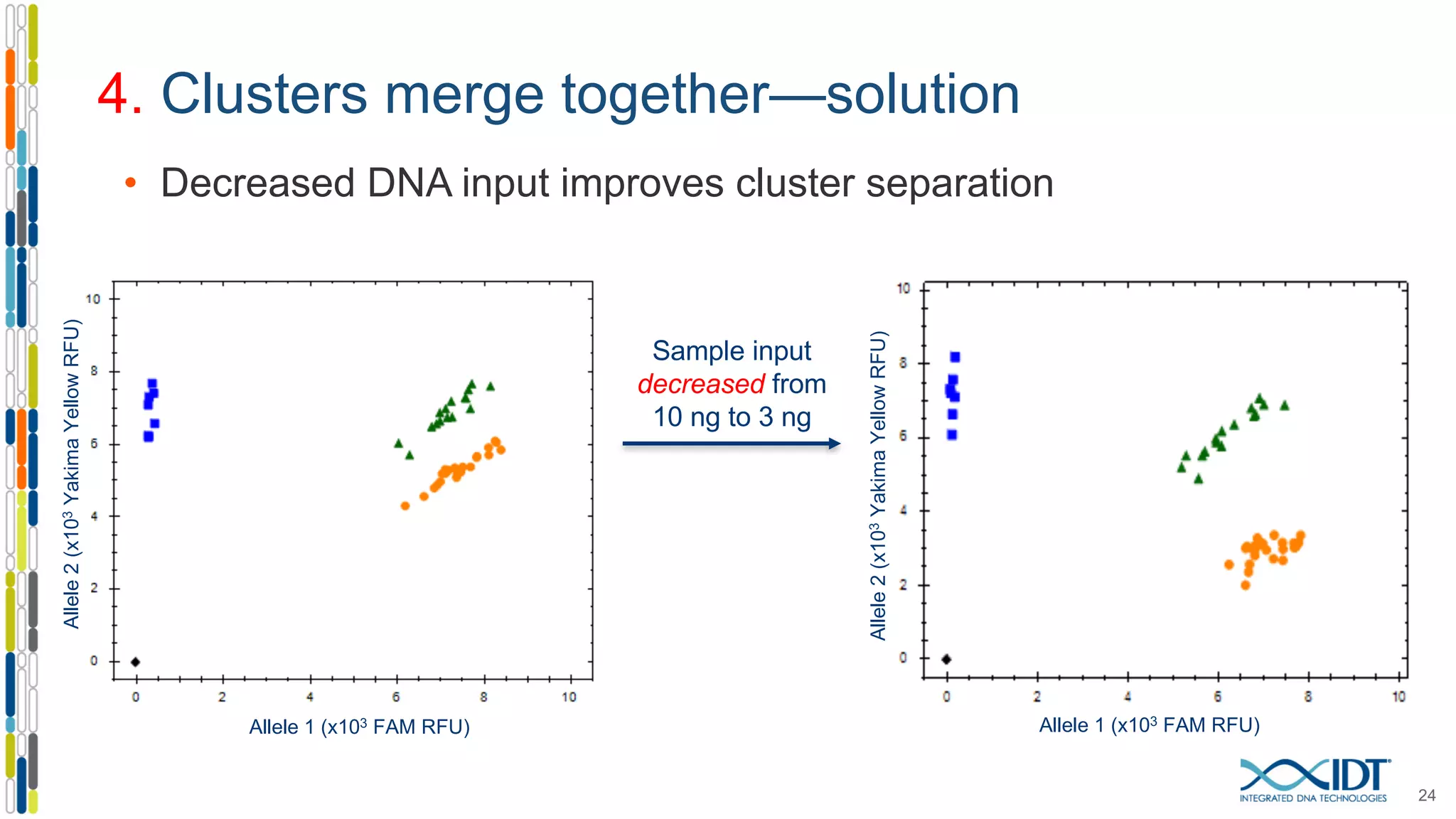
4. Clusters merge together—solution
Sample input
decreased from
10 ng to 3 ng
• Decreased DNA input improves cluster separation
Allele2(x103YakimaYellowRFU)
Allele 1 (x103 FAM RFU) Allele 1 (x103 FAM RFU)
24
25
• AD plot characteristics
– No NTC amplification
– Single cluster
– One dye has strong signal, but the
second dye has weak signal
4.0
3.5
3.0
2.5
2.0
1.5
1.0
1.0 2.0 3.0 4.0 5.0 6.0
• Result
– No genotype call
Allele2(YakimaYellowRn)
Allele 1 (FAM Rn)
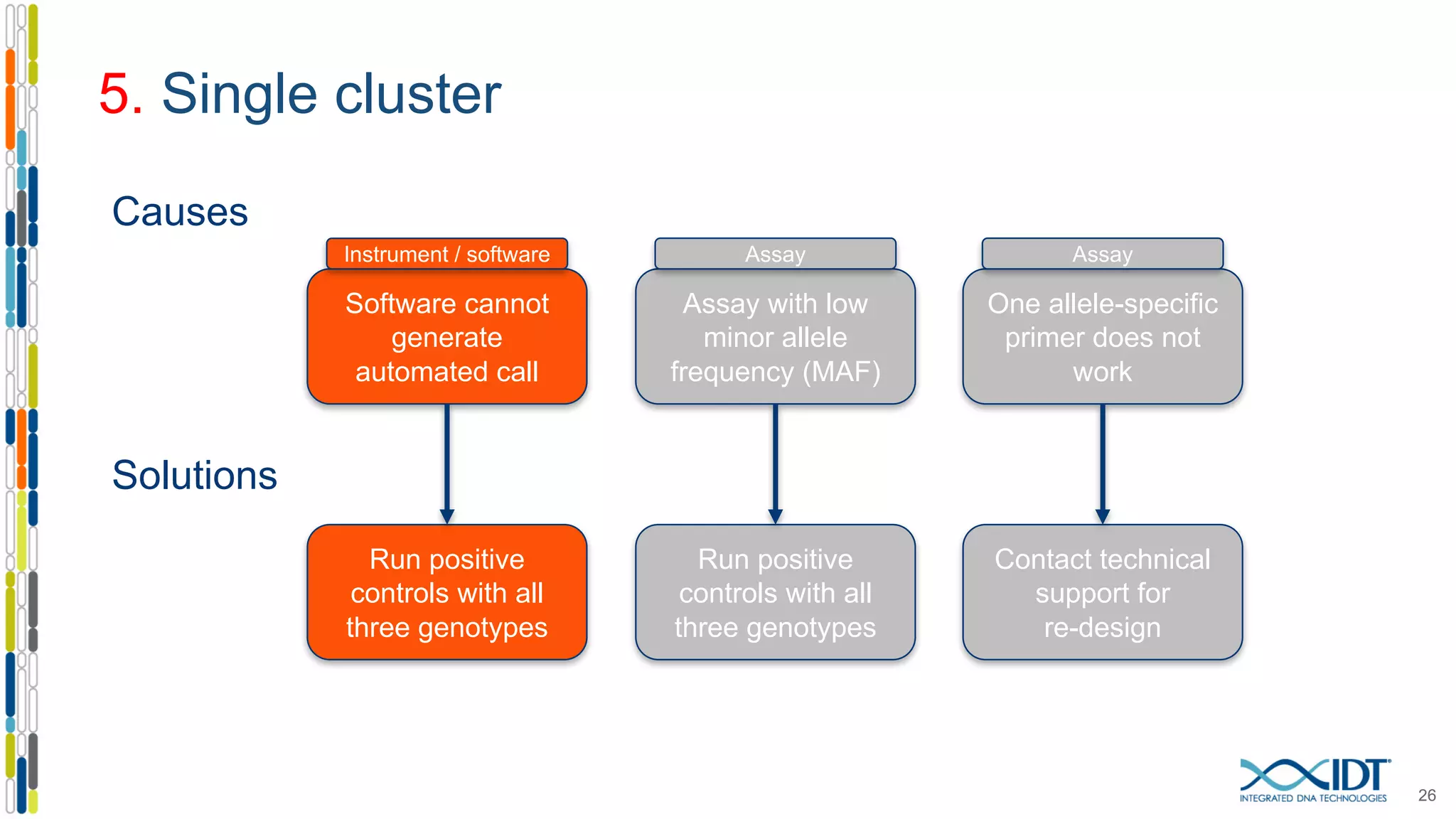
5. Single cluster
5. Single cluster
26
Assay with low
minor allele
frequency (MAF)
Software cannot
generate
automated call
Run positive
controls with all
three genotypes
Causes
Solutions
One allele-specific
primer does not
work
Contact technical
support for
re-design
Instrument / software Assay
Run positive
controls with all
three genotypes
Assay
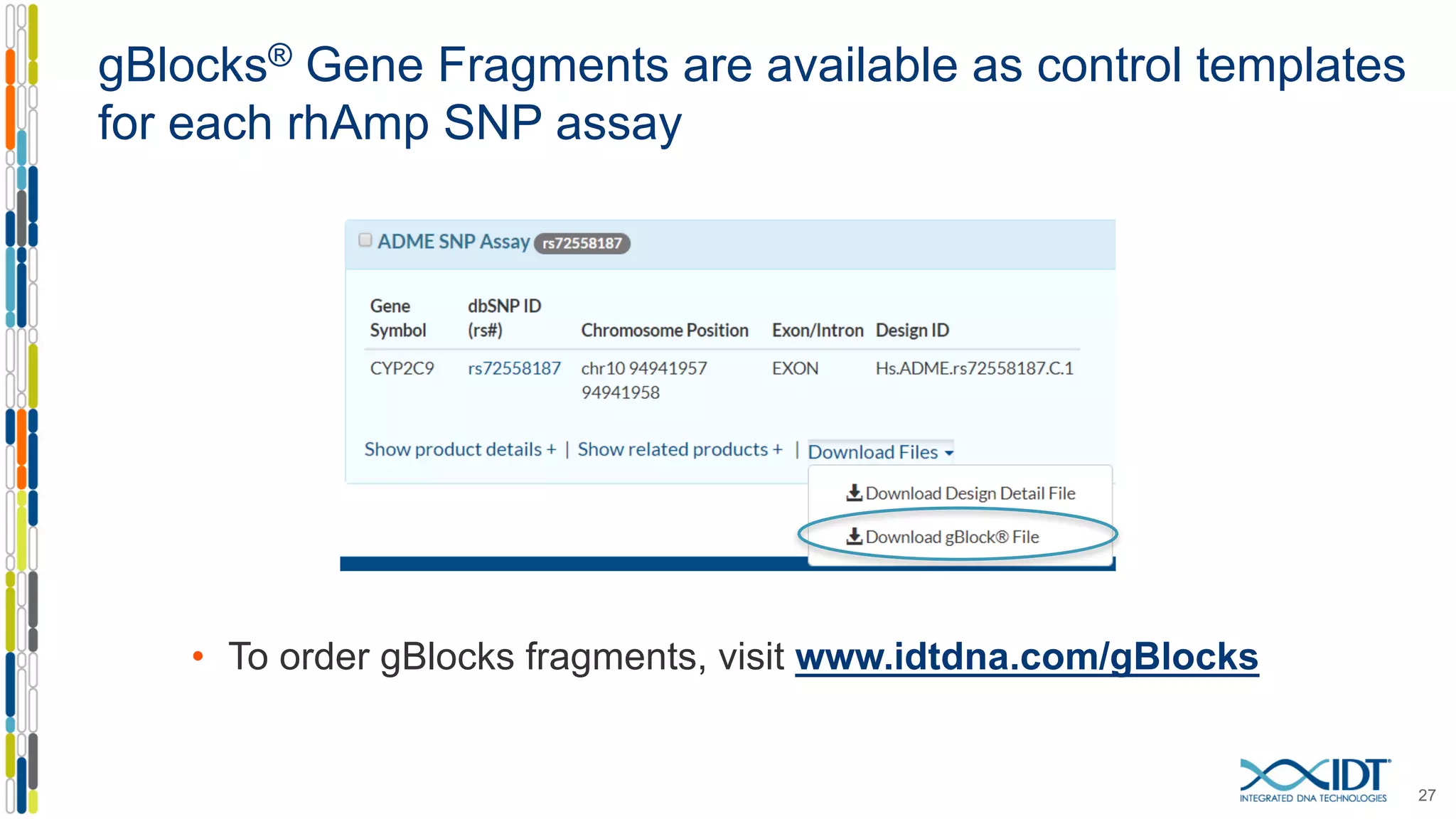
gBlocks® Gene Fragments are available as control templates
for each rhAmp SNP assay
• To order gBlocks fragments, visit www.idtdna.com/gBlocks
27
Allele 1 (FAM Rn)
Positive controls improve genotype calling
28
CYP2C9 (rs72558187)
10 ng of human gDNA
purified from whole blood
Analysis including 1000 copies of
gBlocks controls for each genotype
• Manual and automated calls are improved with positive controls for
each genotype cluster
4.0
3.5
3.0
2.5
2.0
1.5
1.0
1.0 2.0 3.0 4.0 5.0 6.0
Allele2(YakimaYellowRn)
Allele 1 (FAM Rn)
4.0
3.5
3.0
2.5
2.0
1.5
1.0
1.0 2.0 3.0 4.0 5.0 6.0
Allele2(YakimaYellowRn)
gBlocks controls
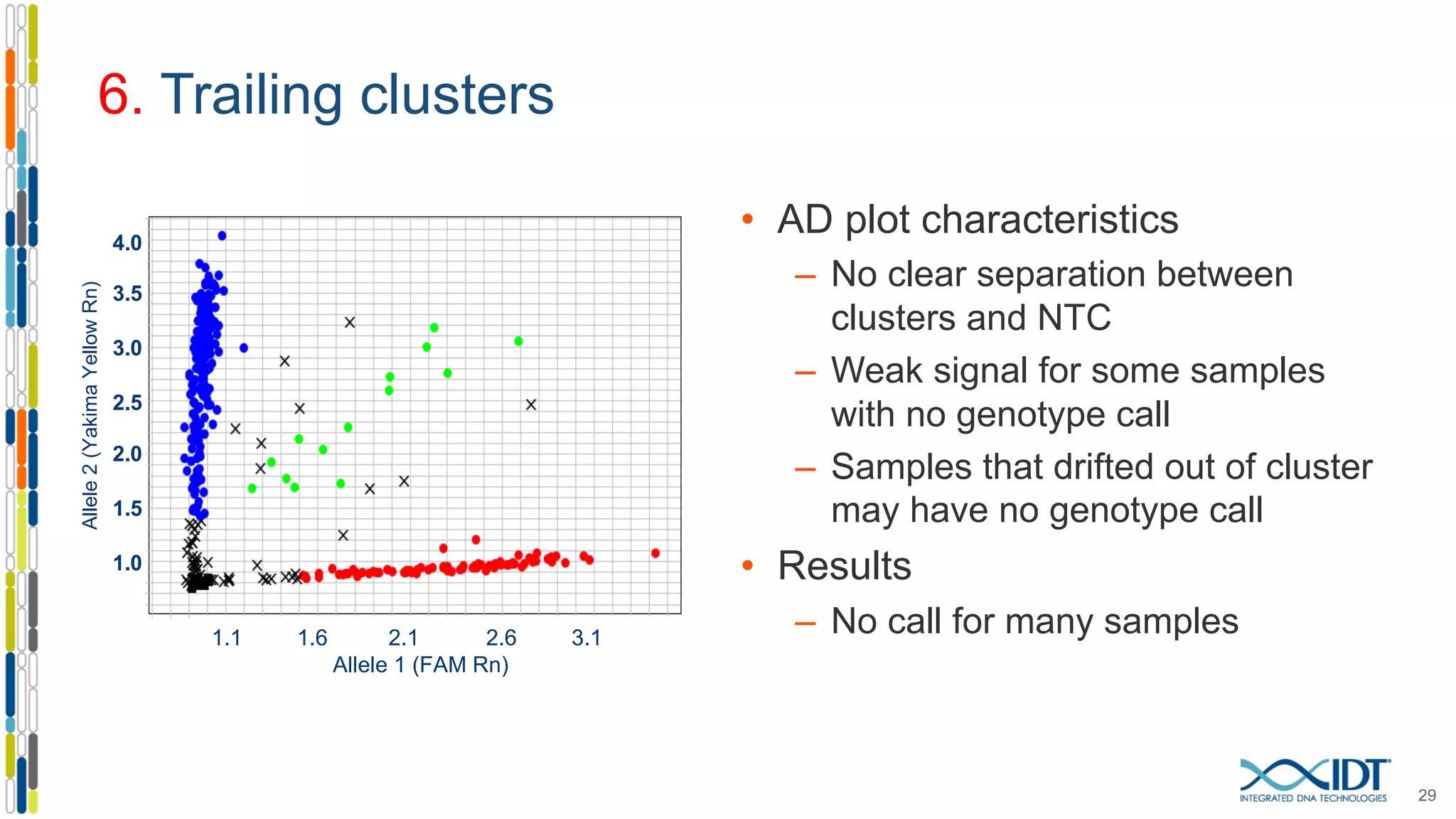
6. Trailing clusters
• AD plot characteristics
– No clear separation between
clusters and NTC
– Weak signal for some samples
with no genotype call
– Samples that drifted out of cluster
may have no genotype call
• Results
– No call for many samples1.1 1.6 2.1 2.6 3.1
Allele 1 (FAM Rn)
4.0
3.5
3.0
2.5
2.0
1.5
1.0
Allele2(YakimaYellowRn)
29
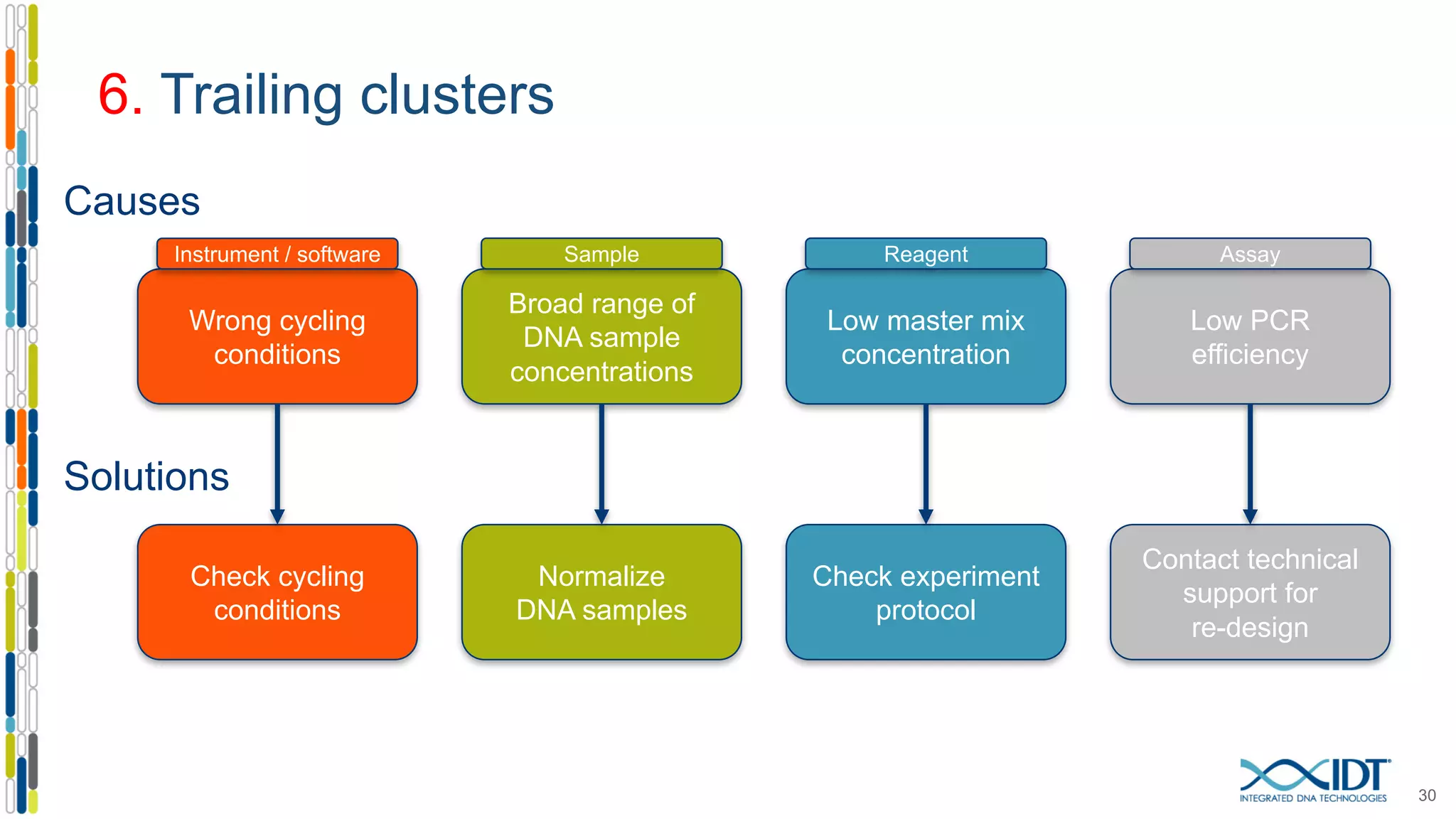
6. Trailing clusters
30
Broad range of
DNA sample
concentrations
Low PCR
efficiency
Low master mix
concentration
Wrong cycling
conditions
Normalize
DNA samples
Contact technical
support for
re-design
Check experiment
protocol
Check cycling
conditions
Causes
Solutions
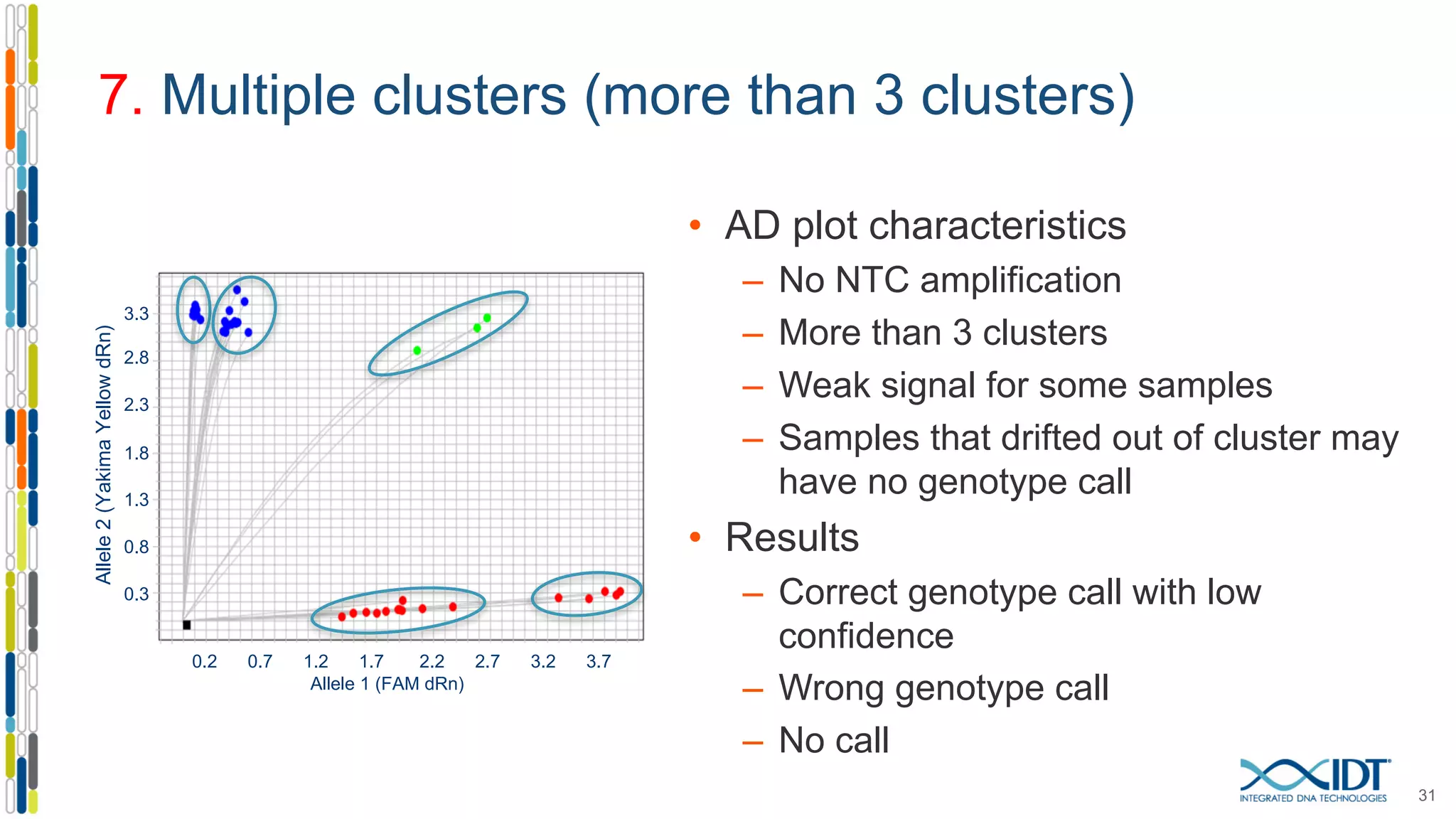
Instrument / software Sample Reagent Assay
7. Multiple clusters (more than 3 clusters)
31
• AD plot characteristics
– No NTC amplification
– More than 3 clusters
– Weak signal for some samples
– Samples that drifted out of cluster may
have no genotype call
• Results
– Correct genotype call with low
confidence
– Wrong genotype call
– No call
0.2 0.7 1.2 1.7 2.2 2.7 3.2 3.7
Allele 1 (FAM dRn)
Allele2(YakimaYellowdRn)
3.3
2.8
2.3
1.8
1.3
0.8
0.3
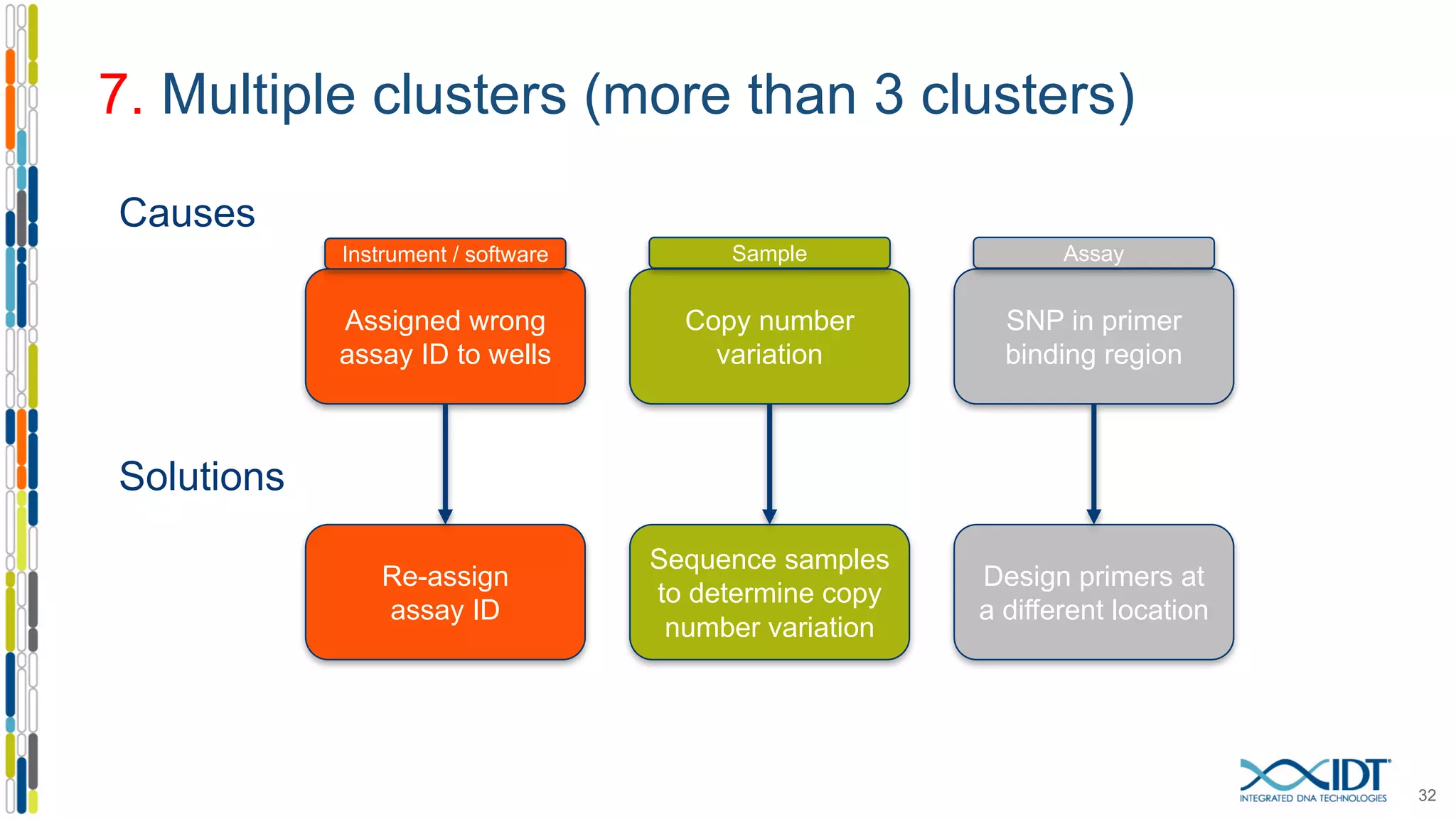
7. Multiple clusters (more than 3 clusters)
32
Copy number
variation
SNP in primer
binding region
Assigned wrong
assay ID to wells
Sequence samples
to determine copy
number variation
Design primers at
a different location
Re-assign
assay ID
Causes
Solutions
Instrument / software Sample Assay
THANK YOU
33
Take home messages
• rhAmp SNP system offers multiple
advantages for genotyping
– Clean NTCs
– Robust and consistent signals
– Improved cluster separation
– gBlocks Gene Fragments are available
as control templates for each assay
34
4.0
3.5
3.0
2.5
2.0
1.5
1.0
1.0 2.0 3.0 4.0 5.0 6.0
gBlocks controls
More information at:
www.idtdna.com/rhAmp-Genotyping
Webinar:
www.idtdna.com/video
Allele2(YakimaYellowRn)
Allele 1 (FAM Rn)

SNP genotyping on qPCR platforms: Troubleshooting for amplification and cluster separation

  • 1.
    SNP genotyping onqPCR platforms: Troubleshooting for amplification and cluster separation Daniel Tsang, Research Scientist 1
  • 2.
    • Background: Genotypingby qPCR • Introduction of rhAmp™ SNP Genotyping System • Common genotyping failure modes and solutions – Benefits of IDT rhAmp SNP Genotyping System 2 Outline: SNP genotyping on qPCR platforms
  • 3.
    • Background: Genotypingby qPCR • Introduction of rhAmp SNP Genotyping System • Common genotyping failure modes and solutions – Benefits of IDT rhAmp SNP Genotyping System 3 Outline: SNP genotyping on qPCR platforms
  • 4.
    Introduction to genotypingby qPCR • Technologies used for genotyping – Sequencing: Discovering novel SNPs • Large number of SNPs • Small number of samples – Array: Detecting known SNPs • Large number of SNPs • Small number of samples – Quantitative PCR (qPCR): Detecting known SNPs • Fewer number of SNPs • Large number of samples • Small quantity of samples • Shorter workflow 4 Number of samples Numberoftargets Seq Array qPCR
  • 5.
    Factors to considerfor high confidence calls • Lack of amplification in no template control (NTC) reaction • High signal-to-noise ratio • Tight clusters • Clear cluster separation 5 Example of allelic discrimination (AD) plot Yakima Yellow is a registered trademark of Elitech Group.
  • 6.
    • Background: Genotypingby qPCR • Introduction of rhAmp SNP Genotyping System • Common genotyping failure modes and solutions – Benefits of IDT rhAmp SNP Genotyping System 6 Outline: SNP genotyping on qPCR platforms
  • 7.
    rhAmp SNP Genotypingmechanism • Step 1: Primer design and annealing – Modified primers include a 3′ blocking group and an RNA base next to the SNP site. – Primers must be annealed to the matched target for RNase H2 cleavage to occur, resulting in deblocking of primers. • Step 2: Primer cleavage and extension – Primer cleavage by RNase H2 generates a 3′-OH group extendable by the highly discriminating, mutant Taq polymerase. • Step 3: Universal reporter incorporation – rhAmp primers have 5′ tails, which incorporate a universal 5′ nuclease assay reporter system. • Step 4: Probe cleavage and signal generation – The FAM and Yakima Yellow reporter dyes distinguish the 2 alleles. 7
  • 8.
    Complete rhAmp SNPGenotyping System • Simple, one-tube chemistry works on all common qPCR platforms • >10 million predesigned assays for human SNPs • High performance, custom assay design tool for other species 8 1. Select your assay type 2. Select your species 3. Select your target input format 4. Copy and paste your target list
  • 9.
    • Background: Genotypingby qPCR • Introduction of rhAmp SNP Genotyping System • Common genotyping failure modes and solutions – Benefits of IDT rhAmp SNP Genotyping System 9 Outline: SNP genotyping on qPCR platforms
  • 10.
    Common failure modesin SNP genotyping by qPCR 1. NTC amplification 2. No amplification 3. Weak amplification 4. Merging clusters 5. Single cluster with no call 6. Trailing clusters 7. More than 3 clusters 10
  • 11.
    Importance of havingno template control reactions • NTCs serve as reference points for genotyping 11 1.2 1.7 2.2 2.7 3.2 3.7 4.2 Allele 1 (FAM Rn) 2.8 2.3 1.8 1.3 Wrong genotype assignment without NTCs Correct genotype assignment with NTCs 2.8 2.3 1.8 1.3 1.2 1.7 2.2 2.7 3.2 3.7 4.2 Allele 1 (FAM Rn) Allele2(YakimaYellowRn) Allele2(YakimaYellowRn)
  • 12.
    Importance of havingno template control reactions • Use of NTCs is recommended to confirm manual genotype calls • NTCs help rule out non-specific amplification 12 Correct genotype assignment with no NTC amplification No genotype assignment with NTC amplification NTCs NTCs Allele2(x103YakimaYellowRFU) Allele2(x103YakimaYellowRFU) Allele 1 (x103 FAM RFU)Allele 1 (x103 FAM RFU)
  • 13.
    1. NTC amplification •AD plot characteristics – NTC signals are high – NTCs are close to sample data points – Clusters merge or have no separation • Results – Wrong genotype call – No call NTCs Samples indicated as no amplification Allele2(x103YakimaYellowRFU) Allele 1 (x103 FAM RFU) 13
  • 14.
    1. NTC amplification 14 DNA contaminationin NTC Primer-dimers Extensive post-PCR hold time Sample wells incorrectly assigned as “NTC” Use new reagents Contact technical support for re-design Add enzyme heat-kill step Re-assign “NTC” in software Causes Solutions Instrument / software Sample Reagent Assay
  • 15.
    15 Homo1 cluster isclose to Het cluster, NTC positive amplification 1. NTC amplification—solution Homo1 cluster is further away from Het cluster, No NTC amplification NTCs NTCs Allele2(x103YakimaYellowRFU) Allele2(x103YakimaYellowRFU) Allele 1 (x103 FAM RFU) Allele 1 (x103 FAM RFU) • Fewer PCR cycles reduce NTC amplification PCR cycles decreased from 45 to 40 cycles
  • 16.
    2. No amplification •AD plot characteristics – Sample signal is very low – NTC data is close to sample data – No cluster separation – Dispersed clusters • Results – Wrong genotype call – No call 16 NTCs Allele2(YakimaYellowRFU) Allele 1 (FAM RFU)
  • 17.
    2. No amplification 17 Poorsample quality Incorrect dilution of assays Enzyme is not active Assign wrong reporter dye in software Use new samples Repeat experiment at correct assay dilution Check thermal cycling protocol Check run file and re-assign reporter dye Causes Solutions Instrument / software Sample Reagent Assay
  • 18.
    3. Weak signalfrom one of the reporter dyes • AD plot characteristics – No NTC amplification – Two clusters compress together – One dye has strong signal, but the second dye has weak signal • Results – Correct genotype call with low confidence – Wrong genotype call – No call 0.8 0.6 0.4 0.2 0.0 Allele2(YakimaYellowdRn) 0.3 0.8 1.3 1.8 2.3 2.8 Allele 1 (FAM dRn) Weak Allele 2 signal 18
  • 19.
    3. Weak signalfrom one of the reporter dyes 19 Presence of PCR inhibitors Amplification biased to one primer PCR cycle number is too low Perform sample titration Contact technical support for re-design Increase PCR cycle number Causes Solutions Instrument / software Sample Assay
  • 20.
    3. Weak signalfrom one of the reporter dyes—solution DNA input increased from 1 ng to 3 ng • Increased DNA input improves cluster separation Allele2(x103YakimaYellowRFU) Allele2(x103YakimaYellowRFU) Allele 1 (x103 FAM RFU) Allele 1 (x103 FAM RFU) 20
  • 21.
    Improved cluster separationwith rhAmp SNP Genotyping System rhAmp SNP Genotyping System • NTC amplification is minimal, and NTC location is consistent • Robust, consistent signal improves cluster separation • Greater cluster separation provides higher confidence for automated and manual calls 21 AD plots for 18 assays combined 5′ nuclease genotyping assayrhAmp SNP Assay
  • 22.
    4. Clusters mergetogether • AD plot characteristics – No NTC amplification – Clusters merge together – High signals • Results – Correct genotype call with low confidence – Wrong genotype call – No call 0.0 1.0 2.0 3.0 4.0 5.0 6.0 Allele 1 (FAM dRn) 3.7 2.7 1.7 0.7 0.2 Allele2(YakimaYellowdRn) No cluster separation 22
  • 23.
    4. Clusters mergetogether 23 DNA sample input is too high Non-specific amplification from the other primer Extensive post-PCR hold time Too many PCR cycles Reduce DNA input amount Contact technical support for re-design Add enzyme heat-kill step Reduce PCR cycle number Causes Solutions Instrument / software Sample Reagent Assay
  • 24.
    4. Clusters mergetogether—solution Sample input decreased from 10 ng to 3 ng • Decreased DNA input improves cluster separation Allele2(x103YakimaYellowRFU) Allele2(x103YakimaYellowRFU) Allele 1 (x103 FAM RFU) Allele 1 (x103 FAM RFU) 24
  • 25.
    25 • AD plotcharacteristics – No NTC amplification – Single cluster – One dye has strong signal, but the second dye has weak signal 4.0 3.5 3.0 2.5 2.0 1.5 1.0 1.0 2.0 3.0 4.0 5.0 6.0 • Result – No genotype call Allele2(YakimaYellowRn) Allele 1 (FAM Rn) 5. Single cluster
  • 26.
    5. Single cluster 26 Assaywith low minor allele frequency (MAF) Software cannot generate automated call Run positive controls with all three genotypes Causes Solutions One allele-specific primer does not work Contact technical support for re-design Instrument / software Assay Run positive controls with all three genotypes Assay
  • 27.
    gBlocks® Gene Fragmentsare available as control templates for each rhAmp SNP assay • To order gBlocks fragments, visit www.idtdna.com/gBlocks 27
  • 28.
    Allele 1 (FAMRn) Positive controls improve genotype calling 28 CYP2C9 (rs72558187) 10 ng of human gDNA purified from whole blood Analysis including 1000 copies of gBlocks controls for each genotype • Manual and automated calls are improved with positive controls for each genotype cluster 4.0 3.5 3.0 2.5 2.0 1.5 1.0 1.0 2.0 3.0 4.0 5.0 6.0 Allele2(YakimaYellowRn) Allele 1 (FAM Rn) 4.0 3.5 3.0 2.5 2.0 1.5 1.0 1.0 2.0 3.0 4.0 5.0 6.0 Allele2(YakimaYellowRn) gBlocks controls
  • 29.
    6. Trailing clusters •AD plot characteristics – No clear separation between clusters and NTC – Weak signal for some samples with no genotype call – Samples that drifted out of cluster may have no genotype call • Results – No call for many samples1.1 1.6 2.1 2.6 3.1 Allele 1 (FAM Rn) 4.0 3.5 3.0 2.5 2.0 1.5 1.0 Allele2(YakimaYellowRn) 29
  • 30.
    6. Trailing clusters 30 Broadrange of DNA sample concentrations Low PCR efficiency Low master mix concentration Wrong cycling conditions Normalize DNA samples Contact technical support for re-design Check experiment protocol Check cycling conditions Causes Solutions Instrument / software Sample Reagent Assay
  • 31.
    7. Multiple clusters(more than 3 clusters) 31 • AD plot characteristics – No NTC amplification – More than 3 clusters – Weak signal for some samples – Samples that drifted out of cluster may have no genotype call • Results – Correct genotype call with low confidence – Wrong genotype call – No call 0.2 0.7 1.2 1.7 2.2 2.7 3.2 3.7 Allele 1 (FAM dRn) Allele2(YakimaYellowdRn) 3.3 2.8 2.3 1.8 1.3 0.8 0.3
  • 32.
    7. Multiple clusters(more than 3 clusters) 32 Copy number variation SNP in primer binding region Assigned wrong assay ID to wells Sequence samples to determine copy number variation Design primers at a different location Re-assign assay ID Causes Solutions Instrument / software Sample Assay
  • 33.
  • 34.
    Take home messages •rhAmp SNP system offers multiple advantages for genotyping – Clean NTCs – Robust and consistent signals – Improved cluster separation – gBlocks Gene Fragments are available as control templates for each assay 34 4.0 3.5 3.0 2.5 2.0 1.5 1.0 1.0 2.0 3.0 4.0 5.0 6.0 gBlocks controls More information at: www.idtdna.com/rhAmp-Genotyping Webinar: www.idtdna.com/video Allele2(YakimaYellowRn) Allele 1 (FAM Rn)