TECHNICAL PITFALLS
IN NCS
Shehzad Hussain
Technologist
Important technical factors that
influencing NCS
Physiological factors
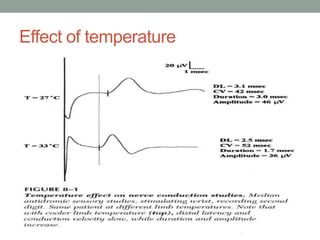
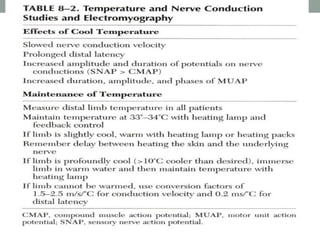
Temperature
Age
Height or length of nerve
Proximal vs. distal nerve segment
Anomalous innervation
Non physiological Factors
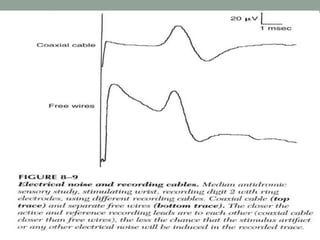
 Electrode impedance mismatch and 60-Hz interference
Filters
Electronic averaging
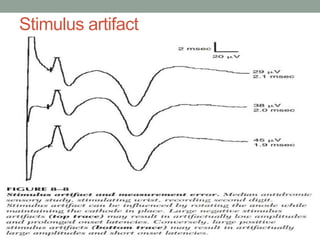
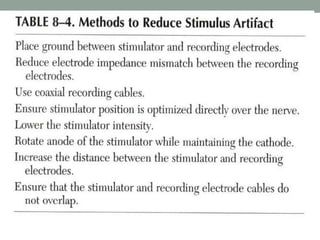
Stimulus artifact
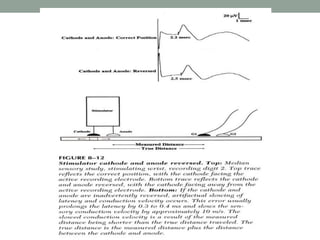
Cathode position: reversing stimulating polarity
Supramaximal stimulation
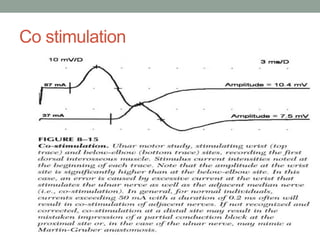
Co-stimulation of adjacent nerve
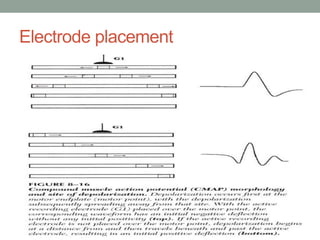
Electrode placement for motor studies
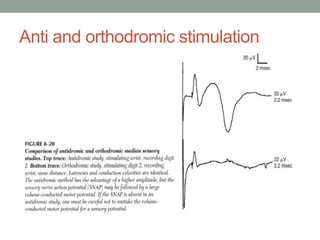
Antidromic versus orthodromic recording
Distance between recording electrodes and nerve
Distance between active and reference recording
electrodes
Limb position and distance measurements
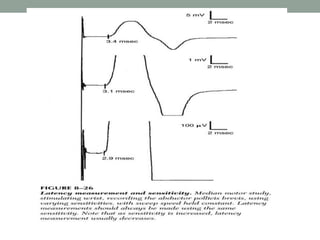
Sweep speed and sensitivity
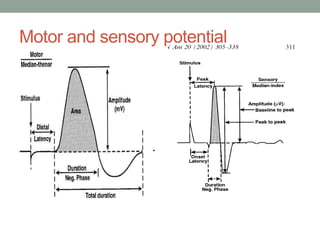
Motor and sensory potential
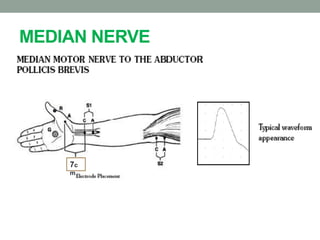
MEDIAN NERVE
7c
m
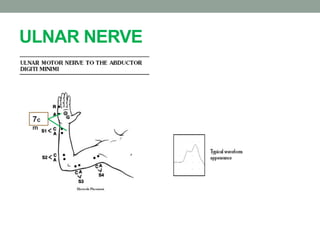
ULNAR NERVE
7c
m
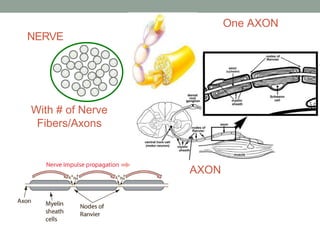
NERVE
With # of Nerve
Fibers/Axons
One AXON
AXON
Effect of temperature
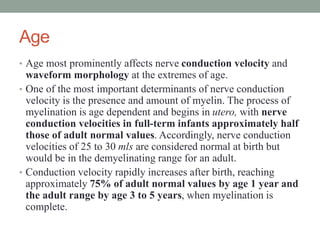
Age
• Age most prominently affects nerve conduction velocity and
waveform morphology at the extremes of age.
• One of the most important determinants of nerve conduction
velocity is the presence and amount of myelin. The process of
myelination is age dependent and begins in utero, with nerve
conduction velocities in full-term infants approximately half
those of adult normal values. Accordingly, nerve conduction
velocities of 25 to 30 mls are considered normal at birth but
would be in the demyelinating range for an adult.
• Conduction velocity rapidly increases after birth, reaching
approximately 75% of adult normal values by age 1 year and
the adult range by age 3 to 5 years, when myelination is
complete.
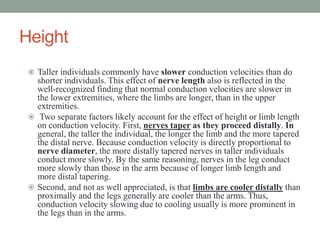
Height
 Taller individuals commonly have slower conduction velocities than do
shorter individuals. This effect of nerve length also is reflected in the
well-recognized finding that normal conduction velocities are slower in
the lower extremities, where the limbs are longer, than in the upper
extremities.
 Two separate factors likely account for the effect of height or limb length
on conduction velocity. First, nerves taper as they proceed distally. In
general, the taller the individual, the longer the limb and the more tapered
the distal nerve. Because conduction velocity is directly proportional to
nerve diameter, the more distally tapered nerves in taller individuals
conduct more slowly. By the same reasoning, nerves in the leg conduct
more slowly than those in the arm because of longer limb length and
more distal tapering.
 Second, and not as well appreciated, is that limbs are cooler distally than
proximally and the legs generally are cooler than the arms. Thus,
conduction velocity slowing due to cooling usually is more prominent in
the legs than in the arms.
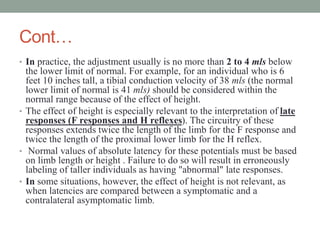
Cont…
• In practice, the adjustment usually is no more than 2 to 4 mls below
the lower limit of normal. For example, for an individual who is 6
feet 10 inches tall, a tibial conduction velocity of 38 mls (the normal
lower limit of normal is 41 mls) should be considered within the
normal range because of the effect of height.
• The effect of height is especially relevant to the interpretation of late
responses (F responses and H reflexes). The circuitry of these
responses extends twice the length of the limb for the F response and
twice the length of the proximal lower limb for the H reflex.
• Normal values of absolute latency for these potentials must be based
on limb length or height . Failure to do so will result in erroneously
labeling of taller individuals as having "abnormal" late responses.
• In some situations, however, the effect of height is not relevant, as
when latencies are compared between a symptomatic and a
contralateral asymptomatic limb.
Filters
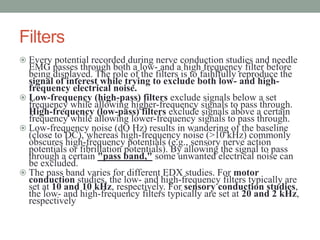
 Every potential recorded during nerve conduction studies and needle
EMG passes through both a low- and a high frequency filter before
being displayed. The role of the filters is to faihlfully reproduce the
signal of interest while trying to exclude both low- and high-
frequency electrical noise.
 Low-frequency (high-pass) filters exclude signals below a set
frequency while allowing higher-frequency signals to pass through.
High-frequency (low-pass) filters exclude signals above a certain
frequency while allowing lower-frequency signals to pass through.
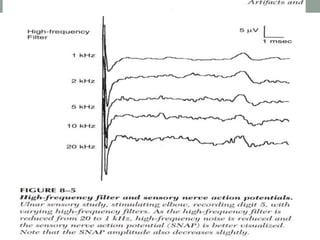
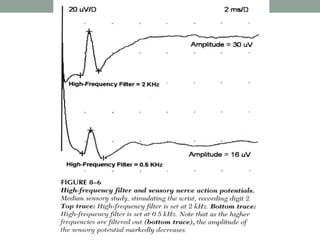
 Low-frequency noise (dO Hz) results in wandering of the baseline
(close to DC), whereas high-frequency noise (>10 kHz) commonly
obscures high-frequency potentials (e.g., sensory nerve action
potentials or fibrillation potentials). By allowing the signal to pass
through a certain "pass band," some unwanted electrical noise can
be excluded.
 The pass band varies for different EDX studies. For motor
conduction studies, the low- and high-frequency filters typically are
set at 10 and 10 kHz, respectively. For sensory conduction studies,
the low- and high-frequency filters typically are set at 20 and 2 kHz,
respectively
Electronic averaging
Stimulus artifact
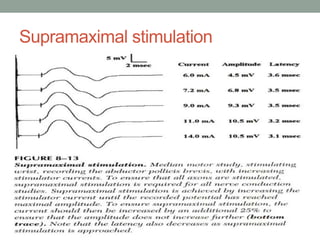
Supramaximal stimulation
Co stimulation
Electrode placement
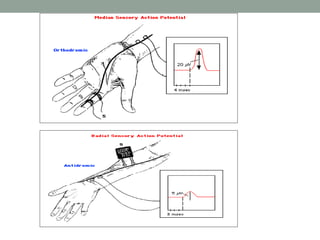
Anti and orthodromic stimulation
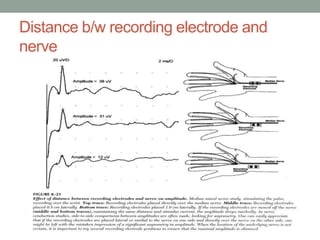
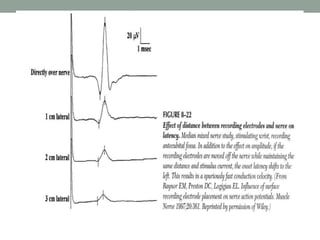
Distance b/w recording electrode and
nerve
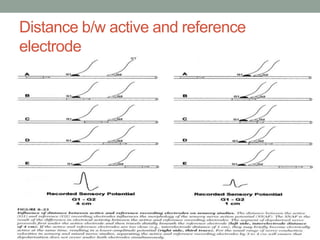
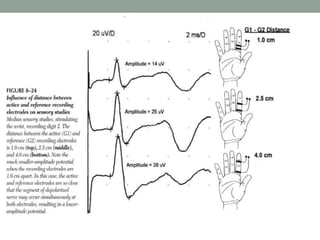
Distance b/w active and reference
electrode
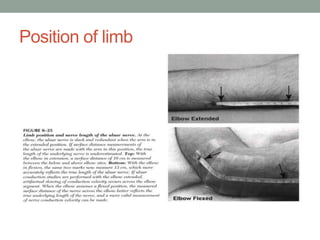
Position of limb
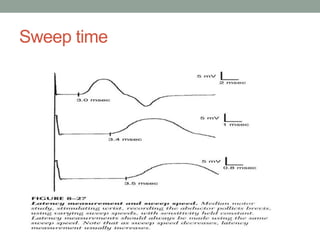
Sweep time
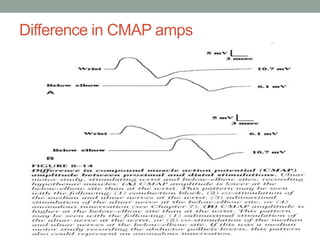
Difference in CMAP amps

Technical pitfalls in ncs

  • 1.
  • 2.
    Important technical factorsthat influencing NCS Physiological factors Temperature Age Height or length of nerve Proximal vs. distal nerve segment Anomalous innervation
  • 3.
    Non physiological Factors Electrode impedance mismatch and 60-Hz interference Filters Electronic averaging Stimulus artifact Cathode position: reversing stimulating polarity Supramaximal stimulation Co-stimulation of adjacent nerve
  • 4.
    Electrode placement formotor studies Antidromic versus orthodromic recording Distance between recording electrodes and nerve Distance between active and reference recording electrodes Limb position and distance measurements Sweep speed and sensitivity
  • 5.
  • 6.
  • 7.
  • 8.
    NERVE With # ofNerve Fibers/Axons One AXON AXON
  • 9.
  • 11.
    Age • Age mostprominently affects nerve conduction velocity and waveform morphology at the extremes of age. • One of the most important determinants of nerve conduction velocity is the presence and amount of myelin. The process of myelination is age dependent and begins in utero, with nerve conduction velocities in full-term infants approximately half those of adult normal values. Accordingly, nerve conduction velocities of 25 to 30 mls are considered normal at birth but would be in the demyelinating range for an adult. • Conduction velocity rapidly increases after birth, reaching approximately 75% of adult normal values by age 1 year and the adult range by age 3 to 5 years, when myelination is complete.
  • 12.
    Height  Taller individualscommonly have slower conduction velocities than do shorter individuals. This effect of nerve length also is reflected in the well-recognized finding that normal conduction velocities are slower in the lower extremities, where the limbs are longer, than in the upper extremities.  Two separate factors likely account for the effect of height or limb length on conduction velocity. First, nerves taper as they proceed distally. In general, the taller the individual, the longer the limb and the more tapered the distal nerve. Because conduction velocity is directly proportional to nerve diameter, the more distally tapered nerves in taller individuals conduct more slowly. By the same reasoning, nerves in the leg conduct more slowly than those in the arm because of longer limb length and more distal tapering.  Second, and not as well appreciated, is that limbs are cooler distally than proximally and the legs generally are cooler than the arms. Thus, conduction velocity slowing due to cooling usually is more prominent in the legs than in the arms.
  • 13.
    Cont… • In practice,the adjustment usually is no more than 2 to 4 mls below the lower limit of normal. For example, for an individual who is 6 feet 10 inches tall, a tibial conduction velocity of 38 mls (the normal lower limit of normal is 41 mls) should be considered within the normal range because of the effect of height. • The effect of height is especially relevant to the interpretation of late responses (F responses and H reflexes). The circuitry of these responses extends twice the length of the limb for the F response and twice the length of the proximal lower limb for the H reflex. • Normal values of absolute latency for these potentials must be based on limb length or height . Failure to do so will result in erroneously labeling of taller individuals as having "abnormal" late responses. • In some situations, however, the effect of height is not relevant, as when latencies are compared between a symptomatic and a contralateral asymptomatic limb.
  • 14.
    Filters  Every potentialrecorded during nerve conduction studies and needle EMG passes through both a low- and a high frequency filter before being displayed. The role of the filters is to faihlfully reproduce the signal of interest while trying to exclude both low- and high- frequency electrical noise.  Low-frequency (high-pass) filters exclude signals below a set frequency while allowing higher-frequency signals to pass through. High-frequency (low-pass) filters exclude signals above a certain frequency while allowing lower-frequency signals to pass through.  Low-frequency noise (dO Hz) results in wandering of the baseline (close to DC), whereas high-frequency noise (>10 kHz) commonly obscures high-frequency potentials (e.g., sensory nerve action potentials or fibrillation potentials). By allowing the signal to pass through a certain "pass band," some unwanted electrical noise can be excluded.  The pass band varies for different EDX studies. For motor conduction studies, the low- and high-frequency filters typically are set at 10 and 10 kHz, respectively. For sensory conduction studies, the low- and high-frequency filters typically are set at 20 and 2 kHz, respectively
  • 17.
  • 18.
  • 22.
  • 23.
  • 24.
  • 25.
  • 27.
    Distance b/w recordingelectrode and nerve
  • 29.
    Distance b/w activeand reference electrode
  • 31.
  • 33.
  • 34.

Editor's Notes

  • #11 Conduction velocity slows in a fairly linear manner within the normal physiologic range of limb temperature (approximately 21-34°C). For motor and sensory conduction velocities, conduction velocity slows between 1.5 and 2.5 m/s for every 1°C drop in temperature, and distal latency prolongs by approximately 0.2 ms per degree.
  • #20 During routine nerve conduction studies, the current from the stimulator depolarizes the underlying nerve, but it also spreads via volume conduction through the tissues within the limb and is seen at the recording electrodes. This stimulus artifact occurs in every nerve conduction study and serves a useful purpose by indicating when the shock occurred and from which point latencies should be measured. The stimulus artifact becomes problematic, however, if its trailing edge overlaps with the potential being recorded. This occurs most commonly when recording small potentials (i.e., sensory potentials) or when stimulating at very short distances. In those situations, the onset of the recorded potential may be obscured, possibly leading to inaccurate measurements of both amplitude and latency. There are several ways to reduce the trailing edge of the stimulus artifact.
  • #24  All measurements made in nerve conduction studies are based on the assumption that all axons of the nerve have been depolarized. Different degrees of current intensity are required in different anatomic locations and in different individuals in order to depolarize all nerve fibers. To ensure that all axons have been depolarized, supramaximal stimulation must be performed. To achieve supramaximal stimulation, one must slowly increase current intensity until a point is reached where the amplitude of the recorded potential no longer increases. At that point, one increases the current an additional 25% to ensure that the potential will not change further. If it does not, then it can be assumed that supramaximal stimulation has been achieved. Note that the latency decreases as supramaximal stimulation is approached.