CEREBELLAR DYSFUNCTION
By: SHAIKH AFRAN
Guided by: SALOME GVIDIANI MAM
FACTS TO REMEMBER
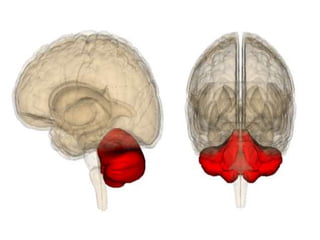
• Cerebellum or a little brain acts like younger sibling of
the large cerebrum.
• It control tone, posture, equilibrium and fine
movements of the body. It cannot initiate the
movement.
• Its is connected by cerebellar peduncle (inferiorly,
middelly and superiorly).
• Number of the neurons is about half of the cerebrum,
though is much smaller than the cerebrum.
• Its structure is uniform through out, i.e. homotypical.
• Its control is ipsilateral.
ANATOMICAL LOBES AND FUNTIONAL
LOBES
• Anterior(spinocerebellum) lobe: control
axial(trunk), limb muscles and postural reflexes.
• Posterior(neocerebellum) lobe: control skilled
voluntary muscles.
• Flocculonodular lobe: (related to vestibular
apparatus) control body posture balance,
equilibrium and maintaining visual fixation.
CEREBELLAR DYSFUNCTION: ATAXIA
What is ataxia ?
• It is a disorder that occurs when cerebellum is
inflamed(cerebellitis) or damged.
• Lack of the muscle coordinations.
• Affect the control of muscles: walking or picking,
effect in upper limb, lower limb and all voluntary
muscles.
• Ataxia can effects the various movements.
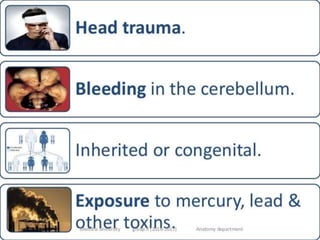
CAUSES OF ATAXIA
• Damage, degeneration or loss of nerve cells in
the part of cerebellum.
• Destroy the part of the brain(cerebellum) that
controls muscle coordinations.
• Caused by cerebellar lesionor(localised) and
vermis lession(effect both side).
[ Note: common cause is thrombosis, tumor and
injuries]
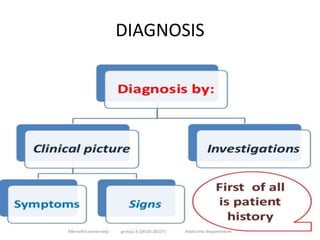
DIAGNOSIS
CLINICALLY SYMTOMS (ATAXIA
EFFECTS)
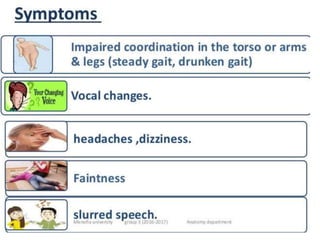
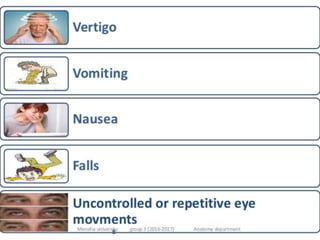
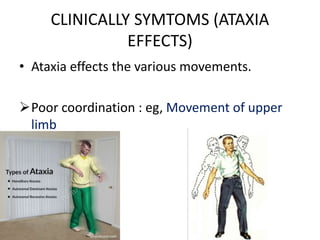
• Ataxia effects the various movements.
Poor coordination : eg, Movement of upper
limb
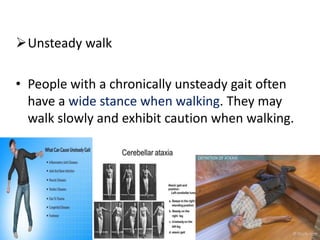
Unsteady walk
• People with a chronically unsteady gait often
have a wide stance when walking. They may
walk slowly and exhibit caution when walking.
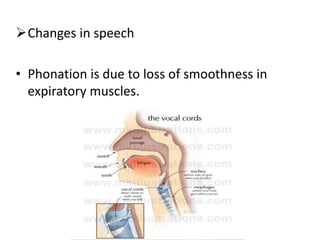
Changes in speech
• Phonation is due to loss of smoothness in
expiratory muscles.
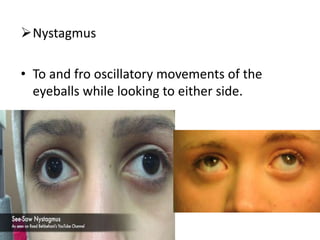
Nystagmus
• To and fro oscillatory movements of the
eyeballs while looking to either side.
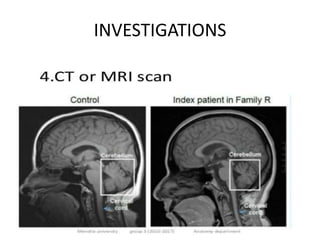
INVESTIGATIONS
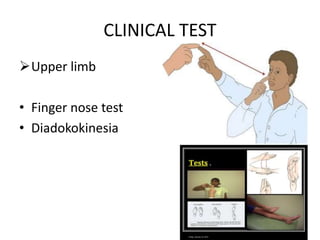
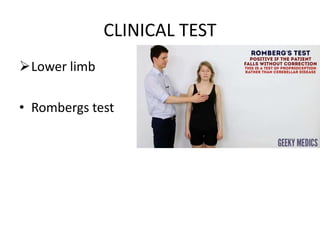
CLINICAL TEST
Upper limb
• Finger nose test
• Diadokokinesia
CLINICAL TEST
Lower limb
• Rombergs test
TREATMENT
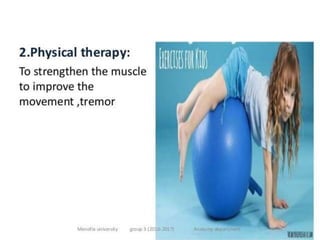
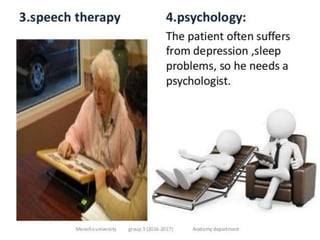
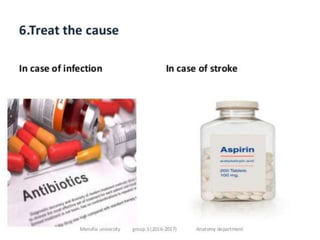
 Ataxia is generally not curable but we can just
ease the symptoms to make the patients life
better.
[http://puhuahospital.com/case-
studies/ataxia/omar?gclid=Cj0KCQjwsvrpBRCsARI
sAKBR_0JKxSec95R6Mkl5cvlEwjzPiobM_S8-
qXaNQjFCqdNVA6KnMdUn4E8aAmfXEALw_wcB]
cerebellar dysfunction-ppt

cerebellar dysfunction-ppt

  • 1.
    CEREBELLAR DYSFUNCTION By: SHAIKHAFRAN Guided by: SALOME GVIDIANI MAM
  • 2.
    FACTS TO REMEMBER •Cerebellum or a little brain acts like younger sibling of the large cerebrum. • It control tone, posture, equilibrium and fine movements of the body. It cannot initiate the movement. • Its is connected by cerebellar peduncle (inferiorly, middelly and superiorly). • Number of the neurons is about half of the cerebrum, though is much smaller than the cerebrum. • Its structure is uniform through out, i.e. homotypical. • Its control is ipsilateral.
  • 3.
    ANATOMICAL LOBES ANDFUNTIONAL LOBES • Anterior(spinocerebellum) lobe: control axial(trunk), limb muscles and postural reflexes. • Posterior(neocerebellum) lobe: control skilled voluntary muscles. • Flocculonodular lobe: (related to vestibular apparatus) control body posture balance, equilibrium and maintaining visual fixation.
  • 4.
    CEREBELLAR DYSFUNCTION: ATAXIA Whatis ataxia ? • It is a disorder that occurs when cerebellum is inflamed(cerebellitis) or damged. • Lack of the muscle coordinations. • Affect the control of muscles: walking or picking, effect in upper limb, lower limb and all voluntary muscles. • Ataxia can effects the various movements.
  • 6.
    CAUSES OF ATAXIA •Damage, degeneration or loss of nerve cells in the part of cerebellum. • Destroy the part of the brain(cerebellum) that controls muscle coordinations. • Caused by cerebellar lesionor(localised) and vermis lession(effect both side). [ Note: common cause is thrombosis, tumor and injuries]
  • 9.
  • 12.
    CLINICALLY SYMTOMS (ATAXIA EFFECTS) •Ataxia effects the various movements. Poor coordination : eg, Movement of upper limb
  • 13.
    Unsteady walk • Peoplewith a chronically unsteady gait often have a wide stance when walking. They may walk slowly and exhibit caution when walking.
  • 14.
    Changes in speech •Phonation is due to loss of smoothness in expiratory muscles.
  • 15.
    Nystagmus • To andfro oscillatory movements of the eyeballs while looking to either side.
  • 16.
  • 17.
    CLINICAL TEST Upper limb •Finger nose test • Diadokokinesia
  • 18.
  • 19.
    TREATMENT  Ataxia isgenerally not curable but we can just ease the symptoms to make the patients life better. [http://puhuahospital.com/case- studies/ataxia/omar?gclid=Cj0KCQjwsvrpBRCsARI sAKBR_0JKxSec95R6Mkl5cvlEwjzPiobM_S8- qXaNQjFCqdNVA6KnMdUn4E8aAmfXEALw_wcB]