Review of DSM5 Mental Disorders for NCMHCE Study
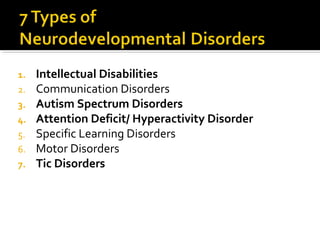
1. Intellectual Disabilities
2. Communication Disorders
3. Autism Spectrum Disorders
4. Attention Deficit/ Hyperactivity Disorder
5. Specific Learning Disorders
6. Motor Disorders
7. Tic Disorders
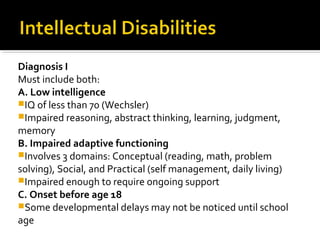
Diagnosis I
Must include both:
A. Low intelligence
IQ of less than 70 (Wechsler)
Impaired reasoning, abstract thinking, learning, judgment,
memory
B. Impaired adaptive functioning
Involves 3 domains: Conceptual (reading, math, problem
solving), Social, and Practical (self management, daily living)
Impaired enough to require ongoing support
C. Onset before age 18
Some developmental delays may not be noticed until school
age
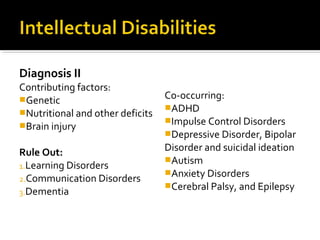
Diagnosis II
Contributing factors:
Genetic
Nutritional and other deficits
Brain injury
Rule Out:
1.Learning Disorders
2.Communication Disorders
3.Dementia
Co-occurring:
ADHD
Impulse Control Disorders
Depressive Disorder, Bipolar
Disorder and suicidal ideation
Autism
Anxiety Disorders
Cerebral Palsy, and Epilepsy
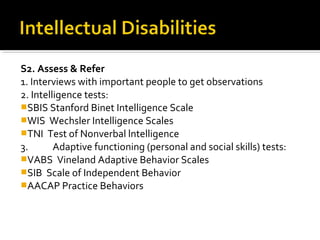
S2. Assess & Refer
1. Interviews with important people to get observations
2. Intelligence tests:
SBIS Stanford Binet Intelligence Scale
WIS Wechsler Intelligence Scales
TNI Test of Nonverbal lntelligence
3. Adaptive functioning (personal and social skills) tests:
VABS Vineland Adaptive Behavior Scales
SIB Scale of Independent Behavior
AACAP Practice Behaviors
S4. Treatments
1. Education
2. Skills Training
Life skills
Social skills
Diagnosis I
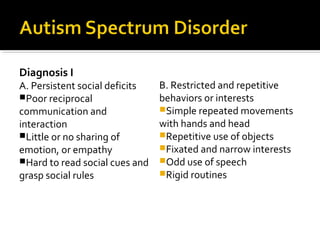
A. Persistent social deficits
Poor reciprocal
communication and
interaction
Little or no sharing of
emotion, or empathy
Hard to read social cues and
grasp social rules
B. Restricted and repetitive
behaviors or interests
Simple repeated movements
with hands and head
Repetitive use of objects
Fixated and narrow interests
Odd use of speech
Rigid routines
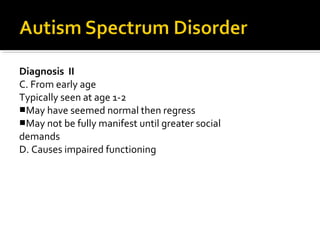
Diagnosis II
C. From early age
Typically seen at age 1-2
May have seemed normal then regress
May not be fully manifest until greater social
demands
D. Causes impaired functioning
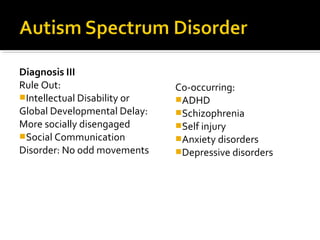
Diagnosis III
Rule Out:
Intellectual Disability or
Global Developmental Delay:
More socially disengaged
Social Communication
Disorder: No odd movements
Co-occurring:
ADHD
Schizophrenia
Self injury
Anxiety disorders
Depressive disorders
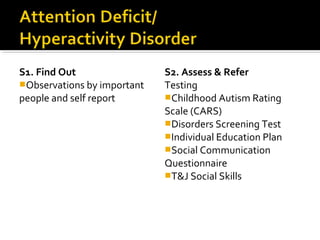
S1. Find Out
Observations by important
people and self report
S2. Assess & Refer
Testing
Childhood Autism Rating
Scale (CARS)
Disorders Screening Test
Individual Education Plan
Social Communication
Questionnaire
T&J Social Skills
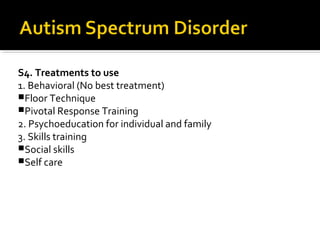
S4. Treatments to use
1. Behavioral (No best treatment)
Floor Technique
Pivotal Response Training
2. Psychoeducation for individual and family
3. Skills training
Social skills
Self care
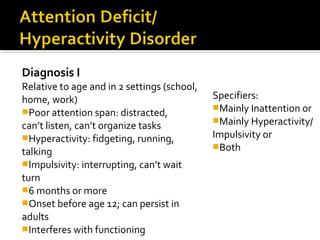
Diagnosis I
Relative to age and in 2 settings (school,
home, work)
Poor attention span: distracted,
can’t listen, can’t organize tasks
Hyperactivity: fidgeting, running,
talking
Impulsivity: interrupting, can’t wait
turn
6 months or more
Onset before age 12; can persist in
adults
Interferes with functioning
Specifiers:
Mainly Inattention or
Mainly Hyperactivity/
Impulsivity or
Both
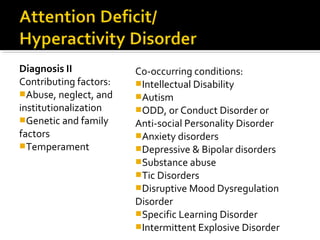
Diagnosis II
Contributing factors:
Abuse, neglect, and
institutionalization
Genetic and family
factors
Temperament
Co-occurring conditions:
Intellectual Disability
Autism
ODD, or Conduct Disorder or
Anti-social Personality Disorder
Anxiety disorders
Depressive & Bipolar disorders
Substance abuse
Tic Disorders
Disruptive Mood Dysregulation
Disorder
Specific Learning Disorder
Intermittent Explosive Disorder
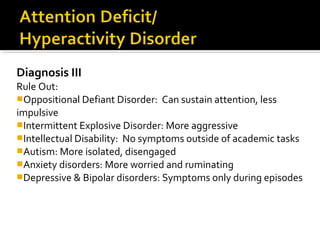
Diagnosis III
Rule Out:
Oppositional Defiant Disorder: Can sustain attention, less
impulsive
Intermittent Explosive Disorder: More aggressive
Intellectual Disability: No symptoms outside of academic tasks
Autism: More isolated, disengaged
Anxiety disorders: More worried and ruminating
Depressive & Bipolar disorders: Symptoms only during episodes
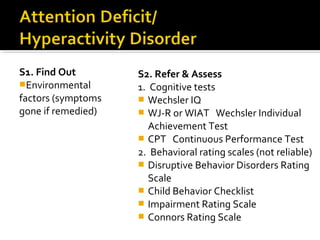
S1. Find Out
Environmental
factors (symptoms
gone if remedied)
S2. Refer & Assess
1. Cognitive tests
 Wechsler IQ
 WJ-R or WIAT Wechsler Individual
Achievement Test
 CPT Continuous Performance Test
2. Behavioral rating scales (not reliable)
 Disruptive Behavior Disorders Rating
Scale
 Child Behavior Checklist
 Impairment Rating Scale
 Connors Rating Scale
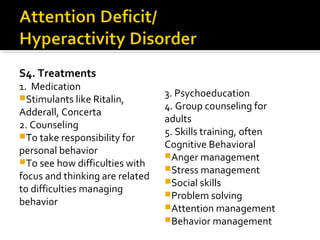
S4. Treatments
1. Medication
Stimulants like Ritalin,
Adderall, Concerta
2. Counseling
To take responsibility for
personal behavior
To see how difficulties with
focus and thinking are related
to difficulties managing
behavior
3. Psychoeducation
4. Group counseling for
adults
5. Skills training, often
Cognitive Behavioral
Anger management
Stress management
Social skills
Problem solving
Attention management
Behavior management
S5. Monitoring
Self report and observation of overt
behavior regarding:
Interrupting others
Inability to delay getting what
they want
Acting without thinking about
consequences
Forgetting what they are saying or
what someone just said
Losing focus when talking
S6. Termination
Diagnosis
Tic: Sudden, rapid, repeating
movement or vocalization
Involving face, head and limbs
1. May come and go
2. Onset before age 18
Typically before age 6, peaking by
age 12
Tourette’s Disorder
Most severe
Both motor and vocal tics present,
including offensive outbursts
Over 1 year
Co-Occurring:
ADHD
OCD
Rule Out:
Obsessive
Compulsive
disorders: More
cognitive and
complex
S1. Find Out S2. Assess & Refer
Test
Yale Global Tic Severity
Scale
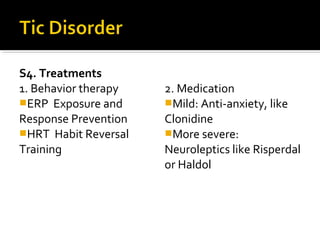
S4. Treatments
1. Behavior therapy
ERP Exposure and
Response Prevention
HRT Habit Reversal
Training
2. Medication
Mild: Anti-anxiety, like
Clonidine
More severe:
Neuroleptics like Risperdal
or Haldol

Neurodevelopmental Disorders for NCMHCE Study

  • 1.
    Review of DSM5Mental Disorders for NCMHCE Study
  • 2.
    1. Intellectual Disabilities 2.Communication Disorders 3. Autism Spectrum Disorders 4. Attention Deficit/ Hyperactivity Disorder 5. Specific Learning Disorders 6. Motor Disorders 7. Tic Disorders
  • 4.
    Diagnosis I Must includeboth: A. Low intelligence IQ of less than 70 (Wechsler) Impaired reasoning, abstract thinking, learning, judgment, memory B. Impaired adaptive functioning Involves 3 domains: Conceptual (reading, math, problem solving), Social, and Practical (self management, daily living) Impaired enough to require ongoing support C. Onset before age 18 Some developmental delays may not be noticed until school age
  • 5.
    Diagnosis II Contributing factors: Genetic Nutritionaland other deficits Brain injury Rule Out: 1.Learning Disorders 2.Communication Disorders 3.Dementia Co-occurring: ADHD Impulse Control Disorders Depressive Disorder, Bipolar Disorder and suicidal ideation Autism Anxiety Disorders Cerebral Palsy, and Epilepsy
  • 6.
    S2. Assess &Refer 1. Interviews with important people to get observations 2. Intelligence tests: SBIS Stanford Binet Intelligence Scale WIS Wechsler Intelligence Scales TNI Test of Nonverbal lntelligence 3. Adaptive functioning (personal and social skills) tests: VABS Vineland Adaptive Behavior Scales SIB Scale of Independent Behavior AACAP Practice Behaviors
  • 7.
    S4. Treatments 1. Education 2.Skills Training Life skills Social skills
  • 9.
    Diagnosis I A. Persistentsocial deficits Poor reciprocal communication and interaction Little or no sharing of emotion, or empathy Hard to read social cues and grasp social rules B. Restricted and repetitive behaviors or interests Simple repeated movements with hands and head Repetitive use of objects Fixated and narrow interests Odd use of speech Rigid routines
  • 10.
    Diagnosis II C. Fromearly age Typically seen at age 1-2 May have seemed normal then regress May not be fully manifest until greater social demands D. Causes impaired functioning
  • 11.
    Diagnosis III Rule Out: IntellectualDisability or Global Developmental Delay: More socially disengaged Social Communication Disorder: No odd movements Co-occurring: ADHD Schizophrenia Self injury Anxiety disorders Depressive disorders
  • 12.
    S1. Find Out Observationsby important people and self report S2. Assess & Refer Testing Childhood Autism Rating Scale (CARS) Disorders Screening Test Individual Education Plan Social Communication Questionnaire T&J Social Skills
  • 13.
    S4. Treatments touse 1. Behavioral (No best treatment) Floor Technique Pivotal Response Training 2. Psychoeducation for individual and family 3. Skills training Social skills Self care
  • 15.
    Diagnosis I Relative toage and in 2 settings (school, home, work) Poor attention span: distracted, can’t listen, can’t organize tasks Hyperactivity: fidgeting, running, talking Impulsivity: interrupting, can’t wait turn 6 months or more Onset before age 12; can persist in adults Interferes with functioning Specifiers: Mainly Inattention or Mainly Hyperactivity/ Impulsivity or Both
  • 16.
    Diagnosis II Contributing factors: Abuse,neglect, and institutionalization Genetic and family factors Temperament Co-occurring conditions: Intellectual Disability Autism ODD, or Conduct Disorder or Anti-social Personality Disorder Anxiety disorders Depressive & Bipolar disorders Substance abuse Tic Disorders Disruptive Mood Dysregulation Disorder Specific Learning Disorder Intermittent Explosive Disorder
  • 17.
    Diagnosis III Rule Out: OppositionalDefiant Disorder: Can sustain attention, less impulsive Intermittent Explosive Disorder: More aggressive Intellectual Disability: No symptoms outside of academic tasks Autism: More isolated, disengaged Anxiety disorders: More worried and ruminating Depressive & Bipolar disorders: Symptoms only during episodes
  • 18.
    S1. Find Out Environmental factors(symptoms gone if remedied) S2. Refer & Assess 1. Cognitive tests  Wechsler IQ  WJ-R or WIAT Wechsler Individual Achievement Test  CPT Continuous Performance Test 2. Behavioral rating scales (not reliable)  Disruptive Behavior Disorders Rating Scale  Child Behavior Checklist  Impairment Rating Scale  Connors Rating Scale
  • 19.
    S4. Treatments 1. Medication Stimulantslike Ritalin, Adderall, Concerta 2. Counseling To take responsibility for personal behavior To see how difficulties with focus and thinking are related to difficulties managing behavior 3. Psychoeducation 4. Group counseling for adults 5. Skills training, often Cognitive Behavioral Anger management Stress management Social skills Problem solving Attention management Behavior management
  • 20.
    S5. Monitoring Self reportand observation of overt behavior regarding: Interrupting others Inability to delay getting what they want Acting without thinking about consequences Forgetting what they are saying or what someone just said Losing focus when talking S6. Termination
  • 22.
    Diagnosis Tic: Sudden, rapid,repeating movement or vocalization Involving face, head and limbs 1. May come and go 2. Onset before age 18 Typically before age 6, peaking by age 12 Tourette’s Disorder Most severe Both motor and vocal tics present, including offensive outbursts Over 1 year Co-Occurring: ADHD OCD Rule Out: Obsessive Compulsive disorders: More cognitive and complex
  • 23.
    S1. Find OutS2. Assess & Refer Test Yale Global Tic Severity Scale
  • 24.
    S4. Treatments 1. Behaviortherapy ERP Exposure and Response Prevention HRT Habit Reversal Training 2. Medication Mild: Anti-anxiety, like Clonidine More severe: Neuroleptics like Risperdal or Haldol