Autism Spectrum DisorderSara Grona
What is Autism Spectrum Disorder?Autism Spectrum Disorder (Pervasive Developmental Disorder) that primarily affects social interactions,communicationand behaviourIt is referred to as a “spectrum disorder”, meaning that its symptoms and characteristics can present themselves in a variety of combinations, ranging from mild to quite severe
Pervasive Developmental Disorder
AutismBiological (but unknown) 4 times more likely to be found in boys over girlsAbout 1 in every 150 births will be affectedAppears in the first 3 years of lifeProblems with social interaction, pretend play, and communicationHave a limited range of activities and interests. Many (nearly 75%) of children with autism also have some degree of mental retardation.
Asperger Syndrome400,000 families are affected by Asperger Syndrome (AS)Onset of AS is later than what is typical in autism — or at least it is recognized later.Many kids are diagnosed after age 3Motor delays, clumsiness, limited interests, and peculiar preoccupationsThey usually have good grammatical skills and an advanced vocabulary at an early age.Typically exhibit a language disorder — they might be very literal and have trouble using language in a social context.Problems with attention span and organizationAverage and sometimes above-average intelligence.Research indicates that in some cases AS may be associated with other mental health disorders such as depression and bipolar disorder
Rett Syndrome1 per 10,000-22,000 girls are affectedSuffer the loss of many motor or movement, skills -- such as walking and use of their hands -- and develop poor coordination. Almost always affects girls.Normal development during the first 6-18 months of life followed first by a period of stagnation and then by rapid regression in motor and language skills. Screaming fits and inconsolable crying are common.Key features include loss of speech, behavior reminiscent of autism, panic-like attacks, grinding teeth, hyperventilation, small headThe girls typically survive into adulthood but are at risk of sudden unexplained deathChildhood Disintegrative DisorderChildren with this rare condition begin their development normally in all areas, physical and mental. At some point, usually between 2 and 10 years of age, a child with this illness loses many of the skills he or she has developed.In addition to the loss of social and language skills,  he/she may lose control of other functions, including bowel and bladder control.
Pervasive Developmental Disorder Not Otherwise Specified (PDDNOS)Identified around age 3Delays in the development of many basic skillsability to socialize with othersto communicateto use imagination.Children with these conditions often are confused in their thinking and generally have problems understanding the world around themrefer to children who have significant problems with communication and play, and some difficulty interacting with others, but are too social to be considered autistic.
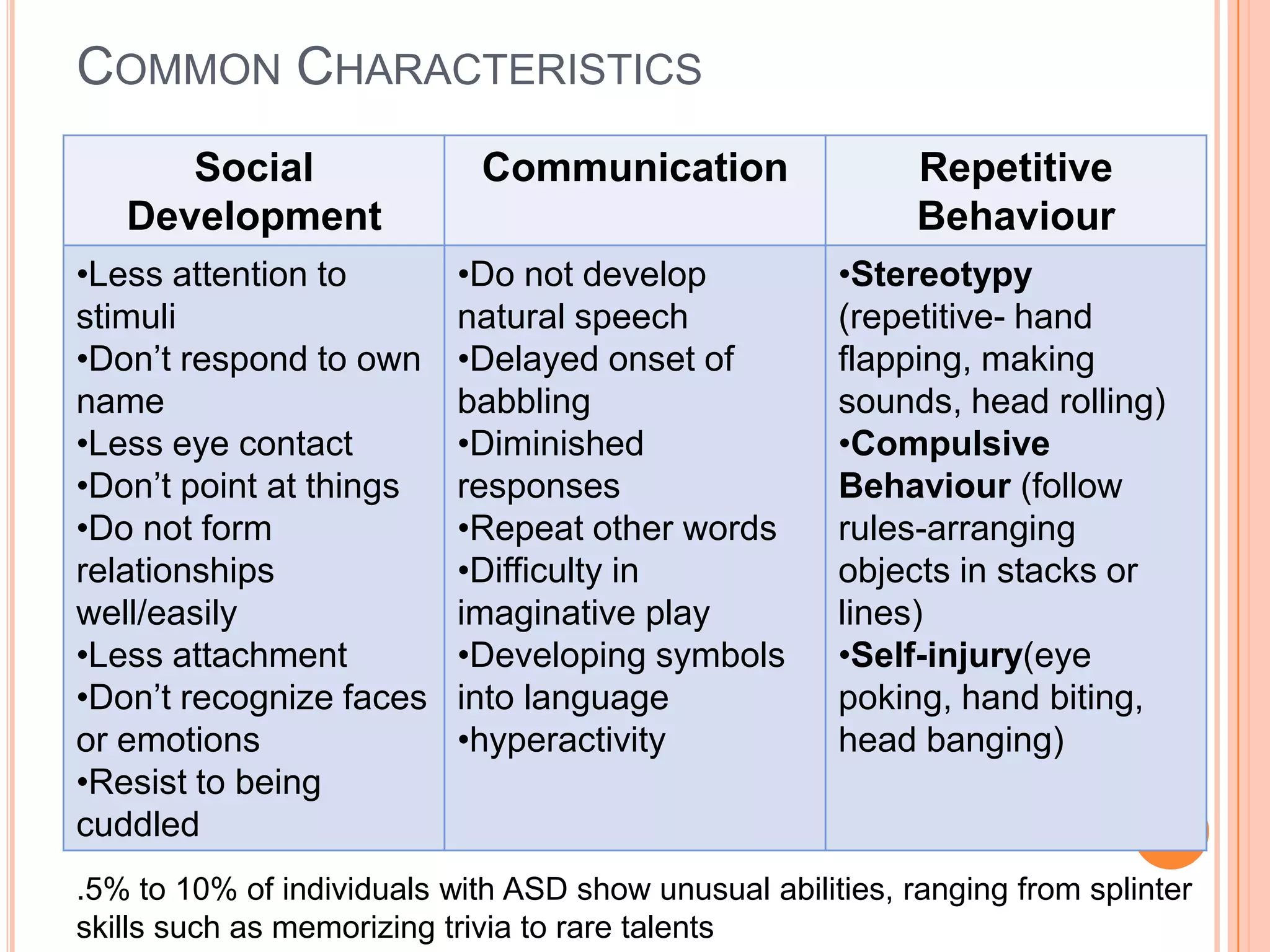
Common Characteristics.5% to 10% of individuals with ASD show unusual abilities, ranging from splinter skills such as memorizing trivia to rare talents
Classroom AdaptationsRemember these students present a wide range of characteristics, strengths and weaknesses.Treat each child as unique individualPeer buddiesLearn aboutthe spectrumand the child’s developmentFoster an atmosphere of shared decision makingPrepare the class for the child with autism (with consent)Use literal language (avoid idioms, jokes, sarcasm)Clear instructionsPraise and rewards for positive behavioursColor coding, separating binder for the student (organization)Daily schedules (on desk, binder, locker)IEP specific
Promoting Inclusive ClassroomsUse consistent classroom routinesGive visual instructionsWatch for signs of high anxieties or difficultiesStructure the layout of the classroomExplain purpose of assignmentsProvide written rubricsUse special interests to introduce new & difficult taskAssign individual roles for group work
Environmental SupportsCommunication with the studentSlow down the paceState positively what to do (“let’s walk instead of “stop running”)Provide information visuallyCommunication from the studentPause, listen, waitEncourage input and choice when possibleProvide alternative means (written or pictures)Social SupportsPractice specific skills through natural activitiesProvide cooperative learning activitiesExpanding interests of studentCapitalize on strengthsMinimize fears and frustrationsUse rehearsal with visuals
bibliographyhttp://eslhq.com/worksheetshttp://kidshealth.org/parent/medical/brain/asperger.html#http://www.medicinenet.com/pervasive_development_disorders/article.htmhttp://teacch.com/about-autismSmith, T., Polloway, E., Patton, J., Dowdy, C., Heath, N., McIntyre, L., Francis, G. Teaching Students with Special Needs in Inclusive Settings. 2nd ed. Toronto, Ontario: Pearson Education Canada, 2006. 221-228. Print.

Autism Spectrum Disorder

  • 1.
  • 2.
    What is AutismSpectrum Disorder?Autism Spectrum Disorder (Pervasive Developmental Disorder) that primarily affects social interactions,communicationand behaviourIt is referred to as a “spectrum disorder”, meaning that its symptoms and characteristics can present themselves in a variety of combinations, ranging from mild to quite severe
  • 3.
  • 4.
    AutismBiological (but unknown)4 times more likely to be found in boys over girlsAbout 1 in every 150 births will be affectedAppears in the first 3 years of lifeProblems with social interaction, pretend play, and communicationHave a limited range of activities and interests. Many (nearly 75%) of children with autism also have some degree of mental retardation.
  • 5.
    Asperger Syndrome400,000 familiesare affected by Asperger Syndrome (AS)Onset of AS is later than what is typical in autism — or at least it is recognized later.Many kids are diagnosed after age 3Motor delays, clumsiness, limited interests, and peculiar preoccupationsThey usually have good grammatical skills and an advanced vocabulary at an early age.Typically exhibit a language disorder — they might be very literal and have trouble using language in a social context.Problems with attention span and organizationAverage and sometimes above-average intelligence.Research indicates that in some cases AS may be associated with other mental health disorders such as depression and bipolar disorder
  • 6.
    Rett Syndrome1 per10,000-22,000 girls are affectedSuffer the loss of many motor or movement, skills -- such as walking and use of their hands -- and develop poor coordination. Almost always affects girls.Normal development during the first 6-18 months of life followed first by a period of stagnation and then by rapid regression in motor and language skills. Screaming fits and inconsolable crying are common.Key features include loss of speech, behavior reminiscent of autism, panic-like attacks, grinding teeth, hyperventilation, small headThe girls typically survive into adulthood but are at risk of sudden unexplained deathChildhood Disintegrative DisorderChildren with this rare condition begin their development normally in all areas, physical and mental. At some point, usually between 2 and 10 years of age, a child with this illness loses many of the skills he or she has developed.In addition to the loss of social and language skills, he/she may lose control of other functions, including bowel and bladder control.
  • 7.
    Pervasive Developmental DisorderNot Otherwise Specified (PDDNOS)Identified around age 3Delays in the development of many basic skillsability to socialize with othersto communicateto use imagination.Children with these conditions often are confused in their thinking and generally have problems understanding the world around themrefer to children who have significant problems with communication and play, and some difficulty interacting with others, but are too social to be considered autistic.
  • 8.
    Common Characteristics.5% to10% of individuals with ASD show unusual abilities, ranging from splinter skills such as memorizing trivia to rare talents
  • 9.
    Classroom AdaptationsRemember thesestudents present a wide range of characteristics, strengths and weaknesses.Treat each child as unique individualPeer buddiesLearn aboutthe spectrumand the child’s developmentFoster an atmosphere of shared decision makingPrepare the class for the child with autism (with consent)Use literal language (avoid idioms, jokes, sarcasm)Clear instructionsPraise and rewards for positive behavioursColor coding, separating binder for the student (organization)Daily schedules (on desk, binder, locker)IEP specific
  • 10.
    Promoting Inclusive ClassroomsUseconsistent classroom routinesGive visual instructionsWatch for signs of high anxieties or difficultiesStructure the layout of the classroomExplain purpose of assignmentsProvide written rubricsUse special interests to introduce new & difficult taskAssign individual roles for group work
  • 11.
    Environmental SupportsCommunication withthe studentSlow down the paceState positively what to do (“let’s walk instead of “stop running”)Provide information visuallyCommunication from the studentPause, listen, waitEncourage input and choice when possibleProvide alternative means (written or pictures)Social SupportsPractice specific skills through natural activitiesProvide cooperative learning activitiesExpanding interests of studentCapitalize on strengthsMinimize fears and frustrationsUse rehearsal with visuals
  • 12.
    bibliographyhttp://eslhq.com/worksheetshttp://kidshealth.org/parent/medical/brain/asperger.html#http://www.medicinenet.com/pervasive_development_disorders/article.htmhttp://teacch.com/about-autismSmith, T., Polloway,E., Patton, J., Dowdy, C., Heath, N., McIntyre, L., Francis, G. Teaching Students with Special Needs in Inclusive Settings. 2nd ed. Toronto, Ontario: Pearson Education Canada, 2006. 221-228. Print.