Dr Parag Moon
Senior resident,
Dept. of Neurology,
GMC, Kota.
 A disorder in one or more of basic psychological
processes involved in understanding or in using
language, spoken or written, that may manifest
itself in imperfect ability to listen, think, speak,
read, write, spell, or to do mathematical
calculations, including conditions such as
perceptual disabilities, brain injury, minimal brain
dysfunction, dyslexia, and developmental aphasia.
[Individuals with disability education act IDEA
2004]
 Disorders not included- learning problems
that are primarily result
 Visual, hearing, or motor disabilities
 Mental retardation
 Emotional disturbance
 Environmental, cultural, or economic
disadvantage.
 Characterized by academic underachievement
in reading, written expression, or
mathematics in comparison with overall
intellectual ability of child.
 Children with learning disorders often find it
difficult to keep up with their peers in certain
academic subjects, whereas they excel in
others.
 Significant difference between student’s
scores on test of general intelligence (e.g. IQ
test such as WISC-IV) and scores obtained on
achievement test (e.g. Woodcock Johnson
Achievement Test).
 If score on IQ test at least two standard
deviations (30 points) higher than his or her
scores on achievement-learning disability.
 Heredity- tends to run in families
 Illness or injury during pregnancy and
delivery- use of drugs, alcohol during
pregnancy, RH incompatibility, premature or
prolonged labor or lack of oxygen or low
weight at birth.
 Incidents after birth. Head injuries, nutritional
deprivation, poisonous substances, (e.g.,
lead), and child abuse can contribute.
 5% of children suffer from some form of
learning disability.
 Dyslexia most common-80-85%.
 Twice as common in males as in females
 25% of Learning disabilities have associated
Attention Deficit/Hyperactive Disorder-ADHD
 35% of children with learning disabilities drop
out of high school.
• Dyslexia
A language and reading
disability
• Dyscalculia
Problems with arithmetic and
math concepts
• Dysgraphia
A writing disorder resulting in
illegibility
• Dyspraxia (Sensory Integration
Disorder)
Problems with motor
coordination
• Central Auditory Processing
Disorder
Difficulty processing and
remembering language-related
tasks
• Non-Verbal Learning Disorders
Trouble with nonverbal cues, e.g.,
body language; poor coordination,
clumsy
• Visual Perceptual/Visual Motor
Deficit
Reverses letters; cannot copy
accurately;
• Language Disorders
(Aphasia/Dysphasia)
Trouble understanding spoken
language; poor reading
comprehension
 Reading achievement below expected level
for child's age, education, & intelligence, with
impairment interfering significantly with
academic success or daily activities involving
reading
 Developmental alexia-developmental deficit
in recognition of printed symbols
 Dyslexia replaced by broader term learning
disorder
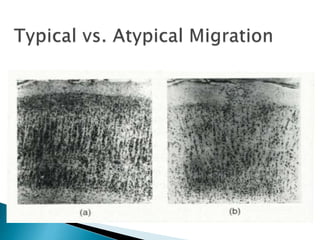
 Described as neurobiological disorder with a
genetic origin.
 Deficit in phonological processing skills.
 Asymmetry of left planum temporale
 Lesion in splenium of corpus callosum
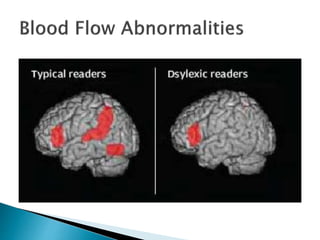
 Altered left temporal blood flow
 Visual magnocellular system (which normally
contains large cells) containing more
disorganized and smaller cell bodies than
expected.
 Genetic- 35 to 40% of first-degree relatives of
reading disorder have some reading disability
 Usually identified by 7 years (second grade)
 Characterized by omissions, additions and
distortions of words.
 Have difficulty in distinguishing between printed
letter characters and sizes, especially those that
differ only in spatial orientation and length of
line.
 Child's reading speed is slow, often with minimal
comprehension.
 May start a word either in middle or at end of
printed or written sentence
 Have age appropriate ability to copy from written
or printed text, but nearly all spell poorly.
 Problems pronouncing multisyllabic words
(e.g.“aminals” for“animals” and “sblanation”
for “explanation”).
 Many false starts, hesitations, and nonspecific
terms
 Dislike and avoid reading and writing.
1. Reading achievement, as measured by
individually administered standardized tests of
reading accuracy or comprehension, is
substantially below that expected given
person's chronological age, measured
intelligence, and age-appropriate education.
2. Disturbance in Criterion A significantly
interferes with academic achievement or
activities of daily living that require reading
skills.
3. If sensory deficit is present, reading difficulties
are in excess of those usually associated with
it.
1. Either of following must be present:
I. Score on reading accuracy and/or comprehension at least
2 standard errors of prediction below level expected on
basis of child's chronological age and general
intelligence, with both reading skills and IQ assessed on
individually administered test standardized for child's
culture and educational system.
II. History of serious reading difficulties, or test scores that
met Criterion A(1) at earlier age, plus score on spelling
test that at least 2 standard errors of prediction below
level expected on basis of child's chronological age and
IQ.
2. Disturbance described in Criterion A significantly interferes
with academic achievement or with activities of daily living
that require reading skills.
3. Disorder is not direct result of defect in
visual or hearing acuity, or of neurological
disorder.
4. School experiences within average
expectable range (i.e., there have been no
extreme inadequacies in educational
experiences).
5. Exclusion clause: IQ is below 70 on
individually administered standardized
test.
 Special individual educational programmes
 Teaching child to make accurate associations
between letters and sounds.
 After individual letter-sound have been
mastered, remediation can target larger
components of reading such as syllables and
words.
 Positive coping strategies include small,
structured reading groups that offer
individual attention and make it easier for
child to ask for help.
 Orton Gillingham, Direct Instructional System for
Teaching and Remediation (DISTAR), Merill
program, Science Research Associates, Inc. (SRA)
Basic Reading Program,
 Introducing whole words first and then teach
children how to break them down and recognize
sounds of syllables and individual letters in word.
 Teaches to recognize whole words through use
of visual aids and bypasses sounding-out
process.
 Parent counselling
 Treatment of coexisting emotional and
behavioral problems
 Dyscalculia, congenital arithmetic disorder, acalculia,
and developmental arithmetic disorder
 Have difficulty learning and remembering numerals,
cannot remember basic facts about numbers, are
slow and inaccurate in computation.
 Poor achievement in four groups of skills:
◦ Linguistic skills (those related to understanding
mathematical terms and converting written problems into
mathematical symbols)
◦ Perceptual skills (ability to recognize and understand
symbols and order clusters of numbers)
◦ Mathematical skills (basic addition, subtraction,
multiplication, division, and following sequencing of basic
operations)
◦ Attentional skills (copying figures correctly and observing
operational symbols correctly).
 Affect 1 percent of school-age children
 More common in females
 Comorbid with reading disorder and disorder
of written expression.
 Early theory-neurological deficit in right
cerebral hemisphere
 Currently, cause is thought multifactorial-
maturational, cognitive, emotional,
educational, and socioeconomic factors
 Detected during 2nd and 3rd grades
 Difficulty in learning number names,
remembering signs for addition and
subtraction, learning multiplication tables,
translating word problems into computations,
doing calculations at expected pace.
 Has significant problems with concepts, such
as counting and adding even one-digit
numbers, compared with classmates of same
age.
 Classified mathematics disorder following:
1. Difficulty learning to count meaningfully;
2. Difficulty mastering cardinal and ordinal
systems;
3. Difficulty performing arithmetic operations
4. Difficulty envisioning clusters of objects as
groups.
 Mathematical ability, as measured by individually
administered standardized tests, is substantially
below that expected given person's chronological
age, measured intelligence, and age-appropriate
education.
 Disturbance in Criterion A significantly interferes
with academic achievement or activities of daily
living that require mathematical ability.
 If a sensory deficit is present, difficulties in
mathematical ability are in excess of those
usually associated with it.
1. Score on standardized arithmetic test at least 2
standard errors of prediction below level
expected on basis of child's chronological age
and general intelligence.
2. Scores on reading accuracy and comprehension
and on spelling within normal range (±2
standard deviations from mean).
3. No history of significant reading or spelling
difficulties.
4. School experience within average expectable
range (i.e. no extreme inadequacies in
educational experiences).
5. Arithmetical difficulties present from early
stages of learning arithmetic.
6. Disturbance described in Criterion A
significantly interferes with academic
achievement or with activities of daily living
that require arithmetical skills.
7. Exclusion clause: IQ is below 70 on
individually administered standardized test.
 Most effective treatments for mathematics
disorder combine teaching mathematics
concepts with continuous practice in solving
math problems.
 Flash cards, workbooks, and computer games
 Project MATH, a multimedia self-instructional
or group instructional in-service training
program.
 Development of positive problem-solving
skills in social arena as well as in
mathematics.
 Dysgraphia, spelling disorder, spelling dyslexia
 Characterized by writing skills that are significantly
below expected level for child's age and intellectual
capacity.
 Components of writing disorder include poor
spelling, errors in grammar and punctuation, and
poor handwriting.
 Spelling errors-most common difficulties which are
most often phonetic errors
 Eg- fone for phone, or beleeve for believe.
 Disorder may result from combined effects of one or
more of following: expressive language disorder,
mixed receptive-expressive language disorder and
reading disorder.
 Poor performance on composing written text,
including handwriting and impaired ability to
spell and to place words sequentially in
coherent sentences
 In addition to spelling mistakes, he may have
serious grammatical mistakes, such as using
incorrect tenses, forgetting words in
sentences, and placing words wrong order.
 Punctuation may be incorrect with poor ability
to remember which words begin with capital
letters
 Letters are not legible, inverted letters, and
mixtures of capital and lowercase letters in
given word.
 Poor organization of written stories, which
lack critical elements such as “where,” “when,”
and “who” or clear expression of plot.
1. Writing skills, as measured by individually
administered standardized tests (or functional
assessments of writing skills), are substantially
below those expected given person's chronological
age, measured intelligence, and age-appropriate
education.
2. Disturbance in Criterion A significantly interferes
with academic achievement or activities of daily
living that require composition of written texts
(e.g., writing grammatically correct sentences and
organized paragraphs).
3. If a sensory deficit is present, difficulties in writing
skills are in excess of those usually associated with
it.
1. Score on standardized spelling test at least 2
standard errors of prediction below level
expected on basis of child's chronological age
and general intelligence.
2. Scores on reading accuracy and comprehension
and on arithmetic are within normal range (±2
standard deviations from mean).
3. No history of significant reading difficulties.
4. School experience within average expectable
range (i.e., there have been no extreme
inadequacies in educational experiences).
5. Spelling difficulties present from early
stages of learning to spell.
6. Disturbance described in Criterion A
significantly interferes with academic
achievement or with activities of daily living
that require spelling skills.
7. Exclusion clause: IQ is below 70 on
individually administered standardized test.
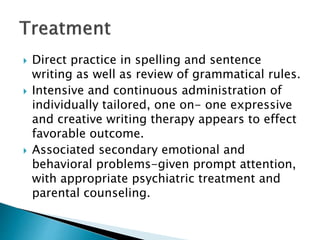
 Direct practice in spelling and sentence
writing as well as review of grammatical rules.
 Intensive and continuous administration of
individually tailored, one on- one expressive
and creative writing therapy appears to effect
favorable outcome.
 Associated secondary emotional and
behavioral problems-given prompt attention,
with appropriate psychiatric treatment and
parental counseling.
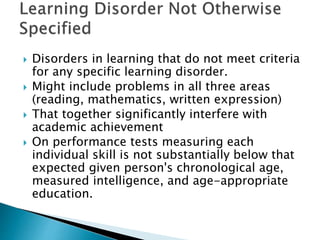
 Disorders in learning that do not meet criteria
for any specific learning disorder.
 Might include problems in all three areas
(reading, mathematics, written expression)
 That together significantly interfere with
academic achievement
 On performance tests measuring each
individual skill is not substantially below that
expected given person's chronological age,
measured intelligence, and age-appropriate
education.
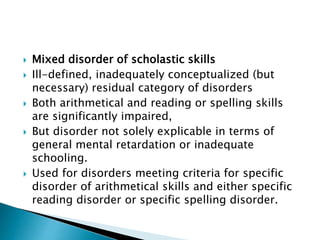
 Mixed disorder of scholastic skills
 Ill-defined, inadequately conceptualized (but
necessary) residual category of disorders
 Both arithmetical and reading or spelling skills
are significantly impaired,
 But disorder not solely explicable in terms of
general mental retardation or inadequate
schooling.
 Used for disorders meeting criteria for specific
disorder of arithmetical skills and either specific
reading disorder or specific spelling disorder.
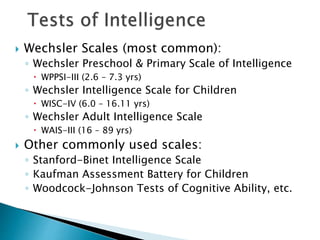
 Wechsler Scales (most common):
◦ Wechsler Preschool & Primary Scale of Intelligence
 WPPSI-III (2.6 – 7.3 yrs)
◦ Wechsler Intelligence Scale for Children
 WISC-IV (6.0 – 16.11 yrs)
◦ Wechsler Adult Intelligence Scale
 WAIS-III (16 – 89 yrs)
 Other commonly used scales:
◦ Stanford-Binet Intelligence Scale
◦ Kaufman Assessment Battery for Children
◦ Woodcock-Johnson Tests of Cognitive Ability, etc.
 Verbal Comprehension Index
◦ Similarities, vocabulary, comprehension,
information, word reasoning
 Perceptual Reasoning Index
◦ Block design, picture concepts, matrix reasoning,
picture completion
 Working Memory Index
◦ Digit span, letter-number sequencing, arithmetic
 Processing Speed Index
◦ Coding, symbol search, cancellation
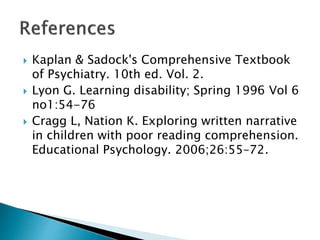
 Group Administered Tests
◦ Stanford Achievement Tests (Stanford 9)
◦ California Achievement Tests (CAT)
◦ IOWA Tests of Basic Skills, etc.
 Individually Administered Tests
◦ Wide Range Achievement Tests 3 (WRAT 3)
◦ Wechsler Individual Achievement Tests (WIAT)
◦ Woodcock-Johnson Psychoeducational Battery, rev (WJ-
R), etc.
 Tom Cruise
 Walt Disney
 Henry “The Fonz”
Winkler
 Magic Johnson
 Kaplan & Sadock's Comprehensive Textbook
of Psychiatry. 10th ed. Vol. 2.
 Lyon G. Learning disability; Spring 1996 Vol 6
no1:54-76
 Cragg L, Nation K. Exploring written narrative
in children with poor reading comprehension.
Educational Psychology. 2006;26:55–72.

Learning disorders

  • 1.
    Dr Parag Moon Seniorresident, Dept. of Neurology, GMC, Kota.
  • 2.
     A disorderin one or more of basic psychological processes involved in understanding or in using language, spoken or written, that may manifest itself in imperfect ability to listen, think, speak, read, write, spell, or to do mathematical calculations, including conditions such as perceptual disabilities, brain injury, minimal brain dysfunction, dyslexia, and developmental aphasia. [Individuals with disability education act IDEA 2004]
  • 3.
     Disorders notincluded- learning problems that are primarily result  Visual, hearing, or motor disabilities  Mental retardation  Emotional disturbance  Environmental, cultural, or economic disadvantage.
  • 4.
     Characterized byacademic underachievement in reading, written expression, or mathematics in comparison with overall intellectual ability of child.  Children with learning disorders often find it difficult to keep up with their peers in certain academic subjects, whereas they excel in others.
  • 5.
     Significant differencebetween student’s scores on test of general intelligence (e.g. IQ test such as WISC-IV) and scores obtained on achievement test (e.g. Woodcock Johnson Achievement Test).  If score on IQ test at least two standard deviations (30 points) higher than his or her scores on achievement-learning disability.
  • 6.
     Heredity- tendsto run in families  Illness or injury during pregnancy and delivery- use of drugs, alcohol during pregnancy, RH incompatibility, premature or prolonged labor or lack of oxygen or low weight at birth.  Incidents after birth. Head injuries, nutritional deprivation, poisonous substances, (e.g., lead), and child abuse can contribute.
  • 7.
     5% ofchildren suffer from some form of learning disability.  Dyslexia most common-80-85%.  Twice as common in males as in females  25% of Learning disabilities have associated Attention Deficit/Hyperactive Disorder-ADHD  35% of children with learning disabilities drop out of high school.
  • 8.
    • Dyslexia A languageand reading disability • Dyscalculia Problems with arithmetic and math concepts • Dysgraphia A writing disorder resulting in illegibility • Dyspraxia (Sensory Integration Disorder) Problems with motor coordination • Central Auditory Processing Disorder Difficulty processing and remembering language-related tasks • Non-Verbal Learning Disorders Trouble with nonverbal cues, e.g., body language; poor coordination, clumsy • Visual Perceptual/Visual Motor Deficit Reverses letters; cannot copy accurately; • Language Disorders (Aphasia/Dysphasia) Trouble understanding spoken language; poor reading comprehension
  • 9.
     Reading achievementbelow expected level for child's age, education, & intelligence, with impairment interfering significantly with academic success or daily activities involving reading  Developmental alexia-developmental deficit in recognition of printed symbols  Dyslexia replaced by broader term learning disorder
  • 10.
     Described asneurobiological disorder with a genetic origin.  Deficit in phonological processing skills.  Asymmetry of left planum temporale  Lesion in splenium of corpus callosum  Altered left temporal blood flow  Visual magnocellular system (which normally contains large cells) containing more disorganized and smaller cell bodies than expected.  Genetic- 35 to 40% of first-degree relatives of reading disorder have some reading disability
  • 13.
     Usually identifiedby 7 years (second grade)  Characterized by omissions, additions and distortions of words.  Have difficulty in distinguishing between printed letter characters and sizes, especially those that differ only in spatial orientation and length of line.  Child's reading speed is slow, often with minimal comprehension.  May start a word either in middle or at end of printed or written sentence  Have age appropriate ability to copy from written or printed text, but nearly all spell poorly.
  • 14.
     Problems pronouncingmultisyllabic words (e.g.“aminals” for“animals” and “sblanation” for “explanation”).  Many false starts, hesitations, and nonspecific terms  Dislike and avoid reading and writing.
  • 15.
    1. Reading achievement,as measured by individually administered standardized tests of reading accuracy or comprehension, is substantially below that expected given person's chronological age, measured intelligence, and age-appropriate education. 2. Disturbance in Criterion A significantly interferes with academic achievement or activities of daily living that require reading skills. 3. If sensory deficit is present, reading difficulties are in excess of those usually associated with it.
  • 16.
    1. Either offollowing must be present: I. Score on reading accuracy and/or comprehension at least 2 standard errors of prediction below level expected on basis of child's chronological age and general intelligence, with both reading skills and IQ assessed on individually administered test standardized for child's culture and educational system. II. History of serious reading difficulties, or test scores that met Criterion A(1) at earlier age, plus score on spelling test that at least 2 standard errors of prediction below level expected on basis of child's chronological age and IQ. 2. Disturbance described in Criterion A significantly interferes with academic achievement or with activities of daily living that require reading skills.
  • 17.
    3. Disorder isnot direct result of defect in visual or hearing acuity, or of neurological disorder. 4. School experiences within average expectable range (i.e., there have been no extreme inadequacies in educational experiences). 5. Exclusion clause: IQ is below 70 on individually administered standardized test.
  • 18.
     Special individualeducational programmes  Teaching child to make accurate associations between letters and sounds.  After individual letter-sound have been mastered, remediation can target larger components of reading such as syllables and words.  Positive coping strategies include small, structured reading groups that offer individual attention and make it easier for child to ask for help.
  • 19.
     Orton Gillingham,Direct Instructional System for Teaching and Remediation (DISTAR), Merill program, Science Research Associates, Inc. (SRA) Basic Reading Program,  Introducing whole words first and then teach children how to break them down and recognize sounds of syllables and individual letters in word.  Teaches to recognize whole words through use of visual aids and bypasses sounding-out process.  Parent counselling  Treatment of coexisting emotional and behavioral problems
  • 20.
     Dyscalculia, congenitalarithmetic disorder, acalculia, and developmental arithmetic disorder  Have difficulty learning and remembering numerals, cannot remember basic facts about numbers, are slow and inaccurate in computation.  Poor achievement in four groups of skills: ◦ Linguistic skills (those related to understanding mathematical terms and converting written problems into mathematical symbols) ◦ Perceptual skills (ability to recognize and understand symbols and order clusters of numbers) ◦ Mathematical skills (basic addition, subtraction, multiplication, division, and following sequencing of basic operations) ◦ Attentional skills (copying figures correctly and observing operational symbols correctly).
  • 21.
     Affect 1percent of school-age children  More common in females  Comorbid with reading disorder and disorder of written expression.  Early theory-neurological deficit in right cerebral hemisphere  Currently, cause is thought multifactorial- maturational, cognitive, emotional, educational, and socioeconomic factors
  • 22.
     Detected during2nd and 3rd grades  Difficulty in learning number names, remembering signs for addition and subtraction, learning multiplication tables, translating word problems into computations, doing calculations at expected pace.  Has significant problems with concepts, such as counting and adding even one-digit numbers, compared with classmates of same age.
  • 23.
     Classified mathematicsdisorder following: 1. Difficulty learning to count meaningfully; 2. Difficulty mastering cardinal and ordinal systems; 3. Difficulty performing arithmetic operations 4. Difficulty envisioning clusters of objects as groups.
  • 24.
     Mathematical ability,as measured by individually administered standardized tests, is substantially below that expected given person's chronological age, measured intelligence, and age-appropriate education.  Disturbance in Criterion A significantly interferes with academic achievement or activities of daily living that require mathematical ability.  If a sensory deficit is present, difficulties in mathematical ability are in excess of those usually associated with it.
  • 25.
    1. Score onstandardized arithmetic test at least 2 standard errors of prediction below level expected on basis of child's chronological age and general intelligence. 2. Scores on reading accuracy and comprehension and on spelling within normal range (±2 standard deviations from mean). 3. No history of significant reading or spelling difficulties. 4. School experience within average expectable range (i.e. no extreme inadequacies in educational experiences).
  • 26.
    5. Arithmetical difficultiespresent from early stages of learning arithmetic. 6. Disturbance described in Criterion A significantly interferes with academic achievement or with activities of daily living that require arithmetical skills. 7. Exclusion clause: IQ is below 70 on individually administered standardized test.
  • 27.
     Most effectivetreatments for mathematics disorder combine teaching mathematics concepts with continuous practice in solving math problems.  Flash cards, workbooks, and computer games  Project MATH, a multimedia self-instructional or group instructional in-service training program.  Development of positive problem-solving skills in social arena as well as in mathematics.
  • 28.
     Dysgraphia, spellingdisorder, spelling dyslexia  Characterized by writing skills that are significantly below expected level for child's age and intellectual capacity.  Components of writing disorder include poor spelling, errors in grammar and punctuation, and poor handwriting.  Spelling errors-most common difficulties which are most often phonetic errors  Eg- fone for phone, or beleeve for believe.  Disorder may result from combined effects of one or more of following: expressive language disorder, mixed receptive-expressive language disorder and reading disorder.
  • 29.
     Poor performanceon composing written text, including handwriting and impaired ability to spell and to place words sequentially in coherent sentences  In addition to spelling mistakes, he may have serious grammatical mistakes, such as using incorrect tenses, forgetting words in sentences, and placing words wrong order.  Punctuation may be incorrect with poor ability to remember which words begin with capital letters
  • 30.
     Letters arenot legible, inverted letters, and mixtures of capital and lowercase letters in given word.  Poor organization of written stories, which lack critical elements such as “where,” “when,” and “who” or clear expression of plot.
  • 31.
    1. Writing skills,as measured by individually administered standardized tests (or functional assessments of writing skills), are substantially below those expected given person's chronological age, measured intelligence, and age-appropriate education. 2. Disturbance in Criterion A significantly interferes with academic achievement or activities of daily living that require composition of written texts (e.g., writing grammatically correct sentences and organized paragraphs). 3. If a sensory deficit is present, difficulties in writing skills are in excess of those usually associated with it.
  • 32.
    1. Score onstandardized spelling test at least 2 standard errors of prediction below level expected on basis of child's chronological age and general intelligence. 2. Scores on reading accuracy and comprehension and on arithmetic are within normal range (±2 standard deviations from mean). 3. No history of significant reading difficulties. 4. School experience within average expectable range (i.e., there have been no extreme inadequacies in educational experiences).
  • 33.
    5. Spelling difficultiespresent from early stages of learning to spell. 6. Disturbance described in Criterion A significantly interferes with academic achievement or with activities of daily living that require spelling skills. 7. Exclusion clause: IQ is below 70 on individually administered standardized test.
  • 34.
     Direct practicein spelling and sentence writing as well as review of grammatical rules.  Intensive and continuous administration of individually tailored, one on- one expressive and creative writing therapy appears to effect favorable outcome.  Associated secondary emotional and behavioral problems-given prompt attention, with appropriate psychiatric treatment and parental counseling.
  • 35.
     Disorders inlearning that do not meet criteria for any specific learning disorder.  Might include problems in all three areas (reading, mathematics, written expression)  That together significantly interfere with academic achievement  On performance tests measuring each individual skill is not substantially below that expected given person's chronological age, measured intelligence, and age-appropriate education.
  • 36.
     Mixed disorderof scholastic skills  Ill-defined, inadequately conceptualized (but necessary) residual category of disorders  Both arithmetical and reading or spelling skills are significantly impaired,  But disorder not solely explicable in terms of general mental retardation or inadequate schooling.  Used for disorders meeting criteria for specific disorder of arithmetical skills and either specific reading disorder or specific spelling disorder.
  • 37.
     Wechsler Scales(most common): ◦ Wechsler Preschool & Primary Scale of Intelligence  WPPSI-III (2.6 – 7.3 yrs) ◦ Wechsler Intelligence Scale for Children  WISC-IV (6.0 – 16.11 yrs) ◦ Wechsler Adult Intelligence Scale  WAIS-III (16 – 89 yrs)  Other commonly used scales: ◦ Stanford-Binet Intelligence Scale ◦ Kaufman Assessment Battery for Children ◦ Woodcock-Johnson Tests of Cognitive Ability, etc.
  • 38.
     Verbal ComprehensionIndex ◦ Similarities, vocabulary, comprehension, information, word reasoning  Perceptual Reasoning Index ◦ Block design, picture concepts, matrix reasoning, picture completion  Working Memory Index ◦ Digit span, letter-number sequencing, arithmetic  Processing Speed Index ◦ Coding, symbol search, cancellation
  • 39.
     Group AdministeredTests ◦ Stanford Achievement Tests (Stanford 9) ◦ California Achievement Tests (CAT) ◦ IOWA Tests of Basic Skills, etc.  Individually Administered Tests ◦ Wide Range Achievement Tests 3 (WRAT 3) ◦ Wechsler Individual Achievement Tests (WIAT) ◦ Woodcock-Johnson Psychoeducational Battery, rev (WJ- R), etc.
  • 40.
     Tom Cruise Walt Disney  Henry “The Fonz” Winkler  Magic Johnson
  • 41.
     Kaplan &Sadock's Comprehensive Textbook of Psychiatry. 10th ed. Vol. 2.  Lyon G. Learning disability; Spring 1996 Vol 6 no1:54-76  Cragg L, Nation K. Exploring written narrative in children with poor reading comprehension. Educational Psychology. 2006;26:55–72.