Presenter - Dr. Habtamu M.
Moderator - Dr. Getasew ( Assistant professor of pediatrics )
1
Objectives
 Categorize mental health disorders in children
and adolescents.
 Recognize the cultural issues and symptoms
of commonly diagnosed mental health disorders
in children and Adolescents.
 Identify the latest methods of treatment and
assessment.
2
Epidemiology
– 11.3 percent of U.S. children ages 2-17
– ADHD was the most prevalent diagnosis among
children ages 3-17
– Boys were more likely than girls to have ADHD,
behavioral or CD, ASD, and anxiety
– Girls were more likely to be diagnosed with
depression
– Suicide is the second leading cause of death among
children ages 12-17
3
4
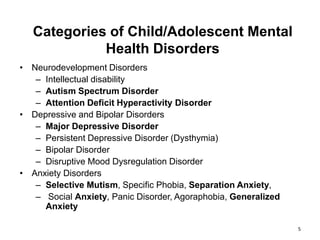
Categories of Child/Adolescent Mental
Health Disorders
• Neurodevelopment Disorders
– Intellectual disability
– Autism Spectrum Disorder
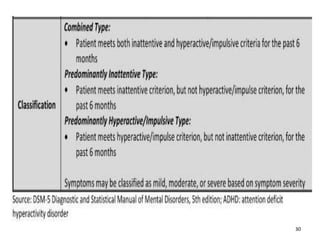
– Attention Deficit Hyperactivity Disorder
• Depressive and Bipolar Disorders
– Major Depressive Disorder
– Persistent Depressive Disorder (Dysthymia)
– Bipolar Disorder
– Disruptive Mood Dysregulation Disorder
• Anxiety Disorders
– Selective Mutism, Specific Phobia, Separation Anxiety,
– Social Anxiety, Panic Disorder, Agoraphobia, Generalized
Anxiety
5
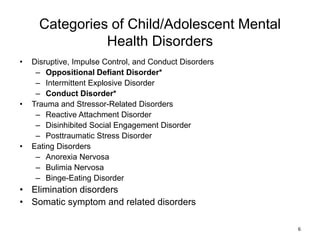
Categories of Child/Adolescent Mental
Health Disorders
• Disruptive, Impulse Control, and Conduct Disorders
– Oppositional Defiant Disorder*
– Intermittent Explosive Disorder
– Conduct Disorder*
• Trauma and Stressor-Related Disorders
– Reactive Attachment Disorder
– Disinhibited Social Engagement Disorder
– Posttraumatic Stress Disorder
• Eating Disorders
– Anorexia Nervosa
– Bulimia Nervosa
– Binge-Eating Disorder
• Elimination disorders
• Somatic symptom and related disorders
6
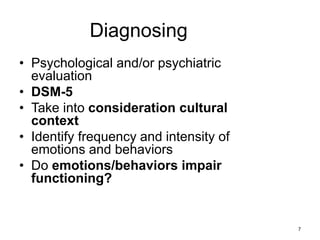
Diagnosing
• Psychological and/or psychiatric
evaluation
• DSM-5
• Take into consideration cultural
context
• Identify frequency and intensity of
emotions and behaviors
• Do emotions/behaviors impair
functioning?
7
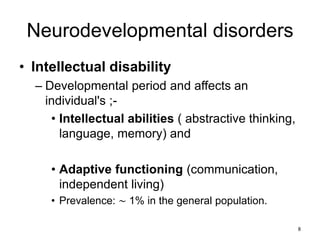
Neurodevelopmental disorders
• Intellectual disability
– Developmental period and affects an
individual's ;-
• Intellectual abilities ( abstractive thinking,
language, memory) and
• Adaptive functioning (communication,
independent living)
• Prevalence: ∼ 1% in the general population.
8
Etiology
– Congenital
• Genetic conditions ( fragile X
syndrome, trisomy
21, Klinefelter syndrome)
• Exposure to teratogens in
utero ( fetal alcohol
syndrome)
• Congenital hypothyroidism
• Congenital infections
(toxoplasmosis, rubella)
• Perinatal hypoxia
• Perinatal trauma
– Acquired
• CNS infections
(viral encephalitis, meningitis)
• CNS malignancies
( neuroblastoma)
• Traumatic brain injury
• Intoxications ( lead, mercury)
• Iodine deficiency
• Malnutrition
9
Clinical features
– Deficits in cognitive functioning
• learning, problem-solving, reasoning, abstract
thinking, judgment, and planning
– Impaired adaptive functioning
• Inability to maintain personal independence and
social responsibility
• Leading to educational, occupational,
communication, and social problems
– Onset during the developmental period
(during childhood or adolescence)
10
Diagnosis
• IQ testing
• Genetic testing
• Neuroimaging
11
Management
• Nonpharmacological
– Psychotherapy (CBT, family-oriented therap)
– Occupational therapy
– Special education programs
– Speech-language therapy
• Pharmacological:
– used to control psychiatric symptoms of
accompanying conditions
– Atypical antipsychotics
• ( risperidone, aripiprazole, olanzapine)
– Antidepressants (SSRIs)
12
GDD
• Significant delay in ≥ 2 of the
major developmental domains (gross motor, fine
motor, language, cognition, and social
milestones) in children < 5 years of age
• Prevalence: up to 5% of children in developed
countries
13
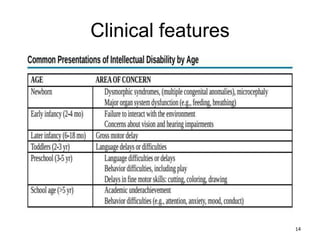
Clinical features
14
Neurodevelopmental Disorders
• Autism Spectrum Disorder (ASD)
• Attention Deficit Disorder (ADHD)
15
Autism spectrum disorder (ASD)
• A Characterized by
– Qualitative impairment in social interaction
and communication
– Repetitive stereotyped behavior, interests,
and activities.
16
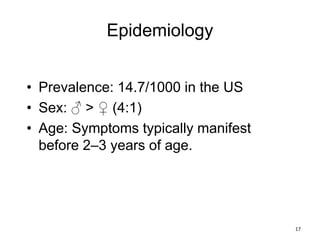
Epidemiology
• Prevalence: 14.7/1000 in the US
• Sex: ♂ > ♀ (4:1)
• Age: Symptoms typically manifest
before 2–3 years of age.
17
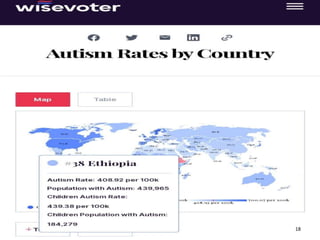
18
Etiology
• Genetics
– Strong underlying predisposition
• Environmental factors
• toxin exposure, prenatal infections
19
Clinical features
• Core features
– Persistent impairment in communication and social interaction
(e.g., inability to form relationships, abnormal language
development, reduced empathy, difficulties in adjusting behavior
to social situations, and poor eye contact)
– Restricted, stereotyped patterns of behavior, interests, and
activities (e.g., hand flapping, excessive touching/smelling, lining
up toys, adverse response to sounds, and echolalia)
– Repetitive movements (e.g., stereotyped hand movements)
• Additional features
– Intellectual impairment
– Language impairment
– Sensory abnormalities (sensation can be hyporesponsive or
enhanced)
20
• Mild ASD
– No intellectual impairment
– Affected individuals are able to speak in full sentences, read and
write, and handle basic life skills
• Symptoms may not become fully apparent until school age,
when social impairments and stereotypies begin to exceed
limited capabilities.
• Impaired social communication and interaction
• Insistence on sameness (e.g., eating specific foods in a
particular order)
• Fixated interest in unusual objects (e.g., ceiling fans)
• Unusual responses to sensory stimuli
• Affected individuals may develop strategies that mask deficits
later in life.
21
Associated conditions
• Epilepsy
• ADHD, Pica, anxiety disorder
• Genetic disorders, e.g., tuberous
sclerosis, fragile X syndrome, Rett
syndrome
– Associated with a higher head circumference
to brain volume ratio
22
Diagnosis
• Comprehensive evaluation of
– Social interaction and communication skills
– Language and comprehension skills
– Behavior
• Cognitive development
• Associated conditions
• Hearing and vision testing
• Genetic testing
23
Treatment
• Early behavioral and educational
management
– Competence training: social skills,
communication skills
– Establishing clear and consistent structures
• Medical treatment
– SSRIs: repetitive stereotyped behavior, anxiety
– Antipsychotic drugs: aggression, self-injury
– Methylphenidate: ADHD
24
Prognosis
• Indicators of poor prognosis:
– Severe core symptoms
– Cognitive impairment (low IQ)
– Poor or absent language skills
– Late initiation of treatment
• Impaired social interaction often persists into
adulthood
• Approx. 50% of individuals with language
impairment do not develop the ability to speak.
• Adolescents: Insensitive behavior towards peers
often results in social exclusion.
25
ADHD
• A neurodevelopmental disorder that
manifests in childhood and may persist
into adulthood.
• Inattention and/or impulsivity and
hyperactivity .
26
Epidemiology
• Sex: ♂ > ♀ [1]
• Age of onset: usually before 12 years [2]
• Prevalence: ∼ 5% [1]
27
28
Etiology
• Multifactorial disorder; pathogenesis is
thought to be related to altered
catecholamine metabolism.
• Genetic predisposition: family history of
ADHD, polymorphisms of the dopamine,
serotonin, or glutamate receptor subtypes
• Enviromental factors
• Prematurity, in-utero exposure to alcohol
29
30
Clinical features
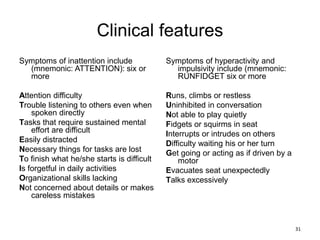
Symptoms of inattention include
(mnemonic: ATTENTION): six or
more
Attention difficulty
Trouble listening to others even when
spoken directly
Tasks that require sustained mental
effort are difficult
Easily distracted
Necessary things for tasks are lost
To finish what he/she starts is difficult
Is forgetful in daily activities
Organizational skills lacking
Not concerned about details or makes
careless mistakes
Symptoms of hyperactivity and
impulsivity include (mnemonic:
RUNFIDGET six or more
Runs, climbs or restless
Uninhibited in conversation
Not able to play quietly
Fidgets or squirms in seat
Interrupts or intrudes on others
Difficulty waiting his or her turn
Get going or acting as if driven by a
motor
Evacuates seat unexpectedly
Talks excessively
31
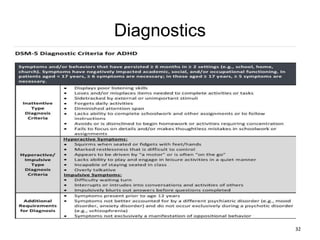
Diagnostics
• DSM-5
32
Management
• Behavioral interventions
• Parent training in behavioral management
(PTBM)
• Indication: caregivers with children 4–11 years of
age with problematic behaviors (e.g., ADHD)
• Goals: reinforce preferred behaviors and reduce
problematic behaviors
• Classroom interventions: behavioral intervention
plan (organized via the school district)
• PTBM can also be utilized for children who do
not meet the full criteria for ADHD.
33
• Pharmacotherapy
• Options include stimulant and nonstimulant
therapy.
– Stimulant therapy
• First-line treatment for children ≥ 6 years of age
– Nonstimulants are preferred for individuals
with:
• Contraindications to or potential for serious
adverse effects with stimulants
• Certain comorbidities
34
• Stimulant therapy
– Options: methylphenidate or amphetamine analogues (e.g.,
lisdexamfetamine, dextroamphetamine)
– Mechanism of action: indirect and central sympathomimetic activity →
increased release and blocked reuptake of norepinephrine and dopamine
(minor effect on serotonin) → increased concentration of norepinephrine
and dopamine in the synaptic cleft → increased mental performance (e.g.,
improved concentration, cognition, short-term memory) and fine motor skills
– Adverse effects
• Sympathomimetic effects
– Anxiety, agitation, restlessness, bruxism, tics
– Difficulty falling asleep (insomnia)
– Reduced appetite, nausea, vomiting, weight loss
• Increased arterial blood pressure, tachycardia
• Increased risk of seizure: reduces the seizure threshold
• Decreased growth rate (may be reversible if medication is stopped)
• Psychosis (e.g., hallucinations)
• Priapism
• Other indications: also used in patients with narcolepsy or binge eating
disorder
35
Initiation of stimulant therapy
– Obtain an ECG if either of the following are present:
• Symptoms of a cardiac disorder (e.g., syncope,
palpitations)
• A personal or family history of cardiac conduction
disorders
– Inform individuals that effects may be noticed within
2–3 days of initiation.
– Start on a low dose and slowly titrate medication as
necessary, e.g.:
• Children: every 1–4 weeks
– Arrange regular follow-up for patients with ADHD to
monitor the effects of pharmacotherapy.
36
• Nonstimulant therapy
– It may take 4–6 weeks for nonstimulants to reach
maximum efficacy.
• Selective norepinephrine reuptake inhibitors
– Indication: alternative to stimulant medications for ADHD
in adults and children ≥ 6 years of age
– Mechanism of action: block norepinephrine reuptake,
which increases synaptic cleft levels of norepinephrine and
dopamine in the prefrontal cortex
– Options: atomoxetine or viloxazine
– Adverse effects
• GI symptoms (e.g., appetite suppression, nausea, discomfort)
• Sedation
• Rare: liver failure, prolonged QT interval, suicidal ideation
37
• Alpha-2 adrenergic agonists
– Indications: children 6–17 years of age with
either of the following.
• Contraindications to stimulants .
• Preference for nonstimulants
• Inadequate response to stimulants alone (i.e.,
adjunctive therapy)
– Options: guanfacine extended-release or
clonidine extended-release
38
Follow-up
– For patients on pharmacotherapy:
• Advise patients and/or caregivers
• Arrange regular scheduled follow-up appointments.
– Monthly until treatment is optimized
– Every 3 months for at least the first year
– Once stable, every 6 months
• At every visit, assess vital signs and inquire about
adverse effects.
• Laboratory studies are not routinely required.
• If the response is insufficient or significant adverse
effects occur, consider medication adjustments.
• Periodically reassess if medication is still required.
39
Prognosis
• The persistence of symptoms after
treatment predicts prognosis into adulthood.
• In 35–65% of patients, symptoms of ADHD
and their associated functional impairment
will persist into adulthood.
• Patients with untreated ADHD are at higher
risk of injury , substance use disorder,
and antisocial personality disorder.
40
Affective Disorders and
Posttraumatic Stress Disorder
• Major Depressive Disorder (MDD)
• Anxiety disorders
– Separation anxiety
– Social anxiety
• Posttraumatic Stress Disorder
41
Anxiety disorders
• A broad spectrum of conditions
characterized by excessive and persistent
fear (an emotional response to imminent
threats),
• Anxiety (the anticipation of a future threat),
worry (apprehensive expectation), and/or
avoidance behavior.
42
Etiology
• Neurobiological factors
– Disruption of the serotonin system
– Dysfunction of GABAergic inhibitory transmission
• Substance use (leading to substance/medication-induced anxiety disorder)
• Environmental and developmental factors
– Stress
– Smoking (risk factor for panic disorder and panic attacks)
– Psychological trauma, esp. during childhood
• Other medical conditions: conditions that may lead to anxiety and/or panic
attacks
– Endocrine disease (e.g., hyperthyroidism)
– Cardiovascular disorders (e.g., congestive heart failure)
– Respiratory illness (e.g., asthma)
– Metabolic disorders (e.g., porphyria)
– Neurological diseases (e.g., encephalitis)
43
Separation anxiety disorder
• Excessive fear, anxiety, or avoidance of
separation from major attachment figures
• Separation anxiety disorder differs from
nonpathological separation anxiety in its
intensity and effect on the social and
academic life of the individual.
44
– Separation anxiety is normal in children under
a developmental age of 3 years.
– Typically develops after a stressful life event,
usually involving some form of loss (e.g.,
death of a relative, parental divorce, change
of school)
45
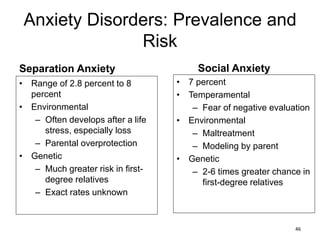
Anxiety Disorders: Prevalence and
Risk
Separation Anxiety
• Range of 2.8 percent to 8
percent
• Environmental
– Often develops after a life
stress, especially loss
– Parental overprotection
• Genetic
– Much greater risk in first-
degree relatives
– Exact rates unknown
Social Anxiety
• 7 percent
• Temperamental
– Fear of negative evaluation
• Environmental
– Maltreatment
– Modeling by parent
• Genetic
– 2-6 times greater chance in
first-degree relatives
46
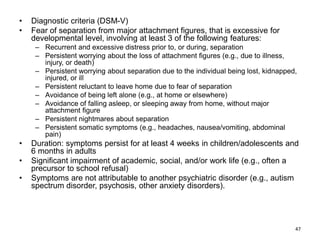
• Diagnostic criteria (DSM-V)
• Fear of separation from major attachment figures, that is excessive for
developmental level, involving at least 3 of the following features:
– Recurrent and excessive distress prior to, or during, separation
– Persistent worrying about the loss of attachment figures (e.g., due to illness,
injury, or death)
– Persistent worrying about separation due to the individual being lost, kidnapped,
injured, or ill
– Persistent reluctant to leave home due to fear of separation
– Avoidance of being left alone (e.g., at home or elsewhere)
– Avoidance of falling asleep, or sleeping away from home, without major
attachment figure
– Persistent nightmares about separation
– Persistent somatic symptoms (e.g., headaches, nausea/vomiting, abdominal
pain)
• Duration: symptoms persist for at least 4 weeks in children/adolescents and
6 months in adults
• Significant impairment of academic, social, and/or work life (e.g., often a
precursor to school refusal)
• Symptoms are not attributable to another psychiatric disorder (e.g., autism
spectrum disorder, psychosis, other anxiety disorders).
47
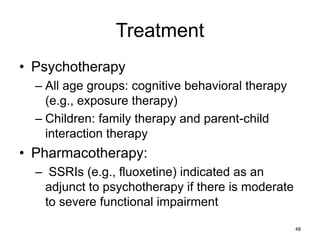
Treatment
• Psychotherapy
– All age groups: cognitive behavioral therapy
(e.g., exposure therapy)
– Children: family therapy and parent-child
interaction therapy
• Pharmacotherapy:
– SSRIs (e.g., fluoxetine) indicated as an
adjunct to psychotherapy if there is moderate
to severe functional impairment
48
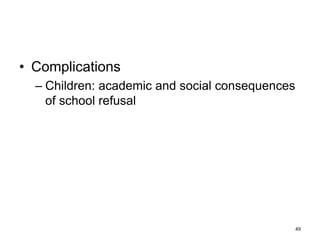
• Complications
– Children: academic and social consequences
of school refusal
49
Selective Mutism
– Description: a psychiatric disorder characterized
by the inability to speak in specific social
situations (e.g., during class)
• Typically normal development of language and speech.
• Onset: generally before 5 years of age, although may
not become clinically relevant until the child is required
to perform verbally (e.g., with the start of school)
50
Diagnostic criteria (DSM-V)
• Consistent inability to speak in specific social settings
where speaking is expected (e.g., does not speak in
class but speaks at home)
• Interferes with academic or professional performance
and social interaction
• Duration of symptoms: at least 1 month
• The inability to speak is not due to difficulties or
discomfort with the spoken language expected in the
social situation.
• The inability to speak is not attributable to
schizophrenia spectrum disorder or another psychotic
disorder, autism spectrum disorder, or a communication
disorder.
51
• Treatment
– Psychotherapy
• Cognitive behavioral therapy (e.g., exposure therapy) at
all ages
• Children: family therapy and parent-child interaction
therapy
• Pharmacotherapy: SSRIs (e.g., fluoxetine) may be
beneficial in those who do not respond to psychotherapy
• Complications: may coexist with social anxiety
disorder and may also result in school refusal
52
Disruptive, Impulse-Control, and
Conduct Disorders
• Oppositional Defiant Disorder
(ODD)
• Conduct Disorder (CD)
53
Disruptive disorder, impulse-control
disorder, and conduct disorder
• are a group of psychiatric conditions that
affect the self-regulation of emotions and
behaviors beginning in childhood or
adolescence.
• The disturbance in behavior significantly
impairs social, academic, and/or
occupational functioning.
54
Oppositional defiant disorder
(ODD)
• Definition: anger, irritable mood, and defiant
behavior toward authority figures that
significantly impairs social and/or academic
functioning
• Epidemiology
– Onset is usually during late preschool or
elementary school years
– Before puberty ♂ > ♀, after puberty ♂ = ♀
– Frequent comorbidity of ADHD, anxiety disorder,
mood disorders, and/or learning disorders
55
• Etiology: associated with genetic,
environmental, psychological, and/or
social factors (e.g., abuse, exposure to
toxins, positive family history, neglectful
parents, family instability)
56
Symptoms
• Angry/irritable mood
– Often loses temper
– Is often touchy or easily annoyed
– Is often angry and resentful
• Argumentative/defiant behavior
– Argues with adults
– Defies or refuses to comply with requests or rules
– Deliberately annoys others
– Blames others for mistakes
• Vindictiveness/spiteful
• At least four symptoms; symptoms present at least 6 months
(American Psychiatric Association, 2013)
57
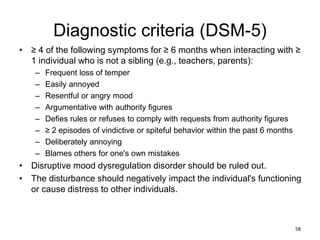
Diagnostic criteria (DSM-5)
• ≥ 4 of the following symptoms for ≥ 6 months when interacting with ≥
1 individual who is not a sibling (e.g., teachers, parents):
– Frequent loss of temper
– Easily annoyed
– Resentful or angry mood
– Argumentative with authority figures
– Defies rules or refuses to comply with requests from authority figures
– ≥ 2 episodes of vindictive or spiteful behavior within the past 6 months
– Deliberately annoying
– Blames others for one's own mistakes
• Disruptive mood dysregulation disorder should be ruled out.
• The disturbance should negatively impact the individual's functioning
or cause distress to other individuals.
58
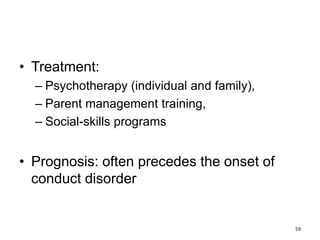
• Treatment:
– Psychotherapy (individual and family),
– Parent management training,
– Social-skills programs
• Prognosis: often precedes the onset of
conduct disorder
59
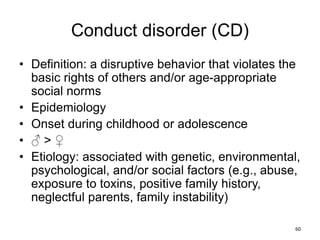
Conduct disorder (CD)
• Definition: a disruptive behavior that violates the
basic rights of others and/or age-appropriate
social norms
• Epidemiology
• Onset during childhood or adolescence
• ♂ > ♀
• Etiology: associated with genetic, environmental,
psychological, and/or social factors (e.g., abuse,
exposure to toxins, positive family history,
neglectful parents, family instability)
60
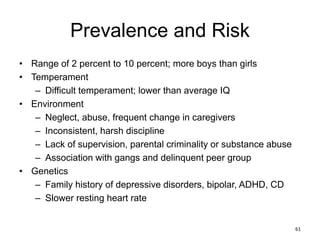
Prevalence and Risk
• Range of 2 percent to 10 percent; more boys than girls
• Temperament
– Difficult temperament; lower than average IQ
• Environment
– Neglect, abuse, frequent change in caregivers
– Inconsistent, harsh discipline
– Lack of supervision, parental criminality or substance abuse
– Association with gangs and delinquent peer group
• Genetics
– Family history of depressive disorders, bipolar, ADHD, CD
– Slower resting heart rate
61
Symptoms
• Pattern of behavior in which the basic
rights of others or societal norms and rules
are violated
• Behaviors fall into four categories
– Aggression to people/animals
– Destruction of property
– Deceitfulness or theft
– Serious violation of rules
62
• Diagnostic criteria (according to DSM-5)
• Aggression toward people and animals (e.g., bullying,
physical fights, use of weapons)
• Destruction of property (e.g., fire setting)
• Deceitfulness or theft
• Serious rule violation (e.g., truancy, running away from
home)
• The disturbance in behavior lasts ≥ 12 months and
significantly impairs social, academic, and/or
occupational functioning.
• The diagnosis is only applied to patients < 18 years of
age.
63
• Treatment
– CBT, parent management training, social skills
programs
– Pharmacotherapy (e.g., psychostimulants in comorbid
ADHD, antipsychotic medications or mood stabilizers
in cases of severe aggression)
• Prognosis:
– Individuals with CD are at increased risk of
developing antisocial personality disorder in
adulthood.
– If an individual's CD symptoms persist after 18 years
of age, their diagnosis is changed to antisocial
personality disorder.
64
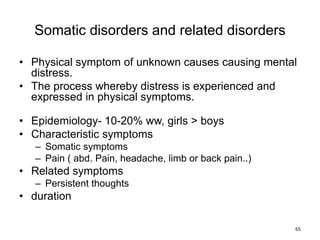
Somatic disorders and related disorders
• Physical symptom of unknown causes causing mental
distress.
• The process whereby distress is experienced and
expressed in physical symptoms.
• Epidemiology- 10-20% ww, girls > boys
• Characteristic symptoms
– Somatic symptoms
– Pain ( abd. Pain, headache, limb or back pain..)
• Related symptoms
– Persistent thoughts
• duration
65
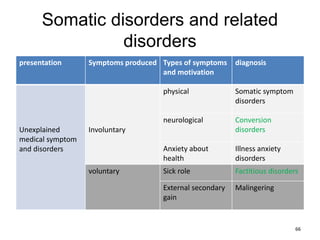
Somatic disorders and related
disorders
presentation Symptoms produced Types of symptoms
and motivation
diagnosis
Unexplained
medical symptom
and disorders
Involuntary
physical Somatic symptom
disorders
neurological Conversion
disorders
Anxiety about
health
Illness anxiety
disorders
voluntary Sick role Factitious disorders
External secondary
gain
Malingering
66
DSM-5 Diagnostic Criteria for Somatic
Symptom Disorder
A. > 1 somatic symptoms that are distressing or result in significant
disruption of daily life.
B. Excessive thoughts, feelings, or behaviors related to the somatic
symptoms
or associated health concerns, as manifested by at least one of the
following:
• Disproportionate and persistent thoughts about the seriousness of
one's symptoms.
• Persistent high level of anxiety about health and symptoms.
• Excessive time and energy devoted to these symptoms or health
concerns.
C. Although any one somatic symptom may not be continuously
present, the
state of being symptomatic is persistent (typically >6 mo).
Specify if:
67
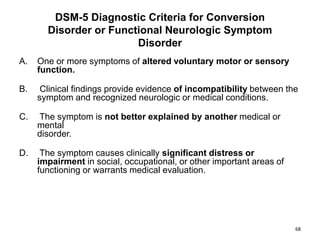
DSM-5 Diagnostic Criteria for Conversion
Disorder or Functional Neurologic Symptom
Disorder
A. One or more symptoms of altered voluntary motor or sensory
function.
B. Clinical findings provide evidence of incompatibility between the
symptom and recognized neurologic or medical conditions.
C. The symptom is not better explained by another medical or
mental
disorder.
D. The symptom causes clinically significant distress or
impairment in social, occupational, or other important areas of
functioning or warrants medical evaluation.
68
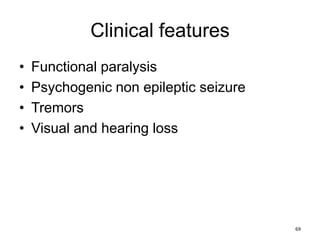
Clinical features
• Functional paralysis
• Psychogenic non epileptic seizure
• Tremors
• Visual and hearing loss
69
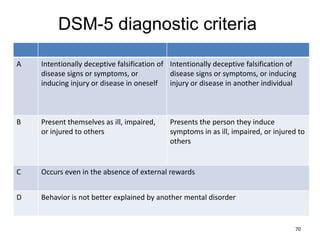
DSM-5 diagnostic criteria
70
A Intentionally deceptive falsification of
disease signs or symptoms, or
inducing injury or disease in oneself
Intentionally deceptive falsification of
disease signs or symptoms, or inducing
injury or disease in another individual
B Present themselves as ill, impaired,
or injured to others
Presents the person they induce
symptoms in as ill, impaired, or injured to
others
C Occurs even in the absence of external rewards
D Behavior is not better explained by another mental disorder
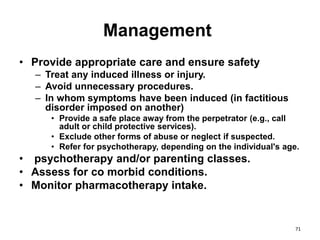
Management
• Provide appropriate care and ensure safety
– Treat any induced illness or injury.
– Avoid unnecessary procedures.
– In whom symptoms have been induced (in factitious
disorder imposed on another)
• Provide a safe place away from the perpetrator (e.g., call
adult or child protective services).
• Exclude other forms of abuse or neglect if suspected.
• Refer for psychotherapy, depending on the individual's age.
• psychotherapy and/or parenting classes.
• Assess for co morbid conditions.
• Monitor pharmacotherapy intake.
71
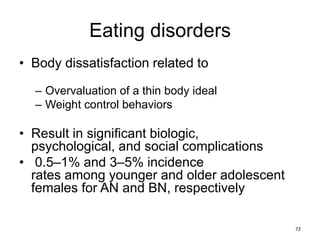
Eating disorders
• Body dissatisfaction related to
– Overvaluation of a thin body ideal
– Weight control behaviors
• Result in significant biologic,
psychological, and social complications
• 0.5–1% and 3–5% incidence
rates among younger and older adolescent
females for AN and BN, respectively
72
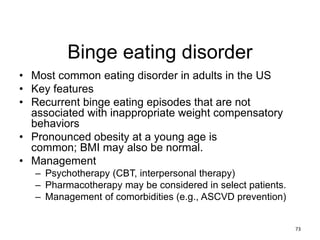
Binge eating disorder
• Most common eating disorder in adults in the US
• Key features
• Recurrent binge eating episodes that are not
associated with inappropriate weight compensatory
behaviors
• Pronounced obesity at a young age is
common; BMI may also be normal.
• Management
– Psychotherapy (CBT, interpersonal therapy)
– Pharmacotherapy may be considered in select patients.
– Management of comorbidities (e.g., ASCVD prevention)
73
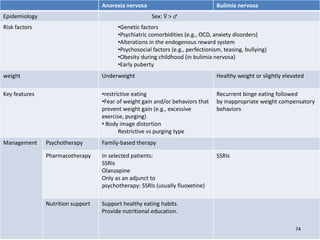
Anorexia nervosa Bulimia nervosa
Epidemiology Sex: ♀ > ♂
Risk factors •Genetic factors
•Psychiatric comorbidities (e.g., OCD, anxiety disorders)
•Alterations in the endogenous reward system
•Psychosocial factors (e.g., perfectionism, teasing, bullying)
•Obesity during childhood (in bulimia nervosa)
•Early puberty
weight Underweight Healthy weight or slightly elevated
Key features •restrictive eating
•Fear of weight gain and/or behaviors that
prevent weight gain (e.g., excessive
exercise, purging)
• Body image distortion
Restrictive vs purging type
Recurrent binge eating followed
by inappropriate weight compensatory
behaviors
Management Psychotherapy Family-based therapy
Pharmacotherapy In selected patients:
SSRIs
Olanzapine
Only as an adjunct to
psychotherapy: SSRIs (usually fluoxetine)
SSRIs
Nutrition support Support healthy eating habits.
Provide nutritional education.
74
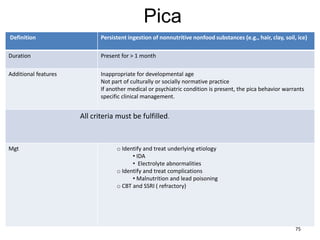
Pica
Definition Persistent ingestion of nonnutritive nonfood substances (e.g., hair, clay, soil, ice)
Duration Present for > 1 month
Additional features Inappropriate for developmental age
Not part of culturally or socially normative practice
If another medical or psychiatric condition is present, the pica behavior warrants
specific clinical management.
All criteria must be fulfilled.
Mgt o Identify and treat underlying etiology
• IDA
• Electrolyte abnormalities
o Identify and treat complications
• Malnutrition and lead poisoning
o CBT and SSRI ( refractory)
75
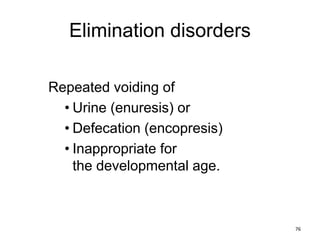
Elimination disorders
Repeated voiding of
• Urine (enuresis) or
• Defecation (encopresis)
• Inappropriate for
the developmental age.
76
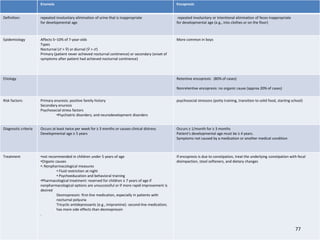
Enuresis Encopresis
Definition: repeated involuntary elimination of urine that is inappropriate
for developmental age
repeated involuntary or intentional elimination of feces inappropriate
for developmental age (e.g., into clothes or on the floor)
Epidemiology Affects 5–10% of 7-year-olds
Types
Nocturnal (♂ > ♀) or diurnal (♀ > ♂)
Primary (patient never achieved nocturnal continence) or secondary (onset of
symptoms after patient had achieved nocturnal continence)
More common in boys
Etiology Retentive encopresis: (80% of cases)
Nonretentive encopresis: no organic cause (approx 20% of cases)
Risk factors: Primary enuresis: positive family history
Secondary enuresis
Psychosocial stress factors
•Psychiatric disorders; and neurodevelopment disorders
psychosocial stressors (potty training, transition to solid food, starting school)
Diagnostic criteria Occurs at least twice per week for ≥ 3 months or causes clinical distress
Developmental age ≥ 5 years
Occurs ≥ 1/month for ≥ 3 months
Patient's developmental age must be ≥ 4 years.
Symptoms not caused by a medication or another medical condition
Treatment •not recommended in children under 5 years of age
•Organic causes
•: Nonpharmacological measures
• Fluid restriction at night
• Psychoeducation and behavioral training
•Pharmacological treatment: reserved for children ≥ 7 years of age if
nonpharmacological options are unsuccessful or if more rapid improvement is
desired
Desmopressin: first-line medication, especially in patients with
nocturnal polyuria
Tricyclic antidepressants (e.g., imipramine): second-line medication;
has more side effects than desmopressin
.
If encopresis is due to constipation, treat the underlying constipation with fecal
disimpaction, stool softeners, and dietary changes
77
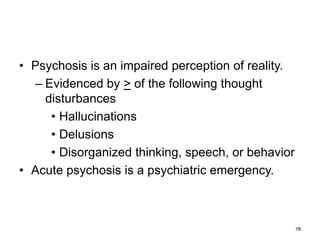
• Psychosis is an impaired perception of reality.
– Evidenced by > of the following thought
disturbances
• Hallucinations
• Delusions
• Disorganized thinking, speech, or behavior
• Acute psychosis is a psychiatric emergency.
78
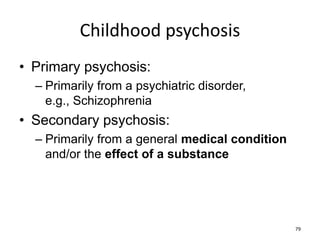
Childhood psychosis
• Primary psychosis:
– Primarily from a psychiatric disorder,
e.g., Schizophrenia
• Secondary psychosis:
– Primarily from a general medical condition
and/or the effect of a substance
79
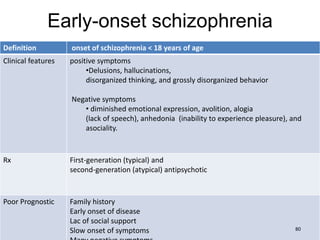
Early-onset schizophrenia
Definition onset of schizophrenia < 18 years of age
Clinical features positive symptoms
•Delusions, hallucinations,
disorganized thinking, and grossly disorganized behavior
Negative symptoms
• diminished emotional expression, avolition, alogia
(lack of speech), anhedonia (inability to experience pleasure), and
asociality.
Rx First-generation (typical) and
second-generation (atypical) antipsychotic
Poor Prognostic Family history
Early onset of disease
Lac of social support
Slow onset of symptoms 80
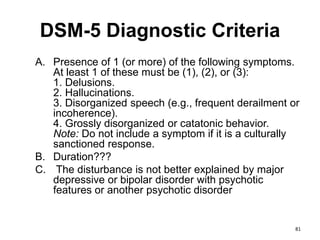
DSM-5 Diagnostic Criteria
A. Presence of 1 (or more) of the following symptoms.
At least 1 of these must be (1), (2), or (3):
1. Delusions.
2. Hallucinations.
3. Disorganized speech (e.g., frequent derailment or
incoherence).
4. Grossly disorganized or catatonic behavior.
Note: Do not include a symptom if it is a culturally
sanctioned response.
B. Duration???
C. The disturbance is not better explained by major
depressive or bipolar disorder with psychotic
features or another psychotic disorder
81
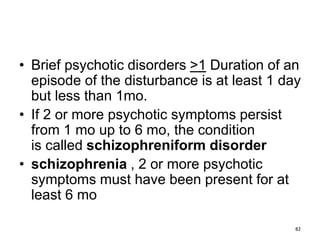
• Brief psychotic disorders >1 Duration of an
episode of the disturbance is at least 1 day
but less than 1mo.
• If 2 or more psychotic symptoms persist
from 1 mo up to 6 mo, the condition
is called schizophreniform disorder
• schizophrenia , 2 or more psychotic
symptoms must have been present for at
least 6 mo
82
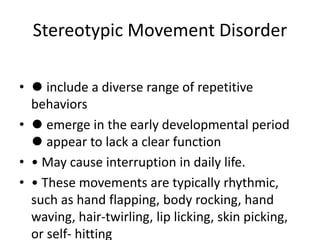
Stereotypic Movement Disorder
• ⚫ include a diverse range of repetitive
behaviors
• ⚫ emerge in the early developmental period
⚫ appear to lack a clear function
• • May cause interruption in daily life.
• • These movements are typically rhythmic,
such as hand flapping, body rocking, hand
waving, hair-twirling, lip licking, skin picking,
or self- hitting
• Epidemiology
• ⚫ increased frequency in children with autism
and intellectual disability
• Age of onset is in the second year of life ⚫ 15
to 20 % in children younger than the age of 6
years display
• stereotypic behavior
• ⚫ self-injurious behaviors in 2 to 3 % of
children and adolescents with intellectual
disability. Eg: head-banging, face slapping, eye
• Etiology
• • Genetic factors
• ⚫ stereotypic movement disorder is
hypothesized to originate from the basal
ganglia
• • Dopamine and serotonin are likely to be
• DIFFERENTIAL DIAGNOSIS
• • obsessive-compulsive disorder
• ⚫tic disorders
• Course and prognosis
• ⚫ symptoms may wax and wane
• ⚫ 60 to 80 percent tend to disappear by 4
years ⚫ Children who exhibit frequent,
severe, self-injurious stereotypic
• behaviors have the poorest prognosis
• Treatment
• ⚫ behavioral techniques, such as habit
reversal and differential
• reinforcement of other behavior
• ⚫ pharmacological
• ⚫ atypical antipsychotics
• ⚫ selective serotonin reuptake inhibitor
(SSRIs)
• Tourette's Disorder
• • Characterized by brief rapid motor
movements or vocalizations that are typically
performed in response to irresistible urges
• ⚫ Tics may be transient or chronic, with a
waxing and waning course
• • Typically the initial tics are in the face and
neck. • The most frequent initial symptom is
an eye-blink tic,
• • Motor tics ⚫ most commonly in face and
• •Simple motor tics eye-blinking, neck-jerking,
shoulder-shrugging, and facial-grimacing.
• • Simple vocal tics coughing, throat-clearing,
grunting, sniffing, snorting, and barking.
• ⚫ complex motor tics grooming behaviors,
the smelling of objects, jumping, touching
behaviors, echopraxia, and copropraxia
(display of obscene
• gestures)
• • Complex vocal tics repeating words or
• ⚫ older children may be able to suppress their
tics for minutes or hours, young children
experience their urges as irresistible. • Tics
often disappear during sleep.
• • ½ to 2/3rd have reduction in or complete
remission of tic symptoms during adolescence
• • >50% of children with Tourette's disorder
also meet criteria for ADHD. ⚫ 20-40% of
Tourette's disorder patients meeting full
criteria for OCD.
• Epidemiology
• • The lifetime prevalence 1%
• ⚫3 to 8 per 1000 school-age children ⚫ Males
2-4 times more than Female
• ⚫ common in children than in adults • Tics
typically emerge at age 5 to 6 years of age and
tend to reach their
• greatest severity between 10 and 12 years.
• Etiology
• • First-degree relatives of patients with OCD
have been shown to have higher rates of tic
disorders compared to the general population.
• • May involve dysfunction in the basal ganglia
region of the brain, in
• the cortico-striato thalamic circuits.
• ⚫ fMRI found that paralimbic and sensory
association areas involvement
• Diagnosis
• •DSM-5/ICD-10
• •persisted for more than a year since the first
tic
• ⚫at least one Vocal tic plus Motor tic
• ⚫before the age of 18 years.
• Treatment
• • Psychoeducation, behavioral interventions
• • Stress reduction Techniques • Habit reversal
training
• • Exposure and response prevention
• • Pharmacological interventions if severe
• • Antipsychotics
• • Noradrenergic Agents: Clonidine,
Guanfacine, atomoxetine (reduces
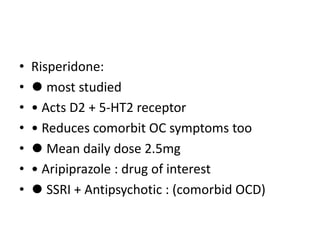
• Risperidone:
• ⚫ most studied
• • Acts D2 + 5-HT2 receptor
• • Reduces comorbit OC symptoms too
• ⚫ Mean daily dose 2.5mg
• • Aripiprazole : drug of interest
• ⚫ SSRI + Antipsychotic : (comorbid OCD)
References
– Uptodate 2023
– Nelson 21 edition
– DSM 5
– https://www.aaidd.org/intellectual-
disability
97
98

common psychiatric disorders hab.pptx rev

  • 1.
    Presenter - Dr.Habtamu M. Moderator - Dr. Getasew ( Assistant professor of pediatrics ) 1
  • 2.
    Objectives  Categorize mentalhealth disorders in children and adolescents.  Recognize the cultural issues and symptoms of commonly diagnosed mental health disorders in children and Adolescents.  Identify the latest methods of treatment and assessment. 2
  • 3.
    Epidemiology – 11.3 percentof U.S. children ages 2-17 – ADHD was the most prevalent diagnosis among children ages 3-17 – Boys were more likely than girls to have ADHD, behavioral or CD, ASD, and anxiety – Girls were more likely to be diagnosed with depression – Suicide is the second leading cause of death among children ages 12-17 3
  • 4.
  • 5.
    Categories of Child/AdolescentMental Health Disorders • Neurodevelopment Disorders – Intellectual disability – Autism Spectrum Disorder – Attention Deficit Hyperactivity Disorder • Depressive and Bipolar Disorders – Major Depressive Disorder – Persistent Depressive Disorder (Dysthymia) – Bipolar Disorder – Disruptive Mood Dysregulation Disorder • Anxiety Disorders – Selective Mutism, Specific Phobia, Separation Anxiety, – Social Anxiety, Panic Disorder, Agoraphobia, Generalized Anxiety 5
  • 6.
    Categories of Child/AdolescentMental Health Disorders • Disruptive, Impulse Control, and Conduct Disorders – Oppositional Defiant Disorder* – Intermittent Explosive Disorder – Conduct Disorder* • Trauma and Stressor-Related Disorders – Reactive Attachment Disorder – Disinhibited Social Engagement Disorder – Posttraumatic Stress Disorder • Eating Disorders – Anorexia Nervosa – Bulimia Nervosa – Binge-Eating Disorder • Elimination disorders • Somatic symptom and related disorders 6
  • 7.
    Diagnosing • Psychological and/orpsychiatric evaluation • DSM-5 • Take into consideration cultural context • Identify frequency and intensity of emotions and behaviors • Do emotions/behaviors impair functioning? 7
  • 8.
    Neurodevelopmental disorders • Intellectualdisability – Developmental period and affects an individual's ;- • Intellectual abilities ( abstractive thinking, language, memory) and • Adaptive functioning (communication, independent living) • Prevalence: ∼ 1% in the general population. 8
  • 9.
    Etiology – Congenital • Geneticconditions ( fragile X syndrome, trisomy 21, Klinefelter syndrome) • Exposure to teratogens in utero ( fetal alcohol syndrome) • Congenital hypothyroidism • Congenital infections (toxoplasmosis, rubella) • Perinatal hypoxia • Perinatal trauma – Acquired • CNS infections (viral encephalitis, meningitis) • CNS malignancies ( neuroblastoma) • Traumatic brain injury • Intoxications ( lead, mercury) • Iodine deficiency • Malnutrition 9
  • 10.
    Clinical features – Deficitsin cognitive functioning • learning, problem-solving, reasoning, abstract thinking, judgment, and planning – Impaired adaptive functioning • Inability to maintain personal independence and social responsibility • Leading to educational, occupational, communication, and social problems – Onset during the developmental period (during childhood or adolescence) 10
  • 11.
    Diagnosis • IQ testing •Genetic testing • Neuroimaging 11
  • 12.
    Management • Nonpharmacological – Psychotherapy(CBT, family-oriented therap) – Occupational therapy – Special education programs – Speech-language therapy • Pharmacological: – used to control psychiatric symptoms of accompanying conditions – Atypical antipsychotics • ( risperidone, aripiprazole, olanzapine) – Antidepressants (SSRIs) 12
  • 13.
    GDD • Significant delayin ≥ 2 of the major developmental domains (gross motor, fine motor, language, cognition, and social milestones) in children < 5 years of age • Prevalence: up to 5% of children in developed countries 13
  • 14.
  • 15.
    Neurodevelopmental Disorders • AutismSpectrum Disorder (ASD) • Attention Deficit Disorder (ADHD) 15
  • 16.
    Autism spectrum disorder(ASD) • A Characterized by – Qualitative impairment in social interaction and communication – Repetitive stereotyped behavior, interests, and activities. 16
  • 17.
    Epidemiology • Prevalence: 14.7/1000in the US • Sex: ♂ > ♀ (4:1) • Age: Symptoms typically manifest before 2–3 years of age. 17
  • 18.
  • 19.
    Etiology • Genetics – Strongunderlying predisposition • Environmental factors • toxin exposure, prenatal infections 19
  • 20.
    Clinical features • Corefeatures – Persistent impairment in communication and social interaction (e.g., inability to form relationships, abnormal language development, reduced empathy, difficulties in adjusting behavior to social situations, and poor eye contact) – Restricted, stereotyped patterns of behavior, interests, and activities (e.g., hand flapping, excessive touching/smelling, lining up toys, adverse response to sounds, and echolalia) – Repetitive movements (e.g., stereotyped hand movements) • Additional features – Intellectual impairment – Language impairment – Sensory abnormalities (sensation can be hyporesponsive or enhanced) 20
  • 21.
    • Mild ASD –No intellectual impairment – Affected individuals are able to speak in full sentences, read and write, and handle basic life skills • Symptoms may not become fully apparent until school age, when social impairments and stereotypies begin to exceed limited capabilities. • Impaired social communication and interaction • Insistence on sameness (e.g., eating specific foods in a particular order) • Fixated interest in unusual objects (e.g., ceiling fans) • Unusual responses to sensory stimuli • Affected individuals may develop strategies that mask deficits later in life. 21
  • 22.
    Associated conditions • Epilepsy •ADHD, Pica, anxiety disorder • Genetic disorders, e.g., tuberous sclerosis, fragile X syndrome, Rett syndrome – Associated with a higher head circumference to brain volume ratio 22
  • 23.
    Diagnosis • Comprehensive evaluationof – Social interaction and communication skills – Language and comprehension skills – Behavior • Cognitive development • Associated conditions • Hearing and vision testing • Genetic testing 23
  • 24.
    Treatment • Early behavioraland educational management – Competence training: social skills, communication skills – Establishing clear and consistent structures • Medical treatment – SSRIs: repetitive stereotyped behavior, anxiety – Antipsychotic drugs: aggression, self-injury – Methylphenidate: ADHD 24
  • 25.
    Prognosis • Indicators ofpoor prognosis: – Severe core symptoms – Cognitive impairment (low IQ) – Poor or absent language skills – Late initiation of treatment • Impaired social interaction often persists into adulthood • Approx. 50% of individuals with language impairment do not develop the ability to speak. • Adolescents: Insensitive behavior towards peers often results in social exclusion. 25
  • 26.
    ADHD • A neurodevelopmentaldisorder that manifests in childhood and may persist into adulthood. • Inattention and/or impulsivity and hyperactivity . 26
  • 27.
    Epidemiology • Sex: ♂> ♀ [1] • Age of onset: usually before 12 years [2] • Prevalence: ∼ 5% [1] 27
  • 28.
  • 29.
    Etiology • Multifactorial disorder;pathogenesis is thought to be related to altered catecholamine metabolism. • Genetic predisposition: family history of ADHD, polymorphisms of the dopamine, serotonin, or glutamate receptor subtypes • Enviromental factors • Prematurity, in-utero exposure to alcohol 29
  • 30.
  • 31.
    Clinical features Symptoms ofinattention include (mnemonic: ATTENTION): six or more Attention difficulty Trouble listening to others even when spoken directly Tasks that require sustained mental effort are difficult Easily distracted Necessary things for tasks are lost To finish what he/she starts is difficult Is forgetful in daily activities Organizational skills lacking Not concerned about details or makes careless mistakes Symptoms of hyperactivity and impulsivity include (mnemonic: RUNFIDGET six or more Runs, climbs or restless Uninhibited in conversation Not able to play quietly Fidgets or squirms in seat Interrupts or intrudes on others Difficulty waiting his or her turn Get going or acting as if driven by a motor Evacuates seat unexpectedly Talks excessively 31
  • 32.
  • 33.
    Management • Behavioral interventions •Parent training in behavioral management (PTBM) • Indication: caregivers with children 4–11 years of age with problematic behaviors (e.g., ADHD) • Goals: reinforce preferred behaviors and reduce problematic behaviors • Classroom interventions: behavioral intervention plan (organized via the school district) • PTBM can also be utilized for children who do not meet the full criteria for ADHD. 33
  • 34.
    • Pharmacotherapy • Optionsinclude stimulant and nonstimulant therapy. – Stimulant therapy • First-line treatment for children ≥ 6 years of age – Nonstimulants are preferred for individuals with: • Contraindications to or potential for serious adverse effects with stimulants • Certain comorbidities 34
  • 35.
    • Stimulant therapy –Options: methylphenidate or amphetamine analogues (e.g., lisdexamfetamine, dextroamphetamine) – Mechanism of action: indirect and central sympathomimetic activity → increased release and blocked reuptake of norepinephrine and dopamine (minor effect on serotonin) → increased concentration of norepinephrine and dopamine in the synaptic cleft → increased mental performance (e.g., improved concentration, cognition, short-term memory) and fine motor skills – Adverse effects • Sympathomimetic effects – Anxiety, agitation, restlessness, bruxism, tics – Difficulty falling asleep (insomnia) – Reduced appetite, nausea, vomiting, weight loss • Increased arterial blood pressure, tachycardia • Increased risk of seizure: reduces the seizure threshold • Decreased growth rate (may be reversible if medication is stopped) • Psychosis (e.g., hallucinations) • Priapism • Other indications: also used in patients with narcolepsy or binge eating disorder 35
  • 36.
    Initiation of stimulanttherapy – Obtain an ECG if either of the following are present: • Symptoms of a cardiac disorder (e.g., syncope, palpitations) • A personal or family history of cardiac conduction disorders – Inform individuals that effects may be noticed within 2–3 days of initiation. – Start on a low dose and slowly titrate medication as necessary, e.g.: • Children: every 1–4 weeks – Arrange regular follow-up for patients with ADHD to monitor the effects of pharmacotherapy. 36
  • 37.
    • Nonstimulant therapy –It may take 4–6 weeks for nonstimulants to reach maximum efficacy. • Selective norepinephrine reuptake inhibitors – Indication: alternative to stimulant medications for ADHD in adults and children ≥ 6 years of age – Mechanism of action: block norepinephrine reuptake, which increases synaptic cleft levels of norepinephrine and dopamine in the prefrontal cortex – Options: atomoxetine or viloxazine – Adverse effects • GI symptoms (e.g., appetite suppression, nausea, discomfort) • Sedation • Rare: liver failure, prolonged QT interval, suicidal ideation 37
  • 38.
    • Alpha-2 adrenergicagonists – Indications: children 6–17 years of age with either of the following. • Contraindications to stimulants . • Preference for nonstimulants • Inadequate response to stimulants alone (i.e., adjunctive therapy) – Options: guanfacine extended-release or clonidine extended-release 38
  • 39.
    Follow-up – For patientson pharmacotherapy: • Advise patients and/or caregivers • Arrange regular scheduled follow-up appointments. – Monthly until treatment is optimized – Every 3 months for at least the first year – Once stable, every 6 months • At every visit, assess vital signs and inquire about adverse effects. • Laboratory studies are not routinely required. • If the response is insufficient or significant adverse effects occur, consider medication adjustments. • Periodically reassess if medication is still required. 39
  • 40.
    Prognosis • The persistenceof symptoms after treatment predicts prognosis into adulthood. • In 35–65% of patients, symptoms of ADHD and their associated functional impairment will persist into adulthood. • Patients with untreated ADHD are at higher risk of injury , substance use disorder, and antisocial personality disorder. 40
  • 41.
    Affective Disorders and PosttraumaticStress Disorder • Major Depressive Disorder (MDD) • Anxiety disorders – Separation anxiety – Social anxiety • Posttraumatic Stress Disorder 41
  • 42.
    Anxiety disorders • Abroad spectrum of conditions characterized by excessive and persistent fear (an emotional response to imminent threats), • Anxiety (the anticipation of a future threat), worry (apprehensive expectation), and/or avoidance behavior. 42
  • 43.
    Etiology • Neurobiological factors –Disruption of the serotonin system – Dysfunction of GABAergic inhibitory transmission • Substance use (leading to substance/medication-induced anxiety disorder) • Environmental and developmental factors – Stress – Smoking (risk factor for panic disorder and panic attacks) – Psychological trauma, esp. during childhood • Other medical conditions: conditions that may lead to anxiety and/or panic attacks – Endocrine disease (e.g., hyperthyroidism) – Cardiovascular disorders (e.g., congestive heart failure) – Respiratory illness (e.g., asthma) – Metabolic disorders (e.g., porphyria) – Neurological diseases (e.g., encephalitis) 43
  • 44.
    Separation anxiety disorder •Excessive fear, anxiety, or avoidance of separation from major attachment figures • Separation anxiety disorder differs from nonpathological separation anxiety in its intensity and effect on the social and academic life of the individual. 44
  • 45.
    – Separation anxietyis normal in children under a developmental age of 3 years. – Typically develops after a stressful life event, usually involving some form of loss (e.g., death of a relative, parental divorce, change of school) 45
  • 46.
    Anxiety Disorders: Prevalenceand Risk Separation Anxiety • Range of 2.8 percent to 8 percent • Environmental – Often develops after a life stress, especially loss – Parental overprotection • Genetic – Much greater risk in first- degree relatives – Exact rates unknown Social Anxiety • 7 percent • Temperamental – Fear of negative evaluation • Environmental – Maltreatment – Modeling by parent • Genetic – 2-6 times greater chance in first-degree relatives 46
  • 47.
    • Diagnostic criteria(DSM-V) • Fear of separation from major attachment figures, that is excessive for developmental level, involving at least 3 of the following features: – Recurrent and excessive distress prior to, or during, separation – Persistent worrying about the loss of attachment figures (e.g., due to illness, injury, or death) – Persistent worrying about separation due to the individual being lost, kidnapped, injured, or ill – Persistent reluctant to leave home due to fear of separation – Avoidance of being left alone (e.g., at home or elsewhere) – Avoidance of falling asleep, or sleeping away from home, without major attachment figure – Persistent nightmares about separation – Persistent somatic symptoms (e.g., headaches, nausea/vomiting, abdominal pain) • Duration: symptoms persist for at least 4 weeks in children/adolescents and 6 months in adults • Significant impairment of academic, social, and/or work life (e.g., often a precursor to school refusal) • Symptoms are not attributable to another psychiatric disorder (e.g., autism spectrum disorder, psychosis, other anxiety disorders). 47
  • 48.
    Treatment • Psychotherapy – Allage groups: cognitive behavioral therapy (e.g., exposure therapy) – Children: family therapy and parent-child interaction therapy • Pharmacotherapy: – SSRIs (e.g., fluoxetine) indicated as an adjunct to psychotherapy if there is moderate to severe functional impairment 48
  • 49.
    • Complications – Children:academic and social consequences of school refusal 49
  • 50.
    Selective Mutism – Description:a psychiatric disorder characterized by the inability to speak in specific social situations (e.g., during class) • Typically normal development of language and speech. • Onset: generally before 5 years of age, although may not become clinically relevant until the child is required to perform verbally (e.g., with the start of school) 50
  • 51.
    Diagnostic criteria (DSM-V) •Consistent inability to speak in specific social settings where speaking is expected (e.g., does not speak in class but speaks at home) • Interferes with academic or professional performance and social interaction • Duration of symptoms: at least 1 month • The inability to speak is not due to difficulties or discomfort with the spoken language expected in the social situation. • The inability to speak is not attributable to schizophrenia spectrum disorder or another psychotic disorder, autism spectrum disorder, or a communication disorder. 51
  • 52.
    • Treatment – Psychotherapy •Cognitive behavioral therapy (e.g., exposure therapy) at all ages • Children: family therapy and parent-child interaction therapy • Pharmacotherapy: SSRIs (e.g., fluoxetine) may be beneficial in those who do not respond to psychotherapy • Complications: may coexist with social anxiety disorder and may also result in school refusal 52
  • 53.
    Disruptive, Impulse-Control, and ConductDisorders • Oppositional Defiant Disorder (ODD) • Conduct Disorder (CD) 53
  • 54.
    Disruptive disorder, impulse-control disorder,and conduct disorder • are a group of psychiatric conditions that affect the self-regulation of emotions and behaviors beginning in childhood or adolescence. • The disturbance in behavior significantly impairs social, academic, and/or occupational functioning. 54
  • 55.
    Oppositional defiant disorder (ODD) •Definition: anger, irritable mood, and defiant behavior toward authority figures that significantly impairs social and/or academic functioning • Epidemiology – Onset is usually during late preschool or elementary school years – Before puberty ♂ > ♀, after puberty ♂ = ♀ – Frequent comorbidity of ADHD, anxiety disorder, mood disorders, and/or learning disorders 55
  • 56.
    • Etiology: associatedwith genetic, environmental, psychological, and/or social factors (e.g., abuse, exposure to toxins, positive family history, neglectful parents, family instability) 56
  • 57.
    Symptoms • Angry/irritable mood –Often loses temper – Is often touchy or easily annoyed – Is often angry and resentful • Argumentative/defiant behavior – Argues with adults – Defies or refuses to comply with requests or rules – Deliberately annoys others – Blames others for mistakes • Vindictiveness/spiteful • At least four symptoms; symptoms present at least 6 months (American Psychiatric Association, 2013) 57
  • 58.
    Diagnostic criteria (DSM-5) •≥ 4 of the following symptoms for ≥ 6 months when interacting with ≥ 1 individual who is not a sibling (e.g., teachers, parents): – Frequent loss of temper – Easily annoyed – Resentful or angry mood – Argumentative with authority figures – Defies rules or refuses to comply with requests from authority figures – ≥ 2 episodes of vindictive or spiteful behavior within the past 6 months – Deliberately annoying – Blames others for one's own mistakes • Disruptive mood dysregulation disorder should be ruled out. • The disturbance should negatively impact the individual's functioning or cause distress to other individuals. 58
  • 59.
    • Treatment: – Psychotherapy(individual and family), – Parent management training, – Social-skills programs • Prognosis: often precedes the onset of conduct disorder 59
  • 60.
    Conduct disorder (CD) •Definition: a disruptive behavior that violates the basic rights of others and/or age-appropriate social norms • Epidemiology • Onset during childhood or adolescence • ♂ > ♀ • Etiology: associated with genetic, environmental, psychological, and/or social factors (e.g., abuse, exposure to toxins, positive family history, neglectful parents, family instability) 60
  • 61.
    Prevalence and Risk •Range of 2 percent to 10 percent; more boys than girls • Temperament – Difficult temperament; lower than average IQ • Environment – Neglect, abuse, frequent change in caregivers – Inconsistent, harsh discipline – Lack of supervision, parental criminality or substance abuse – Association with gangs and delinquent peer group • Genetics – Family history of depressive disorders, bipolar, ADHD, CD – Slower resting heart rate 61
  • 62.
    Symptoms • Pattern ofbehavior in which the basic rights of others or societal norms and rules are violated • Behaviors fall into four categories – Aggression to people/animals – Destruction of property – Deceitfulness or theft – Serious violation of rules 62
  • 63.
    • Diagnostic criteria(according to DSM-5) • Aggression toward people and animals (e.g., bullying, physical fights, use of weapons) • Destruction of property (e.g., fire setting) • Deceitfulness or theft • Serious rule violation (e.g., truancy, running away from home) • The disturbance in behavior lasts ≥ 12 months and significantly impairs social, academic, and/or occupational functioning. • The diagnosis is only applied to patients < 18 years of age. 63
  • 64.
    • Treatment – CBT,parent management training, social skills programs – Pharmacotherapy (e.g., psychostimulants in comorbid ADHD, antipsychotic medications or mood stabilizers in cases of severe aggression) • Prognosis: – Individuals with CD are at increased risk of developing antisocial personality disorder in adulthood. – If an individual's CD symptoms persist after 18 years of age, their diagnosis is changed to antisocial personality disorder. 64
  • 65.
    Somatic disorders andrelated disorders • Physical symptom of unknown causes causing mental distress. • The process whereby distress is experienced and expressed in physical symptoms. • Epidemiology- 10-20% ww, girls > boys • Characteristic symptoms – Somatic symptoms – Pain ( abd. Pain, headache, limb or back pain..) • Related symptoms – Persistent thoughts • duration 65
  • 66.
    Somatic disorders andrelated disorders presentation Symptoms produced Types of symptoms and motivation diagnosis Unexplained medical symptom and disorders Involuntary physical Somatic symptom disorders neurological Conversion disorders Anxiety about health Illness anxiety disorders voluntary Sick role Factitious disorders External secondary gain Malingering 66
  • 67.
    DSM-5 Diagnostic Criteriafor Somatic Symptom Disorder A. > 1 somatic symptoms that are distressing or result in significant disruption of daily life. B. Excessive thoughts, feelings, or behaviors related to the somatic symptoms or associated health concerns, as manifested by at least one of the following: • Disproportionate and persistent thoughts about the seriousness of one's symptoms. • Persistent high level of anxiety about health and symptoms. • Excessive time and energy devoted to these symptoms or health concerns. C. Although any one somatic symptom may not be continuously present, the state of being symptomatic is persistent (typically >6 mo). Specify if: 67
  • 68.
    DSM-5 Diagnostic Criteriafor Conversion Disorder or Functional Neurologic Symptom Disorder A. One or more symptoms of altered voluntary motor or sensory function. B. Clinical findings provide evidence of incompatibility between the symptom and recognized neurologic or medical conditions. C. The symptom is not better explained by another medical or mental disorder. D. The symptom causes clinically significant distress or impairment in social, occupational, or other important areas of functioning or warrants medical evaluation. 68
  • 69.
    Clinical features • Functionalparalysis • Psychogenic non epileptic seizure • Tremors • Visual and hearing loss 69
  • 70.
    DSM-5 diagnostic criteria 70 AIntentionally deceptive falsification of disease signs or symptoms, or inducing injury or disease in oneself Intentionally deceptive falsification of disease signs or symptoms, or inducing injury or disease in another individual B Present themselves as ill, impaired, or injured to others Presents the person they induce symptoms in as ill, impaired, or injured to others C Occurs even in the absence of external rewards D Behavior is not better explained by another mental disorder
  • 71.
    Management • Provide appropriatecare and ensure safety – Treat any induced illness or injury. – Avoid unnecessary procedures. – In whom symptoms have been induced (in factitious disorder imposed on another) • Provide a safe place away from the perpetrator (e.g., call adult or child protective services). • Exclude other forms of abuse or neglect if suspected. • Refer for psychotherapy, depending on the individual's age. • psychotherapy and/or parenting classes. • Assess for co morbid conditions. • Monitor pharmacotherapy intake. 71
  • 72.
    Eating disorders • Bodydissatisfaction related to – Overvaluation of a thin body ideal – Weight control behaviors • Result in significant biologic, psychological, and social complications • 0.5–1% and 3–5% incidence rates among younger and older adolescent females for AN and BN, respectively 72
  • 73.
    Binge eating disorder •Most common eating disorder in adults in the US • Key features • Recurrent binge eating episodes that are not associated with inappropriate weight compensatory behaviors • Pronounced obesity at a young age is common; BMI may also be normal. • Management – Psychotherapy (CBT, interpersonal therapy) – Pharmacotherapy may be considered in select patients. – Management of comorbidities (e.g., ASCVD prevention) 73
  • 74.
    Anorexia nervosa Bulimianervosa Epidemiology Sex: ♀ > ♂ Risk factors •Genetic factors •Psychiatric comorbidities (e.g., OCD, anxiety disorders) •Alterations in the endogenous reward system •Psychosocial factors (e.g., perfectionism, teasing, bullying) •Obesity during childhood (in bulimia nervosa) •Early puberty weight Underweight Healthy weight or slightly elevated Key features •restrictive eating •Fear of weight gain and/or behaviors that prevent weight gain (e.g., excessive exercise, purging) • Body image distortion Restrictive vs purging type Recurrent binge eating followed by inappropriate weight compensatory behaviors Management Psychotherapy Family-based therapy Pharmacotherapy In selected patients: SSRIs Olanzapine Only as an adjunct to psychotherapy: SSRIs (usually fluoxetine) SSRIs Nutrition support Support healthy eating habits. Provide nutritional education. 74
  • 75.
    Pica Definition Persistent ingestionof nonnutritive nonfood substances (e.g., hair, clay, soil, ice) Duration Present for > 1 month Additional features Inappropriate for developmental age Not part of culturally or socially normative practice If another medical or psychiatric condition is present, the pica behavior warrants specific clinical management. All criteria must be fulfilled. Mgt o Identify and treat underlying etiology • IDA • Electrolyte abnormalities o Identify and treat complications • Malnutrition and lead poisoning o CBT and SSRI ( refractory) 75
  • 76.
    Elimination disorders Repeated voidingof • Urine (enuresis) or • Defecation (encopresis) • Inappropriate for the developmental age. 76
  • 77.
    Enuresis Encopresis Definition: repeatedinvoluntary elimination of urine that is inappropriate for developmental age repeated involuntary or intentional elimination of feces inappropriate for developmental age (e.g., into clothes or on the floor) Epidemiology Affects 5–10% of 7-year-olds Types Nocturnal (♂ > ♀) or diurnal (♀ > ♂) Primary (patient never achieved nocturnal continence) or secondary (onset of symptoms after patient had achieved nocturnal continence) More common in boys Etiology Retentive encopresis: (80% of cases) Nonretentive encopresis: no organic cause (approx 20% of cases) Risk factors: Primary enuresis: positive family history Secondary enuresis Psychosocial stress factors •Psychiatric disorders; and neurodevelopment disorders psychosocial stressors (potty training, transition to solid food, starting school) Diagnostic criteria Occurs at least twice per week for ≥ 3 months or causes clinical distress Developmental age ≥ 5 years Occurs ≥ 1/month for ≥ 3 months Patient's developmental age must be ≥ 4 years. Symptoms not caused by a medication or another medical condition Treatment •not recommended in children under 5 years of age •Organic causes •: Nonpharmacological measures • Fluid restriction at night • Psychoeducation and behavioral training •Pharmacological treatment: reserved for children ≥ 7 years of age if nonpharmacological options are unsuccessful or if more rapid improvement is desired Desmopressin: first-line medication, especially in patients with nocturnal polyuria Tricyclic antidepressants (e.g., imipramine): second-line medication; has more side effects than desmopressin . If encopresis is due to constipation, treat the underlying constipation with fecal disimpaction, stool softeners, and dietary changes 77
  • 78.
    • Psychosis isan impaired perception of reality. – Evidenced by > of the following thought disturbances • Hallucinations • Delusions • Disorganized thinking, speech, or behavior • Acute psychosis is a psychiatric emergency. 78
  • 79.
    Childhood psychosis • Primarypsychosis: – Primarily from a psychiatric disorder, e.g., Schizophrenia • Secondary psychosis: – Primarily from a general medical condition and/or the effect of a substance 79
  • 80.
    Early-onset schizophrenia Definition onsetof schizophrenia < 18 years of age Clinical features positive symptoms •Delusions, hallucinations, disorganized thinking, and grossly disorganized behavior Negative symptoms • diminished emotional expression, avolition, alogia (lack of speech), anhedonia (inability to experience pleasure), and asociality. Rx First-generation (typical) and second-generation (atypical) antipsychotic Poor Prognostic Family history Early onset of disease Lac of social support Slow onset of symptoms 80
  • 81.
    DSM-5 Diagnostic Criteria A.Presence of 1 (or more) of the following symptoms. At least 1 of these must be (1), (2), or (3): 1. Delusions. 2. Hallucinations. 3. Disorganized speech (e.g., frequent derailment or incoherence). 4. Grossly disorganized or catatonic behavior. Note: Do not include a symptom if it is a culturally sanctioned response. B. Duration??? C. The disturbance is not better explained by major depressive or bipolar disorder with psychotic features or another psychotic disorder 81
  • 82.
    • Brief psychoticdisorders >1 Duration of an episode of the disturbance is at least 1 day but less than 1mo. • If 2 or more psychotic symptoms persist from 1 mo up to 6 mo, the condition is called schizophreniform disorder • schizophrenia , 2 or more psychotic symptoms must have been present for at least 6 mo 82
  • 83.
    Stereotypic Movement Disorder •⚫ include a diverse range of repetitive behaviors • ⚫ emerge in the early developmental period ⚫ appear to lack a clear function • • May cause interruption in daily life. • • These movements are typically rhythmic, such as hand flapping, body rocking, hand waving, hair-twirling, lip licking, skin picking, or self- hitting
  • 84.
    • Epidemiology • ⚫increased frequency in children with autism and intellectual disability • Age of onset is in the second year of life ⚫ 15 to 20 % in children younger than the age of 6 years display • stereotypic behavior • ⚫ self-injurious behaviors in 2 to 3 % of children and adolescents with intellectual disability. Eg: head-banging, face slapping, eye
  • 85.
    • Etiology • •Genetic factors • ⚫ stereotypic movement disorder is hypothesized to originate from the basal ganglia • • Dopamine and serotonin are likely to be
  • 86.
    • DIFFERENTIAL DIAGNOSIS •• obsessive-compulsive disorder • ⚫tic disorders
  • 87.
    • Course andprognosis • ⚫ symptoms may wax and wane • ⚫ 60 to 80 percent tend to disappear by 4 years ⚫ Children who exhibit frequent, severe, self-injurious stereotypic • behaviors have the poorest prognosis
  • 88.
    • Treatment • ⚫behavioral techniques, such as habit reversal and differential • reinforcement of other behavior • ⚫ pharmacological • ⚫ atypical antipsychotics • ⚫ selective serotonin reuptake inhibitor (SSRIs)
  • 89.
    • Tourette's Disorder •• Characterized by brief rapid motor movements or vocalizations that are typically performed in response to irresistible urges • ⚫ Tics may be transient or chronic, with a waxing and waning course • • Typically the initial tics are in the face and neck. • The most frequent initial symptom is an eye-blink tic, • • Motor tics ⚫ most commonly in face and
  • 90.
    • •Simple motortics eye-blinking, neck-jerking, shoulder-shrugging, and facial-grimacing. • • Simple vocal tics coughing, throat-clearing, grunting, sniffing, snorting, and barking. • ⚫ complex motor tics grooming behaviors, the smelling of objects, jumping, touching behaviors, echopraxia, and copropraxia (display of obscene • gestures) • • Complex vocal tics repeating words or
  • 91.
    • ⚫ olderchildren may be able to suppress their tics for minutes or hours, young children experience their urges as irresistible. • Tics often disappear during sleep. • • ½ to 2/3rd have reduction in or complete remission of tic symptoms during adolescence • • >50% of children with Tourette's disorder also meet criteria for ADHD. ⚫ 20-40% of Tourette's disorder patients meeting full criteria for OCD.
  • 92.
    • Epidemiology • •The lifetime prevalence 1% • ⚫3 to 8 per 1000 school-age children ⚫ Males 2-4 times more than Female • ⚫ common in children than in adults • Tics typically emerge at age 5 to 6 years of age and tend to reach their • greatest severity between 10 and 12 years.
  • 93.
    • Etiology • •First-degree relatives of patients with OCD have been shown to have higher rates of tic disorders compared to the general population. • • May involve dysfunction in the basal ganglia region of the brain, in • the cortico-striato thalamic circuits. • ⚫ fMRI found that paralimbic and sensory association areas involvement
  • 94.
    • Diagnosis • •DSM-5/ICD-10 ••persisted for more than a year since the first tic • ⚫at least one Vocal tic plus Motor tic • ⚫before the age of 18 years.
  • 95.
    • Treatment • •Psychoeducation, behavioral interventions • • Stress reduction Techniques • Habit reversal training • • Exposure and response prevention • • Pharmacological interventions if severe • • Antipsychotics • • Noradrenergic Agents: Clonidine, Guanfacine, atomoxetine (reduces
  • 96.
    • Risperidone: • ⚫most studied • • Acts D2 + 5-HT2 receptor • • Reduces comorbit OC symptoms too • ⚫ Mean daily dose 2.5mg • • Aripiprazole : drug of interest • ⚫ SSRI + Antipsychotic : (comorbid OCD)
  • 97.
    References – Uptodate 2023 –Nelson 21 edition – DSM 5 – https://www.aaidd.org/intellectual- disability 97
  • 98.

Editor's Notes

  • #36 Methamphetamine has FDA approval for the treatment of ADHD but is rarely prescribed because of its high potential for misuse.
  • #38 SNRIs are not addictive or Schedule II drugs and therefore may be preferred for individuals with a history of substance use disorder.
  • #39 To avoid rebound hypertension, do not abruptly stop alpha-2 adrenergic agonists; taper gradually. [6]
  • #50 Children under 3 years of age commonly undergo periods of separation anxiety from attachment figures as a normal part of their development. The diagnosis of separation anxiety disorder should only be considered if the symptoms become excessive for developmental level.
  • #65 “C and D come before E”: Conduct Disorder is diagnosed before Eighteen years.
  • #68 With predominant pain (previously known as “pain disorder” in DSM IV-TR): for individuals whose somatic symptoms predominantly involve pain. Persistent: A persistent course is characterized by severe symptoms, marked impairment, and long duration (>6 mo).
  • #69 Specify symptom type: weakness or paralysis, abnormal movements, swallowing symptoms, speech symptom, attacks/seizures, anesthesia/sensory loss, special sensory symptom (e.g., visual, olfactory, hearing), or mixed symptoms.
  • #82  response to events that, singly or together, would be markedly stressful to almost anyone in similar circumstances in the individual's culture. Without marked stressor(s) : If the symptoms do not occur in response to events that, singly or together, would be would be markedly stressful to almost anyone in similar circumstances in the individual's culture. With postpartum onset : If onset is during pregnancy or within 4 wk postpartum. From the Diagnostic and Statistical Manual of Mental Disorders, Fifth Edition, (Copyright 2013). American Psychiatric Association, p 94.
  • #83 Pharmacotherapy First-generation (typical) and second-generation (atypical) antipsychotic medications have been shown to be effective in reducing psychotic symptoms. These antipsychotics appear to outperform placebo and to have approximately equal effectiveness, except for ziprasidone and clozapine, which may be less and more effective than the others, respectively. Risperidone, aripiprazole, quetiapine, olanzapine, and lurasidone are FDA-approved second-generation antipsychotics for treating schizophrenia in patients 13 yr and older, and paliperidone for those 12 yr and older. Several of the first-generation antipsychotics are also FDA approved for children and adolescents. The choice of which agent to use first is typically based on U.S. Food and Drug Administration approval status, side effect profile, patient and family preference, clinician familiarity, and cost. Depot antipsychotics have not been studied in pediatric age groups and have inherent risks with long-term exposure to side effects. Although clozapine is effective in treating both positive and negative symptoms, its risk for agranulocytosis and seizures limits its use to those patients with treatment-resistant disorders. Ziprasidone and paliperidone are associated with QT prolongation; this finding along with the inferior effectiveness of ziprasidone limits its use with children and adolescents. Most patients require long-term treatment and are at significant risk for relapse if their medication is discontinued, and more than three quarters of youth with schizophrenia discontinue their medication within 180 days. As such, the goal is to maintain the medication at the lowest effective dose to minimize potential adverse events. Many patients will continue to experience some degree of positive or negative symptoms, requiring ongoing treatment. Patients should maintain regular physician contact to monitor symptom course, side effects, and adherence. Electroconvulsive therapy (ECT) may be used with severely impaired adolescents if medications are either not helpful or cannot be tolerated. It has not been systematically studied in children