MENTAL HEALTH
DEFINING A PSYCHOLOGICAL
DISORDER
• DSM-V definition:
• Behavioral, cognitive, and emotional
dysfunction
• Unexpected in cultural context
• Personal distress
• Substantial impairment in function
CHARACTERISTICS OF
GOOD MENTAL HEALTH
• Feels good about
themselves
• Feels comfortable with
others
• Optimistic
• Expresses emotions in
a healthy way
• Group player
• Able to meet demands of
life
• Uses health skills – stress
management, decision
making, conflict resolution,
and “I” messages
• Copes and adapts to
change
• Assertive
• Active listener
CHARACTERISTICS OF
POOR MENTAL HEALTH
• Does not share feelings
• Emotions control
behaviors
• Pessimistic
• Ignores/denies problems
• Cannot accept change
• Lets stress control life
• “You” messages (blaming)
• Aggressive and passive
• Depressed
• Runs from conflict
• Close minded
• Needs to “run” the group
WHAT IS A MENTAL ILLNESS?
• Patterns of thinking or behavior that
cause a person significant emotional
pain or prevents normal functioning
GENERAL CAUSES OF
MENTAL ILLNESS
• Inherited traits
• Traumatic life experiences
• Environmental exposures before birth
• Viruses, toxins, alcohol, drugs
• Brain chemistry
• Hormonal imbalances
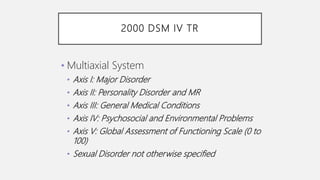
2000 DSM IV TR
• Multiaxial System
• Axis I: Major Disorder
• Axis II: Personality Disorder and MR
• Axis III: General Medical Conditions
• Axis IV: Psychosocial and Environmental Problems
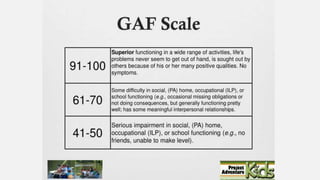
• Axis V: Global Assessment of Functioning Scale (0 to
100)
• Sexual Disorder not otherwise specified
2013 DSM V
• Combines all mental disorders, including
personality disorders and intellectual
disability, as well as other medical diagnoses
• GAF replaced by World Health Organization
Disability Assessment Schedule (WHODAS
2.0) – best current measure of disability for
routine clinical use and applicable for any
health condition
ASSESSMENT VS. TESTING
• Psychological Assessment
• Integrating psychological data for the purpose
of making a psychological evaluation
• Psychological Test
• Device or procedure used to measure variables
related to psychology
PSYCHOLOGICAL ASSESSMENT
• Clinical Interview
• Demographic data, psychiatric medical history,
family history, reason for visit
• Mental Status Exam
• Appearance, behavioral disturbances,
awareness of surroundings, mood/affect
• Behavioral Observations
• Informal observations provide information from
the natural environment through controlled
settings
PSYCHOLOGICAL TESTING
• Projective Tests
• Rorschach Inkblot or Thematic Apperception
Test
• Bender Visual Motor Gestalt Test
• Evaluates neuropsychological status – visual
motor maturity to developmental disorders
• MMPI-2
• Personality test
• Vineland Adaptive Behavior Scales
• Assesses personal and social skills in children
MENTAL HEALTH DISORDERS OF
CHILDREN
AUTISM SPECTRUM DISORDER
• Disorders
• Autistic Disorder
• Pervasive Developmental Disorder
• Asperger’s Disorder
• Cause
• Unknown
• Genetic/environmental factors
• Brain structure abnormalities
• Large total brain mass
• Small frontal cortex
• Abnormal cerebellum
AUTISM SPECTRUM DISORDER
• Signs/Symptoms
• Lack of social skills
• Avoidance of eye contact and physical contact
• Aggressive or passive
• Resistant to change
• Don’t listen
• Throw tantrums
• Echolalia – meaningless repetition of another
person’s spoken words
AUTISM SPECTRUM DISORDER
• Early Indicators
• No babbling, pointing, words, or response to
name
• Loss of language or social skills
• Poor eye contact
• No social responsiveness
• Late Indicators
• Impaired ability to make friends, initiate
conversation, or play
• Inflexible adherence to routines and rituals
AUTISM SPECTRUM DISORDER
• Screening Tests
• Childhood Autism Rating Scale (CARS)
• Checklist for Autism in Toddlers (CHAT)
• Treatment
• Intensive behavioral therapy
ATTENTION DEFICIT HYPERACTIVITY
DISORDER
• The inability to focus on one thing in all aspects
of life
• Impairs functioning
• Diagnosis must have all three:
• Inattention
• Hyperactivity
• Impulsivity
TOURETTE’S SYNDROME
• Characterized by tics – involuntary,
rapid, repetitive, and stereotyped
movements of individual muscle groups
TOURETTE’S SYNDROME
• Classification
• Transient Tic Disorder – do not persist for
more than one year
• Chronic Tic Disorder – duration over many
years w/ an unchanging character
• Chronic Multiple Tics – several chronic
motor tics
• Tourette’s – multiform frequency changing
motor and phone tics; unknown cause
BIPOLAR DISEASE
• Combination of euphoria and depression
• Signs/Symptoms in Kids
• Continuous, rapid-cycling, irritable, mixed
symptom state
• May co-occur with other disruptive
behaviors
SCHOOL AVOIDANCE
• Refusal to go to school on a regular
basis, or problems staying in school
once there
OPPOSITIONAL DEFIANT DISORDER
(ODD)
• Persistent and consistent pattern of
defiance, disobedience, and hostility
toward authority figures
CONDUCT DISORDERS
• Fighting, bullying, intimidating, physically
assaulting, or sexually coercing others
• Cruelty to humans and animals
• Vandalism, theft, and truancy
• Drug and alcohol abuse
• Precocious sexual activity
ADULT MENTAL HEALTH
DISORDERS
DEMENTIA-RELATED DISORDERS
• Dementia
• Alzheimer’s Disease
• Vascular Dementia (TIA)
• Mad Cow Disease
• Huntington’s Disease
ANXIETY DISORDERS
• Generalized Anxiety Disorder
• Excessive worry for at least 6 months
• Focus of worry will shift between topics
• Social Anxiety Disorder
• Extreme anxiety about being judged by others or
being embarrassed
• Causes avoidance behaviors
• Specific Phobias
• Fear of a specific thing that is at a level which is
inappropriate and recognized as irrational
ANXIETY DISORDERS
• Obsessive-Compulsive Disorder (OCD)
• Persistent, recurring thoughts and obsessions
• Repetitive, obsessive behaviors
• Post-Traumatic Stress Disorder (PTSD)
• Follows exposure to a traumatic event
• Three characteristic symptoms: reliving the disaster,
avoidance behavior, and emotional detachment from
other
• Panic Disorder
• Unexpected Panic Attacks
• Situational Panic Attacks
• Situationally Pre-Disposed Panic Attacks
DEPRESSIVE DISORDERS
• Major Depression
• Combination of symptoms that interfere with
work, sleeping, eating, and social activities
• Dysthymia
• Less severe form of depression
• Chronic, but does not interfere w/everyday life
• Bipolar Disorder
• Cyclic mood swings with mania and depression
MA JOR DEPRESSION:
SIGNS/SYMPTOMS
• Depressed Mood
• Diminished Interest
• Weight Loss/Gain
• Sleep Disturbance
• Restlessness
• Being Slowed Down
• Fatigue
• Loss of Energy
• Feelings of Worthlessness
• Feelings of Excessive Guilt
• Difficulty
Thinking/Concentrating
• Symptoms Occur Every Day
• Significant Distress
• Significant Impairment
• Thoughts of Death
BIPOLAR DISORDER
• Manic Episodes
• Elevated mood
• Grandiosity
• Decreased need for sleep
• Talkativeness
• Racing thoughts
• Increased goal-directed activity
• Marked Impairment
• Hospitalization, Psychotic Features
• May Alternate w/ Depressive Episodes
DELUSIONAL DISORDERS
• Delusional Paranoid Disorder
• Persistent, non-bizarre delusions
• No symptoms of other mental disorders
• Delusions of being persecuted
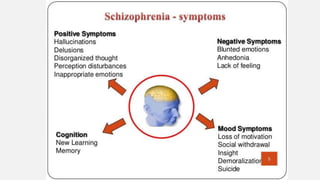
SCHIZOPHRENIA
• Characteristic Symptoms
• Delusions
• Hallucinations
• Disorganized speech and behavior
• Negative symptoms
• Flat affect
• Lack of motivation
• Social and Occupational Dysfunction
• Lasting at least 6 months
PERSONALITY DISORDERS
• Paranoid
• Continual mistrust; view everyone as an enemy
• Hypersensitive, defensive, and antagonistic
• Antisocial
• Long-standing pattern of a disregard for other people’s
rights
• Can only be diagnosed in ages 18 and older
• Avoidant
• Long-standing and complex pattern of feelings of
inadequacy, extreme sensitivity, and social inhibition
PERSONALITY DISORDERS
• Borderline
• Labile interpersonal relationships characterized by
instability, shallow, and impulsive behaviors
• Schizoid
• Detachment from social relationships
• Restricted range of expression of emotion in
interpersonal settings
• Narcissistic
• Pervasive pattern of grandiosity, need for admiration,
and lack of empathy
DISSOCIATIVE IDENTITY DISORDER
• Multiple Personality Disorder
• Two or more separate identities or traits
• Ability to control individual’s behavior and
thinking
• Create alters to distance themselves from
pain and trauma
SUBSTANCE ABUSE
• Addiction
• Physical or psychological craving need for
higher and higher doses of a substance
• Leads to bodily harm, social maladjustment,
or economic hardship
• Dependence on a substance, habit, or
behavior
ANOREXIA NERVOSA
• Irrational fear of becoming obese results in
severe weight loss from self-imposed starvation
• Warning Signs
• Dramatic weight loss
• Anxiety about gaining weight
• Denial of hunger
• Food rituals
• Excessive exercise
• Isolation
• Frequent comments about being “fat”
• Avoids food situations
GENERAL THERAPIES FOR MENTAL
HEALTH DISORDERS
PSYCHOTHERAPY
• Therapeutic treatment of mental illness
provided by trained mental health
professionals
• Explores thoughts, feelings, and
behaviors
• Seeks to improve an individual’s well-
being
SUPPORT GROUP
• Group meeting where members guide
each other towards the shared goal of
recovery
• Often comprised of nonprofessionals,
but peers that have suffered similar
experiences
HOSPITALIZATION
• May be necessary so an individual can
be closely monitored, accurately
diagnosed, or have medications
adjusted when his or her mental illness
temporarily worsens
PHARMACOLOGICAL TREATMENT OF
MENTAL HEALTH DISORDERS
ANTI-PSYCHOTICS
• Combat psychotic symptoms
• Hallucinations
• Delusions
• Confused thinking
• Altered perceptions
• Disorganized speech
ANTI-PSYCHOTICS
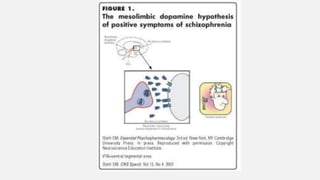
• Anti-Psychotic medications block the
receptor site of dopamine to prevent
dopamine from binding
ANTIPSYCHOTIC: THORAZINE
• Exact mechanism of action unknown
• Psychotropic agent that produces
sedative and antiemetic activities in the
CNS and other organ systems
• Weak anticholinergic activity; strong
antiadrenergic activity
ANTI-DEPRESSANTS
• Used to relieve symptoms of depression
• Sadness
• Feelings of failure
• Loss of interest in life
• Sleep disturbances
• Excessive guilt
• Loss of Energy/Fatigue
• Thoughts of Death
• Suicidal Thoughts
ANTI-DEPRESSANT: LEXAPRO
• Selective Serotonin Reuptake Inhibitor
(SSRI)
• Enhances serotonergic activity in the
central nervous system as a result of its
inhibition of serotonin receptors in CNS
neurons
MOOD STABILIZERS
• Used to treat symptoms of mania
• Rapid talking
• Decreased need for sleep
• Racing thoughts
• Distractibility
• Irritability
• Behavioral excesses
• Grandiosity
MOOD STABILIZERS: LITHIUM
• Lithium alters sodium transport in nerve
and muscle cells
• Results in intraneuronal metabolism of
catecholamines
• Specific mechanism of action in mania is
unknown
ANTI-ANXIETY
• Used to treat symptoms of anxiety
• Nervousness
• Panic
• Shortness of breath
• Trembling
• Feeling of choking
• Heart palpitations
• Obsessions and compulsions
ANTI-ANXIETY: XANAX
• Unknown mechanism of action
• Benzodiazepine
• Binds to various specific receptors in
the central nervous system
• Exhibits antidepressant properties
ANTI-PARKINSONIANS
• Side Effects Medications
• Used to relieve side effects of anti-psychotics
• Stiff muscles
• Unsteady gait
• tremors
• Eyes rolling back
• Restless feeling
ANTI-PARKINSONIANS: COGENTIN
• Synthetic drug
• Anticholinergic activity
• Utilized in the treatment in
parkinsonism
STIMULANTS
• Used to treat symptoms of ADHD
• Mainly used in children
STIMULANTS: ADDERALL
• CNS stimulant activity
• Amphetamines block the reuptake of
norepinephrine and dopamine into the presynaptic
neuron, and increase their release into the
extraneuronal space
• Mechanism of therapeutic activity in ADHD is not
known

Pathophysiology of Mental Illness

  • 1.
  • 2.
    DEFINING A PSYCHOLOGICAL DISORDER •DSM-V definition: • Behavioral, cognitive, and emotional dysfunction • Unexpected in cultural context • Personal distress • Substantial impairment in function
  • 3.
    CHARACTERISTICS OF GOOD MENTALHEALTH • Feels good about themselves • Feels comfortable with others • Optimistic • Expresses emotions in a healthy way • Group player • Able to meet demands of life • Uses health skills – stress management, decision making, conflict resolution, and “I” messages • Copes and adapts to change • Assertive • Active listener
  • 4.
    CHARACTERISTICS OF POOR MENTALHEALTH • Does not share feelings • Emotions control behaviors • Pessimistic • Ignores/denies problems • Cannot accept change • Lets stress control life • “You” messages (blaming) • Aggressive and passive • Depressed • Runs from conflict • Close minded • Needs to “run” the group
  • 5.
    WHAT IS AMENTAL ILLNESS? • Patterns of thinking or behavior that cause a person significant emotional pain or prevents normal functioning
  • 6.
    GENERAL CAUSES OF MENTALILLNESS • Inherited traits • Traumatic life experiences • Environmental exposures before birth • Viruses, toxins, alcohol, drugs • Brain chemistry • Hormonal imbalances
  • 7.
    2000 DSM IVTR • Multiaxial System • Axis I: Major Disorder • Axis II: Personality Disorder and MR • Axis III: General Medical Conditions • Axis IV: Psychosocial and Environmental Problems • Axis V: Global Assessment of Functioning Scale (0 to 100) • Sexual Disorder not otherwise specified
  • 9.
    2013 DSM V •Combines all mental disorders, including personality disorders and intellectual disability, as well as other medical diagnoses • GAF replaced by World Health Organization Disability Assessment Schedule (WHODAS 2.0) – best current measure of disability for routine clinical use and applicable for any health condition
  • 10.
    ASSESSMENT VS. TESTING •Psychological Assessment • Integrating psychological data for the purpose of making a psychological evaluation • Psychological Test • Device or procedure used to measure variables related to psychology
  • 11.
    PSYCHOLOGICAL ASSESSMENT • ClinicalInterview • Demographic data, psychiatric medical history, family history, reason for visit • Mental Status Exam • Appearance, behavioral disturbances, awareness of surroundings, mood/affect • Behavioral Observations • Informal observations provide information from the natural environment through controlled settings
  • 12.
    PSYCHOLOGICAL TESTING • ProjectiveTests • Rorschach Inkblot or Thematic Apperception Test • Bender Visual Motor Gestalt Test • Evaluates neuropsychological status – visual motor maturity to developmental disorders • MMPI-2 • Personality test • Vineland Adaptive Behavior Scales • Assesses personal and social skills in children
  • 13.
  • 14.
    AUTISM SPECTRUM DISORDER •Disorders • Autistic Disorder • Pervasive Developmental Disorder • Asperger’s Disorder • Cause • Unknown • Genetic/environmental factors • Brain structure abnormalities • Large total brain mass • Small frontal cortex • Abnormal cerebellum
  • 15.
    AUTISM SPECTRUM DISORDER •Signs/Symptoms • Lack of social skills • Avoidance of eye contact and physical contact • Aggressive or passive • Resistant to change • Don’t listen • Throw tantrums • Echolalia – meaningless repetition of another person’s spoken words
  • 16.
    AUTISM SPECTRUM DISORDER •Early Indicators • No babbling, pointing, words, or response to name • Loss of language or social skills • Poor eye contact • No social responsiveness • Late Indicators • Impaired ability to make friends, initiate conversation, or play • Inflexible adherence to routines and rituals
  • 17.
    AUTISM SPECTRUM DISORDER •Screening Tests • Childhood Autism Rating Scale (CARS) • Checklist for Autism in Toddlers (CHAT) • Treatment • Intensive behavioral therapy
  • 18.
    ATTENTION DEFICIT HYPERACTIVITY DISORDER •The inability to focus on one thing in all aspects of life • Impairs functioning • Diagnosis must have all three: • Inattention • Hyperactivity • Impulsivity
  • 19.
    TOURETTE’S SYNDROME • Characterizedby tics – involuntary, rapid, repetitive, and stereotyped movements of individual muscle groups
  • 20.
    TOURETTE’S SYNDROME • Classification •Transient Tic Disorder – do not persist for more than one year • Chronic Tic Disorder – duration over many years w/ an unchanging character • Chronic Multiple Tics – several chronic motor tics • Tourette’s – multiform frequency changing motor and phone tics; unknown cause
  • 21.
    BIPOLAR DISEASE • Combinationof euphoria and depression • Signs/Symptoms in Kids • Continuous, rapid-cycling, irritable, mixed symptom state • May co-occur with other disruptive behaviors
  • 22.
    SCHOOL AVOIDANCE • Refusalto go to school on a regular basis, or problems staying in school once there
  • 23.
    OPPOSITIONAL DEFIANT DISORDER (ODD) •Persistent and consistent pattern of defiance, disobedience, and hostility toward authority figures
  • 24.
    CONDUCT DISORDERS • Fighting,bullying, intimidating, physically assaulting, or sexually coercing others • Cruelty to humans and animals • Vandalism, theft, and truancy • Drug and alcohol abuse • Precocious sexual activity
  • 25.
  • 26.
    DEMENTIA-RELATED DISORDERS • Dementia •Alzheimer’s Disease • Vascular Dementia (TIA) • Mad Cow Disease • Huntington’s Disease
  • 27.
    ANXIETY DISORDERS • GeneralizedAnxiety Disorder • Excessive worry for at least 6 months • Focus of worry will shift between topics • Social Anxiety Disorder • Extreme anxiety about being judged by others or being embarrassed • Causes avoidance behaviors • Specific Phobias • Fear of a specific thing that is at a level which is inappropriate and recognized as irrational
  • 28.
    ANXIETY DISORDERS • Obsessive-CompulsiveDisorder (OCD) • Persistent, recurring thoughts and obsessions • Repetitive, obsessive behaviors • Post-Traumatic Stress Disorder (PTSD) • Follows exposure to a traumatic event • Three characteristic symptoms: reliving the disaster, avoidance behavior, and emotional detachment from other • Panic Disorder • Unexpected Panic Attacks • Situational Panic Attacks • Situationally Pre-Disposed Panic Attacks
  • 29.
    DEPRESSIVE DISORDERS • MajorDepression • Combination of symptoms that interfere with work, sleeping, eating, and social activities • Dysthymia • Less severe form of depression • Chronic, but does not interfere w/everyday life • Bipolar Disorder • Cyclic mood swings with mania and depression
  • 30.
    MA JOR DEPRESSION: SIGNS/SYMPTOMS •Depressed Mood • Diminished Interest • Weight Loss/Gain • Sleep Disturbance • Restlessness • Being Slowed Down • Fatigue • Loss of Energy • Feelings of Worthlessness • Feelings of Excessive Guilt • Difficulty Thinking/Concentrating • Symptoms Occur Every Day • Significant Distress • Significant Impairment • Thoughts of Death
  • 31.
    BIPOLAR DISORDER • ManicEpisodes • Elevated mood • Grandiosity • Decreased need for sleep • Talkativeness • Racing thoughts • Increased goal-directed activity • Marked Impairment • Hospitalization, Psychotic Features • May Alternate w/ Depressive Episodes
  • 32.
    DELUSIONAL DISORDERS • DelusionalParanoid Disorder • Persistent, non-bizarre delusions • No symptoms of other mental disorders • Delusions of being persecuted
  • 33.
    SCHIZOPHRENIA • Characteristic Symptoms •Delusions • Hallucinations • Disorganized speech and behavior • Negative symptoms • Flat affect • Lack of motivation • Social and Occupational Dysfunction • Lasting at least 6 months
  • 36.
    PERSONALITY DISORDERS • Paranoid •Continual mistrust; view everyone as an enemy • Hypersensitive, defensive, and antagonistic • Antisocial • Long-standing pattern of a disregard for other people’s rights • Can only be diagnosed in ages 18 and older • Avoidant • Long-standing and complex pattern of feelings of inadequacy, extreme sensitivity, and social inhibition
  • 37.
    PERSONALITY DISORDERS • Borderline •Labile interpersonal relationships characterized by instability, shallow, and impulsive behaviors • Schizoid • Detachment from social relationships • Restricted range of expression of emotion in interpersonal settings • Narcissistic • Pervasive pattern of grandiosity, need for admiration, and lack of empathy
  • 38.
    DISSOCIATIVE IDENTITY DISORDER •Multiple Personality Disorder • Two or more separate identities or traits • Ability to control individual’s behavior and thinking • Create alters to distance themselves from pain and trauma
  • 39.
    SUBSTANCE ABUSE • Addiction •Physical or psychological craving need for higher and higher doses of a substance • Leads to bodily harm, social maladjustment, or economic hardship • Dependence on a substance, habit, or behavior
  • 40.
    ANOREXIA NERVOSA • Irrationalfear of becoming obese results in severe weight loss from self-imposed starvation • Warning Signs • Dramatic weight loss • Anxiety about gaining weight • Denial of hunger • Food rituals • Excessive exercise • Isolation • Frequent comments about being “fat” • Avoids food situations
  • 41.
    GENERAL THERAPIES FORMENTAL HEALTH DISORDERS
  • 42.
    PSYCHOTHERAPY • Therapeutic treatmentof mental illness provided by trained mental health professionals • Explores thoughts, feelings, and behaviors • Seeks to improve an individual’s well- being
  • 43.
    SUPPORT GROUP • Groupmeeting where members guide each other towards the shared goal of recovery • Often comprised of nonprofessionals, but peers that have suffered similar experiences
  • 44.
    HOSPITALIZATION • May benecessary so an individual can be closely monitored, accurately diagnosed, or have medications adjusted when his or her mental illness temporarily worsens
  • 45.
  • 46.
    ANTI-PSYCHOTICS • Combat psychoticsymptoms • Hallucinations • Delusions • Confused thinking • Altered perceptions • Disorganized speech
  • 47.
    ANTI-PSYCHOTICS • Anti-Psychotic medicationsblock the receptor site of dopamine to prevent dopamine from binding
  • 48.
    ANTIPSYCHOTIC: THORAZINE • Exactmechanism of action unknown • Psychotropic agent that produces sedative and antiemetic activities in the CNS and other organ systems • Weak anticholinergic activity; strong antiadrenergic activity
  • 49.
    ANTI-DEPRESSANTS • Used torelieve symptoms of depression • Sadness • Feelings of failure • Loss of interest in life • Sleep disturbances • Excessive guilt • Loss of Energy/Fatigue • Thoughts of Death • Suicidal Thoughts
  • 50.
    ANTI-DEPRESSANT: LEXAPRO • SelectiveSerotonin Reuptake Inhibitor (SSRI) • Enhances serotonergic activity in the central nervous system as a result of its inhibition of serotonin receptors in CNS neurons
  • 51.
    MOOD STABILIZERS • Usedto treat symptoms of mania • Rapid talking • Decreased need for sleep • Racing thoughts • Distractibility • Irritability • Behavioral excesses • Grandiosity
  • 52.
    MOOD STABILIZERS: LITHIUM •Lithium alters sodium transport in nerve and muscle cells • Results in intraneuronal metabolism of catecholamines • Specific mechanism of action in mania is unknown
  • 53.
    ANTI-ANXIETY • Used totreat symptoms of anxiety • Nervousness • Panic • Shortness of breath • Trembling • Feeling of choking • Heart palpitations • Obsessions and compulsions
  • 54.
    ANTI-ANXIETY: XANAX • Unknownmechanism of action • Benzodiazepine • Binds to various specific receptors in the central nervous system • Exhibits antidepressant properties
  • 55.
    ANTI-PARKINSONIANS • Side EffectsMedications • Used to relieve side effects of anti-psychotics • Stiff muscles • Unsteady gait • tremors • Eyes rolling back • Restless feeling
  • 56.
    ANTI-PARKINSONIANS: COGENTIN • Syntheticdrug • Anticholinergic activity • Utilized in the treatment in parkinsonism
  • 57.
    STIMULANTS • Used totreat symptoms of ADHD • Mainly used in children
  • 58.
    STIMULANTS: ADDERALL • CNSstimulant activity • Amphetamines block the reuptake of norepinephrine and dopamine into the presynaptic neuron, and increase their release into the extraneuronal space • Mechanism of therapeutic activity in ADHD is not known