Review of DSM5 Mental Disorders for NCMHCE Study
1. Avoidant Personality Disorder
2. Dependent Personality Disorder
3. Obsessive-Compulsive Personality
Disorder
 Known as
Anxious
type
 Pervasive patterns of thinking, moods and actions
 Relative to self perception, distressing or exciting
circumstances, personal impulses and urges, other
people
 Begun in youth, consistent and inflexible in many
personal and social situations and stable over time
 Causes problems
S2. Assess
Testing
 Personality Disorders
Questionnaire- 4
 MCMI3 (Millon)
 MMPI
 CATI (Coolidge )
 Dimensional
Assessment of
Personality Pathology—
Basic Questionnaire
 Structured Clinical
Interview
 International Personality
Disorder Examination
 NEO Five-Factor Inventory
 Thematic Apperception
Test
 Global Assessment of
Functioning scale
 Adult Attachment
Interview
S4.Treatment
Therapy
 PsychodynamicTherapy
 CBT
 CBT SchemaTherapy
 DBT
 MindfulnessTherapy
 Mentalization FocusedTherapy
Diagnosis I
Key:
 Social inhibition
 Feelings of inadequacy
 Extreme sensitivity to negative evaluation
 Avoidance of social interaction
Diagnosis II
Requires at least four:
1. Avoids occupational activities
that involve significant social
contact, due to fears of
disapproval or rejection
2. Unwilling to deal with people
unless sure of being liked
3. Restraint within intimate
relationships due to fear of
being shamed or ridiculed
4. Preoccupied with being
criticized or rejected in social
situations
5. Inhibited in new social
situations because of feelings
of inadequacy
6.Views themselves as socially
inept, personally unappealing,
or inferior to others
7. Unusually reluctant to take
risks or to engage in new
activities because they may
prove embarrassing
Diagnosis III
Co-occurring:
 Panic Disorder with
Agoraphobia
 Social Anxiety Disorder
 Generalized Anxiety
Disorder
 Obsessive Compulsive
Disorder
Rule out:
 Social Anxiety Disorder:
Monitors the other’s
reactions, not just self
 Dependent Personality
Disorder
 Paranoid, Schizoid and
Schizotypal Personality
Disorders
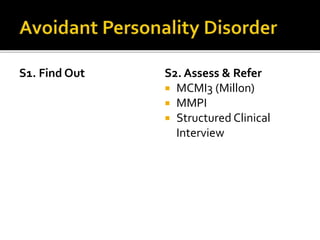
S1. Find Out S2. Assess & Refer
 MCMI3 (Millon)
 MMPI
 Structured Clinical
Interview
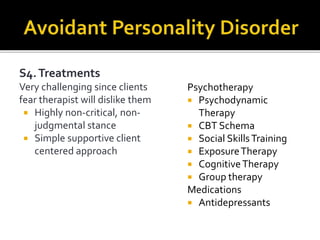
S4.Treatments
Very challenging since clients
fear therapist will dislike them
 Highly non-critical, non-
judgmental stance
 Simple supportive client
centered approach
Psychotherapy
 Psychodynamic
Therapy
 CBT Schema
 Social SkillsTraining
 ExposureTherapy
 CognitiveTherapy
 Group therapy
Medications
 Antidepressants
S5. Monitoring
 Improved social functioning
S6.Termination
Diagnosis I
Key:
 Excessive and pervasive need to be taken care of
 Submissive
 Clinging, needy behavior due to fear of abandonment
Appears in adolescence and young adulthood
Diagnosis II
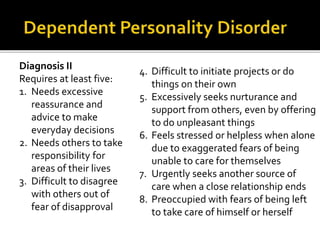
Requires at least five:
1. Needs excessive
reassurance and
advice to make
everyday decisions
2. Needs others to take
responsibility for
areas of their lives
3. Difficult to disagree
with others out of
fear of disapproval
4. Difficult to initiate projects or do
things on their own
5. Excessively seeks nurturance and
support from others, even by offering
to do unpleasant things
6. Feels stressed or helpless when alone
due to exaggerated fears of being
unable to care for themselves
7. Urgently seeks another source of
care when a close relationship ends
8. Preoccupied with fears of being left
to take care of himself or herself
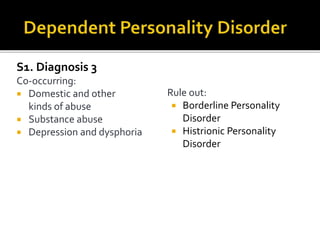
S1. Diagnosis 3
Co-occurring:
 Domestic and other
kinds of abuse
 Substance abuse
 Depression and dysphoria
Rule out:
 Borderline Personality
Disorder
 Histrionic Personality
Disorder
S1. Find Out S2. Assess & Refer
 MCMI3 (Millon)
 MMPI
 Structured Clinical
Interview
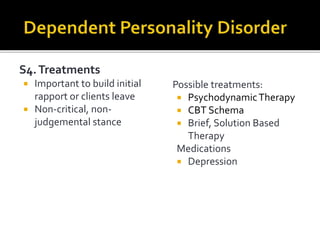
S4.Treatments
 Important to build initial
rapport or clients leave
 Non-critical, non-
judgemental stance
Possible treatments:
 PsychodynamicTherapy
 CBT Schema
 Brief, Solution Based
Therapy
Medications
 Depression
S5. Monitoring
 Improved autonomy
6.Termination
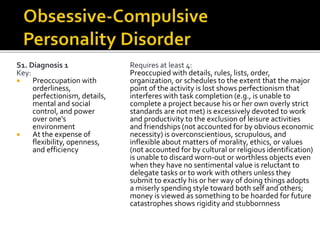
S1. Diagnosis 1
Key:
 Preoccupation with
orderliness,
perfectionism, details,
mental and social
control, and power
over one's
environment
 At the expense of
flexibility, openness,
and efficiency
Requires at least 4:
Preoccupied with details, rules, lists, order,
organization, or schedules to the extent that the major
point of the activity is lost shows perfectionism that
interferes with task completion (e.g., is unable to
complete a project because his or her own overly strict
standards are not met) is excessively devoted to work
and productivity to the exclusion of leisure activities
and friendships (not accounted for by obvious economic
necessity) is overconscientious, scrupulous, and
inflexible about matters of morality, ethics, or values
(not accounted for by cultural or religious identification)
is unable to discard worn-out or worthless objects even
when they have no sentimental value is reluctant to
delegate tasks or to work with others unless they
submit to exactly his or her way of doing things adopts
a miserly spending style toward both self and others;
money is viewed as something to be hoarded for future
catastrophes shows rigidity and stubbornness
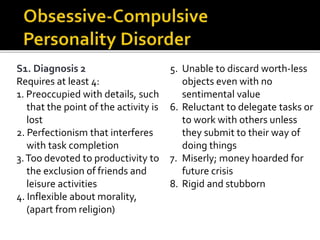
S1. Diagnosis 2
Requires at least 4:
1. Preoccupied with details, such
that the point of the activity is
lost
2. Perfectionism that interferes
with task completion
3.Too devoted to productivity to
the exclusion of friends and
leisure activities
4. Inflexible about morality,
(apart from religion)
5. Unable to discard worth-less
objects even with no
sentimental value
6. Reluctant to delegate tasks or
to work with others unless
they submit to their way of
doing things
7. Miserly; money hoarded for
future crisis
8. Rigid and stubborn
S1. Diagnosis II
Co-occurring:
 OCD
 Autism Spectrum
 Eating disorders
Rule out:
 OCD: Personality disorder
sees traits as rational, not
distressed
S1. Find Out S2. Assess & Refer
 DysfunctionalThought
Record
 MCMI3 (Millon)
 MMPI
 Structured Clinical
Interview
S4.Treatments to Use
 Very challenging since
clients deny symptoms
and avoid confronting
their irrational beliefs
 Non-critical, non-
judgemental stance is
essential
Therapy
 Psychodynamic
best
 CBT
 Cognitive
AnalyticTherapy
Medications
 Antidepressants
(SSRIs)
S5. Monitoring Progress
 Improved flexibility
S6.Termination

Cluster C Personality Disorders for NCMHCE Study

  • 1.
    Review of DSM5Mental Disorders for NCMHCE Study
  • 2.
    1. Avoidant PersonalityDisorder 2. Dependent Personality Disorder 3. Obsessive-Compulsive Personality Disorder  Known as Anxious type
  • 3.
     Pervasive patternsof thinking, moods and actions  Relative to self perception, distressing or exciting circumstances, personal impulses and urges, other people  Begun in youth, consistent and inflexible in many personal and social situations and stable over time  Causes problems
  • 4.
    S2. Assess Testing  PersonalityDisorders Questionnaire- 4  MCMI3 (Millon)  MMPI  CATI (Coolidge )  Dimensional Assessment of Personality Pathology— Basic Questionnaire  Structured Clinical Interview  International Personality Disorder Examination  NEO Five-Factor Inventory  Thematic Apperception Test  Global Assessment of Functioning scale  Adult Attachment Interview
  • 5.
    S4.Treatment Therapy  PsychodynamicTherapy  CBT CBT SchemaTherapy  DBT  MindfulnessTherapy  Mentalization FocusedTherapy
  • 7.
    Diagnosis I Key:  Socialinhibition  Feelings of inadequacy  Extreme sensitivity to negative evaluation  Avoidance of social interaction
  • 8.
    Diagnosis II Requires atleast four: 1. Avoids occupational activities that involve significant social contact, due to fears of disapproval or rejection 2. Unwilling to deal with people unless sure of being liked 3. Restraint within intimate relationships due to fear of being shamed or ridiculed 4. Preoccupied with being criticized or rejected in social situations 5. Inhibited in new social situations because of feelings of inadequacy 6.Views themselves as socially inept, personally unappealing, or inferior to others 7. Unusually reluctant to take risks or to engage in new activities because they may prove embarrassing
  • 9.
    Diagnosis III Co-occurring:  PanicDisorder with Agoraphobia  Social Anxiety Disorder  Generalized Anxiety Disorder  Obsessive Compulsive Disorder Rule out:  Social Anxiety Disorder: Monitors the other’s reactions, not just self  Dependent Personality Disorder  Paranoid, Schizoid and Schizotypal Personality Disorders
  • 10.
    S1. Find OutS2. Assess & Refer  MCMI3 (Millon)  MMPI  Structured Clinical Interview
  • 11.
    S4.Treatments Very challenging sinceclients fear therapist will dislike them  Highly non-critical, non- judgmental stance  Simple supportive client centered approach Psychotherapy  Psychodynamic Therapy  CBT Schema  Social SkillsTraining  ExposureTherapy  CognitiveTherapy  Group therapy Medications  Antidepressants
  • 12.
    S5. Monitoring  Improvedsocial functioning S6.Termination
  • 14.
    Diagnosis I Key:  Excessiveand pervasive need to be taken care of  Submissive  Clinging, needy behavior due to fear of abandonment Appears in adolescence and young adulthood
  • 15.
    Diagnosis II Requires atleast five: 1. Needs excessive reassurance and advice to make everyday decisions 2. Needs others to take responsibility for areas of their lives 3. Difficult to disagree with others out of fear of disapproval 4. Difficult to initiate projects or do things on their own 5. Excessively seeks nurturance and support from others, even by offering to do unpleasant things 6. Feels stressed or helpless when alone due to exaggerated fears of being unable to care for themselves 7. Urgently seeks another source of care when a close relationship ends 8. Preoccupied with fears of being left to take care of himself or herself
  • 16.
    S1. Diagnosis 3 Co-occurring: Domestic and other kinds of abuse  Substance abuse  Depression and dysphoria Rule out:  Borderline Personality Disorder  Histrionic Personality Disorder
  • 17.
    S1. Find OutS2. Assess & Refer  MCMI3 (Millon)  MMPI  Structured Clinical Interview
  • 18.
    S4.Treatments  Important tobuild initial rapport or clients leave  Non-critical, non- judgemental stance Possible treatments:  PsychodynamicTherapy  CBT Schema  Brief, Solution Based Therapy Medications  Depression
  • 19.
    S5. Monitoring  Improvedautonomy 6.Termination
  • 21.
    S1. Diagnosis 1 Key: Preoccupation with orderliness, perfectionism, details, mental and social control, and power over one's environment  At the expense of flexibility, openness, and efficiency Requires at least 4: Preoccupied with details, rules, lists, order, organization, or schedules to the extent that the major point of the activity is lost shows perfectionism that interferes with task completion (e.g., is unable to complete a project because his or her own overly strict standards are not met) is excessively devoted to work and productivity to the exclusion of leisure activities and friendships (not accounted for by obvious economic necessity) is overconscientious, scrupulous, and inflexible about matters of morality, ethics, or values (not accounted for by cultural or religious identification) is unable to discard worn-out or worthless objects even when they have no sentimental value is reluctant to delegate tasks or to work with others unless they submit to exactly his or her way of doing things adopts a miserly spending style toward both self and others; money is viewed as something to be hoarded for future catastrophes shows rigidity and stubbornness
  • 22.
    S1. Diagnosis 2 Requiresat least 4: 1. Preoccupied with details, such that the point of the activity is lost 2. Perfectionism that interferes with task completion 3.Too devoted to productivity to the exclusion of friends and leisure activities 4. Inflexible about morality, (apart from religion) 5. Unable to discard worth-less objects even with no sentimental value 6. Reluctant to delegate tasks or to work with others unless they submit to their way of doing things 7. Miserly; money hoarded for future crisis 8. Rigid and stubborn
  • 23.
    S1. Diagnosis II Co-occurring: OCD  Autism Spectrum  Eating disorders Rule out:  OCD: Personality disorder sees traits as rational, not distressed
  • 24.
    S1. Find OutS2. Assess & Refer  DysfunctionalThought Record  MCMI3 (Millon)  MMPI  Structured Clinical Interview
  • 25.
    S4.Treatments to Use Very challenging since clients deny symptoms and avoid confronting their irrational beliefs  Non-critical, non- judgemental stance is essential Therapy  Psychodynamic best  CBT  Cognitive AnalyticTherapy Medications  Antidepressants (SSRIs)
  • 26.
    S5. Monitoring Progress Improved flexibility S6.Termination