Autism Spectrum Disorders
Submitted By:-Varinder Kumar
1528076
B.Phamacy (7th sem)
 Contents
• Characteristics
Social development
Communication
Repetitive behavior
Other symptoms
•Causes
•Mechanism
•Pathophysiology
•Diagnosis
Classification
•Screening
•Prevention
•Management
Education
Medication
Alternative medicine
•History
•References
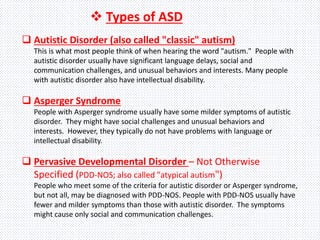
 Autistic Disorder (also called "classic" autism)
This is what most people think of when hearing the word "autism." People with
autistic disorder usually have significant language delays, social and
communication challenges, and unusual behaviors and interests. Many people
with autistic disorder also have intellectual disability.
 Asperger Syndrome
People with Asperger syndrome usually have some milder symptoms of autistic
disorder. They might have social challenges and unusual behaviors and
interests. However, they typically do not have problems with language or
intellectual disability.
 Pervasive Developmental Disorder – Not Otherwise
Specified (PDD-NOS; also called "atypical autism")
People who meet some of the criteria for autistic disorder or Asperger syndrome,
but not all, may be diagnosed with PDD-NOS. People with PDD-NOS usually have
fewer and milder symptoms than those with autistic disorder. The symptoms
might cause only social and communication challenges.
 Types of ASD
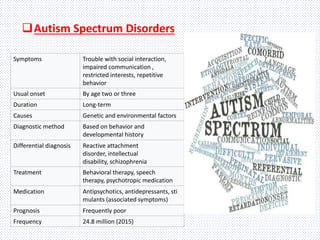
Symptoms Trouble with social interaction,
impaired communication ,
restricted interests, repetitive
behavior
Usual onset By age two or three
Duration Long-term
Causes Genetic and environmental factors
Diagnostic method Based on behavior and
developmental history
Differential diagnosis Reactive attachment
disorder, intellectual
disability, schizophrenia
Treatment Behavioral therapy, speech
therapy, psychotropic medication
Medication Antipsychotics, antidepressants, sti
mulants (associated symptoms)
Prognosis Frequently poor
Frequency 24.8 million (2015)
Autism Spectrum Disorders
 The Social Perspective of Autism
• Autistic Spectrum Disorder is a developmental disorder that affects certain
areas of the mind such as communication, imagination, and socialization
(Lowth, 2015).
• Despite little evidence on what causes Autism, a study suggested that
exposure to toxic chemicals may affect the brain to develop Autism
(Jensen, 1994).
• As Lowth (2015) says, people born with Autism Spectrum Disorders have
impairments certain communication areas that can cause stress within a
victim’s social life.
•
• Communication is a big factor when it comes to Autism,
• “Communication is a transactional process and in a health context it is an
important part of health promotion work (Corcoran, 2007).” There are five
factors in health communication, interpersonal, intrapersonal,
organizational, community, and public mass (Corcoran, 2007).
 Early history
The word “autism” comes from the Greek word “autos”, meaning “self.” The term
describes conditions in which a person is removed from social interaction—hence, an
“isolated self”.
The term "autism" was first used by a psychiatrist named Eugen Bleuler in 1911 to
refer to one group of symptoms of schizophrenia.
 Discovery
Two researchers by the name of Hans Asperger and Leo Kanner were the pioneers of
the research study for autism in the 1940s.
 In 1943 Leo Kanner (a doctor from Johns Hopkins University) did a study of 11
children. The children were very intelligent. But he found out that they had
difficulties like changing environments, being sensitive to certain stimuli, having
speech problems and allergies to food. Later he named the children’s condition
“early infantile autism”.
 Leo Kanner's discovery is now called autistic disorder, childhood autism, infantile
autism, or simply autism.
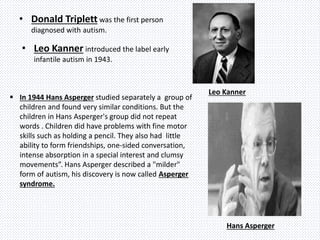
• Donald Triplett was the first person
diagnosed with autism.
• Leo Kanner introduced the label early
infantile autism in 1943.
Leo Kanner
 In 1944 Hans Asperger studied separately a group of
children and found very similar conditions. But the
children in Hans Asperger's group did not repeat
words . Children did have problems with fine motor
skills such as holding a pencil. They also had little
ability to form friendships, one-sided conversation,
intense absorption in a special interest and clumsy
movements”. Hans Asperger described a "milder"
form of autism, his discovery is now called Asperger
syndrome.
Hans Asperger
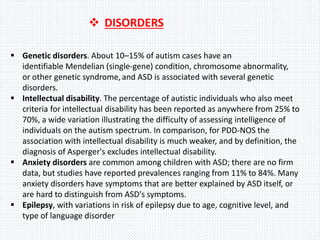
 Genetic disorders. About 10–15% of autism cases have an
identifiable Mendelian (single-gene) condition, chromosome abnormality,
or other genetic syndrome,and ASD is associated with several genetic
disorders.
 Intellectual disability. The percentage of autistic individuals who also meet
criteria for intellectual disability has been reported as anywhere from 25% to
70%, a wide variation illustrating the difficulty of assessing intelligence of
individuals on the autism spectrum. In comparison, for PDD-NOS the
association with intellectual disability is much weaker, and by definition, the
diagnosis of Asperger's excludes intellectual disability.
 Anxiety disorders are common among children with ASD; there are no firm
data, but studies have reported prevalences ranging from 11% to 84%. Many
anxiety disorders have symptoms that are better explained by ASD itself, or
are hard to distinguish from ASD's symptoms.
 Epilepsy, with variations in risk of epilepsy due to age, cognitive level, and
type of language disorder
 DISORDERS
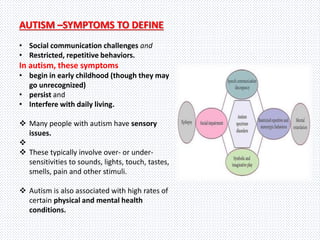
AUTISM –SYMPTOMS TO DEFINE
• Social communication challenges and
• Restricted, repetitive behaviors.
In autism, these symptoms
• begin in early childhood (though they may
go unrecognized)
• persist and
• Interfere with daily living.
 Many people with autism have sensory
issues.

 These typically involve over- or under-
sensitivities to sounds, lights, touch, tastes,
smells, pain and other stimuli.
 Autism is also associated with high rates of
certain physical and mental health
conditions.
 Social communication
challenges
Children and adults with autism
have difficulty with verbal and non-verbal
communication
• Spoken language (around a third of
people with autism are nonverbal)
• Gestures
• Eye contact
• Facial expressions
• Tone of voice
• Expressions not meant to be taken
literally
 Additional social
challenges
• Recognizing emotions and
intentions in others
• Recognizing one’s own emotions
• Expressing emotions
• Seeking emotional comfort from
others
• Feeling overwhelmed in social
situations
• Taking turns in conversation
• Gauging personal space
(appropriate distance between
people)
 Repetitive behavior
 Stereotyped behaviors: Repetitive movements, such as hand flapping, head
rolling, or body rocking.
 Compulsive behaviors: Time-consuming behaviors intended to reduce anxiety
that an individual feels compelled to perform repeatedly or according to rigid
rules, such as placing objects in a specific order, checking things, or hand
washing.
 Sameness: Resistance to change; for example, insisting that the furniture not be
moved or refusing to be interrupted.
 Ritualistic behavior: Unvarying pattern of daily activities, such as an unchanging
menu or a dressing ritual. This is closely associated with sameness and an
independent validation has suggested combining the two factors.
 Restricted interests: Interests or fixations those are abnormal in theme or
intensity of focus, such as preoccupation with a single television program, toy, or
game.
 Self-injury: Behaviors such as eye-poking, skin-picking, hand-biting and head-
banging.
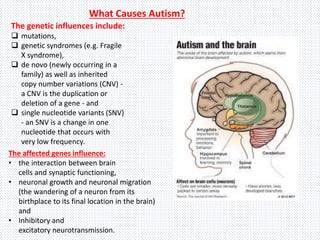
The genetic influences include:
 mutations,
 genetic syndromes (e.g. Fragile
X syndrome),
 de novo (newly occurring in a
family) as well as inherited
copy number variations (CNV) -
a CNV is the duplication or
deletion of a gene - and
 single nucleotide variants (SNV)
- an SNV is a change in one
nucleotide that occurs with
very low frequency.
What Causes Autism?
The affected genes influence:
• the interaction between brain
cells and synaptic functioning,
• neuronal growth and neuronal migration
(the wandering of a neuron from its
birthplace to its final location in the brain)
and
• Inhibitory and
excitatory neurotransmission.
 Autism’s environmental risk
factors
• Increased risk
• Advanced parent age (either parent)
• Pregnancy and birth complications
(e.g. extreme prematurity [before 26
weeks], low birth weight, multiple
pregnancies [twin, triplet, etc.])
• Pregnancies spaced less than one
year apart
• Decreased risk
Prenatal vitamins containing folic acid,
before and at conception and through
pregnancy
• No effect on risk
Vaccines. The results of this research is
clear that Vaccines do not cause autism.
The American Academy of Pediatrics has
compiled a comprehensive list of this
research.
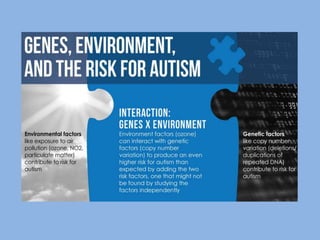
 Autism’s genetic risk factors
• Changes in certain genes increase the
risk that a child will develop autism.
• If a parent carries one or more of these
gene changes, they may get passed to a
child (even if the parent does not have
autism).
• Other times, these genetic changes
arise spontaneously in an early embryo
or the sperm and/or egg that combine
to create the embryo.
• Again, the majority of these gene
changes do not cause autism by
themselves.
 What Causes Autism?
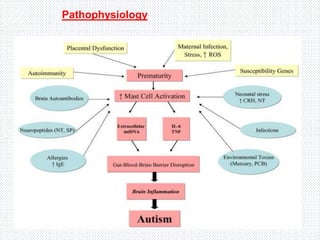
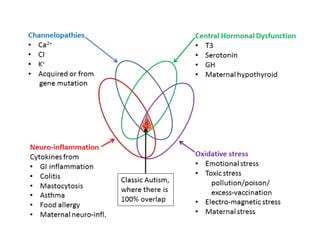
Pathophysiology
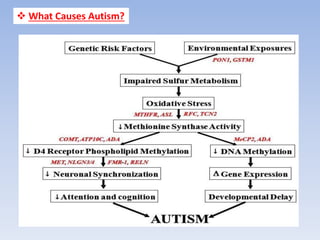
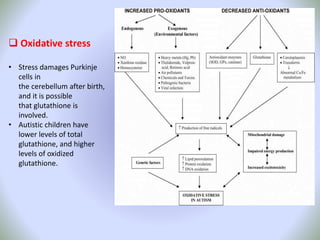
 Oxidative stress
• Stress damages Purkinje
cells in
the cerebellum after birth,
and it is possible
that glutathione is
involved.
• Autistic children have
lower levels of total
glutathione, and higher
levels of oxidized
glutathione.
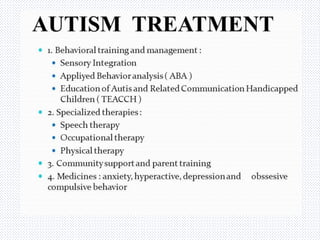
 Behavioral Treatments and
Interventions
 Applied Behavior Analysis (ABA)
 Early Start Denver Model (ESDM)
 Floortime
 Occupational Therapy (OT)
 Pivotal Response Treatment (PRT)
 Relationship Development Intervention
(RDI)
 Speech Therapy
 TEACCH
 Verbal Behavio
• Play therapy can improve their social
and emotional skills, help them think in
different ways, increase their language
or communication skills, and expand
the ways they play with toys and relate
to other people.
• Occupational Therapy
These activities help children with autism
get better at everyday tasks, like learning
to button a shirt or hold a fork properly.
But it can involve anything related to
school, work or play. The focus depends on
the child’s needs and goals.
• Speech Therapy
This helps children with speaking, as well as
communicating and interacting with others. It
can involve non-verbal skills, like making eye
contact, taking turns in a conversation, and
using and understanding gestures. It might also
teach kids to express themselves using picture
symbols, sign language, or computers.
 Therapies for Autism Spectrum Disorder
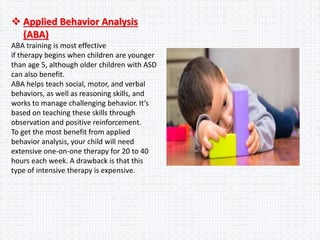
 Applied Behavior Analysis
(ABA)
ABA training is most effective
if therapy begins when children are younger
than age 5, although older children with ASD
can also benefit.
ABA helps teach social, motor, and verbal
behaviors, as well as reasoning skills, and
works to manage challenging behavior. It’s
based on teaching these skills through
observation and positive reinforcement.
To get the most benefit from applied
behavior analysis, your child will need
extensive one-on-one therapy for 20 to 40
hours each week. A drawback is that this
type of intensive therapy is expensive.
Specialists
• Speech therapist
Treats people with speech and language
problems.
• Occupational Therapist
Improves daily living and work skills of
patients.
• Clinical Psychologist
Treats mental disorders primarily with talk
therapy.
• Neurologist
Treats nervous system disorders.
• Psychiatrist
Treats mental disorders primarily with
medications.
• Paediatrician
Provides medical care for infants, children and
teenagers.
• Primary Care Provider (PCP)
Prevents, diagnoses and treats diseases.
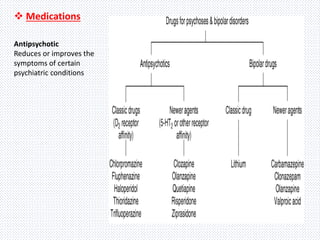
 Medications
Antipsychotic
Reduces or improves the
symptoms of certain
psychiatric conditions
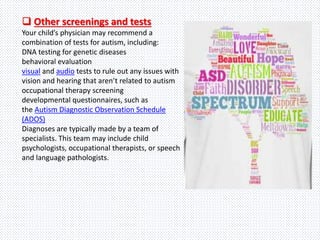
 Other screenings and tests
Your child’s physician may recommend a
combination of tests for autism, including:
DNA testing for genetic diseases
behavioral evaluation
visual and audio tests to rule out any issues with
vision and hearing that aren’t related to autism
occupational therapy screening
developmental questionnaires, such as
the Autism Diagnostic Observation Schedule
(ADOS)
Diagnoses are typically made by a team of
specialists. This team may include child
psychologists, occupational therapists, or speech
and language pathologists.
 References
• Landa RJ (2008). "Diagnosis of autism spectrum disorders in the first 3 years of
life". Nat Clin Pract Neurol. 4 (3): 138–
47. doi:10.1038/ncpneuro0731. PMID 18253102.
• "NIMH " Autism Spectrum Disorder". nimh.nih.gov. October 2016. Retrieved 20
April 2017.
• Autism Spectrum Disorder, 299.00 (F84.0). In: American Psychiatric
Association. Diagnostic and Statistical Manual of Mental Disorders, Fifth Edition.
American Psychiatric Publishing; 2013
• Chaste P, Leboyer M (2012). "Autism risk factors: genes, environment, and gene-
environment interaction". Dialogues in Clinical Neuroscience. 14 (3): 281–
92. PMC 3513682. PMID 23226953.
• Corcoran J, Walsh J (9 February 2006). Clinical Assessment and Diagnosis in
Social Work Practice. Oxford University Press, US. p. 72. ISBN 9780195168303 –
via Google Books.
• Oswald DP, Sonenklar NA (June 2007). "Medication use among children with
autism spectrum disorders". Journal of Child and Adolescent
Psychopharmacology. 17 (3): 348–
55. doi:10.1089/cap.2006.17303. PMID 17630868
• Myers SM, Johnson CP (November 2007). "Management of children with autism
spectrum disorders". Pediatrics. 120 (5): 1162–82. doi:10.1542/peds.2007-
2362. PMID 1796792
• Sanchack, KE; Thomas, CA (15 December 2016). "Autism Spectrum Disorder: Primary
Care Principles". American family physician. 94 (12): 972–79. PMID 28075089.
• Sukhodolsky, DG; Bloch, MH; Panza, KE; Reichow, B (November 2013). "Cognitive-
behavioral therapy for anxiety in children with high-functioning autism: a meta-
analysis". Pediatrics. 132 (5): e1341–50. doi:10.1542/peds.2013-
1193. PMID 24167175
• Ji N, Findling RL (March 2015). "An update on pharmacotherapy for autism spectrum
disorder in children and adolescents". Current Opinion in Psychiatry. 28 (2): 91–
101. doi:10.1097/YCO.0000000000000132. PMID 25602248.
• Rutter M (2005). "Incidence of autism spectrum disorders: changes over time and
their meaning". Acta Paediatr. 94 (1): 2–15. doi:10.1111/j.1651-
2227.2005.tb01779.x. PMID 15858952.
• Doyle CA, McDougle CJ (September 2012). "Pharmacologic treatments for the
behavioral symptoms associated with autism spectrum disorders across the
lifespan". Dialogues in Clinical Neuroscience. 14 (3): 263–
79. PMC 3513681. PMID 23226952.

autism spectrum disorder-a general introduction

  • 1.
    Autism Spectrum Disorders SubmittedBy:-Varinder Kumar 1528076 B.Phamacy (7th sem)
  • 2.
     Contents • Characteristics Socialdevelopment Communication Repetitive behavior Other symptoms •Causes •Mechanism •Pathophysiology •Diagnosis Classification •Screening •Prevention •Management Education Medication Alternative medicine •History •References
  • 3.
     Autistic Disorder(also called "classic" autism) This is what most people think of when hearing the word "autism." People with autistic disorder usually have significant language delays, social and communication challenges, and unusual behaviors and interests. Many people with autistic disorder also have intellectual disability.  Asperger Syndrome People with Asperger syndrome usually have some milder symptoms of autistic disorder. They might have social challenges and unusual behaviors and interests. However, they typically do not have problems with language or intellectual disability.  Pervasive Developmental Disorder – Not Otherwise Specified (PDD-NOS; also called "atypical autism") People who meet some of the criteria for autistic disorder or Asperger syndrome, but not all, may be diagnosed with PDD-NOS. People with PDD-NOS usually have fewer and milder symptoms than those with autistic disorder. The symptoms might cause only social and communication challenges.  Types of ASD
  • 4.
    Symptoms Trouble withsocial interaction, impaired communication , restricted interests, repetitive behavior Usual onset By age two or three Duration Long-term Causes Genetic and environmental factors Diagnostic method Based on behavior and developmental history Differential diagnosis Reactive attachment disorder, intellectual disability, schizophrenia Treatment Behavioral therapy, speech therapy, psychotropic medication Medication Antipsychotics, antidepressants, sti mulants (associated symptoms) Prognosis Frequently poor Frequency 24.8 million (2015) Autism Spectrum Disorders
  • 5.
     The SocialPerspective of Autism • Autistic Spectrum Disorder is a developmental disorder that affects certain areas of the mind such as communication, imagination, and socialization (Lowth, 2015). • Despite little evidence on what causes Autism, a study suggested that exposure to toxic chemicals may affect the brain to develop Autism (Jensen, 1994). • As Lowth (2015) says, people born with Autism Spectrum Disorders have impairments certain communication areas that can cause stress within a victim’s social life. • • Communication is a big factor when it comes to Autism, • “Communication is a transactional process and in a health context it is an important part of health promotion work (Corcoran, 2007).” There are five factors in health communication, interpersonal, intrapersonal, organizational, community, and public mass (Corcoran, 2007).
  • 6.
     Early history Theword “autism” comes from the Greek word “autos”, meaning “self.” The term describes conditions in which a person is removed from social interaction—hence, an “isolated self”. The term "autism" was first used by a psychiatrist named Eugen Bleuler in 1911 to refer to one group of symptoms of schizophrenia.  Discovery Two researchers by the name of Hans Asperger and Leo Kanner were the pioneers of the research study for autism in the 1940s.  In 1943 Leo Kanner (a doctor from Johns Hopkins University) did a study of 11 children. The children were very intelligent. But he found out that they had difficulties like changing environments, being sensitive to certain stimuli, having speech problems and allergies to food. Later he named the children’s condition “early infantile autism”.  Leo Kanner's discovery is now called autistic disorder, childhood autism, infantile autism, or simply autism.
  • 7.
    • Donald Triplettwas the first person diagnosed with autism. • Leo Kanner introduced the label early infantile autism in 1943. Leo Kanner  In 1944 Hans Asperger studied separately a group of children and found very similar conditions. But the children in Hans Asperger's group did not repeat words . Children did have problems with fine motor skills such as holding a pencil. They also had little ability to form friendships, one-sided conversation, intense absorption in a special interest and clumsy movements”. Hans Asperger described a "milder" form of autism, his discovery is now called Asperger syndrome. Hans Asperger
  • 8.
     Genetic disorders.About 10–15% of autism cases have an identifiable Mendelian (single-gene) condition, chromosome abnormality, or other genetic syndrome,and ASD is associated with several genetic disorders.  Intellectual disability. The percentage of autistic individuals who also meet criteria for intellectual disability has been reported as anywhere from 25% to 70%, a wide variation illustrating the difficulty of assessing intelligence of individuals on the autism spectrum. In comparison, for PDD-NOS the association with intellectual disability is much weaker, and by definition, the diagnosis of Asperger's excludes intellectual disability.  Anxiety disorders are common among children with ASD; there are no firm data, but studies have reported prevalences ranging from 11% to 84%. Many anxiety disorders have symptoms that are better explained by ASD itself, or are hard to distinguish from ASD's symptoms.  Epilepsy, with variations in risk of epilepsy due to age, cognitive level, and type of language disorder  DISORDERS
  • 9.
    AUTISM –SYMPTOMS TODEFINE • Social communication challenges and • Restricted, repetitive behaviors. In autism, these symptoms • begin in early childhood (though they may go unrecognized) • persist and • Interfere with daily living.  Many people with autism have sensory issues.   These typically involve over- or under- sensitivities to sounds, lights, touch, tastes, smells, pain and other stimuli.  Autism is also associated with high rates of certain physical and mental health conditions.
  • 10.
     Social communication challenges Childrenand adults with autism have difficulty with verbal and non-verbal communication • Spoken language (around a third of people with autism are nonverbal) • Gestures • Eye contact • Facial expressions • Tone of voice • Expressions not meant to be taken literally  Additional social challenges • Recognizing emotions and intentions in others • Recognizing one’s own emotions • Expressing emotions • Seeking emotional comfort from others • Feeling overwhelmed in social situations • Taking turns in conversation • Gauging personal space (appropriate distance between people)
  • 11.
     Repetitive behavior Stereotyped behaviors: Repetitive movements, such as hand flapping, head rolling, or body rocking.  Compulsive behaviors: Time-consuming behaviors intended to reduce anxiety that an individual feels compelled to perform repeatedly or according to rigid rules, such as placing objects in a specific order, checking things, or hand washing.  Sameness: Resistance to change; for example, insisting that the furniture not be moved or refusing to be interrupted.  Ritualistic behavior: Unvarying pattern of daily activities, such as an unchanging menu or a dressing ritual. This is closely associated with sameness and an independent validation has suggested combining the two factors.  Restricted interests: Interests or fixations those are abnormal in theme or intensity of focus, such as preoccupation with a single television program, toy, or game.  Self-injury: Behaviors such as eye-poking, skin-picking, hand-biting and head- banging.
  • 13.
    The genetic influencesinclude:  mutations,  genetic syndromes (e.g. Fragile X syndrome),  de novo (newly occurring in a family) as well as inherited copy number variations (CNV) - a CNV is the duplication or deletion of a gene - and  single nucleotide variants (SNV) - an SNV is a change in one nucleotide that occurs with very low frequency. What Causes Autism? The affected genes influence: • the interaction between brain cells and synaptic functioning, • neuronal growth and neuronal migration (the wandering of a neuron from its birthplace to its final location in the brain) and • Inhibitory and excitatory neurotransmission.
  • 14.
     Autism’s environmentalrisk factors • Increased risk • Advanced parent age (either parent) • Pregnancy and birth complications (e.g. extreme prematurity [before 26 weeks], low birth weight, multiple pregnancies [twin, triplet, etc.]) • Pregnancies spaced less than one year apart • Decreased risk Prenatal vitamins containing folic acid, before and at conception and through pregnancy • No effect on risk Vaccines. The results of this research is clear that Vaccines do not cause autism. The American Academy of Pediatrics has compiled a comprehensive list of this research.  Autism’s genetic risk factors • Changes in certain genes increase the risk that a child will develop autism. • If a parent carries one or more of these gene changes, they may get passed to a child (even if the parent does not have autism). • Other times, these genetic changes arise spontaneously in an early embryo or the sperm and/or egg that combine to create the embryo. • Again, the majority of these gene changes do not cause autism by themselves.
  • 16.
  • 17.
  • 18.
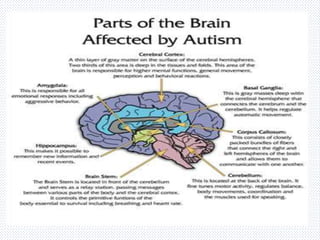
     Oxidative stress •Stress damages Purkinje cells in the cerebellum after birth, and it is possible that glutathione is involved. • Autistic children have lower levels of total glutathione, and higher levels of oxidized glutathione.
  • 21.
     Behavioral Treatmentsand Interventions  Applied Behavior Analysis (ABA)  Early Start Denver Model (ESDM)  Floortime  Occupational Therapy (OT)  Pivotal Response Treatment (PRT)  Relationship Development Intervention (RDI)  Speech Therapy  TEACCH  Verbal Behavio
  • 22.
    • Play therapycan improve their social and emotional skills, help them think in different ways, increase their language or communication skills, and expand the ways they play with toys and relate to other people. • Occupational Therapy These activities help children with autism get better at everyday tasks, like learning to button a shirt or hold a fork properly. But it can involve anything related to school, work or play. The focus depends on the child’s needs and goals. • Speech Therapy This helps children with speaking, as well as communicating and interacting with others. It can involve non-verbal skills, like making eye contact, taking turns in a conversation, and using and understanding gestures. It might also teach kids to express themselves using picture symbols, sign language, or computers.  Therapies for Autism Spectrum Disorder
  • 23.
     Applied BehaviorAnalysis (ABA) ABA training is most effective if therapy begins when children are younger than age 5, although older children with ASD can also benefit. ABA helps teach social, motor, and verbal behaviors, as well as reasoning skills, and works to manage challenging behavior. It’s based on teaching these skills through observation and positive reinforcement. To get the most benefit from applied behavior analysis, your child will need extensive one-on-one therapy for 20 to 40 hours each week. A drawback is that this type of intensive therapy is expensive.
  • 24.
    Specialists • Speech therapist Treatspeople with speech and language problems. • Occupational Therapist Improves daily living and work skills of patients. • Clinical Psychologist Treats mental disorders primarily with talk therapy. • Neurologist Treats nervous system disorders. • Psychiatrist Treats mental disorders primarily with medications. • Paediatrician Provides medical care for infants, children and teenagers. • Primary Care Provider (PCP) Prevents, diagnoses and treats diseases.
  • 25.
     Medications Antipsychotic Reduces orimproves the symptoms of certain psychiatric conditions
  • 26.
     Other screeningsand tests Your child’s physician may recommend a combination of tests for autism, including: DNA testing for genetic diseases behavioral evaluation visual and audio tests to rule out any issues with vision and hearing that aren’t related to autism occupational therapy screening developmental questionnaires, such as the Autism Diagnostic Observation Schedule (ADOS) Diagnoses are typically made by a team of specialists. This team may include child psychologists, occupational therapists, or speech and language pathologists.
  • 29.
     References • LandaRJ (2008). "Diagnosis of autism spectrum disorders in the first 3 years of life". Nat Clin Pract Neurol. 4 (3): 138– 47. doi:10.1038/ncpneuro0731. PMID 18253102. • "NIMH " Autism Spectrum Disorder". nimh.nih.gov. October 2016. Retrieved 20 April 2017. • Autism Spectrum Disorder, 299.00 (F84.0). In: American Psychiatric Association. Diagnostic and Statistical Manual of Mental Disorders, Fifth Edition. American Psychiatric Publishing; 2013 • Chaste P, Leboyer M (2012). "Autism risk factors: genes, environment, and gene- environment interaction". Dialogues in Clinical Neuroscience. 14 (3): 281– 92. PMC 3513682. PMID 23226953. • Corcoran J, Walsh J (9 February 2006). Clinical Assessment and Diagnosis in Social Work Practice. Oxford University Press, US. p. 72. ISBN 9780195168303 – via Google Books. • Oswald DP, Sonenklar NA (June 2007). "Medication use among children with autism spectrum disorders". Journal of Child and Adolescent Psychopharmacology. 17 (3): 348– 55. doi:10.1089/cap.2006.17303. PMID 17630868
  • 30.
    • Myers SM,Johnson CP (November 2007). "Management of children with autism spectrum disorders". Pediatrics. 120 (5): 1162–82. doi:10.1542/peds.2007- 2362. PMID 1796792 • Sanchack, KE; Thomas, CA (15 December 2016). "Autism Spectrum Disorder: Primary Care Principles". American family physician. 94 (12): 972–79. PMID 28075089. • Sukhodolsky, DG; Bloch, MH; Panza, KE; Reichow, B (November 2013). "Cognitive- behavioral therapy for anxiety in children with high-functioning autism: a meta- analysis". Pediatrics. 132 (5): e1341–50. doi:10.1542/peds.2013- 1193. PMID 24167175 • Ji N, Findling RL (March 2015). "An update on pharmacotherapy for autism spectrum disorder in children and adolescents". Current Opinion in Psychiatry. 28 (2): 91– 101. doi:10.1097/YCO.0000000000000132. PMID 25602248. • Rutter M (2005). "Incidence of autism spectrum disorders: changes over time and their meaning". Acta Paediatr. 94 (1): 2–15. doi:10.1111/j.1651- 2227.2005.tb01779.x. PMID 15858952. • Doyle CA, McDougle CJ (September 2012). "Pharmacologic treatments for the behavioral symptoms associated with autism spectrum disorders across the lifespan". Dialogues in Clinical Neuroscience. 14 (3): 263– 79. PMC 3513681. PMID 23226952.