Childhood 
Anxiety 
Disorders
Anxiety 
 Anxiety: mood state 
characterized by strong, 
negative emotion and bodily 
symptoms in which an individual 
apprehensively anticipates 
future danger or misfortune 
 Fear: immediate alarm reaction 
to current danger 
 Anxiety disorder: excessive and 
debilitating anxiety with 
negative emotion and fear
Developmental 
Considerations 
 Anxiety is an adaptive emotion 
that readies children both 
physically and psychologically 
to cope with danger 
 Infancy: loud noises, being 
startled, strangers 
 Toddlerhood: dark, separation 
 School-Age: injury, natural 
disasters 
 Adolescence: competency-based
Developmental 
Considerations 
 DSM-IV qualifiers for children 
 Anxiety may be expressed by crying, 
tantrums, freezing, or clinging 
 Unlike adults, children are not 
required to acknowledge that fears are 
unreasonable or excessive 
 Difficulties in recognizing symptoms 
 Internalizing symptoms less observable 
 Internalizing symptoms less aversive 
 Children may lack verbal skills to 
communicate concerns
Anxiety: 3 Interrelated 
Systems 
 Cognitive 
 Anxious thoughts develop in response to 
cognitive distortions in the attention, 
interpretation, and memory components 
of information processing 
 Physical 
 Brain sends messages to sympathetic 
nervous system: fight or flight 
response 
 Symptoms are excessive in intensity or 
duration 
 Behavioral 
 Action (or inaction) that individuals 
take to prevent exposure to feared
Case Example 
 ““Charlie, now 11 years old , is 
entering 6th grade in a middle 
school. Each September since 
kindergarten the start of school has 
always been a struggle for him. This 
year his distress escalated with the 
added demand of starting in a new 
school, and by November he missed 
twenty-six days of school. His 
academic work has suffered, and his 
teachers have sent his assignments 
home. Charlie insists that he can't 
complete them without his mother's 
presence. He worries that something
Separation Anxiety 
Disorder DSM Criteria: 
3+ symptoms  Excessive distress 
when separation 
from attachment 
figure is 
anticipated 
 Excessive worry 
about losing or 
possible harm to 
figure 
 Excessive worry 
that an event will 
lead to separation 
 Reluctance or 
refusal to go to 
school because of 
separation fear 
 Excessive fear or 
reluctance to be 
alone 
 Reluctance or 
refusal to go to 
sleep without being 
near attachment 
figure 
 Nightmares 
involving theme of 
separation 
 Complaints of 
physical symptoms 
when separation 
occurs/is 
anticipated
SAD: 
Clinical Presentation 
 Demand parental attention 
 Clinging 
 Sleep with parents
Prevalence, Age of Onset, 
Family Characteristics 
 Prevalence rate of 2 - 4% 
 SAD accounts for 1/2 of all 
children and adolescents referred 
for treatment of anxiety 
disorders 
 Occurs as early as preschool age 
 No gender differences 
 Often occurs in response to some 
major stressor
Case Example 
 ““Corinne's mother tried 
everything she could think of 
to get her 14-year-old daughter 
to join an after-school club or 
accept invitations to parties 
at classmates' homes. Corinne 
insisted that she would rather 
stay home and read; she didn't 
think she fit in with her 
friends any more and didn't 
know what to say to them. When 
she did venture out with a
Social Phobia 
DSM Criteria 
 Marked and persistent fear of one or 
more social or performance 
situations in which child is exposed 
to unfamiliar people or possible 
scrutiny by others 
 The child fears he/she will act in a 
way that will be humiliating or 
embarrassing 
 Exposure to situation provokes 
considerable anxiety 
 Feared situations are avoided or 
else endured with intense anxiety
Social Phobia: 
Clinical Features 
 A child with social phobia is 
one who displays phobic 
responses to one or more social 
situations: 
 Speaking, eating, or drinking in 
front of others 
 Initiating or maintaining 
conversations 
 Speaking to adult authority figures 
 Other situations that may elicit 
concerns over being 
embarrassed/humiliated
Social Phobia: 
Clinical Features 
 In young children, the anxiety 
may be reflected in signs of 
distress such as crying, throwing 
temper tantrums, or becoming mute 
and clinging to parents 
 In older children, it may be 
expressed less dramatically in 
terms of trembling hands, a shaky 
voice or other obvious signs of 
anxiety
Social Phobia: 
Clinical Features 
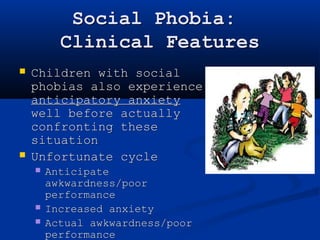
 Children with social 
phobias also experience 
anticipatory anxiety 
well before actually 
confronting these 
situation 
 Unfortunate cycle 
 Anticipate 
awkwardness/poor 
performance 
 Increased anxiety 
 Actual awkwardness/poor 
performance
Social Phobia: 
Associated Features 
 Children with social phobias can 
also show a range of associated 
features: 
 Being overly sensitive to 
criticism 
 Having low levels of self-esteem 
 Having inadequate social skills 
 School performance may be 
impaired due to test anxiety and 
failure to participate in 
classroom activities
Social Phobia: 
Prevalence 
 Relatively rare in the general child 
population 
 Prevalence estimates of around 1-3% 
are suggested by cross-sectional 
research 
 No gender differences 
 Last, et al. (1992) has suggested 
that among children referred to an 
anxiety disorders clinic, 20% met DSM 
criteria for a diagnosis of social 
phobia 
 Thus, social phobia does not seem to
Case Example 
 Donna presented to therapy 
because she reported that she 
was unable to concentrate at 
home, at school, and with 
friends. She indicated that she 
had difficulty falling asleep 
at night because her mind was 
““constantly racing”” with 
thoughts and concerns about 
anything and everything. She 
described feeling constantly 
tense and uptight, noting
Generalized Anxiety 
Disorder 
 Excessive anxiety, unrealistic 
worries, and fearfulness, not 
related to a specific object or 
situation 
 Child finds it difficult to control 
worry 
 Plus one of the following symptoms 
 Restlessness or feeling keyed up/on edge 
 Being easily fatigued 
 Difficulty concentrating or mind going 
blank 
 Irritability 
 Muscle tension 
 Sleep disturbance
GAD 
 ““What if?”” statements 
 Marked degree of subjective distress 
and excessive worry about a things 
including: 
 the appropriateness of past behavior 
 possible injury or illnesses (to 
themselves or others), 
 the possibility of major calamitous 
events 
 their ability to live up to 
expectations 
 their competencies in various areas 
 being accepted by others 
 other things related to concerns about
GAD: Clinical 
Characteristics 
 Children tend to be perfectionistic, 
worrying about what others will think 
of them or their performance 
 Engage in excessive approval seeking 
and frequent solicitations of 
reassurance 
 Anxiety level contributes to physical 
symptoms: 
 headaches, dizziness, shortness of 
breath, upset stomach and problems in 
sleeping, which may also become a source 
of concern and worry 

GAD Prevalence 
 Strauss (1994), in a review of 
epidemiological studies, suggests 
prevalence estimates of 3% to 5% 
with younger children (< 11 
years) 
 Prevalence rates for adolescents 
across studies ranged from 4% - 
7% 
 GAD is somewhat more frequently 
seen in adolescents 
 No significant gender differences
Case Example 
 The mother of 5-year-old Louisa, 
says "I go through a routine every 
night with Louisa. She always makes 
the same requests when I put her to 
bed; don't let the bed go up in the 
sky. Don't let the moon break the 
house. Don't let any alligators, 
cows, or snakes into the house. 
 Scott, age 4, is afraid of the 
banging of the radiator in his room, 
the wail of a siren, the noise of 
thunder. 
 Serena, age 5, and her mother look
Childhood Fears and 
Phobias 
 Childhood fears are 
quite common 
 Lapouse and Monk (l959), 
in a classic survey of 6 
to 12 year‑‑ old children, 
found that some 43% had 
7+ fears 
 Childhood fears range 
from those related to 
very specific and 
concrete objects 
(e.g.,animals and 
strangers) to those 
which are more abstract 
(e.g., monsters, war, 
death). 
 Some fears seem to be
Childhood Fears: 
Developmental Considerations 
 Fear of strangers at age 6 to 
9 months 
 Fear of separation at age 1 
to 2 years 
 Fear of the dark at around 
age 4 
 Many fears resolve with time 
and do not require treatment 
 Some fears are more 
problematic and the term 
““phobia”” is a more
Specific Phobia 
DSM Criteria 
 Marked and persistent fear that is 
excessive and unreasonable, cued by 
the presence or anticipation of a 
specific object or situation 
 Exposure to the phobic stimulus 
almost invariably provokes an 
immediate anxiety response 
 Duration of 6 months 
 Types: 
 Animal (e.g., snakes) 
 Natural environment (e.g., storms) 
 Blood-injection-injury 
 Situational (e.g., bridges, elevators, flying) 
 Other (e.g., loud sounds, choking)
Childhood Phobias 
 Miller, Barrett and Hampe (l974) 
have defined a phobia as a 
specific type of fear that is: 
 out of proportion to the demands 
of the situation 
 cannot be explained or reasoned 
away 
 is beyond voluntary control 
 leads to avoidance of the feared 
situation 
 persists over an extended period 
of time 
 is not adaptive
Childhood Phobias: 
Prevalence 
 Little investigation of the 
prevalance of these 
problems in children 
 2 - 4% in the general child 
population 
 Rates on the order of 4% 
are found for adolescents 
 Rates as high as 6 - 7% are 
found in clinical 
populations
Case Example 
 ““Jesse, l0 years old, cleans 
his teeth so frequently that he 
uses a box of toothpicks each 
week and his gums bleed 
profusely. Each day he uses a 
half box of Q-tips to clean his 
ears and a roll of toilet paper 
when he goes to the toilet. 
When he does his homework, 
Jesse can spend an hour on the 
same page, erasing and
Case Example 
 ““Ashley, l6, reports that each time she 
leaves a classroom, passes the principal's 
office or leaves school, she has to 
imagine the number 12 on a clock and say 
the words "good luck" to herself. She 
reports that she can't stop thinking about 
the words "good luck." If she tries to 
stop herself from thinking about these 
words, she becomes very anxious and 
worries that she'll have a heart attack. 
In the classroom, she is often frozen in 
her seat, unable to respond. She worries 
that any decision she makes will result in 
something dreadful happening to her 
parents. Before going to sleep, she closes 
the bedroom door four times, turns the 
lights on and off four times and looks out 
the window and under her bed twelve
Obsessive-Compulsive Disorder 
DSM Criteria 
DSM IV Criteria 
A. Either obsessions or compulsions: 
Obsessions as defined by (1), (2), (3), and (4): 
1. Recurrent and persistent thoughts, impulses, 
or images that are experienced, at some time 
during the disturbance, as intrusive and 
inappropriate and that cause marked anxiety 
or distress 
2. The thoughts, impulses, or images are not 
simply excessive worries about real-life 
problems 
3. The person attempts to ignore or suppress 
such thoughts, impulses, or images, or to 
neutralize them with some other thought or 
action 
4. The person recognizes that the obsessional 
thoughts, impulses, or images are a product
Obsessive-Compulsive Disorder 
DSM Criteria 
Compulsions as defined by (1) and (2): 
1. Repetitive behaviors (e.g., hand washing, 
ordering, checking) or mental acts (e.g., 
praying, counting, repeating words 
silently) that the person feels driven to 
perform in response to an obsession, or 
according to rules that must be applied 
rigidly 
2. The behaviors or mental acts are aimed at 
preventing or reducing distress or 
preventing some dreaded event or 
situation; however, these behaviors or 
mental acts either are not connected in a 
realistic way with what they are designed 
to neutralize or prevent or are clearly 
excessive
Obsessive-Compulsive Disorder 
DSM Criteria 
B. At some point during the course of the 
disorder, the person has recognized that 
the obsessions or compulsions are 
excessive or unreasonable. Note: This does 
not apply to children. 
C. The obsessions or compulsions cause 
marked distress, are time consuming (take 
more than 1 hour a day), or significantly 
interfere with the person’’s normal 
routine, occupational (or academic) 
functioning, or usual social activities or 
relationships. 
D. If another Axis I disorder is present, 
the content of the obsessions or 
compulsions is not restricted to it. 
E. The disturbance is not due to the direct
Common Obsessions and 
Compulsions 
 Obsessions 
 Contamination 
 Harm to self or 
others 
 Need for 
symmetry/order 
 Religious or 
moral concerns 
 Sexual or 
aggressive 
 Lucky or unlucky 
numbers 
 Compulsions 
 Cleaning 
 Checking, 
counting, 
repeating 
 Ordering, 
straightening 
 Praying, 
confessing, 
reassurance 
seeking 
 Touching, 
tapping, or
OCD: Prevalence and Course 
 Prevalence 
 1-4% of children and adolescents 
 Ratio of boys to girls is 2:1 in 
childhood; equalizes in adolescence 
 80% of all cases have childhood onset 
 Course 
 Age of onset 
 Males 6 - 15 years (peak 10); Females 
20 - 29 years 
 Onset typically gradual, some acute 
 Chronic waxing and waning of symptoms 
 Stress exacerbates symptoms 
 Estimated that 15% display progressive 
deterioration in social & occupational 
functioning
Case Example 
 Dylan, 4 years old, presented to 
treatment because his parents were 
concerned with his behavior 
following a incident in which he was 
attacked by a dog. According to his 
parents, Dylan would use his toys to 
reproduce the incident in play. 
Additionally, Dylan avoided going 
anywhere near his neighbor’’s house 
(where the dog attack occurred) and 
became noticeably startled and very 
distressed when hearing dog barking. 
For the past several weeks, he had 
experienced several nightmares in
Post-traumatic Stress Disorder 
DSM Criteria 
 A. Exposure 
 Person exposed to a event that involved 
threat of harm/death to self or other 
 Person’’s response involved intense 
fear, helplessness, or horror 
 B. Traumatic event is re-experienced 
(1+) 
 Recurrent and intrusive recollections 
(play) 
 Recurrent and distressing dreams 
 Acting or feeling as if event were 
recurring (reenactment) 
 Intense distress at exposure to 
internal or external cues that resemble
PTSD 
DSM Criteria 
 C. Persistent avoidance of stimuli 
associated with trauma and numbing 
of general responsiveness (3+) 
 Efforts to avoid thoughts/feelings 
about event 
 Efforts to avoid activities, places, 
people related to event 
 Inability to recall an important aspect 
of trauma 
 Markedly diminished interest or 
participation 
 Feeling of detachment from others 
 Restricted range of affect
PTSD 
DSM Criteria 
 D. Persistent symptoms of 
increased arousal (2+) 
 Difficulty falling or staying 
asleep 
 Irritability or outbursts of anger 
 Difficulty concentrating 
 Hypervigilance 
 Exaggerated startle response 
 E. Duration of symptoms > 1 
month
Associated Characteristics 
of Anxiety Disorders 
 Cognitive disturbances 
 Interference with academic performance 
 Attentional biases (toward threat) 
 Cognitive biases (negative spin on 
ambiguous situations) 
 Physical symptoms 
 Sleep 
 Aches/pains 
 Social and emotional deficits 
 Interference 
 Low self-esteem 
 Loneliness
Etiology 
 Anxiety arises from a complex 
interaction of specific 
characteristics related to the child 
(e.g., biological, psychological, 
and genetic factors) and his or her 
environment (e.g., conditioning, 
observational learning, family 
relations, traumatic events) 
 Focus on four most recognized models 
 Biological 
 Behavioral 
 Cognitive
Etiology 
 Biological 
 Genetic Influences 
 Biological vulnerability to inherit a 
fearful disposition 
 Genetic influences account for 1/3 of 
variance 
 Neurobiological factors 
 Within the limbic system, the 
behavioral inhibition system is 
overactive 
 Increased tendency to become over-reactive 
and withdraw in response to novel 
stimulation
Etiology 
 Biology, continued 
 Neurochemical factors 
 Abnormal function of serotonin, 
norepinephrine, dopamine, and GABA
Etiology 
 Behavioral 
 Mowrer’’s Two Stage Model of 
Conditioning 
 Acquisition of fear through classical 
conditioning 
 An individual associates a threatening 
stimulus with a nonthreatening stimulus, 
so that the latter by itself triggers 
anxiety 
 Maintenance of fear through operant 
conditioning 
 Negative reinforcement is manifested by 
avoidance and/or escape learning 
 Consequently, without opportunities for
Etiology 
 Behavioral, continued 
 Observational learning 
 Children learn about anxiety-provoking 
situations by 
 observing others experience such 
situations or 
 by acquiring information through 
activities like reading or watching the 
news on television
Etiology 
 Cognitive 
 Attentional biases toward threat-related 
information 
 Selectively attend to information that may be 
potentially threatening 
 Distorted judgments of risk 
 Negative spin on ambiguous/non-threatening 
situations 
 Lead them to select avoidant solutions 
 Selective memory processing 
 Tendency to remember anxiety-provoking 
cues/experiences 
 Perfectionistic beliefs 
 Inflated sense of responsibility
Etiology 
 Ecological 
 Bidirectional relationships among 
child, family, and other 
environmental contributions to 
anxiety 
 Child temperamental characteristics 
(i.e., behavioral inhibition) X 
insecure parent-child attachment X 
anxious and controlling parenting 
styles 
 Parental modeling of fear 
responses
Assessment 
 Diagnostic Interviews 
 Anxiety Disorders Interview 
Schedule for DSM-IV 
 Schedule for Affective Disorders 
and Schizophrenia for School-Age 
Children 
 Clinician-administered 
 Comprehensive 
 Time-consuming and labor-intensive
Assessment 
 Rating Scales 
 Screen for Child Anxiety Related 
Emotional Disorders - Revised 
(SCARED) 
 Multidimensional Anxiety Scale for 
Children 
 Fear Survey Schedule for Children 
–– Revised 
 Also, disorder-specific measures 
 Quick and easy to administer 
 Standardized with good 
psychometric properties
Assessment 
 Observation 
 Social-evaluative tasks (e.g., 
classroom presentation) 
 Behavioral avoidance to phobic 
stimulus 
 Parent-child interaction 
 Self-monitoring procedures 
 Quantify and describe symptoms
Treatment 
 Behavioral and Cognitive- 
Behavioral Treatments have 
received most empirical support 
 Pharmacotherapy has recently 
received promising support 
 Selective Serotonin Reuptake 
Inhibitors (SSRIs) 
 Psychodynamic and Family 
therapies have not received 
much empirical support
Treatment 
 Treatments should target the 3 
interrelated symptoms 
 Physical symptoms 
 Rapid heart beat 
 Muscle tension 
 Insomnia 
 Cognitive symptoms 
 Distorted perceptions of threat 
 Behavioral symptoms 
 Avoidance 
 Escape
Behavioral Therapy 
 Exposure Therapy 
 Systematic Desensitization 
 Relaxation Exercises 
 Contingency Management 
Strategies 
 Modeling
Exposure 
 Create fear hierarchy 
 List of fearful events, rated on 
0-100 scale from least to most 
anxiety-provoking 
 Example: Fear of snakes 
 Talk about snakes 3 
 See pictures of snakes 5 
 Watch movies of snakes 6 
 Touch a rubber snake 8 
 Go to pet store and hold snake 10 
 Gradual exposure: Child confronts 
fear
Exposure with Response 
Prevention 
 Obsessive-compulsive disorder 
 In addition to exposures, the 
child is asked to refrain from 
engaging in compulsive rituals 
 Example 
 Touches floor of public bathroom 
(exposure) 
 Does not engage in handwashing 
(response prevention) 
 Proposed therapeutic mechanism 
of exposure 
 Break the conditioned fear 
response
Systematic 
Desensitization 
 3 Steps 
 Teach child to relax 
 Construct fear hierarchy 
 Present anxiety-provoking stimuli 
sequentially as child remains 
relaxed 
 Proposed therapeutic mechanism 
 Break the conditioned fear 
response, because relaxation is 
incompatible with fear response 
 Which is better???
Relaxation 
 Deep breathing 
 Imagery 
 Progressive Muscle Relaxation 
 Proposed therapeutic mechanism 
 Increased control over sympathetic 
nervous system 
 Decreased physiological symptoms
Reinforced Practice 
 Reinforced 
Practice: in 
vivo exposure 
with a feared 
situation or 
object and 
rewards (e.g. 
praise, tokens, 
toys, hugs, 
etc.) for 
approaching and 
confronting a 
feared situation
Modeling 
 Filmed modeling 
 Live modeling 
 Participant modeling
Cognitive-Behavioral 
Therapy 
 In addition to behavioral 
strategies…… 
 Teaches children to understand 
how thoughts contribute to 
anxiety 
 And how to FEELINGS 
modify distorted 
thoughts to decrease symptoms 
THOUGHTS BEHAVIOR
Cognitive-Behavioral 
Therapy 
 Components 
 Psychoeducation about nature of 
symptoms 
 Skill building 
 Cognitive restructuring 
 Positive self-talk 
 Problem solving 
 Approach-oriented coping 
 Relaxation strategies 
 Exposure 
 Role play 
 Contingency reinforcement: rewards
Coping Cat: CBT for Anxiety 
 Developed by Phil Kendall at Temple 
University 
 It is based on basic Cognitive 
Behavioral Principles 
 Treatment typically takes place 
across 16 sessions where the child is 
taught: 
 how to recognize their physical reactions 
and anxious feelings when confronted with 
anxiety related stimuli 
 to become aware of anxiety-related 
cognitions
Coping Cat 
 The child is also taught to evaluate 
their coping responses and apply 
self-reinforcement for adaptive 
coping behaviors 
 Children are encouraged to engage in 
both imaginal and in vivo exposure 
to anxiety related stimuli, while 
using the skills they have been 
taught 
 In-session and out-of-session 
activities are used to give children 
opportunities to use skills
SAD 
 Behavioral components: 
 Cognitive components: 
 Extra targets: School refusal
Social Phobia 
 Behavioral components: 
 Cognitive components: 
 Extra targets: Social Skills 
Training
Generalized Anxiety 
Disorder 
 Behavioral components 
 Cognitive components 
 Extra targets: Reassurance 
seeking
Specific Phobia 
 Behavioral components 
 Mostly transient conditions
OCD 
 Behavioral components: 
 Cognitive components: 
 Extra Targets: Medications 
 SSRIs: Luvox, Paxil, Prozac, and 
Zoloft 
 Majority of children on medication 
improve, but may relapse and need
PTSD 
 Trauma-focused CBT 
1. psychoeducation and parenting 
skills 
2. relaxation 
3. affective modulation: identifying 
and coping with negative emotions 
4. cognitive strategies 
5. trauma narrative 
6. in vivo mastery of trauma 
reminders 
7. conjoint child-parent sessions 
8. enhancing future safety and
 Any Questions

Childhood Anxiety Disorders

  • 1.
  • 2.
    Anxiety  Anxiety:mood state characterized by strong, negative emotion and bodily symptoms in which an individual apprehensively anticipates future danger or misfortune  Fear: immediate alarm reaction to current danger  Anxiety disorder: excessive and debilitating anxiety with negative emotion and fear
  • 3.
    Developmental Considerations Anxiety is an adaptive emotion that readies children both physically and psychologically to cope with danger  Infancy: loud noises, being startled, strangers  Toddlerhood: dark, separation  School-Age: injury, natural disasters  Adolescence: competency-based
  • 4.
    Developmental Considerations DSM-IV qualifiers for children  Anxiety may be expressed by crying, tantrums, freezing, or clinging  Unlike adults, children are not required to acknowledge that fears are unreasonable or excessive  Difficulties in recognizing symptoms  Internalizing symptoms less observable  Internalizing symptoms less aversive  Children may lack verbal skills to communicate concerns
  • 5.
    Anxiety: 3 Interrelated Systems  Cognitive  Anxious thoughts develop in response to cognitive distortions in the attention, interpretation, and memory components of information processing  Physical  Brain sends messages to sympathetic nervous system: fight or flight response  Symptoms are excessive in intensity or duration  Behavioral  Action (or inaction) that individuals take to prevent exposure to feared
  • 6.
    Case Example ““Charlie, now 11 years old , is entering 6th grade in a middle school. Each September since kindergarten the start of school has always been a struggle for him. This year his distress escalated with the added demand of starting in a new school, and by November he missed twenty-six days of school. His academic work has suffered, and his teachers have sent his assignments home. Charlie insists that he can't complete them without his mother's presence. He worries that something
  • 7.
    Separation Anxiety DisorderDSM Criteria: 3+ symptoms  Excessive distress when separation from attachment figure is anticipated  Excessive worry about losing or possible harm to figure  Excessive worry that an event will lead to separation  Reluctance or refusal to go to school because of separation fear  Excessive fear or reluctance to be alone  Reluctance or refusal to go to sleep without being near attachment figure  Nightmares involving theme of separation  Complaints of physical symptoms when separation occurs/is anticipated
  • 8.
    SAD: Clinical Presentation  Demand parental attention  Clinging  Sleep with parents
  • 9.
    Prevalence, Age ofOnset, Family Characteristics  Prevalence rate of 2 - 4%  SAD accounts for 1/2 of all children and adolescents referred for treatment of anxiety disorders  Occurs as early as preschool age  No gender differences  Often occurs in response to some major stressor
  • 10.
    Case Example ““Corinne's mother tried everything she could think of to get her 14-year-old daughter to join an after-school club or accept invitations to parties at classmates' homes. Corinne insisted that she would rather stay home and read; she didn't think she fit in with her friends any more and didn't know what to say to them. When she did venture out with a
  • 11.
    Social Phobia DSMCriteria  Marked and persistent fear of one or more social or performance situations in which child is exposed to unfamiliar people or possible scrutiny by others  The child fears he/she will act in a way that will be humiliating or embarrassing  Exposure to situation provokes considerable anxiety  Feared situations are avoided or else endured with intense anxiety
  • 12.
    Social Phobia: ClinicalFeatures  A child with social phobia is one who displays phobic responses to one or more social situations:  Speaking, eating, or drinking in front of others  Initiating or maintaining conversations  Speaking to adult authority figures  Other situations that may elicit concerns over being embarrassed/humiliated
  • 13.
    Social Phobia: ClinicalFeatures  In young children, the anxiety may be reflected in signs of distress such as crying, throwing temper tantrums, or becoming mute and clinging to parents  In older children, it may be expressed less dramatically in terms of trembling hands, a shaky voice or other obvious signs of anxiety
  • 14.
    Social Phobia: ClinicalFeatures  Children with social phobias also experience anticipatory anxiety well before actually confronting these situation  Unfortunate cycle  Anticipate awkwardness/poor performance  Increased anxiety  Actual awkwardness/poor performance
  • 15.
    Social Phobia: AssociatedFeatures  Children with social phobias can also show a range of associated features:  Being overly sensitive to criticism  Having low levels of self-esteem  Having inadequate social skills  School performance may be impaired due to test anxiety and failure to participate in classroom activities
  • 16.
    Social Phobia: Prevalence  Relatively rare in the general child population  Prevalence estimates of around 1-3% are suggested by cross-sectional research  No gender differences  Last, et al. (1992) has suggested that among children referred to an anxiety disorders clinic, 20% met DSM criteria for a diagnosis of social phobia  Thus, social phobia does not seem to
  • 17.
    Case Example Donna presented to therapy because she reported that she was unable to concentrate at home, at school, and with friends. She indicated that she had difficulty falling asleep at night because her mind was ““constantly racing”” with thoughts and concerns about anything and everything. She described feeling constantly tense and uptight, noting
  • 18.
    Generalized Anxiety Disorder  Excessive anxiety, unrealistic worries, and fearfulness, not related to a specific object or situation  Child finds it difficult to control worry  Plus one of the following symptoms  Restlessness or feeling keyed up/on edge  Being easily fatigued  Difficulty concentrating or mind going blank  Irritability  Muscle tension  Sleep disturbance
  • 19.
    GAD  ““Whatif?”” statements  Marked degree of subjective distress and excessive worry about a things including:  the appropriateness of past behavior  possible injury or illnesses (to themselves or others),  the possibility of major calamitous events  their ability to live up to expectations  their competencies in various areas  being accepted by others  other things related to concerns about
  • 20.
    GAD: Clinical Characteristics  Children tend to be perfectionistic, worrying about what others will think of them or their performance  Engage in excessive approval seeking and frequent solicitations of reassurance  Anxiety level contributes to physical symptoms:  headaches, dizziness, shortness of breath, upset stomach and problems in sleeping, which may also become a source of concern and worry 
  • 21.
    GAD Prevalence Strauss (1994), in a review of epidemiological studies, suggests prevalence estimates of 3% to 5% with younger children (< 11 years)  Prevalence rates for adolescents across studies ranged from 4% - 7%  GAD is somewhat more frequently seen in adolescents  No significant gender differences
  • 22.
    Case Example The mother of 5-year-old Louisa, says "I go through a routine every night with Louisa. She always makes the same requests when I put her to bed; don't let the bed go up in the sky. Don't let the moon break the house. Don't let any alligators, cows, or snakes into the house.  Scott, age 4, is afraid of the banging of the radiator in his room, the wail of a siren, the noise of thunder.  Serena, age 5, and her mother look
  • 23.
    Childhood Fears and Phobias  Childhood fears are quite common  Lapouse and Monk (l959), in a classic survey of 6 to 12 year‑‑ old children, found that some 43% had 7+ fears  Childhood fears range from those related to very specific and concrete objects (e.g.,animals and strangers) to those which are more abstract (e.g., monsters, war, death).  Some fears seem to be
  • 24.
    Childhood Fears: DevelopmentalConsiderations  Fear of strangers at age 6 to 9 months  Fear of separation at age 1 to 2 years  Fear of the dark at around age 4  Many fears resolve with time and do not require treatment  Some fears are more problematic and the term ““phobia”” is a more
  • 25.
    Specific Phobia DSMCriteria  Marked and persistent fear that is excessive and unreasonable, cued by the presence or anticipation of a specific object or situation  Exposure to the phobic stimulus almost invariably provokes an immediate anxiety response  Duration of 6 months  Types:  Animal (e.g., snakes)  Natural environment (e.g., storms)  Blood-injection-injury  Situational (e.g., bridges, elevators, flying)  Other (e.g., loud sounds, choking)
  • 26.
    Childhood Phobias Miller, Barrett and Hampe (l974) have defined a phobia as a specific type of fear that is:  out of proportion to the demands of the situation  cannot be explained or reasoned away  is beyond voluntary control  leads to avoidance of the feared situation  persists over an extended period of time  is not adaptive
  • 27.
    Childhood Phobias: Prevalence  Little investigation of the prevalance of these problems in children  2 - 4% in the general child population  Rates on the order of 4% are found for adolescents  Rates as high as 6 - 7% are found in clinical populations
  • 28.
    Case Example ““Jesse, l0 years old, cleans his teeth so frequently that he uses a box of toothpicks each week and his gums bleed profusely. Each day he uses a half box of Q-tips to clean his ears and a roll of toilet paper when he goes to the toilet. When he does his homework, Jesse can spend an hour on the same page, erasing and
  • 29.
    Case Example ““Ashley, l6, reports that each time she leaves a classroom, passes the principal's office or leaves school, she has to imagine the number 12 on a clock and say the words "good luck" to herself. She reports that she can't stop thinking about the words "good luck." If she tries to stop herself from thinking about these words, she becomes very anxious and worries that she'll have a heart attack. In the classroom, she is often frozen in her seat, unable to respond. She worries that any decision she makes will result in something dreadful happening to her parents. Before going to sleep, she closes the bedroom door four times, turns the lights on and off four times and looks out the window and under her bed twelve
  • 30.
    Obsessive-Compulsive Disorder DSMCriteria DSM IV Criteria A. Either obsessions or compulsions: Obsessions as defined by (1), (2), (3), and (4): 1. Recurrent and persistent thoughts, impulses, or images that are experienced, at some time during the disturbance, as intrusive and inappropriate and that cause marked anxiety or distress 2. The thoughts, impulses, or images are not simply excessive worries about real-life problems 3. The person attempts to ignore or suppress such thoughts, impulses, or images, or to neutralize them with some other thought or action 4. The person recognizes that the obsessional thoughts, impulses, or images are a product
  • 31.
    Obsessive-Compulsive Disorder DSMCriteria Compulsions as defined by (1) and (2): 1. Repetitive behaviors (e.g., hand washing, ordering, checking) or mental acts (e.g., praying, counting, repeating words silently) that the person feels driven to perform in response to an obsession, or according to rules that must be applied rigidly 2. The behaviors or mental acts are aimed at preventing or reducing distress or preventing some dreaded event or situation; however, these behaviors or mental acts either are not connected in a realistic way with what they are designed to neutralize or prevent or are clearly excessive
  • 32.
    Obsessive-Compulsive Disorder DSMCriteria B. At some point during the course of the disorder, the person has recognized that the obsessions or compulsions are excessive or unreasonable. Note: This does not apply to children. C. The obsessions or compulsions cause marked distress, are time consuming (take more than 1 hour a day), or significantly interfere with the person’’s normal routine, occupational (or academic) functioning, or usual social activities or relationships. D. If another Axis I disorder is present, the content of the obsessions or compulsions is not restricted to it. E. The disturbance is not due to the direct
  • 33.
    Common Obsessions and Compulsions  Obsessions  Contamination  Harm to self or others  Need for symmetry/order  Religious or moral concerns  Sexual or aggressive  Lucky or unlucky numbers  Compulsions  Cleaning  Checking, counting, repeating  Ordering, straightening  Praying, confessing, reassurance seeking  Touching, tapping, or
  • 34.
    OCD: Prevalence andCourse  Prevalence  1-4% of children and adolescents  Ratio of boys to girls is 2:1 in childhood; equalizes in adolescence  80% of all cases have childhood onset  Course  Age of onset  Males 6 - 15 years (peak 10); Females 20 - 29 years  Onset typically gradual, some acute  Chronic waxing and waning of symptoms  Stress exacerbates symptoms  Estimated that 15% display progressive deterioration in social & occupational functioning
  • 35.
    Case Example Dylan, 4 years old, presented to treatment because his parents were concerned with his behavior following a incident in which he was attacked by a dog. According to his parents, Dylan would use his toys to reproduce the incident in play. Additionally, Dylan avoided going anywhere near his neighbor’’s house (where the dog attack occurred) and became noticeably startled and very distressed when hearing dog barking. For the past several weeks, he had experienced several nightmares in
  • 36.
    Post-traumatic Stress Disorder DSM Criteria  A. Exposure  Person exposed to a event that involved threat of harm/death to self or other  Person’’s response involved intense fear, helplessness, or horror  B. Traumatic event is re-experienced (1+)  Recurrent and intrusive recollections (play)  Recurrent and distressing dreams  Acting or feeling as if event were recurring (reenactment)  Intense distress at exposure to internal or external cues that resemble
  • 37.
    PTSD DSM Criteria  C. Persistent avoidance of stimuli associated with trauma and numbing of general responsiveness (3+)  Efforts to avoid thoughts/feelings about event  Efforts to avoid activities, places, people related to event  Inability to recall an important aspect of trauma  Markedly diminished interest or participation  Feeling of detachment from others  Restricted range of affect
  • 38.
    PTSD DSM Criteria  D. Persistent symptoms of increased arousal (2+)  Difficulty falling or staying asleep  Irritability or outbursts of anger  Difficulty concentrating  Hypervigilance  Exaggerated startle response  E. Duration of symptoms > 1 month
  • 39.
    Associated Characteristics ofAnxiety Disorders  Cognitive disturbances  Interference with academic performance  Attentional biases (toward threat)  Cognitive biases (negative spin on ambiguous situations)  Physical symptoms  Sleep  Aches/pains  Social and emotional deficits  Interference  Low self-esteem  Loneliness
  • 40.
    Etiology  Anxietyarises from a complex interaction of specific characteristics related to the child (e.g., biological, psychological, and genetic factors) and his or her environment (e.g., conditioning, observational learning, family relations, traumatic events)  Focus on four most recognized models  Biological  Behavioral  Cognitive
  • 41.
    Etiology  Biological  Genetic Influences  Biological vulnerability to inherit a fearful disposition  Genetic influences account for 1/3 of variance  Neurobiological factors  Within the limbic system, the behavioral inhibition system is overactive  Increased tendency to become over-reactive and withdraw in response to novel stimulation
  • 42.
    Etiology  Biology,continued  Neurochemical factors  Abnormal function of serotonin, norepinephrine, dopamine, and GABA
  • 43.
    Etiology  Behavioral  Mowrer’’s Two Stage Model of Conditioning  Acquisition of fear through classical conditioning  An individual associates a threatening stimulus with a nonthreatening stimulus, so that the latter by itself triggers anxiety  Maintenance of fear through operant conditioning  Negative reinforcement is manifested by avoidance and/or escape learning  Consequently, without opportunities for
  • 44.
    Etiology  Behavioral,continued  Observational learning  Children learn about anxiety-provoking situations by  observing others experience such situations or  by acquiring information through activities like reading or watching the news on television
  • 45.
    Etiology  Cognitive  Attentional biases toward threat-related information  Selectively attend to information that may be potentially threatening  Distorted judgments of risk  Negative spin on ambiguous/non-threatening situations  Lead them to select avoidant solutions  Selective memory processing  Tendency to remember anxiety-provoking cues/experiences  Perfectionistic beliefs  Inflated sense of responsibility
  • 46.
    Etiology  Ecological  Bidirectional relationships among child, family, and other environmental contributions to anxiety  Child temperamental characteristics (i.e., behavioral inhibition) X insecure parent-child attachment X anxious and controlling parenting styles  Parental modeling of fear responses
  • 47.
    Assessment  DiagnosticInterviews  Anxiety Disorders Interview Schedule for DSM-IV  Schedule for Affective Disorders and Schizophrenia for School-Age Children  Clinician-administered  Comprehensive  Time-consuming and labor-intensive
  • 48.
    Assessment  RatingScales  Screen for Child Anxiety Related Emotional Disorders - Revised (SCARED)  Multidimensional Anxiety Scale for Children  Fear Survey Schedule for Children –– Revised  Also, disorder-specific measures  Quick and easy to administer  Standardized with good psychometric properties
  • 49.
    Assessment  Observation  Social-evaluative tasks (e.g., classroom presentation)  Behavioral avoidance to phobic stimulus  Parent-child interaction  Self-monitoring procedures  Quantify and describe symptoms
  • 50.
    Treatment  Behavioraland Cognitive- Behavioral Treatments have received most empirical support  Pharmacotherapy has recently received promising support  Selective Serotonin Reuptake Inhibitors (SSRIs)  Psychodynamic and Family therapies have not received much empirical support
  • 51.
    Treatment  Treatmentsshould target the 3 interrelated symptoms  Physical symptoms  Rapid heart beat  Muscle tension  Insomnia  Cognitive symptoms  Distorted perceptions of threat  Behavioral symptoms  Avoidance  Escape
  • 52.
    Behavioral Therapy Exposure Therapy  Systematic Desensitization  Relaxation Exercises  Contingency Management Strategies  Modeling
  • 53.
    Exposure  Createfear hierarchy  List of fearful events, rated on 0-100 scale from least to most anxiety-provoking  Example: Fear of snakes  Talk about snakes 3  See pictures of snakes 5  Watch movies of snakes 6  Touch a rubber snake 8  Go to pet store and hold snake 10  Gradual exposure: Child confronts fear
  • 54.
    Exposure with Response Prevention  Obsessive-compulsive disorder  In addition to exposures, the child is asked to refrain from engaging in compulsive rituals  Example  Touches floor of public bathroom (exposure)  Does not engage in handwashing (response prevention)  Proposed therapeutic mechanism of exposure  Break the conditioned fear response
  • 55.
    Systematic Desensitization 3 Steps  Teach child to relax  Construct fear hierarchy  Present anxiety-provoking stimuli sequentially as child remains relaxed  Proposed therapeutic mechanism  Break the conditioned fear response, because relaxation is incompatible with fear response  Which is better???
  • 56.
    Relaxation  Deepbreathing  Imagery  Progressive Muscle Relaxation  Proposed therapeutic mechanism  Increased control over sympathetic nervous system  Decreased physiological symptoms
  • 57.
    Reinforced Practice Reinforced Practice: in vivo exposure with a feared situation or object and rewards (e.g. praise, tokens, toys, hugs, etc.) for approaching and confronting a feared situation
  • 58.
    Modeling  Filmedmodeling  Live modeling  Participant modeling
  • 59.
    Cognitive-Behavioral Therapy In addition to behavioral strategies……  Teaches children to understand how thoughts contribute to anxiety  And how to FEELINGS modify distorted thoughts to decrease symptoms THOUGHTS BEHAVIOR
  • 60.
    Cognitive-Behavioral Therapy Components  Psychoeducation about nature of symptoms  Skill building  Cognitive restructuring  Positive self-talk  Problem solving  Approach-oriented coping  Relaxation strategies  Exposure  Role play  Contingency reinforcement: rewards
  • 61.
    Coping Cat: CBTfor Anxiety  Developed by Phil Kendall at Temple University  It is based on basic Cognitive Behavioral Principles  Treatment typically takes place across 16 sessions where the child is taught:  how to recognize their physical reactions and anxious feelings when confronted with anxiety related stimuli  to become aware of anxiety-related cognitions
  • 62.
    Coping Cat The child is also taught to evaluate their coping responses and apply self-reinforcement for adaptive coping behaviors  Children are encouraged to engage in both imaginal and in vivo exposure to anxiety related stimuli, while using the skills they have been taught  In-session and out-of-session activities are used to give children opportunities to use skills
  • 63.
    SAD  Behavioralcomponents:  Cognitive components:  Extra targets: School refusal
  • 64.
    Social Phobia Behavioral components:  Cognitive components:  Extra targets: Social Skills Training
  • 65.
    Generalized Anxiety Disorder  Behavioral components  Cognitive components  Extra targets: Reassurance seeking
  • 66.
    Specific Phobia Behavioral components  Mostly transient conditions
  • 67.
    OCD  Behavioralcomponents:  Cognitive components:  Extra Targets: Medications  SSRIs: Luvox, Paxil, Prozac, and Zoloft  Majority of children on medication improve, but may relapse and need
  • 68.
    PTSD  Trauma-focusedCBT 1. psychoeducation and parenting skills 2. relaxation 3. affective modulation: identifying and coping with negative emotions 4. cognitive strategies 5. trauma narrative 6. in vivo mastery of trauma reminders 7. conjoint child-parent sessions 8. enhancing future safety and
  • 69.

Editor's Notes

  • #34 The most common obsessive themes in the pediatric population include fears of contamination (e.g., dirt, germs, toxins); preoccupations about harm to self or others; the need for symmetry, exactness, and order; concerns with religious or moral conduct (e.g., being concerned with committing a sin); lucky or unlucky numbers, and preoccupations concerning forbidden sexual or aggressive thoughts (Masi et al., 2005; Swedo, Rapoport, Leonard, Lenane, &amp; Cheslow, 1989). The most common compulsive themes include cleaning or decontamination rituals (e.g., excessive washing, bathing, or grooming); checking, counting, repeating, straightening, and routinized behaviors (e.g., doors, locks, homework, appliances); confessing, praying, and reassurance seeking; touching, tapping, and rubbing; measures to prevent harm to self or others; and hoarding and collecting