Review of DSM5 Mental Disorders for NCMHCE Study
 Insomnia Disorder
 Hypersomnolence Disorder
 Narcolepsy
 Breathing-Related Sleep
Disorders
 Circadian Rhythm Sleep-
Wake Disorders
 Non-REM Sleep Arousal
Disorders
 Parasomnias
 Nightmare Disorder
 Restless Legs Syndrome
 Substance/Medication-
Induced Sleep Disorder
S1. Find Out
 Substance abuse
 Depression
 Medical conditions
Comorbidity
 Depressive disorders
 Anxiety disorders
 Autism
 ADHD
 OCD
 Adjustment disorder
 Dissociative disorders
 Feeding & Eating disorders
 Somatic Symptom disorders
 Neurocognitive disorders
Rule Out
 Depressive
disorders
S2. Assess & Refer I
Evaluations
 Polysomnography
 Expensive and to be avoided if possible
 Sleep diaries
 Lab tests for neurotransmitter deficiencies, breathing
difficulties, etc.
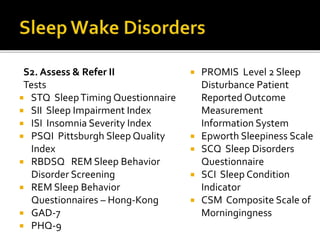
S2. Assess & Refer II
Tests
 STQ SleepTiming Questionnaire
 SII Sleep Impairment Index
 ISI Insomnia Severity Index
 PSQI Pittsburgh Sleep Quality
Index
 RBDSQ REM Sleep Behavior
Disorder Screening
 REM Sleep Behavior
Questionnaires – Hong-Kong
 GAD-7
 PHQ-9
 PROMIS Level 2 Sleep
Disturbance Patient
Reported Outcome
Measurement
Information System
 Epworth Sleepiness Scale
 SCQ Sleep Disorders
Questionnaire
 SCI Sleep Condition
Indicator
 CSM Composite Scale of
Morningingness
S4.Treatment
Therapy
 CBT-Insomnia
 RelaxationTherapy
 CognitiveThought Stopping
 Bright LightTherapy
 Neurostimulation
Medication
 Melatonin
 Amphetamines
 Antidepressants
 Monoamine Oxidase
Inhibitors (MOIs)
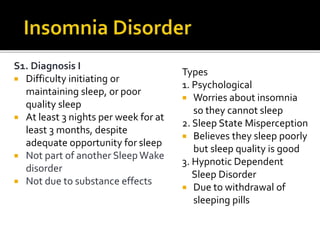
S1. Diagnosis I
 Difficulty initiating or
maintaining sleep, or poor
quality sleep
 At least 3 nights per week for at
least 3 months, despite
adequate opportunity for sleep
 Not part of another SleepWake
disorder
 Not due to substance effects
Types
1. Psychological
 Worries about insomnia
so they cannot sleep
2. Sleep State Misperception
 Believes they sleep poorly
but sleep quality is good
3. Hypnotic Dependent
Sleep Disorder
 Due to withdrawal of
sleeping pills
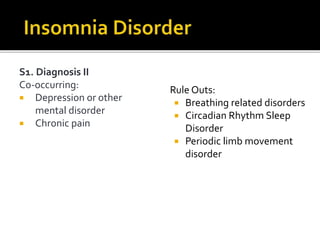
S1. Diagnosis II
Co-occurring:
 Depression or other
mental disorder
 Chronic pain
Rule Outs:
 Breathing related disorders
 Circadian Rhythm Sleep
Disorder
 Periodic limb movement
disorder
S4.Treatments
 CBT
 EEG feedback
 Stimulus control
 RelaxationTherapy
 Psychoeducation
 Sleep-restrictionTherapy
 BehavioralTherapy, such
as regulating the circadian
clock
Lifestyle changes
 Reduced stress
 Exercise
 Restricted caffeine
Medication
 Melatonin
 Brief use of hypnotics
Diagnosis I
 Recurrent episodes of
excessive daytime
sleepiness or prolonged
nighttime sleep
 At least 3 times weekly
 Naps repeatedly
throughout the day, with
no relief from symptoms
 Common among
adolescents and young
adults
Often disoriented when
waking and may experience:
 Anxiety
 Increased irritation
 Decreased energy
 Restlessness
 Slow thinking
 Slow speech
 Loss of appetite
 Hallucinations
 Memory difficulty
Diagnosis II
Co-occurring:
 Other mental disorders, like depression
 Medical conditions like head injury, multiple sclerosis,
encephalitis, epilepsy, or obesity
S4.Treatments
Medications
 Amphetamines
 Antidepressants
 Monoamine Oxidase Inhibitors (MOIs)
Diagnosis I
Requires:
 Presence of
recurrent periods
of irrepressible
need to sleep,
lapsing into
sleep, or napping
occurring within
the same day
 3x per week over
the past 3
months
Also at least one of the following:
 Cataplexy
 Brief episodes of sudden loss of
muscle tone, usually with intense
emotion like laughing or crying
 Hypocretin neurotransmitter deficiency
 Recurrent intrusions of rapid eye
movement (REM) sleep into the
transition between sleep and waking
 With either hypnopompic or
hypnagogic hallucinations or sleep
paralysis at the beginning or end of
sleep episodes
Diagnosis II
 Onset usually from childhood to
young adulthood, especially ages 5–
25 and 30–35
 Onset can be abrupt or progressive
over years
 Childhood onset most severe
 Early Symptoms:
 Sleepiness
 Vivid dreaming
 Excessive movements during REM
sleep
Co-occurring:
Sleep apnea
REM Sleep
Behavior
Disorder
S2. Assess & Refer
 Lab tests
S4.Treatments
Medications for sleepiness
 Central Nervous System
Stimulants
Medications for sleepiness
 Tricyclic Antidepressants
Medication for both
 Sodium Oxybate
Lifestyle changes
 Reduced stress
 Exercise
 Restricted caffeine
 Cataplexy: Brief episodes
of sudden bilateral loss of
muscle tone in neck, jaw,
arms, legs, or whole body,
resulting in head bobbing,
jaw dropping, or complete
falls, most often in
association with intense
emotion, like laughing
 Apnea: No breathing
airflow during sleep
 Hypoapnea: Reduced
airflow
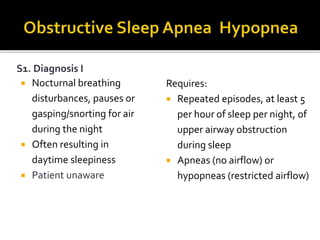
S1. Diagnosis I
 Nocturnal breathing
disturbances, pauses or
gasping/snorting for air
during the night
 Often resulting in
daytime sleepiness
 Patient unaware
Requires:
 Repeated episodes, at least 5
per hour of sleep per night, of
upper airway obstruction
during sleep
 Apneas (no airflow) or
hypopneas (restricted airflow)
S1. Diagnosis II
Co-occurring: Rule Out:
 Lung disease
 Neuromuscular disorder
 Skeletal malformation
S2. Assess & Refer
 Lab tests
S4.Treatments
1. Physical devices
 Positive Airway Pressure mask over face
 Mouth device
 Higher upper body position
2. Neurostimulation
3. Surgery and weight loss
S5. Monitoring Progress
 Sleep diary
S6.Termination
S1. Diagnosis I
Affects timing of sleep; unable to sleep
and wake at the times required
Requires:
1. Pattern of sleep disruption mainly due
to an alteration of the circadian
system
 Or misalignment between the internal
circadian rhythm and the sleep-wake
schedule required
2.The sleep disruption leads to excessive
sleepiness or insomnia, or both
Specify:
Episodic: Lasts 1 to 3
months
Persistent: Lasts 3
months or more
Recurrent:Two or
more episodes occur
within 1 year
S2. Assess & Refer
 Polysomnography
S4.Treatments
 Light therapy
 Dark therapy
 Melatonin supplements
 Sleep Deprivation Phase Advance
S5. Monitoring Progress
 Sleep diary
S6.Termination
Diagnosis I
Episodes of incomplete awakenings during sleep
1. Sleep walking
2. Sleep terrors
Diagnosis Ill
Co-occurring in children
 Restless Leg Syndrome
 Sleep Breathing Disorder
 Bed-wetting (Enuresis)
Co-occurring in adults:
 Delirium
 Seizure disorder
 Drug toxicity
 Schizophrenia
 Anxiety disorders
 Migraine headaches
 Tourette Syndrome
Diagnosis Il
 Most common among children and adolescents
Requires:
1. Rising from bed during sleep and walking about
 Usually during the first third of sleep period
2.While sleepwalking, they have a blank, staring face, are
relatively unresponsive to communicate efforts, and can be
awakened only with great difficulty
3. No memory of the episode upon awakening
4. Shortly after awakening, there is no impairment of mental
activity or behavior
 May be an initial short period of disorientation
S1. Find Out S2. Assess & Refer
 Polysomnography
S2. Assessments to Rule Out Options
 Polysomnography
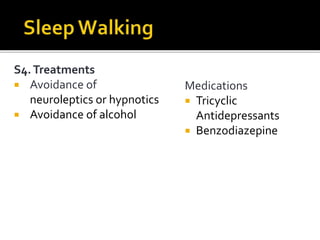
S4.Treatments
 Avoidance of
neuroleptics or hypnotics
 Avoidance of alcohol
Medications
 Tricyclic
Antidepressants
 Benzodiazepine
S5. Monitoring Progress
 Sleep diary
6. Recommendations
afterTermination
Diagnosis II
More likely in young people
Requires:
1. Recurrent periods where the individual
abruptly wakes from sleeping with a
scream
2. Experience of intense fear and
symptoms of autonomic arousal, like
rapid heart rate, heavy breathing and
sweating
3. Cannot be soothed during the episode
4. Unable to remember details of the
dream or episode
Co-occurring
 Neurological
disease
 Hypoglycemia
 Poor nutrition
S1. Find Out S2. Assess & Refer
 Polysomnography
S4.Treatments
Psychotherapy
 Scheduled Awakenings
Therapy very effective
 Increasing quality of sleep
Medications, in extreme
cases
 Tricyclic
Antidepressants
 Benzodiazepine
Diagnosis I
Requires:
 Repeated awakenings with recollection of terrifying dreams,
usually involving threats to survival, or safety
 During REM sleep, after 90 minutes
 Awakes alert and able to recall the dream well
 May be anxious and unable to fall back asleep
 Onset from childhood to adolescence, improvement with age
Diagnosis II
Rule out:
 SleepTerrors: Cannot recall dream
 Side effect of illicit drugs, like cocaine
and amphetamines
 Side effect of prescribed drugs, for
blood pressure, depression,
Parkinson’s
 PTSD
Co-occurring:
Dissociative
disorders
Borderline
Personality
disorder
S4.Treatments
Therapy
 Dealing with frightening dream themes
 RelaxationTherapy
 Hypnosis
 Stress reduction
Medications
 Prazosin, used in PTSD
S5. Monitoring Progress
 Sleep diary
6.Termination
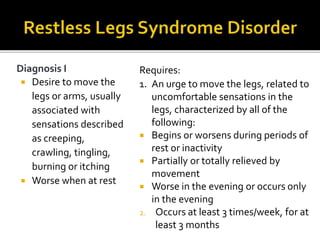
Diagnosis I
 Desire to move the
legs or arms, usually
associated with
sensations described
as creeping,
crawling, tingling,
burning or itching
 Worse when at rest
Requires:
1. An urge to move the legs, related to
uncomfortable sensations in the
legs, characterized by all of the
following:
 Begins or worsens during periods of
rest or inactivity
 Partially or totally relieved by
movement
 Worse in the evening or occurs only
in the evening
2. Occurs at least 3 times/week, for at
least 3 months
Diagnosis II
Co-occurring:
Periodic Limb Movement Disorder, where limbs jerk
during sleep
Neurologic conditions like Parkinsons disease
Renal disease
S4.Treatments
 Stretching, walking
(temporary)
 Iron supplements
Medications
 Benzodiazepines
 Anticonvulsants for pain
 Non-dopaminergic
Gabapentin or Pregabalin
 Dopamine Agonists,
cautiously
S5. Monitoring Progress
 Sleep diary
S6.Termination
Diagnosis I
Requires:
 Repeatedly
waking up
after REM
sleep
 Movements
related to
dreams
Requires:
1. Repeated episodes of arousal during sleep,
associated with vocalization and/or complex
motor behaviors
2. During rapid eye movement (REM) sleep,
usually 90 minutes after sleep onset and more
frequent later in sleep period
3. Awakening alert and not disoriented
4. Either of the following:
 Polysomnographic confirmation of REM sleep
without normal muscle paralysis
 History suggestive of this disorder and
diagnosis of Parkinson’s or related diseases
Diagnosis II
 Onset usually from childhood to
young adulthood, especially at ages
15–25 years and ages 30–35 years
 Onset can be abrupt or progressive
over years
 Childhood onset most severe
 Early Symptoms: Sleepiness, vivid
dreaming, and excessive movements
during REM sleep
Co-occurring:
Other sleep
disorders
Parkinson’s
disease
Multiple System
Atrophy and
Lewy Body
Dementia
S1. Find Out S2. Assess& Refer
Lab tests
 RBDSQ Rapid Eye
Movement (REM) Sleep
Behavior Disorder
Screening
Questionnaire
 REM Sleep Behaviour
Questionnaires – Hong-
Kong
S4.Treatments
Medications
 Clonazepam and
melatonin most effective
 Avoid sleep
deprivation, alcohol,
and certain
medications
 Make bedroom safe
 Cataplexy: Brief episodes
of sudden bilateral loss of
muscle tone in neck, jaw,
arms, legs, or whole body,
resulting in head bobbing,
jaw dropping, or complete
falls, most often in
association with intense
emotion, like laughing
Apnea: No breathing airflow
during sleep
Hypoapnea: Reduced airflow
Akathisia: Movement
disorder characterized by a
feeling of restlessness and a
compelling need to be in
constant motion
Atonia: Muscle paralysis, as in
normal sleep

Sleep Wake Disorders for NCMHCE Study

  • 1.
    Review of DSM5Mental Disorders for NCMHCE Study
  • 2.
     Insomnia Disorder Hypersomnolence Disorder  Narcolepsy  Breathing-Related Sleep Disorders  Circadian Rhythm Sleep- Wake Disorders  Non-REM Sleep Arousal Disorders  Parasomnias  Nightmare Disorder  Restless Legs Syndrome  Substance/Medication- Induced Sleep Disorder
  • 3.
    S1. Find Out Substance abuse  Depression  Medical conditions
  • 4.
    Comorbidity  Depressive disorders Anxiety disorders  Autism  ADHD  OCD  Adjustment disorder  Dissociative disorders  Feeding & Eating disorders  Somatic Symptom disorders  Neurocognitive disorders Rule Out  Depressive disorders
  • 5.
    S2. Assess &Refer I Evaluations  Polysomnography  Expensive and to be avoided if possible  Sleep diaries  Lab tests for neurotransmitter deficiencies, breathing difficulties, etc.
  • 6.
    S2. Assess &Refer II Tests  STQ SleepTiming Questionnaire  SII Sleep Impairment Index  ISI Insomnia Severity Index  PSQI Pittsburgh Sleep Quality Index  RBDSQ REM Sleep Behavior Disorder Screening  REM Sleep Behavior Questionnaires – Hong-Kong  GAD-7  PHQ-9  PROMIS Level 2 Sleep Disturbance Patient Reported Outcome Measurement Information System  Epworth Sleepiness Scale  SCQ Sleep Disorders Questionnaire  SCI Sleep Condition Indicator  CSM Composite Scale of Morningingness
  • 7.
    S4.Treatment Therapy  CBT-Insomnia  RelaxationTherapy CognitiveThought Stopping  Bright LightTherapy  Neurostimulation Medication  Melatonin  Amphetamines  Antidepressants  Monoamine Oxidase Inhibitors (MOIs)
  • 9.
    S1. Diagnosis I Difficulty initiating or maintaining sleep, or poor quality sleep  At least 3 nights per week for at least 3 months, despite adequate opportunity for sleep  Not part of another SleepWake disorder  Not due to substance effects Types 1. Psychological  Worries about insomnia so they cannot sleep 2. Sleep State Misperception  Believes they sleep poorly but sleep quality is good 3. Hypnotic Dependent Sleep Disorder  Due to withdrawal of sleeping pills
  • 10.
    S1. Diagnosis II Co-occurring: Depression or other mental disorder  Chronic pain Rule Outs:  Breathing related disorders  Circadian Rhythm Sleep Disorder  Periodic limb movement disorder
  • 11.
    S4.Treatments  CBT  EEGfeedback  Stimulus control  RelaxationTherapy  Psychoeducation  Sleep-restrictionTherapy  BehavioralTherapy, such as regulating the circadian clock Lifestyle changes  Reduced stress  Exercise  Restricted caffeine Medication  Melatonin  Brief use of hypnotics
  • 13.
    Diagnosis I  Recurrentepisodes of excessive daytime sleepiness or prolonged nighttime sleep  At least 3 times weekly  Naps repeatedly throughout the day, with no relief from symptoms  Common among adolescents and young adults Often disoriented when waking and may experience:  Anxiety  Increased irritation  Decreased energy  Restlessness  Slow thinking  Slow speech  Loss of appetite  Hallucinations  Memory difficulty
  • 14.
    Diagnosis II Co-occurring:  Othermental disorders, like depression  Medical conditions like head injury, multiple sclerosis, encephalitis, epilepsy, or obesity
  • 15.
  • 17.
    Diagnosis I Requires:  Presenceof recurrent periods of irrepressible need to sleep, lapsing into sleep, or napping occurring within the same day  3x per week over the past 3 months Also at least one of the following:  Cataplexy  Brief episodes of sudden loss of muscle tone, usually with intense emotion like laughing or crying  Hypocretin neurotransmitter deficiency  Recurrent intrusions of rapid eye movement (REM) sleep into the transition between sleep and waking  With either hypnopompic or hypnagogic hallucinations or sleep paralysis at the beginning or end of sleep episodes
  • 18.
    Diagnosis II  Onsetusually from childhood to young adulthood, especially ages 5– 25 and 30–35  Onset can be abrupt or progressive over years  Childhood onset most severe  Early Symptoms:  Sleepiness  Vivid dreaming  Excessive movements during REM sleep Co-occurring: Sleep apnea REM Sleep Behavior Disorder
  • 19.
    S2. Assess &Refer  Lab tests
  • 20.
    S4.Treatments Medications for sleepiness Central Nervous System Stimulants Medications for sleepiness  Tricyclic Antidepressants Medication for both  Sodium Oxybate Lifestyle changes  Reduced stress  Exercise  Restricted caffeine
  • 21.
     Cataplexy: Briefepisodes of sudden bilateral loss of muscle tone in neck, jaw, arms, legs, or whole body, resulting in head bobbing, jaw dropping, or complete falls, most often in association with intense emotion, like laughing  Apnea: No breathing airflow during sleep  Hypoapnea: Reduced airflow
  • 23.
    S1. Diagnosis I Nocturnal breathing disturbances, pauses or gasping/snorting for air during the night  Often resulting in daytime sleepiness  Patient unaware Requires:  Repeated episodes, at least 5 per hour of sleep per night, of upper airway obstruction during sleep  Apneas (no airflow) or hypopneas (restricted airflow)
  • 24.
    S1. Diagnosis II Co-occurring:Rule Out:  Lung disease  Neuromuscular disorder  Skeletal malformation
  • 25.
    S2. Assess &Refer  Lab tests
  • 26.
    S4.Treatments 1. Physical devices Positive Airway Pressure mask over face  Mouth device  Higher upper body position 2. Neurostimulation 3. Surgery and weight loss
  • 27.
    S5. Monitoring Progress Sleep diary S6.Termination
  • 29.
    S1. Diagnosis I Affectstiming of sleep; unable to sleep and wake at the times required Requires: 1. Pattern of sleep disruption mainly due to an alteration of the circadian system  Or misalignment between the internal circadian rhythm and the sleep-wake schedule required 2.The sleep disruption leads to excessive sleepiness or insomnia, or both Specify: Episodic: Lasts 1 to 3 months Persistent: Lasts 3 months or more Recurrent:Two or more episodes occur within 1 year
  • 30.
    S2. Assess &Refer  Polysomnography
  • 31.
    S4.Treatments  Light therapy Dark therapy  Melatonin supplements  Sleep Deprivation Phase Advance
  • 32.
    S5. Monitoring Progress Sleep diary S6.Termination
  • 34.
    Diagnosis I Episodes ofincomplete awakenings during sleep 1. Sleep walking 2. Sleep terrors
  • 35.
    Diagnosis Ill Co-occurring inchildren  Restless Leg Syndrome  Sleep Breathing Disorder  Bed-wetting (Enuresis) Co-occurring in adults:  Delirium  Seizure disorder  Drug toxicity  Schizophrenia  Anxiety disorders  Migraine headaches  Tourette Syndrome
  • 36.
    Diagnosis Il  Mostcommon among children and adolescents Requires: 1. Rising from bed during sleep and walking about  Usually during the first third of sleep period 2.While sleepwalking, they have a blank, staring face, are relatively unresponsive to communicate efforts, and can be awakened only with great difficulty 3. No memory of the episode upon awakening 4. Shortly after awakening, there is no impairment of mental activity or behavior  May be an initial short period of disorientation
  • 37.
    S1. Find OutS2. Assess & Refer  Polysomnography
  • 38.
    S2. Assessments toRule Out Options  Polysomnography
  • 39.
    S4.Treatments  Avoidance of neurolepticsor hypnotics  Avoidance of alcohol Medications  Tricyclic Antidepressants  Benzodiazepine
  • 40.
    S5. Monitoring Progress Sleep diary 6. Recommendations afterTermination
  • 41.
    Diagnosis II More likelyin young people Requires: 1. Recurrent periods where the individual abruptly wakes from sleeping with a scream 2. Experience of intense fear and symptoms of autonomic arousal, like rapid heart rate, heavy breathing and sweating 3. Cannot be soothed during the episode 4. Unable to remember details of the dream or episode Co-occurring  Neurological disease  Hypoglycemia  Poor nutrition
  • 42.
    S1. Find OutS2. Assess & Refer  Polysomnography
  • 43.
    S4.Treatments Psychotherapy  Scheduled Awakenings Therapyvery effective  Increasing quality of sleep Medications, in extreme cases  Tricyclic Antidepressants  Benzodiazepine
  • 45.
    Diagnosis I Requires:  Repeatedawakenings with recollection of terrifying dreams, usually involving threats to survival, or safety  During REM sleep, after 90 minutes  Awakes alert and able to recall the dream well  May be anxious and unable to fall back asleep  Onset from childhood to adolescence, improvement with age
  • 46.
    Diagnosis II Rule out: SleepTerrors: Cannot recall dream  Side effect of illicit drugs, like cocaine and amphetamines  Side effect of prescribed drugs, for blood pressure, depression, Parkinson’s  PTSD Co-occurring: Dissociative disorders Borderline Personality disorder
  • 47.
    S4.Treatments Therapy  Dealing withfrightening dream themes  RelaxationTherapy  Hypnosis  Stress reduction Medications  Prazosin, used in PTSD
  • 48.
    S5. Monitoring Progress Sleep diary 6.Termination
  • 50.
    Diagnosis I  Desireto move the legs or arms, usually associated with sensations described as creeping, crawling, tingling, burning or itching  Worse when at rest Requires: 1. An urge to move the legs, related to uncomfortable sensations in the legs, characterized by all of the following:  Begins or worsens during periods of rest or inactivity  Partially or totally relieved by movement  Worse in the evening or occurs only in the evening 2. Occurs at least 3 times/week, for at least 3 months
  • 51.
    Diagnosis II Co-occurring: Periodic LimbMovement Disorder, where limbs jerk during sleep Neurologic conditions like Parkinsons disease Renal disease
  • 52.
    S4.Treatments  Stretching, walking (temporary) Iron supplements Medications  Benzodiazepines  Anticonvulsants for pain  Non-dopaminergic Gabapentin or Pregabalin  Dopamine Agonists, cautiously
  • 53.
    S5. Monitoring Progress Sleep diary S6.Termination
  • 55.
    Diagnosis I Requires:  Repeatedly wakingup after REM sleep  Movements related to dreams Requires: 1. Repeated episodes of arousal during sleep, associated with vocalization and/or complex motor behaviors 2. During rapid eye movement (REM) sleep, usually 90 minutes after sleep onset and more frequent later in sleep period 3. Awakening alert and not disoriented 4. Either of the following:  Polysomnographic confirmation of REM sleep without normal muscle paralysis  History suggestive of this disorder and diagnosis of Parkinson’s or related diseases
  • 56.
    Diagnosis II  Onsetusually from childhood to young adulthood, especially at ages 15–25 years and ages 30–35 years  Onset can be abrupt or progressive over years  Childhood onset most severe  Early Symptoms: Sleepiness, vivid dreaming, and excessive movements during REM sleep Co-occurring: Other sleep disorders Parkinson’s disease Multiple System Atrophy and Lewy Body Dementia
  • 57.
    S1. Find OutS2. Assess& Refer Lab tests  RBDSQ Rapid Eye Movement (REM) Sleep Behavior Disorder Screening Questionnaire  REM Sleep Behaviour Questionnaires – Hong- Kong
  • 58.
    S4.Treatments Medications  Clonazepam and melatoninmost effective  Avoid sleep deprivation, alcohol, and certain medications  Make bedroom safe
  • 59.
     Cataplexy: Briefepisodes of sudden bilateral loss of muscle tone in neck, jaw, arms, legs, or whole body, resulting in head bobbing, jaw dropping, or complete falls, most often in association with intense emotion, like laughing Apnea: No breathing airflow during sleep Hypoapnea: Reduced airflow Akathisia: Movement disorder characterized by a feeling of restlessness and a compelling need to be in constant motion Atonia: Muscle paralysis, as in normal sleep