MALNUTRITION
Adrien MUGIMBAHO
Definition
• Malnutrition
• Deficiencies, excesses or imbalances in intake of energy/ nutrients. The term
malnutrition covers 2 broad groups of conditions.
• Undernutrition
• stunting (low height for age),
• wasting (low weight for height),
• underweight (low weight for age) and
• micronutrient deficiencies or insufficiencies (a lack of important vitamins and minerals).
• Overnutrition
Epidemiology
• Rwanda:
• 38 % or 661,200 children under 5 years suffer from chronic malnutrition
(stunting or low height-for-age)
• 37 % or 643,800 suffer from anemia
• Worldwide
• 52 million children under 5 years of age are wasted, 17 million are severely
wasted and 155 million are stunted
• Around 45% of deaths among children under 5 years of age are linked to
undernutrition
CHRONIC MALNUTRITION
• Diminished height (stunting)
• Poor weight gain and
• Deficits in both lean body mass and adipose tissue.
• Other features include :
• reduced physical activity,
• mental apathy, and
• retarded psychomotor and mental development
ACUTE MALNUTRITION
• Marasmus
• Low weight-for-height and reduced MUAC
• Other physical examination findings may include:
• Head that appears large relative to the body, with staring eyes
• Emaciated and weak appearance.
• Bradycardia, hypotension, and hypothermia
• Thin, dry skin
• Shrunken arms, thighs, and buttocks with redundant skin folds caused by loss
of subcutaneous fat
• Thin, sparse hair that is easily plucked
Kwashiorkor (edematous malnutrition)
Symmetric peripheral pitting edema
Apathetic, listless affect
Rounded prominence of the cheeks ("moon-face")
Pursed appearance of the mouth
Thin, dry, peeling skin
hyperpigmentation and skin lesion( dermatitis)
Kwashiorkor con’t
Dry, dull, hypopigmented hair that falls ( silky hair)
Hepatomegaly (from fatty liver infiltrates)
Distended abdomen with dilated intestinal loops
Bradycardia, hypotension, and hypothermia
Despite generalized edema, most children have loose inner inguinal skin folds
SPECIFIC NUTRIENT DEFICIENCIES
Vitamin A deficiency
corneal cloudiness,
ulceration and xerosis
Bitot spots
Vitamin D deficiency
Skeletal changes with beading of the ribs
widening of the wrists
bowed legs
Nutritional deficiency con’t
Thiamine deficiency
 aphonia,
 peripheral neuropathy,
 nystagmus,
 ophthalmoplegia,
 cerebellar ataxia, confusion, or coma (dry beriberi),
 cardiomegaly and congestive heart failure (wet beriberi)
Zinc deficiency
 bullous dermatitis
 diarrhea
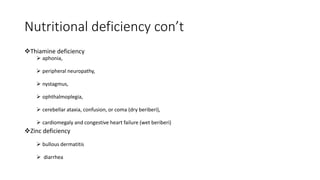
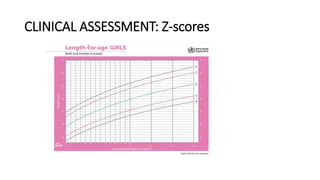
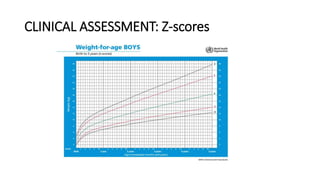
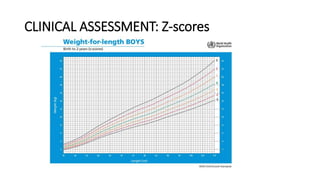
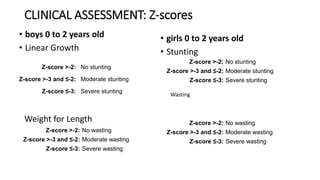
CLINICAL ASSESSMENT: Z-scores
• boys 0 to 2 years old
• Linear Growth
Z-score >-2: No stunting
Z-score >-3 and ≤-2: Moderate stunting
Z-score ≤-3: Severe stunting
Z-score >-2: No wasting
Z-score >-3 and ≤-2: Moderate wasting
Z-score ≤-3: Severe wasting
Weight for Length
• girls 0 to 2 years old
• Stunting
Wasting
Z-score >-2: No stunting
Z-score >-3 and ≤-2: Moderate stunting
Z-score ≤-3: Severe stunting
Z-score >-2: No wasting
Z-score >-3 and ≤-2: Moderate wasting
Z-score ≤-3: Severe wasting
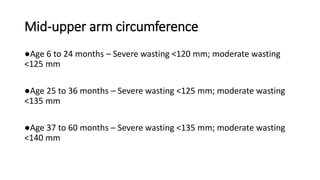
Mid-upper arm circumference
●Age 6 to 24 months – Severe wasting <120 mm; moderate wasting
<125 mm
●Age 25 to 36 months – Severe wasting <125 mm; moderate wasting
<135 mm
●Age 37 to 60 months – Severe wasting <135 mm; moderate wasting
<140 mm
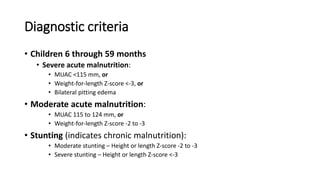
Diagnostic criteria
• Children 6 through 59 months
• Severe acute malnutrition:
• MUAC <115 mm, or
• Weight-for-length Z-score <-3, or
• Bilateral pitting edema
• Moderate acute malnutrition:
• MUAC 115 to 124 mm, or
• Weight-for-length Z-score -2 to -3
• Stunting (indicates chronic malnutrition):
• Moderate stunting – Height or length Z-score -2 to -3
• Severe stunting – Height or length Z-score <-3
Diagnostic criteria Cont’d
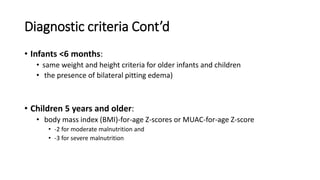
• Infants <6 months:
• same weight and height criteria for older infants and children
• the presence of bilateral pitting edema)
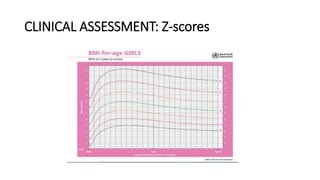
• Children 5 years and older:
• body mass index (BMI)-for-age Z-scores or MUAC-for-age Z-score
• -2 for moderate malnutrition and
• -3 for severe malnutrition
Management
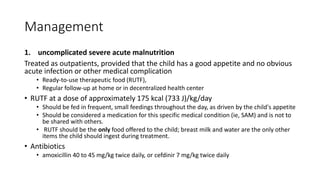
1. uncomplicated severe acute malnutrition
Treated as outpatients, provided that the child has a good appetite and no obvious
acute infection or other medical complication
• Ready-to-use therapeutic food (RUTF),
• Regular follow-up at home or in decentralized health center
• RUTF at a dose of approximately 175 kcal (733 J)/kg/day
• Should be fed in frequent, small feedings throughout the day, as driven by the child's appetite
• Should be considered a medication for this specific medical condition (ie, SAM) and is not to
be shared with others.
• RUTF should be the only food offered to the child; breast milk and water are the only other
items the child should ingest during treatment.
• Antibiotics
• amoxicillin 40 to 45 mg/kg twice daily, or cefdinir 7 mg/kg twice daily
Management Cont’d
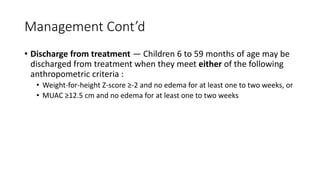
• Discharge from treatment — Children 6 to 59 months of age may be
discharged from treatment when they meet either of the following
anthropometric criteria :
• Weight-for-height Z-score ≥-2 and no edema for at least one to two weeks, or
• MUAC ≥12.5 cm and no edema for at least one to two weeks
Management Cont’d
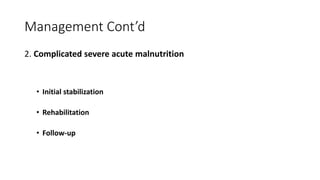
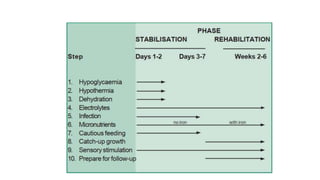
2. Complicated severe acute malnutrition
• Initial stabilization
• Rehabilitation
• Follow-up
Steps 1 and 2
1. Prevent/treat HYPOGLYCEMIA
2. Prevent/treat HYPOTHERMIA
• KEY is frequent feeding – every two hrs night/day
• Skin to skin contact with parent, warm lamp,
warm blanket, avoid exposure
STEP 3
 Give ReSoMaL or comparable oral solution.
5 ml/kg every 30 min for two hours
5-10 ml/kg/h for next 4-10 hours
Do not use the IV route except in shock,
Feed through diarrhea (50-100 ml after each watery stool)
continue breast feeding
Treat/prevent dehydration
STEP 4
child with severe acute malnutrition has:
Excessive sodium
Low potassium
Low magnesium
So they need low sodium diet and fluid
Remember: Two weeks minimum to correct
Do NOT use a diuretic to treat edema
CORRECT ELECTROLYTE IMBALANCES
STEP 5
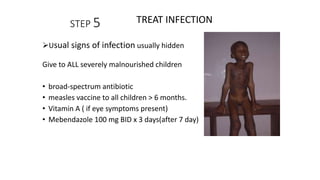
Usual signs of infection usually hidden
Give to ALL severely malnourished children
• broad-spectrum antibiotic
• measles vaccine to all children > 6 months.
• Vitamin A ( if eye symptoms present)
• Mebendazole 100 mg BID x 3 days(after 7 day)
TREAT INFECTION
STEP 6
All severely malnourished children have vitamin and mineral
deficiencies.
Recommended: Zinc, copper and MV daily
Vitamin A and folic acid on Day 1
Do NOT give iron until the child has a good appetite and starts
gaining weight (usually during the second week of treatment).
CORRECT MICRONUTRIENT
DEFICIENCIES
STEP 7 Cautious Feeding
•small, frequent feeds of low osmolality and low lactose
•May include electrolyte/mineral solution
•Day 1 – 7
•Low in protein and iron, high in energy
Feeding protocols
• During stabilization phase :
Start F75 100ml/kg/day divided in every 2 to 3 hours
Or 130 ml/Kg/day if no edema divided in every 2 to 3 hours
Monitor if vomiting and diarrhea
Weigh the child every day ( the child would loose weight when edema are
resolving.
Feeding protocol con’t
If edema are resolved and the child has appetite.
Start F100, at the last volume of F75 divided in every 3 to 4 hours
Check recurrence of edema and rapid weight gain
If the child is not tolerating F100 or edema reoccur you may go back to F75
Once the child tolerate F100, the solid food /RUTF may be introduced
Catch-up growth
Second week
change from starter to catch-up formula
Advance to 200 ml/kg/day div q 3 to 4 hours
Advance to local foods – peanut butter, beans,
margarine – energy dense local foods
Monitor progress after the transition by assessing the rate
of weight gain
Step 8
STEP 9
In severe malnutrition there is delayed mental and behavioural
development.
Provide:
• tender loving care
• a cheerful, stimulating environment
• structured play therapy 15-30 min/d
• physical activity as soon as the child is well enough
• maternal involvement when possible (e.g. comforting, feeding, bathing,
play)
• 90% expected weight for height ready for discharge
Stimulation, Play and Loving Care
Step 10
Preparation for
Discharge
Nutritional education
Show parent or carer how to:
• feed frequently with energy- and nutrient-dense foods
• give structured play therapy
Advise parent or carer to:
• bring child back for regular follow-up checks
• ensure booster immunizations are given
• ensure vitamin A is given every six months
References
• Phillips SM, Jensen C, Editor S, Motil KJ, Editor D, Hoppin AG. Micronutrient
deficiencies associated with malnutrition in children Micronutrient deficiencies
associated with malnutrition in children. 2013;1(table 1):1–15.
• Praveen S Goday M. Malnutrition in children in resource-limited countries:
Clinical assessment - UpToDate. UpToDate [Internet]. 2019;5. Available from:
https://www.uptodate.com/contents/malnutrition-in-children-in-resource-limited-
countries-clinical-assessment%0Ahttps://www.uptodate.com/contents/malnutrition-
in-children-in-resource-limited-countries-clinical-assessment/print
• WHO. Girls z-scores. 2006;15. Available from:
http://www.who.int/childgrowth/standards/LFA_girls_0_13_percentiles.pdf%5Cnpape
rs2://publication/uuid/8A8286DD-5E8A-4952-AAFF-8A0275597782
• WHO. WHO | Chart catalogue. Who. 2010.
• Ashworth A, Schofield C. Book Review: Guidelines for the Inpatient Treatment of
Severely Malnourished Children. Food Nutr Bull. 2005;26(2):245–245.
• Goday P. Malnutrition in children in resource-limited countries: Clinical
assessment - UpToDate [Internet]. UpToDate. 2019. Available from:
https://ezproxy.ufm.edu:2053/contents/malnutrition-in-children-in-resource-limited-
countries-clinical-assessment?search=malnutrition in
children&source=search_result&selectedTitle=1~150&usage_type=default&display_ra
nk=1
References
• USAID. Rwanda : Nutrition Profile. American [Internet]. 2014;(June):7–10.
Available from:
https://www.usaid.gov/sites/default/files/documents/1864/Rwanda-Nutrition-
Profile-Mar2018-508.pdf
• Trehan I, Manary M. Management of complicated severe acute
malnutrition in children in resource-limited countries. UpToDate.com
[Internet]. 2017;1–22. Available from: https://0-
www.uptodate.com.innopac.wits.ac.za/contents/management-of-complicated-
severe-acute-malnutrition-in-children-in-resource-limited-
countries?source=search_result&search=severe
malnutrition&selectedTitle=1~150
• Trehan I, Manary M. Management of complicated severe acute
malnutrition in children in resource-limited countries [Internet].
UpToDate.com. 2017. p. 1–22. Available from: https://0-
www.uptodate.com.innopac.wits.ac.za/contents/management-of-complicated-
severe-acute-malnutrition-in-children-in-resource-limited-
countries?source=search_result&search=severe
malnutrition&selectedTitle=1~150
• Airlines S. 済無No Title No Title. J Chem Inf Model. 2013;53(9):1689–99.

Malnutrition in pediatrics

  • 1.
  • 2.
    Definition • Malnutrition • Deficiencies,excesses or imbalances in intake of energy/ nutrients. The term malnutrition covers 2 broad groups of conditions. • Undernutrition • stunting (low height for age), • wasting (low weight for height), • underweight (low weight for age) and • micronutrient deficiencies or insufficiencies (a lack of important vitamins and minerals). • Overnutrition
  • 3.
    Epidemiology • Rwanda: • 38% or 661,200 children under 5 years suffer from chronic malnutrition (stunting or low height-for-age) • 37 % or 643,800 suffer from anemia • Worldwide • 52 million children under 5 years of age are wasted, 17 million are severely wasted and 155 million are stunted • Around 45% of deaths among children under 5 years of age are linked to undernutrition
  • 4.
    CHRONIC MALNUTRITION • Diminishedheight (stunting) • Poor weight gain and • Deficits in both lean body mass and adipose tissue. • Other features include : • reduced physical activity, • mental apathy, and • retarded psychomotor and mental development
  • 5.
    ACUTE MALNUTRITION • Marasmus •Low weight-for-height and reduced MUAC • Other physical examination findings may include: • Head that appears large relative to the body, with staring eyes • Emaciated and weak appearance. • Bradycardia, hypotension, and hypothermia • Thin, dry skin • Shrunken arms, thighs, and buttocks with redundant skin folds caused by loss of subcutaneous fat • Thin, sparse hair that is easily plucked
  • 6.
    Kwashiorkor (edematous malnutrition) Symmetricperipheral pitting edema Apathetic, listless affect Rounded prominence of the cheeks ("moon-face") Pursed appearance of the mouth Thin, dry, peeling skin hyperpigmentation and skin lesion( dermatitis)
  • 7.
    Kwashiorkor con’t Dry, dull,hypopigmented hair that falls ( silky hair) Hepatomegaly (from fatty liver infiltrates) Distended abdomen with dilated intestinal loops Bradycardia, hypotension, and hypothermia Despite generalized edema, most children have loose inner inguinal skin folds
  • 8.
    SPECIFIC NUTRIENT DEFICIENCIES VitaminA deficiency corneal cloudiness, ulceration and xerosis Bitot spots Vitamin D deficiency Skeletal changes with beading of the ribs widening of the wrists bowed legs
  • 9.
    Nutritional deficiency con’t Thiaminedeficiency  aphonia,  peripheral neuropathy,  nystagmus,  ophthalmoplegia,  cerebellar ataxia, confusion, or coma (dry beriberi),  cardiomegaly and congestive heart failure (wet beriberi) Zinc deficiency  bullous dermatitis  diarrhea
  • 10.
  • 11.
  • 12.
  • 13.
  • 14.
    CLINICAL ASSESSMENT: Z-scores •boys 0 to 2 years old • Linear Growth Z-score >-2: No stunting Z-score >-3 and ≤-2: Moderate stunting Z-score ≤-3: Severe stunting Z-score >-2: No wasting Z-score >-3 and ≤-2: Moderate wasting Z-score ≤-3: Severe wasting Weight for Length • girls 0 to 2 years old • Stunting Wasting Z-score >-2: No stunting Z-score >-3 and ≤-2: Moderate stunting Z-score ≤-3: Severe stunting Z-score >-2: No wasting Z-score >-3 and ≤-2: Moderate wasting Z-score ≤-3: Severe wasting
  • 15.
    Mid-upper arm circumference ●Age6 to 24 months – Severe wasting <120 mm; moderate wasting <125 mm ●Age 25 to 36 months – Severe wasting <125 mm; moderate wasting <135 mm ●Age 37 to 60 months – Severe wasting <135 mm; moderate wasting <140 mm
  • 16.
    Diagnostic criteria • Children6 through 59 months • Severe acute malnutrition: • MUAC <115 mm, or • Weight-for-length Z-score <-3, or • Bilateral pitting edema • Moderate acute malnutrition: • MUAC 115 to 124 mm, or • Weight-for-length Z-score -2 to -3 • Stunting (indicates chronic malnutrition): • Moderate stunting – Height or length Z-score -2 to -3 • Severe stunting – Height or length Z-score <-3
  • 17.
    Diagnostic criteria Cont’d •Infants <6 months: • same weight and height criteria for older infants and children • the presence of bilateral pitting edema) • Children 5 years and older: • body mass index (BMI)-for-age Z-scores or MUAC-for-age Z-score • -2 for moderate malnutrition and • -3 for severe malnutrition
  • 18.
    Management 1. uncomplicated severeacute malnutrition Treated as outpatients, provided that the child has a good appetite and no obvious acute infection or other medical complication • Ready-to-use therapeutic food (RUTF), • Regular follow-up at home or in decentralized health center • RUTF at a dose of approximately 175 kcal (733 J)/kg/day • Should be fed in frequent, small feedings throughout the day, as driven by the child's appetite • Should be considered a medication for this specific medical condition (ie, SAM) and is not to be shared with others. • RUTF should be the only food offered to the child; breast milk and water are the only other items the child should ingest during treatment. • Antibiotics • amoxicillin 40 to 45 mg/kg twice daily, or cefdinir 7 mg/kg twice daily
  • 19.
    Management Cont’d • Dischargefrom treatment — Children 6 to 59 months of age may be discharged from treatment when they meet either of the following anthropometric criteria : • Weight-for-height Z-score ≥-2 and no edema for at least one to two weeks, or • MUAC ≥12.5 cm and no edema for at least one to two weeks
  • 20.
    Management Cont’d 2. Complicatedsevere acute malnutrition • Initial stabilization • Rehabilitation • Follow-up
  • 22.
    Steps 1 and2 1. Prevent/treat HYPOGLYCEMIA 2. Prevent/treat HYPOTHERMIA • KEY is frequent feeding – every two hrs night/day • Skin to skin contact with parent, warm lamp, warm blanket, avoid exposure
  • 23.
    STEP 3  GiveReSoMaL or comparable oral solution. 5 ml/kg every 30 min for two hours 5-10 ml/kg/h for next 4-10 hours Do not use the IV route except in shock, Feed through diarrhea (50-100 ml after each watery stool) continue breast feeding Treat/prevent dehydration
  • 24.
    STEP 4 child withsevere acute malnutrition has: Excessive sodium Low potassium Low magnesium So they need low sodium diet and fluid Remember: Two weeks minimum to correct Do NOT use a diuretic to treat edema CORRECT ELECTROLYTE IMBALANCES
  • 25.
    STEP 5 Usual signsof infection usually hidden Give to ALL severely malnourished children • broad-spectrum antibiotic • measles vaccine to all children > 6 months. • Vitamin A ( if eye symptoms present) • Mebendazole 100 mg BID x 3 days(after 7 day) TREAT INFECTION
  • 26.
    STEP 6 All severelymalnourished children have vitamin and mineral deficiencies. Recommended: Zinc, copper and MV daily Vitamin A and folic acid on Day 1 Do NOT give iron until the child has a good appetite and starts gaining weight (usually during the second week of treatment). CORRECT MICRONUTRIENT DEFICIENCIES
  • 27.
    STEP 7 CautiousFeeding •small, frequent feeds of low osmolality and low lactose •May include electrolyte/mineral solution •Day 1 – 7 •Low in protein and iron, high in energy
  • 28.
    Feeding protocols • Duringstabilization phase : Start F75 100ml/kg/day divided in every 2 to 3 hours Or 130 ml/Kg/day if no edema divided in every 2 to 3 hours Monitor if vomiting and diarrhea Weigh the child every day ( the child would loose weight when edema are resolving.
  • 29.
    Feeding protocol con’t Ifedema are resolved and the child has appetite. Start F100, at the last volume of F75 divided in every 3 to 4 hours Check recurrence of edema and rapid weight gain If the child is not tolerating F100 or edema reoccur you may go back to F75 Once the child tolerate F100, the solid food /RUTF may be introduced
  • 30.
    Catch-up growth Second week changefrom starter to catch-up formula Advance to 200 ml/kg/day div q 3 to 4 hours Advance to local foods – peanut butter, beans, margarine – energy dense local foods Monitor progress after the transition by assessing the rate of weight gain Step 8
  • 31.
    STEP 9 In severemalnutrition there is delayed mental and behavioural development. Provide: • tender loving care • a cheerful, stimulating environment • structured play therapy 15-30 min/d • physical activity as soon as the child is well enough • maternal involvement when possible (e.g. comforting, feeding, bathing, play) • 90% expected weight for height ready for discharge Stimulation, Play and Loving Care
  • 32.
    Step 10 Preparation for Discharge Nutritionaleducation Show parent or carer how to: • feed frequently with energy- and nutrient-dense foods • give structured play therapy Advise parent or carer to: • bring child back for regular follow-up checks • ensure booster immunizations are given • ensure vitamin A is given every six months
  • 33.
    References • Phillips SM,Jensen C, Editor S, Motil KJ, Editor D, Hoppin AG. Micronutrient deficiencies associated with malnutrition in children Micronutrient deficiencies associated with malnutrition in children. 2013;1(table 1):1–15. • Praveen S Goday M. Malnutrition in children in resource-limited countries: Clinical assessment - UpToDate. UpToDate [Internet]. 2019;5. Available from: https://www.uptodate.com/contents/malnutrition-in-children-in-resource-limited- countries-clinical-assessment%0Ahttps://www.uptodate.com/contents/malnutrition- in-children-in-resource-limited-countries-clinical-assessment/print • WHO. Girls z-scores. 2006;15. Available from: http://www.who.int/childgrowth/standards/LFA_girls_0_13_percentiles.pdf%5Cnpape rs2://publication/uuid/8A8286DD-5E8A-4952-AAFF-8A0275597782 • WHO. WHO | Chart catalogue. Who. 2010. • Ashworth A, Schofield C. Book Review: Guidelines for the Inpatient Treatment of Severely Malnourished Children. Food Nutr Bull. 2005;26(2):245–245. • Goday P. Malnutrition in children in resource-limited countries: Clinical assessment - UpToDate [Internet]. UpToDate. 2019. Available from: https://ezproxy.ufm.edu:2053/contents/malnutrition-in-children-in-resource-limited- countries-clinical-assessment?search=malnutrition in children&source=search_result&selectedTitle=1~150&usage_type=default&display_ra nk=1
  • 34.
    References • USAID. Rwanda: Nutrition Profile. American [Internet]. 2014;(June):7–10. Available from: https://www.usaid.gov/sites/default/files/documents/1864/Rwanda-Nutrition- Profile-Mar2018-508.pdf • Trehan I, Manary M. Management of complicated severe acute malnutrition in children in resource-limited countries. UpToDate.com [Internet]. 2017;1–22. Available from: https://0- www.uptodate.com.innopac.wits.ac.za/contents/management-of-complicated- severe-acute-malnutrition-in-children-in-resource-limited- countries?source=search_result&search=severe malnutrition&selectedTitle=1~150 • Trehan I, Manary M. Management of complicated severe acute malnutrition in children in resource-limited countries [Internet]. UpToDate.com. 2017. p. 1–22. Available from: https://0- www.uptodate.com.innopac.wits.ac.za/contents/management-of-complicated- severe-acute-malnutrition-in-children-in-resource-limited- countries?source=search_result&search=severe malnutrition&selectedTitle=1~150 • Airlines S. 済無No Title No Title. J Chem Inf Model. 2013;53(9):1689–99.