FEBRILE SEIZURES -REVISITED
Presented by – Dr Gururaja R
MD,DNB(Paed)
Introduction
• Most common seizure in children below 5 yrs
• Diagnosis may pose dilemma
• Benign?
• Epilepsy?
• CNS infection?
• Spectrum – from Benign to Dravet syndrome and GEFS+
• Detailed knowledge of febrile seizures essential to all
pediatricians
• Majority of febrile seizures are benign with excellent
prognosis
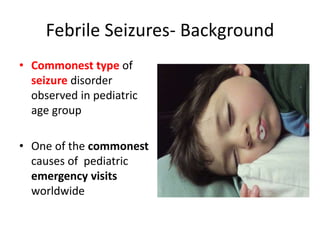
Febrile Seizures- Background
• Commonest type of
seizure disorder
observed in pediatric
age group
• One of the commonest
causes of pediatric
emergency visits
worldwide
IS THIS SEIZURE IS SIMPLE FEBRILE
SEIZURE OR DUE TO ANY OTHER
SERIOUS CAUSE?
Febrile Seizures- Background
• Generally have a good
prognosis
• Sometimes may also indicate
acute CNS –Infection
• Admission ----to ---- discharge
• So many questions by anxious
paretns
• Detailed knowledge of febrile
seizures is essential for all
pediatricians
Febrile Seizures- Background
some Historical aspects
• First described by Greeks
• Thought be some form of
epilepsy before 1980
• 1980 – consensus
conference held by NIH –
(National institute of
health)---defined FEBRILE
SEIZURES which is
currently accepted
Febrile Seizures- Background
some Historical aspects
• Some definitions given
by NIH – not accepted
• Rectal temp 38 degree
Celsius
• Did not specify the
neurological status of
child
Febrile Seizures- Present Definition
• Seizure accompanied by fever
• 6 months to 5 yrs of age
• Peak age 18 months
• In the absence of acute
intracranial infection or
defined cause of a metabolic
disturbance or previous
afebrile seizure
• Only neurologically normal
children included in defn of
febrile seizure
• Febrile seizures are not
epilepsy
• Provoked seizures -
fever
• Epileptic children are
prone to seizures during
fever
• NO SPECIFIC LEVEL OF
DEGREE OF FEVER IS
REQUIRED TO
DIAGNOSE FEBRILE
SEIZURES
CLASSIFICATION
Simple febrile seizure
• Generalizes seizures at onset
• <15 minutes
• Single episode during single
illness
• Most common 70-80%
• Early in course of illness
• 90% viral infection- cause of fever
• Short post ictal period --- Normal
behaviour
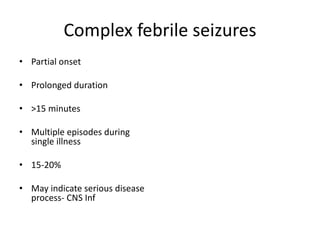
Complex febrile seizures
• Partial onset
• Prolonged duration
• >15 minutes
• Multiple episodes during
single illness
• 15-20%
• May indicate serious disease
process- CNS Inf
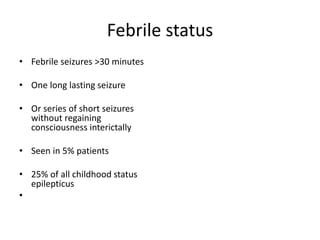
Febrile status
• Febrile seizures >30 minutes
• One long lasting seizure
• Or series of short seizures
without regaining
consciousness interictally
• Seen in 5% patients
• 25% of all childhood status
epilepticus
•
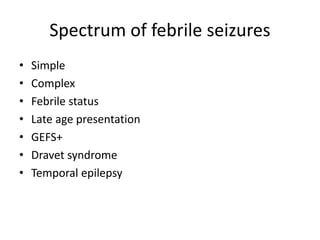
Spectrum of febrile seizures
• Simple
• Complex
• Febrile status
• Late age presentation
• GEFS+
• Dravet syndrome
• Temporal epilepsy
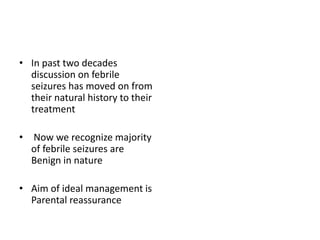
• In past two decades
discussion on febrile
seizures has moved on from
their natural history to their
treatment
• Now we recognize majority
of febrile seizures are
Benign in nature
• Aim of ideal management is
Parental reassurance
Basic knowledge required for rational
parental advice
• Epidemiology
• Causes
• Recurrence
• Prognosis
Epidemiology
• 3-5% OF CHILDREN
• Peak age of onset 14 -18 months
• Recurrence rate – 33-50%
• More recurrence rate if first
episode <12 months, seizure at
low grade and family H/O febrile
seizures
• Febrile Seizure and subsequent
cause of temporal lobe epilepsy –
cause and effect relationship
uncertain
Epidemiology
• Male > female
• Higher incidence of
epilepsy when
compared to general
population - - 2% v/s 1%
• Remission of febrile
seizures by 5 yrs of age
Pathophysiology
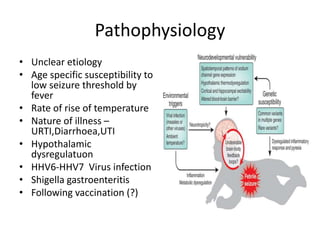
• Unclear etiology
• Age specific susceptibility to
low seizure threshold by
fever
• Rate of rise of temperature
• Nature of illness –
URTI,Diarrhoea,UTI
• Hypothalamic
dysregulatuon
• HHV6-HHV7 Virus infection
• Shigella gastroenteritis
• Following vaccination (?)
Pathophysiology
• Hyper excitability induced by fever
• Very Strong Genetic predisposition
• Family history
• Channelopathies affecting sodium channels
and GABA receptor genes
• FEB1 and FEB2 - Chromosome 8 and 19p
• Chromosome 2,19q and 5 involve GEFS Plus
• Autosomal dominant
• Variable penetrance
• polygenic
Genetics
• Play clear major role
• Family history
• Concordance rate of 56%
in monozygotic twins
• 14% in dizygotic twins
• Multifactorial mode of
inhritance
• Subset of pts – autosomal
dominant inheritance
• Gene on chromosome
8and 19 linked
Approach to child with Febrile seizures
• Once diagnosis is sure
of febrile seizure
• RULE OUT CNS INF
• FIRST EPISODE
• Delay in diagnosis of
CNS INF – Long term
neurological
disability/death
Approach to child with Febrile seizures
• Look for cause of fever
• Control seizure
• Reduction of body temp/fever
• Common causes of fever –
VIRAL URTI/LRTI/Otitis
media/acute
GE/Pneumonia/UTI/Malaria/E
nteric
• Head injury Hx
• Seizure semiolgy
• Treatment Hx – antibiotics
• Past Hx of seizures
• Developmental milestones
• Family Hx of seizures
Approach to child with Febrile seizures
• Clinical exmn
• ABC(C-A-B)
• Vitals
• Signs of CNS INF and
raised ICT
• Detailed GPE and
Systemic exmn
• Look for focal
neurological deficits
• Serial monitoring of
patients neurological
status -IMPORTANT
Investigations
• Investigate for common
causes of fever
• Do RBS, Serum
electrolytes (sodium,
calcium and
magnesium)
• LUMBAR PUNCTURE
Febrile seizures – requirement of
Lumbar puncture?
• Children <12 months of age
• Age b/w 12- 18 months
Require careful evaluation
• In young infants typical signs of
meningitis may be subtle
• Children with first episode of
complex febrile seizures
• Children with febrile seizures who
received antibiotics – LP????
EEG and Neuroimaging
• Not required routinely
• Abnormal spike wave
patterns indicate
genetic nature
• EEG should be done if
fever triggered epilepsy
or risk factors for
epilepsy are present
• Routine neuroimaging
not required
EEG and Neuroimaging
• Considered in complex
febrile seizures
• In children with
neurological disability
and developmental
delay
Treatment
• Febrile seizures are benign
• Focus is to abort seizures, control
Fever and prevent status epilepticus
• Hospital setting – child with seizures--
--- diazepam -0.3-0.5 mg/kg rectally
• Lorazepam – 0.1 mg/kg i.v
• Midazoalm – 0.1 mg/kg i.v
• Midazolam – nasal – as puff both
nostrils
• Dose - 0.2 mg/kg
• Each spray – 0.5 mg
• If seizures continues – status
epilepticus protocol
Antipyretics
• Paracetamol – 15 mg/kg/dose
• Ibufrofen 5mg/kg/dose
• Tepid sponging
• Avoid aspirin
• Antipyretics does not prevent the
recurrence of febrile seizures
• Definitely adds to giving comfort to
patient
• Rational use of Antibiotics – as
indicated
WHAT TO TELL PARENTS?
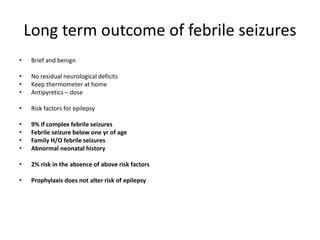
Long term outcome of febrile seizures
• Brief and benign
• No residual neurological deficits
• Keep thermometer at home
• Antipyretics – dose
• Risk factors for epilepsy
• 9% if complex febrile seizures
• Febrile seizure below one yr of age
• Family H/O febrile seizures
• Abnormal neonatal history
• 2% risk in the absence of above risk factors
• Prophylaxis does not alter risk of epilepsy
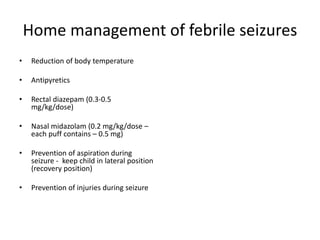
Home management of febrile seizures
• Reduction of body temperature
• Antipyretics
• Rectal diazepam (0.3-0.5
mg/kg/dose)
• Nasal midazolam (0.2 mg/kg/dose –
each puff contains – 0.5 mg)
• Prevention of aspiration during
seizure - keep child in lateral position
(recovery position)
• Prevention of injuries during seizure
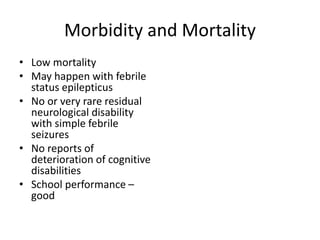
Morbidity and Mortality
• Low mortality
• May happen with febrile
status epilepticus
• No or very rare residual
neurological disability
with simple febrile
seizures
• No reports of
deterioration of cognitive
disabilities
• School performance –
good
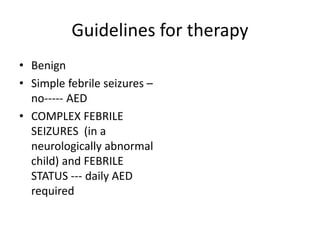
Guidelines for therapy
• Benign
• Simple febrile seizures –
no----- AED
• COMPLEX FEBRILE
SEIZURES (in a
neurologically abnormal
child) and FEBRILE
STATUS --- daily AED
required
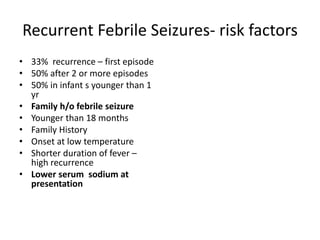
Recurrent Febrile Seizures- risk factors
• 33% recurrence – first episode
• 50% after 2 or more episodes
• 50% in infant s younger than 1
yr
• Family h/o febrile seizure
• Younger than 18 months
• Family History
• Onset at low temperature
• Shorter duration of fever –
high recurrence
• Lower serum sodium at
presentation
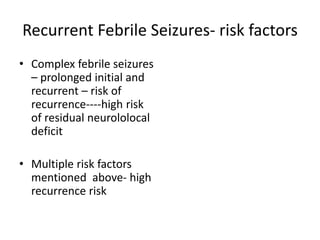
Recurrent Febrile Seizures- risk factors
• Complex febrile seizures
– prolonged initial and
recurrent – risk of
recurrence----high risk
of residual neurololocal
deficit
• Multiple risk factors
mentioned above- high
recurrence risk
Prophylaxis
• For preventing possible recurrence of febrile
seizures is controversial
• Indication for prophylaxis
• Prevent febrile seizures
• To allay parental anxiety
• Two options
• Intermittent and continuous
• Prophylaxis does not alter the risk for future
epilepsy
• Duration of prophylaxis -2 yrs seizure free
period
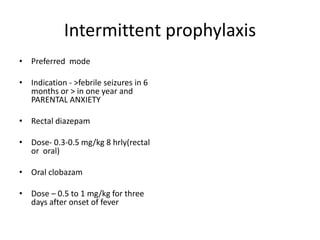
Intermittent prophylaxis
• Preferred mode
• Indication - >febrile seizures in 6
months or > in one year and
PARENTAL ANXIETY
• Rectal diazepam
• Dose- 0.3-0.5 mg/kg 8 hrly(rectal
or oral)
• Oral clobazam
• Dose – 0.5 to 1 mg/kg for three
days after onset of fever
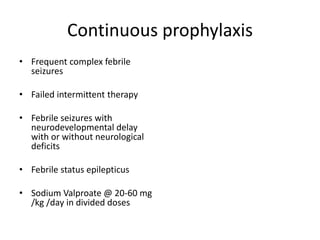
Continuous prophylaxis
• Frequent complex febrile
seizures
• Failed intermittent therapy
• Febrile seizures with
neurodevelopmental delay
with or without neurological
deficits
• Febrile status epilepticus
• Sodium Valproate @ 20-60 mg
/kg /day in divided doses
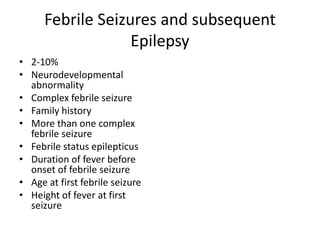
Febrile Seizures and subsequent
Epilepsy
• 2-10%
• Neurodevelopmental
abnormality
• Complex febrile seizure
• Family history
• More than one complex
febrile seizure
• Febrile status epilepticus
• Duration of fever before
onset of febrile seizure
• Age at first febrile seizure
• Height of fever at first
seizure
Febrile Seizures and subsequent
Epilepsy
• Type of epilepsy after first
febrile seizure – VARIABLE
• Usually those with
generalized seizures ----
generalized epilepsy
• Focal- focal epilepsy
• Age specific expression of
seizure susceptibility with
an underlying seizure
diathesis
Febrile Seizures and subsequent
Epilepsy
• Febrile seizure can be an
initial manifestation of
specific epilepsy
• Initial febrile seizure ---
• Simple one? Or
future epilepsy?
• Numerous studies ----
answer this question
• SIMPLE and COMPLEX
febrile seizures
Two epilepsy syndromes typically
start with febrile seizures
• Generalized Epilepsy
with Febrile Seizure Plus
(GEFS+)
• Dravet Syndrome
(Severe Myoclonic
epilepsy of Infancy)
GEFS+
• Autosomal dominant
• Onset – early childhood
• Remision – mid-
childhood
• Initially multiple febrile
seizures ----subsequently
afebrile seizures
• GTCS
• Absence
• Myoclonic
• Focal variant also
described
Dravet syndrome
• Severe phenotypic
spectrum of febrile seizures
• Onset – infancy
• Initially febrile seizures ----
afebrile seizures---unilateral
clonic seizures recurring
every month
• Prolonged,frequent,focal
• Myoclonic and atypical
absence seizure variety
• Autosomal dominant
• SCN1A mutation
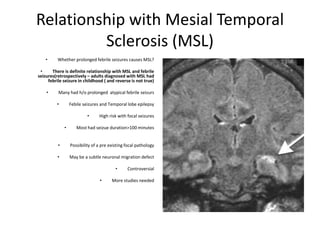
Relationship with Mesial Temporal
Sclerosis (MSL)
• Whether prolonged febrile seizures causes MSL?
• There is definite relationship with MSL and febrile
seizures(retrospectively – adults diagnosed with MSL had
febrile seizure in childhood ( and reverse is not true)
• Many had h/o prolonged atypical febrile seizurs
• Febile seizures and Temporal lobe epilepsy
• High risk with focal seizures
• Most had seizue duration>100 minutes
• Possibility of a pre existing focal pathology
• May be a subtle neuronal migration defect
• Controversial
• More studies needed
Take Home Message
• Febrile seizure s are common in children
• Vast majority are benign
• Detailed history and exmn is diagnostic
• Mainstay of treatment is antipyretics and
management of cause of fever
• Always rule out CNS Infection
• Parental counseling is very important
• Risk of recurrence and risk of developing epilepsy
should be clearly explained to parents
•THANK YOU

FEBRILE SEIZURES.pptx

  • 1.
    FEBRILE SEIZURES -REVISITED Presentedby – Dr Gururaja R MD,DNB(Paed)
  • 2.
    Introduction • Most commonseizure in children below 5 yrs • Diagnosis may pose dilemma • Benign? • Epilepsy? • CNS infection? • Spectrum – from Benign to Dravet syndrome and GEFS+ • Detailed knowledge of febrile seizures essential to all pediatricians • Majority of febrile seizures are benign with excellent prognosis
  • 3.
    Febrile Seizures- Background •Commonest type of seizure disorder observed in pediatric age group • One of the commonest causes of pediatric emergency visits worldwide
  • 4.
    IS THIS SEIZUREIS SIMPLE FEBRILE SEIZURE OR DUE TO ANY OTHER SERIOUS CAUSE?
  • 5.
    Febrile Seizures- Background •Generally have a good prognosis • Sometimes may also indicate acute CNS –Infection • Admission ----to ---- discharge • So many questions by anxious paretns • Detailed knowledge of febrile seizures is essential for all pediatricians
  • 6.
    Febrile Seizures- Background someHistorical aspects • First described by Greeks • Thought be some form of epilepsy before 1980 • 1980 – consensus conference held by NIH – (National institute of health)---defined FEBRILE SEIZURES which is currently accepted
  • 7.
    Febrile Seizures- Background someHistorical aspects • Some definitions given by NIH – not accepted • Rectal temp 38 degree Celsius • Did not specify the neurological status of child
  • 8.
    Febrile Seizures- PresentDefinition • Seizure accompanied by fever • 6 months to 5 yrs of age • Peak age 18 months • In the absence of acute intracranial infection or defined cause of a metabolic disturbance or previous afebrile seizure • Only neurologically normal children included in defn of febrile seizure
  • 9.
    • Febrile seizuresare not epilepsy • Provoked seizures - fever • Epileptic children are prone to seizures during fever
  • 10.
    • NO SPECIFICLEVEL OF DEGREE OF FEVER IS REQUIRED TO DIAGNOSE FEBRILE SEIZURES
  • 11.
  • 12.
    Simple febrile seizure •Generalizes seizures at onset • <15 minutes • Single episode during single illness • Most common 70-80% • Early in course of illness • 90% viral infection- cause of fever • Short post ictal period --- Normal behaviour
  • 13.
    Complex febrile seizures •Partial onset • Prolonged duration • >15 minutes • Multiple episodes during single illness • 15-20% • May indicate serious disease process- CNS Inf
  • 14.
    Febrile status • Febrileseizures >30 minutes • One long lasting seizure • Or series of short seizures without regaining consciousness interictally • Seen in 5% patients • 25% of all childhood status epilepticus •
  • 15.
    Spectrum of febrileseizures • Simple • Complex • Febrile status • Late age presentation • GEFS+ • Dravet syndrome • Temporal epilepsy
  • 16.
    • In pasttwo decades discussion on febrile seizures has moved on from their natural history to their treatment • Now we recognize majority of febrile seizures are Benign in nature • Aim of ideal management is Parental reassurance
  • 17.
    Basic knowledge requiredfor rational parental advice • Epidemiology • Causes • Recurrence • Prognosis
  • 18.
    Epidemiology • 3-5% OFCHILDREN • Peak age of onset 14 -18 months • Recurrence rate – 33-50% • More recurrence rate if first episode <12 months, seizure at low grade and family H/O febrile seizures • Febrile Seizure and subsequent cause of temporal lobe epilepsy – cause and effect relationship uncertain
  • 19.
    Epidemiology • Male >female • Higher incidence of epilepsy when compared to general population - - 2% v/s 1% • Remission of febrile seizures by 5 yrs of age
  • 20.
    Pathophysiology • Unclear etiology •Age specific susceptibility to low seizure threshold by fever • Rate of rise of temperature • Nature of illness – URTI,Diarrhoea,UTI • Hypothalamic dysregulatuon • HHV6-HHV7 Virus infection • Shigella gastroenteritis • Following vaccination (?)
  • 21.
    Pathophysiology • Hyper excitabilityinduced by fever • Very Strong Genetic predisposition • Family history • Channelopathies affecting sodium channels and GABA receptor genes • FEB1 and FEB2 - Chromosome 8 and 19p • Chromosome 2,19q and 5 involve GEFS Plus • Autosomal dominant • Variable penetrance • polygenic
  • 22.
    Genetics • Play clearmajor role • Family history • Concordance rate of 56% in monozygotic twins • 14% in dizygotic twins • Multifactorial mode of inhritance • Subset of pts – autosomal dominant inheritance • Gene on chromosome 8and 19 linked
  • 23.
    Approach to childwith Febrile seizures • Once diagnosis is sure of febrile seizure • RULE OUT CNS INF • FIRST EPISODE • Delay in diagnosis of CNS INF – Long term neurological disability/death
  • 24.
    Approach to childwith Febrile seizures • Look for cause of fever • Control seizure • Reduction of body temp/fever • Common causes of fever – VIRAL URTI/LRTI/Otitis media/acute GE/Pneumonia/UTI/Malaria/E nteric • Head injury Hx • Seizure semiolgy • Treatment Hx – antibiotics • Past Hx of seizures • Developmental milestones • Family Hx of seizures
  • 25.
    Approach to childwith Febrile seizures • Clinical exmn • ABC(C-A-B) • Vitals • Signs of CNS INF and raised ICT • Detailed GPE and Systemic exmn • Look for focal neurological deficits • Serial monitoring of patients neurological status -IMPORTANT
  • 26.
    Investigations • Investigate forcommon causes of fever • Do RBS, Serum electrolytes (sodium, calcium and magnesium) • LUMBAR PUNCTURE
  • 27.
    Febrile seizures –requirement of Lumbar puncture? • Children <12 months of age • Age b/w 12- 18 months Require careful evaluation • In young infants typical signs of meningitis may be subtle • Children with first episode of complex febrile seizures • Children with febrile seizures who received antibiotics – LP????
  • 28.
    EEG and Neuroimaging •Not required routinely • Abnormal spike wave patterns indicate genetic nature • EEG should be done if fever triggered epilepsy or risk factors for epilepsy are present • Routine neuroimaging not required
  • 29.
    EEG and Neuroimaging •Considered in complex febrile seizures • In children with neurological disability and developmental delay
  • 30.
    Treatment • Febrile seizuresare benign • Focus is to abort seizures, control Fever and prevent status epilepticus • Hospital setting – child with seizures-- --- diazepam -0.3-0.5 mg/kg rectally • Lorazepam – 0.1 mg/kg i.v • Midazoalm – 0.1 mg/kg i.v • Midazolam – nasal – as puff both nostrils • Dose - 0.2 mg/kg • Each spray – 0.5 mg • If seizures continues – status epilepticus protocol
  • 31.
    Antipyretics • Paracetamol –15 mg/kg/dose • Ibufrofen 5mg/kg/dose • Tepid sponging • Avoid aspirin • Antipyretics does not prevent the recurrence of febrile seizures • Definitely adds to giving comfort to patient • Rational use of Antibiotics – as indicated
  • 32.
    WHAT TO TELLPARENTS?
  • 33.
    Long term outcomeof febrile seizures • Brief and benign • No residual neurological deficits • Keep thermometer at home • Antipyretics – dose • Risk factors for epilepsy • 9% if complex febrile seizures • Febrile seizure below one yr of age • Family H/O febrile seizures • Abnormal neonatal history • 2% risk in the absence of above risk factors • Prophylaxis does not alter risk of epilepsy
  • 34.
    Home management offebrile seizures • Reduction of body temperature • Antipyretics • Rectal diazepam (0.3-0.5 mg/kg/dose) • Nasal midazolam (0.2 mg/kg/dose – each puff contains – 0.5 mg) • Prevention of aspiration during seizure - keep child in lateral position (recovery position) • Prevention of injuries during seizure
  • 35.
    Morbidity and Mortality •Low mortality • May happen with febrile status epilepticus • No or very rare residual neurological disability with simple febrile seizures • No reports of deterioration of cognitive disabilities • School performance – good
  • 36.
    Guidelines for therapy •Benign • Simple febrile seizures – no----- AED • COMPLEX FEBRILE SEIZURES (in a neurologically abnormal child) and FEBRILE STATUS --- daily AED required
  • 37.
    Recurrent Febrile Seizures-risk factors • 33% recurrence – first episode • 50% after 2 or more episodes • 50% in infant s younger than 1 yr • Family h/o febrile seizure • Younger than 18 months • Family History • Onset at low temperature • Shorter duration of fever – high recurrence • Lower serum sodium at presentation
  • 38.
    Recurrent Febrile Seizures-risk factors • Complex febrile seizures – prolonged initial and recurrent – risk of recurrence----high risk of residual neurololocal deficit • Multiple risk factors mentioned above- high recurrence risk
  • 39.
    Prophylaxis • For preventingpossible recurrence of febrile seizures is controversial • Indication for prophylaxis • Prevent febrile seizures • To allay parental anxiety • Two options • Intermittent and continuous • Prophylaxis does not alter the risk for future epilepsy • Duration of prophylaxis -2 yrs seizure free period
  • 40.
    Intermittent prophylaxis • Preferredmode • Indication - >febrile seizures in 6 months or > in one year and PARENTAL ANXIETY • Rectal diazepam • Dose- 0.3-0.5 mg/kg 8 hrly(rectal or oral) • Oral clobazam • Dose – 0.5 to 1 mg/kg for three days after onset of fever
  • 41.
    Continuous prophylaxis • Frequentcomplex febrile seizures • Failed intermittent therapy • Febrile seizures with neurodevelopmental delay with or without neurological deficits • Febrile status epilepticus • Sodium Valproate @ 20-60 mg /kg /day in divided doses
  • 42.
    Febrile Seizures andsubsequent Epilepsy • 2-10% • Neurodevelopmental abnormality • Complex febrile seizure • Family history • More than one complex febrile seizure • Febrile status epilepticus • Duration of fever before onset of febrile seizure • Age at first febrile seizure • Height of fever at first seizure
  • 43.
    Febrile Seizures andsubsequent Epilepsy • Type of epilepsy after first febrile seizure – VARIABLE • Usually those with generalized seizures ---- generalized epilepsy • Focal- focal epilepsy • Age specific expression of seizure susceptibility with an underlying seizure diathesis
  • 44.
    Febrile Seizures andsubsequent Epilepsy • Febrile seizure can be an initial manifestation of specific epilepsy • Initial febrile seizure --- • Simple one? Or future epilepsy? • Numerous studies ---- answer this question • SIMPLE and COMPLEX febrile seizures
  • 45.
    Two epilepsy syndromestypically start with febrile seizures • Generalized Epilepsy with Febrile Seizure Plus (GEFS+) • Dravet Syndrome (Severe Myoclonic epilepsy of Infancy)
  • 46.
    GEFS+ • Autosomal dominant •Onset – early childhood • Remision – mid- childhood • Initially multiple febrile seizures ----subsequently afebrile seizures • GTCS • Absence • Myoclonic • Focal variant also described
  • 47.
    Dravet syndrome • Severephenotypic spectrum of febrile seizures • Onset – infancy • Initially febrile seizures ---- afebrile seizures---unilateral clonic seizures recurring every month • Prolonged,frequent,focal • Myoclonic and atypical absence seizure variety • Autosomal dominant • SCN1A mutation
  • 48.
    Relationship with MesialTemporal Sclerosis (MSL) • Whether prolonged febrile seizures causes MSL? • There is definite relationship with MSL and febrile seizures(retrospectively – adults diagnosed with MSL had febrile seizure in childhood ( and reverse is not true) • Many had h/o prolonged atypical febrile seizurs • Febile seizures and Temporal lobe epilepsy • High risk with focal seizures • Most had seizue duration>100 minutes • Possibility of a pre existing focal pathology • May be a subtle neuronal migration defect • Controversial • More studies needed
  • 49.
    Take Home Message •Febrile seizure s are common in children • Vast majority are benign • Detailed history and exmn is diagnostic • Mainstay of treatment is antipyretics and management of cause of fever • Always rule out CNS Infection • Parental counseling is very important • Risk of recurrence and risk of developing epilepsy should be clearly explained to parents
  • 50.