
MRS.JEBAKUMARI SUTHA.A
ASSOCIATE PROFESSOR
HOD,PAEDIATRIC DEPARTMENT
GANGA COLLEGE OF NURSING
COIMBATORE-22
ASSESSMENTOF
NEWBORN
REFLEXES
INTRODUCTION
• A newborn should have a thorough evaluation
performed within 24 hours of birth to identify any
abnormality
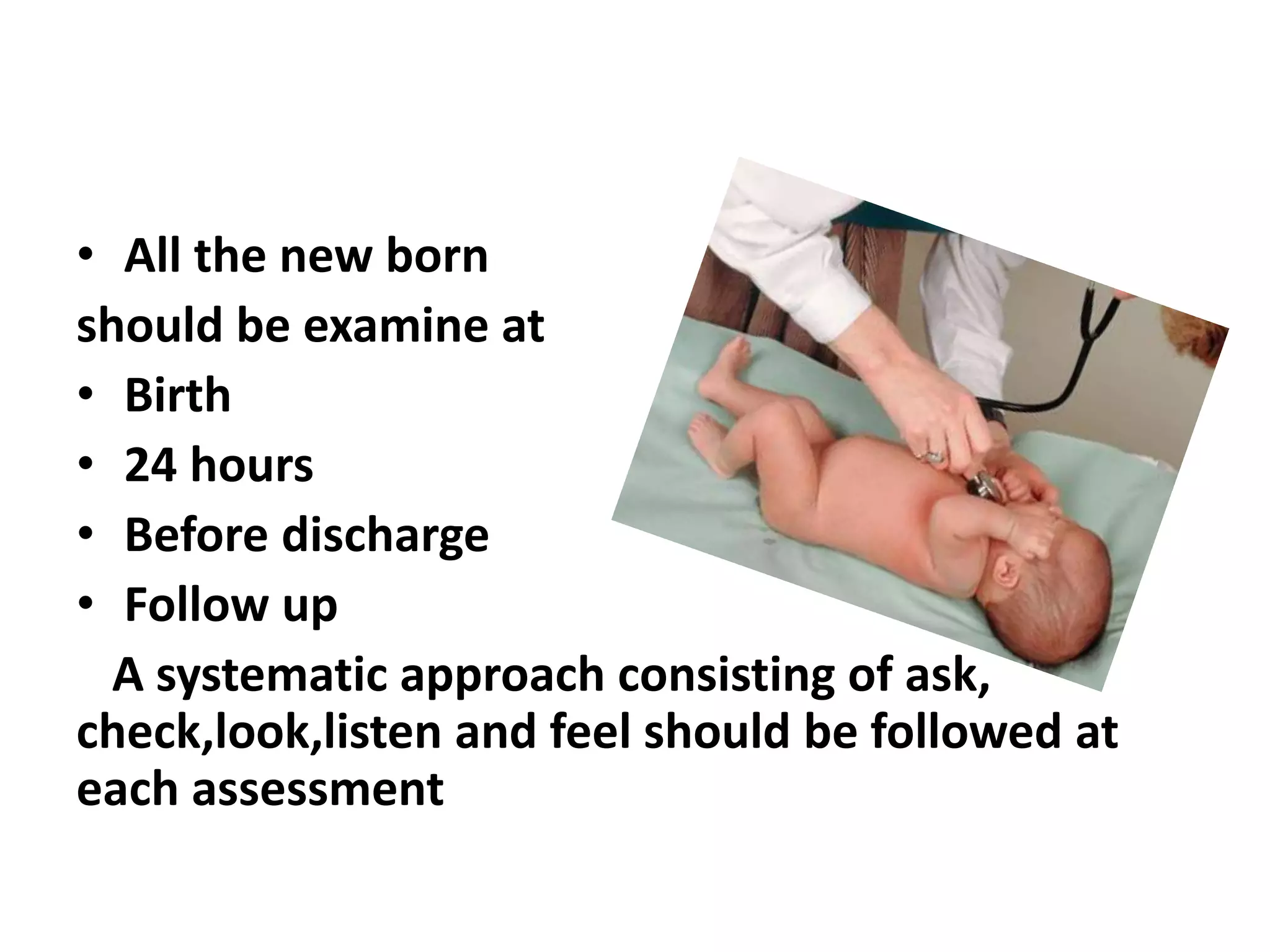
• All the new born
should be examine at
• Birth
• 24 hours
• Before discharge
• Follow up
A systematic approach consisting of ask,
check,look,listen and feel should be followed at
each assessment
NEWBORN PERIOD
• Newborn usually
refers to a baby from
birth to 28 days period
• Infants can be
considered children
anywhere from one
month to 1 year old.
ASSESSMENT
• Examination of
the child during
new-born
period
TYPES OF ASSESSMENT
1. Initial Assessment
2. Transitional Assessment
3. Behavioural assessment
4. Assessment of
gestational age
5. Systemic physical
examination
INITIAL ASSESSMENT
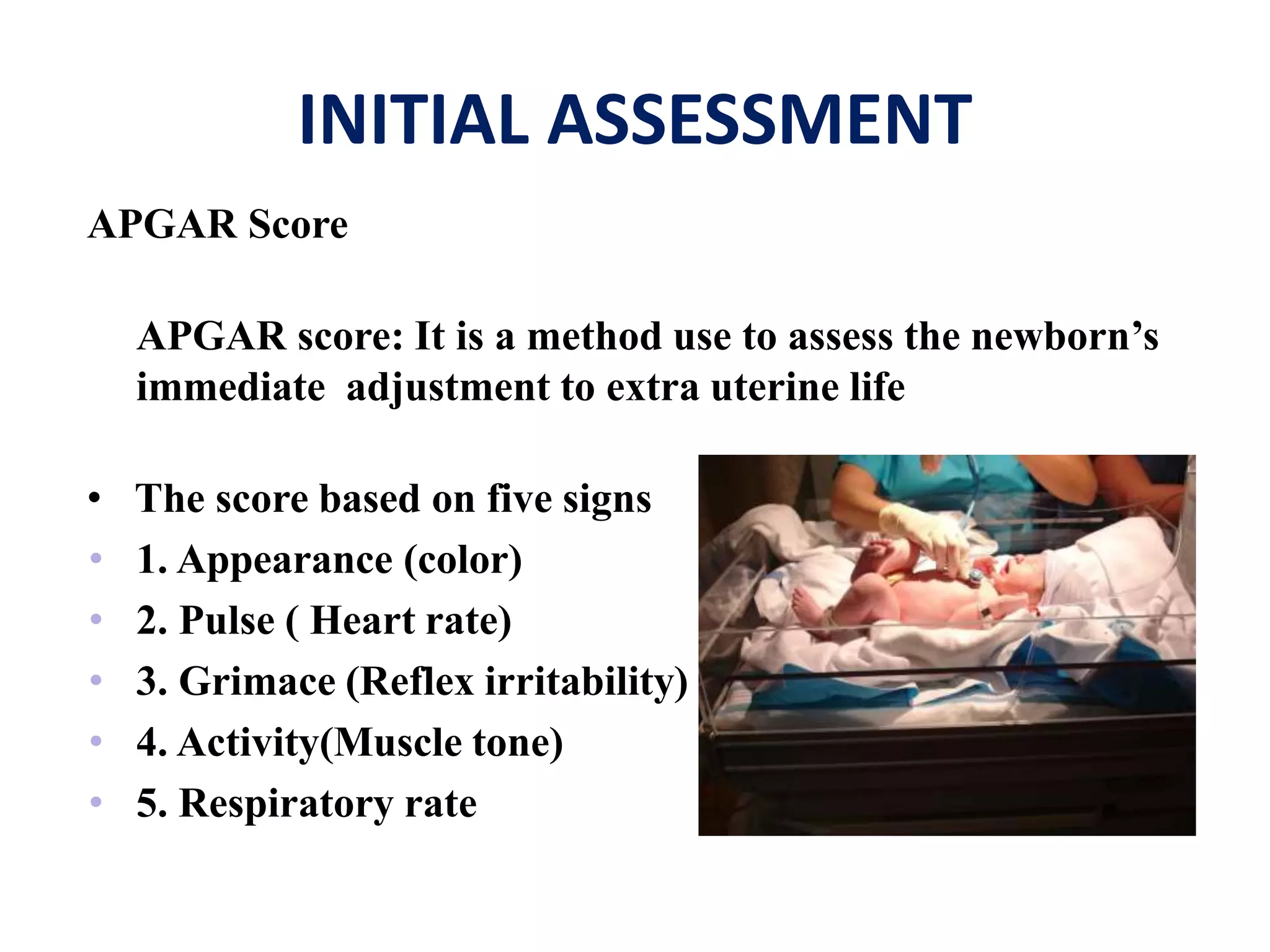
APGAR Score
APGAR score: It is a method use to assess the newborn’s
immediate adjustment to extra uterine life
• The score based on five signs
• 1. Appearance (color)
• 2. Pulse ( Heart rate)
• 3. Grimace (Reflex irritability)
• 4. Activity(Muscle tone)
• 5. Respiratory rate
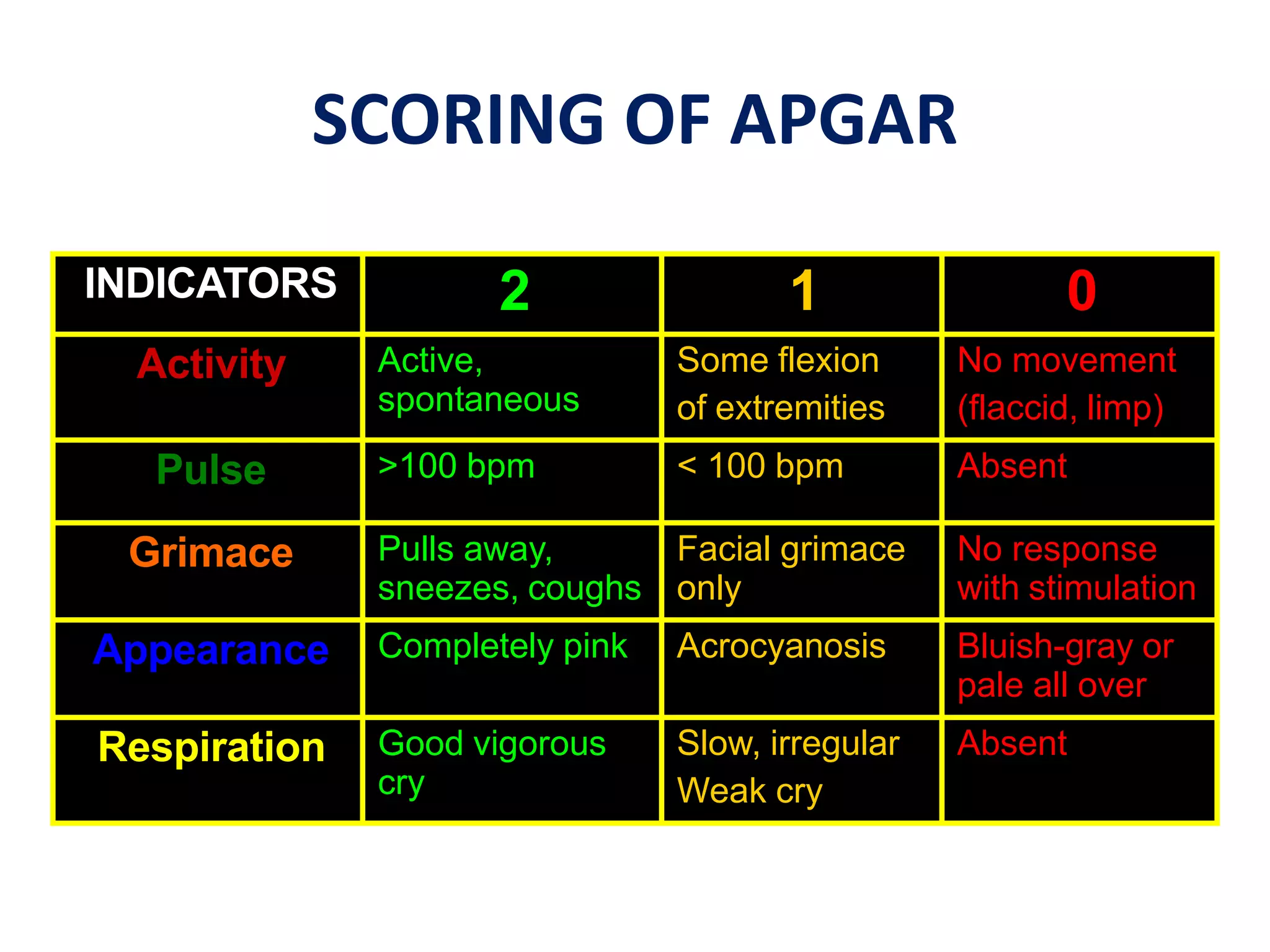
SCORING OF APGAR
INDICATORS 2 1 0
Activity Active,
spontaneous
Some flexion
of extremities
No movement
(flaccid, limp)
Pulse >100 bpm < 100 bpm Absent
Grimace Pulls away,
sneezes, coughs
Facial grimace
only
No response
with stimulation
Appearance Completely pink Acrocyanosis Bluish-gray or
pale all over
Respiration Good vigorous
cry
Slow, irregular
Weak cry
Absent
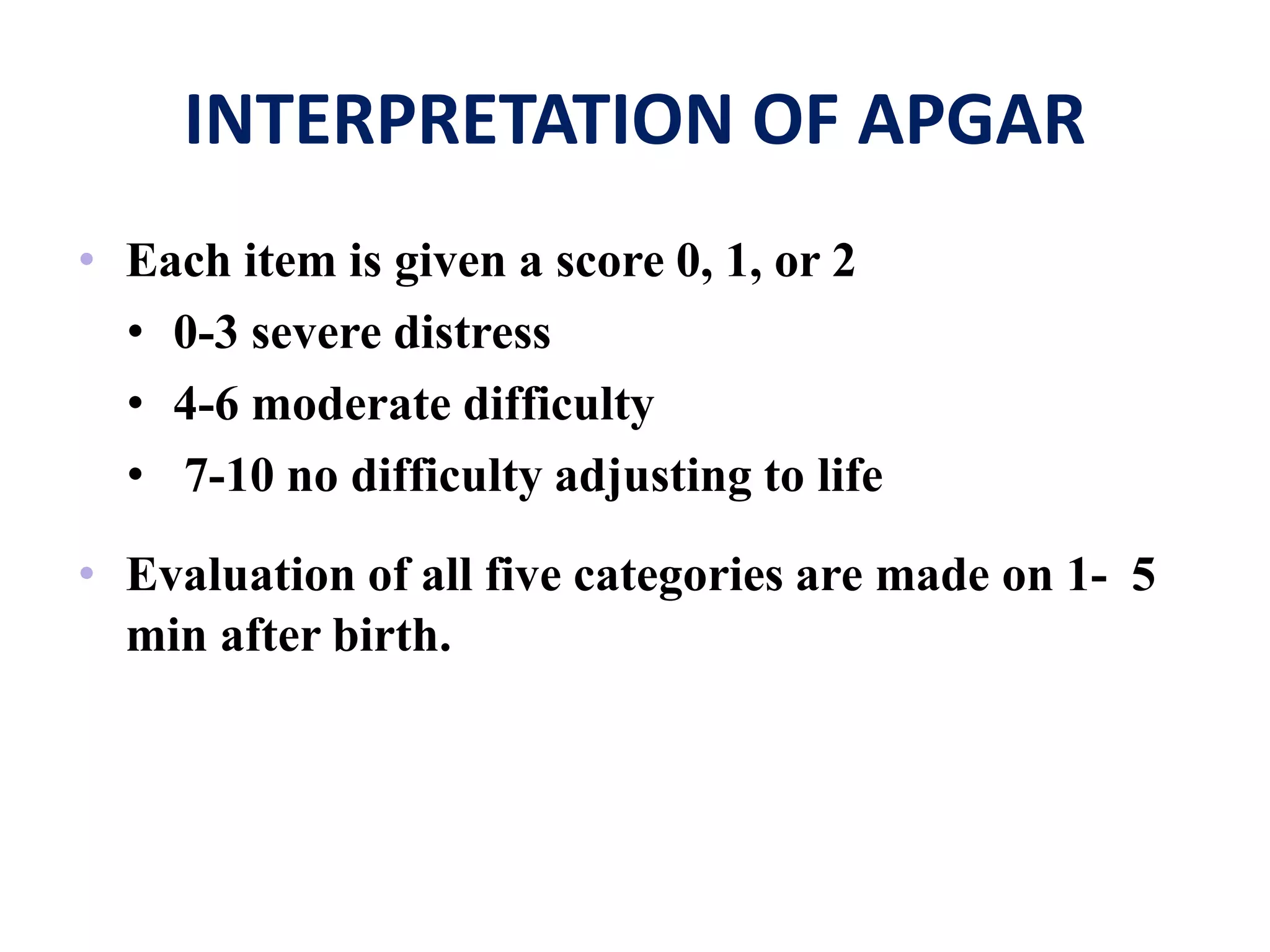
INTERPRETATION OF APGAR
• Each item is given a score 0, 1, or 2
• 0-3 severe distress
• 4-6 moderate difficulty
• 7-10 no difficulty adjusting to life
• Evaluation of all five categories are made on 1- 5
min after birth.
OTHER INITIAL ASSESSMENTS ARE…..
• Stabilization
• Measuring weight.
TRANSITIONAL ASSESSMENT
• Transitional Assessment during the period of
reactivity: First period of reactivity (6- 8 hours
after birth)
BEHAVIOURAL ASSESSMENT
• While babies may not speak their first word for a
year, they are born ready to communicate with a
rich vocabulary of body movements, cries and
visual responses: all part of the complex language
of infant behavior.
ASSESSMENT OF GESTATIONAL AGE
An accurate assessment of age is important for 2
reasons
• Identifying neonatal risks
• Developing management plans
ASSESSMENT OF GESTATIONAL AGE
• Gestational age can measure by weight for
gestational age chart.
19
PHYSICAL MATURITY- BALLARD SCORE
17
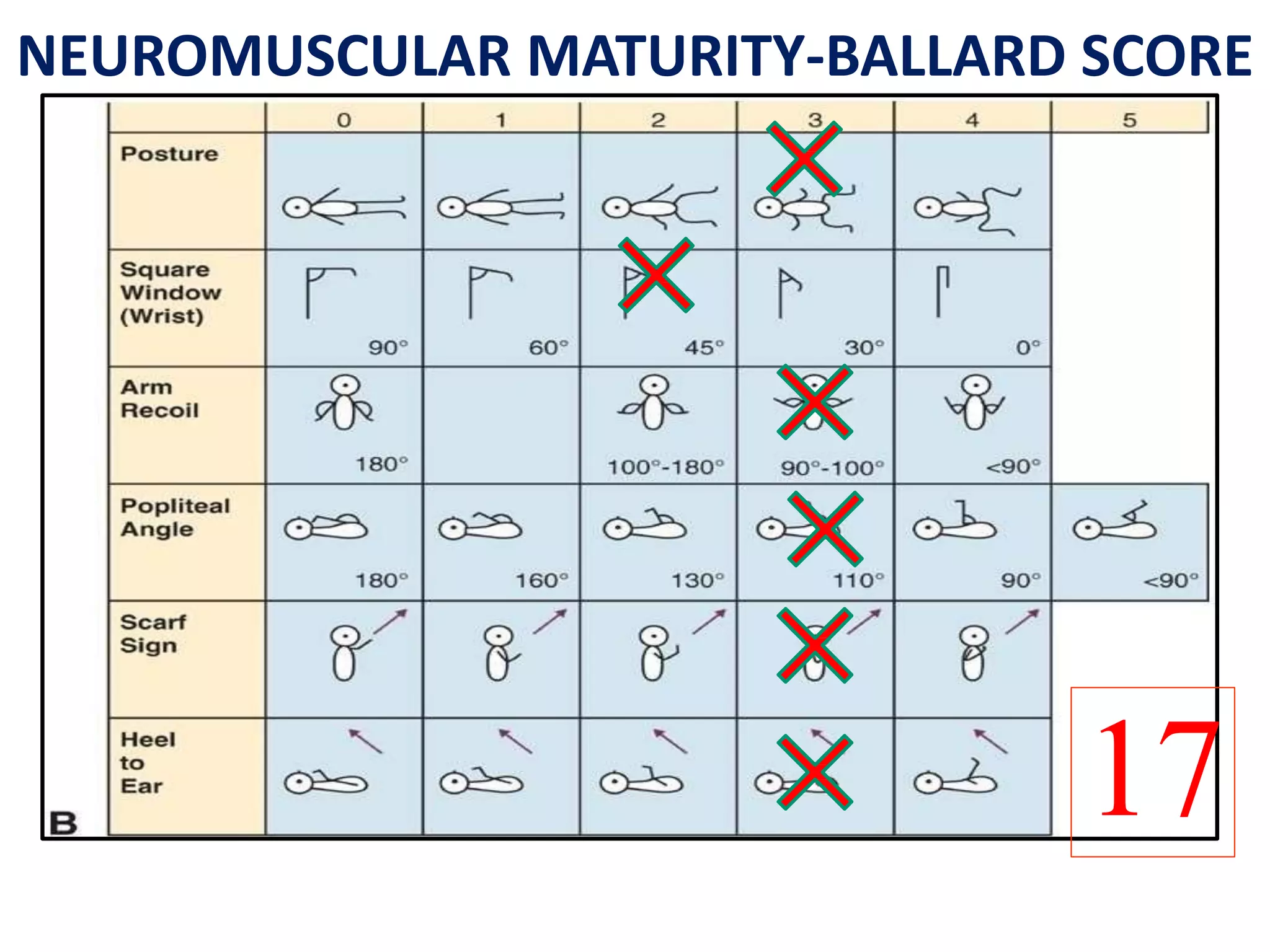
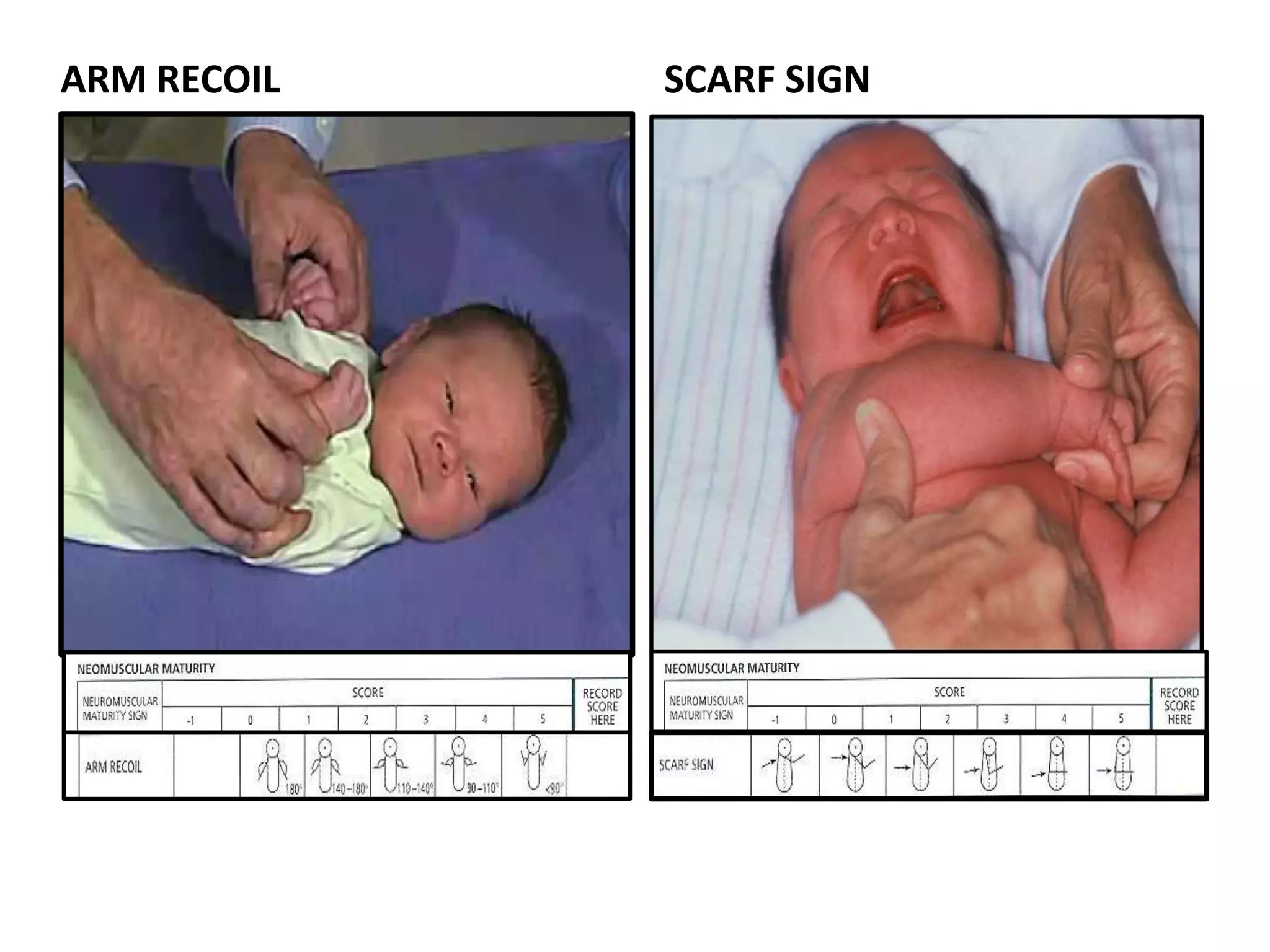
NEUROMUSCULAR MATURITY-BALLARD SCORE
NEUROMUSCULAR MATURITY
POSTURE SQUARE WINDOW
ARM RECOIL SCARF SIGN
POPLITEAL ANGLE HEAL TO EAR
Scoring
19+17=36
36 39
SYSTEMIC, PHYSICAL EXAMINATION
REFLEXES
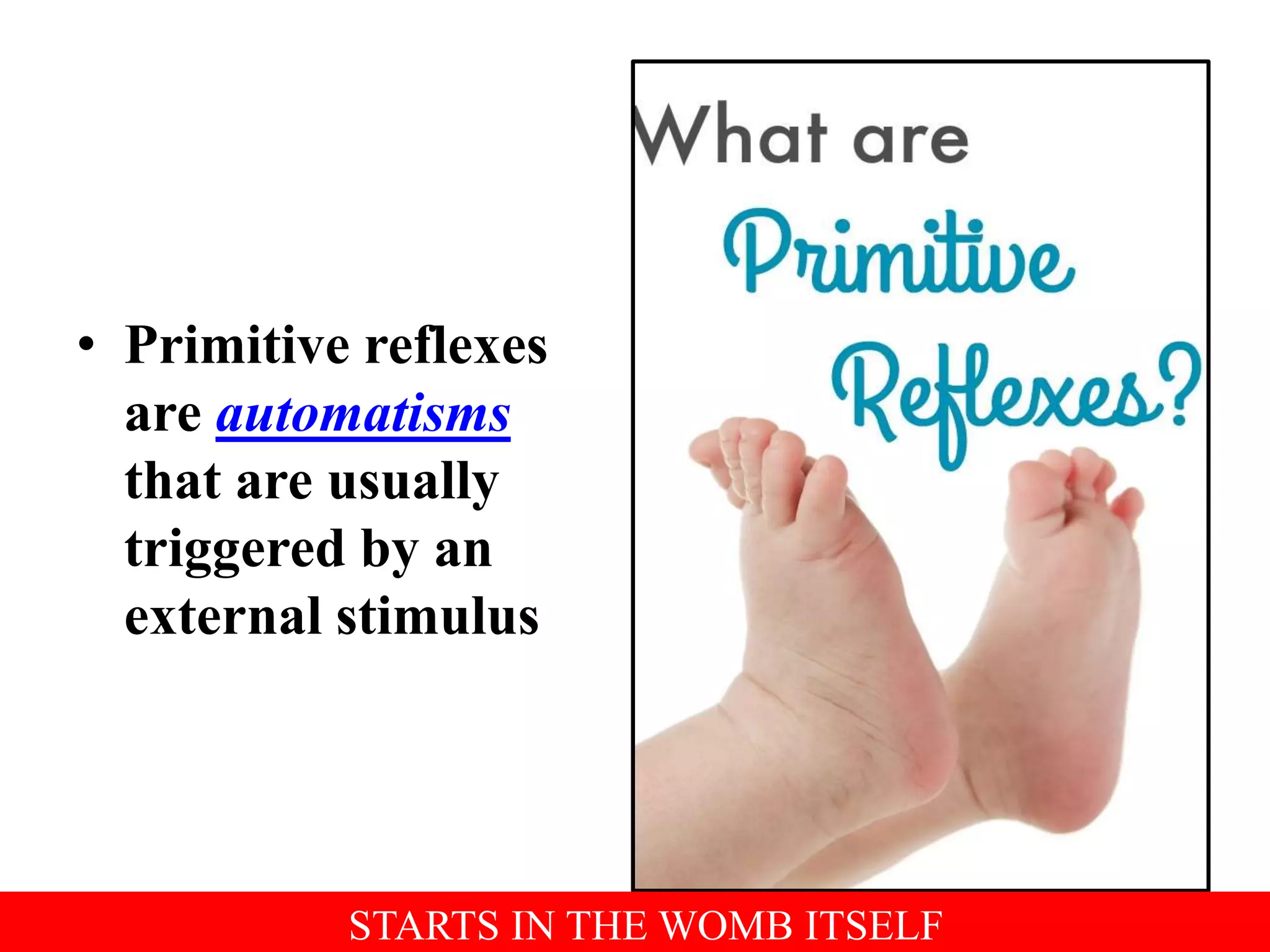
• Primitive reflexes
are automatisms
that are usually
triggered by an
external stimulus
STARTS IN THE WOMB ITSELF
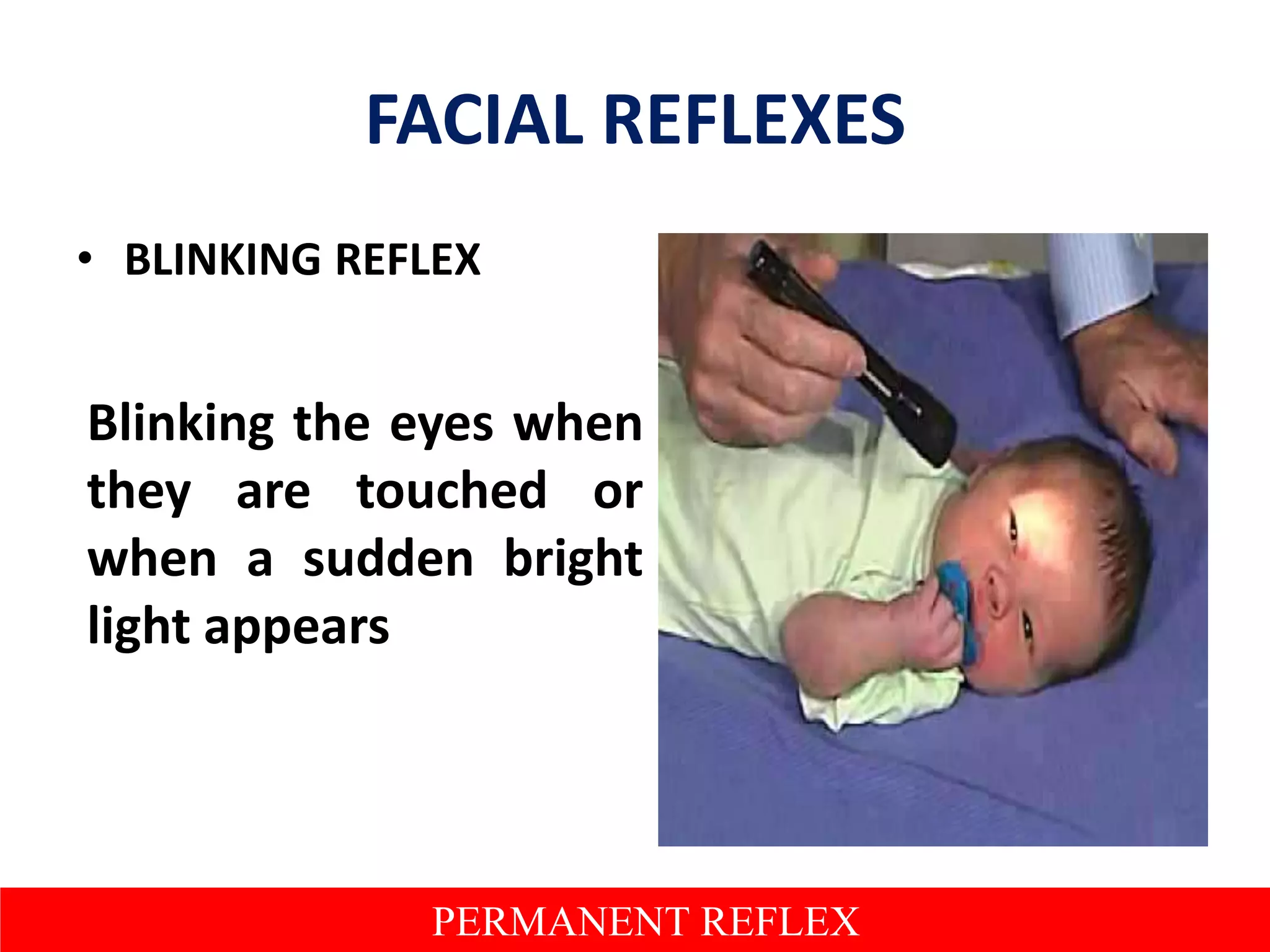
FACIAL REFLEXES
• BLINKING REFLEX
Blinking the eyes when
they are touched or
when a sudden bright
light appears
PERMANENT REFLEX
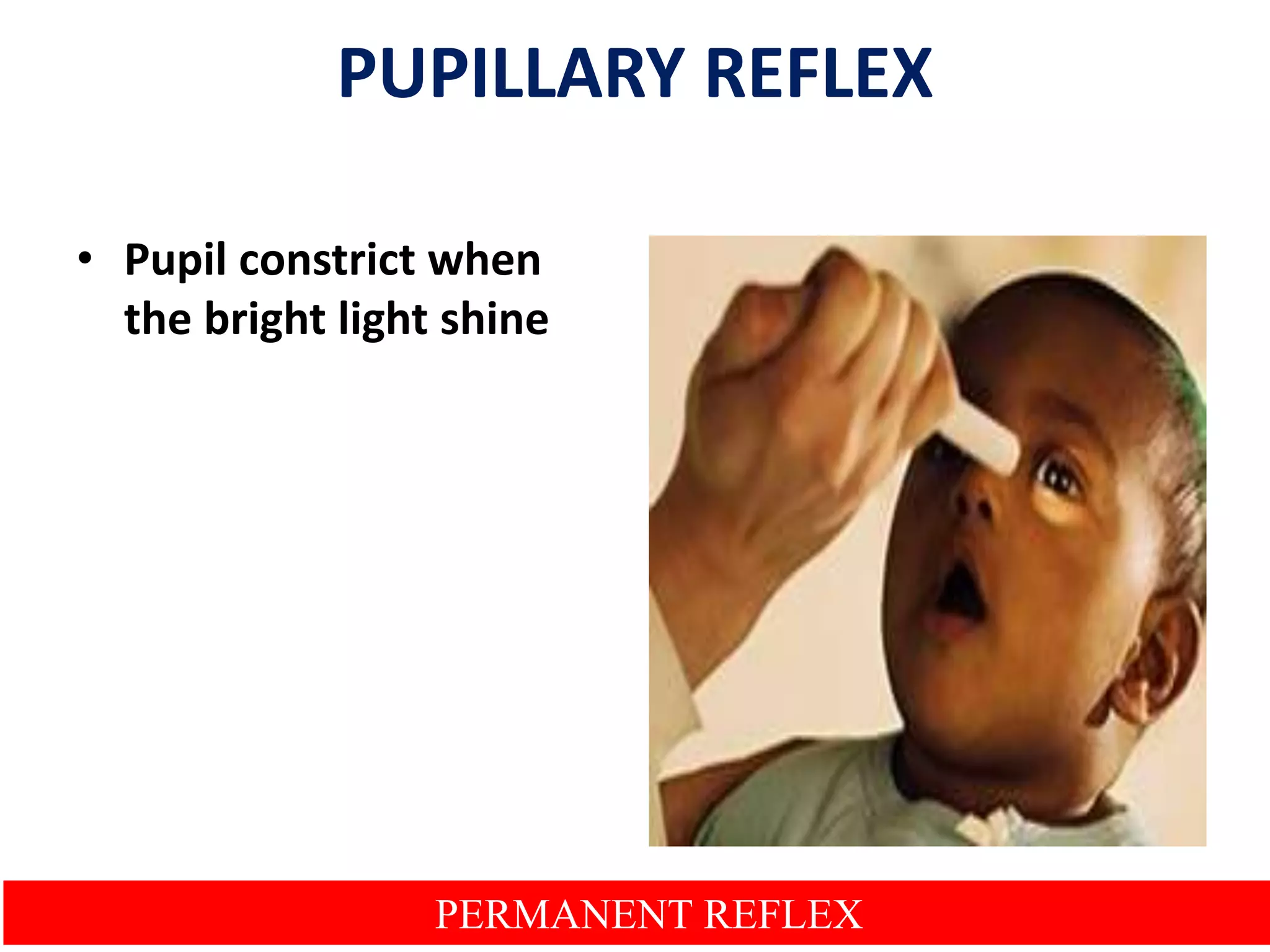
PUPILLARY REFLEX
• Pupil constrict when
the bright light shine
PERMANENT REFLEX
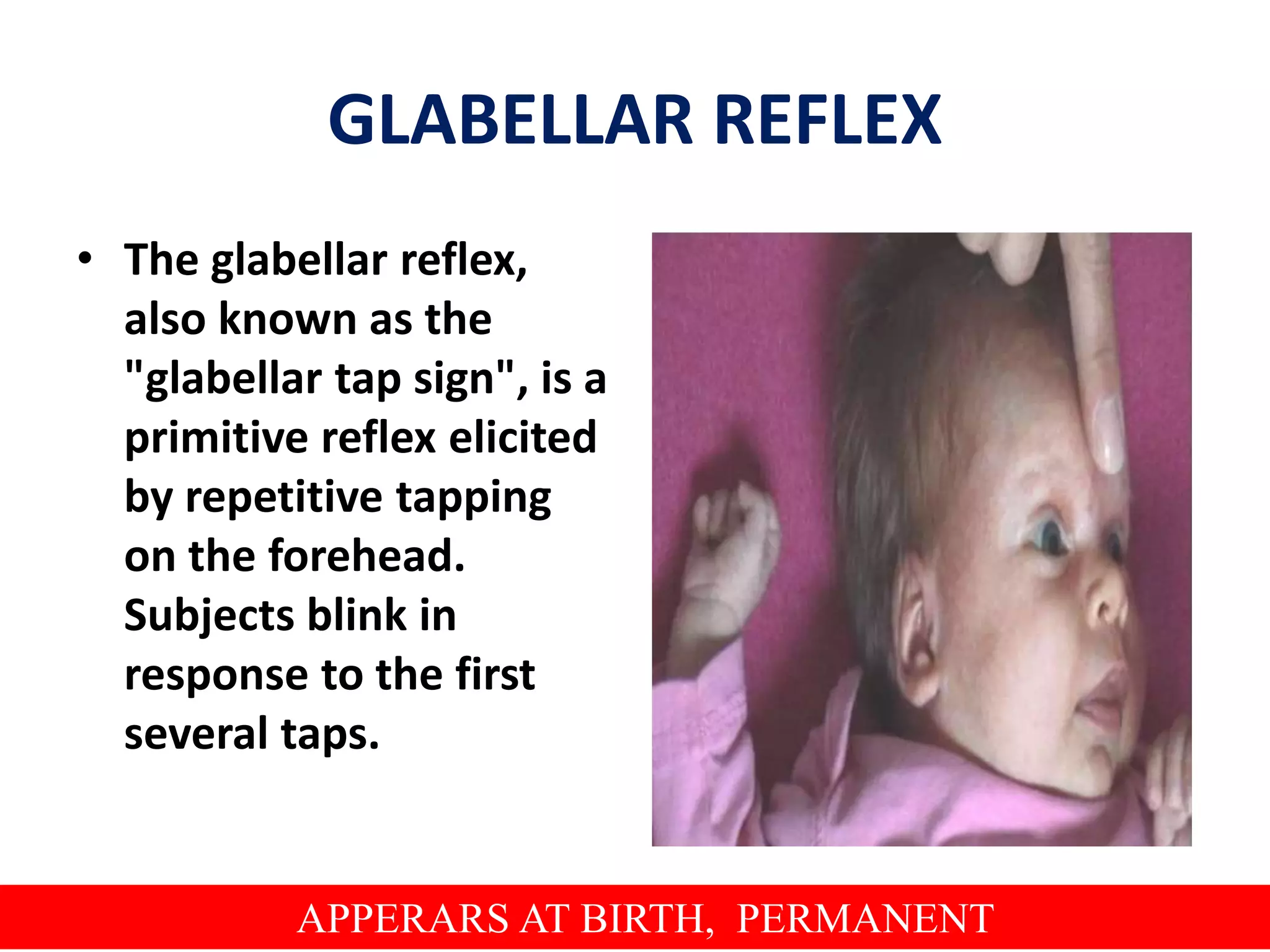
GLABELLAR REFLEX
• The glabellar reflex,
also known as the
"glabellar tap sign", is a
primitive reflex elicited
by repetitive tapping
on the forehead.
Subjects blink in
response to the first
several taps.
APPERARS AT BIRTH, PERMANENT
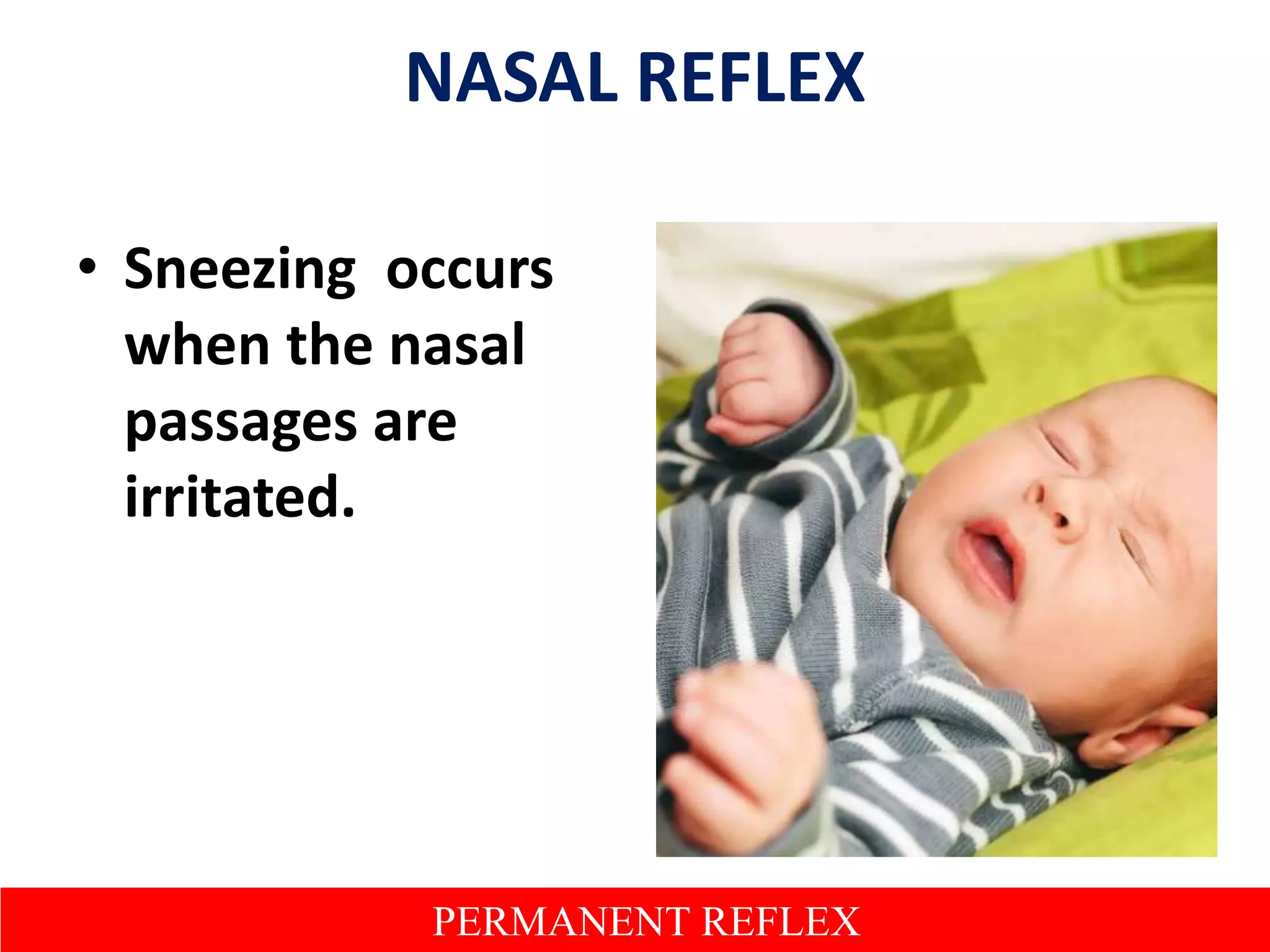
NASAL REFLEX
• Sneezing occurs
when the nasal
passages are
irritated.
PERMANENT REFLEX
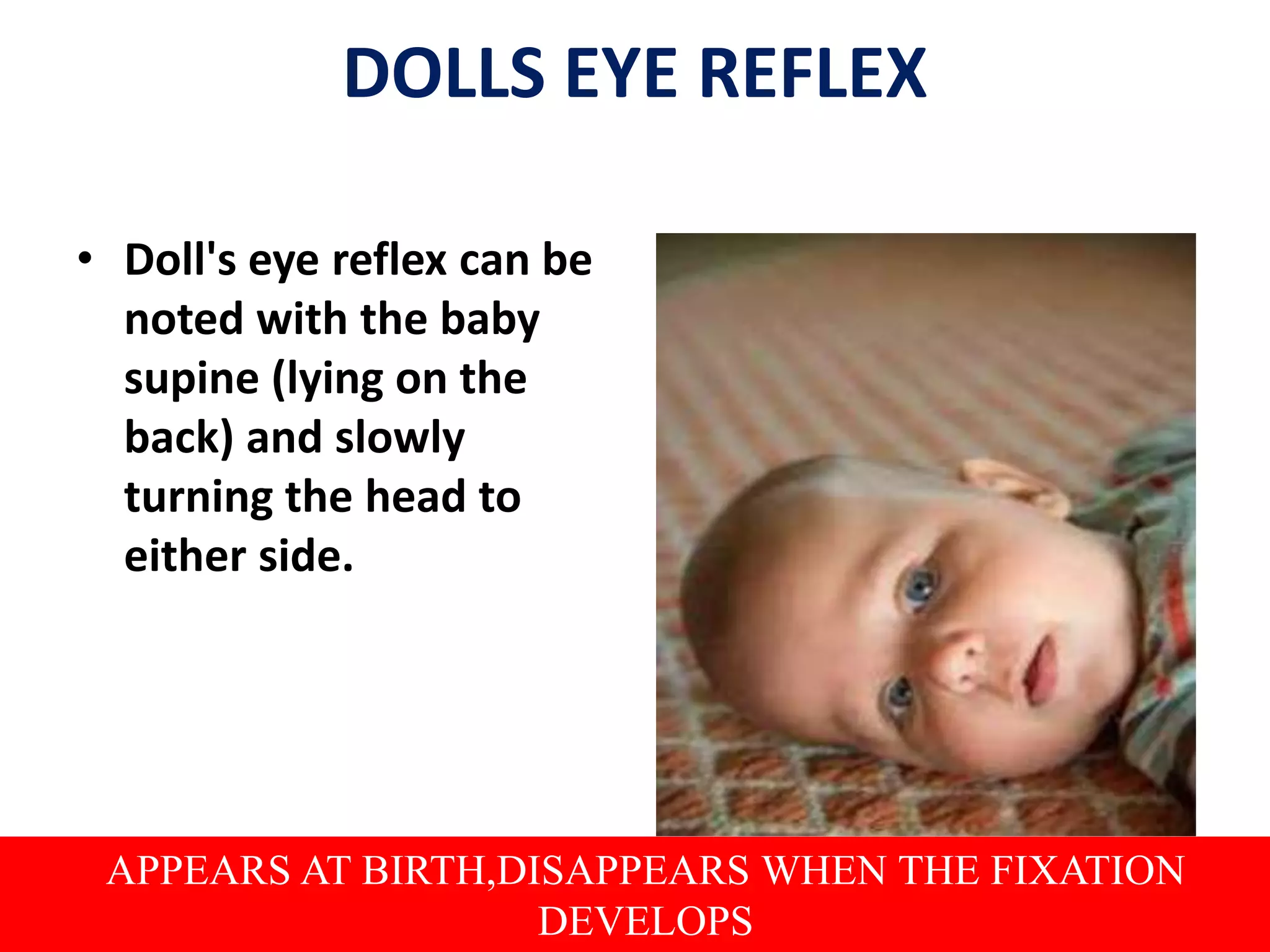
DOLLS EYE REFLEX
• Doll's eye reflex can be
noted with the baby
supine (lying on the
back) and slowly
turning the head to
either side.
APPEARS AT BIRTH,DISAPPEARS WHEN THE FIXATION
DEVELOPS
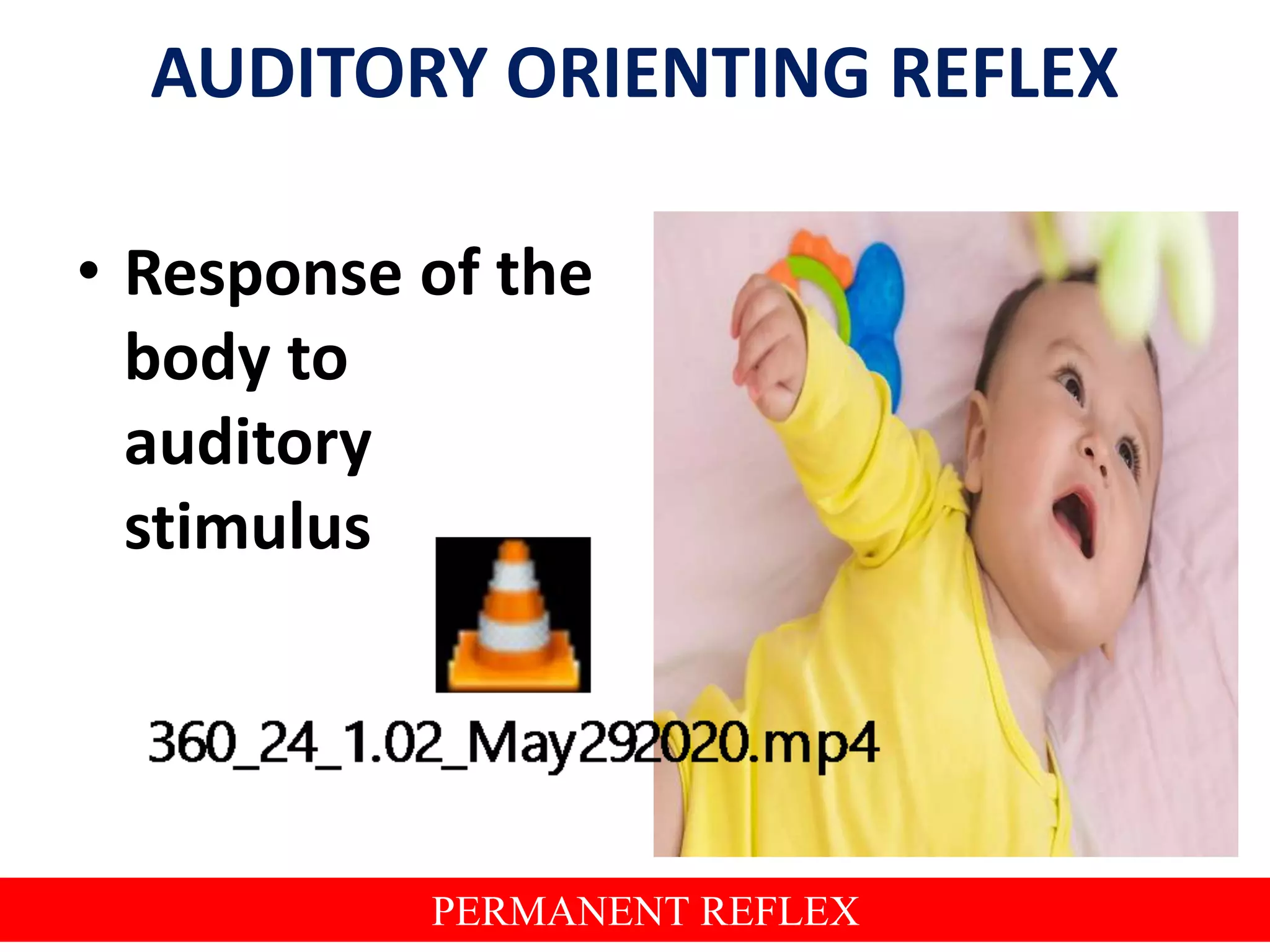
AUDITORY ORIENTING REFLEX
• Response of the
body to
auditory
stimulus
PERMANENT REFLEX
ORAL REFLEX
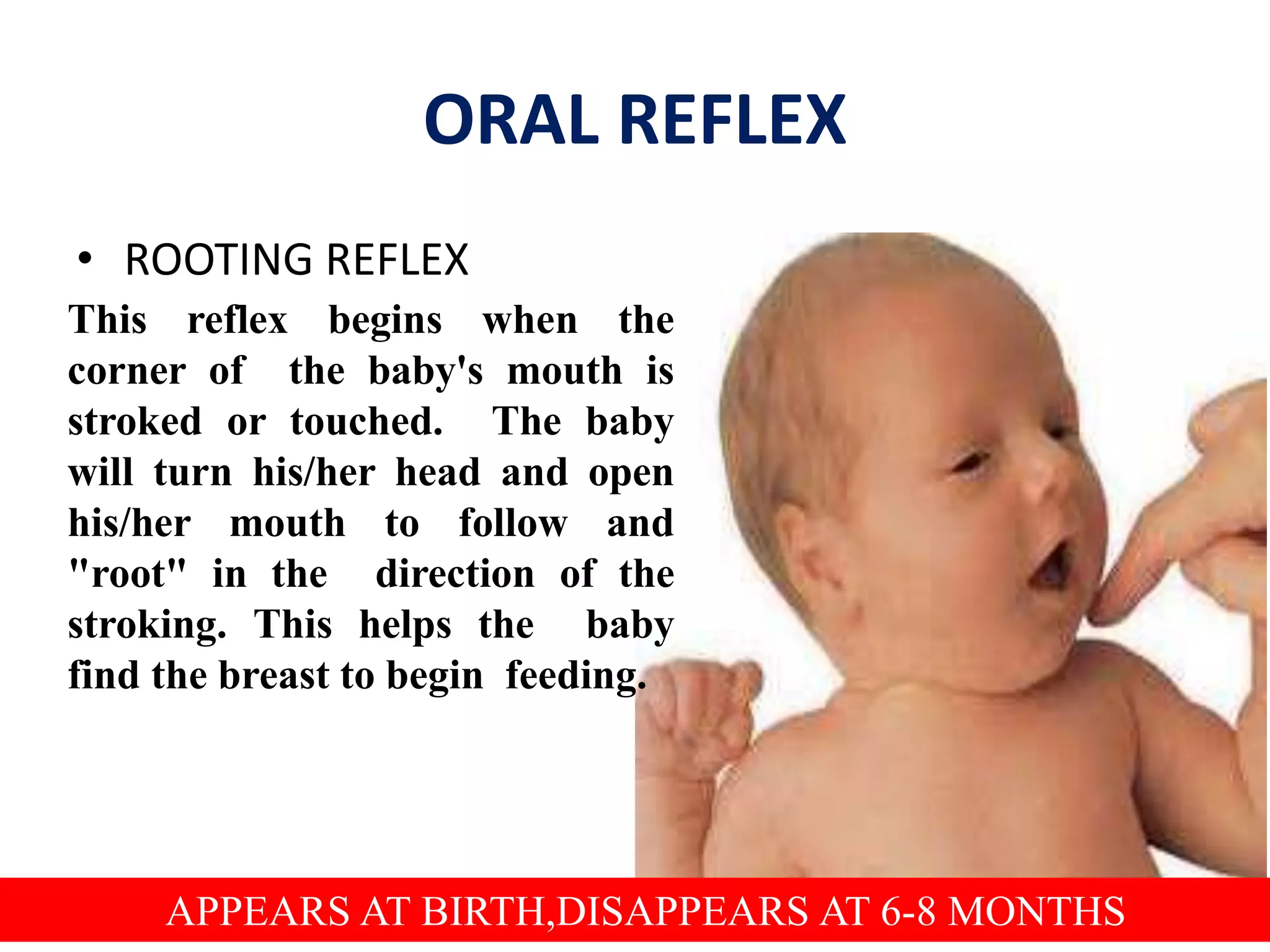
• ROOTING REFLEX
This reflex begins when the
corner of the baby's mouth is
stroked or touched. The baby
will turn his/her head and open
his/her mouth to follow and
"root" in the direction of the
stroking. This helps the baby
find the breast to begin feeding.
APPEARS AT BIRTH,DISAPPEARS AT 6-8 MONTHS
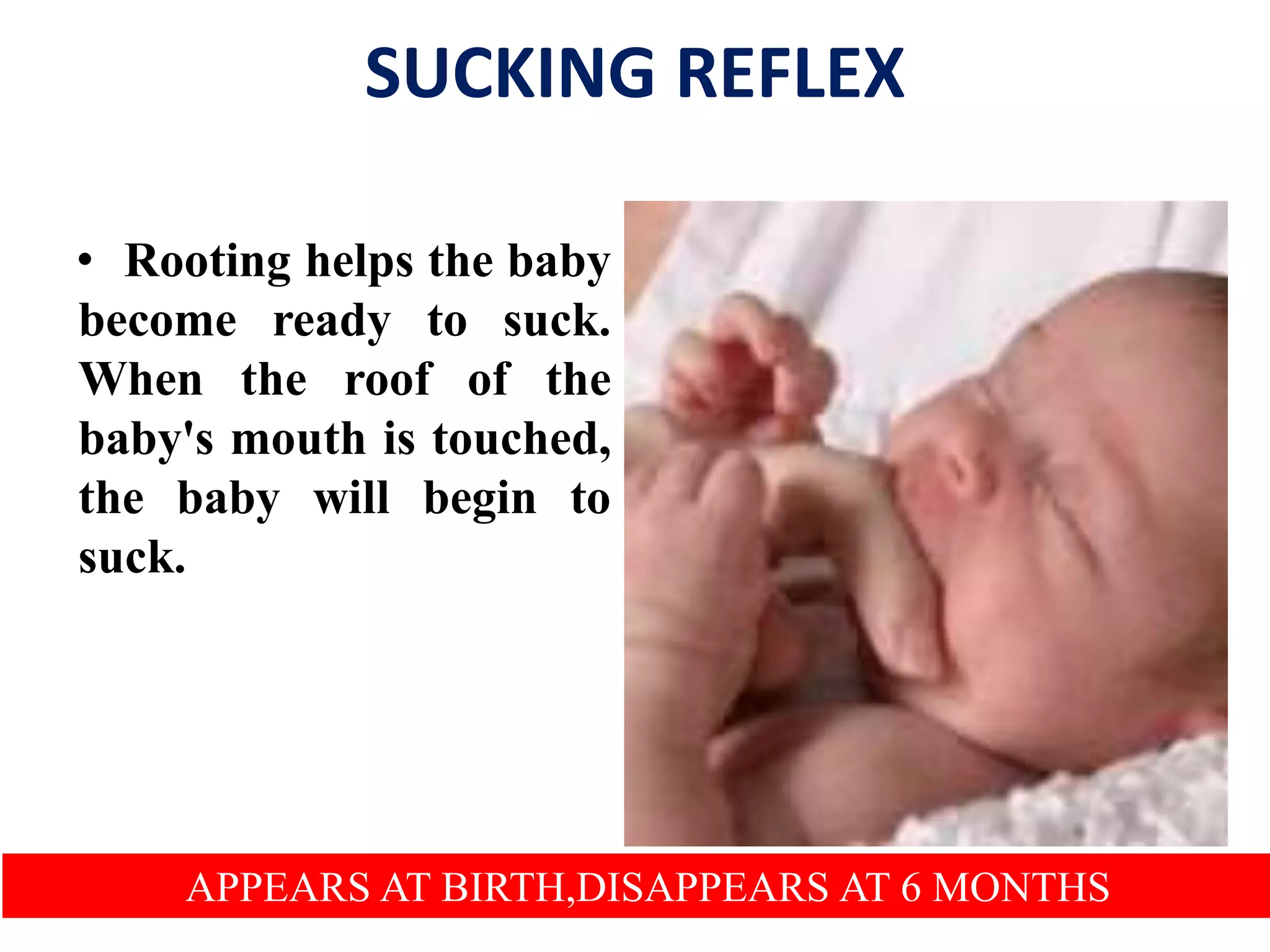
SUCKING REFLEX
• Rooting helps the baby
become ready to suck.
When the roof of the
baby's mouth is touched,
the baby will begin to
suck.
APPEARS AT BIRTH,DISAPPEARS AT 6 MONTHS
SWALLOWING REFLEX
• SWALLOWING
When an infant's lips and
mouth area are touched,
the mouth opens and
suckling or sucking
movements begin. As
liquid moves into the
mouth, the tongue
immediately moves it to
the back of the mouth for
swallowing.
PERMANENT REFLEX
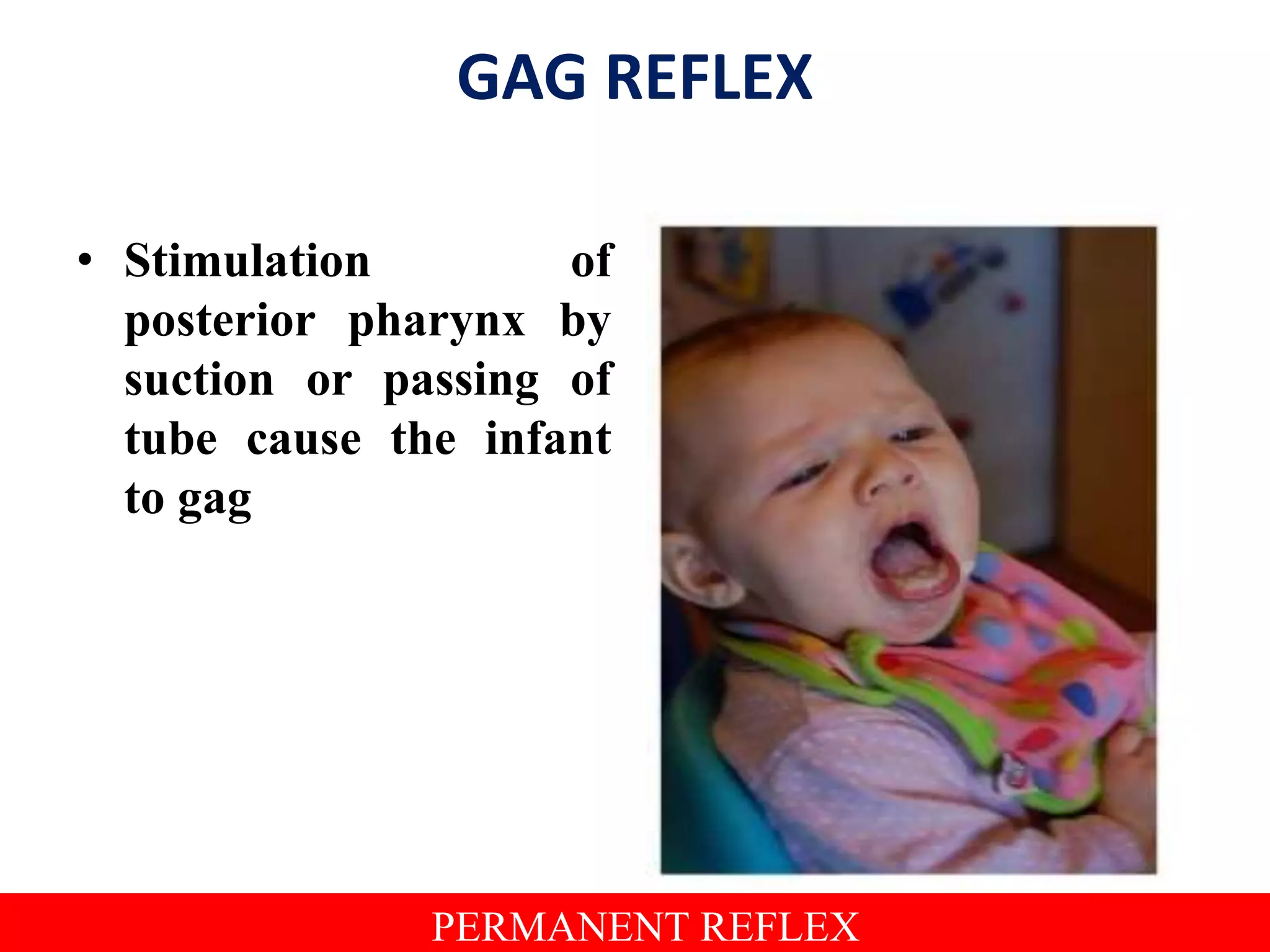
GAG REFLEX
• Stimulation of
posterior pharynx by
suction or passing of
tube cause the infant
to gag
PERMANENT REFLEX
COUGHING REFLEX
• Irritation of mucus
membrane of larynx
and tracheobronchial
tree causes coughing
PERMANENT REFLEX
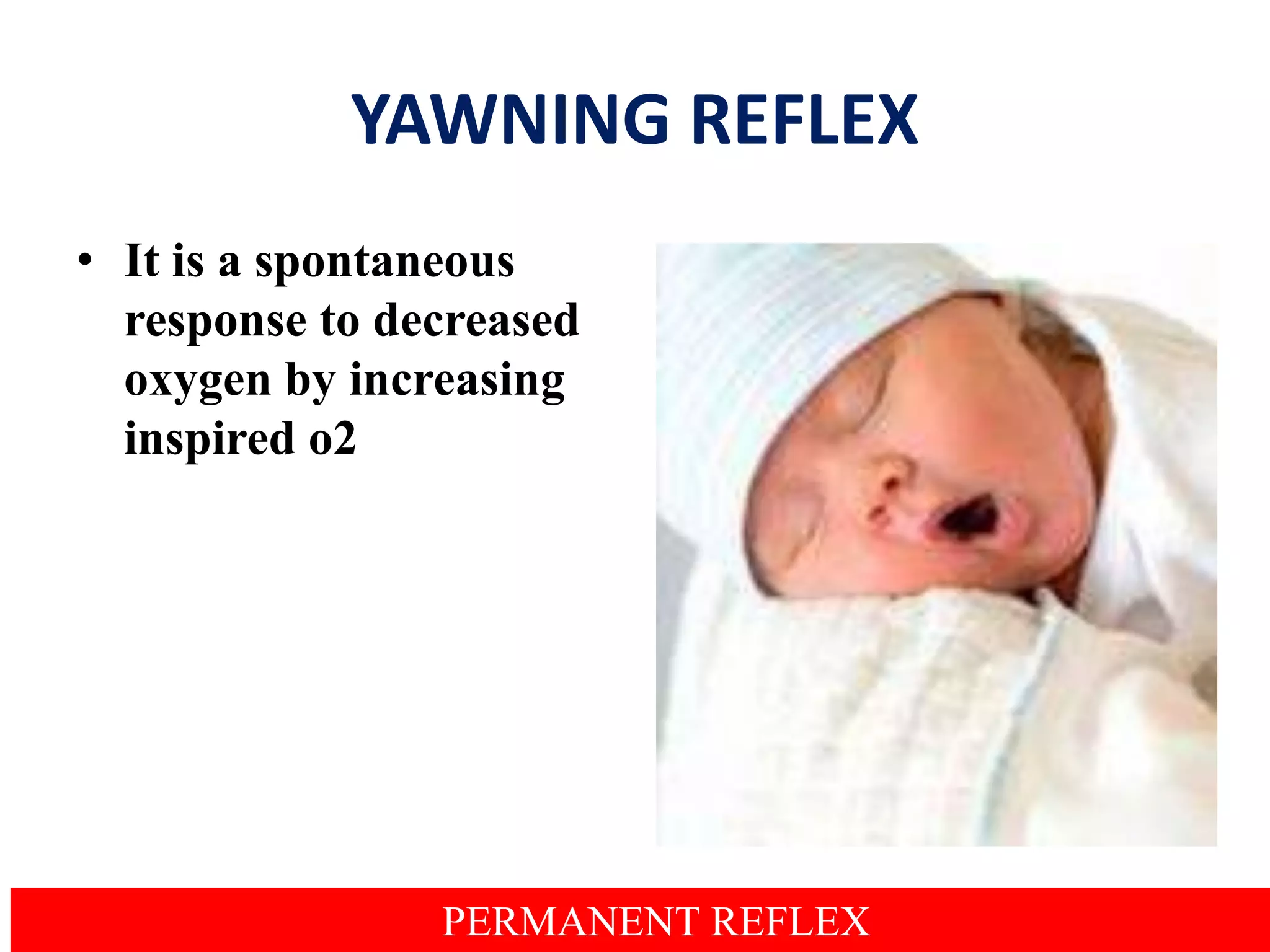
YAWNING REFLEX
• It is a spontaneous
response to decreased
oxygen by increasing
inspired o2
PERMANENT REFLEX
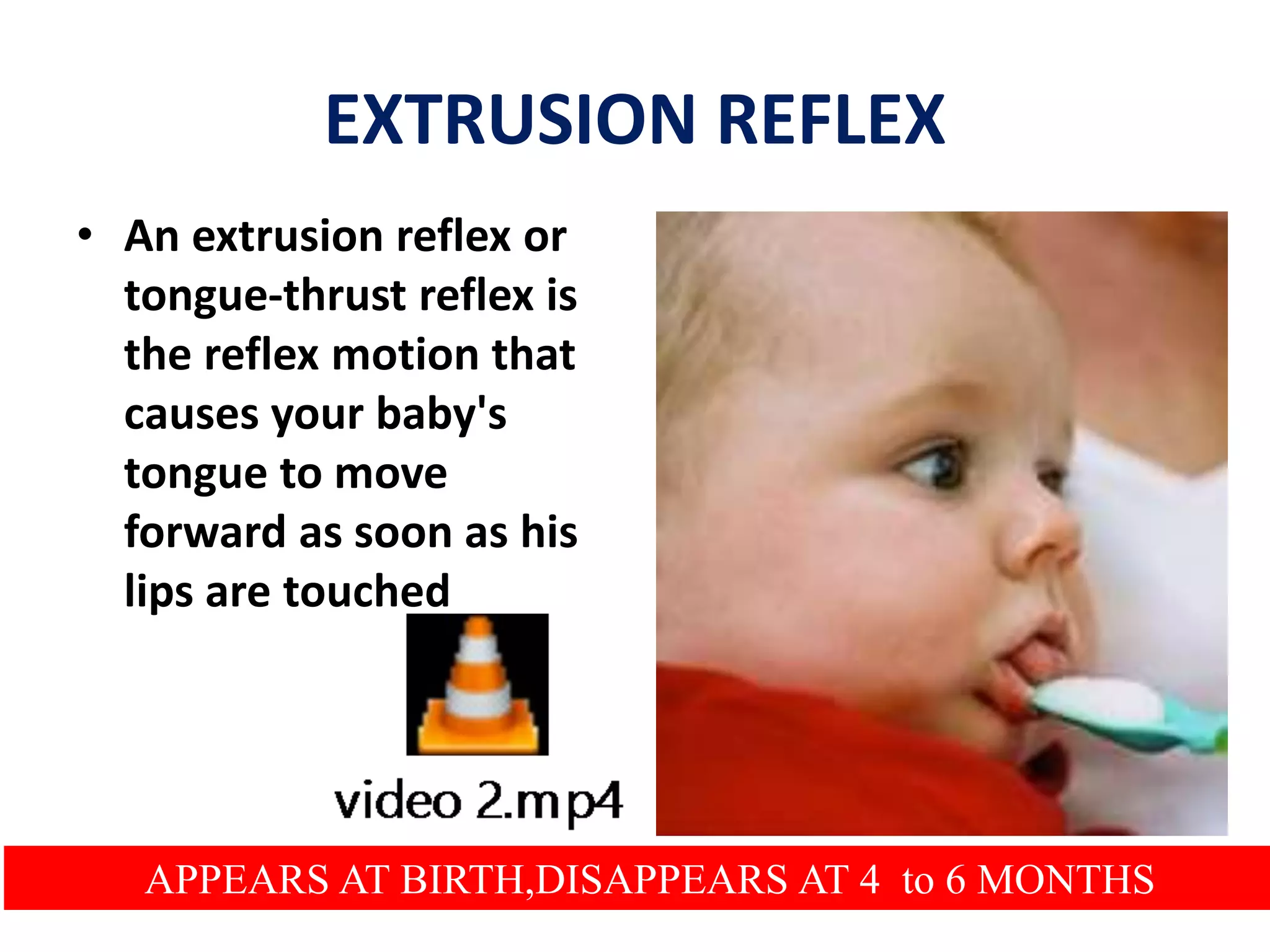
EXTRUSION REFLEX
• An extrusion reflex or
tongue-thrust reflex is
the reflex motion that
causes your baby's
tongue to move
forward as soon as his
lips are touched
APPEARS AT BIRTH,DISAPPEARS AT 4 to 6 MONTHS
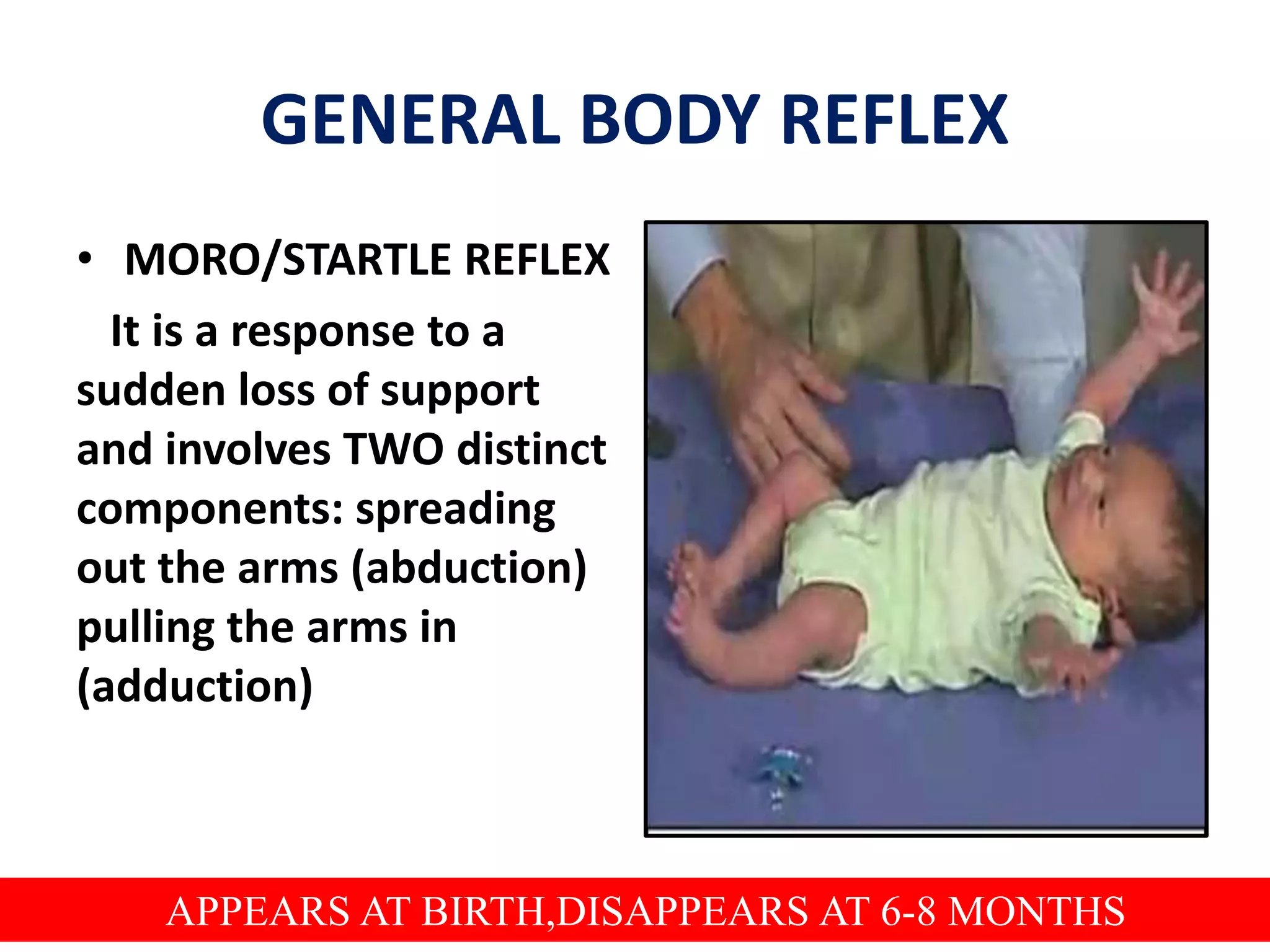
GENERAL BODY REFLEX
• MORO/STARTLE REFLEX
It is a response to a
sudden loss of support
and involves TWO distinct
components: spreading
out the arms (abduction)
pulling the arms in
(adduction)
APPEARS AT BIRTH,DISAPPEARS AT 6-8 MONTHS
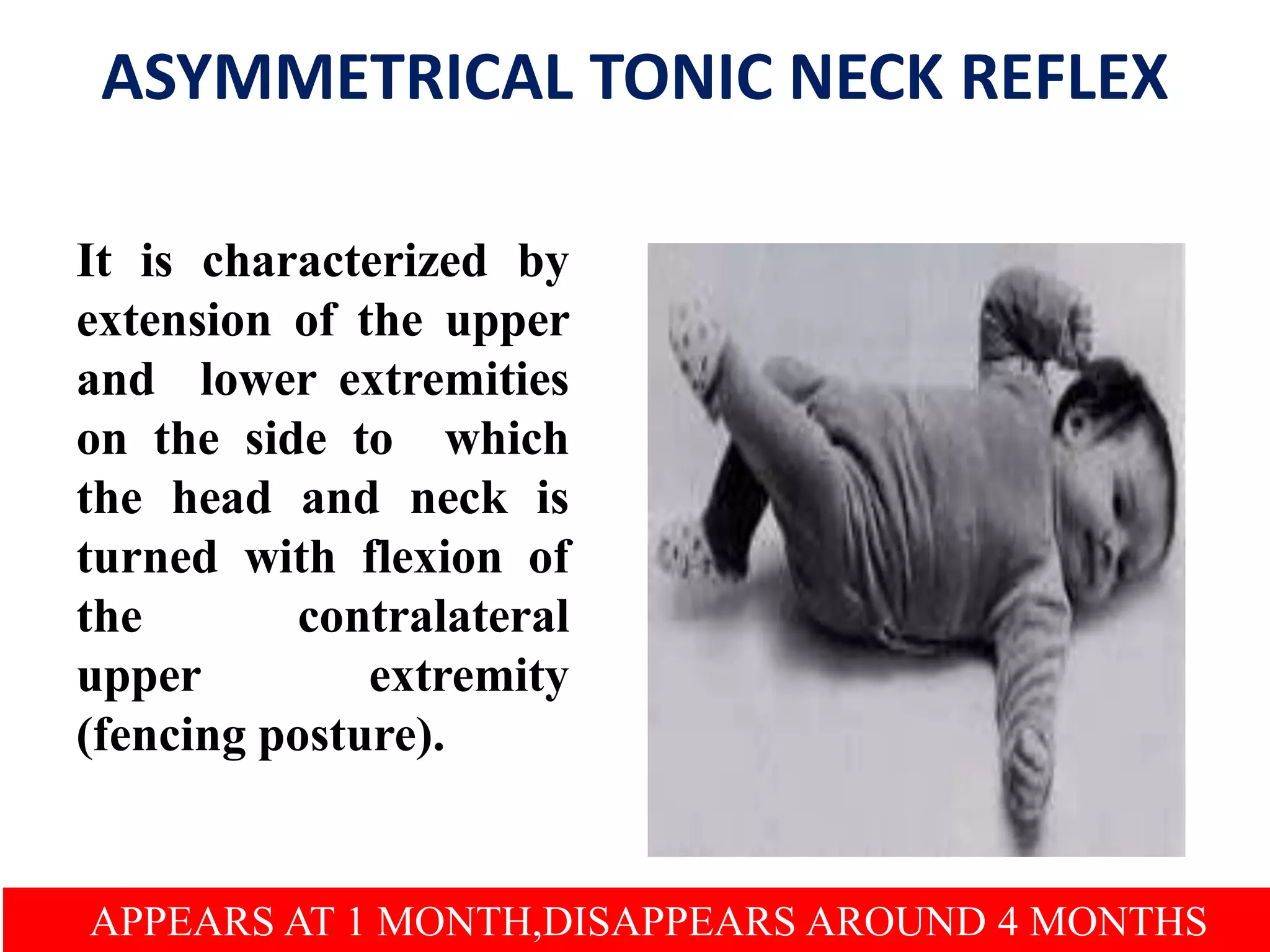
ASYMMETRICAL TONIC NECK REFLEX
It is characterized by
extension of the upper
and lower extremities
on the side to which
the head and neck is
turned with flexion of
the contralateral
upper extremity
(fencing posture).
APPEARS AT 1 MONTH,DISAPPEARS AROUND 4 MONTHS
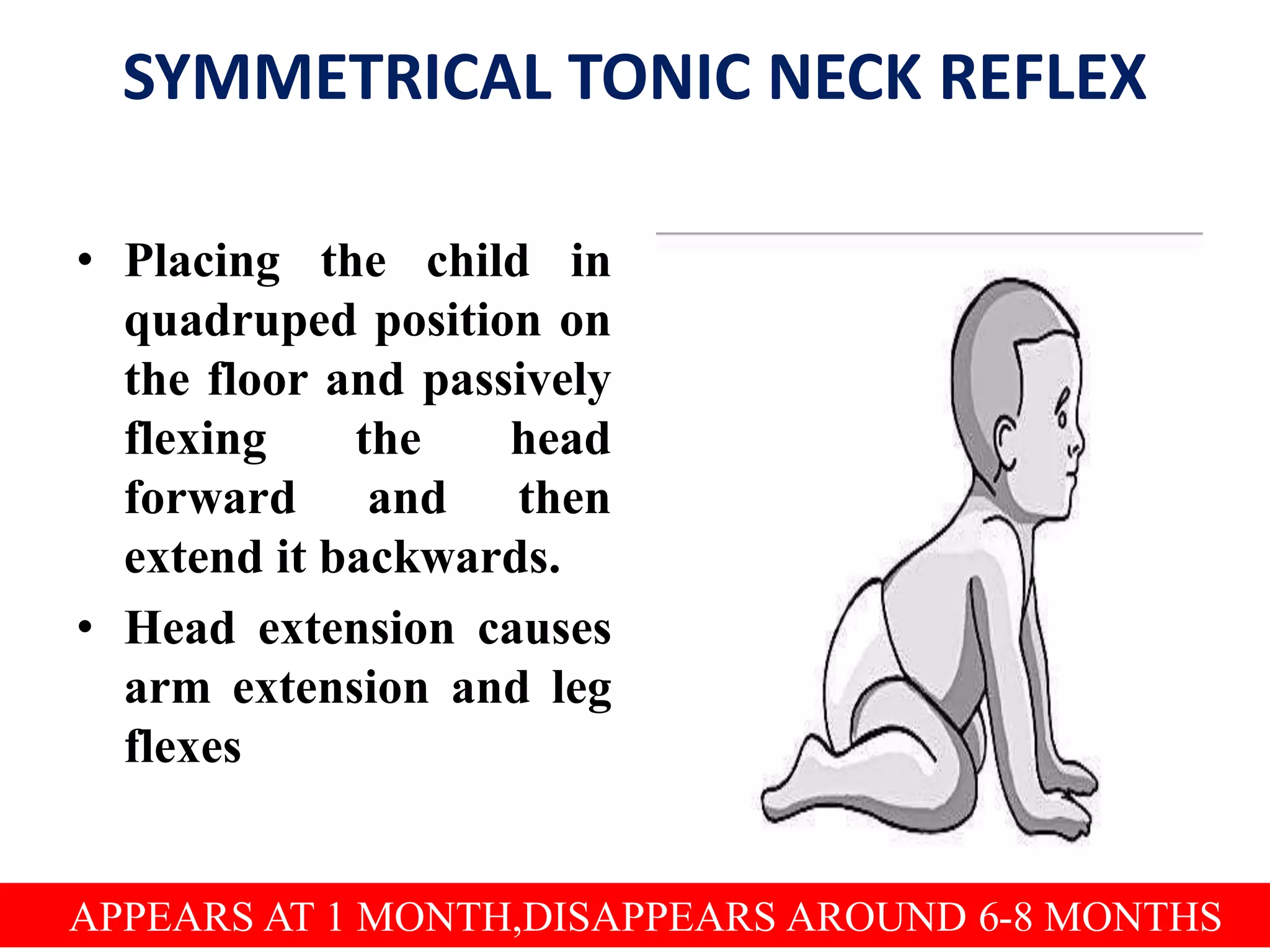
SYMMETRICAL TONIC NECK REFLEX
• Placing the child in
quadruped position on
the floor and passively
flexing the head
forward and then
extend it backwards.
• Head extension causes
arm extension and leg
flexes
APPEARS AT 1 MONTH,DISAPPEARS AROUND 6-8 MONTHS
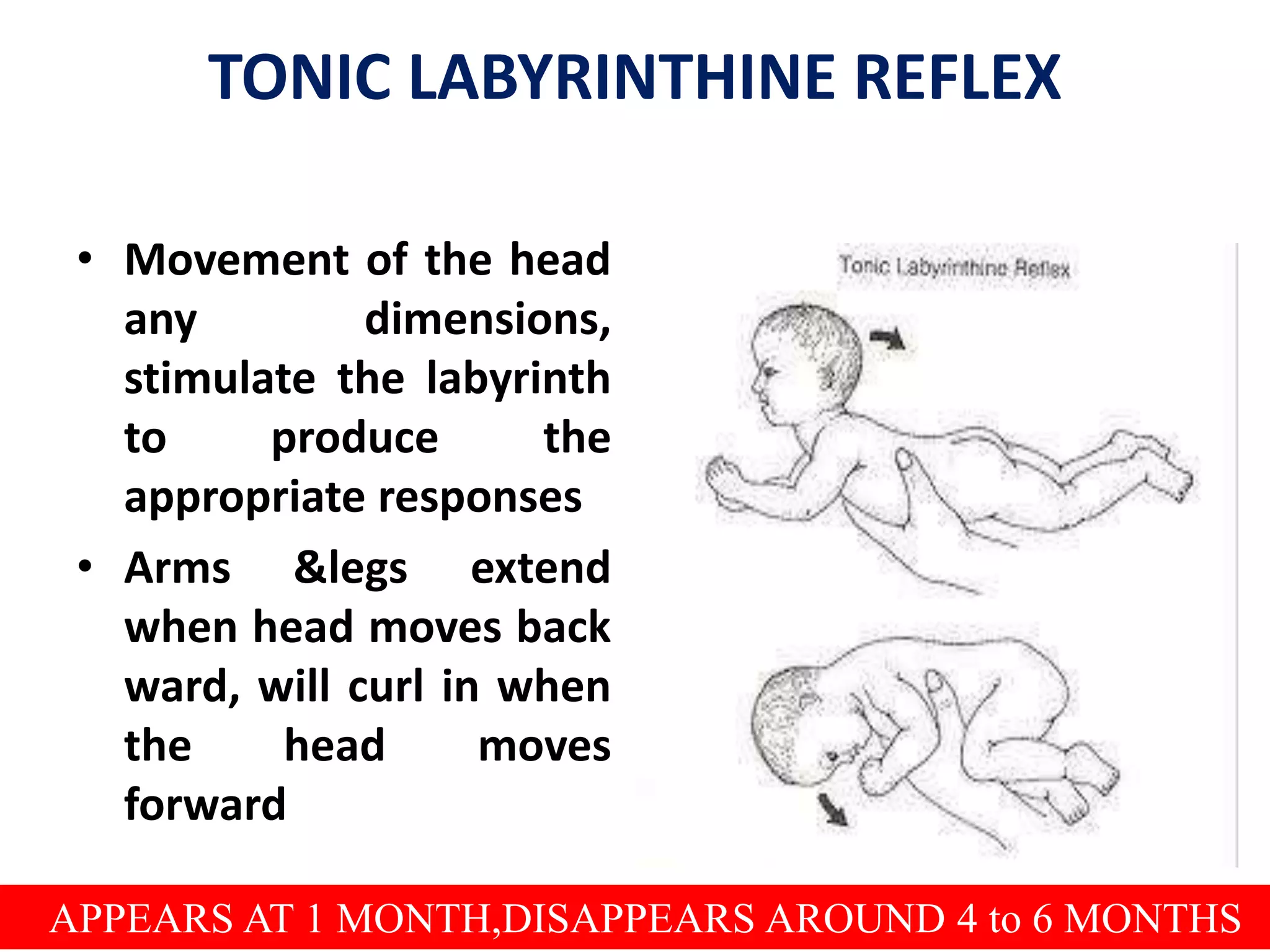
TONIC LABYRINTHINE REFLEX
• Movement of the head
any dimensions,
stimulate the labyrinth
to produce the
appropriate responses
• Arms &legs extend
when head moves back
ward, will curl in when
the head moves
forward
APPEARS AT 1 MONTH,DISAPPEARS AROUND 4 to 6 MONTHS
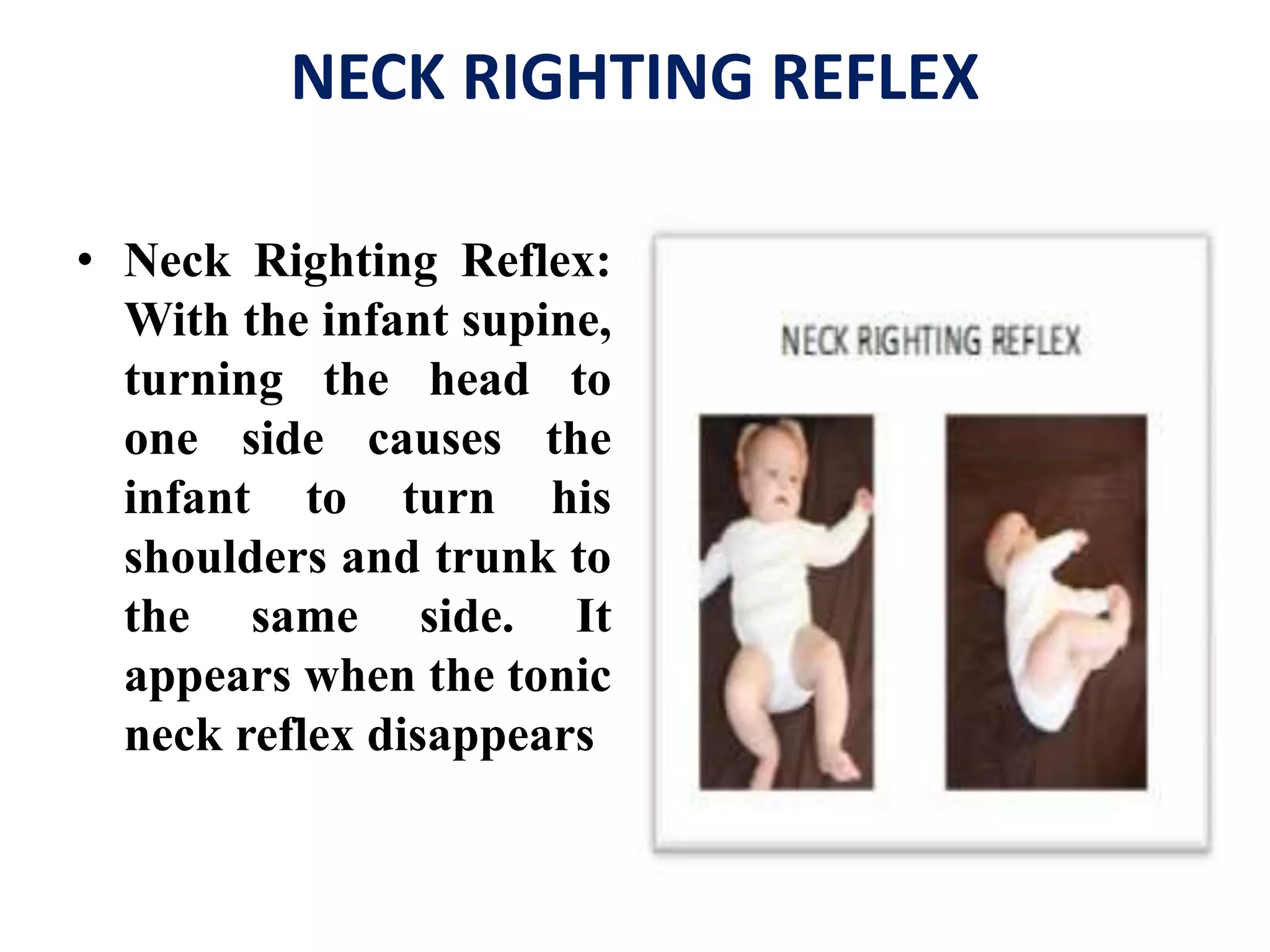
NECK RIGHTING REFLEX
• Neck Righting Reflex:
With the infant supine,
turning the head to
one side causes the
infant to turn his
shoulders and trunk to
the same side. It
appears when the tonic
neck reflex disappears
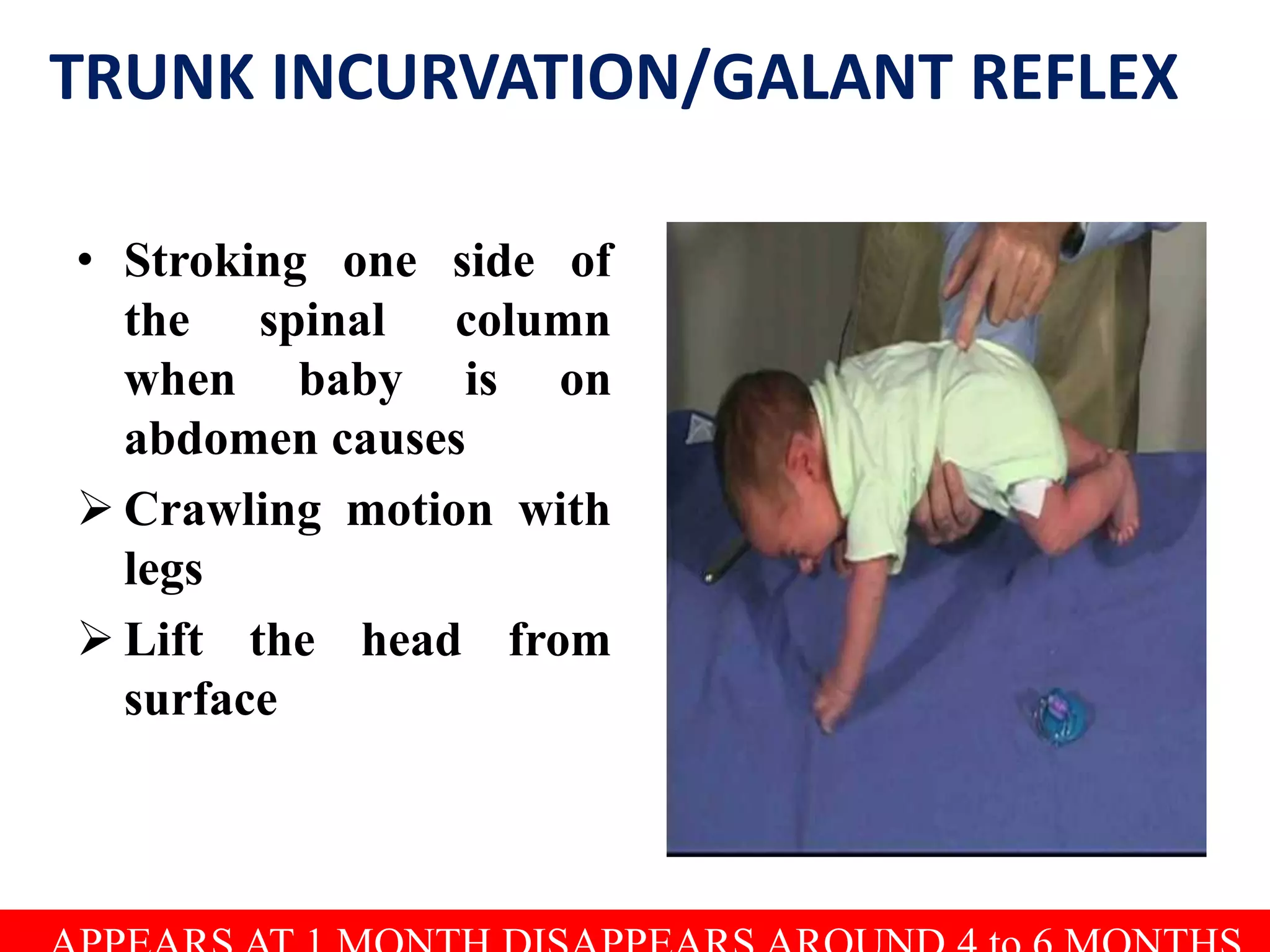
TRUNK INCURVATION/GALANT REFLEX
• Stroking one side of
the spinal column
when baby is on
abdomen causes
 Crawling motion with
legs
 Lift the head from
surface
LIMP PLACEMENT
• ALSO CALLED AS
STEPPING REFLEX
APPEARS AT BIRTH , DISAPPEARS WHEN CHILD STARTS
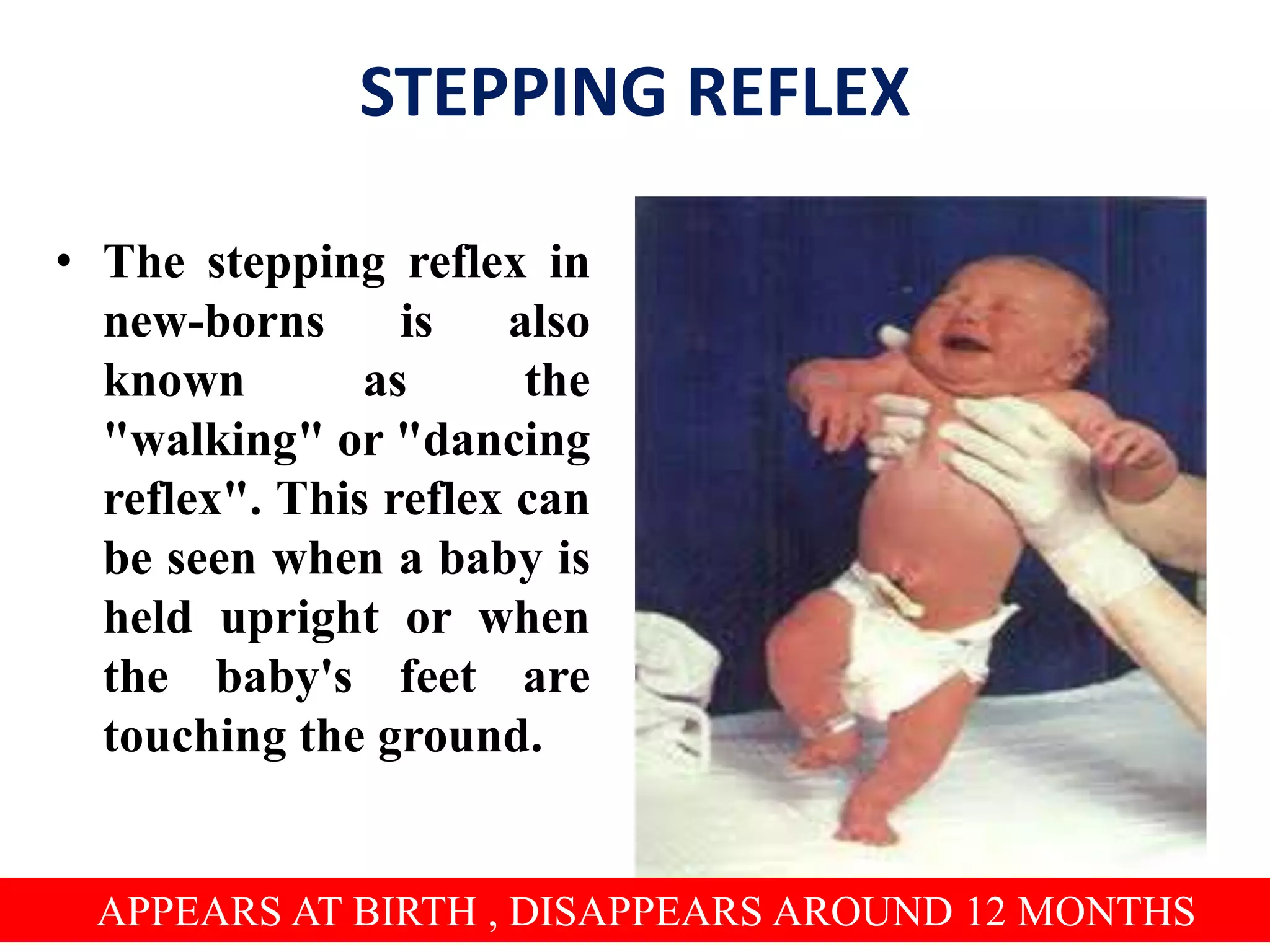
STEPPING REFLEX
• The stepping reflex in
new-borns is also
known as the
"walking" or "dancing
reflex". This reflex can
be seen when a baby is
held upright or when
the baby's feet are
touching the ground.
APPEARS AT BIRTH , DISAPPEARS AROUND 12 MONTHS
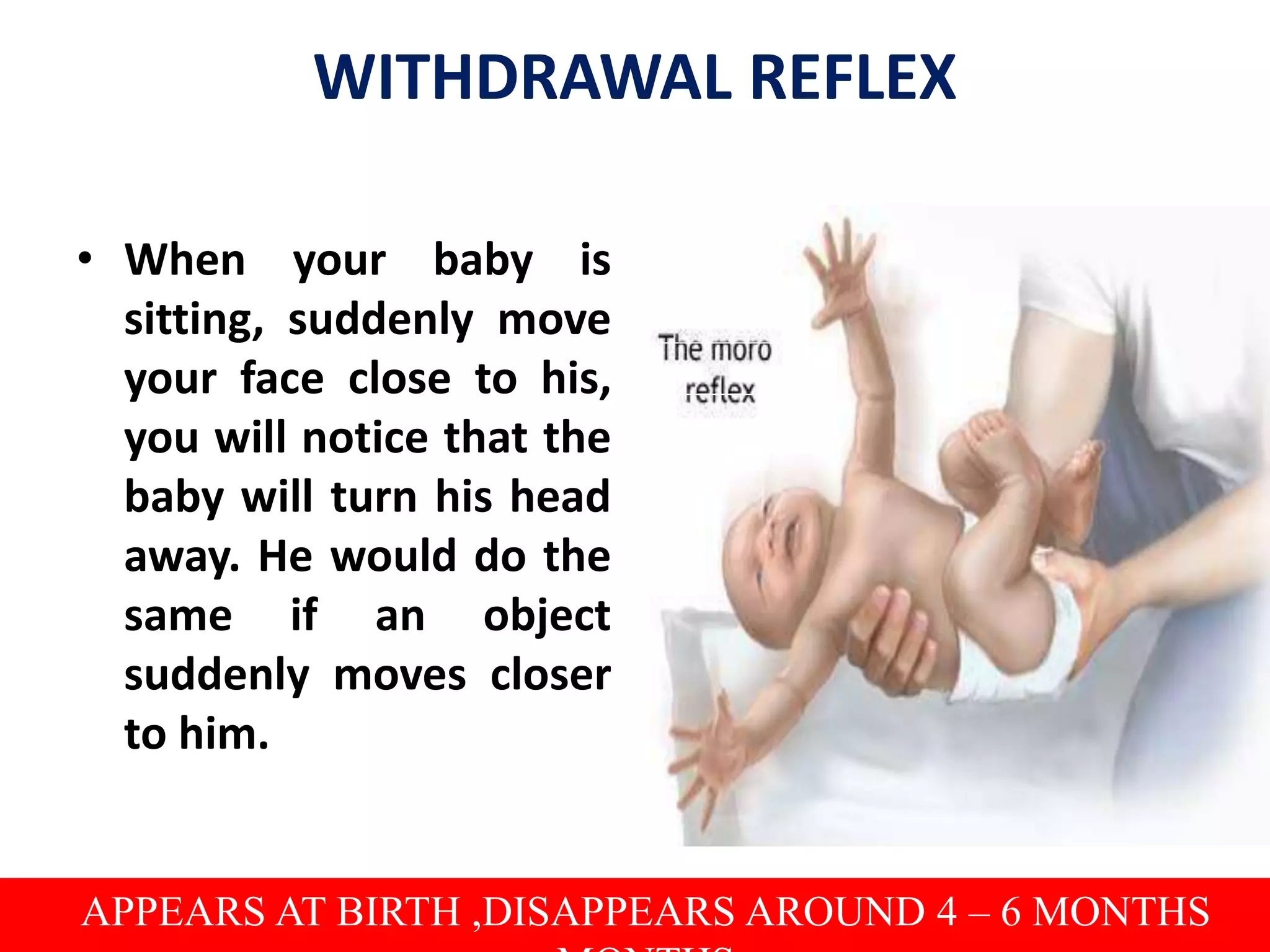
WITHDRAWAL REFLEX
• When your baby is
sitting, suddenly move
your face close to his,
you will notice that the
baby will turn his head
away. He would do the
same if an object
suddenly moves closer
to him.
APPEARS AT BIRTH ,DISAPPEARS AROUND 4 – 6 MONTHS
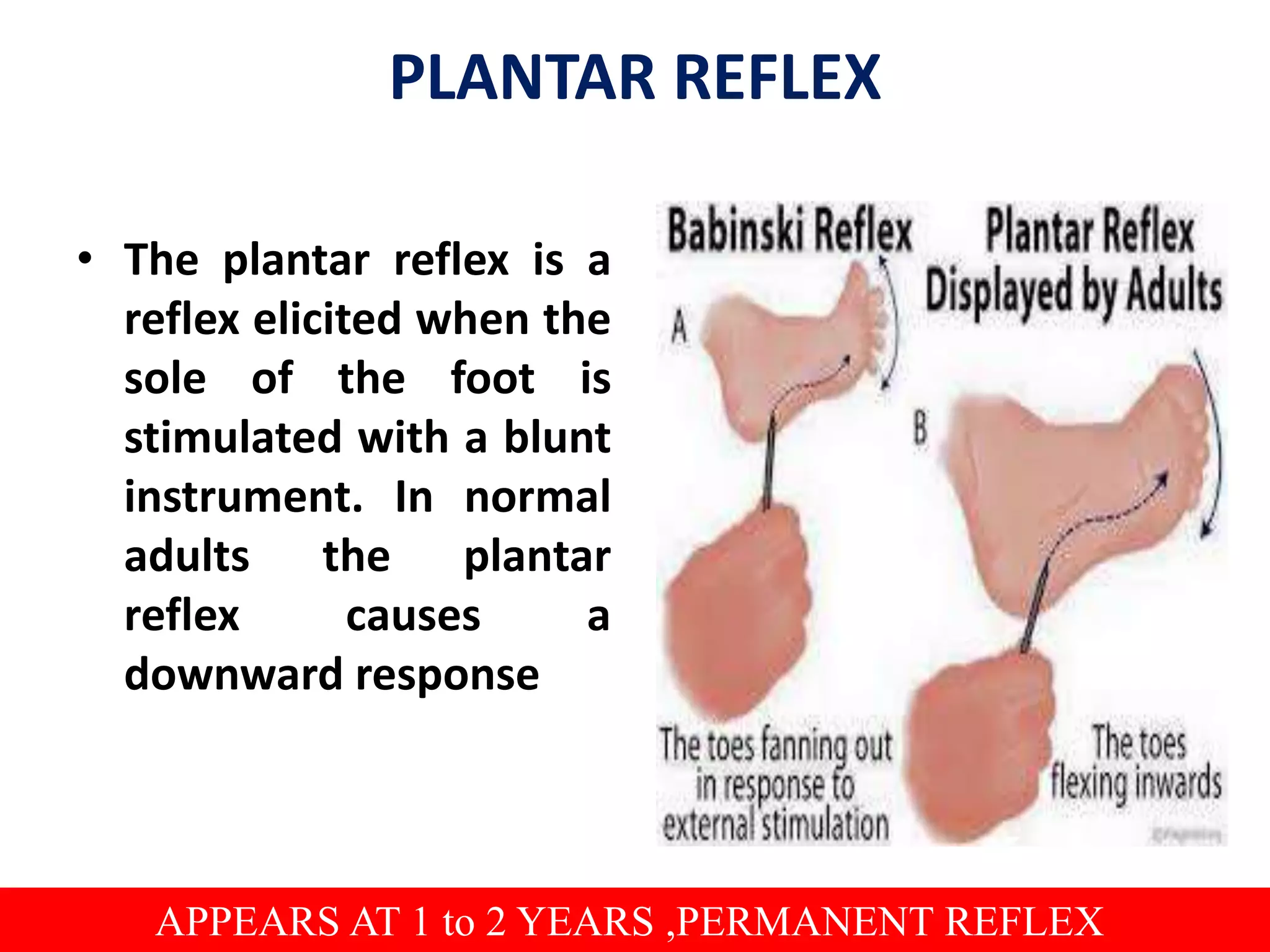
BABINSKI’S REFLEX
• The Babinski reflex
occurs after the sole of
the foot has been
firmly stroked. The big
toe then moves upward
or toward the top
surface of the foot. The
other toes fan out.
APPEARS AT BIRTH ,DISAPPEARS AROUND 1 to 2 Years
PLANTAR REFLEX
• The plantar reflex is a
reflex elicited when the
sole of the foot is
stimulated with a blunt
instrument. In normal
adults the plantar
reflex causes a
downward response
APPEARS AT 1 to 2 YEARS ,PERMANENT REFLEX
BABKIN REFLEX
• The hand-mouth
reflex of Babkin
consisting of head
flexion and rotation
with opening of the
mouth in response to
pressure on the palms
of both hands
APPEARS AT 1 MONTH,DISAPPEARS AROUND 4-6 MONTHS
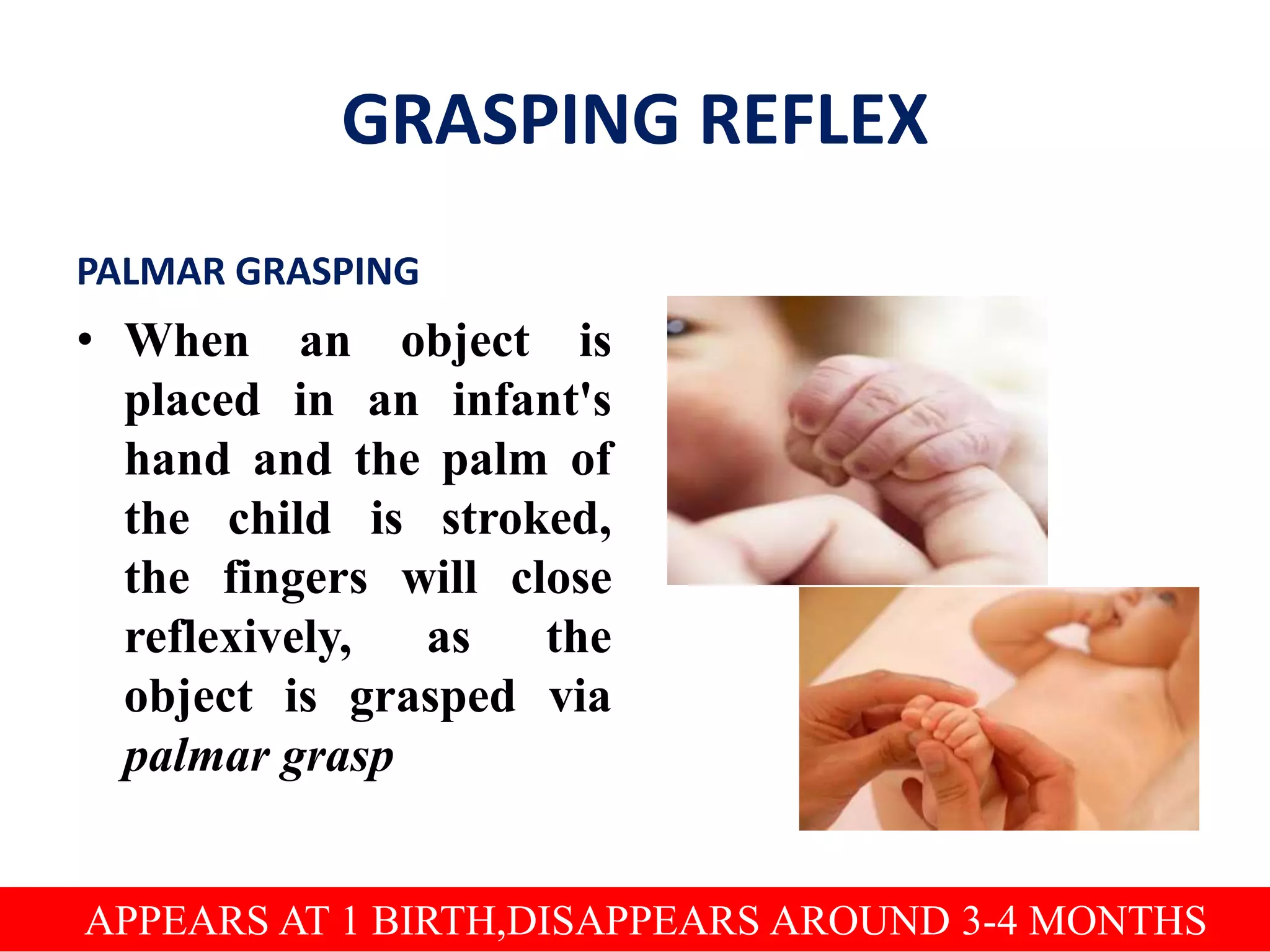
GRASPING REFLEX
PALMAR GRASPING
• When an object is
placed in an infant's
hand and the palm of
the child is stroked,
the fingers will close
reflexively, as the
object is grasped via
palmar grasp
APPEARS AT 1 BIRTH,DISAPPEARS AROUND 3-4 MONTHS
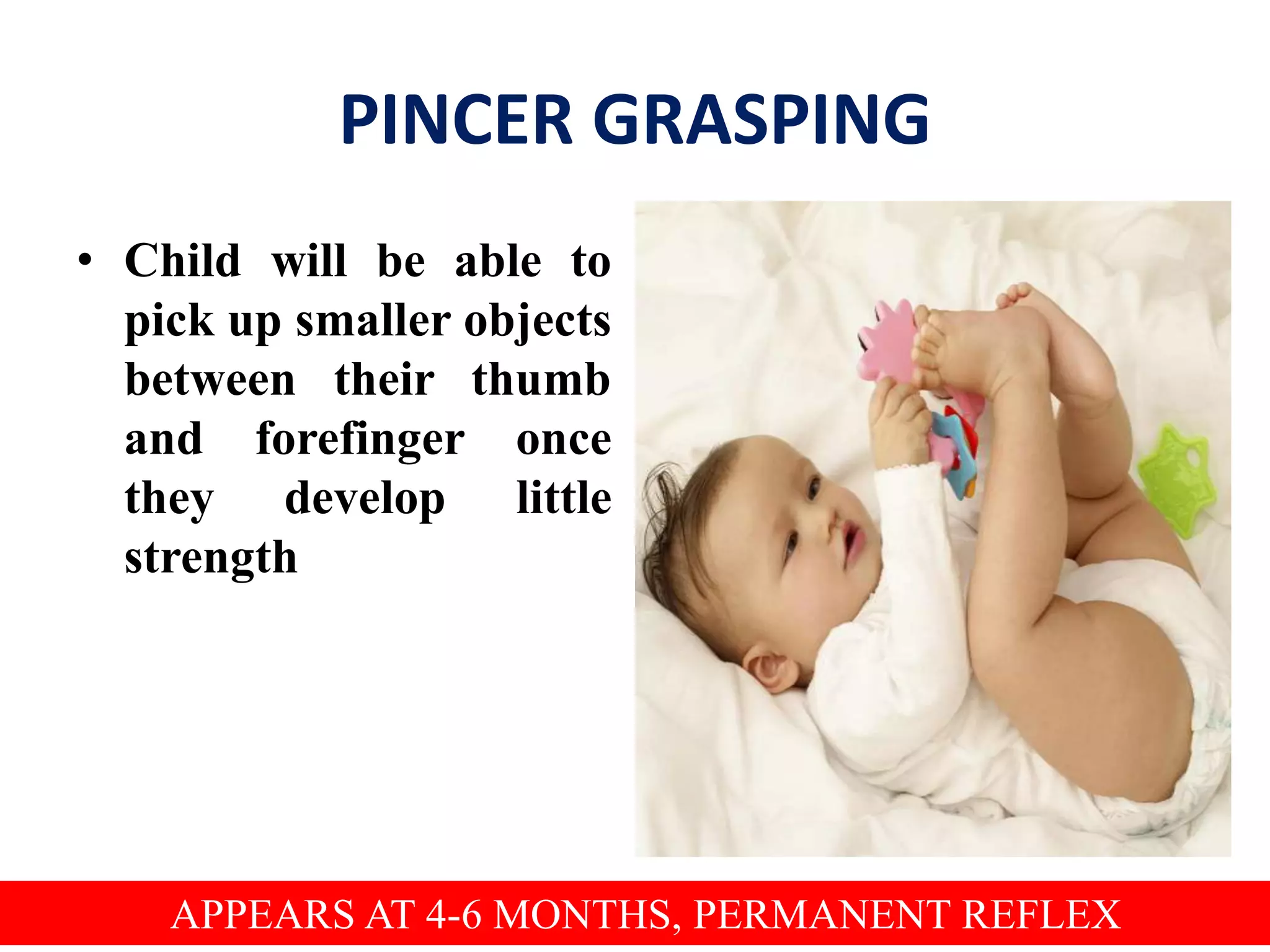
PINCER GRASPING
• Child will be able to
pick up smaller objects
between their thumb
and forefinger once
they develop little
strength
APPEARS AT 4-6 MONTHS, PERMANENT REFLEX
LANDOU REFLEX
• A normal response in
infants when held in a
horizontal, face-down
position to maintain a
convex arc with the
head raised and legs
slightly flexed;
APPEARS AT 2-3 MONTH,DISAPPEARS AROUND 12
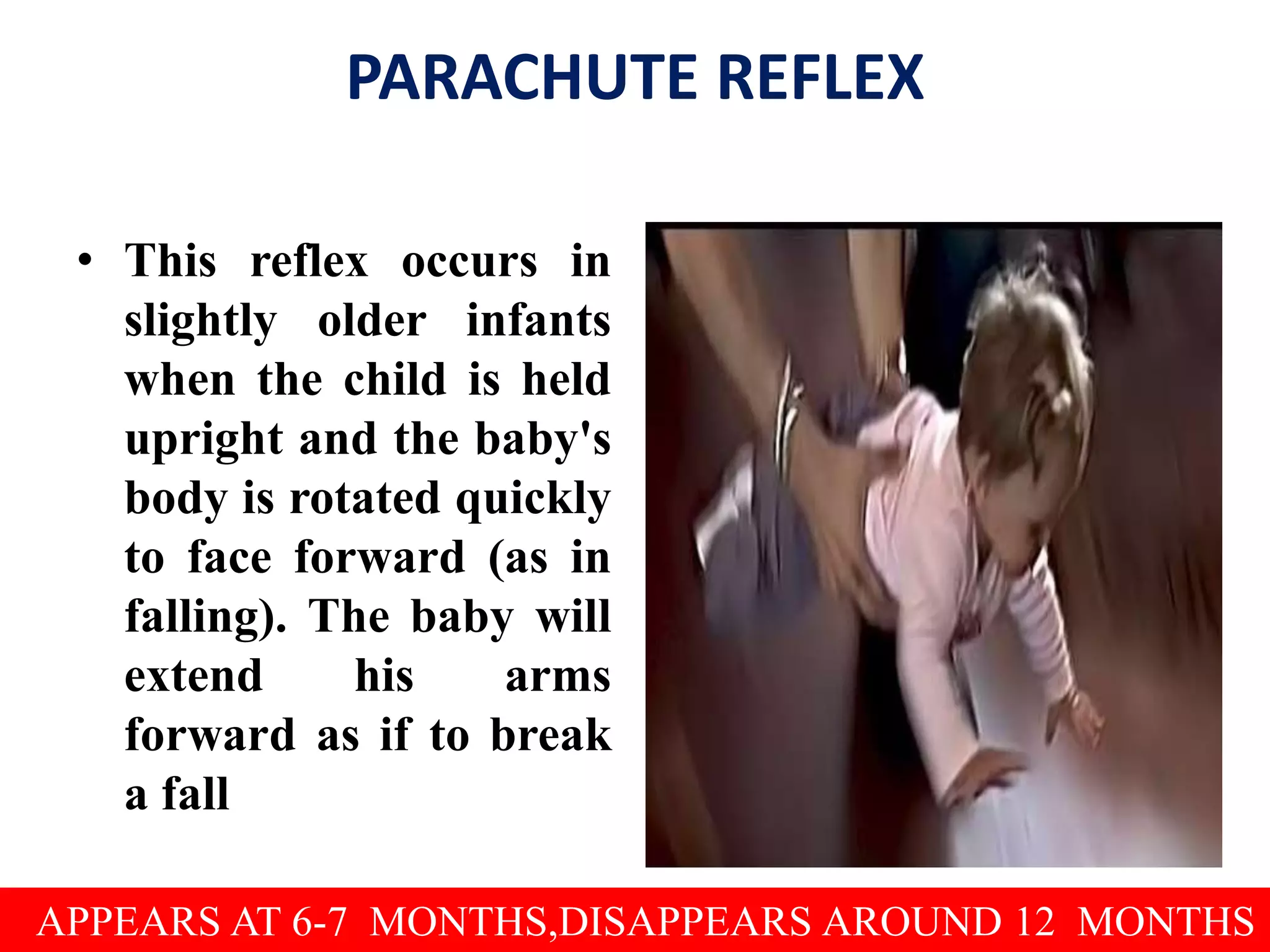
PARACHUTE REFLEX
• This reflex occurs in
slightly older infants
when the child is held
upright and the baby's
body is rotated quickly
to face forward (as in
falling). The baby will
extend his arms
forward as if to break
a fall
APPEARS AT 6-7 MONTHS,DISAPPEARS AROUND 12 MONTHS
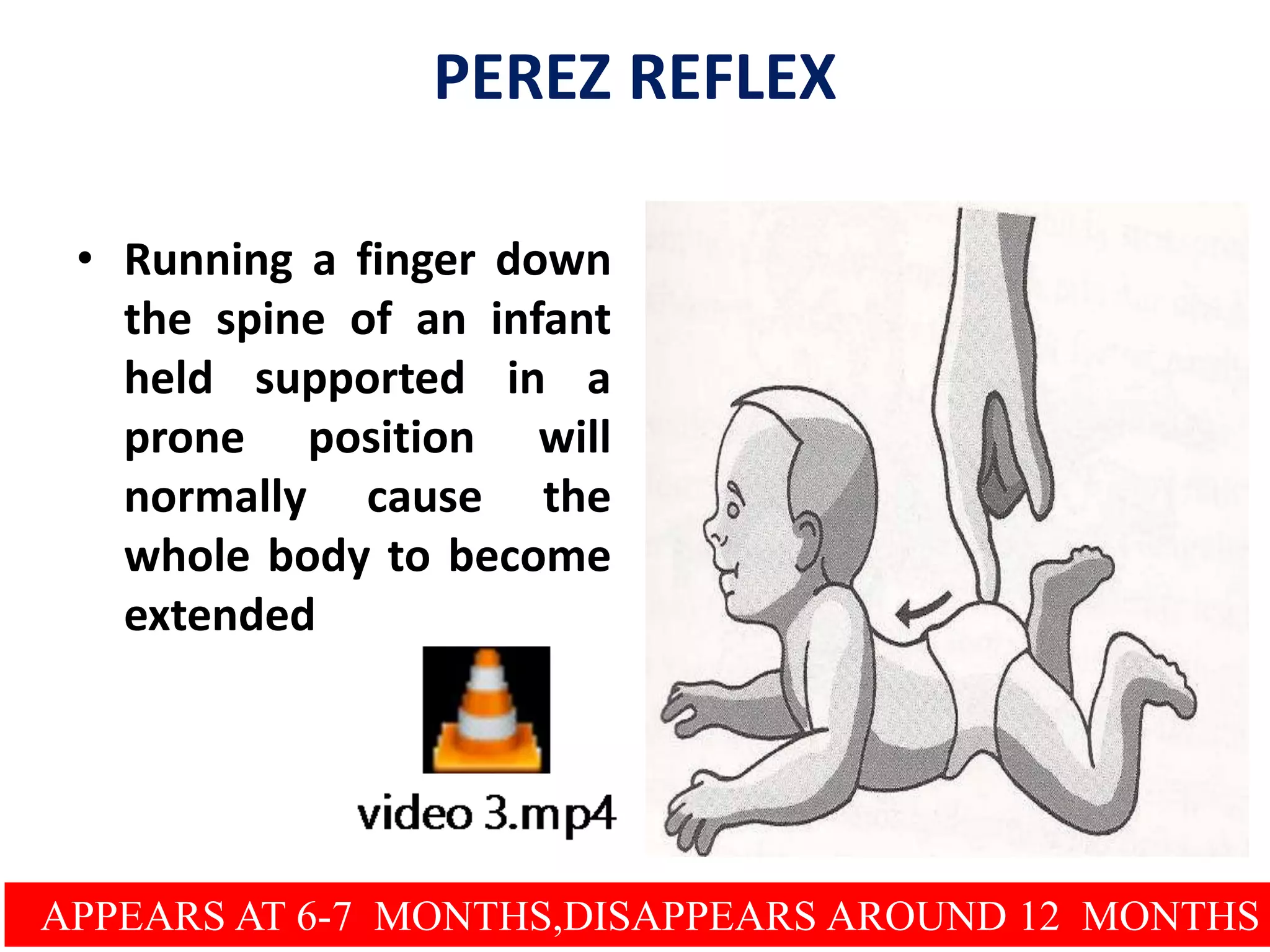
PEREZ REFLEX
• Running a finger down
the spine of an infant
held supported in a
prone position will
normally cause the
whole body to become
extended
APPEARS AT 6-7 MONTHS,DISAPPEARS AROUND 12 MONTHS
CONCLUSION
• Neonatal examination especially assessment of
reflexes is important for understanding the baby's
development as a whole and recognition of neuro
developmental damage in prenatal and perinatal
period.With this impression we can predict the
Childs future potential
Children's are our future asset…..
• Every child has……..
..the right to be respected
..the right to dream
..the right to be loved and care
..the right to achieve their god given potential
At last
They need unconditional love
ASSESSMENT OF NEWBORN REFLEXES

ASSESSMENT OF NEWBORN REFLEXES

  • 1.
    MRS.JEBAKUMARI SUTHA.A ASSOCIATE PROFESSOR HOD,PAEDIATRICDEPARTMENT GANGA COLLEGE OF NURSING COIMBATORE-22
  • 2.
  • 3.
    INTRODUCTION • A newbornshould have a thorough evaluation performed within 24 hours of birth to identify any abnormality
  • 4.
    • All thenew born should be examine at • Birth • 24 hours • Before discharge • Follow up A systematic approach consisting of ask, check,look,listen and feel should be followed at each assessment
  • 5.
    NEWBORN PERIOD • Newbornusually refers to a baby from birth to 28 days period • Infants can be considered children anywhere from one month to 1 year old.
  • 6.
    ASSESSMENT • Examination of thechild during new-born period
  • 7.
    TYPES OF ASSESSMENT 1.Initial Assessment 2. Transitional Assessment 3. Behavioural assessment 4. Assessment of gestational age 5. Systemic physical examination
  • 8.
    INITIAL ASSESSMENT APGAR Score APGARscore: It is a method use to assess the newborn’s immediate adjustment to extra uterine life • The score based on five signs • 1. Appearance (color) • 2. Pulse ( Heart rate) • 3. Grimace (Reflex irritability) • 4. Activity(Muscle tone) • 5. Respiratory rate
  • 9.
    SCORING OF APGAR INDICATORS2 1 0 Activity Active, spontaneous Some flexion of extremities No movement (flaccid, limp) Pulse >100 bpm < 100 bpm Absent Grimace Pulls away, sneezes, coughs Facial grimace only No response with stimulation Appearance Completely pink Acrocyanosis Bluish-gray or pale all over Respiration Good vigorous cry Slow, irregular Weak cry Absent
  • 10.
    INTERPRETATION OF APGAR •Each item is given a score 0, 1, or 2 • 0-3 severe distress • 4-6 moderate difficulty • 7-10 no difficulty adjusting to life • Evaluation of all five categories are made on 1- 5 min after birth.
  • 11.
    OTHER INITIAL ASSESSMENTSARE….. • Stabilization • Measuring weight.
  • 12.
    TRANSITIONAL ASSESSMENT • TransitionalAssessment during the period of reactivity: First period of reactivity (6- 8 hours after birth)
  • 13.
    BEHAVIOURAL ASSESSMENT • Whilebabies may not speak their first word for a year, they are born ready to communicate with a rich vocabulary of body movements, cries and visual responses: all part of the complex language of infant behavior.
  • 14.
    ASSESSMENT OF GESTATIONALAGE An accurate assessment of age is important for 2 reasons • Identifying neonatal risks • Developing management plans
  • 15.
    ASSESSMENT OF GESTATIONALAGE • Gestational age can measure by weight for gestational age chart.
  • 16.
  • 17.
  • 18.
  • 19.
  • 20.
  • 21.
  • 22.
  • 23.
  • 24.
    • Primitive reflexes areautomatisms that are usually triggered by an external stimulus STARTS IN THE WOMB ITSELF
  • 25.
    FACIAL REFLEXES • BLINKINGREFLEX Blinking the eyes when they are touched or when a sudden bright light appears PERMANENT REFLEX
  • 26.
    PUPILLARY REFLEX • Pupilconstrict when the bright light shine PERMANENT REFLEX
  • 27.
    GLABELLAR REFLEX • Theglabellar reflex, also known as the "glabellar tap sign", is a primitive reflex elicited by repetitive tapping on the forehead. Subjects blink in response to the first several taps. APPERARS AT BIRTH, PERMANENT
  • 28.
    NASAL REFLEX • Sneezingoccurs when the nasal passages are irritated. PERMANENT REFLEX
  • 29.
    DOLLS EYE REFLEX •Doll's eye reflex can be noted with the baby supine (lying on the back) and slowly turning the head to either side. APPEARS AT BIRTH,DISAPPEARS WHEN THE FIXATION DEVELOPS
  • 30.
    AUDITORY ORIENTING REFLEX •Response of the body to auditory stimulus PERMANENT REFLEX
  • 31.
    ORAL REFLEX • ROOTINGREFLEX This reflex begins when the corner of the baby's mouth is stroked or touched. The baby will turn his/her head and open his/her mouth to follow and "root" in the direction of the stroking. This helps the baby find the breast to begin feeding. APPEARS AT BIRTH,DISAPPEARS AT 6-8 MONTHS
  • 32.
    SUCKING REFLEX • Rootinghelps the baby become ready to suck. When the roof of the baby's mouth is touched, the baby will begin to suck. APPEARS AT BIRTH,DISAPPEARS AT 6 MONTHS
  • 33.
    SWALLOWING REFLEX • SWALLOWING Whenan infant's lips and mouth area are touched, the mouth opens and suckling or sucking movements begin. As liquid moves into the mouth, the tongue immediately moves it to the back of the mouth for swallowing. PERMANENT REFLEX
  • 34.
    GAG REFLEX • Stimulationof posterior pharynx by suction or passing of tube cause the infant to gag PERMANENT REFLEX
  • 35.
    COUGHING REFLEX • Irritationof mucus membrane of larynx and tracheobronchial tree causes coughing PERMANENT REFLEX
  • 36.
    YAWNING REFLEX • Itis a spontaneous response to decreased oxygen by increasing inspired o2 PERMANENT REFLEX
  • 37.
    EXTRUSION REFLEX • Anextrusion reflex or tongue-thrust reflex is the reflex motion that causes your baby's tongue to move forward as soon as his lips are touched APPEARS AT BIRTH,DISAPPEARS AT 4 to 6 MONTHS
  • 38.
    GENERAL BODY REFLEX •MORO/STARTLE REFLEX It is a response to a sudden loss of support and involves TWO distinct components: spreading out the arms (abduction) pulling the arms in (adduction) APPEARS AT BIRTH,DISAPPEARS AT 6-8 MONTHS
  • 39.
    ASYMMETRICAL TONIC NECKREFLEX It is characterized by extension of the upper and lower extremities on the side to which the head and neck is turned with flexion of the contralateral upper extremity (fencing posture). APPEARS AT 1 MONTH,DISAPPEARS AROUND 4 MONTHS
  • 40.
    SYMMETRICAL TONIC NECKREFLEX • Placing the child in quadruped position on the floor and passively flexing the head forward and then extend it backwards. • Head extension causes arm extension and leg flexes APPEARS AT 1 MONTH,DISAPPEARS AROUND 6-8 MONTHS
  • 41.
    TONIC LABYRINTHINE REFLEX •Movement of the head any dimensions, stimulate the labyrinth to produce the appropriate responses • Arms &legs extend when head moves back ward, will curl in when the head moves forward APPEARS AT 1 MONTH,DISAPPEARS AROUND 4 to 6 MONTHS
  • 42.
    NECK RIGHTING REFLEX •Neck Righting Reflex: With the infant supine, turning the head to one side causes the infant to turn his shoulders and trunk to the same side. It appears when the tonic neck reflex disappears
  • 43.
    TRUNK INCURVATION/GALANT REFLEX •Stroking one side of the spinal column when baby is on abdomen causes  Crawling motion with legs  Lift the head from surface
  • 44.
    LIMP PLACEMENT • ALSOCALLED AS STEPPING REFLEX APPEARS AT BIRTH , DISAPPEARS WHEN CHILD STARTS
  • 45.
    STEPPING REFLEX • Thestepping reflex in new-borns is also known as the "walking" or "dancing reflex". This reflex can be seen when a baby is held upright or when the baby's feet are touching the ground. APPEARS AT BIRTH , DISAPPEARS AROUND 12 MONTHS
  • 46.
    WITHDRAWAL REFLEX • Whenyour baby is sitting, suddenly move your face close to his, you will notice that the baby will turn his head away. He would do the same if an object suddenly moves closer to him. APPEARS AT BIRTH ,DISAPPEARS AROUND 4 – 6 MONTHS
  • 47.
    BABINSKI’S REFLEX • TheBabinski reflex occurs after the sole of the foot has been firmly stroked. The big toe then moves upward or toward the top surface of the foot. The other toes fan out. APPEARS AT BIRTH ,DISAPPEARS AROUND 1 to 2 Years
  • 48.
    PLANTAR REFLEX • Theplantar reflex is a reflex elicited when the sole of the foot is stimulated with a blunt instrument. In normal adults the plantar reflex causes a downward response APPEARS AT 1 to 2 YEARS ,PERMANENT REFLEX
  • 49.
    BABKIN REFLEX • Thehand-mouth reflex of Babkin consisting of head flexion and rotation with opening of the mouth in response to pressure on the palms of both hands APPEARS AT 1 MONTH,DISAPPEARS AROUND 4-6 MONTHS
  • 50.
    GRASPING REFLEX PALMAR GRASPING •When an object is placed in an infant's hand and the palm of the child is stroked, the fingers will close reflexively, as the object is grasped via palmar grasp APPEARS AT 1 BIRTH,DISAPPEARS AROUND 3-4 MONTHS
  • 51.
    PINCER GRASPING • Childwill be able to pick up smaller objects between their thumb and forefinger once they develop little strength APPEARS AT 4-6 MONTHS, PERMANENT REFLEX
  • 52.
    LANDOU REFLEX • Anormal response in infants when held in a horizontal, face-down position to maintain a convex arc with the head raised and legs slightly flexed; APPEARS AT 2-3 MONTH,DISAPPEARS AROUND 12
  • 53.
    PARACHUTE REFLEX • Thisreflex occurs in slightly older infants when the child is held upright and the baby's body is rotated quickly to face forward (as in falling). The baby will extend his arms forward as if to break a fall APPEARS AT 6-7 MONTHS,DISAPPEARS AROUND 12 MONTHS
  • 54.
    PEREZ REFLEX • Runninga finger down the spine of an infant held supported in a prone position will normally cause the whole body to become extended APPEARS AT 6-7 MONTHS,DISAPPEARS AROUND 12 MONTHS
  • 55.
    CONCLUSION • Neonatal examinationespecially assessment of reflexes is important for understanding the baby's development as a whole and recognition of neuro developmental damage in prenatal and perinatal period.With this impression we can predict the Childs future potential
  • 56.
    Children's are ourfuture asset….. • Every child has…….. ..the right to be respected ..the right to dream ..the right to be loved and care ..the right to achieve their god given potential At last They need unconditional love